November 28, 1592 CE(20th year of the Wanli era, Ming, 10th month, 25th day) | Birth | Born at Fe Ala as Nurhaci's eighth son
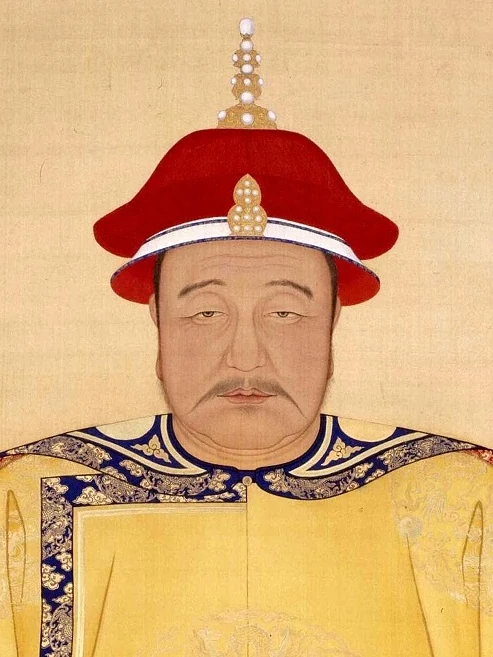
1592 CE–1643 CE
Khan of the Later Jinemperor of the Qing dynasty
Aisin Gioro Hong Taiji
爱新觉罗·皇太极
Aisin Gioro Hong Taiji was born on 28 November 1592(25th day of the tenth lunar month, Wanli 20) and died on 21 September 1643(9th day of the eighth lunar month, Chongde 8). He was the eighth son of Nurhaci and succeeded as khan of Later Jin in 1626, using the era names Tiancong and Chongde. After accession, he gradually concentrated khanal authority within a political structure in which the four senior beile initially shared…
1592 CE–1643 CEQing Dynasty
PROFILE
Aisin Gioro Hong Taiji was born on 28 November 1592(25th day of the tenth lunar month, Wanli 20) and died on 21 September 1643(9th day of the eighth lunar month, Chongde 8). He was the eighth son of Nurhaci and succeeded as khan of Later Jin in 1626, using the era names Tiancong and Chongde. After accession, he gradually concentrated khanal authority within a political structure in which the four senior beile initially shared deliberative power. He reorganized administrative institutions, the Eight Banners, and military formations, incorporated Han Chinese officials and surrendered commanders, and promoted agriculture and cultural education. In 1635, Later Jin changed the ethnonym to "Manchu"; in 1636, Hong Taiji assumed the imperial title at Shengjing and adopted Qing dynasty as the state name. During his rule, Later Jin and then Qing conquered the Chahar Mongols, compelled Joseon to submit, and continued warfare against the Ming Dynasty. After the Battle of Song-Jin from 1640 to 1642, the Ming's principal military strength beyond the passes was severely weakened. Hong Taiji died in 1643 without designating a successor. The succession was settled through negotiations among Dorgon, Hooge, and other leading princes, and his ninth son Fulin ultimately ascended the throne.
- Other Names
- Emperor Taizong of Qing; Tiancong Emperor; Hong Taiji; Tiancong Khan
- Era
- Transition from Ming to Qing
- Dynasty/Regime
- Later Jin; Qing
- Identity
- Khan of the Later Jin; emperor of the Qing dynasty
- Date of Birth
- November 28, 1592 CE(20th year of the Wanli era, Ming, 10th month, 25th day)
- Date of Death
- September 21, 1643 CE(8th year of the Chongde era, 8th month, 9th day)
- Ethnicity
- Manchu
- Clan
- Aisin Gioro clan
- Ancestral Home
- Not reliably confirmed in historical sources
- Place of Birth
- Place of birth unknown
- Reign
- 1626–1636 (Khan of the Later Jin); 1636–1643 (Qing emperor)
- Era Names
- Tiancong; Chongde
- Temple Name
- Taizong
- Posthumous Name
- Yingtian Xingguo Hongde Zhangwu Kuanwen Rensheng Ruixiao Jingmin
- Major Achievement
- Eighth son of Nurhaci; changed the state name to Qing and established the political and military foundations for the later conquest of China proper.
- Other names
- Huang Taiji, Hong Taizhu, Hong Taiji; Emperor Taizong of Qing and Tiancong Khan(later designations)
- Period
- Late Ming and early Qing
- Dynasty / regime
- Later Jin; Qing Dynasty
- Ethnicity / affiliation
- Manchus(the regime's documents used Jurchen at the time and later changed the ethnonym to Manchu)
- Ancestral origin
- No reliable record has been found in the available sources
- Place of birth
- Fe Ala(in the area of the old city of present-day Xinbin Manchu Autonomous County, Fushun, Liaoning)
- Place of death
- Qingning Palace in the inner palace at Shengjing(present-day Shenyang)
- Reign as Great Khan of Later Jin
- 1626(Tianming 11)–1636(Tiancong 10)
- Reign as Qing emperor
- 1636(Chongde 1)–1643(Chongde 8)
- Era names
- Tiancong(Later Jin); Chongde(Qing)
- Honorific titles
- Emperor Kuanwen Rensheng; Bogda Chechen Khan(title presented by Mongol groups)
- Temple name
- Taizong
- Posthumous title
- Yingtian Xingguo Hongde Zhangwu Kuanwen Rensheng Ruixiao Jingmin Zhaoding Longdao Xiangong Wen Huangdi(cumulative posthumous title)
- Mausoleum
- Zhao Mausoleum at Shengjing(present-day Shenyang Beiling)
- Predecessor
- Aisin Gioro Nurhaci(Khan of Later Jin)
- Successor
- Aisin Gioro Fulin(Qing emperor)
- Major achievements
- Reorganized the Later Jin central government and Eight Banners system; established institutions including the Three Inner Academies and Six Boards; established the Qing Dynasty and changed the ethnonym to Manchu; conquered the Chahar Mongols and compelled Joseon to submit; weakened the main Ming forces beyond the passes in the Battle of Song-Jin
LIFE TIMELINE
Youth | His biological mother Monggo Jerjer died and was later posthumously honored as Empress Xiaocigao
Military campaigning | Accompanied Nurhaci in the campaign against Ula and participated in taking forts along the river
Banner command | Later Jin reorganized the Eight Banners, and Hong Taiji took command of the Plain White Banner
Became one of the four senior beile | Nurhaci established Later Jin; Hong Taiji was granted the title hosho beile
Capture of Fushun | Participated in Later Jin operations against the Ming and proposed to Nurhaci a strategy for taking Fushun
Battle of Sarhu | Took part in the campaign against the Ming; Later Jin defeated the Ming armies and their allies
Succession to the khanate | After Nurhaci died, Hong Taiji assumed the khanate at Shenyang; the following year was declared Tiancong 1
Battle of Ning-Jin | Led an attack on the Ming but failed to capture Ningyuan or Jinzhou and withdrew
Jisi Incident | Led forces around the Ningyuan-Jinzhou defensive line and through the passes, captured Zunhua and other places, and eventually withdrew to Shenyang
Political restructuring | Established the Six Boards; besieged Dalinghe and secured the surrender of Zu Dashou's forces
Expansion of Han military forces | Kong Youde, Geng Zhongming, and others surrendered, bringing troops and red cannons
Unification of the ethnonym | Conquered Chahar and received the submission of Ejei; Later Jin formally changed the ethnonym to "Manchu"
Establishment of the Qing Dynasty | Assumed the imperial title at Shengjing, adopted Qing dynasty as the state name, and changed the era name to Chongde
Compelling Joseon to submit | Qing forces invaded Joseon; King Injo surrendered and accepted a tributary relationship
May 15, 1636 CE(10th year of the Tiancong era, 4th month, 11th day; 1st year of the Chongde era) | Continued warfare against the Ming | Qing forces advanced deep into Shandong and other regions, taking cities and carrying off population and property
Battle of Song-Jin | Qing forces besieged Jinzhou and Songshan, captured Hong Chengchou, and compelled Zu Dashou to surrender
Death | Died at Qingning Palace in Shengjing without designating a successor
From 1638 to 1639(Chongde 3–4) | From 1638 to 1639(Chongde 3–4), they advanced into Shandong and other areas, taking cities and carrying off large numbers of people and quantities of property.
After the Battle of Song-Jin from 1640 to 1642 | After the Battle of Song-Jin from 1640 to 1642, the Ming's principal military strength beyond the passes was severely weakened.
Age 50 | In the eighth lunar month of 1641(Chongde 6), with Ming reinforcements blocked and Jinzhou in danger, Hong Taiji personally went to the Songshan front.
Age 51 | In the second lunar month of 1642(Chongde 7), Qing forces captured Songshan and took Hong Chengchou prisoner.
Death | On the night of 21 September 1643(9th day of the eighth lunar month, Chongde 8), Hong Taiji died in Qingning Palace within the inner palace at Shengjing, aged fifty-two by traditional East Asian age reckoning.
BIOGRAPHY
Biography
Family Background and Early Years Hong Taiji was born on 28 November 1592(25th day of the tenth lunar month, Wanli 20 of the Ming Dynasty), the eighth son of Nurhaci. His mother was Monggo Jerjer of the Yehe Nara clan. She came from the family of Yangginu, leader of the Yehe group. In 1603(Wanli 31), Monggo Jerjer became gravely ill and wished to see members of her natal family. Nurhaci sent people to Yehe, but her wish could not be fulfilled. She died in the ninth lunar month of the same year. Nurhaci later referred to Hong Taiji as the son born to his beloved wife, and after succeeding to power Hong Taiji posthumously honored his mother as Empress Xiaocigao. From childhood Hong Taiji accompanied his father and elder brothers in household and military affairs, learned riding and archery, and gradually participated in Later Jin affairs. In 1612(Wanli 40), he accompanied Nurhaci in the campaign against Ula and helped capture positions along the river; in 1613(Wanli 41), Nurhaci took Ula city. In 1615(Wanli 43), Nurhaci reorganized the Eight Banners and Hong Taiji became lord of the Plain White Banner. In 1616(Wanli 44; Tianming 1), Nurhaci established Later Jin. Hong Taiji received the title hosho beile and, together with Daišan, Amin, and Manggūltai, formed the four senior beile, who took turns handling state affairs by month. ### Campaigns under Nurhaci and Succession to the Khanate In 1612(Wanli 40), Hong Taiji accompanied Nurhaci in the campaign against Ula. Nurhaci did not rush into a decisive battle beneath Ula city but first captured forts along the river, burned grain depots, and stationed troops to maintain pressure; Ula city was taken the following year. Through these operations Hong Taiji participated in the military and political expansion of Later Jin. After the Eight Banners were formally reorganized in 1615(Wanli 43), he commanded the Plain White Banner. In 1616(Wanli 44; Tianming 1), Nurhaci established Later Jin and granted him the title hosho beile. By age he ranked fourth among the four senior beile and took part in the rotating management of state affairs. In 1618(Wanli 46; Tianming 3), Nurhaci decided to attack the Ming Dynasty. Hong Taiji proposed taking Fushun first and using the Ming market-opening period to coordinate attacks from inside and outside. Later Jin captured Fushun, placing pressure on the Ming defensive system in Liaodong. In 1619(Wanli 47; Tianming 4), Ming forces, together with Yehe and Joseon troops, launched an expedition that led to the Battle of Sarhu. Hong Taiji first participated in fighting around Jilin Cliff and then took part in battles against the forces of Ma Lin, Liu Ting, and others. Later Jin concentrated its forces and defeated the opposing armies separately, defeating the Ming columns and their Joseon allies and thereby changing the balance of power in Liaodong. In 1626(Tianming 11), Nurhaci died after suffering a setback at the Battle of Ningyuan. The succession had not been explicitly designated. Daišan and his sons Yoto and Sahaliyan supported Hong Taiji, and the Eight Banner nobles subsequently selected him. On 20 October 1626(1st day of the ninth lunar month, Tianming 11), Hong Taiji assumed the khanate at Shenyang and declared that the following year would be Tiancong 1. At the time of his accession, Daišan, Amin, and Manggūltai still shared in deliberation with him, and major affairs required coordination among the beile. Later Jin also faced the Ming Ningyuan-Jinzhou defensive line, pressure from Mongolia and Joseon, and the population, grain, and fiscal burdens created by prolonged warfare. ### Concentration of Khanal Power and Reform of Later Jin In 1627(Tiancong 1), Hong Taiji led an attack on the Ming but failed to capture Ningyuan or Jinzhou and withdrew. Confronted by the Ming defensive system around Ningyuan and Jinzhou, he shifted toward entering the passes through Mongol territory, winning allies, and reorganizing internal institutions. From 1629(Tiancong 3) to 1630(Tiancong 4), he led troops through the passes by way of Mongolia, capturing Zunhua, Yongping, and other places. When Ming forces counterattacked, Later Jin withdrew from within the passes. The Jisi Incident showed that Later Jin could bypass the Liaoxi defences and penetrate the passes but could not yet hold cities there securely. Hong Taiji gradually reduced the power of the other senior beile. In 1630(Tiancong 4), Amin was convicted and confined after failures and alleged offenses connected with the campaign inside the passes. In 1631(Tiancong 5), Hong Taiji came into conflict with Manggūltai, who was stripped of the designation senior beile and punished. On New Year's Day in 1632(Tiancong 6), Hong Taiji began receiving court congratulations alone while facing south, symbolizing that he no longer stood on an equal footing with the other beile. By 1635(Tiancong 9), Daišan was also punished in court deliberations, further breaking down the earlier system of joint rule by the four senior beile. Later Jin's administrative institutions also changed during this period. In 1629(Tiancong 3), Hong Taiji established a Literary Office in which Confucian scholars translated texts, recorded government affairs, and participated in drafting and deliberation. In 1631(Tiancong 5), he established the Six Boards of Personnel, Revenue, Rites, War, Punishments, and Works on the model of Ming institutions. He subsequently restricted the beile from directly controlling the boards, gradually making the central offices answerable to the khan. In 1636(Chongde 1), the Literary Office was reorganized into the Three Inner Academies, and institutions including the Censorate and Mongol Yamen were established. These new institutions operated alongside the Eight Banners but reduced the extent to which Later Jin administration depended entirely on the personal power of banner lords and beile. ### Ethnonym, State Formation, and External Wars After succeeding to the khanate, Hong Taiji adjusted relations with surrounding powers as well as continuing warfare against the Ming. In 1627(Tiancong 1), Later Jin forces campaigned eastward against Joseon and compelled it to make a temporary peace. In dealing with Mongol groups, Hong Taiji formed ties with Khorchin, Kharachin, and others while campaigning against Chahar and its subordinate peoples. After 1628(Tiancong 2), Later Jin forces attacked groups including the Dörbed and continued making alliances or waging war with Mongol leaders. The strategic purpose was to reduce the pressure of fighting on two fronts, but these relationships emerged through a combination of warfare, alliances, and political interests and did not represent all groups submitting in the same way at the same time. In 1633(Tiancong 7), Ming commanders Kong Youde, Geng Zhongming, and others surrendered with troops and red cannons. The Later Jin court treated these surrendered commanders favorably and incorporated them into the military system, expanding its Han military strength and increasing its siege capability. From 1634(Tiancong 8) to 1635(Tiancong 9), Later Jin continued campaigning against Chahar. After Ligdan Khan died, his son Ejei submitted. Later Jin sources described a seal presented by Ejei as the imperial heirloom seal, but the encyclopedia full text also notes that its inscription read "Seal for Issuing Imperial Commands" and that whether it was the historic imperial heirloom seal is uncertain. In 1635(Tiancong 9), Hong Taiji formally changed the ethnonym to "Manchu" in order to integrate the different groups under his rule. On 15 May 1636(11th day of the fourth lunar month, Tiancong 10; Chongde 1), Hong Taiji offered sacrifice to Heaven and Earth at Shengjing, accepted honorific titles from his officials, adopted Qing dynasty as the state name, and changed the era name to Chongde. Mongol groups presented him with the title Bogda Chechen Khan. The change of state name and assumption of the imperial title were important steps in state-building, but did not mean that Qing then controlled the entire territory of the Ming Dynasty. The Qing still had to compete for regional control through warfare, negotiated submission, and administrative expansion. In the winter of 1636(Chongde 1), Qing forces again invaded Joseon. In the first lunar month of 1637(Chongde 2), King Injo, besieged at Namhansanseong, surrendered, accepted a tributary relationship with Qing, and sent princes to Shengjing. Qing forces captured Ganghwa Island and took members of the royal family and the families of court officials. Thereafter Joseon entered a new tributary relationship with Qing, and the Ming lost an important ally on its northeastern flank. After 1636(Chongde 1), Qing forces repeatedly entered the passes to attack the Ming. From 1638 to 1639(Chongde 3–4), they advanced into Shandong and other areas, taking cities and carrying off large numbers of people and quantities of property. These operations increased the destruction inflicted on the Ming interior and also caused civilian casualties, capture, and forced migration. At the same time, Qing forces had not broken through Shanhai Pass, and Hong Taiji continued to prioritize weakening the Ming positions beyond the passes before seeking conditions for a larger advance into the interior. ### Battle of Song-Jin and Death In 1640(Chongde 5), Qing forces began besieging Jinzhou and the Ming court sent reinforcements. Hong Taiji strengthened the siege while building walls and defensive works along the communications routes in an attempt to cut Jinzhou off from relief forces. In the eighth lunar month of 1641(Chongde 6), with Ming reinforcements blocked and Jinzhou in danger, Hong Taiji personally went to the Songshan front. The Veritable Records of Emperor Taizong of Qing records that he continued a forced march despite an unceasing nosebleed. Qing forces then besieged Songshan, while the relief army commanded by Ming general Hong Chengchou was divided and compressed. The fighting continued into the following year. In the second lunar month of 1642(Chongde 7), Qing forces captured Songshan and took Hong Chengchou prisoner. In the third lunar month, the Jinzhou commander Zu Dashou surrendered. Qing forces then captured Tashan and Xingshan. The Battle of Song-Jin ended with the main Ming forces beyond the passes suffering major losses. The campaign gave Qing a decisive advantage in Liaoxi, but Ningyuan remained under Ming control and Shanhai Pass had not been breached. Hong Taiji did not lead an army through the passes during his lifetime. These military gains provided conditions for later Qing expansion rather than marking the completion of the conquest of the Ming. On the night of 21 September 1643(9th day of the eighth lunar month, Chongde 8), Hong Taiji died in Qingning Palace within the inner palace at Shengjing, aged fifty-two by traditional East Asian age reckoning. Qing official histories state that he "died without illness." Later discussions offer different views of his health and cause of death, but the available materials are insufficient to establish specific rumors about the cause as historical fact. Hong Taiji did not designate a successor. Dorgon and Hong Taiji's eldest son Hooge became the principal rivals, and the leading factions ultimately selected Hong Taiji's ninth son Fulin, with Dorgon and Jirgalang serving as regents. Hong Taiji received the temple name Emperor Taizong of Qing. His initial posthumous title was Emperor Wen, later expanded through cumulative additions, and he was buried at Zhao Mausoleum in Shengjing.
Family, Boyhood and His Mother
Hong Taiji was born on 28 November 1592, the eighth son of Nurhaci. His mother, Monggojeje of the Yehe Nara, was a daughter of the Yehe chief Yangginu, who, to ally himself with Nurhaci, betrothed his younger daughter to him as a match "made in heaven"; when they married in 1588 Nurhaci was thirty and the bride fourteen. Of Nurhaci's many wives the Yehe lady was his favourite, prized because she served her husband and did not meddle in politics. Hong Taiji was ruddy-faced, clear-browed, steady in movement and grave in manner; the Draft History of the Qing calls him "of extraordinary appearance and unmatched intelligence, his face like rich cinnabar, unshivering in bitter cold", quick of memory, never forgetting what he heard once or failing to know what he saw once, fond of reading, and the only one among Nurhaci's officers who could read. In 1603, when his mother fell ill and wished to see her kin, Nurhaci sent word to Yehe, but the Yehe beile Narinbulu refused; she died in the ninth month, when Hong Taiji was twelve. Her tenure as senior wife had been short, and he honoured her after his accession as Empress Xiaoci Gao.
Sharing the Family Burden and Early Campaigns
With his father and brothers long away at war, Hong Taiji from the age of seven managed the household, keeping its affairs and accounts in good order, sometimes doing what Nurhaci intended without being told, so that his father loved him as his "heart and liver". He learned the traditional ways and hunted from boyhood, becoming so strong that he never missed with bow or arrow. He recalled later that under the Taizu, hearing that they would hunt the next day, they would ready falcons and balls, and if forbidden would weep and beg to go; that with few servants each man saddled his own horse and cut his own firewood, yet gladly served; and that the state's present prosperity came from just such striving. The Shisheng Temple in Mukden kept a bow of his, whose arrows were more than four feet long, which a strong man could scarce draw but which he had handled with ease. In the ninth month of 1612, newly twenty, he followed Nurhaci against Ula with thirty thousand men; marching along the western bank of the Ula river while the Ula chief Bujantai watched from the east without daring to cross, Nurhaci sat down, had Hong Taiji and the others take six riverside forts, and camped at Jinzhou city two li from the west gate of Ula. After four or five days of standoff Hong Taiji and the others pressed to cross and attack, but Nurhaci likened it to "skimming water from the surface" and said that a great tree is not felled at a stroke but by axe and knife until it is slender; he refused, sending troops to burn and plunder, demolish the six forts and burn houses and stores, and built a fort at Yimahada to watch Ula, which fell the next spring, Bujantai fleeing to Yehe. Nurhaci had made his eldest son Cuyen heir, but Cuyen did much against his will and even tried to force Hong Taiji and others to join him; they exposed his plots, and in 1613 Nurhaci imprisoned him, putting him to death two years later, so that Hong Taiji gained further trust. In 1615 Nurhaci reorganised the Eight Banners, and Hong Taiji became master of the Plain White Banner.
Merit in the Tianming Years
In 1616, when Nurhaci founded the Later Jin, Hong Taiji was made a hošoi beile and, with Daišan, Amin and Manggūltai, one of the Four Great Beile, the fourth by age; they served in monthly rotation, "all affairs of state being managed by the beile of the month", and Hong Taiji became a core figure of the Manchu aristocracy. In 1618, when Nurhaci resolved to attack the Ming but the plan was undecided, Hong Taiji proposed using the horse market open from the eighth to the twenty-fifth of the fourth month to send fifty men in five groups disguised as horse traders into the city while he led five thousand by night to its walls, attacking within and without; Nurhaci accepted, and on the thirteenth of the fourth month the attack began and Fushun fell, the news causing consternation at the Ming capital, which cried that "our army in Liaodong is destroyed and its generals lost, the enemy's arrogance grows, and the frontier is in great danger". In 1619 the Ming, with the Yehe and Korea, attacked in force and the battle of Sarhū was fought. Daišan sent Hong Taiji with the right wing of four banners against the Jilin cliff column and took the left wing himself to watch the eastern Ming force; Nurhaci, arriving, changed the plan, leading five banners against the Sarhū Ming army and leaving Hong Taiji with three banners to watch Dusong at Jilin cliff. After destroying the Sarhū force Nurhaci joined Hong Taiji in a fierce assault, in which Hong Taiji charged at the head of his men and the Ming were routed, their commander Dusong killed; he then took a thousand men against Gong Niansui at Wohun Emo, charging first with cavalry and then breaking the war-carts with infantry, so that Gong and his men died in the field; he next joined the fight at Shangjian cliff, where Ma Lin barely escaped. On the fourth day of the third month Daišan and Hong Taiji led the Eight Banners east against Liu Ting, and Hong Taiji, stopping Daišan from climbing the hill himself, took the four banners of the right wing up the eastern height and charged with thirty picked horsemen; Daišan then led the four banners against the Ming camp, which broke, and Liu Ting died in the fighting, his army destroyed. In 1625 Hong Taiji and his brother rode with five thousand picked cavalry to relieve the Khorchin, forcing the Chakhar leader to withdraw. Earlier, in the matter of ten ounces of gold received by Wu'ergudai and not reported, he was severely reprimanded by Nurhaci and fined ten ounces of gold and three hundred ounces of silver.
The Succession
In the seventh month of 1626 Nurhaci, unwell, went with three thousand guards to the Qinghe hot springs; threatened on the night of the tenth of the eighth month by troops of Mao Wenlong, he returned by boat on the eleventh, met the senior consort Abahai at Aiji fort forty li from Mukden, and died that day at sixty-eight. On news of his death, Daišan's eldest son Yoto first persuaded his father to support Hong Taiji, and Daišan, thinking him "braver and wiser than I", brought the two Red Banners to him; Manggūltai, whose early livelihood Hong Taiji had supplied, brought the Plain Blue Banner, and Amin supported him with conditions, so that Hong Taiji held an absolute advantage among the Eight Banners. Nurhaci had summoned only Abahai before his end, and what he said none knew, a matter of lasting speculation; on the evening of the eleventh she returned with the coffin, and the next morning Daišan and the others announced the "last words", accusing her of jealousy and pretending that Nurhaci had ordered that "when I die she must follow me", forcing her to take her own life at the chen hour at thirty-seven, her only request being that her two young sons be "kindly reared". As to his name, most modern scholars hold that Hong Taiji was not a personal name but a title from the Mongol "khung taiji", often confused with the Chinese "huang taizi" (heir apparent); his real name is disputed, the Russian sinologist Gorsky's "Abakhai" lacking documentary support, the Ming Shanhai Jiwen giving "Hegan", and the Korean Veritable Records "Heihuan Bolie", from which the Japanese scholar Mitamura Taisei argued a name read approximately "Hekan". On 20 October 1626 Hong Taiji took the throne at Mukden, burning incense and announcing Heaven, and declared the next year the first of Tiancong.
The Dilemma and the New Policies
At his accession the Later Jin faced the Ming defence line, a Ming, Korean and Mongol blockade, the constraint of the Four Beile's joint rule, ethnic and class tensions, economic difficulty and war-weariness. Toward the Ming he adopted the two policies of "peace and self-strengthening", buying time to settle internal affairs before attacking. In the fifth month of 1627 he led a campaign against the Ming, the battle of Ning-Jin. The Ming commander Yuan Chonghuan was then carrying out his plan of "holding Liaodong with Liaodong men and feeding them from Liaodong land", building cities and farming, with defence as the orthodox and attack the extraordinary. Hong Taiji attacked precipitately, but Ningyuan stood firm, and after more than ten days he had nothing; the Ming guns swept the Jin ranks, the beile Jirgalang and Sahaliyan were wounded, the Ming general Man Gui gravely hurt, and with many men overcome by heat he ordered a withdrawal. Since Liaoxi could not be taken and Shanhaiguan therefore unreached, another road to Peking had to be found; knowing Mongolia well, he turned to winning over the Khorchin and Karachin and campaigning against the Chakhar and their dependent tribes. In 1628 the Jin attacked the Dorot tribe, reaching the Aomulun country and taking eleven thousand two hundred prisoners, and for that victory Dorgon was given the title Mergen Daicing and Dodo that of Erke Chukur. From 1629 to 1630, unable to break the Ning-Jin line, he led his army through Mongolia into the interior — the "jisi incident" — taking Zunhua, Yongping, Qian'an and Luanzhou in the first month of 1630, intending to drive a nail into the pass as a base; but the Ming gathered their armies and retook the four cities, and the Jin withdrew to Mukden, Hong Taiji "weeping in grief, so that all his ministers, great and small, wept to see him".
Removing the Three Great Beile
Hong Taiji progressively reduced the other three. In the sixth month of 1630 he used Amin's abandonment of Luanzhou, Yongping, Qian'an and Zunhua as a pretext, called a council of beile and ministers, drew up sixteen charges and had Amin imprisoned behind high walls, never to be employed again; he died soon after. In the eighth month of 1631 Hong Taiji quarrelled with Manggūltai, who laid his hand on his sword, and on that ground stripped him of the title of Great Beile, reducing him to an ordinary beile, taking five niru of his people and fining him ten thousand ounces of silver and horses; Manggūltai soon died of rage. Only Daišan remained, and in the twelfth month, when the beile proposed that Manggūltai "should not sit with the emperor", Daišan at once asked to withdraw, saying that he and Manggūltai should sit at the side while the emperor faced south in the centre, which Hong Taiji approved. At the New Year audience of 1632, on the suggestion of the Board of Rites official Li Bolong, he abolished the old rule of sitting facing south together with the three beile and ruled alone, making the throne's uniqueness clear. In the ninth month of 1635 he called another council, reproved Daišan, and had four charges drawn up against him with proposals to strip his titles and niru; knowing it was a device to raise the khan's authority, he fined him only silver, horses and armour. The power of the three beile was thus removed.
Emperor, New Ethnic Name and Conquests around
On the thirteenth day of the tenth month of 1635 Hong Taiji ordered the ethnic name changed from Jurchen to Manchu, to unite the various peoples under his rule. That year Dorgon subdued the Chakhar, and Ligdan Khan's son Ejei submitted with his mother and the seal; the Ordos were also absorbed, and the ministers, citing the submission of the Chakhar and the acquisition of the "imperial transmission seal", asked him to take the higher title, which he declined. In the fourth month of 1636 the Manchu beile, the Mongol commanders of the Eight Banners, the ministers of the Six Boards, Kong Youde, Geng Zhongming and Shang Kexi, the Mongol princes of the outer dependencies and the civil and military officials of all three peoples assembled; three scholars of the Manchu, Mongol and Chinese bureaux presented the memorial and the beile and ministers performed the three kneelings and nine prostrations, praising his civil and military achievement and asking for the title, which he accepted with an oath of diligence. On the eleventh of the fourth month he sacrificed to Heaven and Earth, took the title "Wide, Mild, Benevolent and Sage Emperor", founded the Great Qing and changed the era to Chongde, decreeing that the sacrifice to Heaven should use cooked offerings, and sent officers to honour his ancestors: the founder as Prince Ze, the great-great-grandfather as Prince Qing, the great-grandfather as Prince Chang and the grandfather as Prince Fu, with the father given the posthumous name Wu and the temple name Taizu and the mother that of Empress Wu, with posthumous honours for kinsmen and merit, and a general amnesty. In the eleventh month of 1636, on the ground that "Korea has broken faith and defied the mandate", he sent an army; marching in the twelfth month, in the first month of the next year he defeated the Korean relief armies of Jeolla and Chungcheong, and King Injo, hard pressed, fled into the Namhan mountain fortress and sued for submission, while the Qing built boats and took Kanghwa island, seizing the queen, princes and ministers. On the thirtieth the king came before Hong Taiji and prostrated himself, the "bingzi incident"; after the surrender his eldest and second sons were kept as hostages and two hundred of the captured wives and households were sent home, and on the second day of the second month Hong Taiji returned. Qing thus replaced Ming as Korea's suzerain and removed its eastern worry. Toward the Mongols he used "awe by arms and winning by virtue", binding them by marriage, gifts, titles, the regulation of hereditary merit, patronage of Lamaism and contacts with Tibetan clergy; the three khans of northern Mongolia also sent envoys and tribute, becoming Qing dependencies.
The Incursions of the Chongde Years and the Song-Jin Decisive Battle
Because Shanhaiguan blocked the way, Hong Taiji's Ming campaigns were divided into incursions through the passes and operations outside them, each time leaving part of his force outside the pass to pin the enemy. In the fifth month of 1636 he sent Ajige south, the first incursion, taking a hundred and seventy-nine thousand eight hundred and twenty people and animals and capturing the commander Chao Pichang. In 1638 he sent Dorgon and Yoto south, who took more than fifty cities and four hundred and sixty thousand people and over a million ounces of gold and silver; in the third month of 1639 the Qing crossed the Grand Canal and took Jinan in Shandong, seizing two hundred and fifty thousand people. In the third month of 1640 they fortified Yizhou, devoting all their strength to the Song-Jin campaign. In the eighth month of 1641, seeing the crisis, Hong Taiji rode to Songshan despite a nosebleed, covering the distance in six days of forced marching, greatly raising the army's spirits; he deployed the Qing from the Uxin river south to the sea, cutting the great road and camping in unbroken lines, and laid an ambush at Gaoqiao, blocking and pursuing with preparation everywhere. On the eighteenth day of the second month of 1642 Songshan fell, Hong Chengchou being captured, and Zu Dashou surrendered at Jinzhou; in the fourth month the Qing took Tashan and Xing shan and destroyed the two cities, ending the campaign in their favour with more than fifty thousand Ming troops destroyed. The Veritable Records of Taizong state that "in this action the enemy slain were counted at fifty-three thousand seven hundred and eighty-three, with seven thousand four hundred and forty horses, sixty-six camels and nine thousand three hundred and forty-six suits of armour", and that the Ming dead floating from Xing shan south to Tashan "drifted on the sea like flocks of geese and ducks". In the same year he launched his last incursion, sending Abatai with two wings through the Jieling and Huangyan passes to Yanzhou in Shandong, taking three prefectures, eighteen departments and sixty-seven counties, with two thousand two hundred and fifty ounces of gold and 2,205,270 ounces of silver, and three hundred and sixty-nine thousand prisoners. When the Chinese-martial officers asked leave to take Peking, he held to his plan, saying that "to take Yanjing is like felling a great tree: first cut away the sides, and the tree falls of itself"; the Ming's best troops were gone, and Yanjing would follow.
His Last Years and Death
Hong Taiji married fifteen wives, his favourite being the Borjigit lady taken in 1634 and made Consort Chen in 1636. She was gentle and retiring, and they were devoted; she bore a son for whom he issued the second great amnesty of the Qing, but the child died at two. In the ninth month of 1641, while he was at the Song-Jin front, he heard she was dying and hurried back to Shengjing, only to find her dead, and was so stricken that the Korean Veritable Records note that "the khan grieved greatly, weeping all the way back". Thereafter the once robust emperor would fall into stupor or eat little, often "the imperial person being unwell"; on the second day of the tenth month he told the princes and their wives that "mountains crumble when high, trees break when tall, and men decline in their prime; this is Heaven's special gift of sorrow to me", betraying his unease at failing health. After 1641, being unwell, he issued amnesties, reduced his daily business and even prayed; he had taken the waters at Anshan in 1640, and in 1642 and 1643 was again unwell, cancelling the New Year congratulations, issuing another amnesty and giving silver to the temples. On the night of the ninth day of the eighth month of 1643 he died suddenly in the rear palace at Shengjing, aged fifty-two. Qing official histories say he died "without illness", but the records of repeated illness in his last years, with the blow of Consort Chen's death, have led to much later discussion of the cause. He named no heir; Dorgon and his eldest son Hooge were the chief contenders, and finally the ninth son Fulin was enthroned with Dorgon and Jirgalang as regents. He was given the temple name Taizong and at first the posthumous name Emperor Wen, later accumulated; he was buried at the Zhao Mausoleum at Shengjing (the Northern Tomb at Shenyang), the largest of the three Shengjing tombs, begun in 1643 and finished in 1651.
Major Activities
Central Institutions and Khanal Authority In the early Later Jin period, the banners were basic military-administrative units, and banner lords and beile exercised extensive authority over government, troops, and dependent populations. After accession, Hong Taiji initially retained the form of joint deliberation among the four senior beile but gradually changed its practical balance of power. In 1629(Tiancong 3), he established the Literary Office, which translated Chinese texts and recorded government affairs while also processing correspondence and offering advice to the khan. In 1631(Tiancong 5), he created the Six Boards of Personnel, Revenue, Rites, War, Punishments, and Works, initially supervised by beile. Hong Taiji later ended the direct control of the boards by beile and concentrated their business under the khan and the central institutions. In 1636(Chongde 1), the Literary Office was reorganized as the Three Inner Academies, while the Censorate and Mongol Yamen were established; the latter was later renamed the Lifan Yuan. This produced an administrative structure centered on the Three Inner Academies, Six Boards, Censorate, Lifan Yuan, and related institutions. Institutional construction proceeded alongside the concentration of political power. After Amin was confined and Manggūltai punished, Hong Taiji began receiving court congratulations alone while facing south in 1632(Tiancong 6). Daišan was also punished in 1635(Tiancong 9). The earlier arrangement in which banner lords and beile jointly managed government gradually shifted toward decision-making centered on the khan. This increased the unity of orders and military coordination while strengthening monarchical control over the nobility. ### Reorganization of the Eight Banners and the Army Hong Taiji continued to use the Eight Banners as the core military organization but did not limit the system to the original Manchu banners. He incorporated surrendered Mongol groups into Mongol banners and Ming defectors and their followers into Han military banners, producing Manchu, Mongol, and Han banner formations. Kong Youde and Geng Zhongming surrendered in 1633(Tiancong 7), bringing troops and red cannons that provided Later Jin with new siege capabilities. Qing forces increasingly combined cavalry, infantry, and artillery, and firearms played a growing role in siege warfare. The addition of Mongol and Han troops also broadened sources of manpower and military technology. Recruitment through surrender and incorporation into banners had two functions. It supplied Later Jin forces with soldiers, technology, and intelligence while also placing newly surrendered populations under banner organization and military control. Incorporation into the banners did not mean equal status or free choice. The disposition of prisoners and conquered populations was often accompanied by forced migration, compulsory service, and transfer of property. Military expansion under Hong Taiji was linked to wartime mobilization and strengthened the regime while increasing burdens on conquered areas. ### Land, Households, and Agricultural Production Long-running warfare created pressure on food supplies and labor, while banner estates also affected control of people and land. Hong Taiji promoted separation of agricultural households from aristocratic estates and registration of able-bodied men, moving some Han Chinese from noble estates into commoner households administered by the state. He also surveyed land and distributed some surplus land for cultivation by commoner households, restricting aristocrats from expanding estates at will. During the Tiancong period he also adopted a rule under which one of every three adult males was drawn for military service while others remained at home to farm, attempting to balance agricultural labor and military obligations. He issued rules protecting working cattle, limiting demands on laborers that interfered with the farming season, and prohibiting nobles from arbitrarily taking livestock and property from common households. In 1631(Tiancong 5), he promulgated the Regulations on Leaving Masters, under which some servants could denounce a master for unauthorized killing, seizure, or other offenses and then leave that master. In 1638(Chongde 3), he ordered that some free people who had been forced into slavery be registered as common households. These measures limited aristocratic control over people and productive resources in some circumstances but did not abolish slavery or status differences. Their effects were also shaped by warfare, requisitions, and local implementation and cannot be inferred as universal improvement simply from the edicts themselves. ### Manchu-Han Relations and Ethnonym Policy Hong Taiji repeatedly ordered favorable treatment of Han Chinese who surrendered or lived under his rule, prohibited officials and beile from arbitrary killing and plunder or seizure of livestock and property, and required local officials to be evaluated on their settlement and support of common households. Some Han people were registered as common households and administered by Han officials, becoming part of the Qing court's expanding agricultural and tax base. These policies were intended to mitigate Manchu-Han tensions in Liaodong, sustain production, and gain support. At the same time, Qing preserved distinctions between banner and civilian status and expanded rule through conquest, household registration, and requisition. The slogan that "Manchus and Han are one" therefore cannot be understood as modern ethnic equality. In 1635(Tiancong 9), Hong Taiji ordered the ethnonym changed from Jurchen to Manchu as a means of integrating different groups within Later Jin rule. He also emphasized the Manchu language, Manchu clothing, and riding and archery traditions and required Manchu nobles to avoid complete assimilation into Han culture. Adoption of Chinese administrative institutions and Confucian education proceeded in parallel with maintenance of the ruling group's language and military traditions, forming two aspects of political integration. ### Education, Texts, and Language and Script Hong Taiji used cultural and educational projects for administration and rule. After the Literary Office was established, Confucian scholars translated Chinese texts, recorded government affairs, and drafted documents. He required the sons of beile and officials to study and also recruited students through examinations. After the Three Inner Academies were created, translation, historiography, drafting of edicts, and discussion of classical texts became more institutionalized. The Qing court drew on Chinese texts and bureaucratic experience to administer Liaodong and surrounding regions with larger and more complex populations. In 1632(Tiancong 6), Hong Taiji ordered Dahai to add dots and circles to the earlier Manchu script, making pronunciation and graphic distinctions easier to recognize. Manchu script was used for orders, archives, and administrative affairs and strengthened the regime's ability to issue commands and preserve records in its own language. Hong Taiji supported translation of Chinese works and Confucian education while also requiring Manchu nobles to maintain the Manchu language and traditions of riding and archery. These policies operated in parallel and cannot be reduced to a simple process of complete Sinicization. ### External Warfare and Expansion of the Regime Hong Taiji used military attack, negotiated submission, alliances, and marriage ties in external expansion. Against the Ming Dynasty, after setbacks in the Battle of Ning-Jin he shifted toward entering the passes through Mongol territory and used repeated raids to consume Ming frontier resources. Against Joseon, Later Jin and Qing forces campaigned in 1627(Tiancong 1) and again from 1636 to 1637(Chongde 1–2); the second campaign compelled Joseon to accept a tributary relationship with Qing, reducing pressure on the eastern flank. In Mongolia, he allied with Khorchin and other groups, conquered Chahar, and absorbed its followers. In the Heilongjiang basin, warfare and negotiated submission brought some groups and populations into the banner system. After the state name was changed to Qing dynasty in 1636(Chongde 1), Qing still did not control Shanhai Pass or the entirety of the Ming realm, and regional expansion depended on later warfare. Qing military operations caused destruction of towns, civilian casualties, capture of population, and forced migration, all of which were also important consequences of the regime's expansion.
The Ordinance on Leaving One's Master and the Status of Slaves
To adjust the relations of production and turn the producers bound to Manchu noble estates into free men, Hong Taiji in the seventh month of 1631 issued the Ordinance on Leaving One's Master: where a master, other than one of the eight great beile, committed such crimes as private hunting, killing at will, concealing booty, violating women of his household, claiming false merit or suppressing appeals, his slaves might accuse him, and the accuser "shall be permitted to leave his master" and go where he wished. In the third month of 1632 he added that accusers must be truthful: if of two or more charges the graver proved true and the lighter false, the accuser should not be punished for false accusation and might still leave his master; if the charges were equal in weight and one proved true, likewise; and if most or half proved true, the accuser might leave. In the first month of 1638 he went further and freed some slaves outright, saying that "when Liaodong was first taken, those who resisted were killed and the captured made slaves", and that pitying these good people so many of whom served as slaves, he ordered that from the princes down to common households any who held free men as slaves should be discovered and enrolled as commoner households. These measures struck at the slave owners and many slaves became free men with the disposal of their own economy.
Agricultural Policy and the Balance of Farming and War
Hong Taiji held agriculture to be "the foundation of the state" and "the great rule of the realm". Soon after his accession he halted large-scale construction, saying that "the raising of works hinders farming" and that thereafter only repairs should be made, "to spare the people's strength and devote it to the fields". In the ninth month of 1627 he forbade the slaughter of large livestock, ordering an end to the use of oxen, horses, mules and donkeys for sacrifices, banquets, funerals and sale; in the seventh month of 1631 he fixed penalties for letting animals into fields: a pig, five tenths of an ounce of silver each time, the pig itself passing to the owner after a third offence; a sheep, two tenths an ounce; and camels, oxen, horses, mules and donkeys a fine per head with compensation for the grain. In the third month of 1635 he warned that thereafter any who overworked the people's labour to the hindrance of farming should have their niru captains and clerks punished, and in the sixth month forbade nobles to hawk in the countryside lest they trample the fields. He also had land measured, the "surplus lands" taken for the state and given to commoner households, forbidding banner lords and nobles to establish new estates; changed the estate of thirteen able-bodied men to one of eight, with "the remaining Han settled in separate villages as commoner households"; and ordered a census of able-bodied men and the freeing of some slaves. Because almost all Manchu able-bodied men were in arms, from the Tiancong years one man in three was conscripted and two kept at home as "surplus men" to farm for the soldier and share in his booty, so that farming and war supported each other. Most of the Shengjing palace was built in his time, and the great bell of the Shisheng Temple, weighing a thousand catties, marked the growth of metallurgy.
Manchu Language, Office Titles and Identity
Amid Manchu-Han mixing and Manchu study of Chinese, Hong Taiji insisted that Han officials and subjects learn Manchu, and those who could not were scorned and humiliated, some weeping at the treatment. He also ordered office titles and city names changed into Manchu: where Nurhaci had followed Ming ranks, Hong Taiji decreed that "the Chinese terms commander, deputy commander, assistant commander, brigade commander and guard are henceforth not to be used", substituting Manchu titles; some Chinese city names were changed, Mukden being called Shengjing. In dress it was ordered that "Han officials and people, men and women alike, shall wear Manchu style", and Manchu youths were repeatedly urged to keep up archery and horsemanship. These measures went side by side with the favourable treatment of Han and the adoption of Han institutions, the two faces of his consolidation.
Letters, Translation and the Reform of the Script
Hong Taiji valued learning. In 1629 he first declared that "disorder is put down by arms, but peace is aided by letters", reversing Nurhaci's killing of literati, and held examinations that year, selecting two hundred Manchu, Han and Mongol students; he also ordered that the sons of beile and ministers from eight to fifteen years of age should study. The scholars of the Literary Bureau translated Chinese books, the Penal Board Compendium among them through Dahai's hands, and after 1635 the histories of Liao, Song, Jin and Yuan. As to script, in 1599 Nurhaci had ordered Erdeni and others to create a Manchu script from the Mongol alphabet adapted to Jurchen sounds, the unpointed "old Manchu"; in 1632 Hong Taiji had Dahai add diacritical points, perfecting the sounds and forms as the "new Manchu". Manchu was used for orders, archives and administration, strengthening the regime's capacity to issue decrees and keep records in its own script.
His View of Heaven and Legitimacy
His view of Heaven changed over time. In the early Tiancong years he largely inherited Nurhaci's belief in Heaven's power to raise rulers and states, saying that "all the states of the world are established by Heaven's mandate"; in 1627 his letters to the king of Korea and to Yuan Chonghuan both declared that "Heaven is perfectly just, regarding not the size of a state but the rightness of its cause". After reverses, however, he grew uncertain: before the campaign of 1631 he told his ministers that "where Heaven's mind now turns cannot be known in advance; I wish only to practise benevolence and righteousness, subdue the enemy and nourish the people"; and in the twelfth month of 1635, when asked to build the suburban altars and ancestral temple, he answered that "where Heaven's will lies is unknown, and how dare I act at once? If Heaven's favour is indeed granted and the great work accomplished, then to receive Heaven's mind and discuss the rites will not be too late". Drawing on the "virtuous government" of early Confucianism, he held that "Heaven has no favourites; it aids only the virtuous", telling the Literary Bureau that historical writers call any ruler "Son of Heaven" whether good or bad, but that "Heaven has no favourites and aids only the virtuous, and only the virtuous can bear the name of Son of Heaven", and that he himself could only strive daily in awe.
The Amur Peoples and the Reindeer and Horse Evenki
When he took the imperial title, hunting peoples still lived in the Amur basin. In 1635 he sent the deputy lieutenant-general Baqilan against the Amur country to win over the tribes, saying that "the people there speak as we do, and if brought here can all serve us"; the submitted households were either formed into niru or left in place, or moved with the army and given fields, houses and tools, and the Huerha submitted the same year. In 1637 the Solon brought sable tribute, and the next year rose against the Qing; in 1639 the Qing sent troops and in 1641 Xiteku pursued them, capturing Bombogor at Chilhotai near Chita, while Suohai and others took two thousand seven hundred and fifty-one Solon men and three thousand nine hundred and eighty-nine women, forming them into the Eight Banners as "new Manchu" and giving out clothes and cloth. In the same years the Qing subdued the Ujara, Nimang and Akuri and other tribes, so that the former East Sea Jurchen all came under Qing rule; the Veritable Records of Taizong record twenty-four thousand eight hundred and forty-four prisoners taken from the tribes, most formed into niru as "new Manchu", and the horse-riding and reindeer-riding Evenki who submitted "had their households counted and were made into companies".
The Question of the Transmission Seal
On the sixth day of the ninth month of 1635 Ejei, son of the Chakhar Ligdan Khan, submitted with his people and presented the seal handed down from earlier ages; Hong Taiji led the beile to meet him at the southern hill outside Shengjing, set up an incense table and received it with worship of Heaven. He and his ministers took it for the imperial transmission seal of the Qin and Han, which may have suggested to him that he could replace the Ming or at least divide the world with them, and the next year he changed the dynastic name to Qing. But examination shows the seal was a Han-seal script "Zhigao zhibao", the seal affixed by the Ming to patents granted to Mongols, so it was either a Ming seal or a Mongol forgery of one; it fell out of use in the later Shunzhi years, and the Qianlong emperor determined it was not the ancient transmission seal and destroyed it, insisting that "a ruler lies in virtue, not in a seal", though, fearing that the lack of a transmission seal might weaken Hong Taiji's legitimacy as emperor, he later had a "Zhigao zhibao" made again. The case shows the gap between Qing official legitimacy and the objects and documents themselves.
Personal Relations
- Aisin Gioro Nurhaci: father and founder of Later Jin; Hong Taiji succeeded to his khanate.
- Monggo Jerjer: mother, of the Yehe Nara clan; posthumously honored by Hong Taiji as Empress Xiaocigao.
- Daišan: elder brother and one of the four senior beile; supported Hong Taiji's accession.
- Amin: cousin, nephew of Nurhaci, and one of the four senior beile; later confined by Hong Taiji.
- Manggūltai: elder brother and one of the four senior beile; later punished after a power conflict with Hong Taiji.
- Dorgon: younger brother; after Hong Taiji's death participated in the succession negotiations and supported Fulin.
- Hooge: eldest son; after Hong Taiji's death competed with Dorgon over the succession.
- Aisin Gioro Fulin: ninth son; succeeded after Hong Taiji's death as Emperor Shizu of Qing and holder of the Shunzhi era name.
- Empress Xiaoduanwen Jerjer: Empress, of the Khorchin Borjigin clan.
- Empress Xiaozhuangwen Bumbutai: imperial consort and mother of Fulin; niece of Jerjer and younger sister of Harjol.
- Harjol: imperial consort, elder sister of Bumbutai; died in Chongde 6.
- Fan Wencheng: Han Chinese official who participated in documentary, institutional, and governmental work.
- Hong Chengchou: Ming general captured in the Battle of Song-Jin who later surrendered to Qing.
- Yuan Chonghuan: Ming general and principal opponent of Later Jin in the Ningyuan and Ning-Jin campaigns; Hong Taiji used disinformation to encourage suspicion of Yuan at the Ming court.
- Ligdan Khan: Mongol khan who competed with Later Jin for influence over Mongol groups; after his death Chahar power collapsed.
- King Injo: king of Joseon who accepted a tributary relationship with Qing after the war of 1636–1637.
Historical Assessment
The "Basic Annals of Emperor Taizong" in the Draft History of Qing describes Hong Taiji as "accomplished in civil and military affairs, cultivating government internally and diligently campaigning externally," treating his institutional construction and military expansion as a foundation for later Qing development. This is the Draft History of Qing's assessment of a founding ruler of the Qing dynasty and reflects a dynastic legitimacy narrative. Later research often recognizes Hong Taiji's reorganization of Later Jin central institutions, the Eight Banners army, and the Manchu-Mongol-Han structure of rule, as well as his handling of the Ming defensive line in Liaoxi and relations with Joseon and Mongolia. Other research emphasizes that the expansion of his regime depended on warfare, capture of people, and compulsory household registration and caused severe losses to people in Liaodong and areas entered through the passes. Questions involving the slogan "Manchus and Han are one," the change of ethnonym, change of state name, and the alleged imperial heirloom seal need to be considered in their specific political and documentary contexts rather than treating the Qing official narrative as a neutral conclusion.
FIGURES ASSOCIATED WITH THIS DYNASTY
Bibliography
- Zhao Erxun et al., Draft History of Qing, vol. 2, "Basic Annals of Emperor Taizong."
- Veritable Records of Emperor Taizong Wen of Qing*, vols. 1, 2, 3, 5, 9, 10, 14, 18, 28, 33, 45, 58, 63, and 64.