Birth | Born in Yuanshi County, Changshan Commandery (present-day Yuanshi County, Shijiazhuang, Hebei)
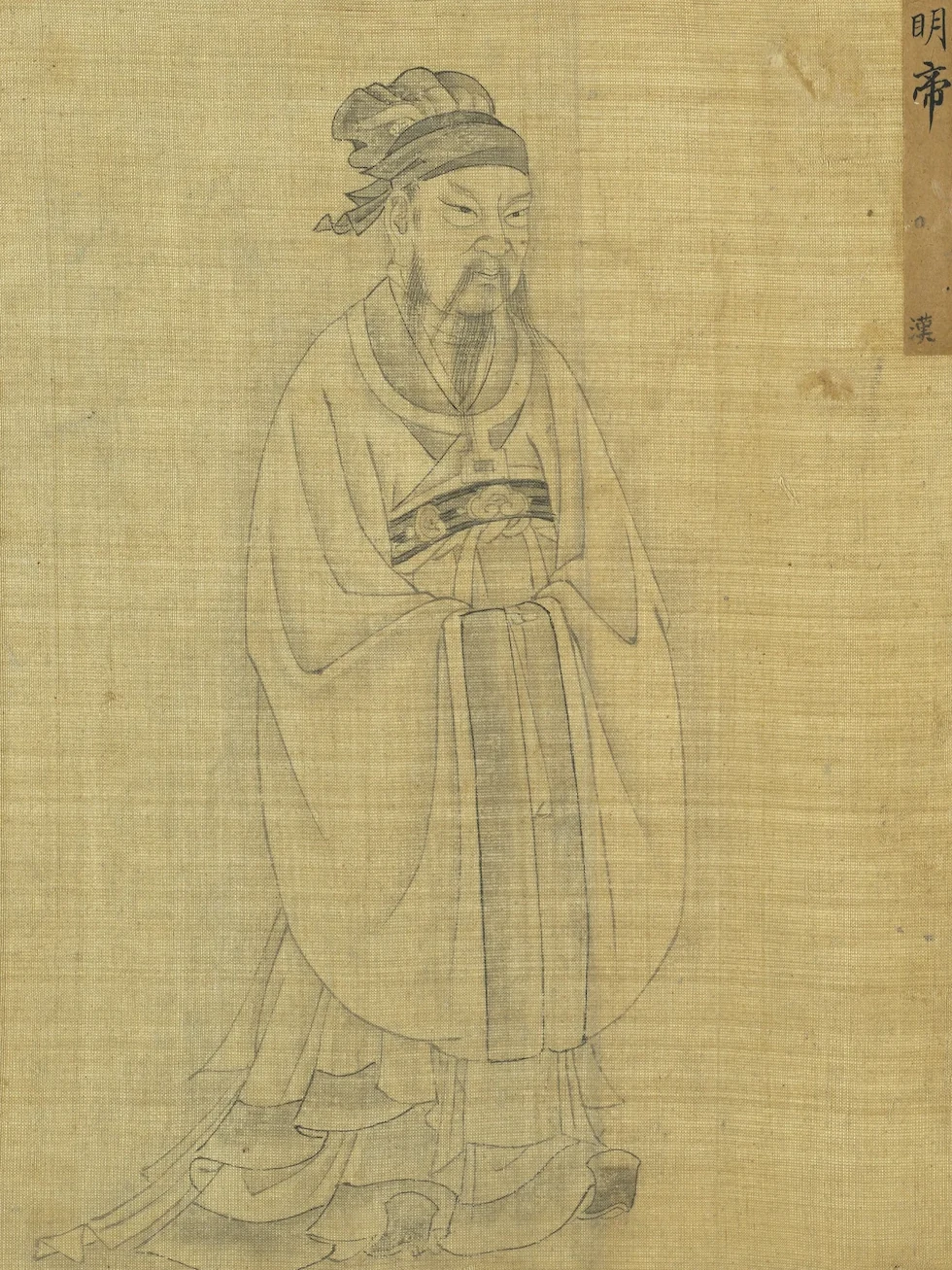
57 CE–75 CE
Emperor
Liu Zhuang
刘庄
Emperor Ming of Han, Liu Zhuang (June 15, 28–September 5, 75), courtesy name Zili and originally named Liu Yang, was the second emperor of the Eastern Han. He was the fourth son of Liu Xiu, Emperor Guangwu, and his mother was Empress Guanglie Yin Lihua. In 43 (the nineteenth year of Jianwu), he was made crown prince; in 57 (the second year of the Jianwuzhongyuan era), he succeeded to the throne and reigned for eighteen years.…
57 CE–75 CEEastern Han
PROFILE
Emperor Ming of Han, Liu Zhuang (June 15, 28–September 5, 75), courtesy name Zili and originally named Liu Yang, was the second emperor of the Eastern Han. He was the fourth son of Liu Xiu, Emperor Guangwu, and his mother was Empress Guanglie Yin Lihua. In 43 (the nineteenth year of Jianwu), he was made crown prince; in 57 (the second year of the Jianwuzhongyuan era), he succeeded to the throne and reigned for eighteen years. Liu Zhuang honored Confucian learning and promoted education, personally attended the Biyong academy to perform the ceremony honoring the aged, and received what the text describes as the first foreign students in history. He sent envoys to India to seek Buddhist teachings and founded White Horse Temple, described here as China's first state-sponsored Buddhist temple. He employed Wang Jing to regulate the Yellow River and control flooding; ordered Dou Gu and Geng Bing to campaign against the Northern Xiongnu; sent Ban Chao to manage the Western Regions and restored the office of Protector-General of the Western Regions; and incorporated the Ailao kingdom, creating Yongchang Commandery. His government was severe. He strictly restricted political intervention by imperial in-laws, suppressed powerful meritorious families, enforced strict official discipline, and oversaw population growth. His reign and that of his son Liu Da, Emperor Zhang, were collectively known as the “Rule of Ming and Zhang”. His posthumous title was Emperor Xiaoming, his temple name was Xianzong, and he was buried at Xianjie Mausoleum.
- Alternate names
- Emperor Ming of Han; fourth son of Emperor Guangwu
- Courtesy name
- Zili
- Period
- Eastern Han
- Dynasty / regime
- Eastern Han
- Identity
- Emperor
- Ethnicity / people
- Not recorded in historical sources
- Ancestral origin
- Not recorded in historical sources
- Date of birth
- June 15, 28
- Place of birth
- Not recorded in historical sources
- Date of death
- September 5, 75
- Reign
- 57–75
- Predecessor
- Emperor Guangwu of Han (Liu Xiu)
- Successor
- Emperor Zhang of Han (Liu Da)
- Posthumous title
- Emperor Xiaoming
- Principal achievements
- Second emperor of the Eastern Han; promoted Confucian learning and education, sent envoys to seek Buddhist teachings, employed Ban Chao, and presided over the Yongping period of good government
LIFE TIMELINE
Age twelve | Enfeoffed as Duke of Donghai; displayed early political insight during the land survey
Age fourteen | Raised in rank to Prince of Donghai
Age sixteen | Proposed a plan that helped suppress the rebellion at Yuanwu; made crown prince the same year; studied the Book of Documents under Huan Rong
Age thirty | Emperor Guangwu died, and Liu Zhuang succeeded to the throne
Age thirty-two | Executed Dou Lin, Colonel Protecting the Qiang, for deceiving the ruler and corrupt malfeasance; dismissed Grand Minister over the Masses Dou Rong
Age thirty-eight | Sent envoys to India to seek Buddhist teachings
Age thirty-nine | Established the School for the Young Marquises of the Four Clans, receiving what the source describes as the first foreign students in history; ordered the Colonel Director of Retainers and provincial inspectors to evaluate local officials annually
Age forty | Established White Horse Temple in Luoyang, described in the source as China's first state-sponsored Buddhist temple
Age forty-two | The Ailao kingdom submitted; Yongchang Commandery was established; Wang Jing was ordered to regulate the Yellow River for more than one thousand li from Xingyang eastward to the sea outlet at Qiancheng
Age forty-five | Sent Dou Gu and Geng Bing to station troops in Liangzhou in preparation for an attack on the Northern Xiongnu
Age forty-six | Ordered Dou Gu, Geng Bing, and two other columns to attack the Northern Xiongnu, heavily defeating the King of Huyan at the Tianshan Mountains; sent Ban Chao to the Western Regions, after which Shanshan and Khotan submitted
Age forty-seven | Dou Gu and Geng Bing again defeated the Northern Xiongnu at Lake Pulei; the Protector-General of the Western Regions and Wuji Colonels were restored; Dan'er on Hainan Island submitted
Age forty-eight | Died in the Front Hall of the Eastern Palace at Luoyang; received the posthumous title Emperor Xiaoming and temple name Xianzong and was buried at Xianjie Mausoleum
BIOGRAPHY
Biography
Family Background and Early Years
Liu Zhuang was born on June 15, 28 (the fourth day of the fifth month of the fourth year of Jianwu) in Yuanshi County, Changshan Commandery (present-day Yuanshi County, Shijiazhuang, Hebei). His father Liu Xiu, Emperor Guangwu, founded the Eastern Han, and his mother Yin Lihua was Empress Guanglie. Liu Zhuang was Liu Xiu's fourth son. His elder brother Liu Jiang was born to Empress Guo, while the source also identifies Liu Yang, later Prince Gong of Donghai Liu Qiang, as his full brother.
Liu Zhuang was exceptionally intelligent from childhood and was said to have a striking appearance, which impressed Liu Xiu. The Dongguan Hanji records that he was “intelligent and wise from childhood, magnificent in appearance; Shizu considered him extraordinary, repeatedly asked his views on government, and found his responses quick and his plans profound.” By the age of ten he had mastered the Spring and Autumn Annals, greatly surprising Liu Xiu. In 39 (the fifteenth year of Jianwu), at age twelve, Liu Zhuang was enfeoffed as Duke of Donghai.
The land-survey incident of the fifteenth year of Jianwu provided the first demonstration of his early political insight. The court was then checking cultivated acreage and household registration, and officials from the provinces and commanderies came to the capital to report. Emperor Guangwu saw a document from Chenliu stating, “Yingchuan and Hongnong may be questioned; Henan and Nanyang may not be questioned,” and asked its meaning. The Chenliu official did not know. Liu Zhuang, standing behind the imperial canopy, interjected that commandery officials had been instructing the Chenliu official how to check land. Liu Xiu asked why Henan and Nanyang could not be investigated. Liu Zhuang replied that Henan contained the imperial capital and Nanyang the emperor's home region, so estates and residences there were certain to exceed regulations and could not be rigorously examined. Liu Xiu ordered a Tiger Guards officer to interrogate the Chenliu official, and the explanation proved correct. From then on, Liu Xiu favored this son even more.
In 41 (the seventeenth year of Jianwu), Liu Zhuang was raised to Prince of Donghai. In 43 (the nineteenth year of Jianwu), Shan Chen, Fu Zhen, and others rebelled in Yuanwu city and seized officials. The general Zang Gong besieged the city for a long time without taking it, and many officials proposed offering rewards for a storming assault. Liu Zhuang instead advised easing the siege so the rebels could break out, after which, he said, even a local pavilion chief could deal with them. The rebels dispersed when they escaped and were indeed suppressed. That same year Liu Zhuang was made crown prince.
Crown Prince Period
After Liu Zhuang became crown prince, Emperor Guangwu initially wished to appoint his maternal uncle Yin Shi as Grand Tutor to the Heir Apparent. The Erudite Zhang Yi objected: “Now that Your Majesty establishes a crown prince, is it for the Yin clan or for all under Heaven? If it is for the Yin clan, then the Marquis of Yin may serve; if it is for all under Heaven, then surely one should use the worthy men of all under Heaven.” Liu Xiu praised the argument and appointed Zhang Yi Grand Tutor to the Heir Apparent and Huan Rong Junior Tutor to the Heir Apparent. Liu Zhuang studied the Book of Documents under Huan Rong, a renowned classical scholar whose learning had a deep influence on him. At the same time, Yin Shi instructed the Eastern Palace in his capacity as Bearer of the Gilded Mace. Musicians composed four songs—“The Sun Shines Again,” “The Moon Wheels Again,” “The Stars Shine Again,” and “The Sea Is Enriched Again”—to praise the crown prince's virtue.
Accession and Government
On the wuxu day of the second month of the second year of Jianwuzhongyuan (March 29, 57), Emperor Guangwu died, and thirty-year-old Liu Zhuang succeeded to the throne.
After taking power, Liu Zhuang followed Emperor Guangwu's institutions. His government was severe, and he concentrated authority in his own hands rather than delegating it downward. He strictly prohibited imperial in-laws from interfering in politics and guarded against powerful relatives and meritorious officials. In 59 (the second year of Yongping), Dou Lin, Colonel Protecting the Qiang and a relative of Dou Rong, was sentenced to death for “deceiving the ruler and corrupt malfeasance.” Liu Zhuang repeatedly rebuked Dou Rong for failing to discipline his relatives and dismissed him. Later, Liu Ying, Prince of Chu; Liu Jing, Prince of Guangling; Minister over the Masses Yu Yan; Xing Mu; and others died by suicide or under sentence for offenses. Xue Zhao, Administrator of Hedong; Wang Kang, Colonel Director of Retainers; Han Guang, Commandant-Escort; and others were successively condemned to death. Liu Zhuang exercised strict control over imperial in-laws, senior officials, and princes of the imperial clan: once they violated the law, he punished them severely and did not extend leniency on account of high office or kinship. Officials were therefore fearful, and the court became sternly disciplined.
Liu Zhuang was unusually harsh toward officials even by Han standards. He had high ministers, including the Nine Ministers, subjected to beating, establishing a precedent for corporal punishment at court. The Annals of the Later Han records: “In the time of Emperor Ming, government was severe, and even the Nine Ministers were flogged.” His sister, the Imperial Princess of Guantao, requested a gentleman's office for her son, but Liu Zhuang refused and instead gave her ten million cash, saying: “Gentlemen correspond above to the ranked stars and go out to govern districts of one hundred li. If the wrong person is appointed, the people suffer; this is why I am cautious.” The official Yan Zhang was highly talented, but because his younger sister was a consort in the palace, Liu Zhuang refused to promote him rather than violate his rule that imperial in-laws should not be enfeoffed and allowed to participate in government.
Liu Zhuang also emphasized official discipline. In 66 (the ninth year of Yongping), he ordered the Colonel Director of Retainers and provincial inspectors to evaluate local officials every year, specifying that “among those who have served for three years or more, one whose administration is especially distinguished shall be chosen and accompany the annual accounts to court; those whose administration is especially bad shall likewise be reported.”
Final Years and Death
On the renzi day of the eighth month of the eighteenth year of Yongping (September 5, 75), Liu Zhuang died in the Front Hall of the Eastern Palace at Luoyang at the age of forty-eight. His final edict ordered a frugal burial: “Do not erect a resting temple; place the spirit tablet in a separate changing chamber of Empress Guanglie. When I first prepared my longevity tomb, I ordered only drainage. The stone outer coffin is to be one zhang two chi wide and two zhang five chi long, and no mound is to be raised. After ten thousand years, sweep the ground and sacrifice there; only water, dried meat, and provisions are needed. After one hundred days, offerings shall be made only in the four seasons. Place only a few officials and soldiers there to provide for sweeping and cleaning, and do not open or repair roads. Anyone who dares undertake additional construction shall be punished under the law against unauthorized discussion of the ancestral temples.” His posthumous title was Emperor Xiaoming, his temple name Xianzong, and he was buried at Xianjie Mausoleum (southeast of present-day Luoyang, Henan).
Family and Early Years
Liu Zhuang, Emperor Ming of Han, 28 to 75, courtesy name Zili, was first named Yang and also called Zhuang; he was the fourth son of the founder Guangwu, his mother the empress Guanglie, lady Yin Lihua. By the Cefu Yuangui he was born on the jiashen day of the fifth month of the fourth year of Jianwu at Yuanshi in Changshan. By the Records of Han of the Eastern Pavilion he was "from childhood intelligent and wise, of handsome appearance," so that Guangwu marveled at him and "repeatedly asked him about government, to which he answered promptly and with deep counsel"; at twelve he was made duke of Donghai as an imperial son and three years later raised to prince, and in the nineteenth year of Jianwu, 43, he was made heir apparent. Two early episodes show his judgment. The first was the dispute over land measurement, when a clerk of Chenliu carried a note saying that Yingchuan and Hongnong might be questioned but Henan and Nanyang might not, and Guangwu, not understanding, asked the clerk, who said he had got it in the Changshou street of Luoyang; then Liu Zhuang, twelve years old, speaking from behind the tent, said that this was how the commandery clerks taught the clerk of Chenliu to check the land, Henan being the imperial city and Nanyang the imperial home region, whose fields and houses must exceed the regulations and so must not be strictly examined; and Guangwu having the tiger guards interrogate the clerk, what he said proved to agree with Liu Zhuang, after which Guangwu favoured this son the more. The second was the affair of Yuanwu, where Shan Chen and Fu Zhen held a city with ample stores and Zang Gong, besieging it, lost many men without taking it; and Guangwu calling his ministers to consider the matter, most proposed offering rewards for the assault, but Liu Zhuang alone held that the siege should not be drawn too close and too urgently, so that the rebels might break out and be destroyed at one blow. In the twenty-eighth year, a great assembly of the officials being held and the emperor asking who might be tutor to the heir, the ministers, guessing his wish, all said that the heir's maternal uncle, the bearer of the golden mace and marquis of Yuanlu Yin Shi, would do; but the erudite Zhang Yi said gravely that if the emperor were setting up the heir for the sake of the Yin family then the marquis of Yin would do, but if for the sake of the realm then the worthies of the realm should be used; and Guangwu approving, saying that he wished to set a tutor to assist the heir and that the erudite did not scruple to correct even himself, much less the heir, at once made Zhang Yi tutor to the heir and Huan Rong junior tutor, giving them carriages and horses; and Huan Rong, gathering the students and displaying his carriage, horses and seals, said that what he enjoyed today was the strength of studying antiquity, and that they should be diligent. The musicians of the time also composed four songs, the Sun Renewed, the Moon Haloed, the Star Rekindled and the Sea Refreshed, in praise of the heir's virtue.
His Accession and the Stern Handling of Consort Kin and Princes
In the second year of Zhongyuan, 57, Guangwu died and Liu Zhuang took the throne, continuing the policies by which Guangwu had consolidated the Eastern Han while punishing sternly the consort kin and ministers who abused their power and influence: the colonel against the Qiang Dou Lin was thrown into prison and sentenced to death for deceiving the throne and taking bribes, Dou Rong was dismissed after repeated edicts reproving him for failing to control his sons and brothers, and his brother the prince of Chu, Liu Ying, and others were likewise sentenced to death for their offences, so that the ministers were awed and the court was orderly. By the annals of Emperor Ming, he "reverently kept the institutions of Jianwu, daring to transgress none; the families of the inner palace might not be enfeoffed as marquises or take part in government": when the princess of Guantao asked a post for her son he refused and gave her ten million cash instead, telling his ministers that the gentlemen of the palace answered to the constellations and went out to rule a hundred li, and that if the wrong man were appointed the people would suffer, which was why he was reluctant; and Yan Zhang, of outstanding learning and performance, was deliberately not promoted because his sister was a palace consort, so as not to break the rule against consort kin taking fiefs or office. By the Records of Han of the Eastern Pavilion, by the Yongping period the noble families of the empresses had at most "one man from each house holding the rank of general, colonel or commandant in the horse and foot, to fill the palace guards and shut their doors," and none was enfeoffed or took part in government. Another famous sign of his policy was that in painting the twenty-eight generals on the Cloud Terrace he deliberately did not include his own father-in-law Ma Yuan. He was no gentler with his own kin: the prince of Shanyang, Liu Jing, having urged the prince of Donghai, Liu Jiang, to seize the realm and take the throne, Liu Jiang in terror at once sent the letter to Liu Zhuang, who took no action; and afterwards, when the Qiang were fighting the Han and Liu Jing was again active, Liu Zhuang merely sent him to his fief, where he asked a physiognomist whether, resembling the late emperor who had taken the throne at thirty, he too at thirty might raise troops, so frightening the man that he told the commandery officers at once, at which Liu Jing in fear put himself in prison, and Liu Zhuang again took no action; and when he afterwards had shamans sacrifice and curse, the officers of the commandery reported it and he killed himself in terror. The prince of Chu, Liu Ying, who had been on good terms with Emperor Ming when he was heir apparent, gathered retainers in his fief and made golden tortoises and jade cranes with inscriptions as omens, preparing actively to rebel; and being denounced by Yan Guang and the responsible officers asking that he be put to death, Liu Zhuang could not bear it and only dismissed and banished him, and Liu Ying afterwards killed himself; and Liu Zhuang, finding the register of scholars and officials with whom he had associated, raised a great case on it and implicated many. The prince of Huaiyang, Liu Yan, was likewise found to be plotting and the minister of education Xing Mu and the emperor's son-in-law Han Guang died in prison for it, with many others implicated and executed. The house of Dou fared the same: Dou Rong's cousin's son Dou Lin died in prison for deceit and bribery, and Dou Rong's eldest son Dou Mu, a son-in-law of Guangwu, wishing to seize Liu'an, forged the empress dowager Yin's command to make the marquis of Liu'an, Liu Xu, divorce his wife and marry his own daughter; and the emperor learning of it, Dou Mu was dismissed and all the Dou except Dou Rong sent back to their home commandery, Dou Rong being reproved and resigning to nurse his health; and Dou Mu and his two sons Dou Xuan and Dou Xun, though later pardoned and allowed to live in the capital under strict surveillance, complained and bribed officials and all three died in prison.
The Discipline of Officials, His Severity, and His Kindness
Liu Zhuang attended to the rectification of the bureaucracy, examining and promoting or dismissing local officers strictly, and beginning with care in the selection of officials: in the ninth year of Yongping, 66, he decreed that the colonel of the capital province and the inspectors of the provinces should annually report one senior clerk of exceptional record in office more than three years, to come up with the accounts, and also those notably unfit to govern; thus establishing an annual system of examination, and in appointments he strictly forbade solicitation by the powerful. He was very severe with officials, for whereas his father Guangwu had governed the ministers loosely because his prestige was great, Emperor Ming had no such prestige and could not control the old ministers by it, and so was harsh with officials to a degree rare among the emperors of the two Han, so that "in the time of Emperor Ming government was severe and the nine chief ministers were all flogged." By the Later Han, a decree granting silk to surrendered barbarians having been mishandled by the secretariat, which read ten as a hundred, the emperor, seeing the report of the minister of agriculture, was furious and summoned the gentleman of the secretariat to be flogged; and the assistant of the secretariat, Zhongli Yi, entering and knocking his head on the ground, said that errors are what men pardon, but that if negligence were to be imputed, then he, being of higher rank, was the more guilty and the gentleman of lower rank the less, and that the fault was his and he should be punished first, and stripping off his clothes he went to the rack; and the emperor's mind relenting he had him put on his cap again and pardoned the gentleman. His nature was narrow and inquisitive, fond of using informers to uncover secrets, so that the ministers and chief officers were often slandered and the attendants and those below the secretariat were even dragged about; and having once been angered by the gentleman Yao Song he struck at him with a staff, and Yao Song crawling under the bed and the emperor in great anger crying "come out, sir, come out," he said that the Son of Heaven is majestic and the princes splendid, and that he had never heard of a ruler rising to strike a gentleman, and the emperor pardoned him; and the court, none daring but to tremble, vied in strict severity to avoid punishment. On the other hand he showed kindness to those below: Yao Song, of a plain and loyal nature, was poor as a gentleman and often kept the night watch at the office alone with no quilt, sleeping on a bench and eating chaff, and the emperor coming in at night would see him and asking why, greatly approved him; and from that time he decreed that the grand provisioner should give those below the secretariat breakfast and supper, with curtains, quilts and robes, and two attendant clerks. He told his ministers that the officers answered to the constellations and went out to rule a hundred li, so that if the wrong man were in place the people would suffer, and that this was why he governed them strictly; and so in his reign officials were competent, the people at peace in their callings, near and far awed and submissive, and the registered population grew yearly.
River Control, Relief and the Question of the Xiongnu
In his reign Liu Zhuang several times decreed reductions of taxes and labour service and lightened punishments, ordered officials to encourage farming and sericulture and to deal with pests, and gave or assigned public fields to the poor. He greatly extended irrigation works, the greatest being the control of the Yellow river and the Bian canal: since the reign of Ping of the Western Han these had burst and flooded, and no repair had been made during the wars that followed, and though Guangwu wished to build dikes the realm was newly settled and could not bear so vast a work, so it was left undone; and under Emperor Ming, with the population growing, the harm from the broken river and canal increased and the cries of the people of the central plains for its control grew louder. Emperor Ming therefore ordered the famous water engineer Wang Jing and Wang Wu to lead several hundred thousand troops and labourers to the work; Wang Jing, a man of Lelang commandery widely read and well versed in hydraulic works, being questioned by the emperor on the difficulties of the task and analysing the advantages and harms so promptly that the emperor approved him. In the summer of the twelfth year of Yongping the emperor levied several hundred thousand soldiers and labourers, and Wang Jing, "measuring the lie of the land, cutting through hills, breaking the reefs, straightening the channels and gullies, damming the critical points and clearing the blockages," built a dike of more than a thousand li from Xingyang east to the mouth of the Qiancheng, with a sluice gate every ten li to keep the water circulating, so that there was no more bursting and leaking, and agriculture in the middle and lower Yellow river was secured; whence the saying that Wang Jing's work left no trouble for a thousand years, the river not changing course for over nine hundred years and its long-standing ills being wholly cured. In farming matters, in the spring of the fourth year of Yongping, in the second month, he decreed that he had himself ploughed the sacred field to pray for the crops, and that the timely rain having come and the winter wheat being moistened, half the tribute of the ministers should be remitted, and he required the officers to observe the government of the times and to keep punishments fair; and in the second month of the thirteenth year, after ploughing the sacred field, he gave food to the onlookers, and one scholar raising his hand said that it was fine indeed, like King Wen meeting the Grand Duke, and wrote on a board that the scholar was no Grand Duke and the emperor no King Wen. He promoted frugality and did not affect luxury in the palace, so that high and low followed suit, the people were at peace in their callings and the population increased: at the end of Guangwu's reign the registered population was over twenty-one million, and by the later part of Liu Zhuang's reign, in less than twenty years, it had grown sharply to over thirty-four million. As to the northern Xiongnu, when they saw the Eastern Han marrying a princess to the southern Xiongnu they too asked for a marriage, and Guangwu consulting his ministers could not decide, whereupon Liu Zhuang, then heir apparent, said that the northern Xiongnu feared the Han because the southern Xiongnu had come over and been given a marriage, and that if the Han did not attack the northern but gave them a marriage too, then the northern would not fear the Han and the southern would be of two minds; and Guangwu therefore decided against the marriage. On his accession Liu Zhuang granted the northern Xiongnu's request for trade, but this did not end their raiding and rather unsettled the southern Xiongnu who had already submitted, so that he had to abandon Guangwu's policy of resting the troops and the people and go to war with the Xiongnu again. The earlier refusal of the Western Regions' requests to restore the protectorate and send hostages was, given the weakness of the realm at the time, no bad choice; and after some thirty years of recuperation since the founding of the Eastern Han the realm had much recovered, and three years before Liu Zhuang's death he resolved to take a firm line with the Xiongnu once more.
The Opening of the Western Regions, the Submission of Ailao, and the Coming of the Four Quarters
In the spring of the sixteenth year of Yongping, 73, Liu Zhuang ordered Dou Gu, Geng Bing and others to attack the northern Xiongnu in four columns: Dou Gu marching from Jiuquan heavily defeated the Xiongnu chief Huyan at the Tianshan and left troops to garrison Yiwu; and in the eleventh month of the winter he sent the carriage-escort commandant Dou Gu, the emperor's son-in-law Geng Bing and the cavalry commandant Liu Zhang out by the Kunlun pass of Dunhuang, where they broke the White Mountain barbarians on the lake of Pulei and so entered Jushi, setting up for the first time the protector of the Western Regions and the wuji and wuyi colonels; and two years later Geng Bing and Dou Gu again led troops into the Western Regions against Jushi. In the southwest, in the twelfth year of Yongping, the king of Ailao, Liu Mao, sent his son at the head of his people to submit, with seventy-seven who called themselves city lords, fifty-one thousand eight hundred and ninety households and five hundred and fifty-three thousand seven hundred and eleven souls, seven thousand li southwest of Luoyang; and Liu Zhuang set up the two counties of Ailao and Bonan there and detached the six counties of the western commandant of Yizhou to form Yongchang commandery. The crossing of the Bonan mountain and the Lancang water being hard on travellers, a song said that the virtue of Han was wide and brought the unsubmissive to allegiance, that they crossed Bonan, passed the Lancang ford, and crossing the Lancang water became other men. By the account of the southern barbarians and southwestern Yi in the Later Han, in the Yongping period the inspector of Yizhou, Zhu Fu of Liang, fond of making a name and of generous and large design, spent several years in the province proclaiming the virtue of Han and overawing and embracing the distant barbarians, so that west of Wenshan, where former ages had never reached and the calendar had never been imposed, more than a hundred states such as the Bailang, Panmu and Tangzou, with a million three hundred thousand households and more than six million souls, brought tribute as his servants. Ban Gu's Rhapsody on the Eastern Capital set out the splendour of it, saying that Liu Zhuang "spread virtue over the middle land and raised his majesty over the four borders, sweeping west to the source of the river, east to the shore of the sea, shaking the northern cliffs and leaping to the southern red bounds," so that even where Emperor Wu of Han could not campaign and Emperor Xuan could not make them subjects, "none but trembled on land and water and ran to pay homage," and so "he pacified Ailao and opened Yongchang," the kings of the states coming to court and gathering at Luoyang, where Liu Zhuang received the maps and registers of the four seas and the tribute of ten thousand states, "comforting the various Xia within and pacifying the hundred barbarians without," so that men of the time sang that this age was splendid.
Ritual, Confucian Learning and Buddhism
Liu Zhuang was the first emperor in Chinese history to wear the ceremonial cap-and-apron, restoring the system abolished by Qin and giving the Han costume its final and complete form. In the second year of Yongping, 59, he first decreed that the officers should follow the Officers of Zhou, the Book of Rites and the Gaoyao chapter of the Book of Documents to restore the cap with hanging beads and fix its rules: the cap board seven inches broad and a foot two inches long, round in front and square behind, black above with red and green lining, hanging four inches before and three behind; the emperor tying twelve strings of white jade beads with the cord of the colour of his seal ribbon, the three excellencies and princes seven strings with green jade, and the ministers and grand masters five with black jade, worn at the sacrifices to heaven and earth, in the ancestral temple and in the Bright Hall. In the first month of that year, on the day xinwei, he sacrificed to the founder Guangwu in the Bright Hall, "then first wearing cap, beads and jade," and after the rites went up the spirit terrace to observe the clouds, proclaiming a general amnesty; and by the treatise on carriages and dress, "Emperor Ming then accomplished the great work, first wearing cap and beads, robes and emblems, red shoes and broidered sandals, to sacrifice to heaven and earth and to nourish the three elders and five experienced men in the three schools." In Confucian learning, by the treatise on the forest of scholars, Emperor Ming on his accession performed the rites in person: "the Son of Heaven first wore the cap of communication with heaven and robes of sun and moon, prepared the carriages of the ritual paraphernalia, made splendid the ceremony of clearing the way, sat in the Bright Hall and gave audience to the princes, ascended the spirit terrace to observe the clouds, and bared his arm to cut the sacrifice in the Biyong, honouring and nourishing the three elders and five experienced men"; and the archery and feasting rites being over, the emperor sat upright and lectured himself, with the scholars holding the classics and putting questions before him, while "of capped and girdled gentry who ringed the bridge gate to watch and listen there were perhaps millions"; and he further set up separate schools for the sons and grandsons of meritorious ministers and the cadet branches of the four families, choosing men of high ability to teach there, and ordered all the guards of the palace gates and the feathered forest to master the chapters of the Classic of Filial Piety, so that even the Xiongnu sent their sons to study. By the Comprehensive Mirror, in the ninth year of Yongping he honoured Confucian learning, so that from the heir apparent, the princes and marquises and the sons of ministers and meritorious officials none but studied the classics, and he set up schools in the southern palace for the sons of the consort families Fan, Guo, Yin and Ma, called the "young marquises of the four surnames," with masters of the Five Classics; and the Xiongnu sent the prince of Yizhizi, Da Chejuqu, to study, so that "when men of later ages speak of a flourishing age they always say Yongping." In Buddhism, by the treatise on Buddhism and Daoism in the History of Wei, the emperor dreamed at night of a golden man with light about his head flying in the palace court, and questioning his ministers, Fu Yi was the first to answer that it was the Buddha; and he sent the gentleman of the interior Cai Yin and the erudite's disciple Qin Jing to India to copy the model of the Buddha, and Cai Yin returned east to Luoyang with the monks Kasyapa Matanga and Dharmaratna, "and from this began monks and the rite of bowing in China"; Cai Yin also obtained the Sutra in Forty-two Sections and a standing image of Shakyamuni, and the emperor had painters draw the Buddha's image and set it in the Qingliang terrace and on the Xianjie tomb, the sutra being sealed in the Orchid terrace stone chamber; and the scriptures having come on a white horse, the White Horse temple was founded west of the Yong gate of Luoyang, all palace and pagoda rules being rebuilt after the Indian model. Moreover, in the second year of Yongping a white elephant presented by Gandhara, "with a five-coloured screen and a seven-jewel couch on its back seating several dozen men," was afterwards given a special park called the White Elephant Ward; and the emperor, hearing from a monk of the holy mound, learned that a hundred years after the Buddha's passing King Ashoka had distributed relics in eighty-four thousand places, nineteen of them in China, and that the mound the emperor had asked about was one of them, whereupon he decreed that a nine-storey pagoda more than five hundred feet high be built on it after the Indian model, named the Cloud-Reaching Pagoda and praised as China's first ancient pagoda. Yet the ban on Chinese becoming monks remained, for by the biography of Fotucheng only men of the Western Regions were allowed to build temples in the cities and worship their god, and Chinese might not leave their households, on the ground that the institutions of Hua and the Rong differ and the ways of men and gods are separate, that outer and inner are not the same and the rites of offering differ, and that the sacrifices of the Xia should not be mixed; and this ban greatly limited the growth of Buddhism.
His Reverence for His Teacher, His Filial Grief, and the Inner Palace
Liu Zhuang was exceedingly respectful to his teacher Huan Rong: on his accession he honoured him with the rites of a teacher and greatly favoured him, making his two sons gentlemen, and he visited the office of the imperial sacrifices in person, seating Huan Rong facing east with a stool and staff, gathering the ministers and several hundred of Huan Rong's students, the emperor himself taking the lesson in hand and saying whenever he spoke that the great master was there; and when Huan Rong fell ill the emperor sent envoys to inquire, with the provisioner and the physicians on the road in an unbroken line, and when he was gravely ill the emperor visited his house to ask after him, "alighting from his carriage at the mouth of the street and coming forward with the classic in his arms," and stroking Huan Rong wept, giving him couch and cushions, curtains, swords, clothing and quilts, and long remained before leaving; and from that time when marquises, generals and grand masters asked after the sick they dared not drive to the gate but all bowed below the bed; and when Huan Rong died the emperor himself changed his dress and attended the mourning and the burial, granting a grave on the south of Shoushan and making two of his brother's sons officers of four hundred shi and eight lecture students two hundred shi, while most of his other disciples rose to be ministers. He was by nature filial and loving beyond measure: in the first month of the seventeenth year of Yongping, when he was to visit the Yuanling, he dreamed at night of the late emperor and empress dowager happy as in life, and waking could not sleep for grief, and consulting the calendar and finding the next morning auspicious he led the ministers and his old retainers to the tomb; and on that day sweet dew fell on the trees of the tomb, which the emperor had the ministers gather and offer, and after the assembly "he leaned from his mat against the imperial couch and looked at the things in the empress dowager's mirror case, and was moved to tears," so that all about him wept and none could look up. By the annals of the empresses, when generals memorialised on military matters or ministers disputed without coming to a decision, Emperor Ming often tested his wife the empress Ma, who "would analyse the meaning and reason of each, getting the truth of every view," and whenever she attended him would speak of affairs of state, greatly aiding his decisions, never using private or family matters; and so she was ever more favoured and honoured, without decline. He also valued the discernment of men: the clerk of Xinye, Deng Yan, being of the consort family's cadet line, attended court and passed through the palace court of very handsome appearance, and Liu Zhuang turning to those about him said that his own bearing could hardly match it, though he liked him in his heart and specially gave him carriage, horses and clothing; but when the clerk of Nanyang came back with the accounts and told Yu Yan in detail, Yu Yan knew that Deng Yan's conduct did not match his looks and for three years did not employ him; and when Deng Yan afterwards failed to wear mourning for his father, Liu Zhuang said with a sigh that to know men is wisdom and that even Emperor Yao found it hard, and that Yu Yan's words were true indeed.
His Death and the Xianjie Tomb
On the day renzi of the eighth month of the autumn of the eighteenth year of Yongping, 75, Liu Zhuang died in the front hall of the eastern palace at forty-eight. His testamentary edict forbade the building of a temple, the tablet to be kept in the dressing room of the empress Guanglie; and when he first built his tomb he ordered that water should merely flow through it, the stone chamber twelve feet broad and twenty-five feet long with no mound to be raised, and that after ten thousand years he should be sacrificed to on swept ground with a bowl of water and strips of dried meat, and after a hundred days only the four seasonal offerings be made, with a few guards to sweep, and no road opened; and any who dared to build anything should be dealt with under the law against unauthorised discussion of the ancestral temple. His tomb is the Xianjie, south of the Mang hills in Luoyang in Henan, commonly called the Great Han Mound; and after his death a Jetavana garden was laid out on the tomb, which may have held Buddhist buildings, so that the tomb park of the time must have been imposing and splendid. The Xianjie was once robbed, and before it now stands a stone tablet erected by Gong Songlin in the Qing, reading the Xianjie tomb of Emperor Ming of Han; and from the top of the mound the surrounding tombs are spread like stars, a splendid sight.
Major Activities
Promotion of Confucian Learning and Education
Liu Zhuang had studied under Huan Rong while crown prince and showed him exceptional honor after ascending the throne. In 59 (the second year of Yongping), he personally visited the Biyong academy and performed the ceremony honoring the aged, appointing Li Gong as one of the Three Elders and Huan Rong as one of the Five Elders. After the banquet and archery rites, Liu Zhuang sat in the proper position and lectured in person while Confucian scholars held their texts and questioned him before the assembly; the source says the onlookers numbered in the hundreds of millions. Soldiers of the Feathered Forest all studied the Classic of Filial Piety, and the Xiongnu also sent sons to study. In 66 (the ninth year of Yongping), Liu Zhuang established the School for the Young Marquises of the Four Clans for sons of the Fan, Guo, Yin, and Ma families and hired renowned teachers to instruct them in the Five Classics. The source describes it as China's earliest specialized school for aristocratic youth. In the same year, he also received students from the Xiongnu, described in the source as inaugurating international education.
Envoys for Buddhist Teachings and White Horse Temple
In 65 (the eighth year of Yongping), Liu Zhuang dreamed at night of a golden man with sunlight around his neck flying through the palace courtyard. The next day he questioned his ministers, and Fu Yi answered that there was a deity in the West called the Buddha. Liu Zhuang therefore sent the Gentleman Cai Yin and the Erudite's student Qin Jing to India to seek Buddhist teachings. In 67 (the tenth year of Yongping), Cai Yin and the others returned to Luoyang with Buddhist scriptures in Indic originals and the two monks Kasyapa Matanga and Dharmaratna. Liu Zhuang established White Horse Temple outside Yong Gate on the western side of Luoyang, described here as China's first state-sponsored Buddhist temple and named after the white horse that carried the scriptures. The source treats the founding of White Horse Temple as marking the formal transmission of Buddhism into China's interior. Liu Zhuang is also said to have built Qiyun Pagoda in Luoyang, described as China's first pagoda, five hundred chi high (about 120 meters) and the tallest building in Asia at the time.
Wang Jing and Yellow River Regulation
Since the end of the Western Han, long neglect of the Yellow River had led to frequent flooding, and “the people of Yan and Yu lamented.” In 69 (the twelfth year of Yongping), Liu Zhuang ordered the noted hydraulic specialist Wang Jing and Wang Wu to lead several hundred thousand soldiers and laborers in regulating the river. The project extended for more than one thousand li from Xingyang east to the sea outlet at Qiancheng. Water gates were built every ten li so that the flow could be redirected in sequence, and major breaches ceased. The source states that this project fundamentally solved Yellow River flooding and maintained the river's stability for more than nine hundred years, protecting normal agricultural production in the middle and lower reaches.
Frontier Campaigns
In 72 (the fifteenth year of Yongping), Liu Zhuang sent Commandant of the Imperial Carriages Dou Gu and Commandant-Escort Geng Bing to station troops in Liangzhou in preparation for an attack on the Northern Xiongnu. In spring 73 (the sixteenth year), he ordered Dou Gu, Geng Bing, Ji Rong, and Lai Miao to advance against the Northern Xiongnu in four columns. Dou Gu marched from Jiuquan and heavily defeated the Xiongnu King of Huyan at the Tianshan Mountains. He left troops at Yiwulu City (west of present-day Hami, Xinjiang) and sent Acting Major Ban Chao with thirty-six men to the Western Regions. Ban Chao successively defeated pro-Xiongnu forces in Shanshan (around present-day Ruoqiang, Xinjiang) and Khotan (present-day Hotan, Xinjiang), after which “the various states all sent sons to serve at court; the Western Regions had been cut off from Han for sixty-five years, and at this point communications were restored.”
In 74 (the seventeenth year of Yongping), Dou Gu, Geng Bing, and others again defeated the Northern Xiongnu at Lake Pulei (present-day Barkol Lake, Xinjiang). The office of Protector-General of the Western Regions was reestablished, along with the Wuji Colonels at Kucha (present-day Kuqa, Xinjiang) and Jushi (present-day Turpan, Xinjiang), restoring Han control over the Western Regions. That same year Dan'er on Hainan Island submitted to the Eastern Han.
Establishment of Yongchang Commandery
In 69 (the twelfth year of Yongping), Liu Mao, king of the Ailao kingdom in the southwest, sent his son at the head of his people to submit to Han. The group was recorded as numbering 553,711. Ailao lay seven thousand li from Luoyang. Liu Zhuang established Ailao and Bonan counties there and combined them with six counties formerly governed by the western commandant of Yizhou Commandery to form Yongchang Commandery. The source describes this as the first opening of the Bonan Mountain route. Travelers had to cross the Lancang River and suffered great hardship, giving rise to the song: “Han virtue is broad and opens the unsubmitted. Cross Bonan, pass the Lan ford. Cross the Lancang—for the sake of others.”
During the Yongping era, Inspector Zhu Fu of Yizhou “proclaimed Han virtue and awed and conciliated distant peoples.” More than one hundred states, including Bailang, Panmu, and Tangzuo, comprising more than 1.3 million households and over six million people, “submitted tribute as whole peoples and called themselves subjects and servants.” Ban Gu praised this in “Rhapsody on the Eastern Capital”: “To the west it swept to the source of the Yellow River, to the east it reached the seacoast; to the north it stirred the remote cliffs, to the south it sprang to the vermilion borders. Distant regions and separate zones, cut off and nonadjacent—even those Emperor Wu could not campaign against and Emperor Xuan had not subjected—were all terrified on land and trembling on water, hurrying to come as guests.”
Economic Development and Population Growth
During Liu Zhuang's reign, he repeatedly ordered reductions in taxes and labor service and mitigation of punishments. Officials were instructed to encourage agriculture and sericulture and control crop diseases and pests, and public land was granted or assigned to the poor. He advocated frugality and did not promote luxury at court. The example spread downward, the people settled into their livelihoods, and the registered population increased. At the end of Emperor Guangwu's reign, the registered population was a little over twenty-one million; by the later years of Liu Zhuang's rule, fewer than twenty years later, it had risen to more than thirty-four million. According to the Book of the Later Han, in 75 (the eighteenth year of Yongping) there were 5,860,573 registered households and 34,125,021 people.
The Measures of His Government and His Institutional Foundations
In institutions and ritual, Liu Zhuang in the second year of Yongping decreed that the officers should follow the Officers of Zhou, the Book of Rites and the Gaoyao chapter to restore the cap with hanging beads, twelve strings of white jade for the emperor, seven with green jade for the three excellencies and princes and five with black jade for the ministers and grand masters, worn at the sacrifices to heaven and earth and in the Bright Hall, so that the ceremonial dress of the Han received its fixed form and he is called the emperor who "first wore cap and beads"; and he performed the rite of nourishing the aged in the Biyong, honouring the three elders and five experienced men, sitting in the Bright Hall to receive the princes and ascending the spirit terrace to observe the clouds.
In the bureaucracy he examined officials strictly, and in the ninth year of Yongping established the annual rule that the colonel of the capital province and the provincial inspectors should report one long-serving clerk of exceptional record and also those notably unfit to govern, and he put an end to solicitation by the powerful; he held firmly to the family rule that the families of the inner palace might not be enfeoffed or take part in government, refusing a post to the princess of Guantao's son while giving her ten million cash, not promoting Yan Zhang because his sister was a consort, and omitting his own father-in-law Ma Yuan from the twenty-eight generals of the Cloud Terrace, so that in his reign none of the consort families was enfeoffed or in the government. He laboured at business and his laws were clear, sitting in court until late so that hidden wrongs reached him, and his judgments were held to be the fewest of former ages.
In economy and livelihood he employed the water engineers Wang Jing and Wang Wu with several hundred thousand men to control the Yellow river and the Bian canal, building a dike of more than a thousand li from Xingyang to the mouth of the Qiancheng with a sluice every ten li, after which the river did not change course for more than nine hundred years; and he repeatedly decreed reductions of taxes and service, relief to the poor from public fields, and ordered officials to encourage farming. In his reign the registered population rose from over twenty-one million at the end of Guangwu's time to over thirty-four million.
In letters he performed the rites of nourishing the aged and of archery and feasting in person and lectured himself sitting upright, set up separate schools for the sons of meritorious ministers and the cadet branches of the four families, required the palace and forest guards to master the Classic of Filial Piety, and founded schools in the southern palace for the sons of the four consort families Fan, Guo, Yin and Ma, called the young marquises of the four surnames, with masters of the Five Classics, so that even the Xiongnu sent the prince of Yizhizi, Da Chejuqu, to study.
Abroad, having first refused the Western Regions' requests to restore the protectorate and send hostages, he sent Dou Gu, Geng Bing and others against the northern Xiongnu in the sixteenth year of Yongping, defeating Huyan at the Tianshan and garrisoning Yiwu, entering Jushi and for the first time appointing a protector of the Western Regions with the wuji and wuyi colonels; and in the southwest he received the submission of the king of Ailao, Liu Mao, with his people, setting up the counties of Ailao and Bonan and joining them into Yongchang commandery, while through the inspector of Yizhou, Zhu Fu, more than a hundred states such as the Bailang, Panmu and Tangzou brought tribute as servants.
In religion and culture, moved by a dream he sent envoys to India for the dharma, obtaining the Sutra in Forty-two Sections and a standing image of the Buddha, founding the White Horse temple west of the Yong gate of Luoyang with the scriptures carried on a white horse, and built the Cloud-Reaching Pagoda after the Indian model, so that he is regarded as the beginning of the eastward spread of Buddhism and of pagoda building in China; yet Chinese were still forbidden to become monks, only men of the Western Regions being allowed to build temples and worship their god.
Personal Relations
- Father: Liu Xiu, Emperor Guangwu. Mother: Yin Lihua, Empress Guanglie. Full brother: Liu Qiang, Prince Gong of Donghai. Half-brothers included Liu Fu, Prince Xian of Pei, and others. Wife: Empress Mingde Ma. Sons: Liu Da, Emperor Zhang of Han; Liu Jian, Prince Ai of Qiancheng; Liu Xian, Prince Jing of Chen; Liu Gong, Prince Jing of Pengcheng; Liu Dang, Prince Jing of Lecheng; Liu Yan, Prince Hui of Xiapi; Liu Chang, Prince Jie of Liang; and Liu Bing, Prince Qing of Huaiyang.
- Grand Tutor to the Heir Apparent Zhang Yi; Huan Rong, Junior Tutor to the Heir Apparent and one of the Five Elders. Huan Rong was Liu Zhuang's teacher in the classics. After taking the throne, Liu Zhuang honored him as one of the Five Elders and treated him with exceptional courtesy.
- Grand Tutor Deng Yu; General of Agile Cavalry Liu Cang, Prince of Dongping; Defender-in-chief Zhao Xi; Commandant of the Imperial Carriages Dou Gu; Commandant-Escort Geng Bing; Acting Major Ban Chao; hydraulic specialists Wang Jing and Wang Wu.
- Dou Rong, Grand Minister over the Masses, was dismissed because of crimes committed by his relatives; Liu Ying, Prince of Chu, died by suicide after a treason case; Liu Jing, Prince of Guangling, died by suicide after conviction; Minister over the Masses Yu Yan and Xing Mu were sentenced in criminal cases.
Historical Assessment
Eastern Han / Contemporary
Fu Yi praised him in “Elegy for Emperor Ming”: “This Yongping was upright in virtue; vast achievements were opened, and distant regions cherished him. Bright and solemn, the four quarters submitted to his awe; brilliant was the flourishing Han, lofty its achievement and virtue... His brightness matched the sun and moon and cast no partial light; like the Northern Dipper, he shone together with Heaven.”
Xue Ying wrote: “While still in the heir's palace, Emperor Ming's intelligence and sincerity were already manifest. When he came to the myriad affairs, he personally led through ritual and respectfully continued the inherited enterprise with one consistent principle. Even Qi of Xia or Cheng of Zhou, succeeding to and maintaining a dynastic line, could add nothing to it. Therefore the realm was orderly and peaceful, the four barbarians came as guests and submitted, criminal cases were few, and there was the atmosphere of good government. That he was called Xianzong—was this not appropriate?” (Hou Han Ji)
Hua Qiao wrote: “Shizu had already burdened himself with administrative affairs; Emperor Ming especially relied on written law, gathered authority into his own hands, and did not lend power to subordinates. Because the realm had only recently been pacified, the four classes of people enjoyed their occupations and the population multiplied. Since the restoration, he followed in the footsteps of Emperor Xuan.” (Eight Histories of the Later Han)
Wei, Jin, and Northern and Southern Dynasties
Fu Xuan criticized him in “Praise of Emperor Ming of Han”: “Solemn was Emperor Xiaoming; he relied on law and punishments, diligently managed the myriad affairs, and examined his subordinates through their circumstances. He did not broaden the Way to achieve order and thereby attain great peace; he relied exclusively on conventional Confucians and not on the classics of ritual.”
Liu Yuan stated: “Xianzong, Emperor Xiaoming, and Suzong, Emperor Xiaozhang, shone through successive generations, and the fiery brilliance was displayed anew.” (Book of Jin, “Records of the Sixteen Kingdoms I”)
Fan Ye wrote in the Book of the Later Han: “Emperor Ming was skilled in the management of punishments, and laws and commands were clear. He sat in court until late in the day, and hidden grievances always reached him. Within and without there was no favoritism for private interests, and above there was no display of arrogance. In adjudicating cases he obtained the true circumstances and was said to rank among the best of earlier generations. Thus later men who spoke of government invariably first cited the administrations of Jianwu and Yongping. Yet Zhongli Yi, Song Jun, and others repeatedly criticized his excessive scrutiny and cleverness. Was it perhaps that his capacity to encompass others was insufficient?”
Tang and Song Periods
Chu Suiliang wrote: “I respectfully observe that the three emperors Ming, Zhang, and He of Han were able to show fraternal affection toward their brothers. From that point onward, this may be taken as a standard.” (Old Book of Tang, “Biography of Chu Suiliang”)
Su Zhe wrote: “Emperor Wen of the Western Han reigned twenty-three years, Emperor Jing sixteen, Emperor Zhao twelve; Emperor Ming of the Eastern Han eighteen, Emperor Zhang thirteen, Emperor He seventeen; Emperor Taizong of Tang twenty-three. These were all enlightened rulers of recent ages.” (Luancheng Collection, “Discussions of the Dynasties”)
Chen Li wrote in Lidai Tonglüe: “Emperor Ming was intelligent and accomplished from youth... Those who speak of Eastern Han government name Jianwu and Yongping together... What a pity! Huan Rong taught the classics through specialized chapter-and-verse learning and did not use the Great Learning of the ancients on self-cultivation and governing the realm to enlighten and guide him... Yet why did he fall into narrow scrutiny, treating hidden discovery by eyes and ears as enlightenment, personally initiating beatings of gentlemen and humiliating high ministers? In the cases of the princes of Guangling and Chu, several thousand families suffered death or exile. Was his capacity to encompass others perhaps insufficient? As for sending envoys to India to seek Buddhist books and bring them into China, the later calamity of Buddhism began here and became an incurable disease in the universe. The empty beauty of honoring Confucian learning was not enough to cover the actual harm of opening the way for Buddhism. It is deeply lamentable!”
Ming, Qing, and Modern Periods
Gu Yanwu wrote in the Record of Daily Knowledge: “Looking at what the histories record, they are nothing but men of achievement, fame, power, and profit... From after the Spring and Autumn period to the Eastern Capital, customs somewhat returned toward antiquity. Therefore I know that Guangwu, Ming, and Zhang truly accomplished something like transforming Qi until it approached Lu, though regrettably they did not fully attain the Way.”
Wang Fuzhi wrote in Du Tongjian Lun: “Emperor Ming's fault lay in excessive scrutiny. It was not that he went outside the law to add slaughter, as Hu Hai did, but that he exhausted the law without a heart of compassion. His law was right, but his feeling went too far; his feeling went too far, yet the law itself remained right.”
Zhao Yi, in Notes on the Twenty-Two Histories, cited imperial edicts of Emperor Ming and praised him as “a ruler who possessed the Way.”
Modern historians generally regard Liu Zhuang as an effective ruler of the early Eastern Han. The “Rule of Ming and Zhang” is often compared in the source with the Western Han Rule of Wen and Jing, and his reign is credited with significant achievements in culture and education, frontier administration, and hydraulic works.
FIGURES ASSOCIATED WITH THIS DYNASTY
Bibliography
- Book of the Later Han*, “Annals of Xianzong, Emperor Xiaoming”
- Annals of the Later Han*