Birth | Born into the Guo family of Zheng County, Huazhou.
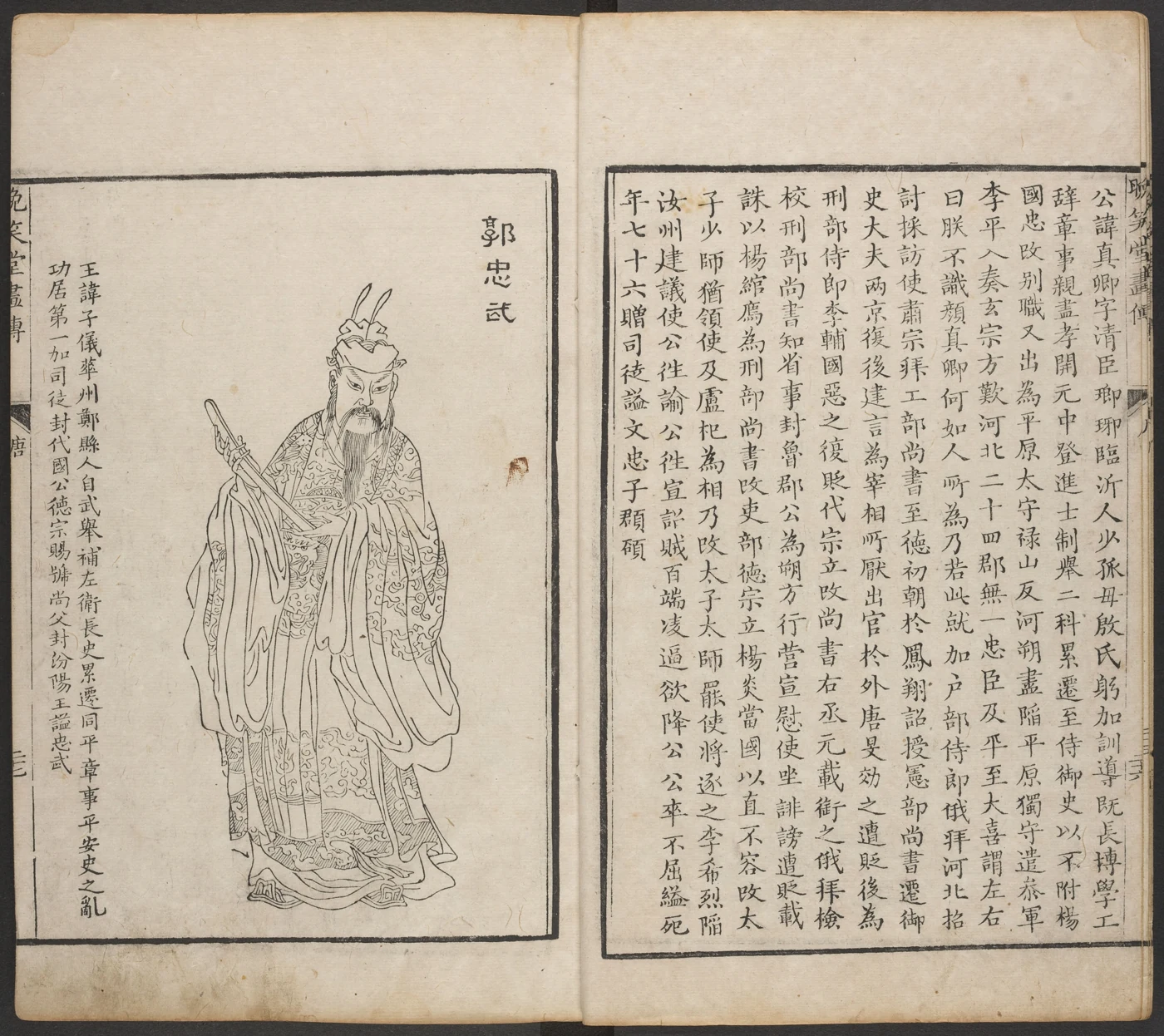
697 CE–781 CE
Generalsenior statesman
Guo Ziyi
郭子仪
Guo Ziyi (697–781), a native of Zheng County in Huazhou, was a major military commander of the mid-Tang Dynasty. He entered official service through the military examinations and spent many years on the northern frontier. After the An Lushan Rebellion broke out in 755 (fourteenth year of the Tianbao era), he took command of the Shuofang Army and fought alongside Li Guangbi and others in Hebei and Hedong. In 757 (second year…
697 CE–781 CETang Dynasty
PROFILE
Guo Ziyi (697–781), a native of Zheng County in Huazhou, was a major military commander of the mid-Tang Dynasty. He entered official service through the military examinations and spent many years on the northern frontier. After the An Lushan Rebellion broke out in 755 (fourteenth year of the Tianbao era), he took command of the Shuofang Army and fought alongside Li Guangbi and others in Hebei and Hedong. In 757 (second year of the Zhide era), he also participated in the recovery of Chang'an and Luoyang, becoming one of the principal generals in the Tang restoration of the two capitals. Although he was repeatedly removed from command thereafter, the court recalled him whenever crises arose, including the mutiny at Hezhong, the Tibetan occupation of Chang'an, and Pugu Huai'en's invasion with allied forces.
- Other names
- Prince of Fenyang; Lord Guo; Prince Fenyang
- Courtesy name
- Ziyi
- Period
- Mid-Tang Dynasty
- Date of Birth
- 697
- Date of Death
- July 9, 781 CE(2nd year of the Jianzhong era, 6th month, 14th day)
- Dynasty/Regime
- Tang Dynasty
- Identity
- General, senior statesman
- Ethnicity
- Han
- Native place
- Zheng County, Huazhou (present-day Huazhou District, Weinan, Shaanxi)
- Place of birth
- Not recorded in historical sources
- Posthumous title
- Zhongwu
- Noble title
- Prince of Fenyang
- Highest office
- Defender-in-chief; Secretariat Director
- Major achievements
- Led the Shuofang Army in the suppression of the An Lushan Rebellion; helped recover Chang'an and Luoyang; restored stability in Guanzhong after the Tibetan occupation of Chang'an and during Pugu Huai'en's coalition invasion
LIFE TIMELINE
Entry through the military examinations | He sat the military examinations, was appointed Adjutant of the Left Guard with a distinguished grade, and later held frontier military posts.
Shuofang Army service | Served as commander of Tiande Army, concurrently administrator of Jiuyuan, and right army commander under the Shuofang Military Commissioner.
An Lushan Rebellion begins | Appointed Military Commissioner of Shuofang; led troops east and recovered Yunzhong, Mayi, and other places.
Campaigns in Hebei | Coordinated with Li Guangbi and attacked rebel forces around Changshan and Jiashan; later returned by imperial order to Lingwu.
Recovery of the two capitals | Together with Uyghur forces and other Tang units, recovered Chang'an and then Luoyang; for his service he was advanced to Duke of Dai and appointed Minister of Works.
Battle of Xiangzhou and loss of command | Participated with nine Military Commissioners in the siege of An Qingxu; after defeat, Yu Chao'en and others blamed him and he was stripped of military command.
Hezhong crisis | A military mutiny broke out in Hezhong; the court recalled Guo Ziyi, who quickly restored order after arriving.
Tibetan occupation of Chang'an | Tibetan forces occupied Chang'an and Emperor Daizong fled east; Guo gathered troops and created the impression that a large Tang army had arrived, causing the Tibetans to withdraw and the capital to be restored.
Defense of Guanzhong | Stationed at Hezhong, Binzhou, and other places; defended against the Tibetan Empire and reorganized the Shuofang Army.
Relief of Jingyang | Pugu Huai'en led Tibetan, Uyghur, and other forces into Guanzhong; Guo persuaded the Uyghurs to renew their alliance with the Tang, after which the allied Tang-Uyghur forces defeated the Tibetans.
Emperor Dezong of Tang's accession | Honored as Shangfu and advanced to Defender-in-chief and Secretariat Director, effectively withdrawing from front-line military and political affairs.
Death | Died at the age of eighty-five; posthumously elevated to Grand Preceptor and given the posthumous title Zhongwu.
BIOGRAPHY
Biography
Early Career on the Frontier
Guo Ziyi came from the Guo family of Huazhou. Unlike officials who entered the civil bureaucracy through the regular literary examinations, he obtained office through the military examinations. His early career was concentrated along the Shuofang and Hexi frontiers. Long service there gave him familiarity with northern military commands, cavalry warfare, and dealings with steppe peoples, enabling him to take command of the important Shuofang Army quickly when the An Lushan Rebellion erupted.
His lineage and the posthumous honors to his parents appear in the epitaphs and genealogical tables. According to the genealogical table of chancellors in the New Tang History, the Guo family of Huayin also came from Taiyuan; in the Han there was Guo Ting, whose great-grandson, the grand master of the golden purple Guo Guangzhi, had Guo Mengru, governor of Fengyi, and the descendants moved from Taiyuan to Fengyi; under the Northern Wei there was Guo Hui, commander of Tongzhou. The Old Tang History records that his father Guo Jingzhi governed the five prefectures of Sui, Wei, Gui, Shou and Si, and for his son's eminence was posthumously made grand guardian and enfeoffed as duke of Qi; the spirit-way inscription for the governor of Shou adds that his mother was the lady Xiang of Pingyuan commandery and that honors were later granted to his grandfather as minister of war, to his father as grand guardian and to his mother as lady of Wei. His younger brother Guo Youming was careful and blameless by nature, unskilled in arms and fond of guests, and through his brother's eminence ended as director of the palace treasury and was posthumously made grand tutor to the heir apparent; another brother, Guo Youxian, rose to grand master of the golden purple, minister of the imperial insignia and deputy protector of Chanyu, his epitaph naming him brother of "the secondary marshal of the passes and Hedong, director of the secretariat, prince of Fenyang commandery." Within a single house father and grandfather and mother all received posthumous honors while the younger brothers stood in high office through the elder's merit — not rare among Tang worthies' families, yet especially marked among the Guos.
As to his names, Guo Ziyi took Ziyi as his courtesy name and was generally known as Lord Guo; from his title of prince of Fenyang commandery he was also called Guo of Fenyang, and under Dezong he was honored as venerable father. Later commemoration attaches chiefly to the name Fenyang, and both the Old and the New Tang History give him a biography of his own.
Guo Ziyi was born in 697, a man of Zheng county in Hua prefecture, in what is now the Huazhou district of Weinan in Shaanxi; his ancestral home was Taiyuan in Bing prefecture, he came of the Guo family of Huayin, and his father was Guo Jingzhi, governor of Shou prefecture. By the epitaphs, his line descended from a Zhou enfeoffment in Jin and lived at Taiyuan, later settling at Zheng through official postings: his great-great-grandfather Guo Chang served the Sui as judicial officer of Liangzhou, and had Guo Tong, who in the Yonghui period was transferred for his ability to be registrar of Meiyuan county in the capital prefecture; Guo Tong had Guo Jingzhi, who under the Kaiyuan emperor governed the four prefectures of Wei, Ji, Sui and Shou with a name for good administration and was posthumously made grand guardian in the early Qianyuan period. Guo Ziyi was, as the texts say, a man sent down by heaven with innate knowledge of how to assist a king; he was of imposing appearance and stood over six feet tall, and although his early years fell in the high noon of the Tang he was not then much employed.
He entered office through the military examinations, placed in the highest grade and appointed a long-mounted guard of the left guard, a rank at the very bottom of the ninth class, and thereafter rose through a long series of posts: alternate commander of the Chenggao headquarters in the Henan prefecture, then of the Xingde headquarters in Tongzhou, then a reserve commander of the Luoyang headquarters in Ruzhou with duty in the right feathered forest, then chief of staff of the Gui prefecture governor's office as deputy commissioner of the Jing command, then deputy protector of Beiting as deputy commissioner of the four garrisons, then commandant of the left awe-inspiring guard, then commander of the right imperial chariots with the post of deputy protector of Anxi, then general of the right awe-inspiring guard and deputy commissioner of the Shuofang command, then commissioner of the Dingyuan walled town and agricultural commissioner of his own camp, then deputy grand protector of Chanyu, commissioner of the eastern surrender city and commander of the left wing, then general of the right metal-mace guard with the deputy protectorate of Chanyu, then general-in-chief of the left martial guard with the deputy protectorate of Anbei, commissioner of the Hengsai army and agricultural commissioner, then commissioner of the Tianhe army and deputy protector of Anbei, then governor of Feng prefecture, commissioner of the western surrender city and commander of the right wing. This series began at the lowest military ranks of the frontier garrisons and passed through nearly every command in Shuofang, Anxi, Beiting and Chanyu, so that his knowledge of frontier conditions in the northwest was beyond that of ordinary commanders. In the third month of 749 he was promoted general-in-chief of the left martial guard, an official of the third class upper grade, commissioner of the Hengsai army and deputy protector of Anbei, and the Hengsai command was changed to the Tianhe command; in the spring of 754 he concurrently held the governorship of Jiuyuan commandery, that is Feng prefecture, the commissionership of the western surrender city, the governorship of Jiuyuan and the right-wing command of the Shuofang army. Not long afterwards his mother, the lady Xiang, posthumously honored as lady of Wei, died and he left office to mourn. Beyond the official records, a legend survives in the inscription of his family temple: that when he first served as a soldier on the desert frontier he returned from the capital where he had gone to hurry the military pay, and some ten li from Yinzhou a sandstorm darkened heaven and earth and he lost his baggage, so that he took shelter in an empty house by the road; at night a red glow appeared about the house, and looking up he saw a splendid carriage descending slowly through the air, in whose brocade curtains a beautiful woman leaned down to look at him, and he bowed and addressed her, saying that it was the seventh day of the seventh month and she must be a heavenly being. The story comes from later inscriptions rather than the histories and stands beside the recorded military career as evidence that popular tradition already regarded him as a man of portentous appearance.
An Lushan Rebellion
After An Lushan rebelled, Guo first recovered lost territory in northern Shanxi and then entered Hebei with Li Guangbi, threatening the rebels' rear. After Emperor Xuanzong of Tang fled west and Emperor Suzong established his court at Lingwu, Guo was ordered to lead the Shuofang Army to the imperial headquarters and became one of the new court's most dependable military pillars. In 757, Tang armies, aided by Uyghur cavalry, recovered Chang'an and Luoyang; Guo played a central role in organizing troops and directing operations on the front.
When Emperor Suzong took the throne at Lingwu the court was newly set up with few and weak troops, and though it had obtained horse pastures its military array was plainly wanting. When Guo Ziyi and Li Guangbi brought their whole army to the headquarters the army's renown revived, and the prospect of restoration gave the people hope. The court made Guo Ziyi minister of war and concurrent participant in the deliberations of the secretariat and chancellery, still as chief of staff of the Lingzhou governor's office and commissioner of the Shuofang army. Suzong reviewed the six armies and moved south toward the passes, and at Pengyuan commandery the chancellor Fang Guan asked for ten thousand men and command in his own person against the rebels; Suzong, who had long esteemed him, agreed, and Fang Guan's force was beaten at Chentao with almost all its men lost. With a campaign to conduct and half the imperial army already destroyed, the court could rely only on the Shuofang army. In the eleventh month of that year the rebel general Ashina Congli led five thousand horsemen of the Tongluo and Pugu out beyond the frontier and drew several tens of thousands from the nine offices and six Hu prefectures of Hequ, intending to press on the imperial headquarters; Guo Ziyi and the Uyghur chief Geluozhi went out and defeated them, killing and capturing tens of thousands, and Hequ was pacified.
In the third month of 757 Guo Ziyi heavily defeated the rebels at Tong pass and Cui Qianyou fell back to Pujin. The magistrate of Yongle, Zhao Fu, the revenue officer of Hedong, Han Min, the executive officer Xu Jiong, and a clansman, Li Cangfeng, all then held by the rebels at Puzhou, plotted to act as internal supporters when the royal army came. When Guo Ziyi attacked Puzhou, Zhao Fu and the others killed the guards on the wall and opened the gates to him; Cui Qianyou fled north to Anyi with several thousand men, and the people of Anyi pretended to surrender, letting half his troops in and then dropping the portcullis on them, so that Cui Qianyou, not having entered, escaped eastward. Guo Ziyi then recovered the Yongfeng granary in Shan commandery, and from that time there was no more raiding between Tong pass and Shanzhou. Earlier the rebel general An Shouzhong had walled himself in at the Yongfeng granary, and Guo Ziyi had sent his son Guo Gan against him, killing as many as ten thousand, and Guo Gan died in the fighting.
In the ninth month Guo Ziyi accompanied the marshal, the prince of Guangping, against Chang'an with a hundred and fifty thousand Turco-Chinese troops. The Uyghurs sent Prince Yehu with four thousand horsemen to help against the rebels, and Guo Ziyi feasted with him and made an alliance, swearing together to put down the state's calamity, and the two got on well. Guo Ziyi placed the marshal in the center and fought the rebel generals An Shouzhong and Li Guiren north of the Xiangji temple west of the city: the royal army's line stretched thirty li and the rebels' hundred thousand faced it to the north; Li Guiren first pressed on the army, which fell into disorder until Li Siye charged desperately and took a dozen rebel horsemen, restoring the line; the Uyghurs then sent a surprise force behind the rebel array and attacked from both sides, and the rebels broke utterly, with sixty thousand heads taken between noon and evening. The rebel general Zhang Tongru, holding Chang'an, heard of Li Guiren's defeat and fled that night to Shanzhou. The next day the prince of Guangping entered the capital, and a million old and young called out joyfully along the roads and said through their tears that they had not thought to see the royal army again; the prince rested his troops three days and led them east. In the tenth month An Qingxu sent Yan Zhuang with a hundred thousand to Shanzhou to join Zhang Tongru against the royal army, which on hearing of its approach massed west of Shanzhou with a mountain at its back. Guo Ziyi attacked the front with his main force while the Uyghurs climbed the mountain to strike the rear; encountering a rebel ambush in the hills and fighting past the appointed time, the main force fell back a little, and the rebels sent three thousand men to cut the retreat, shaking the army's confidence, whereupon Guo Ziyi waved the Uyghurs forward and killed them all; the army then galloped to the rebel rear and loosed a dozen arrows in the yellow dust, and the rebels looked round in alarm crying that the Uyghurs had come and were at once routed, with bodies strewn over hills and marshes. Yan Zhuang and Zhang Tongru fled to Luoyang and crossed the river with An Qingxu to hold Xiangzhou. Guo Ziyi escorted the prince of Guangping into the eastern capital and drew up his troops south of the Tianjin bridge, the people cheering along the road; the puppet chancellor Chen Xilie, the puppet director of the secretariat Zhang Ji and more than three hundred others came in plain clothes to confess, and the prince consoled them and sent them away. All the commanderies and counties of Hedong, Hexi and Henan that the rebels had taken were now pacified, and Guo Ziyi for his services was made minister of education, enfeoffed as duke of Dai and given a thousand households.
At the Battle of Xiangzhou, the nine Tang Military Commissioners lacked unified command and were routed by Shi Siming's counterattack. Although Guo preserved part of his force, he was still deprived of command after accusations by the eunuch supervisor Yu Chao'en and others. The episode reflected the late-rebellion court's simultaneous dependence on, and suspicion of, powerful generals. Over the next several years, Guo moved repeatedly between recall and dismissal until the end of Emperor Suzong's reign and the beginning of Emperor Daizong's, when he again assumed responsibility for resolving major crises.
Emperor Daizong took the throne in the fourth month of 762, and the eunuch Cheng Yuanzhen came into power. Priding himself on having made the emperor, Cheng Yuanzhen resented the veteran generals and held Guo Ziyi too powerful to control, so he worked secretly to divide him from the throne, asking that he be relieved of the secondary marshalate and given seven hundred more households and the office of commissioner for Suzong's tomb. After thanking the emperor for the favor, Guo Ziyi submitted the edicts Suzong had sent him and took the occasion to state his own case: that his virtue was thin as a cicada's wing and his life light as a feather, that he had time and again received the state's grace and stood undeservedly in the ranks of courtiers; that when heaven and earth were convulsed and the central plains ran with blood he had gone north from Lingwu to enthrone the late emperor and had then raised troops and come south, mustering at Qiyang; that the late emperor, anxious for the ancestral altars, had entrusted him with the house and the state and made him second to the emperor in clearing away the evil vapors over the two capitals; that the emperor's great design and decisive judgment had remade the realm, and that he had since been given both the civil and the military handles, spreading the teaching of the state abroad and seasoning the cauldron within; and that he had therefore long pledged himself to die for the state. He added that his words were often blunt and he feared they would draw slander, and that only the emperor and heaven and earth knew he was without duplicity or self-interest; that a vessel dreads being full and he dared not long block the road of worthies; that in ten years east and west, in a hundred battles, with swords snapping in the cold and blood spattering his clothes, sleeping in the fields with a startled soul and drinking ice that hurt his bones, through difficulties and dangers, he had relied on nothing but heaven; and that the emperor had given him more than a thousand edicts and twenty scrolls of handwritten rescripts from Lingwu, Hebei, Henan, Pengyuan, Fufang, Hedong, Fengxiang, the two capitals and Jiangzhou, wherever he had been, which he now submitted at the risk of his life. Daizong's reply was that he himself was without virtue and without understanding, and that it was his own fault if he had made a great minister anxious and doubtful, for which he was much ashamed, and that Guo Ziyi should not be concerned. This exchange is rare in Tang letters between ruler and minister: a veteran who had held troops for years, stripped of his command, offered not a complaint but a compilation of more than a thousand edicts of the late emperor, and the emperor's answer began by admitting his own fault.
Guanzhong Crises Under Emperor Daizong
In 763, taking advantage of the Tang interior's weakness, Tibetan forces entered Chang'an and Emperor Daizong fled in haste. Guo had only limited forces at the time, yet he managed to rally scattered soldiers and create the appearance that a large Tang army had arrived, inducing the Tibetans to withdraw from the capital. Two years later, Pugu Huai'en brought a coalition of Tibetan, Uyghur, and other forces against Guanzhong. Rather than rushing into battle, Guo used his old ties with Uyghur commanders, personally approached their lines, explained that Pugu Huai'en had already died, and invoked the existing Tang-Uyghur alliance. He ultimately persuaded the Uyghurs to change sides and cooperate with the Tang against the Tibetans.
Not long afterwards Liang Chongyi rebelled at Xiangyang and Pugu Huai'en held troops at Fenzhou, drawing in Uyghurs and Tibetans to raid Hexi. In the tenth month of the following year the Tibetans took Jingzhou and captured its governor Gao Hui, who became their guide and led them deep into the metropolitan region, plundering Fengtian and Wugong, crossing the Wei southward and moving east along the hills. The commander of the northern Wei camp, Lü Rijiang, met them at Zhouzhi and from morning to evening killed several thousand Tibetans, though his own men suffered heavily. As the enemy pressed on the capital and the emperor had no plan, he hastily made Guo Ziyi secondary marshal of the passes and posted him to Xianyang. Since the defeat at Xiangzhou, when Li Guangbi had taken over the army and he had been recalled to court, Guo Ziyi's retainers had dispersed; receiving the summons now he had only twenty riders and had to seize livestock from the people's houses to equip his men. When he reached Xianyang the Tibetan army had already crossed the Wei, and on that same day the emperor left for Shanzhou to avoid them. Hearing of it, Guo Ziyi wiped away his tears and returned to the capital, but by his arrival the imperial carriage had gone. The archer-general Wang Xianzhong, who had followed the emperor, mutinied on the road with four hundred riders and tried to force the prince of Feng and ten other princes to go over to the enemy. Guo Ziyi, entering by the Kaiyuan gate, met them, questioned the prince of Feng and the rest as to their destination, and escorted them to the imperial headquarters.
After the Tibetans withdrew, the secondary marshal of Hebei, Pugu Huai'en, was encamped at Fenzhou and plundered the counties of Bing and Fen as though they were his own domain, so the court made Guo Ziyi secondary marshal of the passes and Hedong and commissioner of Hezhong, posting him there. With the Tibetan danger gone, Pugu Huai'en's following began to scatter; that month his son Pugu Yang, commanding at Yüci, was killed by a camp officer, Zhang Weiyue, whose head was sent to the capital, and Zhang Weiyue brought Pugu Yang's troops over to Guo Ziyi. Pugu Huai'en in fear abandoned his mother and fled to Lingzhou. In the ninth month of the following year the court made Guo Ziyi acting grand protector and commissioner of the northern circuit of Bin and Ning, Jing and Yuan and Hexi for peace with the Tibetans and for the pacification of Shuofang, his secondary marshalate of the passes and Hedong and his directorship of the secretariat continuing. Since Pugu Huai'en was not yet destroyed, Guo Ziyi held it wrong to refuse an office, yet firmly declined the grand protectorate, memorializing that the post was too powerful and its duties too heavy for him to occupy with an easy mind, that the imperial edict had not granted his sincere request, that he had long known when to stop, and that in repeatedly asking he feared fullness and overflow. He cited the ancient case of Fan Xuanzi, whose own yielding made all below him yield, so that even the overbearing Luan Yan did not dare defy him, and said that though of small worth he privately admired the ancients, wishing to lead by his own example and greatly change the frivolous customs of the age, and had therefore earnestly asked to be relieved of the office in the hope that propriety and yielding might prevail through him; that as chief minister and true prince, sharing in the counsels of the throne and charged as a confidant, his honors were at their height and his work accomplished, so that he ought to beg leave to retire and preserve his remaining years, and only because the enemy was near and the house and state unsettled did a subject's heart find no rest; and that once the western barbarians were settled and Huai'en taken, he swore to accept no rank he had formerly held, but would follow in the steps of Fan Li and Zhang Liang. A gracious edict refused it; Guo Ziyi came before Daizong, and weeping besought him, whereupon the matter dropped.
In the tenth month of the same year Pugu Huai'en drew in several hundred thousand Tibetans, Uyghurs and Tanguts and moved south, the capital was in great alarm, and Guo Ziyi went out to hold Fengtian. Daizong summoned him and asked for a plan against the invaders, and Guo Ziyi answered that in his view Huai'en could do nothing. Asked why, he replied that Huai'en, though famed for daring, had long since lost his soldiers' hearts; that what enabled him to make trouble was simply that he led men who wished to go home; that Huai'en had been his own subordinate commander and his men had all been Guo Ziyi's retainers, to whom his kindness and good faith had extended; and that now that he was their general, they could not bring themselves to turn their blades on him, which was why he judged Huai'en powerless. When the enemy raided Binzhou, Guo Ziyi being at Jingyang sent his eldest son, the Shuofang cavalry commander Guo Yao, with troops to help, joining the governor of Bin and Ning, Bai Xiaode, to shut the city and hold it. Pugu Huai'en's vanguard came to Fengtian and challenged close to the wall, and the generals asked to attack; Guo Ziyi stopped them, saying that a guest army deep in another's country profits by a quick fight and must not be met head-on, that the men were all his own retainers, and that if he delayed they would fall away of themselves, whereas pressing them would force the battle whose outcome was uncertain, and that any man who spoke of fighting would be beheaded. He held his ramparts, and the enemy indeed withdrew without fighting. To explain holding fast by those six words about delay making them fall away was the clearest statement Guo Ziyi ever made of his grasp of how the armies of the military governors held together.
At that time the Tibetans raided the metropolitan region repeatedly, and the court, treating Puzhou and Shanzhou as its inner line, kept heavy forces there. In the fifth month of 765 it made Guo Ziyi commander-in-chief of the Henan circuit and posted him to Hezhong. In the eighth month Pugu Huai'en drew in more than three hundred thousand Tibetans, Uyghurs, Tanguts, Qiang, Hun and Nula, with the mountain bandits Ren Fu, Zheng Ting, Hao De and Liu Kaiyuan, and moved south, first sending tens of thousands to plunder Tongzhou, intending to go from Huayin toward Lantian to block the southern road while Huai'en followed with the main force. The Uyghurs and Tibetans raided the metropolitan region by the roads of Jing, Bin and Fengxiang and plundered Fengtian and Liquan. The capital was shaken, the emperor issued an edict of personal campaign, ordering Li Zhongchen to camp at the eastern Wei bridge, Li Guangjin at Yunyang, Ma Lin and Hao Tingyu at the Bian bridge, Luo Fengxian and Li Riyue at Zhouzhi, Li Baoyu at Fengxiang, Zhou Zhiguang at Tongzhou and Du Mian at Fangzhou, while the emperor camped the imperial guards in the park; the able-bodied men of the capital were organized in militia, one of two city gates was walled up, and Yu Chao'en seized the private horses of officials and people and held the gates with troops, so that townsmen fled through holes in the wall and men's minds were desperate. Guo Ziyi was hastily summoned from Hezhong and camped at Jingyang, where the enemy horse had already closed around him.
In the twelfth month of 766 the commissioner of Huazhou, Zhou Zhiguang, killed the army supervisor Zhang Zhibin and rebelled. Because the Tong and Hua route was cut off, Daizong summoned Guo Ziyi's son-in-law, the vice minister of works Zhao Zong, to receive an oral edict and go to Hezhong ordering Guo Ziyi to raise troops against him; Zhao Zong asked to use a letter written in wax and sent it to Guo Ziyi by a servant on a side road. Guo Ziyi reviewed his troops in obedience to the edict, and as he was about to move the officers of Tong and Hua, hearing that the great army was coming, killed Zhou Zhiguang and his son and sent their heads to the capital. In the second month of 767 Guo Ziyi went to court, and the chancellor Yuan Zai, Wang Jin, the vice director of the department of state affairs Pei Mian, the governor of the capital prefecture Li Gan and the eunuch Yu Chao'en together spent three hundred thousand in cash on a banquet at Guo Ziyi's house, Yu Chao'en adding two hundred bolts of brocade for the gifts, and they parted in high spirits. In the ninth month the Tibetans raided Jingzhou, and the court ordered Guo Ziyi to move from Hezhong to Jingyang with thirty thousand foot and horse; in the tenth month the Tibetan army withdrew to Lingzhou, and Guo Ziyi intercepted and defeated it, cutting off twenty thousand heads.
In the twelfth month of that year someone robbed the grave of Guo Ziyi's father, and the robbers were not caught. As Yu Chao'en had long disliked Guo Ziyi, men suspected he had set them on. Guo Ziyi knew the reason in his heart, and as he was about to come to court from Jingyang those who discussed the matter feared he would make trouble, and the high ministers were anxious. When he came before the emperor and Daizong told him of it, Guo Ziyi wept and memorialized that having long commanded troops he had been unable to restrain their violence, and that soldiers had despoiled men's graves often enough in any case; that this was his own disloyalty and impiety and a retribution from heaven rather than the work of men. And the court was calmed. Yu Chao'en had also once invited Guo Ziyi to a feast, and Yuan Zai sent word that the army supervisor meant him harm; Guo Ziyi's officers all wished to attend him in armor, and he would not allow it, going only with a dozen household servants. Yu Chao'en asked why his carriage and riders were so few, Guo Ziyi told him what he had heard, and Yu Chao'en wept and said that had he not been a man of great heart he would surely have taken alarm. The histories place these two incidents side by side to show that Guo Ziyi could be slandered by favorites again and again without being divided from the throne, half because he never suspected others out of private resentment.
Later Years
Of the sons the story of Guo Ai is the best known. Sixth son of Guo Ziyi and a consort's husband under Daizong, he married the princess Shengping. In 767 husband and wife quarreled, and Guo Ai said that she relied on her father's being Son of Heaven, whereas his own father simply did not wish to be Son of Heaven. The princess in a fury rode to the palace and reported his treasonous words to Daizong, who said that this was not as she understood it: that Guo Ziyi was indeed as his son said, and that had he wished to be Son of Heaven, would the empire have belonged to her father's house? He consoled her and sent her home. When Guo Ziyi learned of it he shut Guo Ai up in anger and went to the palace to await punishment, and Daizong consoled him with the saying that unless one is a little deaf and a little blind one cannot be the head of a household, and asked how words exchanged in a young couple's private room could be taken seriously. Guo Ziyi, having begged pardon, went home and gave Guo Ai several dozen strokes. The incident is the original of the Peking opera The Drunken Beating of the Princess. Guo Shu, when Dezong fled to Fengtian, was hunting north of the park with the family troops, and hearing the imperial carriage had come he knelt by the road and followed it into the Luo valley; the rain was heavy and the roads muddy and the guards were murmuring, and Dezong summoned the generals and said that he was without virtue and had brought hardship on them, and that they should seize him and hand him to Zhu Ci to satisfy the empire, at which the generals all wept and swore to follow him in life and death; Guo Shu, with the sons of other worthies — Li Sheng, Wei Qing, Linghu Jian and Li Yanfu — then came in armor to say that the road south was dangerous and treachery to be feared, and that having received grace for generations they had sworn among themselves to ride at the emperor's side. Dezong consented, and on his return Guo Shu and Wei Qing were made generals of the metal-mace guard. As for Guo Xi, when his son Guo Gang was made acting governor of Fengzhou as an aide to the Shuofang commissioner Du Xiquan, Guo Xi, thinking him too young and weak for a frontier post, memorialized in 791 to have him removed; Dezong sent a palace messenger to summon him, and Guo Gang, suspecting he was being arrested on some other matter, rode alone into Tibet, where the Tibetan officers, seeing a solitary deserter, would not receive him and set him on a raft to float down the Yellow river; Du Xiquan took him and sent him to the capital, where he was ordered to take his own life, and Guo Xi was dismissed for his son's sake. In later generations the family produced five Tang consorts' husbands: Guo Ai marrying the princess Shengping, his son Guo Zong and Guo Rong marrying the princesses Hanyang and Xihe, and his great-grandsons Guo Zhonggong and Guo Zhongci marrying the princesses Jintang and Raoyang; and one empress dowager, Guo Ai's eldest daughter, the consort Guo, who married Emperor Xianzong and bore Emperor Muzong. His house occupied a quarter of Qinren lane with an open passage through it, and three thousand members of the household came and went without knowing one another; the fields, fine vessels, gardens and mansions granted him were beyond counting; Daizong did not use his name but called him the great minister; for nearly twenty years the empire's safety hung on him; his eight sons and seven sons-in-law were all eminent at court; and of his several dozen grandsons he could not know them all, nodding only when they came to inquire after him.
Throughout his life Guo Ziyi repeatedly placed himself in the posture of one who declines, and his most famous refusal was that of the directorate of the secretariat. In Daizong's reign he was offered the post and memorialized earnestly against it: that he was of small worth and had never had ability, that meeting a time of confusion he had undeservedly been driven to service, taking part in court government within and commanding troops without; that above he could not sustain the three luminaries nor below correct the mass of wickedness, and that his merit being slight and his reward heavy, his responsibility heavy and the grace deep, the fear of overturning the cauldron filled his nights and days; that having firmly declined the grand protectorate to preserve his remaining years and having been graciously indulged, he had supposed the emperor knew his wish and had fathomed his heart, and had not expected a new favor within ten days; that being narrow and shallow and lacking in strategy, how could he falsely occupy the southern palace and so great a charge; that moreover Taizong had held this office while still a prince, and successive sages had left it vacant rather than appoint anyone; that when the heir apparent was prince of Yong the emperor, because he had commanded troops in a brief campaign and pacified the region east of the passes, had at the ceremony of drinking to the victory and recording merit granted it once more; and that he, a mere minor official, dared not disorder the great order of things, for with thin virtue in a lofty seat he could not escape the emperor's reproof, and like a burden borne by one unworthy would bring disaster and hasten the punishment of the spirits. He begged the emperor's compassion to stay the new appointment.
The answering edict did not permit it, and the next day the court ordered the offices to have Guo Ziyi attend to business in the secretariat, with the chancellor and the hundred officials to see him off, five hundred archer-guards with halberds for escort from the hall of government to the secretariat, and music from the imperial troupe. Guo Ziyi still would not accept. Daizong then sent five hundred armored riders with halberds to escort him and pressed him to take up the post, and Guo Ziyi again refused, memorializing that Taizong had held the office, that for that reason the emperors of succeeding generations had not appointed anyone to it, and that only when the heir apparent was prince of Yong and had pacified the east of the passes had it been granted; how then should it be given to him out of partiality in violation of an important rule; that moreover since the rebellion many had falsely claimed rewards, some holding several offices at once out of greed for promotion and heedless of shame; and that now that the rebels were nearly subdued it was the moment to set the law in order and examine the officials, beginning with himself. Daizong had no choice but to agree, and gave the record of his refusal to the historians with orders that it be entered in the state history. Given Guo Ziyi's fame and standing there was no objection to his taking the office, yet he preferred to let the appointment lapse, using as his reason that the rectification of law and the examination of officials should begin with him; and Daizong's eventual acceptance of his refusal entered the history, so that the affair became a model in the Tang of a great minister declining honor. In 779, when Dezong came to the throne, he further honored him with the title of venerable father and advanced him to grand protector and concurrent director of the secretariat, a rank of dignity hardly matched among Tang military men.
In old age, Guo Ziyi possessed enormous prestige but took care to avoid becoming directly involved in palace power struggles. He reduced suspicion by keeping his residence open, showing respect to eunuchs, and voluntarily relinquishing military authority. After Emperor Dezong of Tang ascended the throne, Guo was honored as Shangfu and received exceptional ceremonial treatment, but he was no longer given direct field command. After his death in 781, the court exceptionally increased the scale permitted for his tomb.
Guo Ziyi's family and descendants were the most flourishing of any Tang worthy. By the epitaph of his wife, the lady Wang, honored as lady of Huo, her father Wang Shouyi was an aide in the household of the prince of Ning, posthumously made grand governor of Yan prefecture; she was his eldest daughter, and when Guo Ziyi was posted to Hezhong in the Tianbao period and his services were recorded in the princely household, she was enfeoffed as lady of Langya and soon after as lady of Taiyuan commandery; a decree afterwards described her as of gentle virtue and reverent bearing, trained by her governess, a fit companion to her husband and one who kept his house in order, and said that in the hardships he had borne her support had been real, so that she should be enfeoffed as lady of Huo. The epitaph lists six sons: Guo Yao, grand master of the golden purple, chief of staff to the heir apparent, pillar of state and duke of Taiyuan commandery; Guo Xi, grand master of the golden purple opening office as the emperor's equal in the three departments, acting chief of staff to the left, duke of Zhao; Guo Wu, in the same first rank, acting secretary of the bureau of enfeoffment in the ministry of personnel, pillar of state and duke of Leping commandery; Guo Ai, grand master of the golden purple, probationary director of the palace stables and consort's husband; Guo Shu, grand master of the golden purple, acting assistant director of the palace stables; and Guo Ying, the youngest, grand master of the court of scattered riders and acting assistant author in the secretariat. Guo Yao's epitaph says that as Ding Gong carried on the merit of the venerable father and became a bulwark of Zhou, preserving the great Jiang surname, so the junior guardian now bore the inheritance of Fenyang, serving as teacher to the eastern court and giving luster to the clan, and that though the times differed the merit was equal, as observers agreed; and that Guo Yao, mourning his stepmother the lady of Huo, was known for the purity of his grief.
After Guo Ziyi's death the places of his commemoration in the records are more than one. He was buried in attendance at Jianling, and his grave still stands below the hill of the martial generals at Zhaoling in Liquan, Shaanxi; the heading of the inscription of his shrine records his dates as 697 to 781 and his home as Zheng county in Hua prefecture, in what is now Huazhou in Shaanxi, and calls him a famous minister of the Tang restoration. In 786 Han Youhuai, who had been his subordinate officer and was by then commissioner of Bin and Ning, built a shrine to his former commander at Binzhou; the new shrine was finished on the fifteenth day of the eighth month and the stele set up on the second day of the ninth, with the text written and inscribed by Gao Can and Zhang Yi respectively. Binzhou is the present Bin county in Shaanxi. That a former subordinate should build and dedicate a shrine to his old commander, with the text written and cut by men of the day, shows how much prestige he still held in the army; and that the inscription was preserved in later clan genealogies and local gazetteers shows that his name endured in local memory as well. Besides his title of prince of Fenyang commandery, the name by which historians and people most often referred to him was Lord Guo; and in recent centuries, through the phrase about riches and long life, he came to stand for complete good fortune and longevity, his likeness appearing among the painted scenes of the Long Corridor at the Summer Palace.
The name Fenyang and the shrines raised after his death involve two separate threads, of place and of commemoration. Fenyang was a county of Taiyuan commandery in the Han and was merged away in the Eastern Han; the present Fenyang county was Zishi county of Taiyuan commandery in Han times and the seat of Fenzhou, Xihu county, under the Sui and Tang, until Fenzhou was raised to a prefecture in 1595 and Xihu renamed Fenyang after it. Guo Ziyi received the title prince of Fenyang from the place of his ancestry, whose exact location later scholars have placed differently. His grave, however, is certain: he was buried in attendance at Jianling, below the hill of the martial generals at Zhaoling in Liquan, Shaanxi, or by one account at Poyang village two kilometers southwest of Jianling. As to shrines: in 786 Han Youhuai, commissioner of Bin and Ning and vice director of the department of state affairs, built a shrine to his former commander at Binzhou, finished on the fifteenth day of the eighth month with the stele set up on the second day of the ninth, the text written and inscribed by Gao Can and Zhang Yi; afterwards there was the shrine to the prince of Fenyang built at Changle in Fujian in 910, regarded as the best preserved and earliest surviving; and in the Wanli period of the Ming another was built at Fenzhou in Shanxi, later destroyed. In the present city of Fenyang, in Miaoqian street, stands a memorial hall to the prince of Fenyang, with his statue in the center of the main hall and portraits of his eight sons hanging on either side, which has become the place where Guo descendants at home and abroad sacrifice to him. From the shrine raised by a subordinate officer at Binzhou, to official and popular worship at Changle and Fenzhou, to the modern memorial hall, his name has left fixed places of cult at the levels of the army, the locality and the clan.
Major Activities
Recovery of Chang'an and Luoyang
The recovery of the two capitals in 757 reversed the near-collapse of the Tang state during the early An Lushan Rebellion. Guo Ziyi's Shuofang Army was one of the main forces, and he also had to coordinate court troops, regional armies, and Uyghur auxiliaries. The recovery had both military and political significance, restoring the Suzong court's ability to claim authority throughout the empire.
In 755 An Lushan rebelled from Fanyang, and the court appointed Guo Ziyi minister of the imperial insignia, governor of Lingwu commandery and commissioner of the Shuofang command, to lead his army east against the rebels. He first recovered Jingbian and killed the rebel general Zhou Wanqing, then defeated Gao Xiuyan at Hequ, and so recovered Yunzhong and Mayi and opened the eastern pass, receiving for it the office of grand censor. Meanwhile the rebels took Changshan and the commanderies of Hebei fell one after another; but when Li Guangbi attacked and took Changshan, which the rebels held, Guo Ziyi led his army down the Jingxing pass, joined Li Guangbi, broke several tens of thousands of Shi Siming's men and pacified Gaocheng; he then attacked Zhao commandery in the south, took four thousand rebels alive, released them all, and killed the puppet governor Guo Xianqiu.
Thereafter the two sides held each other in turn about Changshan, Xingtang, Shahe and Hengyang. When the Tang army returned to Changshan, Shi Siming followed with tens of thousands, moving when they moved and halting when they halted; Guo Ziyi picked five hundred swift horsemen and challenged him by turns, and after three days at Xingtang the rebels were worn out and withdrew, whereupon the Tang army followed and beat them again at Shahe. Hearing of Shi Siming's defeat, An Lushan reinforced him with picked troops, and when the Tang army reached Hengyang the rebels came too. Guo Ziyi strengthened his ramparts and held them: when the rebels came he defended, when they went he pursued, displaying his troops by day and raiding their camp by night, so that they had no rest. After some days Li Guangbi observed that the rebels were weary and could be fought. In the sixth month Guo Ziyi and Li Guangbi drew up Pugu Huai'en, Hun Shizhi, Chen Huiguang and others at Jiashan, and the rebel generals Shi Siming, Cai Xide and Yin Ziqi likewise came up in order of battle; in a single engagement they broke them, cutting off forty thousand heads, taking five thousand alive and seizing five thousand horses, and Shi Siming fled to Boling with hair unbound and barefoot. More than ten commanderies in Hebei then killed the rebels' officers and welcomed the royal army, and Guo Ziyi, about to move north against Fanyang, saw his army's renown rise high. According to the New Tang History he had said before this battle that the enemy, trusting in his reinforcements, would certainly underestimate them, and that being underestimated their hearts would not be firm, so that battle would bring victory; and when the fight was undecided he killed a junior commander and paraded the body, whereupon the soldiers fought to the death and broke the enemy, cutting off two thousand heads, taking five hundred prisoners and as many horses. In that same month Geshu Han was defeated by the rebels and Tong pass fell, the emperor went to Shu and the crown prince to Lingwu; in the seventh month the crown prince took the throne and, since the rebels held the two capitals and their recovery was being planned, ordered Guo Ziyi to bring his army back; in the eighth month Guo Ziyi and Li Guangbi reached the imperial headquarters with fifty thousand foot and horse from Hebei. The plan against Fanyang was never carried out before the situation changed, and with that the initiative in the Hebei theatre was lost.
In the seventh month of 758 Guo Ziyi defeated the rebels on the river, took the rebel general An Shouzhong alive and presented him, and went to court, where the court ordered the hundred officials to meet him in ranks at the Changle post station and the emperor himself received him at the Wangchun tower, advancing him to director of the secretariat. In the ninth month he was ordered to join the great campaign against An Qingxu, with the nine army commands under Li Guangbi of Hedong, Wang Sili of the passes, Li Siye of Beiting, Lu Jiong of Xiangdeng, Ji Guangchen of Jingnan, Cui Guangyuan of Henan, Xu Shuji of Huapu and Dong Qin of Pinglu. Because Guo Ziyi and Li Guangbi were both founding worthies and hard to subordinate one to the other, Suzong set up no marshal and made the eunuch Yu Chao'en commissioner for inspecting the armies — an arrangement later thought one of the chief causes of the defeat.
In the tenth month Guo Ziyi crossed the river from Xingyuan and besieged Weizhou. An Qingxu came to relieve it with his swift generals An Xiongjun, Cui Qianyou, Xue Song and Tian Chengsi, dividing into three armies. Guo Ziyi drew up in order of battle and secretly picked three thousand archers to lie within the ramparts, instructing them to wait until he fell back, when the rebels would certainly press forward, and then to mount the wall, beat the drums and shoot with all the crossbows at once. When the fighting began he feigned retreat, the rebels indeed followed to the camp gate, and on the sudden din of drums and the volley of arrows falling like rain they were shaken; Guo Ziyi then reformed and pursued, utterly defeating them. In this action the puppet prince of Zheng, An Qinghe, was taken and presented, Weizhou recovered, forty thousand heads cut off and several hundred thousand suits of armor and helmets seized. The Tang army advanced on Ye, fought the rebels again at Chousi hill and beat them, then ringed the city with linked camps and diverted the Zhang river to flood it, which after two seasons could not break it, until the grain inside was gone and the people ate one another. An Qingxu sent Xue Song with ten of his own horses to beg help of Shi Siming and to offer him the succession, and Shi Siming brought a hundred and thirty thousand men from Fanyang to relieve Ye.
Shi Siming came from Wei, and Li Guangbi, Wang Sili, Xu Shuji and Lu Jiong met him with their forward troops south of Ye, where the losses were even, Lu Jiong taking a stray arrow; Guo Ziyi commanded the rear and had not engaged. A great wind then tore up trees and darkness fell so that a man could not make out his neighbor, and the royal army collapsed southward while the rebels also fled, baggage and weapons strewn over the fields, and the several commanders led their troops home. Guo Ziyi held Heyang with the Shuofang army and cut the floating bridge. The historians say the royal army, though numerous, had no unified command, each waiting on the others and none taking responsibility, and so came to defeat. He was then ordered to hold the eastern capital, and soon after made commander of the eastern metropolitan region, Shannan east circuit and the Henan circuits.
In the second month of 761 Li Guangbi was defeated at Mangshan, Heyang was lost and Yu Chao'en fell back on Shanzhou. In the third year, in the second month, the army at Hezhong mutinied and killed its commander Li Guozhen, and the governor of Taiyuan, Deng Jingshan, was likewise killed by his subordinates. Fearing that the mutineers would combine with the rebels, the court was alarmed, and since the commanders of the next generation could not overawe them, it perforce appointed Guo Ziyi commander of the Shuofang, Hezhong, Beiting, Lu, Yi, Ze and Qin prefectures with the secondary marshalate of Xingping and Dingguo, commissioner of inspection and disposal, enfeoffing him as prince of Fenyang commandery and posting him to Jiangzhou. In the third month, as he was taking leave for his post, Suzong was ill and none of the ministers could see him; Guo Ziyi asked leave to say that as an old servant charged with dying abroad he could not close his eyes without seeing the emperor, and Suzong had him brought to his bedside and told him that the affairs of Hedong were wholly entrusted to him, at which Guo Ziyi sobbed. He was given the imperial horse, silver vessels and silk stuffs, and separately four thousand bolts of silk and fifty thousand lengths of cloth to reward the army. Reaching Jiangzhou he seized the ringleader Wang Yuanzhen and several dozen others who had killed Li Guozhen and executed them; and Xin Yunjing at Taiyuan, hearing that Guo Ziyi had executed Wang Yuanzhen, executed those who had killed Deng Jingshan, so that the commands of Hedong all submitted to the law.
Guo Ziyi recovered Chang'an by gathering the scattered troops and at the same time magnifying his appearance. He rode east along the hills from Yüsu river with thirty riders and told his adjutant Wang Yanchang that most of the six armies' fugitives were at Shangzhou, and that they must go quickly to gather them, call out the guards of the Wu pass, and within a few days come north through Lantian toward Chang'an, whereupon the Tibetans would certainly flee. Passing Lantian he met the marshal's provost Zang Xirang and the governor of Fengxiang Gao Sheng and got nearly a thousand men. He and Wang Yanchang reasoned that when the routed troops reached Shangzhou the officials would surely flee and hide and the people would be in disorder, so he sent Wang Yanchang by a direct road into Shangzhou to soothe and instruct them. The generals were then letting their troops plunder, but hearing that Guo Ziyi had come they were all delighted and obeyed. Fearing the Tibetans would press the imperial carriage, he kept his army at Qipan for three days before moving; reaching Shangzhou he gathered troops along the way and with the Wu pass guards had four thousand men, and his army's spirit revived somewhat. He then exhorted the officers and men with tears to wipe out the state's shame together and retake Chang'an, and they were all moved and submitted to his discipline; he asked the crown prince's guest Diwu Qi to be grain commissioner to feed the army. Daizong sent an edict, fearing the Tibetans would come east through Tong pass, summoning Guo Ziyi to headquarters, and Guo Ziyi memorialized that he could not face the emperor without recovering the capital, and that if he moved out at Lantian the enemy would not dare turn east; the emperor permitted it.
In his dispositions he sent the senior general of the left feathered forest, Zhangsun Quanxu, with two hundred riders out from Lantian to observe the enemy, had Diwu Qi act as governor of the capital prefecture and go with him, and sent the commissioner of the Baoying army, Zhang Zhijie, after him with troops. Reaching Hangongdui, Zhangsun Quanxu beat drums and spread banners by day and lit many fires by night to confuse the Tibetans; the former chief of the imperial table, Yin Zhongqing, who had gathered nearly a thousand men and held Lantian, acted in concert with him and crossed the Chan river with more than two hundred riders. The Tibetans took fright, and questioning the people were told by them falsely that Lord Guo had come from Shangzhou with an army of unknown size to retake Chang'an; believing it, they began to draw off, while their remaining troops were still in the city, whereupon the officers Wang Fu and the grand censor Wang Zhongsheng brought troops in from the park with drums and shouting and Yin Zhongqing's force entered too, and the Tibetans all fled. Zhangsun Quanxu also sent the archer-general Wang Fu into the city to make secret contact with several hundred young men, who beat drums and shouted by night in the Zhuque street, at which the Tibetans took alarm and on the gengyin day all fled. Gao Hui, hearing of it, fled east with three hundred riders and was captured and killed at Tong pass by the guard commander Li Riyue. Guo Ziyi followed up and entered Chang'an to the sound of drums, and men's minds were settled; the Tibetans had held the capital fifteen days in all.
Afterwards Cheng Yuanzhen, blamed by the empire for the Tibetan invasion and the emperor's flight, and fearing the censors' repeated attacks, and unwilling that the emperor should return to the capital now that Guo Ziyi had won fresh credit, urged Daizong to make Luoyang the capital for the time being to avoid the Tibetans, and Daizong agreed and had already issued the edict some days before. Hearing of it, Guo Ziyi sent up a memorial with the returning commissioner Zhang Chongguang, arguing strongly against it. Daizong read it and said to those about him with tears that Guo Ziyi's heart made him a true minister of the altars of the state, and that they must return to the capital at once. In the eleventh month the carriage came back from Shanzhou, Guo Ziyi threw himself down to ask pardon, and the emperor halted his carriage to console him, saying that he had not employed him early enough and so had come to this; and he gave him an iron warrant and had his portrait painted in the Lingyan gallery. To secure a capital with the resources of forty riders is the episode of Guo Ziyi's life that best shows both his nerve and his resource: with no troops to speak of he used banners, drums, fires and rumor to conjure the approach of a great army and make the Tibetans withdraw of themselves, which is where the saying that he won by intelligence comes from.
Negotiations at Jingyang
During the crisis of 765, Guo relied on his prestige and his understanding of alliance politics to negotiate directly with the Uyghurs, splitting the forces that had initially invaded together. This was not simply a story of individual heroism; it rested on earlier joint campaigns, diplomatic exchanges, and mutual interests. The result spared Guanzhong from a potentially more serious military disaster.
At Jingyang Guo Ziyi had rather more than ten thousand men and was ringed several deep by the mixed barbarian horse. He set Li Guochen and Gao Sheng against their east, Wei Chuyu against their south, Chen Huiguang against their west and Zhu Yuancong against their north, while he himself with two thousand armored horse appeared now here and now there. The enemy saw him and asked who he was, and were told it was Lord Guo. The Uyghurs said that Lord Guo was alive then, since Pugu Huai'en had told them the Son of Heaven had abandoned the four seas and Lord Guo had also departed, so that China had no master, and that this was why they had come; if Lord Guo lived, did the Son of Heaven live? They were told the emperor had ten thousand years, and the Uyghurs all said Huai'en had deceived them. Guo Ziyi then sent to reason with them: that in former years they had crossed ten thousand li, cut down the great criminals and helped recover the two capitals, and that he had then been with them through the hardships and had never forgotten it; and that now to cast off the old friendship and help a rebel was folly indeed, the more so as Huai'en had betrayed his own master and abandoned his own kin and owed them nothing. The Uyghurs answered that they had been told Lord Guo was dead, for otherwise how should things have come to this; and that if he truly lived, might they see him?
When Guo Ziyi would go out, the generals remonstrated that the hearts of the barbarians were not to be trusted and begged him not to go. He said that the enemy was several tens of times their number and force could not match it, but that perfect sincerity moves even the spirits, let alone such men. They asked that five hundred armored horsemen escort him, and he said that would only do harm. Then the call went out that Lord Guo was coming. The barbarians at first doubted and stood with bows drawn; Guo Ziyi came slowly out with several dozen riders, took off his helmet and greeted them, asking whether they were well and saying that having long shared loyalty and duty, how had it come to this. The Uyghurs all threw down their weapons, dismounted and bowed together, saying that he was indeed their father. Guo Ziyi summoned their chiefs, gave each wine, presented brocade and talked with them as of old; and he urged them that the Tibetans were their own nephews and uncles by marriage, that to come without cause was to abandon kinship, that to turn on them and ride them down would be as easy as picking up a mustard seed, and that their sheep and horses covered the fields for several hundred li and were a gift of heaven not to be lost; and that to drive out the Tibetans at a profit and renew friendship with him and return in triumph would be a double good. It happened that Pugu Huai'en died suddenly at Mingsha, and the barbarians, having no one to command them, agreed, sending their chief Shiyena and others to the court; and Guo Ziyi sent the Shuofang cavalry commander Bai Yuanguang to join the Uyghurs. The Tibetans, learning of the plan, fled that night, the Uyghurs and Bai Yuanguang pursued, Guo Ziyi's main army followed, and they broke more than a hundred thousand Tibetans at the western plain of the Lingwu terrace, cutting off fifty thousand heads, taking ten thousand alive, recovering four thousand of the women they had carried off, and seizing sheep, cattle, camels and horses without end for three hundred li.
The single ride into the enemy camp is the most famous act of Guo Ziyi's life, and what mattered in it was judgment rather than nerve: he first concluded from the fact that the enemy's men were his own former retainers that their ranks were unstable, then resolved on perfect sincerity to go in person without escort, and finally used the interests dividing Uyghurs and Tibetans to split the two armies. Each step answered to the next: if going without escort was a risk, the Uyghurs' throwing down their arms and bowing when the cry went up that Lord Guo was coming was the return; and had he relied on good faith alone without the argument about heaven's gift, the Uyghurs might not have turned at once. That he then joined them against the Tibetans and in one battle took their plunder shows that the talk of perfect sincerity actually purchased a solid advantage. After this campaign his reputation rested not only on military achievement but on the image of one who won men by sincerity.
Preserving Himself Despite Exceptional Merit
Generals with large armies were often viewed with suspicion by the court in the middle and late Tang. Guo Ziyi was also repeatedly stripped of command, but after crises he could hand over authority, accept reassignment, and maintain workable relations with emperors, eunuchs, and subordinates. Traditional historians therefore praised not only his military achievements but also his political ability to preserve himself while at the height of power.
His method of preserving himself while holding the highest merit is best seen in the matter of his residence having no wall or gate. His mansion stood open, inside and out connected, and when his sons remonstrated that this was improper he answered with a laugh that they had not reckoned the matter: that five hundred of his horses ate the state's grain and a thousand men received the state's rations, so that he had nowhere to advance and nothing to fall back on; that had he built high walls and barred the doors, cutting off inside from outside, a single grudge would have arisen and charges been woven from it, and with men greedy of merit and jealous of ability to complete the work, his whole clan would have been pounded to powder with no chance of repentance; whereas now, open and unpartitioned, with all four gates wide, slander might wish to rise but would find no hold. His sons bowed in assent. To explain his own position by the concrete figures of five hundred horses and a thousand stipendiaries, and to make slander powerless by opening four gates, is the plainest statement he ever made of how he met suspicion, and it explains why the favorites' slanders never divided him from the throne.
In 774 Guo Ziyi came to court and was received by Daizong at the Yanying hall. When the talk turned to the western barbarians and the unending hard fighting, he spoke through tears. Withdrawing, he submitted a sealed memorial on the advantages and disadvantages of defending against the Tibetans: that Shuofang was the state's northern gate, watching the Dog barbarians to the west and the Xianyun to the north, its five cities three thousand li apart; that in the Kaiyuan and Tianbao periods its ten thousand soldiers and thirty thousand war horses had sufficed for one corner only; that since the late emperor rose at Lingwu the soldiers had recovered the two capitals with the emperor, with no peaceful year east or west or north or south; that in mid-course the affair of Pugu had dissipated them further, two-thirds of the men being lost, so that only a tenth of the Tianbao numbers remained. He went on that the Tibetans were now everywhere, ten times as strong, holding the lands of He and Long and mingling the Qiang and Hun peoples, prying at the outskirts every year; and that with a Shuofang army reduced tenfold to meet a Tibetan cavalry increased tenfold, victory was not easily to be had. Entering the inner regions they were reckoned four commands, each commander with more than ten thousand, each raider with three or four spare horses; his own men were not a quarter of the enemy's and his war horses not two in a hundred, so that holding fast was proper and battle improper. He set out the dilemma: if he held his walls the enemy might raid the metropolitan districts, and if the enemy passed within them the people would be greatly alarmed and the several circuits easily shaken; with a strong enemy without and a volatile populace within, in fear both ways, how should peace be had. And he proposed a remedy: that the emperor's mastery of the art of victory was not wanting in strength, only in careful training, unified advance and retreat, and freedom from prolonged stalemate and dispersed forces; that he should seek further honest counsel and choose famous generals to command, drawing picked troops from each circuit to make forty or fifty thousand, whereupon victory would be certain and the moment must not be lost; and that the thousands of small garrisons and tens of thousands of large ones in Henan, Hebei, Shannan and the Huai and Yangzi regions consumed their rations without practice in war, and should be drawn into the passes to be drilled, whereby the army's name would rise and both attack and defense would be secure, which was also a long-term plan. He closed by saying that he had undeservedly held his trust for nearly twenty years, that his teeth and hair were failing, and that he wished to make way for worthies; and the edict answered that his concern was deep and far-seeing, that it greatly refreshed the emperor's heart, and that he must not persist in declining, for he would be relied on to the end. This memorial is the most systematic statement of his later years on the shape of the empire's defense: it points to the actual decline of Shuofang's strength, to the uneven distribution of forces among the circuits, and to concentrated training rather than dispersal.
Guo Ziyi's prestige is also seen in the attitude of the military governors toward him. When Tian Chengsi was at the height of his insolence in Weizhou, rude and overbearing, Guo Ziyi sent an envoy to him, and Tian Chengsi bowed toward the west and, pointing to his own knee, told the envoy that the knee had not bent to any man for years and that he now bowed to him. When Li Lingyao held Bianzhou and cut off all public and private revenues, only Guo Ziyi's sealed funds passing through his territory were never detained and were always escorted by troops. The historians therefore say that even jackals and tigers were subdued by him.
Equally noted is his manner toward small men. Lu Qi was a notorious minister of Dezong's reign, who killed by clever speech, governed harshly, deceived his superiors and destroyed those who opposed him. Once when Guo Ziyi was ill and the hundred officials came to inquire after him, the man who lived in such luxury let his concubines remain in the room; but when Lu Qi, then only a censor, came, Guo Ziyi had the concubines all withdraw and received him alone with respect. After Lu Qi left, his family asked the reason, and Guo Ziyi explained that Lu Qi was ugly, one side of his face gray and the other blue; that his concubines and servants were accustomed to careless pleasure and had no discipline of the heart, so that seeing Lu Qi's face they would certainly have laughed; but that Lu Qi was treacherous within, glib of tongue and full of schemes, and would certainly rise to high place; and that should such a man gain power, the whole Guo clan would not survive, which was why he received him alone and with respect. Some years later Lu Qi did indeed rise to the chancellorship by adroit flattery, trodden on others' heads, destroyed many loyal and worthy men, and brought deep calamity on the Tang — and the Guo clan alone escaped. His camp is also praised: the veteran commanders under him, Li Huaiguang and several dozen others, all princes and nobles of weight, and Guo Ziyi directed them forward and back as though they were servants, while more than sixty members of his staff afterwards became generals and ministers. He was as famous as Li Guangbi, and surpassed him in the generosity that won men. That his prestige alone could make an insolent military governor bow toward the west and keep frontier officials from intercepting his funds, and that he treated an obscure censor with the utmost caution, together explain how he preserved both his achievements and himself through a treacherous official world.
In the summer of 781 Guo Ziyi fell gravely ill and Dezong sent the prince of Shu, Li Yi, with an edict to inquire after him. When the prince reached the gate the Guo sons bowed to him outside it and the prince did not return the bow; Guo Ziyi, unable to rise, only knocked his head on the ground with his hand to thank the emperor. On the fourteenth day of the sixth month he died at the age of eighty-five, that is on 9 July 781, and Dezong was shaken and mourned, suspending court for five days. The edict said that heaven and earth complete things through the four seasons and the sovereign works through his limbs, that the offices of the ducal seat succeed one another like the legs of a tripod, above harmonizing the three luminaries and below sheltering the five sacred mountains; that he had ordered the multitude of affairs and overawed the four barbarians, embodying the vapor of prime harmony and rooted in the virtue of single-minded purity, of the greatest merit and yet never boastful, and in the highest station more secure than ever; that the title of venerable father matched the name of Lü Wang and the office of tutor added to that of the duke of Zhou; and that his great work would endure and shine the more after death. The edict called him an outstanding man sent down by heaven, born with the knowledge of a royal helper, who trained his troops as his own sons and read the enemy like a god; recalled that in the troubles of the Tianbao years, when the Jie barbarians wrought havoc and the passes of Shaanxi fell and the lands of the Yellow river and Luo became the enemy's, he had supported Suzong and remade the realm; that when the state had troubles he was relied on to put them down and when the frontier had raiders to drive them out; that to steady the altars of the state none was so needed as the marquis of Jiang and to settle the Qiang and Rong none surpassed Chongguo; that at Jiang he had gathered the scattered host and at Jingyang brought down a hundred thousand of the enemy; and that his merit was high above ancient and modern and his name feared among the barbarians. He was posthumously made grand tutor and buried in attendance at Jianling, with three thousand bolts of silk, three thousand lengths of cloth and three thousand piculs of grain and wheat contributed; where the regulation gave a first-rank grave a height of one zhang eight chi, the edict added ten chi more; the officials were to go in order to mourn at his house, and all the expenses of the funeral were borne by the government. At the burial Dezong came to the Anfu gate to weep and see him off, the hundred officials standing by in tears, and he was given the posthumous name Zhongwu and sacrificed to in the temple of Daizong.
Later judgment turns largely on the fact that his merit was high yet he was never doubted. The Tang historian Pei Ji said that Fenyang served his sovereign with loyalty, treated those below him with generosity, and wherever he took cities or brought down towns won the soldiers' hearts; that slandered by the favorites Cheng Yuanzhen and Yu Chao'en on a hundred counts, he was then holding strong troops or facing the enemy in the field, yet whenever the summons came he answered it the same day, so that slander could not take effect; and that when Daizong fled to Shanzhou he was sent with a few dozen riders to spy on the enemy, and later at Jingyang was surrounded deep by the barbarian horse, yet in every case he gave himself for the state and never let the peril of death change his mind. Pei Ji's concluding verdict is the most quoted: that his power shook the empire and the court did not fear him, his merit covered a generation and his sovereign did not doubt him, and his luxury exhausted human desire and gentlemen did not condemn him — riches, honor, long life, a flourishing and peaceful house, and honor at death as at the beginning, so that in the way of man nothing was wanting. He also noted one fault: that in a moment of anger at slander Guo Ziyi had falsely accused his adjutant, the revenue official Zhang Tan, and had him beaten to death, which public opinion thought mean. Liu Xu, in the Old Tang History, surveys his life and says that in the last years of Tianbao, when robbers rose at Youling, the imperial carriage wandered and both capitals fell, it was the earth's virtue that produced Fenyang; that from his return from Hebei to the destruction of the rebels in the west he shielded against jackals and tigers and cleared the thorns with his own hands, and that in seven or eight years his labor was extreme, remaking the royal house with merit high above a generation; that when the state's prestige revived and petty men spread slander, being high in place he earnestly declined and being out of favor he bore no grudge; that he never used danger to press his sovereign nor carried a grudge to take revenge, but served with loyalty in peace, faithful unto death, a gentleman of the great odes and a pure minister of the altars of the state; that since the Qin and Han no merit and strength had been comparable; and that his sons Guo Xi and Guo Ai, rising from their mourning clothes out of the tiger's mouth to come to the rescue at Fengtian, showed that the house of loyalty and filial piety had heirs. Liu Xu's encomium runs: how admirable was Fenyang, whose merit upheld the blue heaven; holding to benevolence and treading righteousness, with a heart of iron and bowels of stone; through four reigns he calmed disorder, and the five blessings flourished; the conduct of a minister, let it be told to the loyal and good. Qian Qianyi of the Qing summed up his way of living from another angle: a loyal minister serves his sovereign without leaning on favor, and a filial son reveres his parents without presuming on their love. In popular tradition he is the hero of the phrase riches and long life, and his likeness appears among the painted scenes of the Long Corridor at the Summer Palace.
Tang writers summed up Guo Ziyi's career chiefly under the heading of the minister who was also a general and on whom the state's safety hung. One describes it thus: that wherever he served he was known for integrity, and in private life he took the ordering of the state as his own business; that as a young man he was suddenly raised to command through the taxes of his district, that he was four times advanced to the highest grade with a name in the former reign, thrice a general and twice governor of a great commandery; that he drove through the lands of the Yellow river and the Luo, assisting the imperial design, remaking the people's lives and clearing the path of heaven, so that within a single year the realm was greatly settled; that he was loyal to the state and filial in his house, awe-inspiring yet a model to be imitated, of abundant virtue that bore all things, generous and kind to those below him, using men by his own judgment and following good counsel as a stream follows its bed, his deep plans hidden from the spirits and his refined sense of duty running through heaven and earth, who pledged perfect sincerity to the state and went first among bare blades. Of the height of his offices the same writer says that he twice filled the ducal seat, twice rose to the chief ministry, four times was made marshal and nine years held the secretariat; that he served two sovereigns with ever greater virtue, and that through twenty changes of chancellor his trust deepened; and that he recovered the upper capital twice, pacified the eastern capital once, while the walls he brought down, the cities he cowed and the champions he broke were more than could be counted. Another sums up his way with men in a few words: loyal to those above and forgiving to those below, peaceable in his dealings and sincere with his commanders — so that Yu Chao'en, a petty man, was brought to feel it, Tian Chengsi, insolent and savage, bowed to his envoy, the Uyghurs, barbarians as they were, admired him, and Li Lingyao, holding Bianzhou, escorted his funds.
Those who compared his work across history set Han and Tang side by side. One argues that from antiquity the great minister who was also general and on whom the state's safety depended must have both the virtue of loyalty and the talent of statecraft, and only then could achieve extraordinary merit and a work for ten thousand generations, and that Zhuge Liang of Han and Guo Ziyi of Tang were truly such men: both, loyal, upright and mature, were the hope of their ages, and being of extraordinary ability with merit covering the empire, Liang's death brought Han down and Guo Ziyi's life restored Tang, which the judgment of all ages cannot call false. Another says the Tang historians thought that even Duke Huan and Duke Wen of old were narrow compared with his purity of conduct. Of the debatable points in his career there are two: first, that at the end of the Tianbao period he advised the emperor to move north against Fanyang and strike at the rebels' lair to relieve the pressure on Tong pass, and the emperor refused, an omission which later writers held planted the military governorships that divided the late Tang and was among the distant causes of its fall; second, that in 757, ordered to bring his troops to Fengxiang, he defeated five thousand of Li Guiren's armored horse at the Liuyun bridge on the White canal, yet in the fifth month of the same year was beaten by An Shouzhong and Li Guiren at Qingqu west of Chang'an and fell back to hold Wugong, only winning the great victory at the Xiangji temple in the ninth month. Victory and defeat set side by side show that his handling of war was not without its failures.
The honors after his death are recorded at the level of institutions. In 782 the master of ceremonies proposed that sixty-four generals of antiquity be granted posthumous titles and shrines with sacrifices, and among them was "Guo Ziyi, grand protector, director of the secretariat, venerable father, prince of Fenyang commandery"; later ages followed the precedent, and the seventy-two generals of the temple of famous commanders likewise include him. There were also the services in which meritorious ministers of past and present were given sacrifices in the temples of the emperors, the Ming precedent admitting forty-one. Of his memorials, twelve are collected in the Complete Tang Prose. The prosperity of his descendants is the other side: his eldest son Guo Yao was calm by nature and of striking appearance, repeatedly called to service by the military commissions, and distinguished in breaking the enemy, becoming a resolute commandant of the Kaiyang headquarters; early in the Zhide period he received the ministry of the imperial insignia through his father's merit, rose to chief of staff to the heir apparent and duke of Taiyuan commandery, and dying in 782 was posthumously made grand tutor to the heir apparent with the posthumous name Xiao. His second son Guo Xi was a good horseman and archer, distinguished in campaigns, foremost in the fighting when the two capitals were recovered, defeating the rebels by surprise, rising to director of the court of state ceremonial, made director of the palace stables for his merit and enfeoffed as duke of Zhao, and at his death posthumously made minister of war. His grandson Guo Zhao rose through the offices of general of the left metal-mace guard, acting minister of works, commissioner of Bin and Ning, commissioner of the three cities of Heyang, governor of Hezhong and minister of war; when in the Taihe period the southern barbarians raided Shu and took the outer wall of Chengdu, Guo Zhao was ordered to hold the Xichuan command as well, and he wrote reproving their chief for his raids, receiving the answer that Du Yuanying could not hold his own post and had repeatedly encroached on their borders, which was their reply; the two sides then made peace and swore not to attack one another, and the emperor commended him. As to his daughters, by the inscription for the lady Wang he had eight, the eldest married to Lu Rangjin, magistrate of Chengdu, the rest to the commissioner of Ezhou Wu Zhongru, the minister of the imperial insignia Zhang Jun, the assistant director of the palace stables Li Dongqing, the bureau director Zheng Hun, the assistant governor of Fenzhou Zhang Yong, the governor of Hezhou Zhao Zong, and the assistant in the court of sacrificial worship Wang Zai. What the histories mean in saying that his eight sons and seven sons-in-law were all eminent at court is thus made concrete.
Two further widely told stories may serve as evidence of a different kind. The first is his connection with Li Bai: tradition has it that Guo Ziyi, serving in Bingzhou early in life, was once sent under guard to Chang'an for execution and on the way to the place of execution met Li Bai, who saved him; and that when Li Bai was later condemned over the affair of the prince of Yong, Li Yong, Guo Ziyi, repaying the old debt, obtained his release and memorialized on his behalf. The tale is the best known of all Tang stories of a debt of gratitude repaid, and whether or not its details are sound, it shows how readily later ages cast Guo Ziyi as a man who neither failed to confer kindness nor to return it. The second is his place in drama: in plays such as Guo Ziyi's Birthday, when the old general's birthday comes the princess Shengping, wife of his son Guo Ai, does not go to congratulate him but sets a red lantern to obstruct the way, and Guo Ai, at the end of his patience, gets drunk and beats the princess; Guo Ziyi on learning of it has his son bound and goes to the palace by night to ask punishment, and the emperor and empress reprove the princess and reconcile the young couple. Other plays add episodes such as his whipping of An Lushan or his spearing of the iron pillar. From history to fiction and from fiction to the stage, his image sheds its specific military and political content and takes on the meaning of complete fortune and longevity with a household kept in good order.
Later writers sum up his life thus: he commanded or took part in the campaigns to recover the commanderies of Hebei, to recover the two capitals and at Yecheng; after the An Lushan rebellion he drove back the Tibetans by stratagem and recovered Chang'an a second time, persuaded the Uyghurs and beat the Tibetans again, and awed rebel commanders and pacified Hedong. In a lifetime in the saddle his merit was conspicuous, and the histories call him the restorer of the royal house with merit high above a generation, and the man on whom the empire's safety hung for twenty years. Nor was his military achievement his only distinction: he was adept at observing, thinking about and handling problems from the political side, and being equipped for both civil and military affairs and complete in loyalty and wisdom, he could win extraordinary merit in the tangled warfare of his time and yet preserve both his achievement and himself in a treacherous official world.
Personal Relations
- Emperor Suzong of Tang: relied on the Shuofang Army commanded by Guo Ziyi after establishing his court at Lingwu.
- Emperor Daizong of Tang: repeatedly recalled Guo to deal with Tibetan invasions and the Hezhong mutiny.
- Li Guangbi: a principal commander who fought alongside Guo in the early stages of the An Lushan Rebellion.
- Pugu Huai'en: originally one of Guo's subordinates; later broke with the court and brought foreign forces against the Tang.
- Yu Chao'en: eunuch military supervisor; participated in blaming Guo after the defeat at Xiangzhou.
- Uyghur commanders: important allied commanders during both the recovery of the two capitals and the relief of Jingyang.
Historical Assessment
Traditional histories often describe Guo Ziyi as a restoration general who “re-created the royal house,” praising both his achievements and his loyalty and political self-preservation. This characterization captures his importance in the An Lushan Rebellion and subsequent crises, but it can also over-concentrate on a single individual the contributions of the broader Tang armies, Uyghur assistance, and commanders such as Li Guangbi.
From an institutional perspective, Guo's career shows that after the rise of regional military commands, the Tang central government had to rely on the personal prestige of major generals to maintain armies and allied relationships. At the same time, the court repeatedly used dismissal, reassignment, and eunuch military supervision to prevent commanders from becoming too powerful. Guo's ability to “achieve great merit and still end well” was a political outcome formed within this tense structure.
FIGURES ASSOCIATED WITH THIS DYNASTY
Bibliography
- Old Book of Tang, “Biography of Guo Ziyi.”
- New Book of Tang, “Biography of Guo Ziyi.”