Birth | Born in Haozhou, present-day Fengyang, Anhui
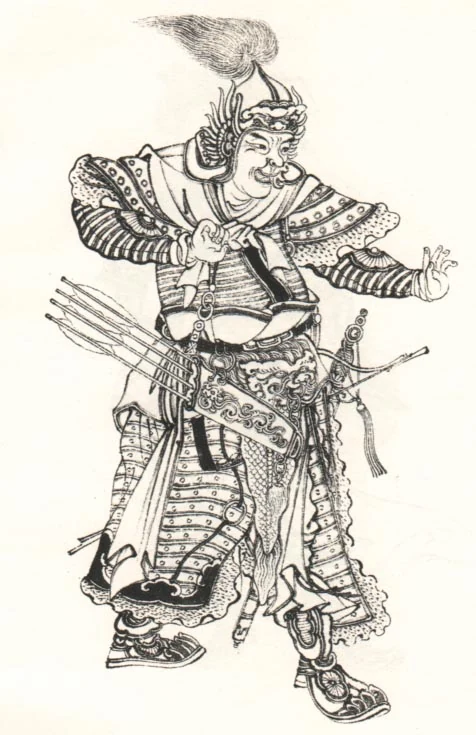
1335 CE–1403 CE
General
Guo Ying
郭英
The source describes Guo Ying with the expression “Jiajing fugui” and as a cautious founding general who served through several reigns and belonged to a prominent family.
1335 CE–1403 CEMing Dynasty
PROFILE
The source describes Guo Ying with the expression “Jiajing fugui” and as a cautious founding general who served through several reigns and belonged to a prominent family.
- Also known as
- Marquis of Wuding
- Period
- Ming
- Dynasty / Polity
- Ming
- Identity
- General
- Ethnicity / affiliation
- Not reliably established in historical sources
- Native place
- Haozhou (present-day Fengyang, Anhui)
- Date of birth
- 1335
- Place of birth
- Unknown
- Date of death
- 1403
- Place of death
- Unknown
- Highest office
- See Biography and Major Deeds
- Major achievements
- The source uses the expression “Jiajing fugui” alongside caution in describing him as a founding general; served through several reigns; member of a prominent family
LIFE TIMELINE
Age eighteen | Joined Zhu Yuanzhang together with his elder brother Guo Xing; served as a personal guard before Zhu's command tent and was called "Guo Four"
Campaigning | Took part in the capture of Chuzhou, He County, Caishi, and Taiping and fought in the Battle of Lake Poyang, earning repeated merit
Campaign against Wuchang | Killed the formidable Chen Youliang officer Chen Tongqian in battle and was appointed chiliarch of the Xiaoqi Guard
Northern campaigns with Xu Da and Chang Yuchun | Helped capture Huai'an, Haozhou, and Anfeng and was promoted to assistant commander; while following Chang Yuchun against Taiyuan, proposed a night attack on Wang Baobao and won a major victory
Rose to regional military commissioner of Henan | Guarded the region, resettled displaced people, and maintained order
Transferred to guard Beiping |
Recalled to the capital | Promoted to assistant commissioner of the Front Chief Military Commission
Followed Fu Youde in the Yunnan campaign | Felled timber at night to make rafts, crossed the Chishui River, defeated Yuan forces, and helped pacify Qujing, Dali, and other areas
Again followed Fu Youde in pacifying Menghua and Lijiang | Recorded more than thirteen thousand enemy heads over the campaigns
Enfeoffed for merit as Marquis of Wuding | Granted a stipend of 2,500 shi and a hereditary patent
Appointed General Who Pacifies the Seas and stationed in Liaodong |
Followed Feng Sheng to Jinshan and accepted Naghachu's surrender | Promoted to Right Deputy General Who Pacifies the Caitiffs; later followed Lan Yu to Buir Lake
Returned to the capital | Placed in command of the palace guard troops
Served as deputy to Geng Bingwen in frontier preparations in Shaanxi and suppressed the rebel Gao Fuxing in Mian County | Impeached by censors after returning to the capital but pardoned by Zhu Yuanzhang
Joined Geng Bingwen and Li Jinglong against Prince of Yan Zhu Di | Defeated at the Battle of Baigou River
Dismissed and returned home; died that year | Aged sixty-nine according to one reckoning and sixty-seven according to another; posthumously made Duke of Yingguo and given the posthumous name Weixiang
Enshrined in the Imperial Ancestral Temple |
BIOGRAPHY
Biography
Family Background and Early Life
Guo Ying came from an ordinary farming family in Haozhou, present-day Fengyang, Anhui. His father Guo Shanfu was posthumously promoted through several ranks to Duke of Yingguo; his mother was Lady Han. Guo Ying was the fourth son, which is why Zhu Yuanzhang called him "Guo Four." He had three elder brothers. The eldest died young, the second is unnamed in the source, and the third was Guo Xing, later Marquis of Gongchang. Guo Ying also had a younger sister who later became Consort Ning of Zhu Yuanzhang.
According to Sanshi Jiadian, Guo Ying was born with unusual signs, was steady, resolute, and intelligent, stood seven chi tall, possessed exceptional physical strength, and was especially skilled in riding and archery. In 1353, the thirteenth year of Zhizheng, the eighteen-year-old Guo Ying joined Zhu Yuanzhang together with his elder brother Guo Xing. Zhu admired his composure, intelligence, and riding and archery skills, assigned him to guard the command tent at night, and called him "Guo Four."
Campaigning with Zhu Yuanzhang, 1353–1368
After joining Zhu Yuanzhang, Guo Ying immediately entered the wars of the late Yuan period. From 1353 to 1364 he followed Zhu in the capture of Chuzhou, He County, Caishi, Taiping, and other places and took part in the Battle of Lake Poyang. During the battle he was badly wounded but bound his wounds and continued fighting, and from a large vessel at the mouth of the Jing River helped inflict a major defeat on Chen Youliang's forces.
In 1364 Zhu Yuanzhang attacked Wuchang. A formidable officer under Chen Youliang named Chen Tongqian charged into Zhu's formation with a spear, creating a dangerous situation. Zhu urgently called on Guo Ying to kill him. Guo responded at once and killed Chen in the fighting. Zhu Yuanzhang was delighted and gave Guo his own battle robe as a reward. Guo then followed the army to attack Yuezhou and capture Luzhou and Xiangyang, receiving the appointment of chiliarch in the Xiaoqi Guard for his service.
Around 1366 Guo Ying joined campaigns against Zhang Shicheng, helping capture Huai'an, Haozhou, and Anfeng and receiving promotion to assistant commander. In 1367 Zhu Yuanzhang launched a northern expedition, and Guo campaigned across the Central Plains under Xu Da and Chang Yuchun. During the attack on Taiyuan, Guo inspected the terrain and advised Chang Yuchun to launch a night attack on Wang Baobao, also known as Köke-Temür. Leading more than ten cavalrymen, he infiltrated Wang's camp and used fire and cannon signals to call in an ambush force, which inflicted a major defeat. Wang fled during the night. Guo subsequently helped capture Xingzhou and Datong, crossed the Yellow River to seize Xi'an, Fengxiang, Gongchang, and Qingyang, and pursued the Yuan commander He Zongzhe into rugged mountains. He was promoted to deputy commander in his guard. He later captured Dingxi, campaigned at Chahannao'er, took Ningzhou, recorded two thousand enemy heads, and rose to regional military commissioner of Henan.
Enfeoffment after the Yunnan Campaign, 1368–1384
In 1381, the fourteenth year of Hongwu, Guo Ying followed Marquis of Yingchuan Fu Youde on the campaign in Yunnan. He and Chen Huan and Hu Hai advanced by separate routes along the Chishui River. After days of heavy rain had swollen the river, Guo ordered timber cut and made into rafts and crossed during the night. At dawn the Ming army reached the Yuan camp, causing the defenders to panic and collapse. Guo captured Yuan commanders including Wusa and Arong. He then led troops to capture Qujing, Luliang, Yuezhou, Guansuoling, and Yizizhai, accepted the submission of Dali, Jinchi, Guangnan, and other places, and pacified numerous mountain strongholds.
In 1383 Guo again followed Fu Youde to pacify Menghua and Dengchuan, crossed the Jinsha River, and seized Beisheng and Lijiang. The campaigns were credited with more than thirteen thousand enemy heads, more than two thousand captives, tens of thousands of sets of armor, and more than a thousand vessels. In 1384 Zhu Yuanzhang rewarded the conquest of Yunnan by enfeoffing Guo Ying as Marquis of Wuding, granting him a stipend of 2,500 shi and a hereditary patent.
Frontier Service and Command of the Palace Guards, 1385–1397
In 1385 Guo Ying was appointed General Who Pacifies the Seas and stationed in Liaodong. In 1387 he followed General-in-Chief Feng Sheng to Jinshan, where the Yuan commander Naghachu surrendered, and for his service Guo was promoted to Right Deputy General Who Pacifies the Caitiffs. He later followed Lan Yu to Buir Lake and took part in the defeat of the remaining Yuan forces. After returning to court Zhu Yuanzhang rewarded him generously and allowed him to return home for rest.
After 1388 Guo was recalled to the capital and put in charge of the imperial guard troops, a sign of Zhu Yuanzhang's particular trust in him. In 1397 Guo served as deputy to the western-expedition general Geng Bingwen in preparing the Shaanxi frontier and suppressed the rebel Gao Fuxing in Mian County. After Guo returned, censor Pei Chengzu accused him of privately maintaining more than 150 household slaves and of unlawfully killing five men and women. Zhu Yuanzhang initially declined to pursue the case, but assistant chief censor Zhang Chun and others continued to impeach him. Zhu ordered senior relatives and officials to discuss the offense and ultimately still pardoned Guo.
Jianwen to Yongle, 1399–1403
In 1399, the first year of Jianwen, Prince of Yan Zhu Di rose in Beiping and began the Jingnan Campaign. As a veteran commander of the central court, Guo Ying followed Geng Bingwen and Li Jinglong against Zhu Di. At the Battle of Baigou River the government army suffered a major defeat; Li Jinglong withdrew south and Guo Ying and others retreated west. The central forces continued to lose. In 1402 Zhu Di entered Nanjing, the Jianwen Emperor's fate became unknown, and Zhu Di took the throne as the Yongle Emperor.
After Zhu Di's accession, Guo Ying was dismissed and returned home. He died at home in 1403, the first year of Yongle, at the age of sixty-nine according to one account and sixty-seven according to another. The Ming court posthumously made him Duke of Yingguo and gave him the posthumous name Weixiang. In 1537, the sixteenth year of Jiajing, he was enshrined in the Imperial Ancestral Temple.
The Gazetteer of Ziyang County preserves another account of Guo Ying's death, stating that in 1385, the eighteenth year of Hongwu, he died in imperial service while supervising construction of the residence of the Prince of Lu and was buried at Anjiazhuang in Ziyang County, at a place commonly called Jiangshan. This conflicts with the date of death in the History of Ming, which places his death in the first year of Yongle. The source text treats the 1385 account as a local tradition, while noting that the local belief that Guo Ying's tomb lay in Ziyang County was accepted there as historical fact.
Major Activities
Military Campaigns
The source credits Guo Ying with taking part in more than five hundred battles, capturing or killing more than 170,000 people and horses, and suffering more than seventy wounds. His principal military service is grouped into the following stages:
Early campaigns: From 1353 to 1364, he followed Zhu Yuanzhang in the capture of Chuzhou, He County, Caishi, and Taiping, fought in the Battle of Lake Poyang, and defeated Chen Youliang's forces at the mouth of the Jing River.
Northern expedition: After 1367 he followed Xu Da and Chang Yuchun on campaigns in the Central Plains. During the attack on Tongzhou he used a feigned retreat and ambush to capture the Yuan Prince Boluo of Liang; during the attack on Taiyuan he proposed the successful night assault on Wang Baobao.
Pacification of Yunnan: In 1381 he followed Fu Youde into Yunnan, cut timber to make rafts for a night crossing of the Chishui River, routed Yuan forces, and captured their leaders. He subsequently took part in the pacification of Qujing, Dali, Menghua, Lijiang, and other areas.
Frontier defense: In 1385 he became General Who Pacifies the Seas and guarded Liaodong; in 1387 he followed Feng Sheng to Jinshan and accepted Naghachu's surrender; in 1397 he served under Geng Bingwen in Shaanxi frontier preparations and suppressed Gao Fuxing in Mian County.
Political Activity
During the Hongwu era Guo Ying long held command over palace guard troops and was one of Zhu Yuanzhang's most trusted generals. In 1397 he was impeached for privately maintaining household slaves and unlawfully killing five people, but Zhu ultimately pardoned him. During the Jianwen era he took part as a veteran government general in campaigns against Zhu Di, Prince of Yan, but failed to defeat him. He was dismissed after Zhu Di's accession.
Family Strategy
The Guo family became one of the most powerful groups of imperial relatives in the early Ming. Guo Ying's sister became Zhu Yuanzhang's Consort Ning; his eldest son Guo Zhen married Zhu's daughter Princess Yongjia; his third daughter became principal consort of Zhu Zhi, Prince of Liao; and his fifth daughter became principal consort of Zhu Dong, Prince of Ying. Guo Ying himself was Marquis of Wuding with a stipend of 2,500 shi and a hereditary patent.
After Guo Ying's death, his family was embroiled for roughly a century in disputes over succession to the marquisate. His principal wife Lady Ma had no sons. His eldest concubine-born son Guo Zhen married Princess Yongjia, while the second son Guo Ming died young. Guo Ming's daughter became a noble consort of the Emperor Renzong of Ming. In 1424, the twenty-second year of Yongle, the Emperor Renzong of Ming posthumously made Guo Ming Marquis of Wuding and ordered Guo Ming's second son Guo Xuan to inherit the title. This triggered a prolonged struggle between the lines of Guo Zhen and Guo Ming, and the marquisate eventually returned to the line of the eldest son Guo Zhen.
Relations with Contemporaries
Guo Ying was extremely close to Zhu Yuanzhang, who called him "Guo Four," praised him as loyal, sincere, and unadorned, and reportedly said that among court officials none surpassed him in such qualities. He campaigned alongside leading generals including Xu Da, Chang Yuchun, Fu Youde, Feng Sheng, Lan Yu, Geng Bingwen, and Li Jinglong.
Personal Relations
Family
- Father: Guo Shanfu, posthumously promoted through several ranks to Duke of Yingguo
- Mother: Lady Han
- Third elder brother: Guo Xing, Marquis of Gongchang; posthumously Duke of Shaanguo with the posthumous name Xuanwu
- Younger sister: Lady Guo, wife of Zhu Yuanzhang and Consort Ning
- Principal wife: Lady Ma, no sons
- Concubines: Lady He, mother of Guo Zhen; Lady Yan, mother of Guo Ming and Guo Yong
- Eldest son: Guo Zhen, married Princess Yongjia and received the rank Commandant-Escort
- Second son: Guo Ming, posthumously Marquis of Wuding
- Third son: Guo Yong, rose to Right Commissioner of the Central Chief Military Commission
- Eldest daughter: Married Lin Yu, a commander in the Palace Army Guard
- Third daughter: Principal consort of Zhu Zhi, Prince of Liao
- Fifth daughter: Principal consort of Zhu Dong, Prince of Ying
- Grandsons: Guo Zhen's son Guo Zhen; Guo Ming's son Guo Xuan, who inherited the Wuding marquisate
- Granddaughter: Guo Ming's daughter, noble consort of the Emperor Renzong of Ming, posthumous name Gongsu
Rulers
- Zhu Yuanzhang: Ruler and subject; Guo enjoyed deep trust
- Zhu Di: Dismissed Guo after the Jingnan Campaign
- Zhu Yunwen: Guo served his court against the Prince of Yan during the Jianwen era
Colleagues
- Xu Da, Chang Yuchun, Fu Youde, Feng Sheng, Lan Yu, Geng Bingwen, Li Jinglong
Historical Assessment
Ming / Contemporary
- Zhu Yuanzhang was quoted in Sanshi Jiadian as saying that among court officials none equaled Guo Ying in loyalty, sincerity, and plainness.
- Zhu Yuanzhang was also quoted as saying that even Yuchi Jingde of the Tang did not surpass Guo Ying.
- Guo Xun, a descendant of Guo Ying, wrote that Guo Ying was a major founding minister whose achievements, flourishing descendants, wealth, longevity, and consistently honorable conduct were rarely matched, and that people compared him to Guo Ziyi, Prince of Fenyang, according to Sanshi Jiadian.
Early and Mid-Qing
- Zhang Tingyu and other compilers of the History of Ming grouped Guo Ying with generals such as Hua Yunlong, Zhang He, Wu Fu, and Hu Hai, praising them for frontier achievements, maritime transport, and battlefield courage and especially for preserving their positions and ending their lives under imperial favor.
- The "Biography of Guo Ying" in the History of Ming describes him as filial and friendly, able to read widely, disciplined in the army, and loyal and cautious in serving Emperor Taizu; it adds that because of his relationship through Consort Ning, imperial favor toward him was especially generous and exceeded that shown to other merit officials.
Late Qing and Republican Period
- Republican-era writer Cai Dongfan, in his historical romance on the Ming dynasty, called Guo Ying "the most fortunate among the founding merit officials of the early Ming" and regarded his survival during Zhu Yuanzhang's period of suspicion and killings as especially remarkable.
Modern
- Modern Ming historian Gu Cheng did not discuss Guo Ying at length in History of the Late Ming Peasant War, but in related studies Guo Ying has been viewed as a representative of the military relatives-by-marriage of the early Ming; the rise and decline of his family reflects the complex relationship between hereditary elites and imperial power.
- Contemporary scholars generally attribute Guo Ying's survival under the Hongwu emperor to his cautious and deferential character, his marital ties with the imperial house, and Zhu Yuanzhang's confidence in his loyalty.
FIGURES ASSOCIATED WITH THIS DYNASTY
Bibliography
- History of Ming, vol. 130, Biography 18