Born | Zhending County, Hengshan Commandery
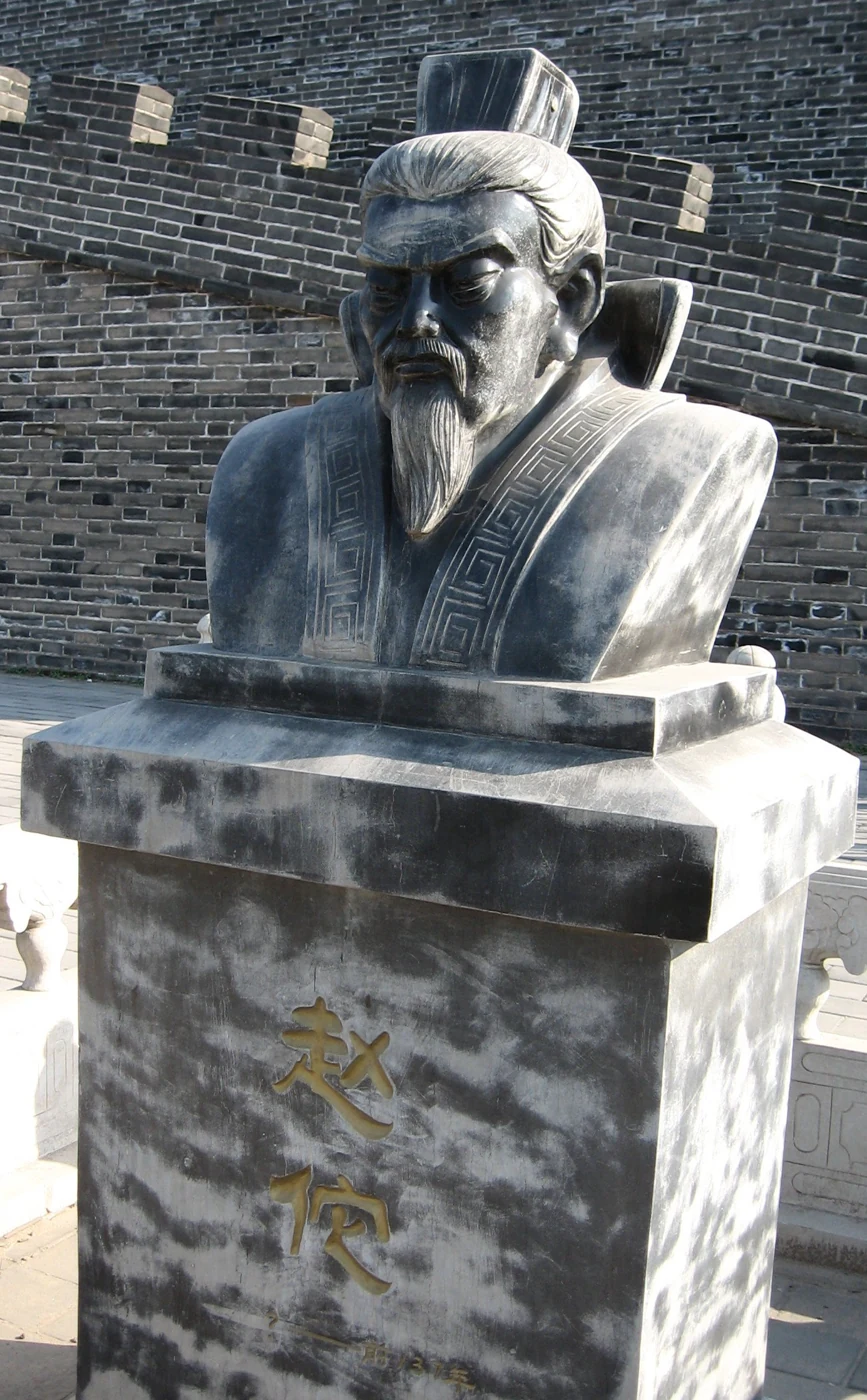
Image credits
David Chen (Iamdavidtheking 11:50, 10 September 2007 (UTC)) · CC BY 3.0Image sourceCC BY 3.0240 BCE–137 BCE
General
Zhao Tuo
赵佗
Zhao Tuo (c. 240 BCE–137 BCE), a native of Zhending County in Hengshan Commandery, present-day Zhengding County, Shijiazhuang, Hebei Province, was a military and political figure in Lingnan during the transition from Qin to Han and the founder of Nanyue. Originally a Qin general, he accompanied commander Tu Sui in the campaign to pacify Lingnan in 219 BCE, the twenty-eighth year of Qin Shi Huang, and later served as…
240 BCE–137 BCEWestern Han
PROFILE
Zhao Tuo (c. 240 BCE–137 BCE), a native of Zhending County in Hengshan Commandery, present-day Zhengding County, Shijiazhuang, Hebei Province, was a military and political figure in Lingnan during the transition from Qin to Han and the founder of Nanyue. Originally a Qin general, he accompanied commander Tu Sui in the campaign to pacify Lingnan in 219 BCE, the twenty-eighth year of Qin Shi Huang, and later served as magistrate of Longchuan County. During the turmoil at the end of the Qin, Zhao Tuo succeeded to the command of Nanhai Commandery and held the region's strategic passes. In 204 BCE, the third year of Emperor Gaozu of Han, he annexed Guilin and Xiang commanderies, founded Nanyue, and styled himself “Martial King of Nanyue.” In 196 BCE, the eleventh year of Emperor Gaozu, he accepted Han investiture and became a Han vassal. Relations deteriorated under Empress Lü, and Zhao Tuo styled himself “Emperor Wu of Nanyue.” In 179 BCE, the first year of Emperor Wen of Han, he again submitted to Han and dropped the imperial title in relations with the Han court, though imperial institutions continued within Nanyue. He died in 137 BCE, the fourth year of the Jianyuan era under Emperor Wu of Han, at an age said to have exceeded one hundred. During his reign Zhao Tuo pursued a policy of “harmonizing the Hundred Yue,” promoted cultural interaction between the Central Plains and the Yue peoples of Lingnan, and had an important influence on the development of the region.
- Other names
- Emperor Wu of Nanyue
- Style/title
- Cheng
- Era
- Western Han
- Dynasty/Regime
- Western Han
- Identity
- General
- Date of Birth
- Not recorded in historical sources
- Date of Death
- 137 BCE
- Ethnicity
- Not recorded in historical sources
- Ancestral home
- Zhending County, Hengshan Commandery (present-day Zhengding County, Shijiazhuang, Hebei Province)
- Place of birth
- Not recorded in historical sources
- Place of death
- Not recorded in historical sources
- Highest office
- See Biography and Major Deeds
- Major achievement
- Military figure in Lingnan at the end of the Qin; founded Nanyue; styled himself first king and later emperor; acknowledged Han suzerainty across three Han reigns
LIFE TIMELINE
About age twenty-one | Served as deputy commander under Tu Sui in the Qin campaign to pacify Lingnan
About age twenty-six | Served as magistrate of Longchuan County and pursued the policy of “harmonizing the Hundred Yue”
About age thirty-two | Succeeded to the post of Commandant of Nanhai Commandery and defended the strategic passes
About age thirty-six | Annexed Guilin and Xiang commanderies, founded Nanyue, and styled himself “Martial King of Nanyue”
About age forty-four | Accepted Han investiture; Nanyue became a Han vassal state
About age fifty-nine | Relations with Empress Lü deteriorated; styled himself “Emperor Wu of Nanyue” and attacked the state of Changsha
About age sixty-one | Accepted Lu Jia's persuasion, abandoned the imperial title in relations with Han, and again acknowledged Han suzerainty
Said to have been over one hundred | Died and was buried at Panyu
BIOGRAPHY
Biography
Family Background and Early Life
Zhao Tuo was born around 240 BCE in Zhending County, Hengshan Commandery, present-day Zhengding County, Shijiazhuang, Hebei Province. Historical sources preserve little about his family background. The “Biography of Nanyue” in the Records of the Grand Historian merely states that he “was a man of Zhending,” without describing his family. Zhending lay in the former territory of the state of Zhao during the Warring States period and became part of Hengshan Commandery after Qin conquered Zhao. Zhao Tuo's early life is unknown. The source text infers that he came from a humble background and rose through military merit. After Qin Shi Huang unified the six states, Zhao Tuo entered military service and became a Qin officer, laying the foundation for his later career in Lingnan.
Pacification of Lingnan and Administration of Longchuan
In 219 BCE, the twenty-eighth year of Qin Shi Huang, the emperor appointed Tu Sui commander and Zhao Tuo deputy commander of a force said to number five hundred thousand, divided into five columns to attack the Baiyue peoples of Lingnan. Qin forces occupied Guangdong but met fierce resistance from the Western Ou in Guangxi; Tu Sui was killed and the campaign remained unresolved for three years. Qin Shi Huang then appointed Ren Xiao commander, with Zhao Tuo assisting him, and in 214 BCE, the thirty-third year of Qin Shi Huang, the conquest of Lingnan was completed. Qin established the commanderies of Nanhai, Guilin, and Xiang. Ren Xiao became Commandant of Nanhai Commandery, while Zhao Tuo was appointed magistrate of Longchuan County.
Longchuan lay on the upper Dong River and had significant geographic and military importance. During six years of administration there, Zhao Tuo pursued the policy of “harmonizing the Hundred Yue” and memorialized the Qin court requesting the relocation of five hundred thousand people from the Central Plains to Nanyue in order to promote integration between Han settlers and Yue communities. He led local people in clearing land, digging wells, constructing settlements, establishing schools, and introducing advanced Central Plains farming methods and iron tools into Lingnan. The city associated with Zhao Tuo was said to have had a circumference of about eight hundred meters and is described in the source text as one of the earliest recorded urban settlements in Lingnan.
Seizing Lingnan during the Collapse of Qin and Founding Nanyue
In 209 BCE, the first year of Qin Er Shi, the Chen Sheng and Wu Guang uprising broke out and the Central Plains descended into war. In 208 BCE, the second year of Qin Er Shi, Ren Xiao, Commandant of Nanhai, became seriously ill. Before his death he summoned Zhao Tuo and explained that Nanhai was protected by mountains and sea and possessed defensible terrain, suggesting that Zhao could use the region to establish an independent state for self-preservation. Ren Xiao issued an appointment order authorizing Zhao Tuo to act as Commandant of Nanhai. After Ren Xiao died, Zhao Tuo ordered the troops guarding the passes of the Nanling Mountains to hold the strategic points and prevent rebel armies from the Central Plains from moving south. He also used the opportunity to remove Qin-appointed officials in Nanhai and replace them with trusted followers.
After the Qin dynasty collapsed, Zhao Tuo raised troops and annexed Guilin and Xiang commanderies. In 204 BCE, the third year of Emperor Gaozu of Han, he founded the state of Nanyue and styled himself “Martial King of Nanyue.” Nanyue extended north to the Nanling Mountains, west toward Yelang, south to the South China Sea and areas corresponding to central and northern Vietnam, and east to Minyue, covering more than ten thousand li from east to west. Its capital was Panyu, present-day Guangzhou.
Submission to Han and Renewed Imperial Claims
In 202 BCE, the fifth year of Emperor Gaozu, Liu Bang established the Western Han and granted Nanhai, Guilin, and Xiang commanderies to Wu Rui, King of Changsha, thereby refusing to recognize Zhao Tuo's possession of the three commanderies. In 196 BCE, the eleventh year of Emperor Gaozu, Liu Bang sent the grandee Lu Jia to Nanyue to persuade Zhao Tuo to submit. After Lu Jia explained the advantages and dangers involved, Zhao Tuo accepted the seal of the King of Nanyue bestowed by Emperor Gaozu and acknowledged Han suzerainty. Nanyue became a Han vassal, and the two sides exchanged envoys and conducted trade.
In 195 BCE, the twelfth year of Emperor Gaozu, Liu Bang died and Empress Lü governed at court. In 181 BCE, the seventh year of Empress Lü, she prohibited the sale of iron tools and other goods to Nanyue, causing relations to deteriorate. Fearing that Empress Lü intended to annex Nanyue through the state of Changsha, Zhao Tuo broke with Han, styled himself “Emperor Wu of Nanyue,” and attacked several border counties of Changsha. Empress Lü sent Marquis of Longlü Zhou Zao with an army against Nanyue, but Central Plains troops were unable to adapt to the hot, damp climate of Lingnan and did not cross the Nanling Mountains. After Empress Lü's death, the Han army withdrew. Zhao Tuo then strengthened his control over the Western Ou, Luoyue, and other groups, further expanding his influence.
Abandoning the Imperial Title and Later Years
In 179 BCE, the first year of Emperor Wen of Han, Liu Heng ascended the throne. He ordered Zhao Tuo's ancestral graves repaired, assigned caretakers to conduct regular sacrifices, and granted offices and material rewards to Zhao Tuo's paternal cousins. On the recommendation of Grand Councilor Chen Ping, Emperor Wen appointed Lu Jia Grand Master of Palace Accord and sent him to Nanyue again. Lu Jia explained the political situation, and Zhao Tuo accepted his arguments. In a memorial he referred to himself as “your subject Tuo, an aged elder among the barbarians,” abandoned the imperial title in relations with Han, and resumed sending envoys to Chang'an in spring and autumn. Within Nanyue itself, however, Zhao Tuo continued to use imperial titles.
In 137 BCE, the fourth year of the Jianyuan era under Emperor Wu of Han, Zhao Tuo died at an age said to have exceeded one hundred and was buried at Panyu. After his death, four generations of his descendants continued to rule Nanyue. The state was destroyed by Han in 112 BCE, the fifth year of the Yuanding era, after existing for about ninety-two years.
After unifying the six states Qin turned to the pacification of Lingnan. In 219 BCE the court sent Tu Sui as commander and Zhao Tuo as his second with 500,000 conscripts in five columns: one to block the ridge at Tancheng, one to hold the Jiuyi pass, one at Panyu, one on the Nan-ye frontier and one to mass at the waters of Yugan. The last had nothing to do with Lingnan, so that some 400,000 were used in the Yue country. The Qin forces came south into Guangdong, camped at Lianghua and pressed on to Panyu, where they built a shipyard; another 300,000 went west into Guangxi to fight the Yue. They killed the Xi'ou lord Yi Yusong, but the three-year campaign ended in failure and the commander Tu Sui was killed in a night attack, the dead said to have been counted in the hundreds of thousands; the court had to send convict garrisons to make up its strength and cut the Lingqu canal to carry grain. Little is recorded of the war, and after the disorders at the end of Qin the Southern Yue closed off contact with the Central Plains altogether.
In 214 BCE, when Lingnan was pacified and the three commanderies of Nanhai, Guilin and Xiang established, Longchuan was judged so important in position and military value that Zhao Tuo was made its magistrate. Arriving, he memorialized for the transfer of 500,000 settlers from the Central Plains to mix Chinese and Yue. In his six years at Longchuan he pursued a policy of "harmonizing the Hundred Yue" and "dwelling among the Yue", encouraging intermarriage, bringing the culture of the Central Plains south, "transforming the people by poetry and rite", and leading the local population in clearing hills and woods, sinking wells, building towns and founding schools, leaving behind many sites laden with Lingnan's cultural memory. The walls of Tuocheng at Longchuan, some eight hundred paces around, are among the earliest towns recorded in the region.
In the reign of the Second Emperor, when the Central Plains fell into chaos, the commandant of Nanhai, Ren Xiao, fell gravely ill. In 208 BCE he summoned Zhao Tuo, then magistrate of Longchuan, and issued him the commission to act in his place. After Ren Xiao's death Zhao Tuo at once ordered the garrisons of the southern passes to hold the defiles, saying that bandit soldiers were coming and the roads must be cut and troops concentrated in self-defense, and he seized the occasion to kill the officials Qin had appointed and replace them with his own men. On the main lines of communication he built a number of towns — Zhaotuo's town at Lechang, the town of Renhua, and the walled stations at Yingde and Qingyuan — to strengthen the defense of Lingnan. When Qin fell he rose and annexed the commanderies of Guilin and Xiang, and with the support of the local people made himself king of Southern Yue, founding a state a thousand li across, reaching from the Nanling range in the north to Yelang in the west, the sea in the south and Min-Yue in the east, comparable to the three Qin commanderies, and laying the foundation of a kingdom that lasted ninety-five years.
After Liu Bang united the empire and founded the Western Han, in 202 BCE he made Wu Rui king of Changsha, granting him Changsha and Yuzhang together with the three commanderies of Nanhai, Guilin and Xiang held by Zhao Tuo, and refusing to recognize them as Zhao Tuo's. In 196 BCE Liu Bang sent the grandee Lu Jia as envoy to the Southern Yue, and Zhao Tuo received him at Panyu and accepted investiture as king of Southern Yue, so that the state entered a nominal relationship of vassalage to the Han court. When the empress Lü came to power, her officials asked that the frontier markets with the Southern Yue be closed to iron tools; Zhao Tuo in anger styled himself emperor of Southern Yue and sent troops against the border towns of Changsha, alarming the south for a time. On the accession of the Wen emperor Lu Jia was sent again, and Zhao Tuo gave up the imperial title and called himself a subject, and diplomatic exchanges were restored. In governing the Southern Yue he promoted the fusion of Chinese and Yue in military, political, economic and cultural matters alike, making the Panyu region the most advanced part of his kingdom and drawing the whole of Lingnan along with it. He died in great old age, said to have passed a hundred years, and the site of his tomb is nowhere stated in the sources — a question still open in the archaeology and local history of Lingnan.
In governing the Southern Yue Zhao Tuo followed Qin institutions on the one hand and the policy of "harmonizing the Hundred Yue" on the other. He employed Yue chiefs in the administration, accommodated local custom — receiving Han envoys in Yue dress with his hair in a knot and sitting with legs spread — and did not force the society of the Central Plains' rites upon the region, while bringing in the farming techniques, town systems, writing, poetry and ritual of the north, so that the Panyu region became the most advanced part of his kingdom. When Lu Jia first came south in 196 BCE, Zhao Tuo received him at Panyu in Yue attire; Lu Jia set out the vastness and strength of the Han, urging him to give up the imperial title and become a subject, and Zhao Tuo complied, accepting investiture as king of Southern Yue, splitting the tally with the Han and exchanging envoys, so that a nominal relation of vassalage was established.
Under the empress Lü, her officials asked that the frontier markets be closed to iron tools. Zhao Tuo, taking it for a scheme of the king of Changsha, in anger styled himself emperor of Southern Yue, sent troops against the border towns of Changsha, and by force of arms brought Min-Yue, the Xi'ou and the Luoyue under his sway, so that for a time his orders ran over a tract ten thousand li across. On the accession of the Wen emperor, to settle the south, the tombs of Zhao Tuo's forebears were repaired, his kin given office and rank, and Lu Jia sent south again. Zhao Tuo abandoned the imperial title, calling himself "the old barbarian chieftain, your servant Tuo", and offered white jade and other gifts, and the exchanges between the Southern Yue and the Han were restored. He died in great old age — said to have passed a hundred years — and was succeeded by his grandson Zhao Hu; the kingdom lasted five reigns, some ninety years in all. The site of his tomb is nowhere stated in the sources, but that of his grandson, King Wen of the Southern Yue, was found at Xianggang in Guangzhou in 1983, yielding an exceptionally rich assemblage that illuminates the institutions, crafts and foreign contacts of the kingdom and gives archaeological confirmation to this early chapter of Lingnan's history.
Judgments of Zhao Tuo have always been two-sided. Those who praise him note that he governed Lingnan for decades and brought the cultures of the Central Plains and the Hundred Yue into contact, laying the groundwork for the region's development; his critics point to a separatist who repeatedly assumed the imperial title and played the Han and the Yue off against each other for his own advantage. Either way, a Qin magistrate who made himself king of Southern Yue and then maneuvered for years between the Han court and his own kingdom, keeping a measure of order in Lingnan through the disorders that followed the fall of Qin, is a figure no study of the frontier and the southern regional regimes at the Qin-Han transition can pass over.
The Southern Yue state was in its institutions a double system of Han and Yue running side by side. Zhao Tuo administered the towns and communications hubs where Chinese settlers lived through the commanderies, bureaucracy and ritual of the Central Plains, while recognizing the effective hold of Yue chiefs over the hills, woods and valleys, drawing them into his network of power by grants of rank, marriage and office; that he received Han envoys in Yue dress with hair in a knot and legs spread was the very emblem of this two-faced stance. In military terms he garrisoned the passes leading to the Central Plains — Hengpu, Yangshan, Huangxi and others — and built the towns of Lechang, Renhua, Yingde and Qingyuan, forming a defense centered on Panyu and screened by the defiles. Economically the Southern Yue depended on the frontier markets for iron tools, cattle, horses and farming implements, and exported pearls, rhinoceros horn, ivory and kingfisher feathers, which is why a single prohibition from the empress Lü provoked so strong a reaction from him.
Zhao Tuo died in great old age, said to have passed a hundred years, and was succeeded by his grandson Zhao Hu; after him came Zhao Yingqi, Zhao Xing and Zhao Jiande, five reigns and some ninety years in all. In 112 BCE, in the fifth year of the Yuanding era of Emperor Wu, the Southern Yue chancellor Lü Jia killed King Zhao Xing and the Han envoys and rose against the Han; the next year the court sent Lu Bode, Yang Pu and others south by separate routes, subdued the Southern Yue and established in its lands the nine commanderies of Nanhai, Cangwu, Yulin, Hepu, Jiaozhi, Jiuzhen, Rinan, Zhuya and Dan'er, so that Lingnan was formally brought into the commandery system of the Central Plains dynasties. The kingdom Zhao Tuo founded was gone, but his policy of harmonizing the Hundred Yue and the pattern of Chinese and Yue dwelling together left the ground for the region's later development; the walls of Tuocheng in Longchuan, Zhao Tuo's well and other sites in Guangdong, together with the tomb of King Wen of the Southern Yue excavated in 1983, are the material evidence most often cited in recalling that history.
Major Activities
Founding Nanyue
Zhao Tuo founded the state of Nanyue. Taking advantage of the collapse of Qin and the inability of the Central Plains powers to intervene in the south, he held Lingnan, annexed Guilin and Xiang commanderies, and established Nanyue. Its territory extended more than ten thousand li from east to west, north to the Nanling Mountains, west to Yelang, south to the sea, and east to Minyue, with its capital at Panyu. Zhao Tuo ruled for more than seventy years. Under him, Nanyue became the first unified political regime in the Lingnan region and laid a foundation for regional development.
Policy of “Harmonizing the Hundred Yue”
The central policy of Zhao Tuo's rule in Nanyue was “harmonizing the Hundred Yue.” He encouraged intermarriage between Central Plains migrants and Yue peoples. The Nanyue royal house itself intermarried with Yue families; for example, Zhao Yingqi, King Ming of Nanyue, married a Yue woman. Zhao Tuo also respected Yue customs, referring to himself as an “aged elder among the barbarians,” removing Central Plains official dress and adopting Yue clothing. Politically, he incorporated Yue leaders into the governing structure. Figures such as Marquis Guiyi Zheng Yan and Tian Jia, and Marquis Chiyi He Qian, are recorded in the Records of the Grand Historian and the Book of Han. In regions where Yue tribal power remained strong, Zhao Tuo enfeoffed local Yue leaders as kings, such as the Xiyu King in the Jiaozhi region.
Economic Development of Lingnan
Zhao Tuo introduced advanced Central Plains agricultural techniques, iron tools, and draft cattle to Lingnan, changing the local reliance on slash-and-burn cultivation. He promoted rice cultivation and developed animal husbandry, fisheries, pottery, textiles, shipbuilding, transportation, commerce, and overseas trade. He also mobilized officials and soldiers to help local people dig wells and construct irrigation canals, improving agricultural production. Iron tools and other productive resources and technologies from the Central Plains entered Nanyue in increasing quantities, stimulating social and economic development in Lingnan.
Transmission of Central Plains Culture
Zhao Tuo placed importance on educating Lingnan populations through Central Plains culture. The Yueji is quoted as saying that “the literary culture of Guangdong began with Commandant Tuo,” and excavated artifacts include many Chinese characters. Zhao Tuo used administrative measures to promote Chinese writing and instructed Yue people to “learn Chinese characters and study rites,” so that local communities “gradually came to know ritual culture.” He promoted Central Plains ethical norms, encouraged care for the elderly and weak, and opposed group marriage. He also introduced sets of bells and other bronze musical instruments from the Central Plains, contributing to cultural development in Lingnan.
Maneuvering in Relations with Han
Zhao Tuo's relations with Han moved through submission, confrontation, and renewed submission. In 196 BCE, the eleventh year of Emperor Gaozu, he first accepted Han investiture and Nanyue became a vassal state. Relations broke down during Empress Lü's regency because of the embargo on iron goods; Zhao Tuo styled himself “Emperor Wu of Nanyue” and attacked the state of Changsha. After Emperor Wen ascended the throne, Zhao Tuo accepted Lu Jia's persuasion and abandoned the imperial title in relations with Han, again acknowledging Han suzerainty. Within Nanyue, however, imperial institutions continued, creating the special arrangement of outward vassalage to Han combined with imperial status internally.
Personal Relations
- Zhao Shi: Zhao Tuo's grandson and second ruler of Nanyue, King Wen of Nanyue
- Zhao Yingqi: Zhao Tuo's grandson and third ruler of Nanyue, King Ming of Nanyue
- Zhao Jiande: son of Zhao Yingqi and last ruler of Nanyue
- Zhao Xing: son of Zhao Yingqi and fourth ruler of Nanyue
- Ren Xiao: Qin Commandant of Nanhai and Zhao Tuo's superior; before his death he entrusted Zhao Tuo with the commandancy
- Tu Sui: Qin general and commander of the Lingnan campaign; killed in Guangxi
- Lu Jia: Han grandee who twice served as envoy to Nanyue and successfully persuaded Zhao Tuo to submit to Han
- Qin Shi Huang: Zhao Tuo served under him early in his career and participated in the pacification of Lingnan
- Emperor Gaozu of Han, Liu Bang: invested Zhao Tuo as King of Nanyue
- Empress Lü: relations with Zhao Tuo deteriorated, causing Nanyue's break with Han
- Emperor Wen of Han, Liu Heng: used conciliatory policies that brought Zhao Tuo back into the Han vassal relationship
- Emperor Wu of Han, Liu Che: reigning Han emperor when Zhao Tuo died
- Wu Rui: King of Changsha; Han granted him Nanhai, Guilin, and Xiang commanderies, creating a territorial conflict with Zhao Tuo
- Zhou Zao: Marquis of Longlü, sent by Empress Lü to attack Nanyue; his forces failed because they could not adapt to the climate of Lingnan
Historical Assessment
Han Period / Contemporary View
- Emperor Gaozu of Han, Liu Bang, was quoted as assessing Zhao Tuo's rule in Nanhai: “Commandant Tuo of Nanhai has long governed the south with considerable order; the migrants from the central commanderies have therefore not diminished, and the Yue custom of mutual attacks has increasingly ceased. All rely on his efforts.” (Book of Han, “Annals of Emperor Gaozu”)
- Sima Qian wrote in the “Biography of Nanyue” in the Records of the Grand Historian: “Commandant Tuo's kingship originally came from Ren Xiao. When Han had just been established, he was ranked among the regional lords. The Marquis of Longlü was separated by damp pestilential lands, so Tuo became increasingly arrogant. Ou and Luo attacked one another and Nanyue was shaken. When Han troops reached the border, Yingqi entered court.”
- In a letter to Zhao Tuo, Emperor Wen of Han stated that “south of the passes, the king may govern it himself,” acknowledging Zhao Tuo's actual rule over Lingnan.
Wei-Jin through Sui-Tang Periods
- The Western Jin historian Sima Biao recorded Zhao Tuo's deeds in the Xu Hanshu and credited his role in developing Lingnan.
- The Tang historian Du You wrote in the Tongdian that Zhao Tuo “was able to pacify the Hundred Yue and open the lands beyond the mountain passes,” crediting him with a pioneering role in Lingnan's development.
- The Tang poet Xu Hun wrote of Zhao Tuo: “Zhao Tuo bowed west after ascending the command platform; Ma Yuan's southern expedition broadened the realm.”
Song, Yuan, Ming, and Qing Periods
- The Song historian Sima Guang recorded Zhao Tuo's activities in the Comprehensive Mirror in Aid of Governance and affirmed his policy of “harmonizing the Hundred Yue.”
- The Ming scholar Qu Dajun, in Guangdong Xinyu, called Zhao Tuo “a worthy king of Nanyue” and praised his role in developing Lingnan.
- The Qing historian Liang Tingnan systematically compiled Zhao Tuo's career in Biographies of the Five Rulers of Nanyue, saying that “as a man of China governing the land of the Hundred Yue, he was able to practice benevolence and righteousness; it is fitting that his state endured so long.”
- The Qing scholar Zhao Yi wrote in Notes on the Twenty-Two Histories that Zhao Tuo “used loose-rein methods to govern the Hundred Yue so that they did not become a frontier threat; he too was a leading figure of his age.”
Modern Period
- The modern historian Lü Simian wrote in History of Qin and Han: “Zhao Tuo, a man of China living in the land of the barbarians, was able to harmonize the Hundred Yue and prevent disorder, while attracting people from China so that Lingnan culture advanced day by day. His contribution cannot be ignored.”
- The modern historian Zhang Rongfang, in History of the Nanyue Kingdom, called Zhao Tuo a “founder of Lingnan civilization” and argued that his policies combining Central Plains and Baiyue cultures had a far-reaching effect on Lingnan development.
- The Vietnamese historian Lê Văn Hưu evaluated Zhao Tuo: “Emperor Wu of Zhao was able to open our Yue lands, proclaim himself emperor of his state, and stand against Han. In writings he called himself an old man. He initiated the imperial enterprise of our Yue; his achievement may indeed be called great.” The source text notes that ancient Vietnamese historians treated Zhao Tuo as one of Vietnam's rulers, reflecting his influence in northern Vietnam.
FIGURES ASSOCIATED WITH THIS DYNASTY
Bibliography
- Sima Qian, Records of the Grand Historian, vol. 113, “Biography of Nanyue,” no. 53
- Ban Gu, Book of Han, vol. 1b, “Annals of Emperor Gaozu,” part 2
- Ban Gu, Book of Han, vol. 3, “Annals of Empress Lü,” no. 3
- Ban Gu, Book of Han, vol. 95, “Biography of Nanyue”
- Sima Guang, Comprehensive Mirror in Aid of Governance, vol. 12, “Han Annals 4”
- Zhang Rongfang, History of the Nanyue Kingdom, Guangdong People's Publishing House
- Zhang Yiping, Studies of the Hundred Yue, Jinan University Press
- Lü Simian, History of Qin and Han, Shanghai Classics Publishing House