Birth | Born to a martial archer family at Sanyangzhai in Chengji County, Fengxiang Prefecture
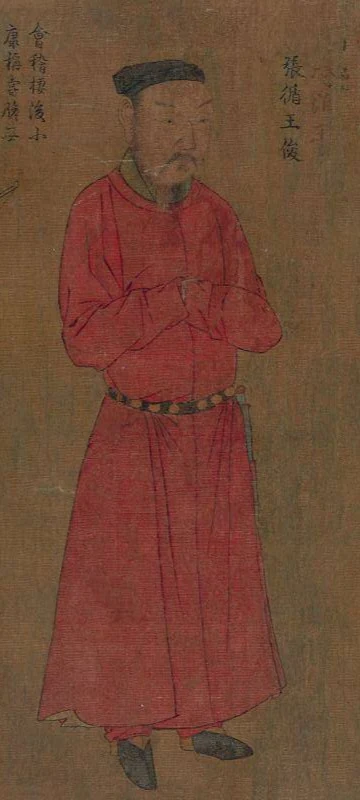
1086 CE–1154 CE
Military CommanderBureaucratic GeneralGrand PreceptorPrince
Zhang Jun
张俊
Zhang Jun (1086 – August 12, 1154), courtesy name Boying, was a native of Chengji in Fengxiang (modern Tianshui, Gansu Province). He was an eminent military commander, Grand Preceptor, and Prince of Qinghe Commandery during the early Southern Song dynasty, revered alongside Han Shizhong, Liu Qi, and Yue Fei as one of the "Four Generals of Zhongxing." Rising from the ranks of regional archers, he made his mark fighting Western…
1086 CE–1154 CENorthern Song
PROFILE
Zhang Jun (1086 – August 12, 1154), courtesy name Boying, was a native of Chengji in Fengxiang (modern Tianshui, Gansu Province). He was an eminent military commander, Grand Preceptor, and Prince of Qinghe Commandery during the early Southern Song dynasty, revered alongside Han Shizhong, Liu Qi, and Yue Fei as one of the "Four Generals of Zhongxing." Rising from the ranks of regional archers, he made his mark fighting Western Xia and breaking through Jurchen encirclement at Yuci during the Jingkang incident. Following the fall of Northern Song, he staunchly urged Prince Kang (Zhao Gou) to ascend the throne as Emperor Gaozong, subsequently crushing the Miao-Liu Coup to rescue the dynasty. In the Jianyan and Shaoxing eras, he secured critical victories at Mingzhou, Outang, and Zhegao against Jin armies. In his later years, however, he pandered to the appeasement policy of Gaozong and Qin Hui, becoming the first general to surrender military command to become Bureau of Military Affairs Commissioner. He actively fabricated treason charges that sent Yue Fei to his death, amassing colossal landholdings. His iron effigy remains cast in perpetual kneeling disgrace before the Yue Fei Mausoleum in Hangzhou.
- Courtesy / Art Name
- Boying
- Era
- Southern Song Dynasty (spanned Northern Song Huizong/Qinzong and Southern Song Gaozong eras)
- Dynasty
- Southern Song
- Identity
- Military Commander, Bureaucratic General, Grand Preceptor, Prince
- Date of Birth
- 1086
- Date of Death
- August 12 1154
- Ethnicity
- Han
- Ancestral Home
- Chengji County, Fengxiang Prefecture (present-day Tianshui, Gansu)
- Place of Birth
- Sanyang stockade, Chengji county, Fengxiang prefecture
- Place of Death
- His private residence at Lin'an
- Lifespan
- 69 years
- Major Offices
- Grand Preceptor、Commissioner of Military Affairs、Military Commissioner of Three Circuits,enfeoffed as Commandery Prince of Qinghe (posthumously enfeoffed as Prince of Xun)
- Peerage
- Prince of Qinghe Commandery
- Posthumous Name
- Zhonglie
- Major Achievements
- Celebrated as one of the "Four Generals of Zhongxing"; winning the Battle of Mingzhou against the Jurchens; suppressing the Miao-Liu Coup to restore Emperor Gaozong; later colluding with Qin Hui to disarm commanders and fabricate evidence that murdered Yue Fei
LIFE TIMELINE
Age 16 | Recruited as a local militia archer, displaying superb horsemanship and martial valor in bandit-quelling operations
Age 31 | Scaled the walls during the assault against Western Xia's Renduoquan fortress; awarded his first commissioned office as Gentleman of Trustworthy Sincerity
Age 41 | During the Jin siege of Yuci, his commander Zhong Shizhong perished; Zhang Jun rallied hundreds of retainers, broke through enemy cavalry, and severed 500 enemy heads
Age 41 | Marched 3,000 veterans to Daming to join Prince Kang (Zhao Gou); commissioned as Rear Army Commander of the Grand Marshal's Headquarters
Age 42 | Vehemently urged Zhao Gou to take the throne at Yingtian (Shangqiu); promoted to Vanguard Commander of the Imperial Camp, formulating southern evacuation plans
Age 44 | When Miao Fu and Liu Yanyan staged a palace coup deposing Gaozong, Zhang Jun formed an alliance with Han Shizhong and Zhang Jun (minister), swiftly crushing the rebels
December of 1129 CE(3rd year of the Jianyan era, Emperor Gaozong of Song, 11th month) | Age 44 | Wanyan Zongbi (Jin Wuzhu) pursued Gaozong across the Yangtze; Zhang Jun stood firm at Mingzhou (Ningbo), killing thousands of Jurchen troops in the premier battle of Southern Song survival
Age 51 | Commanded Southern Song forces in the Battle of Outang, crushing the 300,000-strong puppet Qi invasion force under Liu Yu; ennobled as Military Commissioner of Three Garrisons
Age 56 | Complied with Gaozong and Qin Hui's disarmament stratagem, voluntarily returning his Pacification Commission tally; appointed Military Affairs Commissioner and framed Yue Fei
Age 57 | Relieved of military affairs duties and created Prince of Qinghe Commandery, retiring to luxurious private life in Lin'an
Age 66 | Emperor Gaozong visited Zhang Jun's mansion; Zhang Jun hosted an epochal imperial banquet and was elevated to Grand Preceptor
Age 69 | Passed away at his estate in Lin'an; posthumously titled Grand Preceptor and Prince Xun, with the posthumous name Zhonglie
Later | Later, at the Battle of Zhegao in 1141, Zhang Jun coordinated with Liu Qi and Yang Yizhong to deal another punishing defeat to Wanyan Zongbi's elite heavy cavalry.
CE(12th year of the Shaoxing era, Emperor Gaozong of Song, 11th m
1142 CE(12th year of the Shaoxing era, Emperor Gaozong of Song, 11th month) | ### Lavish Retirement and Eternal Disgrace In November 1142 | ### Lavish Retirement and Eternal Disgrace In November 1142, following the ratification of the Shaoxing Treaty, Gaozong retired Zhang Jun from executive military duties, granting him honorary titles of Grand Guardian and Prince of Qinghe.
CE(21st year of the Shaoxing era, Emperor Gaozong of Song, 10th m
1151 CE(21st year of the Shaoxing era, Emperor Gaozong of Song, 10th month) | In October 1151 | In October 1151, Emperor Gaozong paid a state visit to Zhang Jun's lavish residence in Lin'an.
August 12, 1154 CE(24th year of the Shaoxing era, Emperor Gaozong of Song, 7th month, 2nd day) | Zhang Jun orchestrated a banquet of unprecedented opulence | Zhang Jun orchestrated a banquet of unprecedented opulence, presenting hundreds of priceless jades, silks, and pearls, recorded in dynastic annals as the legendary "Shaoxing Imperial Banquet." On August 12, 1154, Zhang Jun died at his mansion at the age of sixty-nine.
BIOGRAPHY
Biography
Rise from the Ranks and the Ordeal of Yuci Zhang Jun hailed from a family of archer colonists in Chengji County, Fengxiang Prefecture. In 1101, at the age of sixteen, he enlisted as a local militia archer at Sanyangzhai. Renowned for his formidable physical strength and archery prowess, he repeatedly distinguished himself during regional counter-bandit operations in the northwest. In 1116, during the Western Song campaign against the Western Xia kingdom, Zhang Jun participated in the siege of Renduoquan fortress. Armed with a broad blade, he led the scaling ladders, leaped over the ramparts, and slaughtered defenders, earning an appointment as Gentleman of Trustworthy Sincerity. He subsequently fought in Jiangnan against Fang La's rebellion and cleared insurgent factions across Shandong and Hebei. In May 1126, during the initial Jin invasion, Jurchen cavalry surrounded the Song relief army at Yuci in Shanxi. After supreme commander Zhong Shizhong fell in combat, the imperial army disintegrated. Zhang Jun alone gathered several hundred resolute shock troops, forming a defensive square and breaking through dense cavalry lines. Killing over five hundred enemy pursuers, he extracted his unit intact, earning instant fame across northern China. ### Loyalty to Prince Kang and the Miracle of Mingzhou In late 1126, as Kaifeng was besieged, Zhang Jun led three thousand battle-hardened troops to Daming to join Zhao Gou, Prince of Kang. His strategic evaluations of current affairs struck Zhao Gou as exceptionally astute, earning him appointment as Rear Army Commander. In May 1127, following the capture of Emperors Huizong and Qinzong, Zhang Jun urged Zhao Gou to ascend the throne at Yingtian to preserve the dynastic altars. Upon Gaozong's coronation, Zhang Jun was named Vanguard Commander of the Imperial Camp. In March 1129, commanders Miao Fu and Liu Zhengyan mounted a military mutiny in Hangzhou, forcing Emperor Gaozong to abdicate in favor of his infant son. Garrisoned at Wujiang, Zhang Jun immediately formed a coalition with Minister Zhang Jun and Han Shizhong. Mobilizing eight thousand veteran troops from Pingjiang, Zhang Jun spearheaded the assault against the mutineers, retaking the capital and restoring Gaozong. This rescue cemented him as the Emperor's most indispensable military confidant. In winter 1129, Jurchen commander Wanyan Zongbi launched an amphibious pursuit across the Yangtze River, chasing Gaozong onto the coastal seas. Tasked with covering the rear at Mingzhou (modern Ningbo), Zhang Jun swore to fight to the death. When elite Jurchen cavalry assaulted Gaocheng bridge, Zhang Jun, together with his subordinates Yang Yizhong and Liu Bao, fought fiercely for three days in blinding blizzards. Song archers and heavy infantry cut down thousands of Jurchen troops, forcing Wanyan Zongbi to pull back. The victory at Mingzhou became celebrated as the crowning achievement of the "Thirteen Restoration Victories." ### Defense of Jianghuai and the Outang Triumph Throughout the early Shaoxing era, Zhang Jun anchored the central Jianghuai perimeter, while Han Shizhong defended the eastern flanks. In 1131, appointed Pacification Commissioner of Jiangnan and Huainan, Zhang Jun directed generals including Yue Fei to eradicate rampant peasant bandit forces across Hunan, Jiangxi, and Hubei, pacifying interior supply lines. In 1136, Liu Yu, Emperor of the Jin puppet state of Da Qi, launched a nationwide invasion of Southern Song with 300,000 troops. Acting as Commander-in-Chief, Zhang Jun orchestrated a decisive ambush at Outang in Dingyuan. His subordinate Yang Yizhong unleashed volleys of divine-arm crossbow bolts, routing the puppet cavalry and capturing tens of thousands of prisoners. For this triumph, Zhang Jun was ennobled as Military Commissioner of Three Garrisons. Later, at the Battle of Zhegao in 1141, Zhang Jun coordinated with Liu Qi and Yang Yizhong to deal another punishing defeat to Wanyan Zongbi's elite heavy cavalry. ### Surrender of Arms and Complicity in Yue Fei's Murder Following the victory at Zhegao, Emperor Gaozong and Prime Minister Qin Hui resolved to conclude the Shaoxing Peace Accord, which necessitated dismantling the independent command structures of the "Three Great Generals" (Han Shizhong, Zhang Jun, and Yue Fei). Aware of Gaozong's morbid fear of military coups, Zhang Jun chose total political subservience. In April 1141, the three commanders were summoned to Lin'an. Zhang Jun was the first to volunteer the surrender of his command tallies, being rewarded with the office of Commissioner of the Bureau of Military Affairs. Subsequently, Qin Hui tasked Zhang Jun with inspecting Han Shizhong's armies at Chuzhou, where Zhang Jun attempted to fabricate treasonous charges against Han Shizhong. The conspiracy was unmasked when Yue Fei alerted Han Shizhong in secret, enabling Han to plead his case before the Emperor. Zhang Jun harbored vicious resentment against Yue Fei ever after. To consummate peace with the Jin, Qin Hui and Gaozong demanded Yue Fei's death. Zhang Jun eagerly served as Qin Hui's principal accomplice. He suborned Yue Fei's subordinate generals Wang Gui and Wang Jun, coercing them into falsely accusing Yue Fei's chief lieutenant Zhang Xian of attempting a military coup. When judicial officers found no evidence of sedition, Zhang Jun intervened in the Court of Judicature, forcing false confessions. In December 1141, Yue Fei and his son Yue Yun were executed in Fengbo Pavilion. For his complicity, Zhang Jun was ennobled as Prince of Qinghe Commandery. ### Lavish Retirement and Eternal Disgrace In November 1142, following the ratification of the Shaoxing Treaty, Gaozong retired Zhang Jun from executive military duties, granting him honorary titles of Grand Guardian and Prince of Qinghe. Emulating ancient general Wang Jian, Zhang Jun shielded himself from imperial suspicion by throwing himself into voracious land acquisition across Zhejiang and Jiangsu. He accumulated estates producing 600,000 bushels of grain annually, becoming the wealthiest landlord in Southern Song history. In October 1151, Emperor Gaozong paid a state visit to Zhang Jun's lavish residence in Lin'an. Zhang Jun orchestrated a banquet of unprecedented opulence, presenting hundreds of priceless jades, silks, and pearls, recorded in dynastic annals as the legendary "Shaoxing Imperial Banquet." On August 12, 1154, Zhang Jun died at his mansion at the age of sixty-nine. Gaozong suspended court audiences, posthumously conferred the office of Grand Preceptor, and bestowed the posthumous name Zhonglie ("Loyal and Ardent"). History, however, passed an unsparing verdict. While ancient chronicles recorded his battlefield heroism against the Jurchens, his betrayal and destruction of Yue Fei permanently tainted his memory. In 1594, during the Ming dynasty, an iron kneeling statue of Zhang Jun was cast and placed alongside those of Qin Hui, Lady Wang, and Moqi Xie before the Yue Fei Mausoleum in Hangzhou, forcing him to kneel in eternal shame before the hero he murdered.
Zhang Jun's wealth was remarkable even among the generals who crossed south. His household held over a million mu of good farmland and took more than six hundred thousand shi of rent grain a year, besides numbers of gardens and residences; the rents of his houses alone came to seventy-three thousand strings of cash annually. To keep his silver from thieves he had it cast into balls of a thousand taels each, called "no help for it" — too heavy for a thief to carry off. His descendants once presented a hundred thousand shi of rent grain to the court, the schedule listing fifteen estates in ten counties of six prefectures in Jiangdong and Liangzhe.
At a time when the other generals lacked horses, Zhang Jun alone had them in plenty and his troops made a notably imposing show, which owed much to his habit of leaving trade in the hands of others. An old soldier kept idle in his household once said he had some knowledge of overseas commerce. Zhang Jun offered him ten thousand strings; the man thought it too little, and fifty thousand still too little, so Zhang Jun gave him five hundred thousand strings to use as he pleased. A year later he returned with pearls, rhinoceros horn, spices, medicines and fine horses, making several dozen times his outlay, and Zhang Jun's cavalry was the better for it. Asked how he had done it, the old soldier described the voyage in detail; Zhang Jun praised him and rewarded him richly, and then asked whether he would go again. The man answered that it had been luck, that a second venture would fail, and that he would rather return to the back garden and spend his old age there.
In 1130 Zhang Jun was charged with bringing the bandits of Jiangsu and Zhejiang to heel; apart from the armies of Liu Guangshi and Han Shizhong, the other commanders all came under his direction, and he became the foremost general of the time. In 1137 Li Qiong, deputy commander of the Left Guard, deserted to the puppet Qi with forty thousand men; the next year the main body of Liu Guangshi's old command under Wang De, twenty thousand strong, was transferred to Zhang Jun as commissioner of the Huai West, and his forces were much strengthened.
The victory at Mingzhou held a special place in Southern Song accounts: it was said that since the Jin entered the Central Plains the commanders had all fled at the sight of them and none had dared stand, that the restoration's battle honours began with that one victory at Mingzhou, and that only then did the Song armies begin to recover their spirit. Zhang Jun afterward served as commissioner of Zhejiang West and Jiangdong, and when the Jin and Liu Lin of the puppet Qi invaded in 1134 he joined Yang Yizhong in holding them at Sizhou; his command was renamed the Central Guard Army of the travelling camp, and with Han Shizhong's it formed the two most important armies of the Southern Song, the emperor likening the two men to his own right and left hands.
Zhang Jun's early years were spent mostly in the northwest, where he learned the ways of cavalry warfare, and in later years he commanded great armies with a following of his own. Though he kept his honours to the end, his last years were spent in the service of the chief minister, and later judgments of the generals who crossed south have set him beside Han Shizhong and Yue Fei, to his clear disadvantage. After the peace of 1141, though dismissed from the bureau of military affairs, he kept his wealth; his family's estates in the two Zhe provinces lasted for generations, and traces of his extravagance recur in the notebooks of Southern Song men of letters.
After his death his estates still stood first in the two Zhe provinces, and his descendants lived for the most part about Lin'an. When men of letters at the end of the Southern Song weighed the merits of the generals who had crossed south, they set Zhang Jun's battlefield record beside his later conduct, so that praise and blame of him cannot be summed up in a word.
Major Activities
Breakthrough at Yuci and Imperial Accession
During the 1126 collapse at Yuci, Zhang Jun led hundreds of soldiers through heavy Jurchen encirclement, slaying five hundred pursuers. He subsequently brought his three thousand cavalrymen to Prince Kang, emerging as the primary champion who persuaded Zhao Gou to ascend the imperial throne as Emperor Gaozong. ### Suppression of the Miao-Liu Mutiny In March 1129, when mutinous officers held Emperor Gaozong hostage in Hangzhou, Zhang Jun rejected rebel overtures, forged a pact with Han Shizhong, and led eight thousand troops to retake the capital, preserving Southern Song dynastic succession and earning supreme imperial trust. ### Victory at Mingzhou and Outang Stationed at Mingzhou in late 1129, Zhang Jun repulsed Wanyan Zongbi's southern expedition through intense urban combat, dealing the Jurchens their first major defeat in Jiangnan. In 1136, he directed the Battle of Outang, routing Liu Yu's puppet army and securing the northern riverine frontiers for over a decade. ### Disarmament and Collusion in Yue Fei's Execution In 1141, Zhang Jun voluntarily surrendered his military authority to spearhead Gaozong and Qin Hui's appeasement program. Harboring jealousy toward Yue Fei, he orchestrated suborned witness testimony from Wang Gui and Zhang Xian, actively manufacturing the false treason charges that culminated in Yue Fei's judicial murder at Fengbo Pavilion.
Personal Relations
- | Relationship | Name | Details |
- |---| --- |---|
- | Sovereign / Patron | Emperor Gaozong (Zhao Gou) | Lifted to the throne with Zhang Jun's backing; showered him with wealth and titles while utilizing him to eliminate Yue Fei |
- | Appeasement Partner | Qin Hui | Southern Song Grand Chancellor; Zhang Jun collaborated with Qin Hui to purge military commanders and murder Yue Fei |
- | Military Peer | Han Shizhong | Fellow "Zhongxing" general; defended Jianghuai together, though Zhang Jun later attempted to frame Han for treason |
- | Victim / Target | Yue Fei | Fellow "Zhongxing" general; early subordinate of Zhang Jun; framed and murdered by Zhang Jun and Qin Hui's manufactured evidence |
- | Rival Commander | Liu Qi | Fellow "Zhongxing" general; clashed over tactical credit during the Huai River campaigns |
- | Trusted Subordinate | Yang Yizhong | Leading general under Zhang Jun; executed the ambush at Outang and later served as palace guard commander |
- | Suborned Officers | Wang Gui, Wang Jun | Subordinate commanders of the Yue Family Army bribed and coerced by Zhang Jun to fabricate charges against Zhang Xian |
- | Early Patron | Liang Yangzu | Prefect of Xinde; introduced Zhang Jun and his troops to Zhao Gou at Daming in 1126 |
Historical Assessment
Song and Yuan Dynasties
- Emperor Gaozong: "Zhang Jun's merits reside within the dynastic altars; unyielding in times of peril, he is our Guo Ziyi."
- Fan Chong: "Zhang Jun was valiant and adept in combat; since the crossing of the Yangtze, he shattered enemy vanguards repeatedly. Yet his later conduct was ignoble, assisting wicked men to butcher righteous heroes, becoming an eternal criminal against moral order."
- Tuotuo et al., History of Song: "Zhang Jun possessed great strategic calculation and understood enemy dispositions. From his breakthrough at Yuci to victory over the Jurchens at Mingzhou, no early Southern Song commander eclipsed him... Yet in his twilight years he allied with Qin Hui to murder Yue Fei; does his posthumous title 'Zhonglie' not bear eternal shame?" ### Ming, Qing, and Modern Scholarship
- Luo Dajing, Helin Yulu: "Prince Xun amassed estates reaping 600,000 bushels of grain annually, ridiculed by contemporaries as the giant field rat; moreover, he willingly acted as Qin Hui's hound, murdering Yue Fei in prison. Alas, Prince Xun was once a hero, yet greed and ambition dragged him into eternal infamy!"
- Wang Fuzhi, Du Tongjian Lun: "Zhang Jun and Yang Yizhong were merely hunting dogs of Gaozong. When Gaozong desired peace, Jun sought peace; when Gaozong wanted weapons surrendered, Jun disarmed; when Gaozong desired Fei dead, Jun murdered Fei. His shameless obsequiousness was even viler than Qin Hui's."
- Deng Guangming, Biography of Yue Fei: "Zhang Jun was the quintessential embodiment of military privatization and moral degeneracy among early Southern Song commanders. Cloaking himself in avarice to survive, he served as Gaozong and Qin Hui's deadliest accomplice in the Fengbo Pavilion tragedy."
FIGURES ASSOCIATED WITH THIS DYNASTY
Bibliography
- Tuotuo et al. History of Song, Vol. 364, "Biographies 123: Biography of Zhang Jun". Beijing: Zhonghua Book Company, 1977.
- Li Xinchuan. Chronological Record of Events Since the Jianyan Era, Vols. 22-160. Beijing: Zhonghua Book Company, 1988.
- Bi Yuan. Continuation of Zizhi Tongjian, Vols. 108-130. Beijing: Zhonghua Book Company, 1957.
- Luo Dajing. Helin Yulu, Vol. 7, "Prince Xun Zhang". Beijing: Zhonghua Book Company, 1983.
- Wang Fuzhi. Du Tongjian Lun, Vol. 29, "Emperor Gaozong". Beijing: Zhonghua Book Company, 1975.