Birth | Born in Tongzhou, present-day Dali, Shaanxi
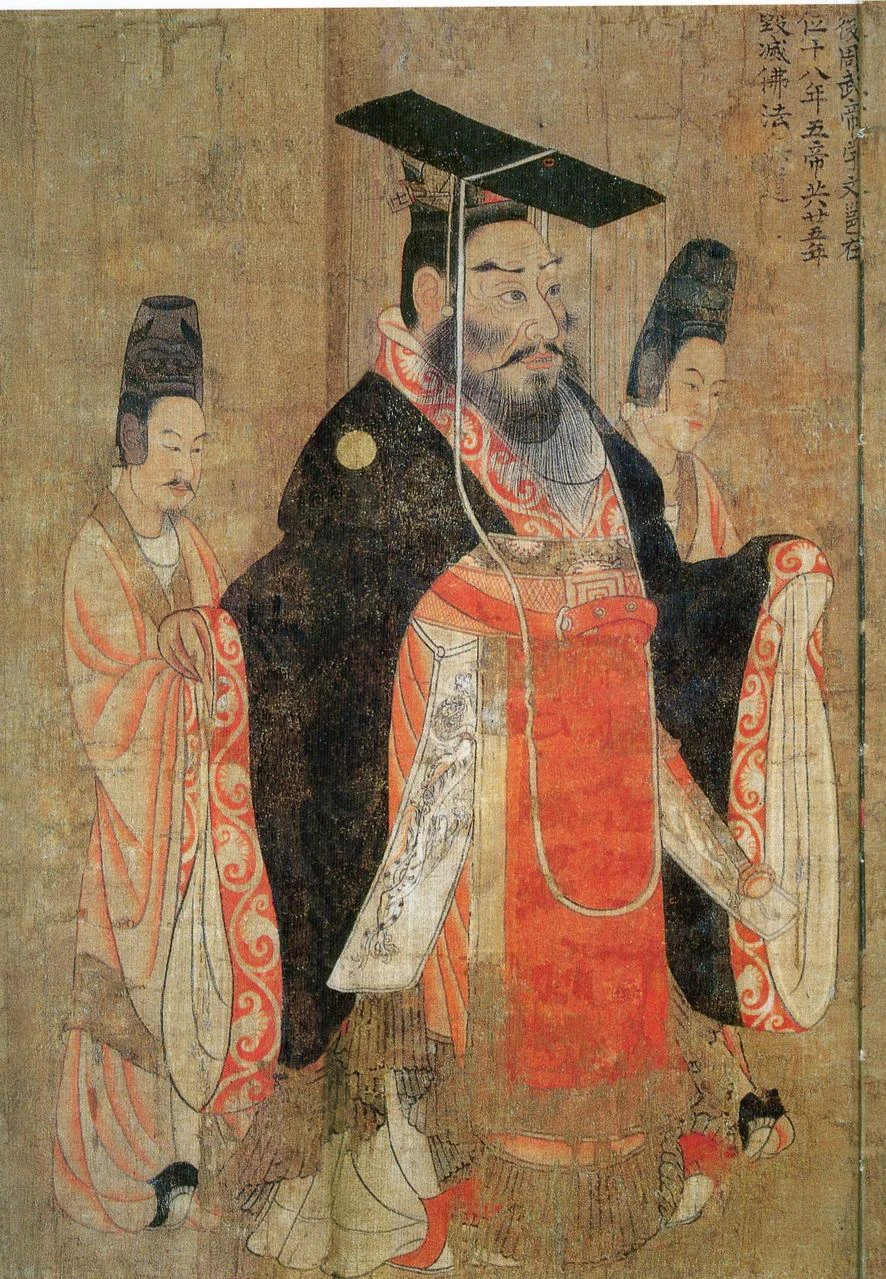
560 CE–578 CE
Emperor
Yuwen Yong
宇文邕
Yuwen Yong (543–June 21, 578), courtesy name Miluotu, was a Xianbei ruler whose ancestral home was Wuchuan in Dai Commandery, west of present-day Wuchuan in Inner Mongolia. He was born in Tongzhou, present-day Dali, Shaanxi, and was the third emperor of Northern Zhou, known to history as Emperor Wu of Northern Zhou. Early in his reign he concealed his intentions while power remained in the hands of Yuwen Hu. In 572, the first…
560 CE–578 CENorthern Zhou
PROFILE
Yuwen Yong (543–June 21, 578), courtesy name Miluotu, was a Xianbei ruler whose ancestral home was Wuchuan in Dai Commandery, west of present-day Wuchuan in Inner Mongolia. He was born in Tongzhou, present-day Dali, Shaanxi, and was the third emperor of Northern Zhou, known to history as Emperor Wu of Northern Zhou. Early in his reign he concealed his intentions while power remained in the hands of Yuwen Hu. In 572, the first year of the Jiande era, he killed Yuwen Hu and recovered control of government. He then reformed the fubing military system, strengthened the army, conquered Northern Qi in 577, and unified northern China. He also carried out a suppression of Buddhism and Daoism that transferred religious resources to the state and strengthened public finances. Yuwen Yong lived frugally and worked diligently at government. He was one of the more active rulers of the Northern and Southern Dynasties and helped create conditions later used by Sui in the reunification of China.
- Other Names
- Emperor Wu / Emperor Wu of Northern Zhou
- Courtesy Name
- Miluotu
- Period
- Northern Zhou
- Dynasty/Regime
- Northern Dynasties · Northern Zhou
- Identity
- Emperor
- Ethnicity/People
- Xianbei
- Native Place
- Wuchuan Garrison, Dai Commandery
- Date of Birth
- 543
- Place of Birth
- Tongzhou
- Date of Death
- June 21, 578
- Reign
- Not recorded in historical sources
- Predecessor
- Emperor Ming of Northern Zhou (Yuwen Yu)
- Successor
- Emperor Xuan of Northern Zhou (Yuwen Yun)
- Era Name
- Not recorded in historical sources
- Temple Name
- Not recorded in historical sources
- Posthumous Name
- Emperor Wu
- Major Achievement
- Eliminated the powerful Yuwen Hu, conquered Northern Qi and unified northern China, and strengthened state finances through the suppression of Buddhism
LIFE TIMELINE
Age twelve | Enfeoffed as Duke of Fucheng Commandery
Age fourteen | His elder brother Yuwen Jue accepted the abdication and founded Northern Zhou; Yuwen Yong was appointed Grand General and stationed at Tongzhou
Age sixteen | Entered court as Grand Minister over the Works and was promoted to Duke of Lu
Age seventeen | After Yuwen Hu poisoned Emperor Ming, Yuwen Yong ascended the throne
Age eighteen | Adopted the era name Baoding and honored Yuwen Hu as Grand Chief Minister and commander of all military affairs
Age twenty-nine | Engineered the killing of Yuwen Hu and took direct control of government
Age thirty-one | Prohibited Buddhism and Daoism and carried out the suppression of the two religions
Age thirty-two | Launched his first campaign against Northern Qi; failed to take Jinyong and withdrew because of illness
Age thirty-three | Personally led another campaign against Northern Qi and captured Jinzhou and Jinyang
Age thirty-four | Captured Ye, took the Northern Qi ruler prisoner, and unified northern China
Age thirty-five | Personally led a five-route campaign against the Turks in the fifth lunar month, fell ill en route, and died in Chang'an in the sixth lunar month
BIOGRAPHY
Biography
Family Background and Early Life
Yuwen Yong was the fourth son of Yuwen Tai, the dominant minister of Western Wei. His mother was Empress Wenxuan Chinu. He was born in Tongzhou in 543, the ninth year of the Datong era of Western Wei. He was said to have shown filial respect to his parents from childhood and to have been intelligent, perceptive, and dignified. Yuwen Tai was very fond of him and was said to have remarked that this son would be the one to fulfill his ambitions.
Because his father held power in Western Wei, Yuwen Yong's youth was politically secure. In 555, at the age of twelve, he was made Duke of Fucheng Commandery. In 557, his elder brother Emperor Xiaomin Yuwen Jue accepted the abdication that established Northern Zhou. Yuwen Yong was made Grand General and stationed at Tongzhou. In the ninth lunar month of that year Yuwen Hu, as Grand Chief Minister, deposed Emperor Xiaomin and enthroned Yuwen Yu as Emperor Ming. On the sixteenth day of the twelfth lunar month Yuwen Yong was promoted to Pillar of State and appointed commander of military affairs and governor of Puzhou.
In 559, the first year of Wucheng, Yuwen Yong entered court as Grand Minister over the Works and an official of Imperial Correction, was promoted to Duke of Lu, and concurrently served as head of the imperial clan. Emperor Ming was close to him and consulted him on major state affairs. Yuwen Yong was reserved and far-sighted and did not readily express opinions unless specifically asked. Emperor Ming often praised him by saying that he did not speak casually, but when he did his words struck the point.
Concealment under Yuwen Hu
In the fourth lunar month of 560, Yuwen Hu had Emperor Ming poisoned and placed the seventeen-year-old Yuwen Yong on the throne. Northern Zhou remained politically unstable because Yuwen Hu monopolized real authority. Yuwen Hu was Yuwen Tai's nephew. Before his death, Yuwen Tai had emphasized that his sons were young and powerful enemies surrounded the state and had therefore asked Yuwen Hu to direct military and civil affairs and continue his work. Yuwen Hu accepted the charge. The next year he had supported Yuwen Jue in founding Northern Zhou, but Emperor Xiaomin strongly resented Yuwen Hu's monopoly of power and was ultimately deposed and killed.
Yuwen Yong understood that Yuwen Hu's position was already deeply entrenched and therefore concealed his own intentions. At the beginning of his reign he did not reveal his resentment. In the first lunar month of 561 he adopted Baoding as the era name and confirmed Yuwen Hu as Grand Chief Minister and commander of all military affairs. He granted Yuwen Hu high honors and also behaved toward him with conspicuous deference in daily life. On one occasion Houmochen Chong, Duke of Liangzao, accompanied Yuwen Yong to Yuanzhou but insisted on returning to Chang'an at night. Thinking himself clever, Houmochen Chong told intimates that Yuwen Hu had already been killed. When the rumor spread, Yuwen Yong summoned the nobles to Dade Hall and publicly rebuked him. Houmochen Chong apologized in fear. That same night Yuwen Hu sent troops into his residence and forced him to commit suicide. Yuwen Yong's conduct demonstrated outwardly that he had no disloyal intention toward Yuwen Hu.
In 564, after Northern Qi returned Yuwen Hu's mother, Yuwen Yong treated her with elaborate courtesy. Gifts were extremely lavish, and at seasonal family observances he led members of the imperial clan in paying her the respect due to an elder relative and offering ceremonial toasts for longevity. This was intended to win Yuwen Hu's confidence. Because of Yuwen Yong's outward respect and compliance, Yuwen Hu did not deal with him as he had with Yuwen Jue and Yuwen Yu.
Behind this surface, Yuwen Hu continued to pressure the emperor and behave arrogantly. In the same year he organized a campaign against Northern Qi. In the eleventh lunar month Pillar of State Yuchi Jiong, Duke of Shu, led a large force to besiege Luoyang; Yuwen Xian, Duke of Qi, held positions at Mangshan; and Yuwen Hu's army camped at Shanzhou. In the twelfth lunar month Quan Jingxuan attacked Northern Qi's Yuzhou and its governor Wang Shiliang surrendered under combined pressure. Northern Qi's Emperor Wucheng Gao Zhan sent Gao Changgong, Duan Shao, and Hulü Guang to relieve Luoyang. Duan Shao used stratagems to defeat the Northern Zhou army. The failure sharply reduced Yuwen Hu's prestige and helped create circumstances favorable to Yuwen Yong's later seizure of power.
Personal Rule and Reform
In 572, the first year of Jiande, Yuwen Yong decided to eliminate Yuwen Hu because of his arrogance and secretly planned the act with his full younger brother Yuwen Zhi, Prince of Wei. When Yuwen Hu returned from Tongzhou to Chang'an, Yuwen Yong accompanied him to see the empress dowager. On the way he told Yuwen Hu that the empress dowager was elderly yet fond of drinking and had ignored repeated admonitions, and asked Yuwen Hu to advise her. He handed him the “Announcement on Alcohol” and asked him to read it as the basis for the remonstrance. Yuwen Hu entered the empress dowager's residence and began reading. While he was occupied, Yuwen Yong struck him hard on the head with a jade tablet. Yuwen Hu fell. Yuwen Yong ordered the eunuch He Quan to cut him down, but He Quan trembled and failed to strike a fatal blow. Yuwen Zhi emerged from hiding and helped kill Yuwen Hu. Yuwen Hu's sons, brothers, and close followers were then executed. A general amnesty was proclaimed and the era name Jiande adopted.
After Yuwen Hu's death, real authority finally passed to Yuwen Yong. He weakened the office of Grand Chief Minister and abolished the central and external military headquarters. Yuchi Jiong, Duke of Shu, was made Grand Preceptor; Dou Chi, Duke of Deng, Grand Tutor; Li Mu, Duke of Shen, Grand Protector; Yuwen Xian, Duke of Qi, Grand Chief Minister; Yuwen Zhi, Duke of Wei, Grand Minister over the Masses; Yuwen Zhao, Duke of Zhao, Grand Minister over the Works; Xin Wei, Duke of Fuhan, Grand Minister of Justice; and Lu Tong, Duke of Suide, Grand Marshal. The Six Offices were no longer required to answer collectively to the Grand Chief Minister of the Heavenly Office, reducing that position to largely nominal importance and strengthening imperial authority.
Yuwen Yong also redesignated military personnel as “attendant officers,” symbolically defining the army as directly subordinate to emperor and state. Ethnic restrictions on recruitment were removed, allowing adult males throughout the realm to serve and greatly broadening the manpower base. He also regulated relations between local chief administrators and their staffs in order to limit personal dependence and private local power. In the fourth lunar month he posthumously honored the Duke of Lüeyang as Emperor Xiaomin and established Yuwen Yun, Duke of Lu, as crown prince.
In the first lunar month of 574 Yuwen Yong elevated several brothers to princely rank, including Yuwen Xian, Duke of Qi; Yuwen Zhi, Duke of Wei; Yuwen Zhao, Duke of Zhao; Yuwen Sheng, Duke of Yue; and Yuwen You, Duke of Teng, intending that imperial princes support the throne. In the second lunar month Yuwen Kang, Duke of Ji; Yuwen Xian, Duke of Bi; Yuwen Zhen, Duke of Feng; Yuwen Shi, Duke of Song; Yuwen Zan, Duke of Han; Yuwen Zhi, Duke of Qin; and the Duke of Cao were likewise raised to princely rank. At the same time the emperor broadened recruitment without regard to ethnicity, strengthened the army, reduced the possibility that Pillars of State could maintain private military power, and brought troops more directly under imperial command.
Suppression of Buddhism and Unification of the North
Northern Zhou and Northern Qi had long been military rivals of broadly comparable strength. After Yuwen Yong took personal power, the balance changed. The source attributes this to three developments: suppression of Buddhism increased the state's economic resources; Han farming households under the equal-field system were incorporated into the fubing forces, enlarging the army; and successful diplomacy created marital ties with the Turks in the north and friendly relations with Chen in the south. Northern Qi, by contrast, suffered from divided authority, sale of offices and judicial decisions, pursuit of profit, sexual excess, and persecution of loyal officials.
In 574 Yuwen Yong prohibited Buddhism and Daoism. Scriptures and images were destroyed, monks and Daoist clergy ordered to return to lay life, religious wealth distributed or transferred, and monasteries and temples granted to princes and nobles. Cults not recognized by established ritual codes were also abolished. In the sixth lunar month he established the Tongdao Institute, selected 120 eminent Buddhist and Daoist figures, required them to wear secular caps and robes as scholars of the institute, and placed them under official administration.
In 575 Yuwen Yong again entered Northern Qi territory intending to destroy the state. He planned the campaign with only a small group including Yuwen Xian, rejected objections, and personally led the army toward Jinyong near present-day Luoyang. In the seventh lunar month he appointed Yuwen Chun, Sima Xiaonan, and Daxi Zhen to command the first three armies and Houmochen Qiong the rear three, while Yang Jian, Xue Jiong, and others advanced on separate routes. Yuwen Yong personally led 60,000 troops toward Heyin. Northern Zhou forces maintained strict discipline, forbidding damage to trees or crops on pain of death, and thereby won some local support. The emperor fell ill, however, and withdrew.
In the tenth lunar month of 576, Yuwen Yong personally led another eastern invasion. Yuwen Sheng, Prince of Yue, commanded the first right army; Yuwen Liang, Duke of Qi, the second; Yang Jian, Duke of Sui, the third; Yuwen Jian, Prince of Qiao, the first left army; Grand General Dou Gong the second; and Qiu Chong, Duke of Guanghua, the third. Yuwen Xian, Prince of Qi, and Yuwen Chun, Prince of Chen, led the vanguard. Yuwen Yong brought the main army to Jinzhou. Yuwen Xian with 20,000 elite cavalry was sent to Queshu Valley; Yuwen Chun with 20,000 infantry and cavalry to Qianli Path; Daxi Zhen with 10,000 to Tongjunchuan; Han Ming with 5,000 to Qizi Ridge; Yin Sheng with 5,000 to Guzhong Garrison; Xin Shao with 5,000 to Pujin Pass; Yuwen Zhao with 10,000 to attack Fen Prefecture from Huagu; and Pillar of State Yuwen Sheng with 10,000 to Fen River Pass. Inner Secretary Wang Yi supervised the six armies attacking Jinzhou. Yuwen Yong's main camp stood at Fenqu, while Yuwen Xian captured Hongdong and Yong'an. The emperor went personally from Fenqu to the city walls each day to supervise fighting, alarming the defenders. Northern Qi official Hou Ziqin surrendered. Cui Jingsong, governor of Jinzhou and commander of the northern defenses, secretly sent an envoy at night to offer surrender. Wang Gui led men to receive him. Before dawn Zhou troops climbed the wall with drums and shouts, the Qi defense collapsed, and Jinzhou fell. The city commander Wei Xianggui, Prince of Haichang, and eight thousand armored troops were captured. Liang Shiyan was appointed governor of Jinzhou and Grand General and left with ten thousand elite troops to hold the city.
Northern Qi ruler Gao Wei was hunting with Feng Xiaolian at Tianchi when emergency reports arrived. Right Chancellor Gao Anagong suppressed the reports until evening, when he finally announced that Pingyang had fallen. Gao Wei led a large army to relieve the city and attacked day and night, while Liang Shiyan defended with ten thousand men. On the third day of the twelfth lunar month Yuwen Yong's army joined Yuwen Xian's forces to relieve Pingyang, and on the sixth the Zhou army confronted Northern Qi. When the Qi eastern wing moved back slightly, Feng Xiaolian screamed that the army had been defeated, and Mu Tipo, Prince of Chengyang and Director of the Department of State Affairs, echoed calls to leave. Gao Wei immediately fled with his favored consort toward Gaoliang Bridge. When the army realized the emperor had fled, morale collapsed and Northern Zhou won a major victory in which more than ten thousand were killed. On the thirteenth Northern Zhou reached Jinyang. On the fourteenth Gao Yanzong proclaimed himself emperor and issued an amnesty. On the seventeenth Northern Zhou defeated the Qi army and captured Jinyang.
On the eighteenth day of the first lunar month of 577, Northern Zhou reached Ye and laid siege to the city. The Zhou army defeated the defenders and took Ye. Gao Wei fled with several hundred cavalry, transferred the throne to Crown Prince Gao Heng, and then, in Gao Heng's name, abdicated in favor of Gao Wei's uncle Gao Jie, Prince of Pengcheng and governor of Yingzhou. Gao Wei was later captured by Yuchi Qin and sent back to Ye. In the second lunar month Gao Jie and the remaining Northern Qi resistance were eliminated, and Northern Zhou unified the north.
Later Years and Death
After the destruction of Northern Qi in 577, Yuwen Yong entered Ye and extended the prohibition of Buddhism into the former Qi territory. The monk Huiyuan argued with him without success. Buddhist monasteries and images in the north were almost eliminated, and many monks fled south of the Yangtze.
That same year Emperor Xuan of Chen, learning that Northern Zhou had destroyed Northern Qi, sought to contest Xuzhou and Yanzhou. He ordered Wu Mingche, governor of Southern Yanzhou and Minister over the Works, to command the expedition. Wu Mingche reached Lüliang, where Liang Shiyan, chief administrator of Xuzhou, resisted. On October 19 Wu defeated Liang, who withdrew behind the city walls and was besieged. On the fourth day of the eleventh lunar month Northern Zhou sent Senior Grand General Wang Gui to relieve Xuzhou. In the second lunar month of 578, Wu Mingche besieged Pengcheng. Wang Gui advanced lightly, occupied the mouth of the Huai, and created an extended blockade by linking hundreds of wheels with iron chains and sinking them in the Qingshui River to block the Chen fleet's route of retreat. Northern Zhou reinforcements increased and the Chen water route was cut. Wu Mingche was captured and the Chen army suffered a major defeat.
In the fifth lunar month of 578 Yuwen Yong personally led forces in five routes against the Turks. He became exhausted near Yunyang Palace at Jingyang and died suddenly while returning to Chang'an. He died in Chang'an on June 21 at the age of thirty-five. He received the posthumous title Emperor Wu, the temple name Gaozu, and was buried at Xiaoling.
Yuwen Yong was the fourth son of Yuwen Tai. He is said to have been a devoted and filial child, intelligent and of generous temper, so that his father, fond of him, often remarked that the son who would accomplish his designs must be this one. His father being the power behind the Western Wei throne, his youth was untroubled: in 555, at twelve, he was made duke of Fucheng; in 557, when his elder brother the Xiaomin emperor took the abdication and founded the Northern Zhou, he was made a general and posted to Tongzhou; in the ninth month of that year, when the grand minister Yuwen Hu deposed Xiaomin and set up the Ming emperor, he was advanced to pillar of state and given the military commands of Puzhou and its governorship. In 559 he entered court as minister of works and director of the imperial clan, being enfeoffed duke of Lu. The Ming emperor was much attached to him and consulted him on great affairs, but he was deep and far-sighted by nature and never spoke unless asked, so that the emperor would say that this man, when he did not speak, spoke to the point when he did.
In the fourth month of 560 the Ming emperor was poisoned by Yuwen Hu's men, and by his testamentary edict the throne passed to Yuwen Yong. He declined repeatedly, and only took it at the urging of all the officials, becoming the Wu emperor of Northern Zhou. Real power lay wholly with Yuwen Hu. Yuwen Tai on his deathbed, pleading his young sons and powerful enemies, had charged Yuwen Hu with the whole of military and civil government and with the continuation of his own purposes; Yuwen Hu had set up the Xiaomin emperor and founded Northern Zhou, then deposed and killed him for resenting his monopoly of power and set up the Ming emperor, so that he had now three times made and unmade emperors. Knowing his power fully grown, Yuwen Yong bided his time, and at his accession dared show no dissatisfaction. In the first month of 561 he changed the era name to Baoding, raised every officer four grades, made Yuwen Hu grand minister and commander of all military affairs, and ordered the five bureaus to report through the celestial office, handing him the highest civil and military authority together.
His deference to Yuwen Hu went to extraordinary lengths. When the duke of Liang, Houmo Chenchong, let it be said that Yuwen Hu had been put to death, Yuwen Yong at once summoned the princes to the Dade hall and rebuked him publicly; Houmo Chenchong apologized in terror, and that same night Yuwen Hu's soldiers entered his house and forced him to take his own life — showing how utterly the emperor was thought to be without designs of his own. He further decreed that edicts and government documents should not use Yuwen Hu's personal name. When Yuwen Hu's mother was sent back by Northern Qi in 564, Yuwen Yong courted her with the most lavish gifts and at every seasonal festival led the imperial kinsmen in the family rites and toasts of congratulation to her, all to win Yuwen Hu's favor.
Yet Yuwen Hu's hold on him never relaxed, and his arrogance grew. In 570 an edict again gave him the music of the suspended bells and the six-row dance, so that his state approached the emperor's; the histories say that he was easygoing by nature but blind to the greater interests of the state, that relying on his service in founding it he long held the axis of power, that those he appointed were all unfit, and that his sons were greedy and cruel and their subordinates unrestrained, plundering the state and the people under his protection while all above and below deceived one another without misgiving. That year he planned a campaign against Northern Qi: in the eleventh month Yuchi Jiong besieged Luoyang, the duke of Qi, Yuwen Xian, camped at Mangshan, Yuwen Hu himself stayed at Shanzhou and Quan Jingxuan took Yuzhou. In the twelfth month the Qi army crossed the river and reached Luoyang at dawn; the Northern Zhou forces scattered in alarm, Yuchi Jiong with a few dozen riders held the enemy off and got his men away, the duke of Yong, Wang Xiong, died fighting, Yang Piao fell at the Zhi pass and Quan Jingxuan abandoned Yuzhou — the first great campaign against Qi ended in failure. It greatly reduced Yuwen Hu's standing and prepared the way for the emperor's seizure of power.
In 572, judging Yuwen Hu violent and arrogant, Yuwen Yong plotted his destruction with the prince of Wei, Yuwen Zhi. Taking the occasion of Yuwen Hu's return from Tongzhou, he brought him into the palace on the pretext of reading the "Announcement on Drink" for the empress dowager, struck him down with a jade tablet with his own hand while he was off guard, and Yuwen Zhi cut him down from behind; his sons and partisans were then wiped out, and the government of Northern Zhou returned to the emperor. Once in control, Yuwen Yong carried through reforms of lasting consequence: he freed state and private slaves and made them registered subjects, reformed the militia system and widened its recruitment, and in 574 proscribed both Buddhism and Daoism, taking the lands and people of the monasteries and temples for the state's finances and armies. In 575 and 576 he campaigned twice against Northern Qi on a great scale, and in 577 destroyed it, unifying the north and laying the ground for the Sui reunification of China. In 578, marching north against the Turks, he fell ill on the way and died at the age of thirty-six; his son Yuwen Yun succeeded him. Of his eighteen years on the throne, the first twelve were spent in endurance under a powerful minister, and in the six after he took power he destroyed Qi; his passage from concealment to seizure of power, and from power to reform, was the hinge of Northern Zhou's rise from weakness to strength.
After Yuwen Hu's destruction, Yuwen Yong's government is usually summed up as one of enriching the state and strengthening its armies: the freeing of slaves, the proscription of Buddhism and Daoism, the reform of the militia, the tightening of official discipline and the promotion of farming were all aimed at increasing the registered population and the pool of soldiers. His two campaigns against Northern Qi did not rest on numbers alone; in 575 he probed with a detached force, and in 576 attacked in earnest, at a moment when the Qi ruler Gao Wei neglected government and the great general Hulü Guang had been unjustly killed, so that in 577 Northern Zhou entered Ye, took the Qi ruler prisoner and unified the north. In 578, marching in person against the Turks, he fell ill on the way; he died shortly after returning to Chang'an, and the reunification he had planned was completed a dozen years later by Yang Jian, the first emperor of Sui.
Yuwen Yong's proscription of Buddhism is often listed with the measures of the Northern Wei emperor Taiwu and the Tang emperor Wuzong as one of the "three persecutions". In the Northern Zhou case, the temples and monasteries held large tracts of land and many people, and monks and nuns were exempt from taxes and service, which clashed directly with the court's need to enlarge the registered population and the pool of soldiers; the ban of 574 was thus a fiscal and military reform as much as a religious policy. Thereafter the Northern Zhou could say that the people's service was lighter and the treasury full, which had much to do with the great armies it raised against Qi. The men he relied on were for the most part practical talents of the Guan-Long group, such as Yuwen Xian and Wei Xiaokuan; his son the Xuan emperor gave himself to drink and pleasure and let power fall to the consort kin Yang Jian, so that Northern Zhou was replaced by Sui a few years later.
After Yuwen Yong, the Northern Zhou's military and civil reforms were largely kept by his successors, only the proscription of Buddhism relaxing gradually in the Sui and Tang. Historians describe him as deep and far-sighted, never speaking unless asked, and count it decision of character that he endured twelve years and then struck in a single day; his diligence in government after taking power, his frugal life and dislike of display are likewise regarded as the marks of an able ruler among the Northern Dynasties. He died at thirty-six, and the men he had relied on, Yuwen Xian among them, were killed one after another in the reign of his son, so that the state, strong as it was, turned sharply with each change of ruler.
One of his reforms is often noted: the militia soldiers were renamed "attendants of the emperor", transferring them from the private following of individual commanders to the imperial guard directly under the throne, so that their standing and honor rose — a precursor of the fully developed militia system of Sui and Tang. He lived frugally himself, opposed display in his lifetime and ordered a simple burial; his tomb is the Xiaoling seen today in the Xianyang region of Shaanxi.
Major Activities
Killing the Powerful Minister Yuwen Hu
After Yuwen Tai's death, Yuwen Hu monopolized Northern Zhou politics. He successively deposed and killed Emperor Xiaomin Yuwen Jue, poisoned Emperor Ming Yuwen Yu, and placed Yuwen Yong on the throne. For twelve years Yuwen Yong concealed his resentment and showed Yuwen Hu extreme deference in order to lower his guard. In 572, working with his full younger brother Yuwen Zhi, Yuwen Yong used the pretext of having Yuwen Hu read the “Announcement on Alcohol” to the empress dowager, struck him from behind with a jade tablet, and had Yuwen Zhi help kill him. Yuwen Hu's sons and principal supporters were then eliminated. The act ended roughly fifteen years of domination by a powerful minister and transferred effective authority to the emperor.
Suppression of Buddhism
In 574 Yuwen Yong prohibited both Buddhism and Daoism. From 566 through 578, spanning the Tianhe through Jiande periods, religious representatives and officials had repeatedly debated the relative standing of Confucianism, Buddhism, and Daoism. In 568 the emperor assembled officials, monks, and Daoists in Dade Hall and personally lectured on the Book of Rites, expressing a desire to govern through Confucian learning. In the fifth lunar month of 574 the court moved toward prohibition. Monks and Daoists were summoned to the capital, Buddhism was criticized as impure, and the emperor ordered scriptures and images destroyed, clergy returned to lay life, religious wealth redistributed, monasteries and temples transferred to princes and nobles, and unrecognized cults abolished.
The source presents fiscal consolidation as a central purpose of the policy. As the number of clergy grew, the tax base declined. Wei Yuansong, a former monk who had turned to Daoism, submitted proposals to reduce monasteries and monks that aligned with the emperor's intentions. After the suppression, most northern monasteries and images disappeared, large numbers of monks and nuns became registered lay households, temple lands and wealth came under state control, and public revenue increased, providing resources for the war against Northern Qi. Yuwen Yong was quoted as saying that if the people could live well, he would not refuse even the sufferings of hell.
Destruction of Northern Qi and Unification of the North
In the seventh lunar month of 575 Yuwen Yong rejected objections and ordered an invasion of Northern Qi. The first three armies were assigned to Yuwen Chun, Sima Xiaonan, and Daxi Zhen; rear armies to Yuwen Sheng, Houmochen Chong, and Yuwen Zhao. Yuwen Xian led 20,000 toward Liyang; Yang Jian and Xue Jiong led 30,000 naval troops from the Wei River into the Yellow River; Houmochen Rui guarded the Taihang route with 20,000; Li Mu led 30,000 at the Heyang route; and Yu Yi led 20,000 through Chen and Ru. The total force was said to be 120,000. In the eighth lunar month the six routes entered Northern Qi under strict discipline. Yuwen Yong's 60,000 advanced on Heyin and captured the outer city, while defenders held the inner city. Yuwen Xian took Wuji and advanced toward Luoyang. Unable to take Heyin, Yuwen Yong attacked Jinyong, but stubborn resistance and the emperor's illness forced a withdrawal when Gao Anagong arrived with relief forces from Jinyang.
In 576 the emperor changed strategy and used the Jinzhou route. His goal was to attack Jinzhou, draw the main Northern Qi army into relief, defeat it in a decisive battle, and then advance on Ye. The Zhou army captured Jinzhou after the defection of Cui Jingsong, taking Wei Xianggui and eight thousand armored soldiers. Gao Wei's attempted relief failed disastrously at Pingyang. Northern Zhou then captured Jinyang in the twelfth lunar month and, in the first lunar month of 577, reached and captured Ye. Gao Wei fled but was captured. Remaining resistance was eliminated in the second lunar month, completing Northern Zhou's unification of northern China.
Reform of the Fubing System
After killing Yuwen Hu, Yuwen Yong reformed the fubing system. Command of the military was taken back from the central and external command headquarters and placed directly under the emperor. Soldiers were redesignated “attendant officers,” emphasizing their relationship to the ruler and state. Ethnic restrictions on recruitment were removed so that adult males throughout the realm could serve, including large numbers of Han farmers under the equal-field system. The emperor also regulated the relationship between local administrators and their subordinates to limit private patronage networks. The reforms broadened recruitment, increased military strength, and supplied manpower for the conquest of Northern Qi.
Northern Expedition of the Taijian Era
After Northern Zhou destroyed Northern Qi in 577, Emperor Xuan of Chen sought to seize Xuzhou and Yanzhou and ordered Wu Mingche to invade. Wu defeated Liang Shiyan at Lüliang and surrounded him. Northern Zhou sent Wang Gui to relieve Xuzhou. By February 578 Wu Mingche had encircled Pengcheng with warships, but Wang Gui seized the mouth of the Huai and blocked the Chen fleet's retreat with linked wheels sunk in the Qingshui River. Wu rejected Xiao Mohe's proposal to break out. The Chen generals debated breaking the embankment and loading horses onto boats. Cavalry commander Pei Zilie warned that releasing the horses after the embankment was broken would overturn the boats and argued they should be sent out first. Wu, who was seriously ill with a sore on his back, also rejected Xiao Mohe's renewed proposal that he withdraw slowly with infantry while several thousand armored cavalry protected the movement. His illness worsened, the army collapsed at night, and Wu Mingche was captured. The victory consolidated Northern Zhou's control in the Huai River region.
Personal Relations
- Yuwen Tai: Father; Western Wei power holder and founder of Northern Zhou
- Lady Chinu: Mother; Empress Wenxuan
- Yuwen Jue: Third elder brother; Emperor Xiaomin of Northern Zhou, deposed and killed by Yuwen Hu
- Yuwen Yu: Elder brother; Emperor Ming of Northern Zhou, poisoned by Yuwen Hu
- Yuwen Zhi: Full younger brother; Duke of Wei, helped kill Yuwen Hu, later rebelled and was executed
- Yuwen Xian: Half-brother; Duke of Qi and famous Northern Zhou general, later killed by Yuwen Yun
- Yuwen Zhao: Half-brother; Duke of Zhao
- Yuwen Sheng: Half-brother; Duke of Yue
- Yuwen You: Half-brother; Duke of Teng
- Yuwen Yun: Eldest son; Emperor Xuan of Northern Zhou
- Yuwen Zan: Second son; Duke of Han
- Yuwen Zhi: Son; Duke of Qin
- Yuwen Hu: Cousin and powerful minister, killed by Yuwen Yong
- Houmochen Chong: Duke of Liangzao, forced by Yuwen Hu to commit suicide after making a reckless statement
- Liang Shiyan: General and contributor to the conquest of Northern Qi; later chief administrator of Xuzhou
- Wang Gui: General who contributed to the conquest of Northern Qi and later defeated the Chen army
- Wei Xiaokuan: Northern Zhou general
- Yu Yi: Chief administrator of Anzhou, consulted before the campaign against Northern Qi
- Lu Yun: Nayan official who carried questions to Yu Yi before the campaign
- Yuchi Jiong: Grand Preceptor, Duke of Shu, senior Northern Zhou official
- Dou Chi: Grand Tutor, Duke of Deng
- Li Mu: Grand Protector, Duke of Shen
- Yang Jian: Duke of Sui, later Emperor Wen of Sui
- Yuwen Chun: Prince of Chen and commander of the first three armies
- Sima Xiaonan: Duke of Xingyang and commander of the first three armies
- Daxi Zhen: Duke of Zheng and commander of the first three armies
- Houmochen Qiong: Commander of the rear three armies
- Gao Wei: Last principal ruler of Northern Qi, defeated by Yuwen Yong
- Gao Yanzong: Prince of Ande of Northern Qi, proclaimed emperor at Jinyang and was captured
- Gao Anagong: Right Chancellor of Northern Qi, whose handling of military information contributed to failures
- Wu Mingche: Minister over the Works of Chen, captured during the Taijian northern expedition
- Xiao Mohe: Chen general serving under Wu Mingche
Historical Assessment
Northern Zhou / Contemporary
- The Book of Zhou described Yuwen Yong as filial and respectful from childhood, intelligent and possessing natural capacity, reserved and far-sighted, and unwilling to speak casually unless asked.
- Emperor Ming Yuwen Yu praised him by saying that when he spoke, his words always struck the point.
- Yuwen Tai was said to have declared that this son would fulfill his ambitions.
- The monk Huiyuan argued against Yuwen Yong during the suppression of Buddhism without changing the emperor's decision, illustrating the emperor's firmness.
Sui and Tang Periods
- Emperor Wen of Sui Yang Jian was said to have remarked that he could not equal Yuwen Yong's frugality.
- Tang historian Li Yanshou in the History of the Northern Dynasties described Yuwen Yong as a ruler of ambitious plans and far-reaching strategy who achieved hegemony and was an outstanding figure of his age despite imperfections.
- Wei Zheng, when involved in the compilation of the Book of Sui, discussed Yuwen Yong's suppression of Buddhism and interpreted it as a pragmatic measure for the times rather than simple hostility toward Buddhism.
- The source associates Tang literary memory with Yuwen Yong's image as a strong ruler, including a reference to Du Fu's Northern Expedition.
Song, Yuan, Ming, and Qing Periods
- Sima Guang's Comprehensive Mirror in Aid of Governance praised Yuwen Yong's decisiveness in seizing the opportunity to eliminate Yuwen Hu.
- Hu Sansheng described Yuwen Yong as deep, resolute, skilled in warfare, and capable of using talented men, qualities that enabled the destruction of Northern Qi.
- Wang Fuzhi argued that the suppression of Buddhism was directed not at doctrine itself but at the fiscal and political burdens created by religious institutions and that Yuwen Yong sought a rich state and strong army.
- Zhao Yi praised the depth of Yuwen Yong's planning and the speed of his operations in conquering Northern Qi.
Modern Period
- Lü Simian regarded Yuwen Yong as deep and strategic, capable of decisive action, while judging the suppression of Buddhism excessively harsh even if fiscally motivated.
- Chen Yinke argued in Draft Essay on the Origins of Sui and Tang Institutions that Yuwen Yong's fubing reforms and religious policies contributed to the institutional foundations of Sui-Tang unification.
- Zhou Yiliang described Yuwen Yong as one of the most active rulers of the later Northern Dynasties and saw his reforms as influential on Sui and Tang institutions.
- Modern scholarship generally regards the suppression of Buddhism as harsh but, under contemporary conditions, as contributing to stronger central authority, public finances, and Northern Zhou's conquest of the north.
FIGURES ASSOCIATED WITH THIS DYNASTY
Bibliography
- Book of Zhou, vol. 5, Imperial Annals 5
- Book of Zhou, vol. 6, Imperial Annals 6
- Book of Zhou, vol. 11, “Biography of Yuwen Hu”
- History of the Northern Dynasties, vol. 10, Lower Annals of Zhou 10
- Comprehensive Mirror in Aid of Governance, Liang Annals, Book 22
- Lü Simian, History of the Jin and the Northern and Southern Dynasties
- Zhou Yiliang, Notes on the History of the Wei, Jin, and Northern and Southern Dynasties