Birth | Born at Prince Chun's Mansion in Beijing; his father was Zaifeng and his mother was Guwalgiya Youlan
1906 CE–1967 CE
Emperor
Aisin Gioro Puyi
爱新觉罗·溥仪
Aisin Gioro Puyi (7 February 1906–17 October 1967), courtesy name Yaozhi, was the last emperor of the Qing Dynasty, with the era name Xuantong. He later served first as Chief Executive and then as Emperor of Japanese-sponsored Manchukuo, using the era names Datong and Kangde. He was the son of Prince Regent Zaifeng. Puyi ascended the throne as a child in 1908 and abdicated in 1912; during the Zhang Xun Restoration of 1917 he…
1906 CE–1967 CEQing Dynasty
PROFILE
Aisin Gioro Puyi (7 February 1906–17 October 1967), courtesy name Yaozhi, was the last emperor of the Qing Dynasty, with the era name Xuantong. He later served first as Chief Executive and then as Emperor of Japanese-sponsored Manchukuo, using the era names Datong and Kangde. He was the son of Prince Regent Zaifeng. Puyi ascended the throne as a child in 1908 and abdicated in 1912; during the Zhang Xun Restoration of 1917 he briefly returned to the throne. After being expelled from the Forbidden City in 1924, he lived in Tianjin and continued to seek a restoration. In 1932, under the control of the Japanese Kwantung Army, he became Chief Executive of Manchukuo, and in 1934 he assumed the imperial title. After Japan's defeat in 1945, Puyi was captured by Soviet forces. He was transferred to China in 1950 and was held at the Fushun War Criminals Management Center and underwent political reeducation and labor reform, receiving a pardon in 1959. He subsequently worked at the Beijing Botanical Garden and the Historical Materials Research Committee of the Chinese People's Political Consultative Conference, and died of illness in 1967. His life encompassed the fall of the Qing Dynasty, a brief restoration, the rule of Manchukuo, and his transformation in status from war criminal to citizen.
- Other Name
- Xuantong Emperor Puyi
- Courtesy Name
- Yaozhi
- Art Name
- Haoran
- Era
- Qing
- Dynasty/Regime
- Qing
- Identity
- Emperor
- Date of Birth
- February 7, 1906 CE(32nd year of the Guangxu era)
- Date of Death
- October 17 1967
- Ethnicity
- Manchu
- Clan
- Aisin Gioro clan
- Ancestral Home
- Not reliably confirmed in historical sources
- Place of Birth
- Place of birth unknown
- Reign
- Reign dates unknown
- Predecessor
- Guangxu Emperor Zaitian (uncle)
- Era Name
- Not reliably confirmed in historical sources
- Temple Name
- Not reliably recorded in historical sources
- Posthumous Name
- Not reliably recorded in historical sources
- Major Achievement
- The last emperor of China; after ascending the throne as a child, he lived through the Zhang Xun Restoration, Manchukuo, and other major historical episodes.
- Courtesy name
- Yaozhi;Haoran
- Period
- Late Qing, Republican period, and the early years of the People's Republic of China;Qing Dynasty; Manchukuo (a Japanese-sponsored regime)
- Ancestral origin
- No clear record has been found in the available sources;7 February 1906(14th day of the first lunar month, Guangxu 32)
- Place of birth
- Prince Chun's Mansion, Beijing;17 October 1967
- Place of death
- Beijing;2 December 1908(9th day of the 11th lunar month, Guangxu 34)–12 February 1912(Republican Year 1); briefly restored in 1917(Republican Year 6), in practice for a little over ten days
- Tenure as Chief Executive of Manchukuo
- 9 March 1932(Datong 1)–28 February 1934(Datong 3);1 March 1934(Kangde 1)–18 August 1945(ceremony date; sources differ on when the abdication edict was issued and read)
- Era names
- Xuantong (Qing Dynasty); Datong (during his tenure as Chief Executive of Manchukuo); Kangde (during his reign as Emperor of Manchukuo);Qing Dynasty: Aisin Gioro Zaitian (Guangxu Emperor); Manchukuo: none
- Successor
- Qing Dynasty: the imperial system ended and there was no succeeding emperor; Manchukuo: the regime collapsed in 1945 and had no successor;None
- Posthumous title
- No official posthumous title;Puyi's tomb at Hualong Royal Cemetery, Yi County, Hebei
- Major roles and later work
- Served as the last emperor of the Qing Dynasty and as Chief Executive and Emperor of Manchukuo; after receiving a pardon in 1959, took part in historical-materials work for the CPPCC and wrote the memoir The First Half of My Life
LIFE TIMELINE
Entry into the palace for education | Empress Dowager Cixi ordered Puyi to be raised in the palace; his wet nurse Wang Jiao accompanied him from Prince Chun’s Mansion
Succession to the imperial line | After the Guangxu Emperor died, Puyi inherited the throne by imperial instruction and continued the lines of both the Tongzhi Emperor and the Guangxu Emperor
Qing emperor | Enthroned at the Hall of Supreme Harmony; the following year the era name was changed to Xuantong
Xinhai Revolution | After the Wuchang Uprising, provinces successively joined the revolution; Zaifeng resigned from the regency, and the Qing court called Yuan Shikai into service
Abdication | Empress Dowager Longyu issued the Imperial Edict of the Abdication of the Qing Emperor, ending the Qing imperial system; under the Articles of Favorable Treatment, Puyi temporarily remained in the Forbidden City
Brief restoration | Zhang Xun restored Puyi to the throne; after the anti-restoration forces entered Beijing, the restoration failed and Puyi abdicated again on 12 July
Palace education | Reginald Johnston entered the palace as English tutor and taught Puyi English, mathematics, world history, and geography
Marriage | Married Gobulo Wanrong, who was installed as Empress; Erdet Wenxiu became Consort Shu
Departure from the Forbidden City | Feng Yuxiang's forces entered the Forbidden City; Puyi was forced to leave, first returning to Prince Chun's Mansion and later entering the Japanese legation
Residence in Tianjin | Moved to the Japanese concession in Tianjin, where he continued to seek restoration with support from former Qing loyalists and Japanese contacts
Journey to the Northeast | After the Mukden Incident, left Tianjin for the Northeast with assistance from Kenji Doihara and other Japanese military personnel
Chief Executive of Manchukuo | Took office as Chief Executive of Japanese-sponsored Manchukuo, using the era name Datong
Emperor of Manchukuo | Ascended the throne under the control of the Japanese Kwantung Army and changed the era name to Kangde
Japanese surrender and abdication edict | Japan announced its surrender, and Puyi issued the abdication edict; Jilin local gazetteer sources separately record approval on 17 August and a reading ceremony on 18 August
End of Manchukuo | The Jilin local gazetteer gives this as the date of the abdication ceremony and the regime’s end
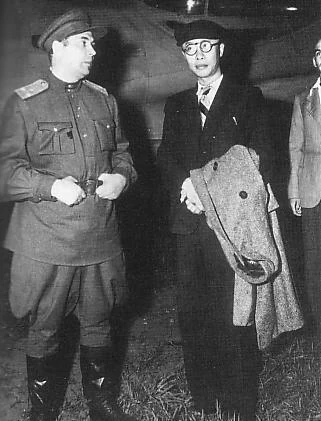
Capture by Soviet forces | Captured at Shenyang Airport while preparing to travel to Japan
Court testimony | Appeared as a witness before the International Military Tribunal for the Far East and testified about the establishment of Manchukuo and Japanese control over it
Transfer to China | Transferred by the Soviet Union to the People's Republic of China and sent to the Fushun War Criminals Management Center for reform
Pardon | Received a pardon and left the Fushun War Criminals Management Center
Return to Beijing | Returned to Beijing and began life as an ordinary citizen
Employment | Began work at the botanical garden of the Institute of Botany, Chinese Academy of Sciences
Remarriage | Married nurse Li Shuxian
CPPCC work | Became a staff member of the Historical Materials Research Committee of the Chinese People's Political Consultative Conference and a member of the Fourth National Committee of the CPPCC
Death | Died of illness in Beijing; he was cremated, and his ashes were eventually buried at Hualong Royal Cemetery in Yi County, Hebei
BIOGRAPHY
Biography
Family Background and Entry into the Palace in Childhood Puyi was born on 7 February 1906(14th day of the first lunar month, Guangxu 32) at Prince Chun's Mansion in Beijing. He was the son of Prince Chun Zaifeng and his principal consort, Guwalgiya Youlan. His paternal grandfather was Yixuan, Prince Chunxian, and his paternal uncle was the Guangxu Emperor Zaitian. Because the Guangxu Emperor had no children, the Qing court faced a succession problem. In the winter of 1908(Guangxu 34), as the Guangxu Emperor became gravely ill, Empress Dowager Cixi ordered Zaifeng's son to enter the palace to be raised there. Puyi was very young when he left the mansion and was accompanied into the palace by his wet nurse Wang Jiao. On 14 November 1908(21st day of the tenth lunar month, Guangxu 34), the Guangxu Emperor died. Puyi inherited the imperial line by imperial instruction and was also made the heir to the lines of both the Tongzhi Emperor Zaichun and the Guangxu Emperor Zaitian. On 2 December (9th day of the 11th lunar month, Guangxu 34), Puyi was enthroned in the Hall of Supreme Harmony, with Empress Dowager Longyu and Zaifeng acting as regents, and the following year the era name was changed to Xuantong. As a child he received a traditional education in the classics and history in the palace. His Chinese tutors included Lu Runxiang, Xu Fang, Zhu Yifan, and Liang Dingfen, while his Manchu tutor was Iktan. Puyi later recalled that his early studies centered on the classics, classical prose, and poetry, with little instruction in such newer subjects as arithmetic, geography, and history. ### Abdication of the Qing Emperor and the Brief Restoration After the Wuchang Uprising of 1911(Xuantong 3), provinces successively declared their separation from the Qing court. Zaifeng resigned as Prince Regent, and the Qing court brought Yuan Shikai into service and granted him authority over the army and cabinet formation. On 12 February 1912(Republican Year 1), Empress Dowager Longyu issued the Imperial Edict of the Abdication of the Qing Emperor in the name of the empress dowager. Puyi abdicated and Qing rule ended. Under the Articles of Favorable Treatment for the Qing imperial house, Puyi continued to live in the Forbidden City and retained the imperial title, while palace institutions and some former living arrangements temporarily remained in place. In 1917(Republican Year 6), Zhang Xun led troops into Beijing and restored Puyi to the throne. Puyi again issued edicts and made official appointments, but the restoration lasted only a little over ten days. After Duan Qirui led anti-restoration forces into Beijing, Zhang Xun fled and Puyi abdicated for a second time. In 1919(Republican Year 8), the Scotsman Reginald Johnston entered the palace as Puyi's English tutor, teaching him English, mathematics, world history, and geography. Puyi also began to encounter Western-style clothing, eyeglasses, and other items. In 1922(Republican Year 11), he married Gobulo Wanrong, installing her as Empress, and took Erdet Wenxiu as Consort Shu. ### Expulsion from the Forbidden City and Residence in Tianjin After the Beijing Coup of 1924(Republican Year 13), Feng Yuxiang's side revised the Articles of Favorable Treatment and sent troops into the Forbidden City. On 5 November 1924(Republican Year 13), Puyi was ordered to leave the palace. He first moved to Prince Chun's Mansion and then entered the Japanese legation. In February 1925(Republican Year 14), he moved to the Japanese concession in Tianjin, living successively at Zhang Garden and Jing Garden. During his Tianjin years, Puyi maintained contacts with former Qing loyalists, figures from the Beiyang political world, and Japanese representatives, and continued to seek restoration of the throne. In his own recollection he stated that he had regarded Japan as the principal external force through which restoration might be achieved; these activities later deepened his cooperation with the Japanese Kwantung Army. After the Mukden Incident of 1931, the Japanese Kwantung Army occupied Northeast China. In the same year, Puyi left Tianjin for the Northeast under arrangements made by Kenji Doihara and other Japanese military personnel. In March 1932, Japan sponsored the establishment of Manchukuo, and Puyi became its Chief Executive under the era name Datong. In September of that year, he signed the Japan–Manchukuo Protocol with Japan. On 1 March 1934(Kangde 1), he ascended the throne in Xinjing as emperor and changed the era name to Kangde. Puyi held the imperial title and took part in ceremonies, tours, and other formal activities, but the full texts of both state that the Japanese Kwantung Army controlled the key levers of power; major administrative, military, and foreign-affairs matters in Manchukuo were under Japanese control. During this period Puyi visited Japan and also attempted to escape Kwantung Army control; a plan to flee to El Salvador did not succeed. ### Collapse of Manchukuo, Capture, and Court Testimony In August 1945(Kangde 12), the Soviet Union declared war on Japan and attacked Northeast China. The Japanese Kwantung Army arranged for Puyi and his entourage to evacuate Xinjing and later move to Dalizigou in Tonghua County. On 15 August 1945(Kangde 12), Japan announced its surrender. Puyi read out an abdication edict, and Manchukuo collapsed. On 19 August 1945(Kangde 12), he was captured by Soviet forces at Shenyang airport and was subsequently taken to the Soviet Union for detention. While in the Soviet Union, Puyi repeatedly requested permission to remain there. In August 1946(Republican Year 35), he was taken to Tokyo to testify before the International Military Tribunal for the Far East. Over successive appearances, he described Japan's establishment of Manchukuo in Northeast China and the circumstances under which he went to the region and assumed office. In court Puyi emphasized that he had been under Japanese control. In his later memoirs, however, he also acknowledged that during his testimony he had shifted part of the responsibility onto the Japanese side because he feared being held accountable himself. His testimony therefore needs to be understood in light of both his circumstances at the time and his later self-account, rather than treated without qualification as a complete and error-free narrative. ### Reform as a War Criminal, Pardon, and Later Life On 1 August 1950, Puyi and other Manchukuo war criminals were transferred by the Soviet Union to the People's Republic of China and then sent to the Fushun War Criminals Management Center for ideological education and labor reform. While there, he took part in study and labor and also wrote autobiographical materials. In September 1959, the Standing Committee of the National People's Congress adopted a pardon decision; on 4 December of the same year, Puyi received a pardon and left the Fushun War Criminals Management Center. He returned to Beijing on 9 December. In 1960, Puyi began work at the botanical garden of the Institute of Botany, Chinese Academy of Sciences, carrying out tasks including watering, sanitation, and greenhouse propagation. In 1961 he was transferred to the Historical Materials Research Committee of the Chinese People's Political Consultative Conference. On 30 April 1962, he married nurse Li Shuxian. His memoir The First Half of My Life, after editorial preparation, was published as an account of his experiences as a Qing emperor, ruler of Manchukuo, war criminal, and citizen. In 1964, he became a staff member of the Historical Materials Research Committee of the CPPCC and a member of the Fourth National Committee of the CPPCC. On 17 October 1967, Puyi died of illness in Beijing. His body was cremated; his ashes were first placed at Babaoshan and were later reinterred in 1995 at Hualong Royal Cemetery in Yi County, Hebei.
Family, Entry into the Palace and Accession
Puyi was born on 7 February 1906 at the Prince Chun's mansion in Beijing, son of the regent Zaifeng by his principal consort, of the Suwan Guwalgiya, daughter of Ronglu. The match came from Cixi's fiat: the lady, whom Cixi liked and had raised in the palace, was assigned by her in marriage to Zaifeng, though his mother Lady Liu had already betrothed him, and on Cixi's insistence the earlier betrothal was broken off. After the 1898 coup Cixi had wished to depose the Guangxu emperor, and as he had no son she created a "Great Elder Brother" in 1899, abolishing the title in 1901, when her relations with Guangxu were very bad. In the winter of 1908, with Guangxu gravely ill, Cixi ordered Puyi to be raised in the palace; at the news the prince's household fell into confusion, his grandmother Lady Liu fainting on hearing the decree, and the child screaming and struggling not to be taken, until he was carried in by his wet-nurse, Wang Jiaoshi. Guangxu died on the fourteenth of the eleventh month; Cixi ordered Puyi to inherit the imperial line, being made heir to the Tongzhi emperor and also continuing the Guangxu emperor's line, at the age of three; the next day his great-grandmother by adoption, Cixi, was made Grand Empress Dowager and the empress by adoption Empress Dowager, and the Grand Empress Dowager died that day. There followed the honouring of the Dowager Consorts of the Wenzong and Muzong emperors and of the late emperor's Consort Jin, the proclamation of the late emperor's testamentary decree, the suppression of a mutiny at Anqing, and a decree that in the seasonal tablets the Prince Chun be styled "my own grandfather" and his consort "my own grandmother". On the second day of the twelfth month Puyi took the throne in the Hall of Supreme Harmony, with the Empress Dowager Longyu and Zaifeng as regents and the era changed to Xuantong the next year; Prince Qing, Yikuang, was granted a prince's title in perpetuity, the beile Zaixun and Zaitao were given the rank of princes, and a Guards Army was established under Zaitao.
The Politics of the Xuantong Reign
In the first month of 1909 the court planned to rebuild the navy, naming Prince Su, Duke Zaize, the minister Tieliang and the admiral Sa Zhenbing to plan it with Prince Qing in charge, and relieving Tieliang of the Guards Army; in the intercalary second month a decree on preparing for constitutional government reproved ministers and governors for slackness; new defence circuits were created; in the sixth month Prince Qing was relieved of the ministry of war; Xu Shichang was made director of the Tianjin-Pukou railway with Shen Yunpei as his deputy. There followed the appointment of a deputy for Tibetan affairs and the retirement of Wang Shizhen. That year the revolutionaries Wang Zhaoming, Huang Fusheng and Luo Shixun plotted to kill the regent with a bomb and were caught and imprisoned. Zaitao reported on his inspection of foreign military systems; in the ninth month the Advisory Council held its opening and the regent attended; in the tenth month a decree advanced the national assembly to the fifth year of Xuantong and named Pulum and Zaize to draft a constitution; in the eleventh month Prince Qing asked to be relieved of the grand council and the foreign office and was asked to stay, while the Advisory Council petitioned for a decree on cutting the queue and changing dress. On the nineteenth day of the eighth month of 1911 the Wuchang rising broke out and the court fell into confusion, first sending two army divisions south and the navy into the Yangtze, but failing to move the Beiyang army; the foreign ministers urged the recall of Yuan Shikai, who was made commissioner, refused on the plea of a bad foot, secretly kept the Beiyang army idle, and demanded a cabinet and full command of land and sea forces. Forced to recall Yinchang, the court made Yuan prime minister with command of the forces; having "received the decree at a distance" he ordered the attack, took Hankou on 2 November and then halted, entering Beijing with his guard, forming a responsible cabinet on the sixteenth, forcing Zaifeng to resign the regency and taking the government into his hands.
Abdication and the Little Court in the Forbidden City
The north-south negotiators held five meetings, settling not only the armistice and the form of government but the terms of Puyi's abdication: eight articles by which the Qing house should remain in the palace for the time being and later move to the Summer Palace, keep the imperial title, be treated by the Republic with the ceremony due to a foreign sovereign, receive four million taels a year, and have its private property specially protected. On 12 February 1912 the Empress Dowager Longyu issued the edict of abdication, ending Qing rule; the edict said that "the minds of the people now incline to a republic" and that "the hearts of men and the mandate of Heaven are thus made known, and how should I, for the honour of one surname, oppose the wishes of millions", and that "the emperor's sovereignty is therefore made public to the realm, which is fixed as a constitutional republic". The government agreed to keep many of the articles, paying four million silver dollars a year and allowing Puyi to remain in the Forbidden City. There, though abdicated, he lived as before at the Republic's expense, the palace offices surviving and his table no less lavish than before. On 10 September 1912 Longyu engaged tutors for the six-year-old, the study being placed in the Yuxing Palace where Guangxu had been confined; Lu Runxiang, Xu Fang, Zhu Yifan and Liang Dingfen taught Chinese and Yiketan Manchu, and for six or seven years he chiefly studied the classics and belles-lettres, learning no arithmetic, geography or history. On New Year's Day 1913 Yuan Shikai sent greetings; Longyu died on 22 February. He still used the Xuantong era, granted posthumous names to dead ministers and kept his dress; in the eleventh month of 1914, when the Advisory Council demanded control of the deposed court, Yuan sent seven "articles of settlement", providing that his gifts be confined to his family, that officials and people receive goods rather than posthumous names, and that palace servants wear the Republic's dress.
The Zhang Xun Restoration and Palace Life
In the fifth month of 1917 Zhang Xun entered Beijing ostensibly to mediate, and on the night of the thirtieth of the sixth month he and others slipped into the palace to inform the Qing clan; at dawn on the first of the seventh month he entered with Kang Youwei, Wang Shizhen and more than fifty others, and Puyi changed the day to the ninth year of Xuantong and issued nine decrees: Li Yuanhong was made a duke of the first rank; Zhang Xun, Wang Shizhen, Chen Baochen, Liang Dunyan, Liu Tingchen, Yuan Dahua and Zhang Zhenfang were made grand councillors; ministers were appointed to the boards, Xu Shichang and Kang Youwei made president and vice-president of the Privy Council, and the realm was ordered to "keep the true calendar and hang the dragon flag". On the third of the seventh month Duan Qirui marched against them; on the twelfth Zhang Xun fled to the Dutch legation and the next day Puyi abdicated a second time. During the restoration a republican aeroplane dropped a small bomb on the Forbidden City, lightly damaging a building — regarded as the first air raid in East Asia. In 1919 the Scot Reginald Johnston entered the palace as English tutor, teaching English, mathematics, world history and geography; Puyi's horizons widened, he began to wear Western clothes and spectacles, which conservatives opposed, and, wishing to study abroad and "more than anyone else feeling the danger of his position", he plotted with Johnston to escape the palace, prevented only by the princes. In 1921 he quarrelled bitterly with the Dowager Consort Duankang over the dismissal of Fan Yimei, and his grandmother and his mother were summoned and reprimanded; his mother, of strong character, took opium and died at thirty-seven, a blow that weighed heavily on Puyi. From 16 November 1922 he had the palace paintings and calligraphy brought to him daily, ostensibly to appraise them; on 1 December he married an empress and a consort, Guo Bulo Wanrong and the Lady Wengxiu of the Eerde. In the palace he read, wrote verse, painted, played the zither, made clay figures, kept dogs and deer, and sometimes drove outside the walls.
Leaving the Palace and the Seven Years in Tianjin
In the tenth month of 1924 Feng Yuxiang turned on Beijing and interned the bribed president, and on 4 November the cabinet resolved to revise the articles of treatment, providing that "the Qing house should leave the palace at once according to the third article", the execution being entrusted to the guard commander Lu Zhonglin. At ten in the morning of the fifth, Lu negotiated with Puyi's people; as Puyi still refused to move that day, force was used, and at three in the afternoon he and his wife and concubine were escorted out in five cars. He first returned to the Prince Chun's mansion, then on 29 November fled into the Japanese legation. His one concern was how to escape the National Army's watch and prepare his return. In the second month of 1925 he moved to the Japanese concession in Tianjin, living at the Zhang and Jing gardens, dealing with Qing loyalists, northern politicians and the Japanese in pursuit of restoration. In 1926, when Feng's army withdrew and the forces of Wu Peifu and Zhang Zuolin entered, the court openly wrote to the State Council and Wu Peifu seeking Puyi's return to the palace and the restoration of the original articles, which caused great stir, being exposed in the press and opposed by the deputy Li Xieyang and the national chamber of commerce. In Tianjin Puyi broke with the old restrictions of the palace, dressed in foreign clothes and went about with his wife and concubine; in the foreign concessions he was treated with great honour, the consuls and garrison commanders calling him emperor, congratulating him on his birthday and inviting him to their national days, though such courtesy was mostly political. He said in his memoirs that after moving to Tianjin he believed "day by day more that the Japanese were the first foreign help for my restoration", and the Japanese press published sympathetic articles preparing the ground for the Manchurian puppet state. From 1925 to 1932 he lived seven years in Tianjin, wavering among the old officials and their schemes and actively seeking restoration.
The Puppet State of Manchuria
On 18 September 1931 the Kwantung Army staged the Mukden incident and soon occupied all Manchuria; in the eleventh month, with the help of the Japanese garrison commander Doihara Kenji, Puyi slipped out of Tianjin for the northeast. On 1 March 1932 Japan set up the puppet state of Manchukuo and on 9 March Puyi became its "chief executive" with the era name Datong. On 6 March, under close Japanese surveillance, he secretly went to Tanggangzi and signed the secret agreement there: the maintenance of order and national defence to be entrusted to the Japanese army; the railways, harbours, waterways and airways needed for defence to be managed and built by Japan; Japanese to be appointed as councillors and in central and local offices, their appointment and dismissal requiring the Kwantung Army commander's consent; and these terms to be the basis of a future formal treaty. In September he signed the Japan-Manchukuo Protocol, by which Japan recognised Manchukuo and Manchukuo recognised Japan's special interests in Manchuria. On 1 March 1934 he was enthroned at Xinghua village south of Xinjing, the state being renamed the "Great Manchurian Empire", his title changed to emperor and the era to Kangde, and he was made commander-in-chief of its forces and honorary president of the Concordia Association; the Kwantung Army commander attended with more than two hundred officials and exchanged instruments of recognition with the prime minister. He attended military reviews as commander-in-chief and travelled from 1932 to 1945 to Mukden, Jilin, Harbin, Dalian, Lushun, Anshan, Benxihu, Andong, Jiandao, Mudanjiang, Qiqihar, Jiamusi, Jinzhou, Fuxin, Huludao, Zhalantun, Wangyeh Miao and Hailar, but had neither the power to decide nor to veto any administrative matter. On 6 April 1935 he visited Japan by arrangement of the Kwantung Army: a fourteen-man reception committee was formed, the navy sent the battleship Hiei and escorts to Dalian, he inspected the twelfth and fifteenth destroyer flotillas, and reaching Tokyo by train he was met at the station by the emperor himself, afterwards riding in a court carriage to lodge with the emperor, inspecting cavalry and tank regiments and visiting wounded soldiers. He visited Tokyo again on 26 June 1940. It is recorded that in 1940 he secretly approached a Salvadoran diplomatic mission hoping to flee to El Salvador and escape Japanese control, and that the Salvadoran president agreed; in October 1941 he told an officer of the Manchukuo guard of the plan, intending to be escorted to the Salvadoran embassy and leave disguised as a clerk, but the officer had been bought by the Japanese and informed the Kwantung Army, so the plan failed: the Salvadorans were expelled, their embassy and several trading offices closed, and El Salvador broke off its alignment with Japan.
Collapse, Capture and Testimony at Tokyo
On 8 August 1945 the Soviet Union declared war and attacked Manchukuo, and the puppet state collapsed. On 9 August the last Kwantung Army commander, Yamada Otozo, and his chief of staff told Puyi that the army would withdraw to southern Manchuria and the capital move to Tonghua, and that he must leave that day, granting three days' grace only on his repeated entreaty; on 11 August he fled south by train with his officials and household, reaching Dalizigou in Tonghua county on the thirteenth, where the ancestral tablets of the Qing emperors were burned. Japan surrendered on 15 August and Puyi issued his abdication edict that day; the Jilin provincial gazetteer records that the edict was approved at a meeting on 17 August and read at a ceremony on 18 August. On 16 August the Kwantung Army staff officer Yoshika Yasunao told him to go at once to Shenyang and fly to Japan the next day, and he chose his brother Pujie, his brothers-in-law Runqi and Wan Jiaxi, three nephews, his doctor and his attendant Li Guoxiong to accompany him. On 19 August, waiting at Shenyang airfield to fly to Japan, he was captured by Soviet troops with the Japanese officers, and taken to the Soviet Union, first to Special Prison No. 30 at Molokovka and then to Special Prison No. 45 at Khabarovsk until the spring of 1946. Well treated there, he several times asked to remain in the Soviet Union; according to declassified archives he submitted a petition on 9 December 1947 asking to reside there permanently, saying that the Soviet campaign had "not only liberated all the people of the three eastern provinces, but delivered me from the yoke of the Japanese militarists", and offering to work with all his strength for lasting friendship and unity between the Soviet and Chinese peoples; some have conjectured that his request came from fear of later prosecution. In the spring and summer of 1946 the Soviet internal affairs organs began interrogating his ministers, and in August he was told he would testify at Tokyo and taken there under Soviet escort. On 10 August 1946 he appeared as a witness before the International Military Tribunal for the Far East, describing Japanese plans and methods in enslaving Manchuria, how he had been forced to Lushun, how the Kwantung Army chief of staff had compelled him to go from Lushun to Changchun as "emperor of Manchukuo", and how he was watched and had no power or even personal freedom; when he spoke of the Japanese killing his wife he lost control and beat the witness stand; speaking of the emperor Hirohito's gifts of the sacred sword and mirror he was again overcome, saying that "when I carried these things home, the family wept; this is the shame of my generation"; when a defence counsel called it an attack on the emperor's ancestors he shouted back, "I did not force them to take my ancestors for theirs", to general laughter. From 16 August he testified on eight successive days, the longest single testimony in the tribunal's history. He later admitted that, fearing prosecution by the Chinese government, he had shifted part of the responsibility onto the Japanese and held back where the responsibility of both sides was involved.
Reform, Amnesty and His Last Years
On 30 July 1950, when the Soviet Union notified him of extradition, he again asked to stay; on 1 August he and two hundred and sixty-three other "war criminals" of Manchukuo were handed over to the Chinese government and sent to the Fushun war criminals' management centre, where he underwent about ten years of thought reform and labour. At first he had little hope of the first amnesty, saying that "anyone but me; my guilt is grave and my conduct no better than others', and I do not meet the conditions", and others thought the same. On the morning of 4 December 1959 the first amnesty meeting was held at Fushun and the notice was read — the Supreme People's Court amnesty notice, 1959, No. 001; after the amnesty he stayed a fortnight at his sister's and then moved to a hotel arranged by the government. In 1960 he reported to the botanical garden of the Institute of Botany of the Chinese Academy of Sciences and began work on 18 February, watering and cleaning in the first month, moving to the cutting greenhouse in the second and later to the observation and propagation houses. On 26 November 1960 he solemnly put on the clothes he wore to meet foreign guests, and in casting his vote with his colleagues was moved to tears, writing afterwards that "I received that ballot bearing the name Aisin Gioro Puyi, and I feel that all the treasures of my life together are not so precious... together with the six hundred and fifty million people of China I have become a master of this land of nine million six hundred thousand square kilometres". In March 1961 he left the garden for the literary and historical materials committee of the National Committee of the Chinese People's Political Consultative Conference. On 30 April 1962 he married Li Shuxian, a nurse at the Chaowai Guanxiang hospital, at a wedding attended by more than a hundred people from the united front department, the conference and his family and colleagues, wearing a Chinese tunic suit and making a long speech, saying he had chosen the day because the next was the workers' festival. The year 1964 was the happiest of his life: his book The First Half of My Life, after repeated revision, was published; he and his wife joined a tour organised by the conference and saw the achievements of ten years of the new China; and above all he became a member of the fourth National Committee of the conference. On 30 December 1964 he appeared with the red and gilt attendance card in the hall of its first session, attending and speaking as a member for the first time, saying that many foreign journalists found it a miracle that a man like him could exist in new China and, more puzzling, live well, and that "in our society such a miracle has indeed occurred: war criminals have been remade into new men". In 1967 he fell ill with uraemia; Zhou Enlai ordered him admitted to the Capital Hospital for combined Chinese and Western treatment, and at the crisis sent doctors with his greetings, but he died at half past two in the morning of 17 October 1967. His body was cremated and the ashes placed at Babaoshan in Beijing; in 1995 his widow Li Shuxian moved them to the Hualong Imperial Cemetery at Yi county in Hebei, a hundred and twenty kilometres southwest of Beijing.
Major Activities
Continuation and End of Nominal Qing Imperial Rule Puyi's imperial status appeared in three political stages: the Qing Dynasty, the restoration of 1917, and Manchukuo. During the Qing period he ascended the throne as a child, while actual state affairs were handled by regents and court officials. After abdication, the Articles of Favorable Treatment allowed a small Qing court to continue to exist within the palace. Although the restoration of 1917 briefly restored his imperial title, it did not alter the political situation of the Republic. After he left the palace in 1924, the Qing imperial house no longer retained its political and residential space within the Forbidden City. ### Nominal Head of State in Manchukuo Puyi first served as Chief Executive of Manchukuo and later as its emperor, with the era name changing from Datong to Kangde. After assuming the imperial title in 1934, he nominally held the titles of head of state and military commander-in-chief and took part in ceremonies, visits to Japan, and tours of various places. Both source texts record that his power was restricted by the Japanese Kwantung Army; the Japan–Manchukuo Protocol and related arrangements placed major matters such as national defense and transport under Japanese control. An account of this period must therefore state both his nominal position and the limitations on his actual authority, as well as the fact of his cooperation with Japan, rather than portraying him solely as a "puppet victim" or as a ruler exercising autonomous power. ### Postwar Trial Testimony and Reform In 1946, Puyi testified before the International Military Tribunal for the Far East about the process by which Japan established and controlled Manchukuo. After being transferred to China in 1950, he was held at the Fushun War Criminals Management Center and underwent political reeducation and labor reform and later received a pardon, becoming a citizen of the People's Republic of China. These two experiences formed key stages in his change of status. His court testimony, autobiographical account, and postwar reform materials, however, were produced in different contexts and must be read with attention to the nature of each source. ### Memoir and Public Life After his pardon, Puyi first worked at a botanical garden and later participated in the compilation of historical materials for the CPPCC. The First Half of My Life follows his personal experiences through palace life, the Qing abdication, his residence in Tianjin, the Manchukuo period, and postwar reform. It is an important source for understanding his own account and the political transformations of twentieth-century China, but as a memoir, its discussion of responsibility and personal experience still requires comparison with other historical materials.
His Marriages and Family
Puyi married several times. In 1922 he married the empress Guo Bulo Wanrong and the consort Wengxiu of the Eerde: at first relations were good and he clearly favoured Wanrong, but after Wengxiu left him in the Tianjin years he turned on Wanrong, who was neglected and took to opium; unwilling to go to Manchuria, she was taken there by force by the Kwantung Army, went mad under Japanese brutality, was captured by Chinese guerrillas after the surrender and died at Yanji in Jilin, her grave unknown, her soul being summoned in 2006 by her brother's consent to lie with Puyi. Wengxiu, made a consort, divorced him in 1931. In 1937, being displeased with Wanrong and having confined her, and wishing for a "necessary ornament", he married the Tatala (later Tan) Yuling, then studying in a Beijing middle school, who came to Changchun and was made the Noble Consort Xiang; five happy years later she died at twenty-two, her death still a mystery, and in 2002 the Aisin Gioro family gave her the posthumous title Illustrious Worthy Imperial Noble Consort. In 1943 Li Yuqin, born in Changchun of Shandong ancestry, was chosen for the puppet palace and made the "Noble Consort of Fortune"; the marriage was dissolved in 1957 and she married again. In 1962 the nurse Li Shuxian married him, and they were devoted. After the amnesty many sought to find him a wife: one young lady, whose father had been a servant in the Prince Chun's household and favoured by the throne, was dropped at once; a cousin of Wanrong and the daughter of an old attendant were also refused, and he said that "what they want to marry is that 'emperor', not this common man".
His Memoirs and Their Historical Value
The First Half of My Life records his progress from enthronement and exile to reform: a memoir and, in a particular historical setting, a book of self-examination. It has been printed twenty-one times, with a total of more than one million eight hundred and sixty-three thousand copies. The author set down truthfully and objectively his extraordinarily rare career of rise and fall, and displayed the mysterious palace life, the cruel dynastic struggles, the diplomatic plots between Japan and Manchukuo and the inner workings of the reform of war criminals, giving the book high value both as a source and as education. His own claim to have "been emperor four times" — inheriting the throne at three, being enthroned for ten days by Zhang Xun in 1917, being set up by the Japanese in Manchuria in 1932 in a reign that ended in 1945, and becoming a citizen of the People's Republic entitled to vote and be elected, so that "like all other Chinese I am a collective emperor" — still requires, where responsibility and personal history are concerned, to be checked against archives, the press and the records of other participants.
Personal Relations
- Aisin Gioro Zaifeng: father; Prince Chun and Prince Regent in the final years of the Qing Dynasty.
- Guwalgiya Youlan: mother; Zaifeng's principal consort and daughter of Ronglu.
- Aisin Gioro Yixuan: paternal grandfather; Prince Chunxian.
- Lady Liugiya: paternal grandmother; secondary consort of Yixuan.
- Aisin Gioro Zaitian: paternal uncle, the Guangxu Emperor; after Puyi inherited the imperial line, he also continued Zaitian's line.
- Aisin Gioro Zaichun: adoptive father, the Tongzhi Emperor; when Puyi inherited the imperial line, he also continued Zaichun's line.
- Aisin Gioro Pujie: younger brother; accompanied Puyi to the Northeast, and after the war was captured and underwent reform.
- Gobulo Wanrong: Empress; married Puyi in 1922.
- Erdet Wenxiu: Consort Shu; entered the palace in 1922 and later divorced Puyi.
- Tatara Yuling (Tan Yuling): consort during the Manchukuo period; died in 1942.
- Li Yuqin: Noble Lady Fu during the Manchukuo period; later ended her marital relationship with Puyi.
- Li Shuxian: nurse; married Puyi in 1962.
- Zhang Xun: military figure who restored Puyi to the throne in 1917.
- Reginald Johnston: British teacher who taught Puyi Western subjects in the palace from 1919.
- Kenji Doihara: Japanese army officer who participated in arranging Puyi's departure from Tianjin for Northeast China.
Representative Works
- The First Half of My Life: Puyi's memoir, recording his palace life, abdication, residence in Tianjin, Manchukuo experience, and postwar reform.
Anecdotes
In The First Half of My Life, Puyi recalled that after learning to ride a bicycle, he had palace gate thresholds sawn away to make riding easier. He remarked that his ancestors had found those thresholds no inconvenience for centuries.
Historical Assessment
The Draft History of Qing, in its "Basic Annals of the Xuantong Emperor," records Puyi's accession in childhood, the rapid political changes faced by the Qing court, and his abdication, and states that historians writing about these recent events should not omit them. Its narrative reflects the standpoint of compilers writing the history of the Qing imperial house and should be read in light of the circumstances of its compilation. Puyi was both the last emperor of the Qing Dynasty and the Chief Executive and Emperor of Japanese-sponsored Manchukuo. Assessments of his Manchukuo period cannot use his lack of substantive power to erase the fact that he served as head of state and took part in political activities, nor can they ignore the Kwantung Army's control over decision-making and military affairs in Manchukuo. His postwar court testimony and subsequent reform were also important experiences in the latter half of his life. His autobiography has historical value for studying changes in his own thinking, but because it is a personal memoir, it must be compared with the two source texts and other historical materials.
FIGURES ASSOCIATED WITH THIS DYNASTY
Bibliography
- Zhao Erxun et al., Draft History of Qing, vol. 25, "Basic Annals of the Xuantong Emperor."
- Puyi, The First Half of My Life, Qunzhong Publishing House, 1964 edition (quoted in the source full text and used to check the subject's recollections).