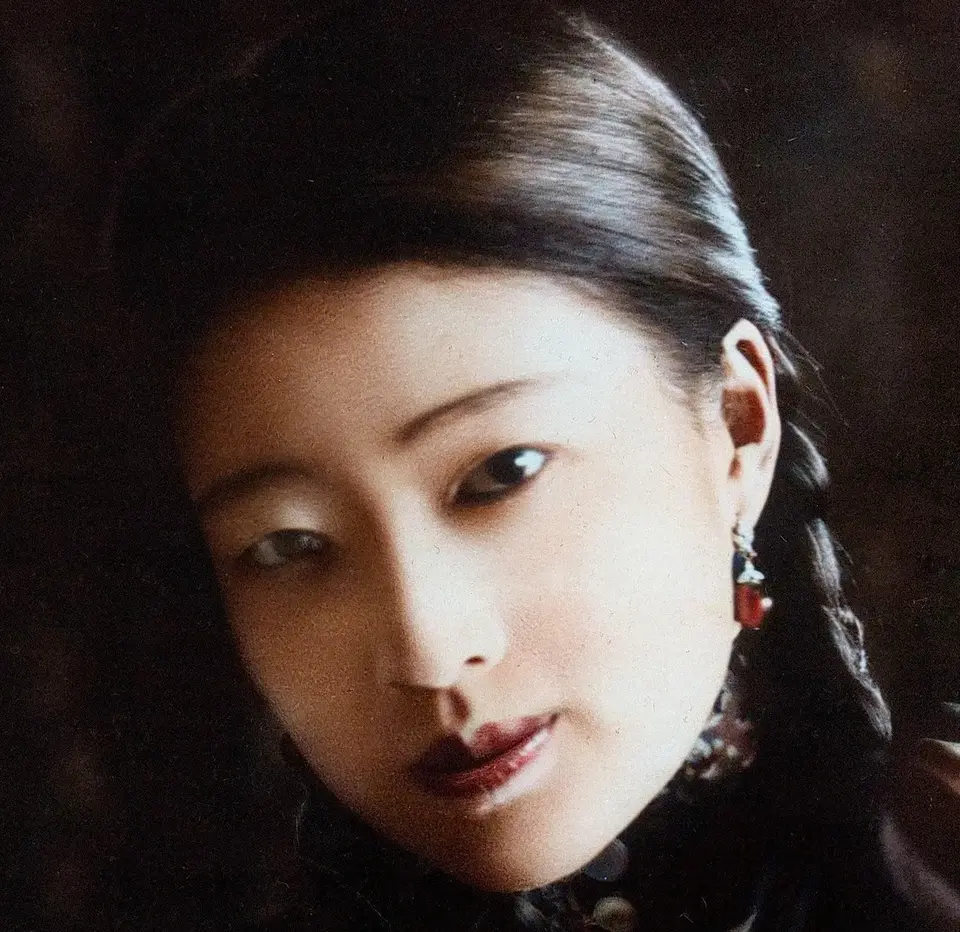
Life Story
Family Heritage and Early Enlightenment
Gobulo Wanrong was born on November 13, 1906, in the Rongyuan family residence located at Mao'er Hutong outside Di'anmen in Beijing. Her ancestral lineage belonged to the Daur people of the Manchu Plain White Banner. Her great-grandfather Changshun had served as the Military Governor of Jilin during the late Qing dynasty, earning distinguished military merit. Her father, Gobulo Rongyuan, served as an expectant intendant of the Ministry of War and later held substantial positions in the Imperial Household Department. Rongyuan possessed an open-minded and cosmopolitan temperament, having traveled widely throughout northern and southern China. Influenced by modern reformist currents, he staunchly advocated gender equality in education, maintaining that daughters deserved an intellectual foundation equal to that of sons. Wanrong's given name and courtesy name Muhong were drawn from Cao Zhi's famed classical poem Ode to the Goddess of the Luo, expressing the ancestral aspiration that she would grow into an elegant, virtuous, and exceptional woman.
Growing up in an affluent environment, Wanrong received loving attention and rigorous instruction from her family. Within the domestic schoolroom, she studied the Confucian classics, history, poetry, calligraphy, and classical guqin alongside her male cousins. Recognizing the growing importance of global engagement, Rongyuan hired an American tutor, Miss Isabel Ingram, to teach her English conversation, Western history, and piano. This dual education endowed Wanrong with both the refined grace of a classical highborn lady and the independent modern demeanor of the early twentieth century. By her mid-teens, she was widely celebrated in Beijing and Tianjin aristocratic circles for her poise, literary talent, and linguistic proficiency.
Palace Selection and Grand Wedding
Following the 1911 Xinhai Revolution and the formal abdication of the Qing emperor in February 1912, the Articles of Favorable Treatment permitted Puyi to retain his imperial title and continue residing within the Forbidden City. As Puyi approached his fifteenth year, senior imperial princes and the surviving dowager consorts began organizing the selection of an empress consort. With Dowager Empress Longyu deceased, internal influence was contested between Dowager Consort Jiyi and Dowager Consort Duankang. Each faction sought to elevate a candidate from their own affiliated circle. Duankang strongly favored Wanrong, praising her pedigree and modern deportment, while Jiyi championed Wenxiu, a girl from an honorable Mongol bannerman family.
Photographs of four prospective candidates were presented to Puyi for imperial confirmation. Facing the small portraits, Puyi initially marked a circle over Wenxiu's picture, causing displeasure to Dowager Consort Duankang. Puyi was subsequently prevailed upon to place another mark on Wanrong's portrait. Because imperial precedent strictly dictated only one primary empress consort, court elders reached a compromise whereby Wanrong was designated empress and Wenxiu was named Consort Shu. In March 1922, the formal decree was announced, and Rongyuan was created a Duke of Chengen of the Third Class according to dynastic precedent.
On December 1, 1922, the grand wedding took place in Beijing. Although the Qing dynasty had been deposed eleven years earlier, the republican authorities permitted the procession to traverse the city using full traditional imperial honors. Street routes were strewn with yellow sand, guarded by police and military units, and accompanied by brass bands and horse-drawn carriages. Wanrong was carried into the Forbidden City in a magnificent thirty-two-bearer imperial palanquin through Donghua Gate. High-ranking republican dignitaries, foreign diplomats, and domestic and foreign journalists gathered to witness the lavish ceremonies, which marked the final imperial nuptials in Chinese history.
Court Life and Philanthropic Endeavors
During the initial phase of their marriage, Wanrong and Puyi developed a cordial relationship grounded in shared interests in modern life and foreign novelties. Wanrong brought a fresh atmosphere into the cloistered Forbidden City. She continued her daily English instruction with Miss Isabel Ingram, read foreign magazines, and enthusiastically embraced modern innovations such as photography and bicycling. However, the rigid court ceremonial, the complex rivalries among inner palace attendants, and Puyi's personal detachment gradually cast a shadow over her daily life, leading to increasing feelings of isolation.
Despite her confined existence, Wanrong demonstrated deep empathy for societal suffering. In the winter of 1923, severe famine and military disruptions displaced tens of thousands of impoverished refugees across northern China, many of whom poured into Beijing. When civic organizations established temporary charity kitchens to distribute steamed corn bread to starving refugees, Wanrong immediately contributed six hundred silver dollars from her personal funds. Her generous gift was widely reported in the press in Beijing and Tianjin, winning widespread public praise for her compassion and social responsibility.
Exile to Tianjin and Modern Transformation
On November 5, 1924, warlord Feng Yuxiang launched the Beijing Coup, unilaterally revising the favorable treatment agreement and commanding that Puyi and his family vacate the palace within two hours. Wanrong hastily packed essential personal items and relocated with Puyi to Prince Chun's mansion. In February 1925, assisted by Japanese diplomats, Puyi fled to the Japanese concession in Tianjin, where Wanrong soon joined him. The couple established residence sequentially at Zhang Garden and Jingyuan Garden.
In the international environment of Tianjin, Wanrong experienced a newfound sense of personal liberation. She discarded cumbersome Qing court robes and heavy headwear, adopted stylish modern hairstyles, and began wearing tailored modern cheongsams paired with high-heeled shoes. She frequently visited luxury department stores, the Astor House Hotel, and social gatherings. However, persistent domestic friction with Consort Shu Wenxiu intensified. In the autumn of 1931, Wenxiu left the residence and publicly filed for divorce in court, an event sensationalized as the Imperial Concubine Revolution. Following the divorce, Puyi harbored deep resentment and blamed Wanrong for the humiliation, causing their relationship to deteriorate irreparably. Facing profound domestic rejection and loneliness, Wanrong turned increasingly to opium to alleviate her distress.
Entrapment in Manchukuo and Strict Confinement
Following the Mukden Incident of September 1931, the Kwantung Army orchestrated Puyi's departure to Manchuria. To compel Wanrong to join him, the Japanese operative Yoshiko Kawashima was dispatched to Tianjin, where she successfully lured Wanrong to Changchun. In March 1932, the puppet state of Manchukuo was proclaimed, with Puyi installed as Chief Executive and Wanrong designated his consort. Upon her arrival, Wanrong discovered that she was surrounded by Japanese surveillance personnel and plainclothes agents. Every action, visitor, and written communication was closely monitored, and she was strictly forbidden from leaving the palace grounds.
Resenting her subjugation as a Japanese captive, Wanrong repeatedly attempted to escape. In August 1932, when Chinese diplomat Wellington Koo visited Dalian with the League of Nations Lytton Commission, Wanrong sent a trusted palace attendant disguised as an antique merchant to meet him in secret. The attendant conveyed her desperate plea for diplomatic aid to escape the Japanese enclosure, noting that she hoped to help Puyi flee once she was safe. Bound by diplomatic protocol and Japanese surveillance, Wellington Koo was unable to intervene directly. In the autumn of 1933, Wanrong secretly arranged with the wife of Zhao Xinbo to flee aboard a vessel traveling to Japan and onward to freedom, but the plot was discovered by imperial relatives and aborted.
In March 1934, Puyi was enthroned as Emperor of Manchukuo, and Wanrong was designated Empress. Yet her conditions only worsened. Subjected to intense psychological isolation and physical constraint, her health deteriorated rapidly. During the mid-1930s, her profound domestic alienation and severe despair culminated in an illicit relationship with a palace attendant. When Puyi discovered her pregnancy in 1935, the resulting child did not survive, and Puyi placed Wanrong under total solitary confinement in Jixi Building. Stripped of all personal autonomy, she remained confined for a decade, consuming vast quantities of opium, suffering severe motor impairment, and experiencing profound mental breakdown.
Tragic Final Days in Yanji
In August 1945, the Soviet military campaign in Manchuria rapidly crushed the Kwantung Army, precipitating the immediate collapse of Manchukuo. Puyi abdicated at Dalizigou near the Korean border and fled to Mukden Airport in an attempt to reach Japan, where he was captured by Soviet forces. Wanrong and other female relatives were left behind in the chaotic frontier region. Hiro Saga, the Japanese wife of Puyi's brother Pujie, along with faithful attendants, cared for the incapacitated empress during the turmoil.
Chinese communist forces soon secured the region and sheltered the imperial family members. Due to shifting military fronts during the Chinese Civil War, Wanrong was transferred through Tonghua to Yanji Prison in Jilin Province. Debilitated by years of opium dependence, extreme malnutrition, and physical exhaustion, Wanrong passed away on June 20, 1946, at the age of forty. Her remains were buried on the slopes of Nanshan near Yanji, though the precise grave location was subsequently lost. In October 2006, through the initiative of her brother Runqi, a ritual reburial of her personal artifacts was conducted beside Puyi's tomb at the Hualong Imperial Cemetery near the Western Qing Tombs in Hebei, bringing symbolic closure to her tumultuous life.
Major Achievements
Philanthropic Contributions and Disaster Relief
Wanrong actively engaged in charitable endeavors during both her court years and her subsequent residence in Tianjin, reflecting a commendable sense of humanitarian responsibility. In December 1923, confronted with severe famine in northern China that sent destitute families fleeing to Beijing, the seventeen-year-old empress donated six hundred silver dollars from her personal allowance to the Temporary Steamed Corn Bread Charity. This financial aid enabled the establishment of emergency soup kitchens that sustained thousands of freezing citizens through the harsh winter, earning her warm praise from civic leaders across northern China.
During the devastating summer floods of 1931, which inundated extensive regions along the Yangtze and Huai rivers across sixteen provinces and displaced millions of civilians, Wanrong took proactive relief action from her Tianjin residence. Despite limited personal resources, she surrendered her most prized possession—a necklace containing one hundred and seventy-two fine natural pearls valued at two thousand five hundred silver dollars—to late Qing scholar Chen Zengshou, instructing him to deliver it to Tianjin's Ta Kung Pao newspaper for auction. The newspaper featured the donation on its front page under the headline 'Madame Pu Haoran Donates Pearls for Disaster Relief,' sparking a major wave of philanthropic giving among wealthy merchants and international donors throughout China.
Vanguard Role in Modern Cheongsam Fashion Reform
As an aristocratic woman who embraced modern aesthetics, Wanrong played a pioneering role in the stylistic evolution of twentieth-century Chinese women's attire. Traditional Manchu women's robes were characterized by rigid, wide silhouettes, heavyweight fabrics, and unslit skirts that concealed the feminine form. In 1932, while living in Changchun, Wanrong resolved to modernize female dress by collaborating directly with master tailor Li Chunfang, formerly of the imperial wardrobe workshops.
Under Wanrong's personal guidance, Li Chunfang incorporated Western three-dimensional tailoring techniques while respecting classical Chinese decorative artistry. The reformed cheongsam was crafted from delicate pale blue satin embroidered with magnolia and butterfly motifs, introducing high side slits and tailored waistlines that accentuated the natural contours of the body while preserving traditional dignity. The design incorporated delicate cloud-patterned borders and refined silk linings. Widely photographed and disseminated through illustrated magazines, Wanrong's modernized gowns were quickly embraced by fashionable women in Shanghai and major urban centers, providing a foundational aesthetic template for the iconic modern haipai qipao.
Resistance and Escape Initiatives Under Japanese Occupation
Throughout her confinement in Changchun following the 1931 Mukden Incident, Wanrong refused to passively submit to Japanese domination and undertook several daring attempts to regain her liberty. In the early phase of Manchukuo, recognizing that the Kwantung Army intended to reduce the imperial household to complete geopolitical servitude, she actively sought external diplomatic assistance. When senior republican diplomat Wellington Koo arrived in Dalian accompanying the League of Nations investigation, Wanrong bypassed Japanese sentries by dispatching an internal palace servant disguised as a merchant to deliver an urgent verbal plea, seeking an escape route through Chinese diplomatic channels.
Even after that initiative proved impossible due to international constraints, Wanrong persisted in seeking escape. In late 1933, she enlisted the cooperation of the wife of Manchukuo legislative official Zhao Xinbo, developing a plan to travel clandestinely to Japan and subsequently depart for safe territory. Although both attempts were thwarted by imperial informants and Japanese military police, her consistent efforts to break free from Japanese captivity demonstrated remarkable personal courage and a refusal to willingly serve as a puppet for foreign occupation forces.