Age 1 | Born in Yangxia, Chen Commandery, present-day Taikang, Henan.
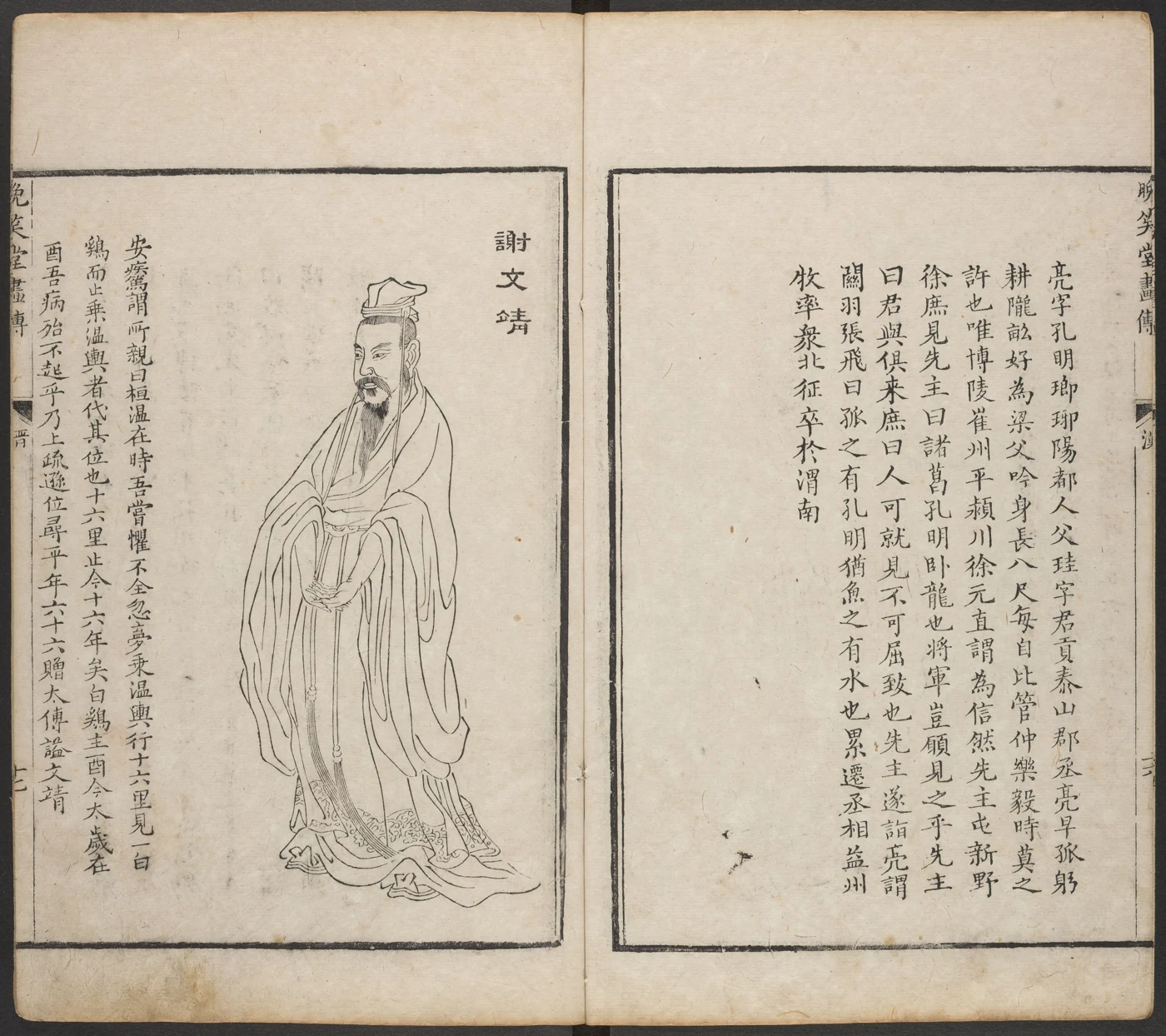
320 CE–385 CE
Officialstatesman
Xie An
谢安
Xie An (320–October 12, 385), courtesy name Anshi, was from Yangxia in Chen Commandery (present-day Taikang County, Henan). He was an Eastern Jin statesman and military leader from the aristocratic Xie clan of Chen Commandery and was the third son of Xie Pou, who served as Minister of Ceremonies. In his early years Xie An lived in retirement at Eastern Mountain in Kuaiji and repeatedly declined official appointments. Only…
320 CE–385 CEEastern Jin
PROFILE
Xie An (320–October 12, 385), courtesy name Anshi, was from Yangxia in Chen Commandery (present-day Taikang County, Henan). He was an Eastern Jin statesman and military leader from the aristocratic Xie clan of Chen Commandery and was the third son of Xie Pou, who served as Minister of Ceremonies. In his early years Xie An lived in retirement at Eastern Mountain in Kuaiji and repeatedly declined official appointments. Only after his younger brother Xie Wan was defeated in a northern campaign and stripped of office in 359 did Xie An enter public service in 360, giving rise to the idiom “returning from the Eastern Mountain.” He successively served as governor of Wuxing, Attendant, Minister of Personnel, Vice Director of the Department of State Affairs, governor of Yangzhou, Director of the Secretariat, and Supervisor of the Department of State Affairs. During the Battle of Fei River, he acted as Eastern Jin's overall strategist; the Jin army, stated in the source as numbering eighty thousand, defeated a Former Qin army popularly said to number one million. Jin forces then launched a northern expedition and recovered extensive territory south of the Yellow River. During his administration, Xie An pursued a conciliatory and relatively lenient approach toward competing aristocratic families, helping produce a rare period of internal cooperation within Eastern Jin. He died in 385, the tenth year of the Taiyuan era, aged sixty-six, was posthumously appointed Grand Tutor, and received the posthumous title Wenjing.
- Other names
- Xie Anshi; Grand Tutor Xie
- Courtesy name
- Anshi
- Period
- Eastern Jin
- Date of Birth
- 320
- Date of Death
- October 12 385
- Dynasty / polity
- Eastern Jin
- Identity
- Official; statesman
- Ethnicity / group
- Not recorded in historical sources
- Ancestral home
- Yangxia, Chen Commandery (present-day Taikang County, Henan)
- Birthplace
- Not known
- Principal achievements
- Leading statesman of Eastern Jin and head of the Xie clan of Chen Commandery; directed strategy for victory at the Battle of Fei River and became associated with the idiom “returning from the Eastern Mountain.”
LIFE TIMELINE
Age 4 | The notable Huan Yi saw him and predicted that his bearing would one day equal that of Wang Cheng.
Age 7 | Already known for calm intelligence, graceful bearing, and skill in running-script calligraphy.
Age 16 | Enjoyed a strong reputation in youth and was highly regarded by Wang Meng and Wang Dao.
Age 17 | First summoned to the office of the Minister over the Masses and appointed Assistant Compiler, but declined on grounds of illness.
Age 20 | Retired to Eastern Mountain in Kuaiji and associated with Wang Xizhi, Xu Xun, Zhi Daolin, and others.
Age 26 | Pressed by Yu Bing, governor of Yangzhou, to accept office; resigned and returned home after a little more than a month.
Age 28 | Declined summons to become a Gentleman of the Department of State Affairs and Friend to the Prince of Langya.
Age 34 | Participated with Wang Xizhi and forty other men in the Lanting purification gathering and composed two Lanting poems.
Age 40 | His younger brother Xie Wan's northern expedition failed and Xie Wan was reduced to commoner status, weakening the Xie clan's position.
Age 41 | Accepted an invitation from Huan Wen, General-in-Chief Who Conquers the West, to serve as his army marshal; later associated with the phrase “return from Eastern Mountain.”
Age 42 | Xie Wan died; Xie An requested leave for mourning and later became governor of Wuxing.
Age 47 | Summoned as Attendant; later became Minister of Personnel and Central Protector of the Army.
Age 52 | Huan Wen deposed the Duke of Haixi and installed Emperor Jianwen; Xie An and Wang Tanzhi maneuvered against Huan Wen.
Age 53 | During Emperor Jianwen's final illness, Huan Wen recommended Xie An as a regent; after the emperor's death, Xie An and Wang Tanzhi thwarted Huan Wen's attempt to seize power.
Age 54 | Calmly confronted Huan Wen at Xinting and helped avert a killing; Huan Wen died and the planned Nine Bestowments were abandoned.
Age 54 | Promoted to Vice Director of the Department of State Affairs, concurrently supervised personnel matters, added the title General of the Rear, and governed jointly with Wang Biaozhi.
Age 57 | As Emperor Xiaowu began personal rule, promoted to Director of the Secretariat and Supervisor of the Department of State Affairs, exercising overall direction of government.
Age 58 | Recommended his nephew Xie Xuan as governor of Yanzhou; Xie Xuan subsequently organized the Beifu Army.
Age 59 | Former Qin attacked Xiangyang; the Huainan campaign followed, and Xie Xuan's Beifu forces won four successive victories.
Age 64 | Battle of Fei River: Xie Shi served as commander-in-chief at the front and Xie Xuan as vanguard; eighty thousand Jin troops defeated the much larger Former Qin army described in the source as numbering one million.
Age 65 | Launched a northern expedition and recovered extensive territory south of the Yellow River.
Age 66 | In the fourth lunar month requested assignment to Guangling; returned to the capital gravely ill in the eighth lunar month and died in Jiankang on the dingyou day, October 12.
Age 66 | In the tenth lunar month was posthumously enfeoffed as Duke of Luling Commandery and given the posthumous title Wenjing.
BIOGRAPHY
Biography
Family Background and Early Life
Xie An was born into the Xie clan of Chen Commandery. His father Xie Pou rose to the office of Minister of Ceremonies. After the Disaster of Yongjia, the Xie clan moved south with the Jin court and by Xie An's birth had become an important émigré aristocratic lineage. When Xie An was four, the notable Huan Yi praised him, saying that the child's clear and distinguished bearing would one day be no less than that of Wang Cheng. The source says that from childhood he was calm and perceptive, graceful in bearing, and skilled in running-script calligraphy.
As a young man Xie An was highly regarded by Wang Meng and the chancellor Wang Dao and already possessed considerable social standing. The Book of Jin records that when the young Xie An visited Wang Meng, the two engaged in extended “pure conversation.” Wang Meng's son Wang Xiu later asked how the visitor compared with his father, and Wang Meng praised Xie An's unflagging conversation and imposing intellectual presence. Wang Dao likewise valued him highly. Xie An, however, was unwilling to pursue high office on the strength of family background and reputation. When the court first summoned him to the office of the Minister over the Masses and appointed him Assistant Compiler, he declined on grounds of illness.
Retirement on Eastern Mountain
After refusing official summons, Xie An withdrew to Eastern Mountain in Kuaiji Commandery, where he frequently associated with Wang Xizhi, Xu Xun, Zhi Daolin, and other notable laymen and monks. The source says that he fished and hunted outdoors and composed poetry and prose at home while refusing office. Yu Bing, governor of Yangzhou, admired his reputation and repeatedly ordered local officials to press him to accept a post. Xie An reluctantly complied but resigned after little more than a month and returned to Kuaiji. Later summons to become a Gentleman of the Department of State Affairs and Friend to the Prince of Langya were all refused. Fan Wang, Minister of Personnel, recommended him as Personnel Gentleman, but Xie An declined by letter. Officials eventually memorialized that, after years of ignoring summons, he should be barred from office for life; Xie An then continued to wander among scenic places in the east.
The source relates that Xie An once sat in a stone cave on Lin'an Mountain facing a deep ravine and remarked that the feeling was not unlike that of the recluse Boyi. On another occasion he went sailing at sea with Sun Chuo and others. When wind and waves rose, the others panicked, but Xie An remained calm and chanted at ease. The boatman, seeing him apparently enjoying himself, continued onward. When the storm grew stronger, Xie An quietly asked how they would return in such wind; the boatman immediately turned back. His companions admired his composure. Although devoted to landscape and leisure, Xie An was also said to take singing women along on excursions.
Sima Yu, Prince of Kuaiji and then chief minister, observed that if Anshi could share others' pleasures he must also be capable of sharing their troubles and predicted that another summons would eventually bring him out. At the time Xie An's younger brother Xie Wan, General of the Western Center and governor of Yuzhou, held major frontier responsibility. Although Xie An remained in retirement, his reputation exceeded Xie Wan's and he was widely considered capable of becoming chief minister. He also regularly instructed younger members of the family in ritual conduct.
“Returning from Eastern Mountain” and Service under Huan Wen
In 359, the third year of Shengping, Xie Wan and Xi Tan, General of the Northern Center, launched a two-pronged northern expedition against Former Yan. Xie Wan failed to reassure his soldiers and mistakenly believed that the enemy had arrived, causing his men to panic and collapse; he fled back alone and was soon reduced to commoner status. This seriously weakened the Xie clan's political position. Xie An, already over forty, only then began to show a serious desire for office.
In 360 he accepted an invitation from Huan Wen, General-in-Chief Who Conquers the West, to serve as army marshal. As Xie An departed from Xinting in Jiankang, officials came to see him off. Gao Song, Palace Aide to the Censor-in-Chief, joked that Xie An had repeatedly disobeyed court summons and “slept high on Eastern Mountain,” so people had long wondered how Xie Anshi could face the people of Jiangdong if he refused to come out; now, how would the people of Jiangdong face Xie Anshi after he finally came out? Xie An was reportedly embarrassed. Huan Wen was delighted when he arrived, and the two talked and laughed all day. After Xie An left, Huan Wen asked his attendants whether they had ever seen him treat another guest in such a way. On another visit, Huan Wen arrived while Xie An was arranging his hair. Because Xie An was slow by nature, it took a long time; when an attendant reached for his headcloth, Huan Wen stopped him and said that the army marshal should finish dressing before meeting him. The anecdote is presented as evidence of Huan Wen's regard for Xie An.
In 361, as Huan Wen prepared another northern campaign, Xie Wan died. Xie An used the occasion to request leave for mourning and departed from Huan Wen's staff. He was soon appointed governor of Wuxing. His reputation in office was ordinary, but after his departure people remembered him fondly. He was later summoned as Attendant and promoted to Minister of Personnel and Central Protector of the Army.
Thwarting Huan Wen's Attempt to Seize the Throne
In 371, the first year of Xian'an, Huan Wen had suffered a severe defeat at the Battle of Fangtou. Seeking to restore his prestige, he followed Xi Chao's advice, deposed Sima Yi, Duke of Haixi, and installed the chancellor Sima Yu as Emperor Jianwen. In 372, after less than a year on the throne and distressed by Huan Wen's dominance, Emperor Jianwen became gravely ill. Huan Wen memorialized recommending Xie An to receive the dying emperor's trust. After Emperor Jianwen died, Huan Wen came to attend the imperial burial and halted at Xinting with a large military escort, intending, according to the source, to transfer the Jin throne to himself. He summoned Xie An and Wang Tanzhi, planning to kill them at the gathering. Wang Tanzhi was terrified and asked Xie An what to do. Xie An remained calm and said, “Whether the Jin dynasty survives or falls depends on this journey.”
In 373, the first year of Ningkang, Huan Wen entered the capital to attend the newly enthroned Emperor Xiaowu, Sima Yao. Empress Dowager Chu Suanzi ordered Xie An and Attendant Wang Tanzhi to welcome him at Xinting. Rumors in Jiankang said Huan Wen intended to kill them. Wang Tanzhi was extremely nervous, but Xie An remained composed. Huan Wen arrived with heavy guards, and prominent officials present were frightened; Wang Tanzhi sweated so heavily that he even held his audience tablet upside down. Xie An alone sat calmly. After taking his seat, he told Huan Wen that he had heard that when the feudal lords followed the Way, their defense lay at the four borders, and asked why Huan Wen needed armed men behind the walls. Huan Wen laughed, replied that circumstances made it unavoidable, and ordered the guards removed. He then talked and laughed with Xie An for a long time. The source credits Xie An's composure and quickness with preventing Huan Wen from killing either man, after which Huan Wen withdrew to Gushu. Although Wang Tanzhi and Xie An had previously enjoyed equal reputations, people now judged Xie An superior.
In the third lunar month of the same year, Huan Wen became gravely ill and hinted that the court should grant him the Nine Bestowments. Yuan Hong, a Personnel Gentleman, drafted the memorial. Xie An repeatedly revised it and allowed more than ten days to pass. Huan Wen died before the document was completed, and the issue was abandoned.
Direction of Government
Two months after Huan Wen's death, Xie An was promoted to Vice Director of the Department of State Affairs, placed in charge of personnel, given the additional title General of the Rear, and governed jointly with Director Wang Biaozhi. In 376, the first year of Taiyuan, Xie An wanted the imperial in-law Wang Yun to take an external command and arranged for Huan Wen's younger brother Huan Chong to leave the governorship of Xuzhou, with Wang Yun replacing him. The court ordered Xie An to supervise the Secretariat. To ease tensions and stabilize the political order, Xie An pursued a long-term policy emphasizing accommodation and stability. Huan Chong, recognizing that his prestige was inferior to Xie An's, willingly concentrated on frontier defense. Xie An in turn entrusted Huan Chong with military authority over Xuzhou, Yuzhou, Yanzhou, Qingzhou, and Yangzhou and the governorship of Xuzhou at Jingkou, later transferring him to military authority over seven provinces and the governorship of Jingzhou. Although Xie An retained some suspicion of Huan Chong, the arrangement largely achieved the balance summarized in the phrase “when Jingzhou and Yangzhou counterbalance one another, the realm is at peace,” allowing them to confront Former Qin jointly.
The source portrays Xie An as governing with benevolence, assisting the court and guiding officials. Even Sima Daozi, Prince of Kuaiji, relied on his mediation. Former Qin meanwhile pressed the frontier and urgent military reports arrived repeatedly as Liangzhou, Yizhou, and other regions fell. Xie An remained outwardly calm and planned for the long term, using leniency to stabilize both the court and the provinces. Contemporary observers compared him with Wang Dao and judged him even more refined in literary culture.
When palace buildings at Jiankang were damaged, Xie An wished to repair them. Wang Biaozhi and others opposed the project because of foreign military threats, but Xie An proceeded. The buildings were designed, according to the source, to correspond with celestial patterns and the position of the North Star, and the laborers reportedly did not complain. In the same year Xie An concurrently became governor of Yangzhou and was permitted to enter the palace with one hundred armed guards. As Emperor Xiaowu began personal rule, Xie An was promoted to Director of the Secretariat, General of Agile Cavalry, and Supervisor of the Department of State Affairs, but firmly declined the cavalry generalship. Amid abnormal celestial phenomena and successive droughts, he memorialized in favor of restoring extinguished noble houses and locating descendants of meritorious founders of the Jin for renewed honors.
The Battle of Fei River and the Northern Expedition
In the seventh lunar month of 377, the court added the title Minister over the Masses to Xie An and upgraded the residences of the civil and military officers under his Rear Army command, but he declined the honor. The court then made him Attendant and military commander over Yangzhou, Yuzhou, Xuzhou, Yanzhou, Qingzhou, and Yan within Youzhou, with a provisional imperial tally.
Former Qin had grown increasingly powerful under Fu Jian, while Jin forces had often been at a disadvantage. Because Guangling lacked a capable commander, Xie An strongly recommended his own nephew Xie Xuan as governor of Yanzhou despite criticism of favoritism. Xie Xuan was stationed at Guangling and given responsibility for defenses north of the lower Yangzi, while Xie An exercised overall military authority over the lower Yangzi region. At Guangling, Xie Xuan selected capable officers and trained elite troops, including Liu Laozhi and He Qian, building the force later known as the Beifu Army, described by the source as among the strongest troops in China at the time.
In the fourth lunar month of 378, Former Qin's General-in-Chief Who Conquers the South, Fu Pi, led seventy thousand infantry and cavalry against Xiangyang. Fu Jian sent more than one hundred thousand additional troops in three columns, bringing the force described by the source to 170,000. Defender Zhu Xu held out for nearly a year, but Xiangyang fell in the second lunar month of 379. Fu Jian also sent Peng Chao against Pengcheng, beginning the Qin–Jin fighting in Huainan. Xie An prepared defenses at Jiankang and ordered Xie Xuan to march from Guangling with fifty thousand Beifu troops. Xie Xuan won four successive battles and destroyed the Qin force. Xie An was promoted for this victory to Duke of Jianchang County, while Xie Xuan became Marquis of Dongxing County.
In the fifth lunar month of 383, Huan Chong led one hundred thousand Jingzhou troops against Qin to divert enemy strength. Fu Jian sent Fu Rui, Murong Chui, Yao Chang, Murong Wei, and others to respond, while Fu Jian himself launched a major southern invasion in the eighth lunar month with forces described as six hundred thousand infantry and 270,000 cavalry and placed his younger brother Fu Rong in the vanguard. Xie An was charged with the crisis. He appointed Xie Shi commander-in-chief at the front, Xie Xuan vanguard commander, and together with Xie Yan, Huan Yi, and others deployed eighty thousand troops in three columns. In the eleventh lunar month Xie Xuan sent Liu Laozhi with five thousand elite soldiers in a surprise attack at Luojian, inflicting heavy losses on the Qin forces. In the twelfth lunar month the armies met at Fei River. Xie Xuan, Xie Yan, and Huan Yi led seventy thousand Jin troops against the 150,000 Former Qin troops under Fu Jian and Fu Rong and killed Fu Rong in battle. The Battle of Fei River ended in a decisive Jin victory.
The source credits Xie An's advance planning as a major factor in the victory and emphasizes his deliberate composure, from the story of wagering a villa over a game of go before the battle to his remark afterward that “the young fellows have thoroughly defeated the bandits.” His calm helped steady opinion in Jiankang. Because the principal field commanders—Xie Shi, Xie Xuan, and Xie Yan—were members of his own family, the Xie clan's prestige reached its height, prompting suspicion from the Sima imperial house. Rewards for the victory were delayed, and only after Xie An's death two years later did Emperor Xiaowu posthumously enfeoff him as Duke of Luling Commandery for his contribution at Fei River.
Later Years and Death
Huan Chong died soon after the Battle of Fei River and entrusted the younger members of the Huan family to Xie An. To preserve the balance between Jingzhou and Yangzhou, Xie An declined the opportunity to place Xie Xuan over both Jingzhou and Jiangzhou and instead appointed members of the Huan family, easing relations between the Huan and Xie clans and stabilizing the rear for the major northern expedition that followed.
In the eighth lunar month of 384, the ninth year of Taiyuan, Xie An launched the northern expedition. In the east, Xie Xuan led the Beifu Army north from Guangling and recovered Yanzhou, Qingzhou, Sizhou, and Yuzhou. In the central and western routes, Huan forces captured Luyang and Luoyang and recovered Liangzhou and Yizhou. The source states that the pre-Fei River frontier along the Huai, Han, and Yangzi rivers was thereby pushed north to the Yellow River, bringing the entire region south of the Yellow River back under Jin control.
As victories continued, the Sima imperial family and some officials became suspicious of Xie An, and some contemporaries wondered whether he might usurp power like Wang Mang. Xie An, whose habitual stance was retirement from power, voluntarily relinquished authority. In the fourth lunar month of 385 he requested assignment to Guangling to direct the northern campaign. Soon Liu Laozhi was defeated at Ye by Murong Chui, forcing Xie An to adjust strategy from further attack to consolidation of the Yellow River defensive line.
In the eighth lunar month Xie An became gravely ill and returned from Guangling to the capital for treatment, entering Jiankang through the Western Province Gate. He died on the dingyou day of the eighth lunar month, October 12, 385, at the nominal age of sixty-six. Emperor Xiaowu held mourning at court for three days and granted him the highest grade of imperial coffin fittings, a court robe, a set of clothing, one million cash, one thousand bolts of cloth, and five hundred jin of wax. He was posthumously appointed Grand Tutor and given the title Wenjing. Because Xie An owned no private residence, the emperor ordered the government to arrange the funeral. Special honors modeled on the precedent for Huan Wen were granted at burial. In recognition of his contribution against Fu Jian, he was posthumously enfeoffed as Duke of Luling Commandery on December 1, 385.
The Years at East Mountain and His Entry into Office
Of Xie An's early retirement the histories preserve a good many particulars. Living at Kuaiji with Wang Xizhi, Xu Xun of Gaoyang and the monk Zhi Dun, he "fished and hunted in the hills and waters abroad, and talked and wrote verse at home, with no thought of the world." Yu Bing, governor of Yangzhou, thinking his fame too great to leave unused, pressed him through the commandery and county offices again and again, and Xie An, unable to refuse, went, only to take his leave after a month; the court then appointed him to the imperial secretariat and to the household of the prince of Langya, and he declined both. When Fan Wang, president of the board of civil office, proposed him for the office of assistant, Xie An refused by letter. The officials reported that he had been summoned and had not come for years, and he was forbidden office for life, and so remained in the east. He once sat in a stone chamber in the hills at Lin'an, looking down into a deep valley, and said with a sigh, "How far is this from Boyi?" and once went to sea with Sun Chuo and others, when "the wind rose and the waves surged and all were afraid, while An sang and whistled as if nothing were happening"; the boatmen, taking his pleasure for wish, rowed on, and only when the wind freshened did he say quietly, "At this rate, how shall we get back?" at which they turned at once, and all admired his composure — though the history also notes that, for all his delight in the hills, he never went on an excursion without taking singing girls with him.
When Jianwen was chancellor he said: "Since Anshi shares men's pleasures, he will surely have to share their sorrows; call him and he will come." At that time Xie An's younger brother Xie Wan was general of the western column, holding the weight of a frontier command, and Xie An, though living in a poor house, "had a name above Wan's and naturally the standing of a chancellor, and at home always instructed the young in propriety." Xie Wan's northern campaign was marked by posturing: he "took pride in whistling and chanting and never comforted his officers," and Xie An, knowing he would fail, went with him and advised him gently to call the officers to banquets and win their hearts; Xie Wan gathered them, had nothing to say, and only pointed at the company with his ruyi sceptre and said, "You gentlemen are all sturdy soldiers," at which they were much aggrieved, and the army indeed scattered, Xie Wan fleeing back alone, and only regard for Xie An kept the troops from killing him. When he was called to office, the officials saw him off at Xinting, where the censor Gao Song teased him: "You have defied the court's commands these many times, lying at ease on East Mountain, and men have said among themselves, 'Anshi will not come out — what of the people?' What now will the people do with you?" at which Xie An was much ashamed. Huan Wen was delighted with him and talked with him all day of his life; when Xie An had gone, Huan Wen asked those about him, "Have you ever seen me with a guest like this?" Huan Wen once came to Xie An's lodging while he was doing his hair, and Xie An, being slow by nature, took a long time; Huan Wen stopped the attendant and said, "Let the marshal put on his cap before he comes," so highly did he regard him. There is also the famous jest of the herb: when someone sent Huan Wen medicinal plants among them "the far ambition," Huan Wen asked Xie An why the same plant was also called "small grass," and Hao Long, sitting by, answered at once, "Dwelling in the hills it is the far ambition; come out of the hills and it is small grass," at which Xie An was much ashamed. When Huan Wen went north on campaign Xie Wan died of illness, and Xie An sent in a note asking to go home, and was made governor of Wuxing, where "in office he had no praise of the day, and after he left men thought of him."
Thwarting Huan Wen and the Years in Power
When Jianwen was gravely ill, Huan Wen memorialized that Xie An should receive the charge of the dying emperor; and after the emperor's death Huan Wen came to the funeral, halted at Xinting and displayed his guards, meaning to transfer the throne, and called Xie An and Wang Tanzhi with the intent of killing them where they sat. Wang Tanzhi was much afraid and asked Xie An for counsel, and Xie An's colour did not change: "The survival of the Jin house depends on this one journey." When they met Huan Wen, Wang Tanzhi's sweat soaked his clothes and he held his tablet upside down, while Xie An took his seat at leisure and, once seated, said to Huan Wen: "I have heard that a prince who has the Way keeps his guards on the four borders; what need, my lord, to station men behind the wall?" Huan Wen laughed and said, "I could not well do otherwise," and had the men withdrawn, and jested with Xie An for the rest of the day. Afterwards, when Huan Wen lay dying, he hinted that the court should grant him the nine bestowals, and had Yuan Hong draft the document; Xie An, on seeing it, amended it each time, so that ten days passed and it was not done, and when Huan Wen died the grant lapsed. The history says that "An and Tanzhi loyally supported and aided him, and in the end brought peace."
In power, Xie An followed a course that looked to the long term and prized harmony and stability. Huan Chong, understanding the matter well and holding his own virtue and standing below Xie An's, was content to take the defence of the frontiers as his task; Xie An made Huan Chong commander of the military affairs of Xu, Yu, Yan, Qing and Yang and governor of Xu, stationed at Jingkou, and later commander of seven provinces. When the Former Qin raided the frontier and urgent reports came in daily, with Liang and Yi lost one after another, Xie An "steadied each crisis with peace and quiet and met it with long reckoning"; his good government once in train, "civil and military gave him their lives, he took no note of small faults and held to the great lines," and men compared him with Wang Dao and thought him the more elegant. When the palace at Jiankang fell into disrepair and he wished to restore it, Wang Biaozhi and others remonstrated on the ground of the foreign enemy, and Xie An would not listen but decided it himself; when the work was done "it took its pattern from the heavens and matched the pole star, and the labour brought no complaint." In a time of strange signs and years of drought he memorialized that fallen marquisates and old noble houses be revived and the descendants of the founding ministers of Jin sought out and enfeoffed. In the seventh month of 377 the court made him minister of education, with all the civil and military officers of the rear army assigned to a great establishment, and he declined. These measures looked to winning men's hearts and holding the balance among the great clans, and it was on this that he was able to call in the crisis at Fei river.
Before and After the Fei River, and His End
Before the battle of the Fei river, Xie An's composure left its two most famous records. First, when Xie Xuan came to ask his plan, Xie An "showed no fear whatever" and answered only, "There is another instruction"; and when Xie Xuan dared not ask again and sent Zhang Xuan, Xie An had his carriage brought and went out to his country villa, where kinsmen and friends gathered and he played go with Xie Xuan staking the villa — he was ordinarily the weaker player, but Xie Xuan's mind was unsteady that day and lost; Xie An turned to his nephew Yang Tan and said, "I give the villa to you," then went walking in the hills and returned only at night, when he "assigned the generals their posts, each to what he could do." Second, Huan Chong, in Jingzhou, deeply anxious for the capital, sent three thousand picked troops to Jiankang, and Xie An, holding that three thousand could make no difference and wishing "to show leisure abroad," refused them outright with the message that "the court's dispositions are made, arms and armour are not lacking; the western marches should look to their own defence." Huan Chong sighed to his staff: "Xie An has the measure of a court, but no skill in war. With the great enemy at hand he has no leisure but for talk; he sends boys without experience and his force is small and weak — the empire's business can be known, and we shall be wearing our coats to the left!" When the news of the victory came, Xie An was playing go with a guest; he read it and laid it by his seat without a change of colour and played on, and when the guest asked, he said lightly, "The children have beaten the enemy." Only when the game was over and the guest had gone did his joy overcome him, so that "crossing the threshold he did not notice that the teeth of his clogs were broken." For his command of all the armies he was promoted to grand guardian, and then memorialized for a northern campaign, being made commander of the military affairs of fifteen provinces with the yellow axe.
Huan Chong died soon after the battle, and Jing and Jiang being both without governors, opinion held that Xie Xuan's merit and standing deserved them; but Xie An, fearing that a father and son both of great service would draw the court's suspicion, and fearing too that the Huan clan would resent the loss, made Huan Shihmin governor of Jingzhou, moved Huan Yi to Jiangzhou and Huan Shiquan to Yuzhou, "so that the three Huans held the three provinces, each without fear, each equal to his post," steadying the rear for the great northern campaign that followed. But Sima Daozi, prince of Kuaiji, held power, and men of greed and crookedness, seeing Xie An's fame at its height, worked against him, so that suspicion grew between him and the emperor. The history records that when Emperor Xiaowu feasted Huan Yi with Xie An in attendance, Huan Yi played the zither and sang the "Poem of Resentment": "To serve as lord is hard indeed, to serve as minister is hard alone. When loyal faith is not made plain, then comes the fear of being doubted. The Duke of Zhou aided Wen and Wu, his merit in the metal-bound coffer is not worn away. He gave his heart to the king's government, and the two uncles spread slander of him." The song was vehement and moving, and Xie An wept into his collar, then left his mat and went to Huan Yi and, stroking his beard, said, "You have shown yourself uncommon in this!" and the emperor looked ashamed. Afterwards Xie An gave up his power of his own accord and asked to be posted to Buqiu in Guangling, where he built a fort called Xincheng to avoid trouble; the emperor feasted him at the West Pool and offered him wine and verse. "Though he held the court's charge, his purpose of East Mountain was unchanged to the end, and often showed in his words and looks"; at Xincheng he took his whole household and built sea-going boats and gear, meaning, when the realm was somewhat settled, to return east by water. Soon he fell gravely ill and memorialized that the army be halted as the times required, calling his son Xie Yan to lay down arms and ordering Zhu Xu to occupy Luoyang with Xie Xuan to direct the Peng and Pei front. By his own account he dreamed that he rode in Huan Wen's carriage for sixteen li and stopped at a white cock, which he read as meaning that he had held Huan Wen's place for sixteen years and that the white cock, being of the you sign, with the year star then in you, was an evil omen; and so he asked to resign. In the eighth month of 385 Xie An died at Jiankang at the age of sixty-six. Emperor Xiaowu mourned in the hall for three days and gave him the imperial coffin and a suit of court dress, a hundred myriads of cash, a thousand bolts of cloth and five hundred catties of wax, with the posthumous title grand tutor and the name Wenjing; as he had no private house, the court ordered the funeral rites prepared in his office, and he was buried with special honours after the precedent of the great marshal Huan Wen, and further enfeoffed as duke of Luling for his merit against Fu Jian. Under the Liu Song his descendants' fief was reduced, the duke of Luling becoming duke of Chaisang county with a thousand households, "to maintain the sacrifices to the late chancellor Wang Dao, grand tutor Xie An, general Wen Qiao, marshal Tao Kan and cavalry general Xie Xuan." His tomb was first at Meigang; after it was damaged, Xie Yiwu, a descendant and magistrate of Changcheng, gathered the bones and moved them to Sanyagang, and it was restored in Tang, Song and Ming times and again in 1799 by the magistrate Xing Shu and the descendant Xie Qikun, then governor of Guangxi, who rebuilt the tomb and the grand tutor's temple; the tomb and temple were destroyed in the Cultural Revolution, leaving only two steles, and have since been restored. The shore of East Mountain Lake at Shangyu in Zhejiang is held to be the place of his retirement, where his cenotaph, stele and the pool where he washed his clogs remain, and from which the phrase "rising again from East Mountain" derives; and Wuyi Lane at Nanjing, a barracks of the Wu garrison at Shitou in the Three Kingdoms, became in the Eastern Jin the residential quarter of the Wang and Xie and other great houses.
Major Activities
Battle of Fei River
In 383 Former Qin ruler Fu Jian led the huge southern invasion described above. Xie An appointed Xie Shi commander-in-chief at the front, Xie Xuan vanguard commander, and sent Xie Yan, Huan Yi, and others with eighty thousand troops in three columns. Liu Laozhi's five-thousand-man surprise attack at Luojian was followed by the main battle at Fei River, where the Jin force defeated the Former Qin army and killed Fu Rong. The source emphasizes Xie An's composure both before and after the battle and its importance in maintaining morale at Jiankang.
Northern Expedition into the Central Plains
In the eighth lunar month of 384, Xie An launched the northern expedition. Xie Xuan's eastern army recovered Yanzhou, Qingzhou, Sizhou, and Yuzhou; Huan forces in the central and western routes took Luyang and Luoyang and recovered Liangzhou and Yizhou. The source states that Jin control again extended over the region south of the Yellow River.
Mediating Aristocratic Conflict
After Huan Wen's death, Xie An worked to ease tension between the Jin imperial house and the Huan clan. In 374, according to the source, he first recovered Xuzhou and Yanzhou from Huan influence by sending Wang Tanzhi out as their governor, then induced Huan Chong to relinquish Yangzhou and take Jingzhou while Xie An himself controlled Yangzhou. This produced the strategic balance summarized as “when Jingzhou and Yangzhou counterbalance one another, the realm is at peace” and secured the Huan clan's cooperation in frontier defense.
Recommending Xie Xuan and Forming the Beifu Army
In 377, because Guangling lacked a capable commander, Xie An strongly recommended his nephew Xie Xuan as governor of Yanzhou. Xie Xuan recruited and trained elite troops at Guangling, including Liu Laozhi and He Qian, forming the force later known as the Beifu Army.
Literature and Calligraphy
Xie An studied running-script calligraphy with Wang Xizhi and was regarded as highly skilled. Mi Fu later praised his calligraphy for combining the refined spirit of mountains and forests with the bearing of a statesman, developing an unforced archaic quality rather than merely imitating Zhong You or Wang Xizhi. Xie An composed two Lanting poems at the Orchid Pavilion gathering and a poem addressed to Wang Huzhi also survives.
Association with Notable Men
During his retirement at Eastern Mountain, Xie An frequently associated with Wang Xizhi, Xu Xun, Zhi Daolin, and others, fishing and hunting outdoors and composing poetry and prose at home. In 353 he joined Wang Xizhi and forty other men at the Lanting purification gathering, where the participants floated cups along a winding stream and composed poems.
Thwarting Huan Wen's Usurpation
In 372, during Emperor Jianwen's final illness, the source says Xie An and Wang Tanzhi pressed the emperor to revise his testament, preventing an intended transfer of power to Huan Wen. Huan Wen later entered the capital with troops and was rumored to intend killing them. Xie An remained composed at Xinting and asked why a ruler of Huan Wen's standing needed guards hidden behind the walls. Later, when Huan Wen hinted that he should receive the Nine Bestowments, Xie An delayed Yuan Hong's memorial by repeatedly revising it until Huan Wen died and the matter lapsed.
“Returning from Eastern Mountain”
After Xie Wan's disastrous northern expedition in 359, the Xie clan no longer had a major representative at court. Xie An therefore emerged from retirement and entered Huan Wen's staff as army marshal in 360, an episode associated with the later idiom “returning from Eastern Mountain.”
The Northern Garrison Army and the Campaign in Huainan
One of Xie An's great acts in the use of men was to recommend his own nephew Xie Xuan, against the talk of others, as governor of Yanzhou and defender of Guangling on the north bank of the lower Yangtze. The court, then anxious about Former Qin, had called for good civil and military officers to hold the north, and Xie An answered the call with his brother's son; Xi Chao, hearing it, sighed: "An's wisdom can go against the crowd and advance a kinsman; Xuan's ability is enough not to betray the recommendation." Others thought otherwise, and Xi Chao said again: "I was once with Xuan in Duke Huan's office and saw how he used men; even in the smallest matters he never failed to put a man in the right place, and so I know it." Xie Xuan at Guangling chose good officers and trained picked troops, enlisting Liu Laozhi of Pengcheng and others, making Liu Laozhi his military adviser and always giving him picked men as vanguard, so that "he never fought without winning," and the force was known as the Army of the Northern Garrison, which the enemy feared. It was this army that bore the brunt at the Fei river.
The campaign in Huainan was the great engagement before the Fei river. On the Qin side, Li Bohu, defender of Xiangyang, secretly sent his son to offer allegiance to Qin and asked to be an agent within, whereupon the Qin took Xiangyang and carried off Zhu Xu to Chang'an. Afterwards Peng Chao stored his baggage at Liucheng, and Xie Xuan proclaimed that he was sending He Qian and others against Liucheng; Peng Chao turned back to protect his baggage, and He Qian pressed on and raised the siege of Pengcheng. Peng Chao advanced south again, joined the Qin generals Gou Nan and Mao Dang, and besieged Tian Luo, governor of Youzhou, at San'a with sixty thousand men; the court sent Xie Shi with the river fleet to Tuzhong and Mao Anzhi, Wang Tanzhi, Yang Guang and Qiu Zhun to Tangyi, and when Xuyi fell and Mao Zao, interior secretary of Gaomi, was lost, the armies "were seized with panic among themselves and scattered," and the court was shaken. Xie Xuan then marched west from Guangling: He Qian first raised the siege of Tian Luo and occupied Baima, fighting a great battle and killing the enemy general Du Yan; advancing again he broke them once more and killed Shao Bao; Peng Chao and Gou Nan withdrew, and Xie Xuan, with He Qian, Dai Lu and Tian Luo in pursuit, broke them heavily at Junchuan, his adviser Liu Laozhi destroying their pontoon and white boats, and the defenders Zhu Gekan and Li Du their transports, so that Gou Nan and the rest "fled north together, barely saving their lives," and the court abolished the garrisons of Pengcheng and Xiapi. In 383 Fu Jian came south with an army said to be a million strong, and Xie An, as commander-in-chief for the campaign, sent Xie Shi and his brother's son Xie Xuan with eighty thousand men against him; the history says that "when Fu Jian was at his height and the frontier full of alarms, and our generals fell back one after another, An sent his brother Shi and his brother's son Xuan and others to attack as occasion offered, and wherever they went they won." That eighty thousand should beat a force said to be a million turned on the planning beforehand and the handling in the field, and Xie An's composure from the go game for the villa to "the children have beaten the enemy" acted directly to steady Jiankang.
Calligraphy, Friendships and Later Judgments
Xie An's record in the arts and in his friendships is equally full. He once climbed Ye city with Wang Xizhi, "musing far off with a purpose above the world," and Wang Xizhi said to him: "Yu the Great laboured for the king till his hands and feet were calloused; King Wen took his meals late and had no leisure. Now with enemies on every side a man should think of serving; but empty talk wastes business and fine writing hinders what matters, and this is not what the times require." Xie An answered: "Qin employed Shang Yang and fell in the second generation — was it pure conversation that ruined it?" The exchange is a famous instance of the argument between pure conversation and practical service, and is often quoted in discussing the manners of the Eastern Jin. In calligraphy, "from his boyhood his spirit was deep and keen, his bearing clear, and he was good at running script"; he first admired Wang Xizhi's cursive and regular scripts, and later critics said his characters were "free and unconstrained, like a dragon coiling or a tiger crouching," while Zhang Huaiguan's Judgment on Calligraphy calls him "calm and empty within, good at cursive and regular," and regrets "that his heart feared Jingxing and his writing slighted Zijng." His running-script letters "Jinwen," "Shanhu" and "Zhonglang" survive. There is also a small anecdote of recitation: having a nasal complaint, Xie An chanted verse with a heavy nasal sound, and many gentlemen, to imitate him, covered their noses as they chanted, the manner acquiring the name of "the Luoyang student's chant." In his family life, on a snowy day he gathered the household and discussed letters with the young, asking what the falling snow resembled; his brother's son Xie Lang said it might be compared to salt thrown in the air, and his brother's daughter Xie Daoyun said it was more like willow catkins rising in the wind, at which Xie An laughed with pleasure; and when his wife Lady Liu asked why she never saw him teaching the children, he answered, "I always teach my son myself."
Later judgments of Xie An turn chiefly on two points: that his fame came to him unsought, and that he steadied things by peace and quiet. The historians say that "he first dwelt beyond the dust of the world and held himself aloof from men, whistling and chanting in the hills and drifting on the rivers and seas... and when he put off his vines and put on the red girdle, left the hillside spring and trod the vermilion steps, all undertakings were thereby set at ease and the constant relations brought into order," and that "at his leisure he thwarted treacherous schemes and, over his cups, cleared away a crowd of bandits, so that the imperial dwelling gained the firmness of Mount Tai." Critics, however, noted that "he pressed lavish gatherings on days of mourning, urged a single feast at the cost of a hundred pieces of gold, abolished ritual in an age of meanness, and exalted extravagance in a season of ploughing and war," pointing to the faults of his manner of life. Song writers, on his calm handling of the enemy, said that "with the position of the Jin house as it then was, one man, Xie An, was enough to stand against Fu Qin's million... for his plans were settled beforehand and not the luck of the moment"; and Wang Fuzhi wrote that "An's government of the empire was deep in thought and complete in method, restoring the ancient to shape the present — how can it be measured against any mere makeshift art?" Modern writers set him beside Wang Meng of Former Qin, saying that the fourth century had two great statesmen in China, Xie An of the Eastern Jin and Wang Meng of Former Qin, and that "Xie An had not only outstanding civil and military ability but was elegant and accomplished in many arts," whence the saying that "of the elegant chancellors of Jiangzuo, only Xie An." A Tang notebook, the Xuan Shi Zhi, has a further legend that Chancellor Xie An memorialized the tomb of Liang Shanbo with the title "Tomb of the Righteous Wife," a tale from a Tang notebook and not to be relied on, yet showing how far his name travelled in later ages.
Personal Relations
- Father: Xie Pou, Minister of Ceremonies.
- Cousin: Xie Shang, General Who Pacifies the West.
- Elder brother: Xie Yi, governor of Yuzhou.
- Younger brother: Xie Wan, General of the Western Center and governor of Yuzhou.
- Younger brother: Xie Shi, front-line commander-in-chief at Fei River.
- Son: Xie Yan, general at Fei River.
- Nephew: Xie Xuan, commander of the Beifu Army.
- Niece: Xie Daoyun, wife of Wang Ningzhi.
- Wang Xizhi: close associate and participant in the Lanting gathering; Xie An studied running script with him.
- Xu Xun: notable associate during Xie An's Eastern Mountain retirement.
- Zhi Daolin: Buddhist monk and associate.
- Sun Chuo: notable man who once sailed with Xie An.
- Sima Yu, Emperor Jianwen: appreciated Xie An while serving as chief minister.
- Sima Yao, Emperor Xiaowu: became suspicious of Xie An after the Battle of Fei River.
- Chu Suanzi, empress dowager: ordered Xie An to welcome Huan Wen.
- Wang Tanzhi: enjoyed a reputation comparable to Xie An and jointly assisted government, helping thwart Huan Wen's seizure attempt.
- Wang Biaozhi: governed jointly with Xie An.
- Huan Wen: initially Xie An's superior after he entered office and later a political opponent.
- Huan Chong: Huan Wen's younger brother; cooperated with Xie An in balancing Jingzhou and Yangzhou.
- Huan Wen: intended to seize the throne; Xie An and Wang Tanzhi thwarted his plans.
- Wang Xun: fell out with the Xie clan over a marriage dispute between their children.
Historical Assessment
Eastern Jin / Contemporary
- Huan Yi: “This child's bearing is clear and distinguished; later he will be no less than Wang Donghai.”
- Wang Meng praised him as a guest whose conversation never tired and whose presence pressed strongly upon the listener.
- Wang Dao also regarded him highly.
- Sima Yu said that since Anshi could share pleasure with others, he must also share their troubles, and another summons would certainly bring him out.
- Contemporaries compared him with Wang Dao and regarded him as even more refined in literary culture.
Northern and Southern Dynasties
- The Book of Jin praised Xie An as a minister who stabilized officials internally and resisted powerful enemies externally at a time of political danger.
- Although Wang Xun had fallen out with the Xie clan, he still traveled from Kuaiji to Jiankang to mourn Xie An after his death.
Tang and Song Periods
- Li Bai wrote in “Song on the Prince of Yong's Eastern Expedition” that one needed only “Xie Anshi of Eastern Mountain” to pacify the enemy amid conversation and laughter.
- Wang Anshi later bought Xie An's former residence in Jinling and jokingly wrote a poem playing on the coincidence between his own name and Xie An's courtesy name.
- Mi Fu praised Xie An's calligraphy for its serene, archaic, self-generated quality.
Modern Assessments
- Later generations regarded him as a model chief minister and an example of lofty personal conduct.
- Mao Zedong referred to Xie An on multiple occasions and, according to the source, praised his ability to use talented people.
- Tian Yuqing's Aristocratic Politics of the Eastern Jin interprets Xie An's administration as the final major phase of Eastern Jin aristocratic politics and emphasizes his success in mediating aristocratic rivalries and balancing imperial power against great clans.
FIGURES ASSOCIATED WITH THIS DYNASTY
Bibliography
- Book of Jin, vol. 79, “Biography of Xie An.”
- Tian Yuqing, Aristocratic Politics of the Eastern Jin, Peking University Press.