Birth | Born in Khorchin to the beile Jaisang.
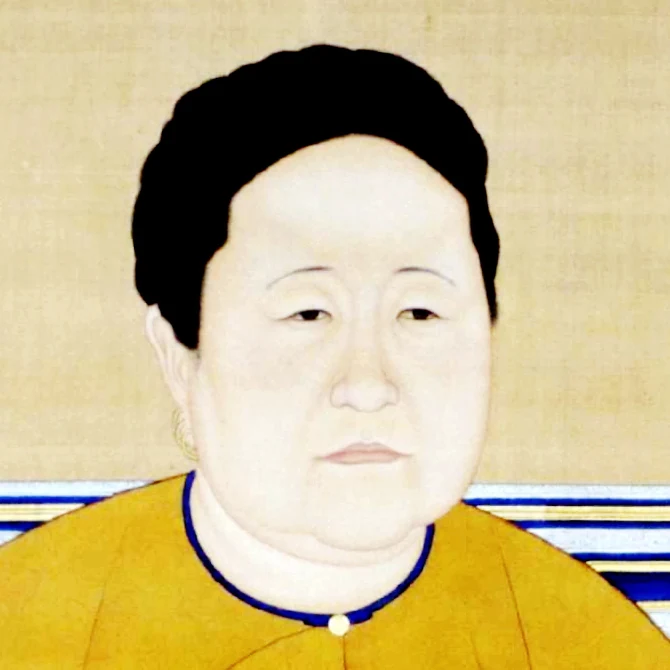
1613 CE–1688 CE
Historical figure
Borjigit Bumbutai
博尔济吉特·布木布泰
Borjigit Bumbutai (1613–1688), a daughter of Jaisang, a Khorchin Mongol beile, was a consort of Hong Taiji, the Qing Taizong Emperor, the mother of Fulin, the Shunzhi Emperor, and the grandmother of Xuanye, the Kangxi Emperor. She entered the Later Jin court through marriage in 1625 and was titled Consort Zhuang in 1636. After Hong Taiji died, Fulin acceded through a succession settlement involving princes and banner…
1613 CE–1688 CEQing Dynasty
PROFILE
Borjigit Bumbutai (1613–1688), a daughter of Jaisang, a Khorchin Mongol beile, was a consort of Hong Taiji, the Qing Taizong Emperor, the mother of Fulin, the Shunzhi Emperor, and the grandmother of Xuanye, the Kangxi Emperor. She entered the Later Jin court through marriage in 1625 and was titled Consort Zhuang in 1636. After Hong Taiji died, Fulin acceded through a succession settlement involving princes and banner officials, and Bumbutai was honored as Empress Dowager. During the Shunzhi reign she took part in court and imperial family affairs; records include relief for disaster victims funded from palace savings. After Xuanye's accession she became Grand Empress Dowager and raised and instructed the Kangxi Emperor. She died in 1688. In accordance with her wishes, her coffin was temporarily placed near the Shunzhi Emperor's Xiaoling Mausoleum; Zhaoxi Mausoleum was completed there in 1725.
- Other names
- Bumbutai; Empress Xiaozhuangwen, a shortened posthumous title
- Period
- Late Ming and early Qing
- Date of Birth
- March 28, 1613 CE(41st year of the Wanli era, Ming, 2nd month, 8th day)
- Date of Death
- January 27, 1688 CE(26th year of the Kangxi era, Qing, 12th month, 25th day)
- Polities
- Later Jin and Qing
- Roles
- Consort of Hong Taiji and Consort Zhuang; mother of the Shunzhi Emperor; Grand Empress Dowager
- Ethnicity
- Mongol, Khorchin region
- Clan
- Borjigit
- Native place
- Khorchin; the specific banner or locality is not confirmed by the sources reviewed
- Birthplace
- Khorchin; the specific place is not confirmed by the sources reviewed
- Place of death
- Cining Palace, Forbidden City, Beijing; the sources differ on the precise room
- Husband
- Aisin Gioro Hong Taiji
- Children
- Three daughters and one son; her son Fulin became the Shunzhi Emperor
- Consort title
- Consort Zhuang, conferred in 1636
- Principal honorific
- Grand Empress Dowager Zhaosheng Cishou Gongjian Anyi Zhangqing Dunhui Wenzhuang Kanghe Renxuan Hongjing, accumulated during the Kangxi reign
- Posthumous title
- Empress Xiaozhuang Renxuan Chengxian Gongyi Zhide Chunhui Yitian Qisheng Wen, accumulated during the Yongzheng and Qianlong reigns
- Mausoleum
- Zhaoxi Mausoleum, completed in 1725
- Major activities
- Participated in Qing imperial household affairs; ordered relief and military rewards from palace savings; raised and instructed the Kangxi Emperor
LIFE TIMELINE
Marriage into the Later Jin court | Escorted to Shengjing by her elder brother Wu Keshan and married Hong Taiji.
Birth of her eldest daughter | Yatu was later made Princess Gurun Yongmu.
Birth of her second daughter | Atu was later made Princess Gurun Shuhui.
Birth of her third daughter | She was later made Princess Gurun Shuzhe.
Title of Consort Zhuang | After Hong Taiji became emperor, Bumbutai was installed at Yongfu Palace and titled Consort Zhuang.
Birth of Fulin | She gave birth to the ninth imperial son at Yongfu Palace in Shengjing.
Fulin's accession | After Hong Taiji's death, Fulin succeeded him and Bumbutai was honored as Empress Dowager.
Move to Beijing | She moved to Yan-jing, present-day Beijing, with the court.
Honorific granted | The Shunzhi Emperor granted her the honorific “Zhaosheng Cishou,” later extended with “Gongjian” and other words.
Relief from palace savings | Records describe silver allocations for disaster relief to soldiers, civilians, and people in the capital region.
Grand Empress Dowager | Xuanye became the Kangxi Emperor; Bumbutai declined Zhou Nan's petition that she rule from behind a screen.
Kangxi Emperor arrests Oboi | An encyclopedia account says she supported the emperor's assumption of personal rule; the arrest itself was carried out by the emperor and his officials.
Military support and restraint on troops | She provided palace savings for troops during the Revolt of the Three Feudatories and urged Qing forces not to plunder during the Bournai rebellion.
Honorific extended | After the revolt was suppressed, the Kangxi Emperor added “Hongjing” and other honorifics.
January 27, 1688 CE(26th year of the Kangxi era, Qing, 12th month, 25th day) | Death | Aged seventy-five by traditional East Asian age reckoning; she asked that Hong Taiji's mausoleum not be moved and that she be buried near Xiaoling.
Zhaoxi Mausoleum completed | Her coffin was moved from the temporary hall into the mausoleum chamber.
BIOGRAPHY
Biography
Khorchin origins and the Later Jin court Bumbutai belonged to the Khorchin Borjigit clan. She was a daughter of the beile Jaisang, a niece of Empress Xiaoduanwen, and the younger sister of Hailanzhu. In 1625 her elder brother Wu Keshan escorted her to Shengjing, where she married Hong Taiji. After Hong Taiji proclaimed himself emperor in 1636, she was titled Consort Zhuang and lived at Yongfu Palace. The sources record three daughters—Yatu, Atu, and a third daughter later titled Princess Gurun Shuzhe—and one son. Fulin was born in 1638. ### Empress Dowager during the Shunzhi reign Hong Taiji died in 1643 without clearly designating a successor. After deliberations involving princes, beiles, and banner officials, Fulin acceded, and Bumbutai was honored as Empress Dowager. The succession involved several political actors and should not be attributed to her alone. She moved to Beijing with the court in 1644. After the Shunzhi Emperor began ruling in his own right, Bumbutai continued to participate in court affairs. In 1651 he granted her an honorific, which was later extended. The Draft History of Qing says that the emperor followed her instruction in commissioning the Inner Rules Extended and Explained. She also ordered relief funded from palace savings. The the source account lists allocations of 80,000 taels in 1653, 40,000 in 1654, and 30,000 in 1656; the Draft History of Qing summarizes her as releasing palace funds during years of disaster. These records show a role in court and imperial family affairs, but do not establish that she replaced the emperor in governing. ### Raising the Kangxi Emperor Xuanye acceded in 1661 and Bumbutai was honored as Grand Empress Dowager. The Draft History of Qing says that she did not directly administer government, while also recording that the Kangxi Emperor often reported personnel decisions to her first and preserving her advice on military preparedness and impartial judgment. When Zhou Nan petitioned her to rule from behind a screen, she declined on the ground that it conflicted with ancestral precedent. These accounts describe her as an influential elder and adviser, not a formal regent. Power relations between the young emperor and the four regents shifted during the early Kangxi reign. In 1669 the Kangxi Emperor arrested Oboi and began ruling in his own right. The the source account says the Grand Empress Dowager supported the emperor during the regency crisis; the sources reviewed do not establish that she personally planned or executed the arrest. She also took an interest in court cultural projects, including the transcription of Buddhist scriptures in Mongolian and Tibetan. During the Revolt of the Three Feudatories she provided palace savings to reward troops. During the Bournai rebellion she instructed commanders not to plunder local communities. ### Death and mausoleum Bumbutai died on 27 January 1688, aged seventy-five by traditional East Asian age reckoning. the source places her death in Cining Palace Before her death, she asked the Kangxi Emperor not to move Hong Taiji's long-established mausoleum and requested burial near the Shunzhi Emperor's Xiaoling. Her coffin was temporarily placed in a hall near Xiaoling. The Kangxi Emperor established her initial posthumous title, which was extended during the Yongzheng and Qianlong reigns. Zhaoxi Mausoleum was completed in 1725, and her coffin was transferred to its burial chamber.
Her Family, Her Entry into the Palace, and the Change in Her Rank
Bumbutai was of the Borjigit clan, her name also written Bumbutai, meaning "bottle" in Mongolian, daughter of the Korchin chief Zaisang and niece of the empress Xiaoduan. In the second month of the tenth year of Tianming, 1625, she came to marry the eighth son of the Later Jin khan Nurhaci, Hong Taiji, as a secondary consort; in the first year of Chongde, 1636, she was invested as consort Zhuang, and in the interval bore three daughters and one son. In the second month of 1632 the daughter of Bayar Daicing, of the Jarud Borjigit, married Hong Taiji as eastern secondary consort and was called the consort of the eastern palace, so that Bumbutai's place in the inner palace fell to third; and in the tenth month of 1634 her own elder sister also married Hong Taiji. She was not a woman ignorant of affairs beyond the palace, having said that "though I am within the palace apartments, I know something of Taizong's government," which shows that she followed the affairs of state closely.
The Death of Hong Taiji and Her Mediation in the Accession of Shunzhi
On the ninth day of the eighth month of 1643 Hong Taiji died suddenly. Bumbutai "advanced by seeming to withdraw," herself asking to be buried with him, while the princes, on the ground that Fulin was young and needed someone to rear him, "joined in urging her to stay and live"; and this affair displayed her courage and her resource. Because Hong Taiji had left no testament on the succession, after his death three groups of political power — that of Nurhaci's fourteenth son, the prince regent of Rui, Dorgon; that of Hong Taiji's eldest son, the prince of Su, Hooge; and the ministers of the two yellow banners — were all moving about in search of the throne. At first the ministers of the two yellow banners, loyal to Hong Taiji, proposed to set up the prince of Su as ruler with Fulin as heir, but under the strong opposition of the two white banners to Hooge this was changed to a demand that a son of the emperor be set up; and under the compromise of the several powers Hooge, Dorgon and the rest were forced to agree to make Fulin emperor. On the twenty-sixth day of the eighth month Fulin, as Hong Taiji's eldest son by the empress — some write third or ninth son — came to the throne without difficulty as the Shunzhi emperor. That he did so, besides the fact that Hooge and Dorgon would not give way to one another, was due to Bumbutai's management with Daišan, Dorgon and others; and her connexion with Dorgon gave rise besides to the story of the "empress dowager's remarriage" to him, the truth of which has been disputed ever since.
Her Part in the Shunzhi Reign, Her Relief Work, and Her Halting of the Personal Campaign
On Shizu's accession she was honoured as empress dowager; in 1654 her father Zaisang was given the posthumous title of prince Zhong of Heshuo and her mother that of lady Xian; and in the second month of 1656, on the empress dowager's birthday, the emperor composed thirty poems to present to her and, following her instruction, wrote the Amplification of the Inner Rules with a preface, which he presented. In 1651 she received the honorific of the empress dowager Zhaosheng, and on the twentieth day of the eighth month the Shunzhi emperor with his ministers added the two characters "gongjian," so that she was styled the empress dowager Zhaosheng Cishou Gongjian. After Dorgon's death in 1650 she did her utmost to assist the Shunzhi emperor, who had just taken the government, and so further consolidated the Qing regime. First she drew up for him "the rule of a ruler": in the second month of 1651 she charged him that to be son of Heaven and stand in the highest place was indeed no easy matter, that the common people were the root of the state, and that therefore an emperor should "in governing the people surely appoint men of worth, in governing the state surely draw near the loyal and keep off the flatterers, and in employing men surely proceed from..." and should see that rewards and punishments were just and dress and utensils conformable to rule, "not practising extravagance, aiming at what is great and far, diligent in study and fond of asking, curbing wrath and guarding against idle pleasure," since if he only knew pleasure the imperial work would pass from him; and that in any business that came before him he must be "…unwearied." This charge both reflected the experience of governing in former dynasties and was aimed at the particular case of the young Shunzhi emperor, who called it "the rule of a ruler" and kept it as his motto; and after taking the government he followed his mother's teaching, often discussing with Chinese ministers the successes and failures of former dynasties and selecting the worthy while punishing the corrupt, carrying out a series of reforms with some success. Second, she supported the government from the inner palace: with the Chinese generals Kong Youde and Shang Kexi she took their orphans under her care and bound them by marriage, so that they served the Qing the better; and she promoted frugality in the palace, often giving the savings in silver to relieve the victims of disaster, issuing forty thousand taels from the palace in 1654 and thirty thousand in 1656. In 1659, when Zheng Chenggong sailed north from Xiamen with his fleet, took Zhenjiang, the gate of the Yangtze, and invested Nanjing to the alarm of the Qing court, the Shunzhi emperor lost his head and wished to fall back beyond the passes, and was rebuked by Bumbutai; whereupon he turned in fury and would "go out in person, to conquer or to die," even striking the table with his sword to show his resolve, and Bumbutai did all she could to dissuade him and sent besides the emperor's wet nurse and the foreign missionaries in the capital to reason with him again and again, so that he gave up the plan of leading the campaign himself. When the consort Donggo died in 1660 and the emperor in his grief would even have shaved his head and become a monk, she and others dissuaded him. In the marriages of the imperial house she showed herself comparatively open: in 1652, after Kong Youde of Dingnan had died in battle, she exceptionally took his daughter as her adopted daughter with the style of the lady Sizhen; and in 1656, when the board of rites, on the instruction of the empress dowager, proposed that she of the Kong family, the legitimate heir of loyal merit, be made an imperial consort of the eastern palace, Kong Sizhen stated that she was already betrothed to Sun Yanling, and Bumbutai, respecting her own wish, gave up the plan and summoned Sun Yanling to the capital, "by the empress dowager's order to be husband and wife," giving them a mansion. In the Shunzhi emperor's own marriage, though mother and son were tangled in disputes, she in the main satisfied her son's wishes.
The Choice of Kangxi, the Four Regents, and the Dispute over the Empress
After the Shunzhi emperor's early death, the eight-year-old grandson Xuanye, chosen by Bumbutai, came to the throne as the Kangxi emperor; this change of sovereign was carried out wholly according to her will and was a choice of great historical weight in the Qing. It is said that the dying Shunzhi wished to set up an adult brother, but that Bumbutai insisted on a son of the emperor and chose Xuanye. Having helped Xuanye to the throne she refused to rule behind a screen and supported the system of four regents; and in view of the lesson of Dorgon's regency in the early Shunzhi years, none of the four regents came from the imperial house. In the third month of 1661 Zhou Nan, a student of Tongcheng county in Jiangnan, presented ten articles at the palace gate, the last of them requesting Bumbutai to "hold court behind a screen to bring about a flourishing government," which she refused as contrary to ancestral rule. On the thirtieth day of the eighth month of 1662 the Kangxi emperor gave his grandmother the honorific of the grand empress dowager Zhaosheng Cishou Gongjian Anyi Zhangqing Dunhui. From about 1665 cracks began to appear in the regency: at the beginning of that year the court deliberated on making Sonin's granddaughter empress to Kangxi, and Oboi declared that if Gabula's daughter were made empress there would be bloodshed, since the daughter of a Manchu commoner could not by rights be empress, and memorialized Bumbutai together with Ebilun and Suksaha; whereupon Bumbutai answered flatly that a Manchu woman could well be empress, that her mind was made up and there was no more to discuss, and so the storm over the empress was stilled. Afterwards Oboi of the Bordered Yellow Banner, with Ebilun who adhered to him, came into sharp conflict with Suksaha of the Plain White Banner over the forcible exchange of the banner lands fixed at the beginning of the Qing; and Sonin, unwilling to be drawn in, memorialized in the third month of 1667 with Oboi and the rest that Kangxi should take the government. Bumbutai replied that the emperor was still young and could not hold all the affairs of the realm alone, and that it should be reconsidered in a year or two; in the sixth month Sonin died, and in the seventh Bumbutai decided that Kangxi should take the government and conduct affairs, though she insisted that "though he takes the government, you are still to share in the regency."
The Protection of Schall, the Arrest of Oboi, and the Rearing of Kangxi
Oboi outwardly agreed that Kangxi should take the government but in fact would not give up the power of regency, excluding those who differed from him and forming factions for his own ends, and against the emperor's opposition put Suksaha to death; and in the ensuing dispute over the calendar Oboi and Ebilun supported certain officials in a great prosecution, arresting and interrogating Johann Adam Schall von Bell, who had drawn up the Shixian calendar, and condemning him to death by slicing. It happened that an earthquake struck the capital and fire broke out in the palace, and Bumbutai intervened in person, summoning the regents and telling them that Schall was a meritorious minister of the late emperor and had not erred in twenty years, that to seek his death was surely too much, and that he should be released at once in answer to Heaven's warning; and so Schall was released, and Kangxi afterwards, on inquiry, decided to restore the Shixian calendar. In the fifth month of 1669 Sonin's second son Songgotu and others, with the emperor's dispositions, arrested Oboi, had him tried and imprisoned, and he died in prison. Kangxi lost his father at eight and his mother at eleven, and Bumbutai herself took on the task of rearing him, pouring out her care to bring him up and teach him how to be a man and how to govern; as Kangxi himself said, "from the time I could first walk and speak I received the loving instruction of my holy grandmother." Under the influence of Bumbutai, who "had no other passion but maps and histories," Kangxi conceived from childhood a keen interest in reading and study which stayed with him all his life: he "set his mind on reading," "reciting early and late without regard to cold or heat, to the forgetting of food and sleep"; and his nurse lady Pu, fearing that he was too young and read too much to the harm of his health, more than once hid his books to make him rest, but he would find them at once and take them back and go on reading with relish. Bumbutai was both comforted and distressed by her grandson's diligence, and once reproached him half in anxiety and half in pleasure, asking what sort of man he was, that being son of Heaven he should study so hard like a scholar going up to the examination. She was both wholly loving and strict with him in everything: in food and drink and in every word and act he must follow the rules and the rites, and the least negligence drew reproof. Early in Kangxi's reign, one day before the assembled ministers, Bumbutai asked him what he intended as lord of the realm, and he answered that he had no other wish than that the realm should be at peace, the people live at their work and all share the blessings of tranquillity; and the matter made so deep an impression on him that decades later he still bore it in mind and would not in private overstep it. Every day before or after holding court Kangxi would go to the inner palace to inquire after Bumbutai and take her instructions, sometimes as often as three times in a day, and she gave him directions privately; and it was she who required that in governing he must first cultivate himself and study the Confucian classics, so that she greatly approved the translation and printing of the Amplification of the Great Learning, and in her delight issued a thousand taels of silver from the inner palace to reward those who had done the work.
Her Frugality and Relief, the Honorific, and Her Death
Bumbutai lived a retired and frugal life without extravagance. After the revolt of the three feudatories broke out in 1673 she gave the silver saved in the palace to reward the troops on campaign; and in years of famine she would bring out the palace savings for relief, supporting with all her strength the work of her sons and grandsons. In 1681, when the revolt was put down, Kangxi refused the ministers' request that he take an honorific and proposed instead to give one to the grand empress dowager; and Bumbutai declined again and again, saying that she was a woman who had done nothing for the people and would not be at ease to receive an honorific title. Kangxi persuaded her to accept it, and her style was fixed as the grand empress dowager Zhaosheng Cishou Gongjian Anyi Zhangqing Dunhui Wenzhuang Kanghe Renxuan Hongjing. In the spring of 1682, when Kangxi toured Shengjing, he sent a rider almost every day to inquire after her and report his whereabouts, and sent back to the palace the silver carp he caught in the rivers. In the ninth month of 1687 her old illness returned and the emperor watched by her day and night; in the twelfth month he walked to the altar of Heaven to pray, asking that his own allotted years be shortened to add to hers, and as he read the prayer his tears ran down his face and all the princes and ministers who assisted wept with him. The prayer said that remembering how from his tender years, early bereft of both parents, he had stood at his grandmother's knee for more than thirty years, reared and taught until he came to something, he could never have achieved what he had without the grand empress dowager, whose incomparable kindness could never be repaid in a lifetime, and that if her allotted span were running out he begged to have his own years reduced to add to hers. When she was near her end she told the emperor that Taizong had long been laid to rest and must not be lightly disturbed for her, and that since her heart was bound to him and his father he should bury her near the Xiaoling, and then she would have no regret. On the twenty-fifth day of the twelfth month she died at the age of seventy-five. Kangxi in his grief wished to wear mourning in the palace for twenty-seven months, and only yielded when the princes and ministers repeatedly memorialized that the testament should be followed and the months counted as days; and he had the palace in which she had lived dismantled and rebuilt near the Xiaoling at Changrui mountain, calling it the "hall of temporary repose," and in the fourth month of the following year had her coffin brought to Changrui mountain, going thereafter every year to sacrifice. Her coffin was not taken to Shengjing to be buried with Hong Taiji but rested temporarily east of the capital, until in 1725, the third year of Yongzheng, a tomb was built on the very spot of the hall of temporary repose and she was laid in the underground chamber; and as the tomb lies west of Hong Taiji's Zhaoling at Shengjing it is called the Zhaoxiling. As to the story of her remarriage to Dorgon, later ages have disputed it endlessly: Meng Sen wrote an Inquiry into the Empress Dowager's Remarriage, rebutting its grounds one by one, holding that Zhang Huangyan was a subject of the fallen Ming and hostile to the Qing, so that his verses might well contain slander; that the Shunzhi emperor's calling Dorgon "father regent" had the sense of the ancient practice by which a sovereign styled an old minister "honoured father" and proved nothing; that the alleged visit to the "inner palace" may point to other misconduct by Dorgon and does not necessarily mean Bumbutai; and that her unwillingness to be buried with Hong Taiji arose because the empress Xiaoduan was already buried at the Zhaoling, while it was by no means rare in antiquity for an empress not to be buried with her husband. The dispute remains unsettled.
Major Activities
Relief and military rewards from palace savings During floods and other disasters in the Shunzhi reign, Bumbutai repeatedly ordered silver from palace savings to be distributed for relief. The the source full text lists 80,000 taels in 1653, 40,000 in 1654, and 30,000 in 1656; the Draft History of Qing summarizes her relief work without specifying those amounts. During the Kangxi reign she also used palace funds to reward troops in the Revolt of the Three Feudatories. These figures are reported as recorded by the respective sources and do not imply that she personally financed Qing military operations. ### Raising and instructing two emperors The Shunzhi Emperor received instruction from Bumbutai; the Draft History of Qing records that he followed her advice in commissioning the Inner Rules Extended and Explained. She raised the Kangxi Emperor from childhood. The Draft History preserves his recollection of her care and instruction and records her counsel on military preparedness, benevolence, and impartial judgment. Her role was that of an imperial elder and instructor, not a formally appointed regent. ### Restraint in court politics The Draft History of Qing says that Bumbutai did not directly administer government, but that the Kangxi Emperor often consulted her before personnel decisions. She declined a petition to rule from behind a screen. The the source account also describes her support for the emperor during the Oboi regency crisis and her concern for military discipline in frontier campaigns. Taken together, these sources indicate influence within the court while showing that government continued to be conducted by the emperor, princes, and officials.
Her Historical Part and the Difference in the Manchu Word for "Zhuang" in Her Styles
Though Bumbutai never ruled from behind a screen, she played a part in the Shunzhi emperor's accession, in the guidance of the young sovereign, in the condemnation of Dorgon, and in helping the Kangxi emperor to arrest Oboi, consolidate the imperial power and put down the revolt of the three feudatories and the rebellion of the Chahar Burni. She gave directions on administration and put forward proposals favourable to stability, to the restoration and development of production and to unification, "which made an important contribution to the consolidation, unification and strengthening of the early Qing regime." In her more than thirty years with the Kangxi emperor she "reared and taught him until he came to something," and the affection between grandmother and grandson was of an unusual depth: she influenced him profoundly from the affairs of state to his personal cultivation, down to private habits such as giving up tobacco and drinking less; and of the memorials of the Kangxi reign now known, a considerable part consists of letters the emperor wrote to Bumbutai in the palace to inquire after her and chat while he was on campaign or on tour, and wherever he went he would report the local customs to her and send back some local delicacy to the palace. Her death was a great shock to him and for a time noticeably weakened his memory: he told his ministers that he was not what he had been, that since the grand empress dowager's death he had felt confused and greatly troubled, and that he forgot as soon as he heard a thing. The memory of his grandmother stayed with him all his life; he "longed for her to the end, and whenever he spoke of her his voice and tears came together," and great affairs of state often came to him in dreams, so that thirty years after her death, when he was past sixty, he would still weep like rain and be overcome with grief when he spoke of her to his ministers. As to the words of her styles, both her honorifics and her posthumous name used the Chinese character "zhuang," but in Manchu they differed: the "zhuang" of the consort Zhuang conferred by Hong Taiji, in Manchu jingji, tended towards the sense of plumpness, while the "zhuang" of the posthumous name Xiaozhuang given by the Kangxi emperor, in Manchu ambalinggū, tended towards the sense of generous and stalwart — so that the figure and the assessment of Bumbutai differed according to the two perspectives of Hong Taiji and Kangxi. As to the surrender of Hong Chengchou, an unofficial history relates that Hong Taiji himself "took off his sable cloak and gave it to him," which moved him deeply, while another account has it that Bumbutai volunteered to carry him a ginseng decoction called medicinal wine, "holding the pot to his lips" and pouring it in mouthful by mouthful, moving him with feeling and reasoning with him, so that after several days of effort she persuaded him; such records belong to unofficial history and differ from the standard accounts, and can only be read as legend, not used to reach a conclusion of fact.
Personal Relations
- Borjigit Jaisang: Father; a Khorchin beile. The Draft History of Qing calls him Jaisang; the encyclopedia source also gives the form Jaisang-Buhe.
- Boli: Mother; described in the encyclopedia account as a secondary consort of Khorchin who was later granted the title Heshuo Worthy Consort.
- Borjigit Zhezhe: Paternal aunt; Empress Xiaoduanwen, who married Hong Taiji before Bumbutai.
- Borjigit Hailanzhu: Elder sister; a consort of Hong Taiji who was later titled Consort Chen.
- Aisin Gioro Hong Taiji: Husband; Later Jin khan and Qing Taizong Emperor.
- Aisin Gioro Yatu: Eldest daughter; later Princess Gurun Yongmu.
- Aisin Gioro Atu: Second daughter; later Princess Gurun Shuhui.
- Aisin Gioro Fulin: Son; the Qing Shizu, or Shunzhi Emperor.
- Aisin Gioro Xuanye: Grandson; the Qing Shengzu, or Kangxi Emperor.
- Dorgon: Hong Taiji's younger brother and regent; a major participant in the political deliberations around Fulin's accession. Claims about a marriage between him and Bumbutai remain disputed and are not established by the sources reviewed.
Historical Assessment
The Draft History of Qing, in the format of an official Qing biographical account of imperial consorts, records Bumbutai's status, honorifics, relief work, instruction, and burial arrangements. It says she did not directly administer government, but also notes that the Kangxi Emperor often reported personnel decisions to her first. The source helps establish her influence at court, but does not support describing her as a formal regent. The the source full text cites later historians including Zhao Erxun, Yang Yulian, and Yang Zhen, whose assessments emphasize her role in the imperial household and the political transition across the Shunzhi and Kangxi reigns. Such assessments are later historical interpretations and should be distinguished from verifiable events. Stories that she married Dorgon or persuaded Hong Chengchou to surrender appear in disputed accounts. The official histories reviewed do not establish them, so they are not presented as biographical facts. “Da Yu'er,” a name used in some later fiction and screen portrayals, is not treated here as a verified alias.
FIGURES ASSOCIATED WITH THIS DYNASTY
Bibliography
- Zhao Erxun et al., Draft History of Qing, juan 214, “Biographies of Imperial Consorts, Part One.”
- Veritable Records of Qing Taizong, juan 40.
- Veritable Records of Qing Shengzu, juan 235 and juan 244.