Chen Wu inherited the title Marquis of Tangyi and married Liu Piao, Grand Princess Guantao.
?–前?
Empress
Chen Ajiao
陈阿娇
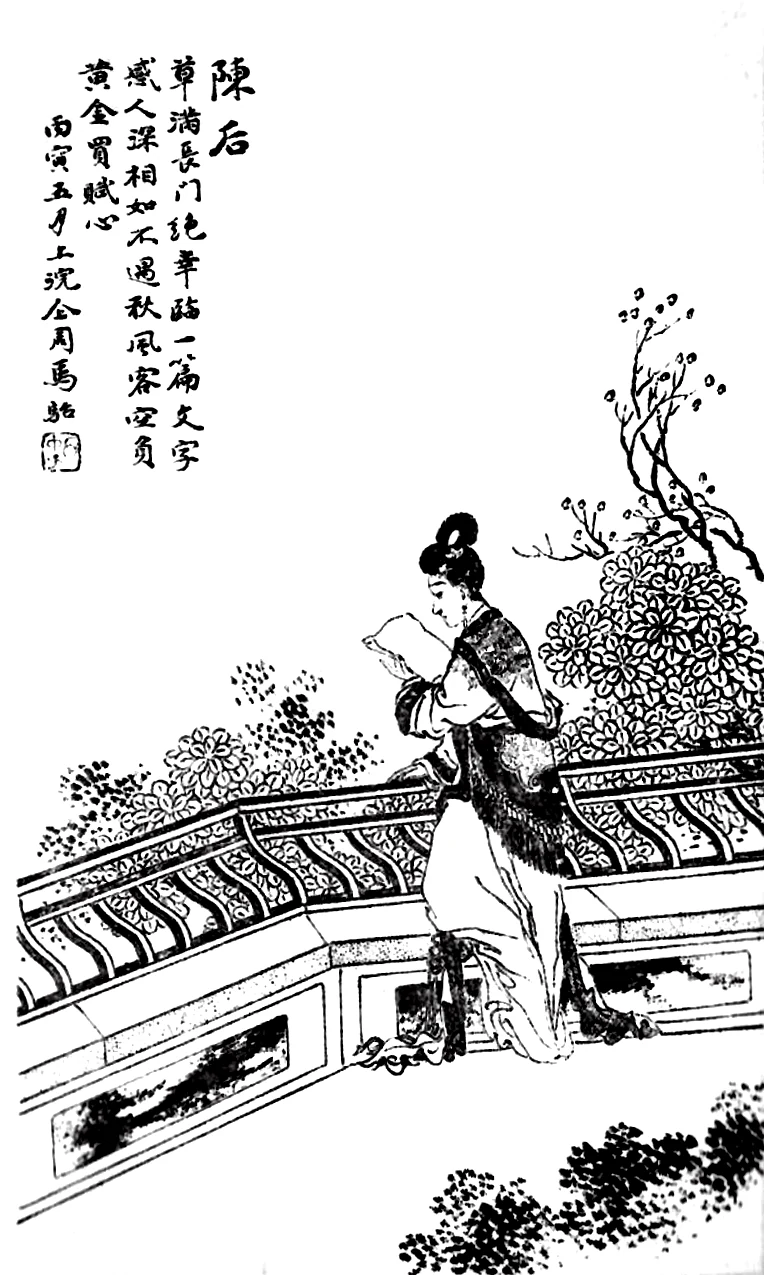
Chen Ajiao, Empress Chen of Emperor Wu of Han (dates unknown), was from Dongyang in Donghai Commandery, present-day Tianchang in Anhui. She was a descendant of Chen Ying, a founding meritorious subject of the Western Han, the daughter of Chen Wu, Marquis of Tangyi, and Liu Piao, Grand Princess Guantao, and the first empress of Liu Che, Emperor Wu of Han. The personal name “Ajiao” does not appear in the standard histories; it…
?–前?Western Han
PROFILE
Chen Ajiao, Empress Chen of Emperor Wu of Han (dates unknown), was from Dongyang in Donghai Commandery, present-day Tianchang in Anhui. She was a descendant of Chen Ying, a founding meritorious subject of the Western Han, the daughter of Chen Wu, Marquis of Tangyi, and Liu Piao, Grand Princess Guantao, and the first empress of Liu Che, Emperor Wu of Han. The personal name “Ajiao” does not appear in the standard histories; it comes from the supernatural tale Stories of Emperor Wu of Han and the Tang-dynasty encyclopedia Classified Collection of Literature, and later generations came to use it for her. Empress Chen was made empress in part because her mother had contributed to Liu Che's elevation as heir apparent. Relying on that merit, she became proud and dominant at court and enjoyed exclusive favor for more than ten years but had no child. In 130 BCE, the fifth year of the Yuanguang era, she was deposed after a case involving witchcraft and curses and was sent to Changmen Palace. She died several years later and was buried east of the Langguan Pavilion at Baling. Her story gave rise to the literary allusions “hiding a beauty in a golden house” and “buying a rhapsody for a thousand pieces of gold,” while “Changmen” became a classic image in later writing about palace resentment and frustrated lives.
- Alternative name
- Empress Chen of Emperor Wu of Han, Chen Ajiao
- Period
- Western Han
- Dynasty / regime
- Western Han
- Identity
- Empress
- Ethnicity / ethnic affiliation
- Not reliably established in the available sources
- Native place
- Dongyang, Donghai Commandery (present-day Tianchang, Anhui)
- Date of birth
- Unknown
- Place of birth
- Unknown
- Date of death
- Unknown
- Tenure as empress
- Not reliably established in the historical sources
- Posthumous name
- Not reliably recorded in the historical sources
- Major achievements
- First empress of Emperor Wu; remembered for the “golden house for Ajiao” story, later fell from favor, was deposed, and withdrew to Changmen Palace.
LIFE TIMELINE
Emperor Jing made his eldest son Liu Rong crown prince; Liu Piao wanted to marry her daughter to Liu Rong but Lady Li rejected the match.
Liu Piao arranged a marriage alliance with Lady Wang, betrothing her daughter Chen to Liu Che, king of Jiaodong.
Liu Rong was deposed, Liu Che became crown prince, and Lady Chen became crown princess.
Emperor Wu ascended the throne and Lady Chen was made empress.
Wei Zifu entered the palace and gained favor; Empress Chen became angry and repeatedly threatened or attempted suicide.
Grand Princess Liu Piao sent men to seize Wei Qing and intended to kill him, but failed.
Grand Empress Dowager Dou died, depriving Empress Chen of her strongest supporter in the palace.
The witchcraft case was exposed; Chu Fu and more than three hundred others were executed, Empress Chen was deposed, and she was sent to Changmen Palace.
Her mother Liu Piao died; her brothers Chen Xu and Chen Jiao committed suicide after being charged with sexual misconduct during mourning and disputes over property.
The deposed Empress Chen died at Changmen Palace and was buried east of the Langguan Pavilion at Baling.
BIOGRAPHY
Biography
Family Background and Early Years
Chen Ajiao was born into a powerful family. Her great-grandfather Chen Ying had been a clerk in Dongyang County at the end of the Qin. During the collapse of the Qin he raised more than 20,000 men in Dongyang and later joined Xiang Liang and Xiang Yu. After Xiang Yu's death, Chen Ying led his followers to Liu Bang, contributed to Han campaigns in Yuzhang and Zhejiang, and received the title Marquis of Tangyi with a fief of 1,800 households. In 177 BCE, Chen Ying's grandson Chen Wu inherited the marquisate and married Liu Piao, Grand Princess Guantao, a daughter of Empress Dou. Liu Piao was the full elder sister of Emperor Jing and exercised considerable influence in the palace. Chen Wu and Liu Piao had two sons and one daughter: the eldest son Chen Xu, also called Chen Jixu; the second son Chen Jiao; and the daughter who later became Empress Chen.
Very little is recorded about Chen Ajiao's early life. Her birth year is unknown and has been estimated as no earlier than about 160 BCE. In 153 BCE Emperor Jing made his eldest son Liu Rong crown prince. Liu Piao sought to marry her daughter to him, but Liu Rong's mother Lady Li resented the grand princess for regularly introducing women to Emperor Jing, thereby threatening her own position, and rejected the proposal. Liu Piao then turned to Lady Wang and betrothed her daughter to Lady Wang's son Liu Che, king of Jiaodong.
Marriage and Elevation as Empress
Liu Piao resented Lady Li's rejection and repeatedly disparaged her before Emperor Jing, accusing her of having attendants curse other favored women and employ occult practices. Lady Li herself also angered the emperor by speaking harshly and refusing to promise good treatment of his other sons. Liu Piao, meanwhile, praised Liu Che to the emperor every day. Together with the auspicious story that Lady Wang had dreamed of the sun entering her womb while pregnant, this strengthened Emperor Jing's inclination to change his heir. Taking advantage of his anger toward Lady Li, Lady Wang secretly encouraged an official to memorialize that Lady Li should be made empress. When the official presented the request at court, Emperor Jing was furious and had him executed. In 150 BCE Liu Rong was deposed as crown prince and made king of Linjiang. In the same year Lady Wang became empress and the seven-year-old Liu Che was made crown prince.
After Liu Che became crown prince, he married Grand Princess Guantao's daughter Chen as crown princess. In 140 BCE, when Liu Che ascended the throne as Emperor Wu, Lady Chen became empress. Because her mother had played a major role in Liu Che's elevation as heir, Empress Chen enjoyed a proud and privileged position in the palace and exclusive favor for more than ten years, but she never bore a child.
Loss of Favor and Deposition
In 139 BCE, because Emperor Wu had remained childless for several years, his elder sister Princess Pingyang selected more than ten young women of good family and housed them at her residence. During a visit, Emperor Wu favored the singer Wei Zifu and later brought her into the palace. Wei gradually gained favor and received the rank of consort. When Empress Chen learned of the emperor's relationship with Wei, she became extremely angry and repeatedly attempted or threatened suicide, which further displeased Emperor Wu.
In 138 BCE Wei Zifu became pregnant, intensifying Empress Chen's jealousy because she herself had no child. Her mother, Grand Princess Liu Piao, distressed on her daughter's behalf, sent men to seize Wei Zifu's younger brother Wei Qing and intended to kill him. Wei Qing was rescued by his friend Gongsun Ao. When Emperor Wu learned of the affair, he instead appointed Wei Qing supervisor of Jianzhang Palace and palace attendant and showered the Wei family with rewards said to accumulate to thousands of pieces of gold each day; the Wei family thereby rose rapidly.
As Wei Zifu's favor increased, she bore the emperor three princesses, while Empress Chen remained childless after more than a decade. In 135 BCE Grand Empress Dowager Dou, Chen's maternal grandmother and strongest supporter in the palace, died. In 130 BCE Empress Chen's use of practices intended to attract a man's affection was exposed and Emperor Wu ordered a full investigation. Investigating censor Zhang Tang discovered that Chu Fu and others had conducted witchcraft rites and curses on Empress Chen's behalf, an offense treated as gross treason. Chu Fu was beheaded in the marketplace and more than three hundred people implicated in the case were executed. In the seventh month of that autumn, on a yisi day, Emperor Wu had the responsible officials deliver a document declaring that the empress had violated proper order, become deluded by sorcery, and could no longer bear the mandate of Heaven; she was to surrender her seal and cord and withdraw to Changmen Palace. Empress Chen was thereby deposed and sent to Changmen.
Life at Changmen Palace
After her deposition, her mother Grand Princess Liu Piao complained to Princess Pingyang that the emperor would never have been established without her help, yet he had now cast aside her daughter and forgotten the source of his position. Princess Pingyang answered that Chen had been deposed because she had no child. Empress Chen is said to have spent ninety million cash on physicians in her efforts to conceive, but she remained childless.
In 129 BCE, the sixth year of the Yuanguang era, her father Chen Wu died and her eldest brother Chen Xu inherited the Tangyi marquisate. In 116 BCE Liu Piao died. Chen Xu and his younger brother Chen Jiao were accused of sexual misconduct during mourning and of fighting over property; both faced capital punishment and committed suicide, and the marquisate was abolished. Several years later the deposed empress died at Changmen Palace and was buried east of the Langguan Pavilion at Baling.
Major Activities
Political Marriage and the Succession Struggle
Chen Ajiao's marriage was connected from the outset with the struggle over the succession during Emperor Jing's reign. Liu Piao first sought to marry her daughter to Crown Prince Liu Rong, but after Lady Li refused, she formed an alliance with Lady Wang instead. The marriage agreement led Liu Piao to support Liu Che politically, contributing to Liu Rong's removal and Liu Che's elevation as crown prince. As the central figure in the marriage alliance, Chen Ajiao's marriage directly affected the course of Western Han succession politics.
The Witchcraft Case and Deposition
The witchcraft case of 130 BCE was the decisive turning point of Empress Chen's life. Emperor Wu personally ordered the investigation and Zhang Tang conducted the proceedings. Chu Fu and more than three hundred others were ultimately executed and Empress Chen was deposed. The source describes it as the first Western Han witchcraft case involving an empress and as a precedent for the later witchcraft disasters of Emperor Wu's reign, after which accusations of sorcery became an important instrument in palace political conflict.
Formation of Literary Images
Empress Chen's story generated two major literary allusions. The first, “hiding a beauty in a golden house,” comes from the supernatural tale Stories of Emperor Wu of Han, in which the young Liu Che is said to have promised that if he married Ajiao he would build a golden house to keep her in. Later generations used the expression for a man's favor toward a woman and, in modern usage, often for taking a wife or concubine. The second is “buying a rhapsody for a thousand pieces of gold.” According to later tradition, after Empress Chen was deposed and moved to Changmen Palace she paid Sima Xiangru one hundred jin of gold to write the Changmen Rhapsody in the hope of moving Emperor Wu. Although the truth of the story is uncertain, “Changmen” thereafter became a standard symbol of palace resentment, the frustration of an unrecognized scholar, and disappointment in life, and poets of later dynasties produced many works on the theme of the “Lament of Changmen.”
Personal Relations
Family
- Great-grandfather: Chen Ying, a founding meritorious subject of the Western Han and Marquis of Tangyi
- Grandfather: Chen Lu, Marquis Gong of Tangyi
- Father: Chen Wu, Marquis Yi of Tangyi
- Mother: Liu Piao, Grand Princess Guantao, also known as the Grand Princess Dou
- Brothers: Chen Xu (Chen Jixu) and Chen Jiao
- Maternal grandfather: Liu Heng, Emperor Wen of Han
- Maternal grandmother: Empress Dou, Empress Xiaowen
Marriage and Imperial Family
- Husband: Liu Che, Emperor Wu of Han
- Father-in-law: Liu Qi, Emperor Jing of Han
- Mother-in-law: Wang Zhi, second empress of Emperor Jing and mother of Emperor Wu
Conflicts
- Wei Zifu: Favored consort of Emperor Wu and the immediate cause of Empress Chen's loss of favor
- Lady Li: Mother of Liu Rong, who had earlier rejected a marriage alliance with Liu Piao
- Zhang Tang: Investigating censor who handled the witchcraft case
Historical Assessment
Han Dynasty / Contemporary Views
- Sima Qian wrote in the Records of the Grand Historian that “Empress Chen was too proud, and in the end Zifu was elevated,” linking her loss of position to arrogance and the rise of Wei Zifu.
- Ban Gu grouped Empress Chen with other Han empresses in the Book of Han and reflected on the rise and decline of imperial in-laws as matters whose apparent attractions did not necessarily accord with Heaven's measure.
- Huan Tan, in a passage preserved in the Book of the Later Han, cited Emperor Wu's deposition of Empress Chen and elevation of Wei Zifu as a warning in discussing the dangerous favor enjoyed by Dong Xian under Emperor Ai.
From the Wei-Jin to the Tang-Song Periods
- Stories of Emperor Wu of Han presented the “golden house for Ajiao” tale in a supernatural and anecdotal style, transforming the historically indistinct empress into a classic figure of later literary narrative.
- The Selections of Refined Literature compiled by Xiao Tong included the Changmen Rhapsody. Its preface claimed that the empress regained favor because of the piece. Although inconsistent with the standard historical record, this made the “buying a rhapsody for a thousand pieces of gold” story a famous allusion.
- Tang poets produced many yuefu poems titled “Lament of Changmen,” including works by Li Bai, Liu Changqing, and Li Yi, and “Changmen” became a central image in palace-lament poetry.
Ming and Qing Periods
- Wang Hui's Qing work New Illustrated Verses on One Hundred Beauties ranked Chen Ajiao second among its hundred beauties, reflecting her continued importance in later traditions of celebrated women.
- Ming and Qing drama and fiction repeatedly reworked her story, including works such as Dream of the Golden House, making her a recurring female figure in romantic literary narratives.
Modern Assessments
- Modern scholars often examine Empress Chen's fate from the perspective of political history and regard her deposition as an important step in Emperor Wu's effort to strengthen imperial authority and reduce dependence on powerful maternal relatives.
- Literary scholars focus on the formation and transformation of the “Changmen” image and treat it as one source of the palace-lament tradition in Chinese literature.
- Chen Ajiao has repeatedly appeared in modern screen productions, including the television series The Emperor in Han Dynasty, maintaining her place in contemporary popular culture.
FIGURES ASSOCIATED WITH THIS DYNASTY
Bibliography
- Sima Qian, Records of the Grand Historian: “Hereditary House of the Imperial Relatives,” “Biographies of the Generalissimo and General of Swift Cavalry,” and “Chronological Table of the Meritorious Marquises of Gaozu”
- Ban Gu, Book of Han: “Biographies of the Imperial Relatives,” “Annals of Emperor Wu,” “Biography of Zhang Tang,” and “Table of the Meritorious Subjects of Gaozu, Emperor Hui, Empress Gao, and Emperor Wen”
- Wang Zhijie, Biographies of Figures at the Court of Emperor Wu of Han, Sanqin Press, 2015