Birth | Born at Zhanjing Studio in the Old Summer Palace, Beijing, the Daoguang Emperor's fourth son
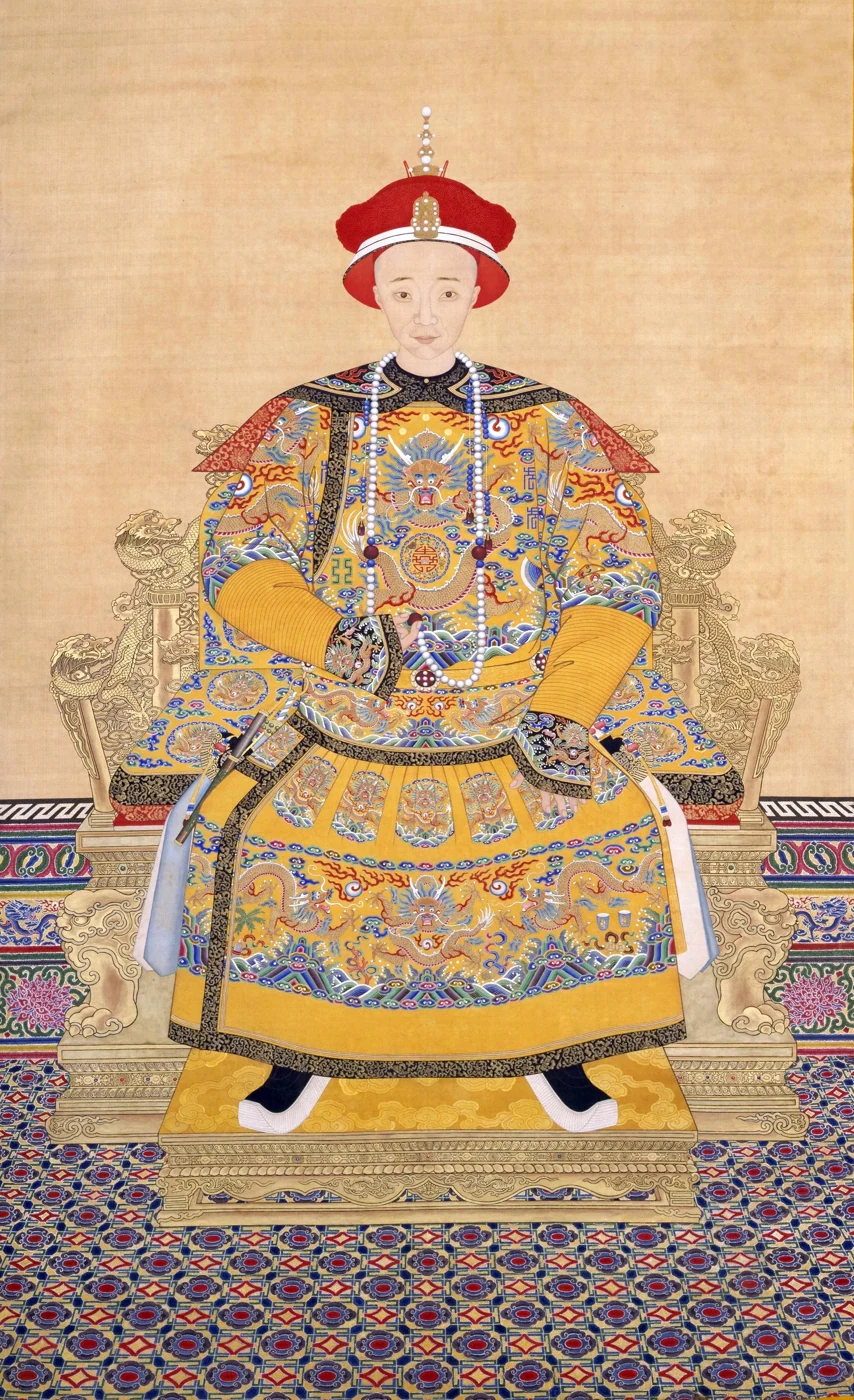
1831 CE–1861 CE
Emperor
Aisin Gioro Yizhu
爱新觉罗·奕詝
The Xianfeng Emperor, Aisin Gioro Yizhu (July 17, 1831–August 22, 1861), who called himself Master Qiele, was the ninth emperor of the Qing dynasty. His era name was Xianfeng and his temple name Wenzong; his full posthumous title was Xietian Yiyun Zhizhong Chuimo Maode Zhenwu Shengxiao Yuangong Duanren Kuanmin Zhuangjian Xian Huangdi. He was the fourth son of the Daoguang Emperor and Empress Xiaoquancheng of the Niohuru clan.…
1831 CE–1861 CEQing Dynasty
PROFILE
The Xianfeng Emperor, Aisin Gioro Yizhu (July 17, 1831–August 22, 1861), who called himself Master Qiele, was the ninth emperor of the Qing dynasty. His era name was Xianfeng and his temple name Wenzong; his full posthumous title was Xietian Yiyun Zhizhong Chuimo Maode Zhenwu Shengxiao Yuangong Duanren Kuanmin Zhuangjian Xian Huangdi. He was the fourth son of the Daoguang Emperor and Empress Xiaoquancheng of the Niohuru clan. Secretly designated crown prince in 1846, the twenty-sixth year of Daoguang, he succeeded in the first lunar month of 1850. His eleven-year reign coincided with severe internal and external crises: the Taiping movement spread across much of China while Anglo-French forces waged the Second Opium War. He died at the Chengde Mountain Resort in Rehe on August 22, 1861, the seventeenth day of the seventh lunar month in the eleventh year of Xianfeng, aged thirty-one, and was buried in Dingling in the Eastern Qing Tombs. Soon after his death, the Xinyou Coup overthrew the eight regents and began nearly half a century of political dominance by Empress Dowager Cixi.
- Other Names
- Xianfeng Emperor; Emperor Wenzong of Qing
- Art Name
- Qiele Daoren
- Era
- Qing
- Dynasty/Regime
- Qing
- Identity
- Emperor
- Date of Birth
- July 17 1831
- Date of Death
- August 22 1861
- Ethnicity
- Manchu
- Clan
- Aisin Gioro clan
- Ancestral Home
- Not reliably confirmed in historical sources
- Place of Birth
- Place of birth unknown
- Reign
- Reign dates unknown
- Era Name
- Not reliably confirmed in historical sources
- Temple Name
- Wenzong
- Posthumous Name
- Xietian Yiyun Zhizhong Chuimo Maode Zhenwu Shengxiao Yuangong
- Major Achievement
- Qing emperor during the Taiping Rebellion and Anglo-French invasion; his death at Rehe led to the Xinyou Coup.
- Predecessor
- Daoguang Emperor Minning
- Successor
- Tongzhi Emperor Zaichun
LIFE TIMELINE
Age ten | His biological mother, Empress Xiaoquancheng of the Niohuru clan, died; he was raised by Imperial Noble Consort Jing, later Empress Xiaojingcheng
Age sixteen | Secret succession designation by the Daoguang Emperor; Yizhu was made crown prince
Age twenty | The Daoguang Emperor died and the secret decree was opened, naming Yizhu crown prince
Age twenty | Formally ascended the throne; the following year became Xianfeng 1
Age twenty-one | Taiping uprising broke out at Jintian in Guangxi
Age twenty-three | Taiping forces established their capital at Nanjing; Zeng Guofan and others were ordered to organize local militia, leading to formation of the Hunan Army
Age twenty-five | The Yellow River changed course after a breach at Tongwaxiang in Henan; Prince Gong Yixin was dismissed from the Grand Council over the title granted to Imperial Noble Consort Kangci
Age twenty-six | Britain used the Arrow Incident as a pretext to launch the Second Opium War; the Taiping Heavenly Kingdom suffered the Tianjing Incident
Age twenty-eight | Signed the Treaties of Tianjin with Britain, France, the United States, and Russia, and the Treaty of Aigun with Russia
Age twenty-nine | Anglo-French naval forces were repelled at the Dagu Forts
Age thirty | Anglo-French forces captured Beijing; Xianfeng fled to Rehe under the pretext of the Mulan autumn hunt, leaving Yixin in Beijing to negotiate; the Convention of Peking was signed and the Old Summer Palace was burned
Age thirty-one | Died in Yanbo Zhishuang Hall at the Chengde Mountain Resort; ordered Zaichun made crown prince and appointed Zaiyuan, Duanhua, Sushun, and five others as regents
Burial | Buried at Dingling in the Eastern Qing Tombs
BIOGRAPHY
Biography
Family Background and Early Years Yizhu was born on July 17, 1831, the ninth day of the sixth lunar month in the eleventh year of Daoguang, at Zhanjing Studio in the Old Summer Palace outside Beijing. His father, the Daoguang Emperor Minning, was nearing fifty. Three sons born earlier—Yiwei, Yigang, and Yiji—had already died, so Yizhu's birth again provided a possible heir. His mother, Lady Niohuru, daughter of second-rank imperial guard Yiling, entered the palace as a consort and won Daoguang's favor for her intelligence and beauty, rising through the ranks. In 1833 Empress Xiaoshencheng of the Tonggiya clan died, Lady Niohuru was promoted to Imperial Noble Consort and placed in charge of the inner palace, and the following year she was made empress. In the first lunar month of 1840 she died suddenly at thirty-three. Yizhu was only ten, and the loss of his mother deeply influenced his character. After Empress Xiaoquancheng's death, Daoguang entrusted Yizhu to Imperial Noble Consort Jing of the Borjigit clan. She was the daughter of Hualiang'a, a subordinate official in the Ministry of Punishments, and had borne three sons; Yigang and Yiji had died young, leaving only the sixth prince Yixin. Yizhu and Yixin were one year apart, were raised together, and studied side by side in the imperial school. Yizhu began formal study at six under Du Shoutian, who taught him closely for more than a decade and exerted a major influence on his character and thought. As a youth, Yizhu fell from a horse while hunting at the Southern Park and injured his thigh; treatment by an imperial bonesetter left him permanently impaired in movement. He also suffered smallpox in childhood, leaving pockmarks on his face. ### Succession Struggle and Accession In Daoguang's later years he hesitated for a long time over the succession. The realistic choices among his sons were the fourth prince Yizhu and the sixth prince Yixin. Yizhu was older and known for filial conduct but was considered less gifted and was physically disabled; Yixin was intelligent, skilled in both civil and martial pursuits, and deeply favored by the emperor, but was of secondary maternal status. Rival groups formed around the succession. Yizhu's tutor Du Shoutian advised him on strategy. According to unofficial Qing accounts, during one imperial hunt Yizhu followed Du's advice and did not shoot. When asked why, he replied that it was spring, when birds and beasts were breeding, and he could not bear to kill them and disturb heavenly harmony. Daoguang was pleased and saw in him the qualities of a humane ruler. The source notes that such stories are not necessarily fully reliable but reflect the intensity of the succession contest. In 1846 the Daoguang Emperor decided to appoint Yizhu and wrote a secret succession edict in Manchu and Chinese, sealing it in a casket. On February 25, 1850, when the emperor became critically ill, he urgently summoned the head of the Imperial Clan Court Zaiquan, imperial attendants Zaiyuan, Duanhua and Sengge Rinchen, grand councillors Mujangga, Saishang'a, He Rulin, Chen Fuen and Ji Zhichang, and Imperial Household minister Wenqing to open the casket. The vermilion decree declared: “The fourth imperial son Yizhu is hereby established as crown prince. You princes and ministers need not await further words from me; work together in loyal assistance, always placing the affairs of state and the livelihood of the people first and disregarding other concerns. Respect this.” Daoguang died at noon that day at Shende Hall in the Old Summer Palace. On the twenty-sixth day of the first lunar month (March 9, 1850), Yizhu formally ascended the throne, proclaimed wide favors, and designated the following year as the first year of Xianfeng. ### Early Efforts at Reform At the beginning of his reign, Xianfeng showed a desire for energetic government. Facing accumulated problems from the Daoguang era, he tried to remove abuses and restore administration. Within eight months he dismissed Mujangga, the leading grand councillor of Daoguang's reign, and later removed and prosecuted Qiying, who had led peace negotiations during the First Opium War. Mujangga had dominated government and built factions for years, so his removal signaled Xianfeng's determination to reorganize the court. He also reshuffled the Grand Council and promoted a group of newer officials. The official on whom Xianfeng relied most was Sushun, younger brother of Prince Zheng Duanhua. Sushun acted decisively, and Xianfeng backed measures to punish corruption and discipline the bureaucracy. The Wuwu examination scandal was handled severely, with the execution of first-rank official Baijun, a step credited in the source with checking corruption that had worsened since the late Qianlong period. Fiscal abuses in the Ministry of Revenue were investigated through the accounts of the five government banking houses, and dozens of officials, merchants, and Manchu imperial clansmen had property confiscated. These measures curbed some overt corruption but did not resolve the dynasty's deeper crisis. Relations with Prince Gong Yixin also changed. Yixin entered the Grand Council in 1853. In 1855, when Yixin's mother Imperial Noble Consort Kangci became critically ill, Yixin requested that she be elevated as empress dowager. Xianfeng reluctantly agreed but deeply resented the matter. After her death he expressed displeasure by reducing the scale of the funeral and dismissing Yixin from the Grand Council. The brothers' relationship deteriorated and never returned to its earlier closeness. ### The Taiping Heavenly Kingdom and Rise of the Hunan Army In January 1851 the Taiping uprising began at Jintian Village in Guiping, Guangxi. Under Hong Xiuquan, Yang Xiuqing, and others, the Taiping forces expanded rapidly, taking Hanyang, Yuezhou, Hankou, Nanjing, and other important southern cities within just over two years. In 1853 they made Nanjing their capital, renamed it Tianjing, and established a regime confronting the Qing court. Their northern expedition once approached Tianjin and alarmed Beijing. The traditional Eight Banner and Green Standard forces proved unable to stop the Taiping advance. Early in 1853 Xianfeng ordered officials and local gentry in provinces north and south of the Yangzi to organize militia. Zeng Guofan built the Hunan Army around Luo Zenan's Hunan braves, creating a distinct military force that became central to the war against the Taiping. Xianfeng entrusted Han officials such as Zeng Guofan, Zuo Zongtang, and Li Hongzhang with unusually broad powers to recruit troops, raise funds, and appoint personnel. In 1856 the Taiping regime suffered the Tianjing Incident: Yang Xiuqing and Wei Changhui were killed and Shi Dakai departed, seriously weakening the movement and giving the Qing breathing room. The Hunan Army thereafter gradually gained the initiative and laid groundwork for the eventual defeat of the Taiping. ### Second Opium War and the Crisis of 1860 In 1854 Britain, the United States, and France requested treaty revisions, which Xianfeng rejected. In 1856 Britain used the Arrow Incident as a pretext for war, while France joined after the Xilin missionary case, beginning the Second Opium War. In 1858 Anglo-French forces captured the Dagu Forts and advanced on Tianjin. Xianfeng sent Guiliang and Huashana to negotiate, resulting in separate Treaties of Tianjin with Britain, France, the United States, and Russia. Their terms angered him, but circumstances forced approval. In 1859 British and French envoys returned with naval forces to exchange treaty ratifications and were resisted at the Dagu Forts, where the allied force was defeated. Encouraged by the victory, Xianfeng adopted a harder line and for a time repudiated the Tianjin agreements. Britain and France then gathered larger expeditionary forces. In the spring of 1860 the allies invaded again. Xianfeng wavered between war and negotiation, declaring that “the foundation of the realm lies not at the seacoast but in the capital,” and ordered Sengge Rinchen to withdraw coastal defenses, which the source describes as a missed opportunity. In August the Anglo-French army defeated the main Qing force at Baliqiao and advanced on Beijing. On September 22, 1860, the eighth day of the eighth lunar month, Xianfeng fled hurriedly to the Chengde Mountain Resort in Rehe under the pretext of the Mulan autumn hunt, leaving Prince Gong Yixin in Beijing to negotiate. Yixin signed the British, French, and Russian Conventions of Peking and ratified the British and French Treaties of Tianjin. The Sino-Russian Convention of Peking recognized, according to the source, the Treaty of Aigun that Russia had forced Heilongjiang general Yishan to sign in 1858. In October 1860, Anglo-French forces occupied the Old Summer Palace, whose superintendent Wenfeng drowned himself in Fuhai. The next day the palace was looted and then largely burned. ### Rehe and Final Political Arrangements After fleeing to Rehe, Xianfeng closely followed events in Beijing. Once the Anglo-French forces withdrew he considered returning but remained hesitant. One major issue was the foreign demand that envoys personally present credentials to the emperor, which he strongly resisted. He also grew attached to life at Rehe, especially theatrical performances. Large groups from the imperial Shengping theatrical office were summoned from Beijing, and performances were reportedly held in Yanbo Zhishuang Hall every three days. Sushun and others, seeking to prevent political upheaval after the emperor's death, strongly urged him to remain at Rehe. On August 20, 1861, the fifteenth day of the seventh lunar month, Xianfeng became gravely ill. On the sixteenth he summoned Prince Yi Zaiyuan, Prince Zheng Duanhua, Sushun, Jingshou, Kuangyuan, Du Han, Jiao Youying, and others to Yanbo Zhishuang Hall. He ordered his eldest son Zaichun established as crown prince and appointed eight men to assist him and handle all state affairs, creating the group later called the Eight Regents. Xianfeng also gave Empress Niohuru a seal engraved “Imperial Reward” and gave Zaichun a seal engraved “Tongdaotang,” which was held by Noble Consort Yi of the Yehe Nara clan. Future edicts were to bear both seals. The intended structure was for the eight regents to administer government while the two empress dowagers restrained them, preventing either side from monopolizing authority. In the early hours of August 22, 1861, the seventeenth day of the seventh lunar month, Xianfeng died in Yanbo Zhishuang Hall at the Chengde Mountain Resort at the age of thirty-one. In the twelfth lunar month he received the temple name Wenzong and the full posthumous title Xietian Yiyun Zhizhong Chuimo Maode Zhenwu Shengxiao Yuangong Duanren Kuanmin Zhuangjian Xian Huangdi. In September 1865 he was buried in Dingling in the Eastern Qing Tombs. The political structure he had designed collapsed soon after his death. Empress Dowager Cixi allied with Empress Dowager Ci'an and Prince Gong Yixin in the Xinyou Coup, eliminating the Eight Regents. Sushun was executed, Zaiyuan and Duanhua were ordered to commit suicide, and the other five were dismissed or exiled. Thereafter the two empress dowagers governed from behind the curtain while Yixin became Prince-Regent for Deliberation, beginning the long era of Cixi's political dominance.
His Mother, His Foster Mother, and His Years in the Study
Yizhu's mother, Niohuru, was the daughter of a second-class guard, Yiling, and of a poor family; she entered the palace first as a concubine but, being clever and beautiful and very winning, soon pleased the Daoguang emperor and rose quickly to be a noble consort. In the sixth month of 1831 she bore the fourth son, Yizhu; two years later, when the empress Xiaoshencheng, Tonggiya, died of illness, the emperor raised her to be imperial noble consort in charge of the six palaces, and the next year made her empress; but she died of illness in the first month of 1840 at thirty-three, when Yizhu was only ten, a sudden loss that deeply marked his character. The emperor afterwards gave Yizhu to the noble consort Jing, of the Borjigit, to rear. The noble consort Jing was the daughter of the vice-director of the ministry of justice, Hualiang'a, and had borne three sons, of whom the second and third, Yigang and Yiji, died young, so that only the sixth son, Yixin, remained; and Yixin was but one year younger than Yizhu. The histories say that Yizhu honoured the noble consort Jing as his own mother and looked on Yixin as a brother of the same womb, "and that his strongest rival for the succession was precisely the sixth brother whom he so regarded." After the deaths of three empresses in succession the Daoguang emperor raised no new empress but made the noble consort Jing imperial noble consort only; and Yizhu and Yixin both studied in the upper study, of like age, close and without suspicion, though Yizhu began his studies a year earlier. Yizhu began at six, his tutor being Du Shoutian, of whom the histories say that "Shoutian taught him morning and evening, always by the right way, for more than ten years." As a prince he once hunted at the southern park, galloping after the game, and fell from his horse and injured his thigh, which the bone-setter of the imperial stables treated but which left him lame; and in childhood he had smallpox, which left his face pitted. Yixin too was clever, accomplished in letters and arms: the histories say that "he practised military matters in the same study as Wenzong," that he compiled twenty-eight postures of the flower spear called "the brothers' joint strength" and eighteen cuts of the sabre called "the precious blade's display of might," and that the Daoguang emperor gave him a treasured sabre — all of which forms the background of the choice between the two.
The Slowness of the Succession, the Contest, and His Accession
The Daoguang emperor settled the succession late. He had more than twenty consorts in all and ten princesses and nine sons, of whom the eldest, Yiwet, died in 1831 at twenty-three; the second and third sons, Yigang and Yiji, died young; the fourth son, Yizhu, was born in 1831, two months after the eldest's death; the fifth son was given in 1846 as heir to Miankai and inherited a princedom; the sixth son, Yixin, was one of those most favoured by the emperor; and in his last years the emperor had three more sons, all infants. Having on his accession not at once settled the succession as Qing custom required, he turned to it late, and from the great caution he showed in the matter it may be inferred that he wished for more room to choose: after Yiwet, with the second and third sons dead young, the only possible heir had been Yiwet himself and the question was meaningless; but after 1831, with Yiwet gone and several young princes born, he faced the problem that should have been settled long before. Among his elder sons the two he most weighed were the fourth and the sixth: Yizhu was "the eldest and worthy," the most senior and very filial, but of ordinary talent and lame in body, while Yixin was a concubine's son. Around the succession rival groups formed at court, and Yizhu's tutor Du Shoutian advised him; and according to Qing unofficial histories, when the emperor took the princes hunting Yizhu, on Du Shoutian's instruction, shot not a single arrow, and being asked why answered that it was spring and the birds and beasts were breeding and he could not bear to take life and offend heaven's harmony, at which the emperor was delighted and thought him of a benevolent ruler's measure — tales not wholly reliable, but showing how sharp the contest was. In 1846 the emperor made up his mind and, by the Qing family law of secret succession, wrote the testament in Manchu and Chinese and sealed it in the locked casket; and on 25 February 1850, gravely ill, he summoned the imperial clan director Zaiquan, the imperial attendants Zaiyuan, Duanhua and Sengge Rinchen, the grand councillors Mu Zhang'a, Saisanga, He Rulin, Chen Fu'en and Ji Zhichang and the imperial household director Wenqing to open the casket and proclaim the decree that "the fourth son Yizhu shall be made heir apparent; and you princes and ministers, why wait for my words — support him with one mind, putting the state and the people's livelihood first and nothing else." At noon that day the emperor died at the Shen'de hall of the Yuanming yuan; and by Qing custom the new emperor escorted the late emperor's body that afternoon into the Qianqing palace in the Forbidden City, taking the throne formally on 9 March 1850 and proclaiming a general amnesty, with the following year made the first of Xianfeng.
His Early Vigour, Su Shun's Reforms, and the Examination Case
At the outset the Xianfeng emperor was full of vigour, his measures being first to purge the men of the Daoguang court and employ reforming officials and second to raise up Chinese officials in numbers against the rebels. The Veritable Records show him working very hard, issuing many decrees daily, not a few in his own red-brushed hand without the grand councillors' drafting. Within eight months he dismissed the chief grand councillor of the Daoguang reign, Mu Zhang'a, and then degraded and impeached Qiying, who had managed the peace in the first Opium War, and rearranged the Grand Council, beginning to employ Su Shun and other reforming officials to set the government in order. Su Shun faced the corruption of officialdom since the late Qianlong reign with an iron hand, punishing peculation and dereliction severely; and in the examination case of 1858 the grand secretary Bojung, having presided over the Shuntian provincial examination and connived at the fraud of his servant Jin Xiang, was tried by Su Shun with the ministry of justice and condemned to death, and when the emperor, thinking Bojung an old servant and the case excusable, wished to spare him, Su Shun pressed him and the execution was ordered, after which the temper of officialdom, and especially the corruption that had grown since Qianlong's later years, was much reformed. In finance, with the treasuries empty from the war against the Taiping, the court had the ministry of revenue set up a note office and a coin bureau issuing great quantities of government notes; but the over-issue eased nothing and instead raised the price of silver and sent prices soaring, while officials and merchants combined to embezzle and to refuse and offset payments for profit, shifting the losses of the failed currency reform onto the people, so that "of soldiers and people inside and outside the five wards there were no fewer than several million households, the grain merchants cornered the market at raised prices, and what a poor man earned in a day could not fill him for a day." At the end of 1858, moved to be minister of revenue, Su Shun set about the accumulated abuses of the finances, beginning with the accounts of the Five Character agencies and going to the root of the matter, with several hundred persons implicated and dozens of households of revenue officials, merchants and Manchu clansmen confiscated, which to some degree checked the open traffic in favour and bribes. At the same time his relations with Prince Gong, Yixin, went through a change: in his first years he made Yixin a grand councillor to ease the political tension, but in 1855, when Yixin's mother the imperial noble consort Kangci fell gravely ill and Yixin asked that she be made empress dowager, the emperor reluctantly agreed and was greatly displeased; and after her death he showed his displeasure by lowering the rites of mourning and took from Yixin his place in the Grand Council, so that the brothers grew estranged and the old affection was not restored.
The Taiping, the Xiang Army, and the Second Opium War
In the first month of 1851 the Taiping rising broke out at Jintian village in Guiping county, Guangxi, and the Taiping army under Hong Xiuquan and Yang Xiuqing grew fast, taking in little more than two years Hanyang, Hankou, Yuezhou and Nanjing, and in 1853 making Nanjing its capital under the name Tianjing and setting up a state in opposition to the Qing, its northern expedition approaching Tianjin and shaking the capital. Against such attacks the Eight Banners and the Green Standard proved useless, and early in 1853 the emperor ordered the gentry and officials of the provinces to the north and south of the Yangtze to raise militia and organize landlord forces; and Zeng Guofan, on the basis of Luo Zenan's Hunan braves, "set up a separate banner and changed the strings," forming the Xiang army in Hunan, which became the chief force against the Taiping. The emperor boldly employed the Chinese officials Zeng Guofan, Zuo Zongtang and Li Hongzhang, giving them the real power to raise troops, collect funds and appoint officials, which was without precedent in Qing history. Because the Taiping did not concentrate on a full northern campaign, and because the Tianjing incident of 1856 left Yang Xiuqing and Wei Changhui killed and Shi Dakai gone, the Taiping were gravely weakened and the court gained breathing space, after which the Xiang army gradually took the initiative. Abroad, in 1854 Britain, the United States and France demanded treaty revision and were refused; in 1856 Britain used the Arrow incident to attack Guangzhou, where she was repelled, while France joined in on the pretext of the Xilin mission case, and the second Opium War began. In the third month of 1858 Tan Tingxiang with the envoys of Britain, France, the United States and Russia reached Tianjin, and the emperor instructed him to use one barbarian against another — to be friendly to Russia, to hold the United States by a slack rein, to coax France and to question Britain sharply; Tan Tingxiang did as instructed and failed. When the allied fleets took the Dagu forts and pressed on Tianjin, the emperor sent Guiliang and Huashana to negotiate, and treaties were signed with Britain, France, the United States and Russia; the draft treaties enraged him, but the situation left him no choice but to ratify. The powers, not content with the rights they had gained, deliberately renewed the war, and the emperor ordered the Dagu defences strengthened; and in 1859, in the Dagu clash that Britain deliberately provoked, the allied troops were beaten, at which the emperor turned firm and for a time destroyed the treaties outright, while Britain and France moved troops for a new attack. In the spring of 1860 the two powers formed a new expedition and invaded in force; in the sixth month they attacked Dagu and the emperor decreed that "the root of the empire lies not at the river mouth but in the capital"; in the seventh month they attacked Beitang while the emperor wavered between war and peace and lost the chance of destroying them, and in the midst of the fighting he ordered the commander to leave his camp, so that Dagu fell again. On the first day of the eighth month the allied fleets reached the sea off Dagu, France sending more than forty ships and six thousand seven hundred troops against a garrison of eleven thousand; and to avoid entanglement the allies landed at Beitang north of Dagu, and Sengge Rinchen, to preserve his strength, ordered the south bank troops back to Tongzhou, the next day the British fleet steaming unhindered into the river, the allies taking Tianjin and marching on Beijing. The emperor sent Prince Yi, Zaiyuan, to Tongzhou to treat with them, and the allies, using the talks as cover, continued their advance on Beijing; in the eighth month they broke the Qing main force at Baliqiao and pressed on the capital. On 22 September 1860 the emperor, under the name of the autumn hunt at Mulan, fled in haste to the Chengde summer resort in Rehe, leaving Prince Gong, Yixin, to negotiate; and Yixin signed the Beijing treaties with Britain, France and Russia and ratified the Tianjin treaties with Britain and France, the treaty with Russia recognizing the Aigun treaty forced on the Heilongjiang general Yishan in 1858. On 6 October 1860 the allies took the Yuanming yuan, its comptroller Wenfeng drowning himself in the Fu sea, and the next day the gardens were plundered and afterwards burnt to the ground.
His Years at Rehe, His Last Arrangements of Power, and After
At Rehe the emperor followed news of the capital closely and, after the allies withdrew, thought of returning but could never decide, one chief reason being that the question of the personal presentation of credentials was unsettled — the British and French envoys demanded to hand their letters to the emperor in person, which he deeply resisted; and he had besides come to like the life of the Rehe palace, giving himself to the theatre, so that the Shengping office was brought from Beijing in batches and a performance given at the Yanbo Zhishuang hall every three days; and Su Shun and the others, to keep the government from changing greatly after his death, urged him strongly to stay at Rehe. On 20 August 1861 he fell gravely ill at the Rehe palace, and on the sixteenth, in the bedchamber of the Yanbo Zhishuang hall, he summoned Prince Yi Zaiyuan, Prince Zheng Duanhua, Su Shun, Jingshou, Kuang Yuan, Du Han and Jiao Youying, decreed that his eldest son Zaichun be made heir apparent, and charged those eight to support him with all their hearts and to assist in all government, the "eight guardians"; and he gave the empress Niohuru the seal "imperial bounty" and the heir Zaichun the seal "hall of the same way" (held in fact by the noble consort Yehenara), providing that all future decrees must bear both seals. His design was that the eight should assist in government while the two palaces checked them, so that no side should monopolize power. In the early hours of 22 August 1861 he died at the Yanbo Zhishuang hall of the summer resort at thirty-one; in the twelfth month he was given the temple name Wenzong and the long posthumous title, and in the ninth month of 1865 he was buried at the Dingling of the eastern Qing tombs. Not long after his death his design was broken: the empress dowager Cixi with Ci'an and Prince Gong made the Xinyou coup, destroying the eight guardians — Su Shun executed, Zaiyuan and Duanhua ordered to kill themselves, the other five dismissed or banished; and from that time the two empresses dowager ruled behind the curtain and Prince Gong was prince regent for the government, opening the age in which Cixi held power for nearly half a century.
Major Activities
Political Measures Xianfeng inherited a government in deep crisis and attempted to respond through personnel changes and reform. He dismissed Daoguang-era grand councillor Mujangga, put peace advocate Qiying to death, promoted the forceful Sushun, and supported measures to discipline officials. He also relied on Han officials Zeng Guofan, Zuo Zongtang, and Li Hongzhang and on Han-led regional armies against the Taiping. Under Sushun, the Wuwu examination scandal led to the execution of first-rank official Baijun, while corruption was punished more harshly. After becoming president of the Ministry of Revenue late in 1858, Sushun investigated accounts of the five government banking houses; hundreds were implicated and dozens of ministry officials, merchants, and Manchu imperial clansmen had assets confiscated. The source says this checked open bribery to some degree. ### Military Affairs and War Xianfeng's reign witnessed two major wars. Internally, the Qing fought to suppress the Taiping. In 1853 he ordered officials and gentry throughout the provinces to organize local militia; Zeng Guofan's Hunan Army emerged from this policy. Xianfeng granted Zeng and other Han officials powers to recruit troops, obtain military funds, and appoint personnel on a scale described as unprecedented in Qing history. Externally, the Second Opium War unfolded from treaty-revision disputes to open fighting, the Qing victory at the Dagu Forts, and finally the fall of Beijing. Xianfeng repeatedly vacillated between resistance and negotiation, unwilling to accept foreign demands but unable to defeat foreign military power, culminating in the occupation of Beijing and destruction of the Old Summer Palace. ### Travels and Residences Xianfeng spent most of his life in Beijing and Rehe. Before accession he resided mainly in the Old Summer Palace and Forbidden City. In the eighth lunar month of 1860, as Anglo-French forces approached Beijing, he fled to the Chengde Mountain Resort in Rehe and remained there for more than a year until his death. During his Rehe residence he became absorbed in theater, and performers from the Shengping office were brought from Beijing in large groups, with a performance held at Yanbo Zhishuang Hall every three days according to the source. ### Relations with Contemporaries Xianfeng's relationship with Prince Gong Yixin changed from intimate brotherhood to open estrangement. Raised together by Imperial Noble Consort Jing, they had been close in childhood. Yixin entered the Grand Council in 1853 but was dismissed in 1855 over the title issue surrounding Imperial Noble Consort Kangci. Their relations then worsened and they never met again before Xianfeng's death. Xianfeng was exceptionally close to Sushun, who in the later years of the reign became almost the effective coordinator of government. The fact that Xianfeng entrusted the regency to Sushun and seven others at his death demonstrates the depth of that confidence.
The Limits of His Domestic Reform, His Military Delegation, and the Breakdown of His Foreign Policy
The Xianfeng emperor's government may be measured in three ways. First, domestic reform: the dismissal of Mu Zhang'a, the punishment of Qiying, the promotion of Su Shun and support for his cleansing of officialdom, the execution of the grand secretary Bojung in the examination case, and the confiscation of dozens of households of revenue officials, merchants and Manchu clansmen in the Five Character case did to some extent check the traffic in corruption that had grown since the late Qianlong reign; but in the same period the over-issue of government notes raised the price of silver, sent prices soaring and let officials and merchants combine for profit, which shows that the reform of the finances and the failure of the currency went together and that the crisis of Qing rule was not solved at the root. Second, military delegation: the order to the provincial gentry to raise militia and the unprecedented grant to Chinese officials such as Zeng Guofan of the power to raise troops, collect funds and appoint officials, with the Xiang army "setting up a separate banner and changing the strings" on the basis of Luo Zenan's braves, together with the Taiping failure to concentrate on a northern campaign and the internal losses of the Tianjing incident, brought about the turn of the war; but to credit the suppression of the Taiping to the emperor's decision alone, or to ignore the failure of the Eight Banners and the Green Standard and the long-term consequences of local militarization, would be incomplete. Third, foreign policy: from the refusal of treaty revision to forced war, from the destruction of the treaties after the success at Dagu in 1859 to the wavering of 1860, the order for the commander to leave his camp and the second loss of Dagu, and then the flight to Rehe under the name of the autumn hunt and the signing of the Beijing treaties by Yixin with the recognition of the Aigun treaty — the whole course shows a government neither willing to accept the powers' demands nor able to resist their arms, ending in the fall of Beijing and the burning of the Yuanming yuan.
In his person and in the institutions, his most direct legacy was his design for power at his death: he made Zaichun heir apparent and gave the eight guardians the conduct of government while binding the issue of decrees to the two seals, so that the guardians and the two palaces should check each other; and that structure was broken within months by the Xinyou coup, with Su Shun executed and Zaiyuan and Duanhua ordered to die, and the two empresses dowager ruling behind the curtain with Yixin as prince regent for the government. In its consequences, the failure of that arrangement changed the distribution of power in the Qing for nearly half a century and made the Xianfeng reign the turning point at which the emperor's sole authority gave way to rule by the empress dowager. His lingering at Rehe and his devotion to the theatre, entangled with the dispute over the personal presentation of credentials, likewise show his resistance on questions of foreign ceremony; and these details and the larger military, political and diplomatic course illustrate one another, making up the whole face of the eleven years of Xianfeng.
Personal Relations
- Father: Daoguang Emperor Minning
- Biological mother: Empress Xiaoquancheng of the Niohuru clan
- Foster mother: Empress Xiaojingcheng of the Borjigit clan (Imperial Noble Consort Jing)
- Empress: Empress Xiaodexian of the Sakda clan (principal wife; died before Xianfeng's accession)
- Empress: Empress Xiaozhenxian of the Niohuru clan (Empress Dowager Ci'an)
- Imperial Noble Consort: Empress Xiaoqinxian of the Yehe Nara clan (Empress Dowager Cixi)
- Son: Tongzhi Emperor Zaichun (born to Cixi)
- Brothers: Prince Gong Yixin, Prince Dun Yicong, Prince Chun Yixuan, Prince Zhong Yihe, Prince Fu Yihui - Tutor: Du Shoutian (his most influential teacher, who instructed him for more than a decade)
- Tutor: Zhuo Bingtian (Yixin's tutor) - Sushun: Xianfeng's most trusted minister, supported reform, and was appointed one of the principal regents before the emperor's death
- Zeng Guofan: Han official promoted by Xianfeng who organized the Hunan Army against the Taiping
- Zaiyuan and Duanhua: members of the Eight Regents, ordered to commit suicide after the Xinyou Coup
- Yixin: Xianfeng's younger brother; entered the Grand Council in 1853, was dismissed in 1855, stayed in Beijing to negotiate in 1860, and later joined Cixi in the Xinyou Coup - Mujangga: senior grand councillor under Daoguang, dismissed after Xianfeng's accession
- Qiying: advocate of peace during the First Opium War, put to death under Xianfeng
- Anglo-French forces: enemy in the Second Opium War
- Taiping Heavenly Kingdom: largest internal threat during the reign
Historical Assessment
Qing and Contemporary Assessments - Guo Songtao, in Collected Writings from the Yangzhi Study, described the early reign: “When Wenzong first established his rule, the southeast was in ruin and the realm in peril. The court acted with grave restraint out of fear, while officials, shocked by the sudden rise of great calamity, looked about and hesitated.”
- The Draft History of Qing, “Annals of Wenzong,” stated that Wenzong “encountered an age of great adversity and personally met a dark conjunction. Powerful foreigners imposed treaties, internal rebels rose, and a hundred anxieties gathered; he labored day and night without respite,” judging him diligent but ill-fated.
- Xue Fucheng, in Notes from the Yong'an Studio, wrote that Xianfeng “employed the worthy and promoted the talented, perceiving affairs clearly and responding to them,” arguing that amid internal and external crisis he could still direct government and that his use of Zeng Guofan and other Han ministers laid foundations for the later Tongzhi-Guangxu restoration. ### Late Qing and Republican Period - Xiao Yishan, in General History of the Qing Dynasty, judged Xianfeng “of middling talent, yet fairly capable of employing worthy men,” arguing that although he was not a great ruler, he recognized and promoted capable figures such as Sushun and Zeng Guofan.
- Cai Dongfan's Romance of Qing History was more critical, describing him as indecisive and arguing that wavering between war and peace during the Anglo-French invasion contributed to the fall of Beijing and destruction of the Old Summer Palace.
- Many Republican-era historians argued that his final arrangement of political power was flawed and helped produce the Xinyou Coup and Cixi's half-century of dominance, making it an important turning point toward Qing decline. ### Modern Assessments - Mao Haijian, in The Ill-Fated Son of Heaven: Xianfeng Emperor Yizhu, calls him an “ill-fated Son of Heaven” facing changes unprecedented in three thousand years; his personal ability was insufficient for such challenges, though his diligence and intention to reform deserve recognition.
- General History of China, edited by Bai Shouyi, argues that the Qing governing crisis erupted comprehensively during Xianfeng's reign. Although he tried to save the dynasty, he could not reverse decline. His reliance on Han officials objectively altered the structure of Qing political power and had lasting consequences.
- Modern scholars often describe Xianfeng as the last Qing emperor to wield substantial personal governing power, with effective power under Tongzhi, Guangxu, and Xuantong largely held by Cixi. The source notes that this claim is disputed: the Guangxu Emperor still exercised some decision-making authority during the First Sino-Japanese War and the Hundred Days' Reform and was not simply a complete puppet.
FIGURES ASSOCIATED WITH THIS DYNASTY
Bibliography
- Draft History of Qing*, vol. 19, Basic Annals 19
- Veritable Records of Emperor Wenzong of Qing*
- Bai Shouyi, ed., General History of China, vol. 11, Early Modern Period
- Xiao Yishan, General History of the Qing Dynasty