Age one | Born in a subsidiary hall of Daming Palace
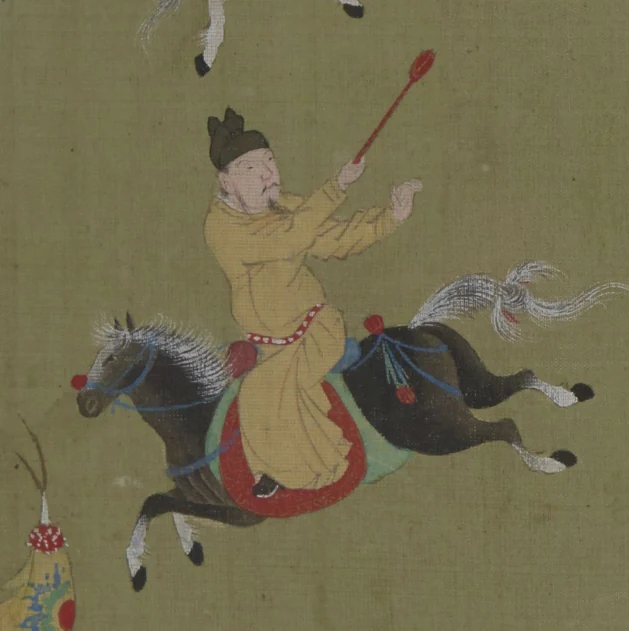
809 CE–827 CE
Emperor of the Tang dynasty
Li Zhan
李湛
Li Zhan (seventh day of the sixth lunar month in the fourth year of Yuanhe, July 22, 809 – eighth day of the twelfth lunar month in the second year of Baoli, January 9, 827) was the fourteenth emperor of the Tang dynasty. He was the eldest son of Li Heng, Emperor Muzong of Tang, and his mother was Empress Gongxi, Lady Wang. He was the elder brother of Li Ang, later Emperor Wenzong of Tang, and Li Yan, later Emperor Wuzong of…
809 CE–827 CETang Dynasty
PROFILE
Li Zhan (seventh day of the sixth lunar month in the fourth year of Yuanhe, July 22, 809 – eighth day of the twelfth lunar month in the second year of Baoli, January 9, 827) was the fourteenth emperor of the Tang dynasty. He was the eldest son of Li Heng, Emperor Muzong of Tang, and his mother was Empress Gongxi, Lady Wang. He was the elder brother of Li Ang, later Emperor Wenzong of Tang, and Li Yan, later Emperor Wuzong of Tang. During his reign from 824 to 826, Li Zhan indulged heavily in recreation, paid little attention to government, and entrusted state affairs to the powerful eunuch Wang Shoucheng, contributing to deterioration in court discipline. On the eighth day of the twelfth lunar month in 826, the second year of Baoli, he was murdered inside the palace by the eunuchs Liu Keming, Su Zuoming, and their associates. He was eighteen years old. His posthumous name was Emperor Ruiwu Zhaomin Xiao, his temple name Jingzong, and he was buried at Zhuangling.
- Other names
- Li Zhan
- Period
- Tang Dynasty
- Date of Birth
- July 22 809
- Date of Death
- January 9 827
- Dynasty/Polity
- Tang Dynasty
- Identity
- Emperor of the Tang dynasty
- Ethnicity/Affiliation
- Not recorded in historical sources
- Ancestral home
- Not recorded in historical sources
- Place of birth
- A subsidiary palace hall in Daming Palace
- Place of death
- Not recorded in historical sources
- Reign
- 824–826
- Predecessor
- Emperor Muzong of Tang (Li Heng)
- Successor
- Emperor Wenzong of Tang (Li Ang)
- Era name
- Baoli
- Temple name
- Jingzong
- Posthumous name
- Emperor Ruiwu Zhaomin Xiao
- Highest office
- See Biography and Major Deeds
- Major achievements
- A short-lived mid-Tang emperor known for excessive recreation and neglect of government; assassinated by the eunuch Liu Keming and others.
LIFE TIMELINE
Age thirteen | Enfeoffed as Prince of Jing in the third lunar month
Age fourteen | Formally designated crown prince in the twelfth lunar month
Age sixteen | Emperor Muzong died in the first lunar month; Li Zhan succeeded to the throne before his father's coffin
Age sixteen | In the fourth lunar month, dyeworks laborer Zhang Shao and others broke into Qingsi Hall; Li Zhan fled to the Left Shence Army for refuge
Age seventeen | Insisted on making an excursion to Mount Li in the eleventh lunar month despite ministers' remonstrations
Age eighteen | Held a large sporting festival in the palace in the sixth lunar month and ordered participants to play polo while riding donkeys
Age eighteen | On the eighth day of the twelfth lunar month, after returning from a night hunt, drank with eunuchs and military officers and was murdered indoors by Liu Keming, Su Zuoming, and others
Age nineteen, posthumously | Ministers conferred the posthumous name Emperor Ruiwu Zhaomin Xiao; buried at Zhuangling on the thirteenth day of the seventh lunar month
BIOGRAPHY
Biography
Family Background and Early Life
Li Zhan was born on the seventh day of the sixth lunar month in the fourth year of Yuanhe (July 22, 809) in a subsidiary hall of Daming Palace. His father Li Heng was then Prince of Sui and was a son of Li Chun, Emperor Xianzong of Tang. Li Zhan was Li Heng's eldest son; his mother, Lady Wang, was a concubine of Li Heng. In 820, the fifteenth year of Yuanhe, Emperor Xianzong died and Li Heng succeeded him as Emperor Muzong. As the emperor's eldest son, Li Zhan was enfeoffed as Prince of Jing in the third lunar month of 821, the first year of Changqing. In the twelfth lunar month of 822 he was formally established as crown prince. By Li Zhan's youth, the Tang had already been shaped by the aftermath of the An Lushan Rebellion, regional military-governor power, and increasing eunuch influence, while internal palace politics had become highly complicated. His father Muzong likewise devoted himself to recreation and neglected government, an environment that strongly affected Li Zhan's upbringing.
Accession and Early Rule
On the ren-shen day of the first lunar month in 824, the fourth year of Changqing, Emperor Muzong died. The following day, gui-you, the sixteen-year-old crown prince Li Zhan succeeded to the throne before his father's coffin. After taking the throne, he showed little concern for major affairs of state and indulged in recreation to an even greater degree than his father. In only the second month of his reign, he played polo one day at Zhonghe Hall, the next at Feilong Court, and on the third held a great banquet again at Zhonghe Hall and celebrated until the festivities ended. He also frequently failed to attend morning court. On one day in the third lunar month, officials assembled for an audience, yet Jingzong had still not appeared long after sunrise. Since ministers had risen before dawn to prepare for court, several eventually collapsed from exhaustion while waiting. The remonstrance official Li Bo criticized this conduct as contrary to ancestral practice. Jingzong eventually appeared only after repeated urging. After court, the Left Reminder Liu Qichu remonstrated even more strongly, repeatedly striking his head against the palace steps until blood flowed. Jingzong seemed deeply moved at the moment, but did not change his behavior. Eventually, he sometimes attended court no more than two or three times in an entire month.
Misgovernment and Palace Disturbances
In an effort to persuade Jingzong to attend court and govern, Li Deyu, then serving outside the capital, submitted six admonitory pieces known as the Danyi Zhen. Jingzong instructed Hanlin academician Wei Chuhou to draft an edict praising Li Deyu, yet made no substantial change in his own conduct. Jingzong's near-obsessive pursuit of amusement was accompanied by a series of disturbances within the palace. Not long after his accession, a commoner named Xu Zhongxin broke through the Bath Hall Gate, causing a scare. In the fourth lunar month, a much more serious incident occurred when Zhang Shao, a laborer from the imperial dye works, and the diviner Su Xuanming organized several hundred dyers and forced their way through the Right Silver Terrace Gate. Jingzong was playing polo in Qingsi Hall when he heard the shouts of more than a hundred attackers and fled in disorder to the Left Shence Army for protection. Kang Yiquan, a military officer of the Left Shence Army, led troops into the palace and killed Zhang Shao and his followers, who had already entered Qingsi Hall and even climbed onto the imperial couch to eat.
In the eighth lunar month, another plot involving the religious rebel Ma Wenzhong, court attendant Ji Wende, and nearly 1,400 others was uncovered; those implicated were beaten to death. Jingzong also had a strong personal taste for construction projects. From spring through winter after his accession, building work continued almost without interruption, provoking resentment among officials, artisans, and laborers. Zhang Shao's uprising should have served as a warning. Ministers argued that such events arose because Jingzong was constantly absorbed in recreation and often absent from regular palace routines, creating opportunities for lawless men. Although Jingzong acknowledged that their argument had merit, his amusements only became more extravagant and varied.
The Baoli Era and Assassination
In the eleventh lunar month of 825, the first year of Baoli, Jingzong suddenly decided to make an excursion to Mount Li. His ministers strongly opposed the plan, but he refused to listen. The Reminder Zhang Quanyu kowtowed in the hall and argued that rulers who had visited Mount Li since King You of Zhou had met unfortunate ends: Qin Shi Huang was buried there and his dynasty fell in the second generation; Emperor Xuanzong built a palace there and An Lushan rebelled; and the late Emperor Muzong visited once and died not long after his return. Instead of discouraging Jingzong, the warning increased his curiosity. He replied in effect, “Is Mount Li really so ominous? If so, all the more reason I should go and test what you say.” He went despite opposition and returned to the palace that same day, remarking to those around him that “the words of those who kowtow to me are not necessarily all trustworthy.” He paid little heed to the advice of his ministers.
Jingzong also enjoyed watching dragon-boat races at Yuzao Palace. On one occasion he suddenly ordered the salt-and-iron commissioner to build twenty racing boats, requiring timber to be transported to the capital for construction. The cost would have consumed roughly half of that year's transport funds. Only after strong remonstrance by Zhang Zhongfang and others did Jingzong agree to reduce the number by half. He not only loved polo himself but required imperial guardsmen and palace women to take part. In the sixth lunar month of 826, the second year of Baoli, he held a major sporting festival in the palace featuring polo, wrestling, boxing, combat contests, and assorted entertainments. Most unusually, he divided soldiers of the Left and Right Shence Armies, palace women, performers of the Music Bureau, and staff of the Inner Garden into teams and ordered them to play polo on donkeys. Because Jingzong was in high spirits, the games continued into the first or second watch of the night. He also loved hunting. Finding daytime insufficient, he often took people out late at night to catch foxes for sport, an activity known in the palace as “hunting night foxes.”
Jingzong also maintained a special group of strongmen who stayed near him day and night. He ordered local authorities to select and present such men and spent ten thousand strings of cash to recruit others for the Inner Garden. He was generous in spending on them, but when amusement took hold of him he showed little restraint. Some strongmen grew arrogant through favor, whereupon Jingzong might exile them and confiscate their property. Eunuchs were frequently abused for minor mistakes, insulted for lesser offenses and beaten for more serious ones, leaving many fearful and resentful. Palace eunuchs Xu Suizhen, Li Shaoduan, and Yu Hongzhi were demoted because they did not perform well enough during his “night fox” hunts. Jingzong's unrestrained amusements soon contributed directly to his death.
On the xin-chou day, the eighth day of the twelfth lunar month in 826, Jingzong once again went out to hunt “night foxes.” After returning to the palace in high spirits, he played ball with the eunuchs Liu Keming, Tian Wucheng, and Xu Wenduan, then drank with the military officers Su Zuoming, Wang Jiaxian, Shi Dingkuan, and twenty-eight others. When he was drunk and warm with wine, he went inside to change clothes. The lamps and candles in the main hall suddenly went out. Liu Keming, Su Zuoming, and their co-conspirators then murdered him inside the room. Jingzong was only eighteen. Apart from Emperor Ai, the final ruler of the Tang, Jingzong was among the shortest-lived Tang emperors. After his death, ministers respectfully conferred the posthumous name Emperor Ruiwu Zhaomin Xiao. On the thirteenth day of the seventh lunar month in 827, the first year of Taihe under Emperor Wenzong, he was buried at Zhuangling.
Li Zhan was a son of Emperor Muzong, born on the seventh day of the sixth month of 809 in a side hall of the Daming Palace and made heir apparent in the twelfth month of 822. On Muzong's death in 824 he took the throne as Emperor Jingzong at only sixteen. He gave no thought to the government and was even more given to pleasure than his father: in the second month of his reign he was playing ball at one place on one day, at the Feilong court the next day, and holding a grand banquet at the Zhonghe Hall on the third.
His neglect of the court was equally famous. One day the ministers assembled to enter the cabinet chamber while the emperor did not appear until the sun was high; those attending audiences had to rise before dawn to prepare, and some, waiting so long, fainted. The remonstrating grand master memorialized against it and a left remonstrator knocked his head on the ground until it bled; the emperor looked moved at the time but would not change, and presently went three or four weeks without holding audience at all. Serving in the provinces, Li Deyu presented six admonitions in verse, and Jingzong had an edict drafted praising him while remaining unmoved about himself.
His negligence let the eunuchs and favorites manipulate the government. In the twelfth month of 826, returning from a night hunt, he was murdered by the eunuch Liu Keming and others at only eighteen; the eunuch Wang Shoucheng and his fellows then raised the Prince of Jiang, Li Ang, as Emperor Wenzong. Jingzong reigned less than three years, in which the government showed no revival while the pattern of eunuchs murdering and installing emperors hardened, setting the stage for the Ganlu incident under Wenzong.
Jingzong's reign left its mark on institutions as well. Under him the eunuchs penetrated further into the palace armies, the Shence armies being commanded by eunuchs, so that the emperor's safety and the making and unmaking of emperors lay in their hands; meanwhile the factional struggle between the groups of Niu Sengru and Li Deyu took shape under Jingzong and Wenzong, the partisanship of the officials and eunuch politics becoming entangled, the basic pattern of late Tang politics.
In the twelfth month of 826 Jingzong, returning from a night hunt, was killed by the eunuch Liu Keming and his fellows at only eighteen. The eunuch Wang Shoucheng then killed Liu Keming and raised the Prince of Jiang, Li Ang, as Emperor Wenzong; Wenzong tried to destroy the eunuchs and in 835 launched the Ganlu coup, which failed and left him in their power, the authority of the Tang emperors falling away from that point. The negligence of Jingzong's reign is an important link in this chain.
Jingzong's negligence had both a family and an institutional background. His father Muzong was also known for pleasure, once falling ill from a fright while playing ball and dying of an elixir; the eunuch group already commanded the Shence armies in Muzong's reign, and with that came the power to install and depose emperors. Jingzong was sixteen when he came to the throne, his days arranged by eunuchs, and given to night hunting, ball games and banquets, so that the remonstrances of officials seldom reached him, leaving the government in the hands of eunuchs and a few favorites.
In the political history of the Tang, Jingzong's reign is often seen as the stage in which eunuch politics became fixed: the accessions and deaths of Xianzong, Muzong, Jingzong and Wenzong were all directly bound up with eunuchs, Jingzong's murder and Wenzong's subjection being the clearest cases. After Jingzong's death there was no reckoning with the eunuch faction; under Wenzong came the failed Ganlu coup instead, and only when Zhu Wen entered the passes at the end of the dynasty were the eunuchs purged wholesale, by which time the Tang itself was ending.
Jingzong's reign produced nothing in letters, but his amusements left many records: he loved ball games and wrestling, brought strongmen into the palace to perform, and often went out hunting at night, his movements becoming known outside the palace. These accounts, together with the memorials of his ministers, were gathered into the old and new histories of the Tang and the Comprehensive Mirror, forming the chief material for later discussion of late Tang court manners.
The finances and military situation under Jingzong were equally unpromising. After Muzong's treaty with the Tibetans and compromises with the Hebei provinces the pressure of military spending eased somewhat, but the two-tax system had long been in place, surtaxes under various names were general in the provinces, and the gap between tax revenue and real burdens kept widening. Jingzong's reign saw no meaningful fiscal reform, while the costs of his amusements were met from the inner treasury and provincial offerings; at the same time the armies of the three Hebei provinces ran themselves and the Shence armies belonged to the eunuchs, leaving the court very little force at its disposal.
These conditions meant that his death caused little political stir: the ministers were concerned chiefly with the choice of a new ruler and their own standing, not with holding the eunuch faction to account. Wenzong tried to set things right, but the failure of the Ganlu coup proved how immovable the eunuchs had become. In the history of the late Tang, Jingzong's reign is the stage at which eunuch politics and factional strife both intensified, and his brief tenure left its mark on institutions and politics alike.
Under Jingzong, Tang relations with neighboring powers broadly continued the pattern set under Xianzong and Muzong: the frontier with the Tibetans was comparatively quiet after the Changqing oath, marriage and embassies with the Uighurs continued, and the three Hebei provinces went their own way with the court's tacit acceptance. These arrangements kept up an appearance of peace but solved neither the autonomy of the provinces nor the fiscal distress, and Jingzong's negligence occurred against that background, its consequence lying less in foreign danger than in the further erosion of central authority.
Jingzong reigned less than three years, established no new policies and left nothing to his credit; what is recorded of him concerns chiefly amusements and neglect of duty.
His tomb, Zhuangling, lies in the area of present-day Sanyuan in Shaanxi.
The sources dwell on his amusements and neglect of duty, leaving few traces of actual governance.
Major Activities
Excessive Recreation
Jingzong became famous among Tang rulers for his devotion to amusement. After accession, he immersed himself in polo, “night fox” hunting, dragon-boat races, wrestling, tug-of-war, and other diversions. He built or modified palace facilities for ball games and ordered imperial guardsmen and palace women to participate. In the sixth lunar month of 826 he held a large sporting festival that included polo, wrestling, boxing, combat contests, and acrobatics, and even ordered members of the Left and Right Shence Armies, palace women, Music Bureau personnel, and Inner Garden staff to play polo while riding donkeys, continuing until late at night. He also hunted foxes after dark. In addition, he had a special kind of “romantic arrow” made with a paper arrowhead containing fragrant powder such as musk or ambergris, which he shot at palace consorts for amusement.
Neglect of Government and Delegation to Eunuchs
During Jingzong's reign he showed little interest in government and often failed to attend morning court, sometimes appearing only two or three times in a month. He delegated substantial political authority to the powerful eunuch Wang Shoucheng, who allied with the chief minister Li Fengji, excluded rivals, and damaged court discipline. Li Deyu submitted the six Danyi Zhen to remonstrate with him. Jingzong issued an edict praising the memorials but made no substantial change. Li Bo, Liu Qichu, and other officials repeatedly remonstrated, in Liu Qichu's case kowtowing until he bled, but Jingzong persisted in his ways.
Construction Projects
Jingzong was personally fond of major building projects. After he came to the throne, construction continued from spring to winter with almost no pause. He ordered twenty racing boats built and timber transported to the capital, at a projected cost of roughly half that year's transport budget. Only after Zhang Zhongfang and other remonstrance officials objected strongly did he agree to cut the project in half.
Zhang Shao Uprising
In the fourth lunar month of 824, the fourth year of Changqing, the imperial dyeworks laborer Zhang Shao and the diviner Su Xuanming mobilized several hundred dyers. They concealed themselves with carts carrying dyestuff, entered Daming Palace, killed the gate eunuchs, and forced their way into Qingsi Hall. Jingzong was playing polo there when he heard the attackers' shouts and fled to the Left Shence Army. Kang Yiquan, an officer of that army, led troops into the palace and killed Zhang Shao and his followers. It was a serious palace uprising early in Jingzong's reign.
Assassination
On the eighth day of the twelfth lunar month in 826, after returning from a night hunt, Jingzong played ball with the eunuchs Liu Keming, Tian Wucheng, and Xu Wenduan and then drank with the officers Su Zuoming, Wang Jiaxian, Shi Dingkuan, and others. When he went inside to change clothing, the lights in the hall suddenly went out, and Liu Keming, Su Zuoming, and their co-conspirators murdered him in the room. He was eighteen years old.
Personal Relations
- Grandfather: Li Chun, Emperor Xianzong of Tang
- Father: Li Heng, Emperor Muzong of Tang
- Mother: Empress Gongxi, Lady Wang
- Brothers: Li Ang, Emperor Wenzong of Tang (younger brother); Li Yan, Emperor Wuzong of Tang (younger brother)
- Sons: Crown Prince Daohuai Li Pu, Prince of Liang Li Xiufu, Prince of Xiang Li Zhizhong, Prince of Ji Li Yanyang, Prince of Chen Li Chengmei
- Daughters: Princess Yongxing, Princess Tianchang, Princess Ningguo
- Powerful eunuch: Wang Shoucheng, who controlled much of the government
- Chief minister: Li Fengji, who allied with Wang Shoucheng
- Upright officials: Li Bo, Liu Qichu, Li Deyu, Zhang Zhongfang, Zhang Quanyu, Wei Chuhou, and Pei Du
- Eunuchs Liu Keming and Su Zuoming: assassins of the emperor
- Eunuchs Xu Suizhen, Li Shaoduan, and Yu Hongzhi: demoted for poor performance during “night fox” hunts
- Rebels Zhang Shao and Su Xuanming: leaders of a palace uprising
Historical Assessment
Tang Period / Contemporary
- The historian's judgment in the Old Book of Tang described the Baoli reign as exceptional in disorder, saying that the imperial succession nearly broke and comparing Jingzong to a reckless youth unworthy of serious discussion; the passage credited Pei Du's return to high office as a fortunate stabilizing factor.
- The “Basic Annals of Jingzong” in the Old Book of Tang records that ministers gave him the posthumous name Emperor Ruiwu Zhaomin Xiao. The graph min carried connotations of pity and sorrow, reflecting the complicated contemporary response to a young ruler who died violently.
- Pei Du returned to prominence late in Jingzong's reign. The record that he again served in a high coordinating role shows that upright ministers still attempted to restore proper government, but they were unable to prevent the emperor's assassination.
Song and Yuan Periods
- Northern Song historian Sima Guang, in the Comprehensive Mirror in Aid of Governance, recorded that Jingzong “held court no more than two or three times a month, and senior ministers rarely gained audience,” documenting the extent of his neglect of government.
- Ouyang Xiu, Song Qi, and other compilers of the New Book of Tang included Jingzong in the imperial annals but judged him poorly, portraying him as failing to behave as a proper ruler.
- Song scholar Hong Mai, discussing Tang emperors in Rongzhai Suibi, regarded both Jingzong and his father Muzong as rulers who damaged the state through excessive amusement, strengthening eunuch power and contributing to later political deterioration.
Ming and Qing Periods
- Ming thinker Li Zhi, in Shigang Pingyao, characterized Jingzong as governing with the mentality of a child, treating rule as if it were play and lacking the responsibility and dignity expected of an emperor.
- Qing historian Zhao Yi, discussing the danger of eunuch power in Notes on the Twenty-Two Histories, treated Jingzong's murder by eunuchs as a major sign of the worsening problem; after this period eunuchs increasingly took part in the deposition and enthronement of emperors.
- Qing scholar Wang Mingsheng, in Critical Discussions of the Seventeen Histories, linked the political disorder of Jingzong's reign to his delegation of power to Wang Shoucheng.
Modern Period
- Historian Lü Simian, in History of the Sui, Tang, and Five Dynasties, described Jingzong as extraordinarily indulgent in pleasure and counted him among the most incapable Tang rulers, regarding his assassination as the outcome of intensifying palace conflict.
- Historian Cen Zhongmian, in History of the Sui and Tang, discussed Jingzong together with Muzong and argued that both father and son “indulged in sensual pleasures and neglected affairs of state,” accelerating the decline of central authority.
- Cai Dongfan, in Romance of Tang History, argued that Jingzong's two-year reign was not marked by systematically cruel government and that he could recognize the value of upright ministers such as Pei Du, Li Jiang, and Wei Chuhou. Cai nevertheless attributed his death to excessive banqueting and recreation and to intimacy with favored attendants.
FIGURES ASSOCIATED WITH THIS DYNASTY
Bibliography
- Old Book of Tang, vol. 17A, Basic Annals 17A
- New Book of Tang, vol. 8, Basic Annals 8
- Comprehensive Mirror in Aid of Governance, Tang annals
- Lü Simian, History of the Sui, Tang, and Five Dynasties
- Cen Zhongmian, History of the Sui and Tang
- Cai Dongfan, Romance of Tang History