Born in Cuiheng Village, Xiangshan County, Guangzhou Prefecture, Guangdong
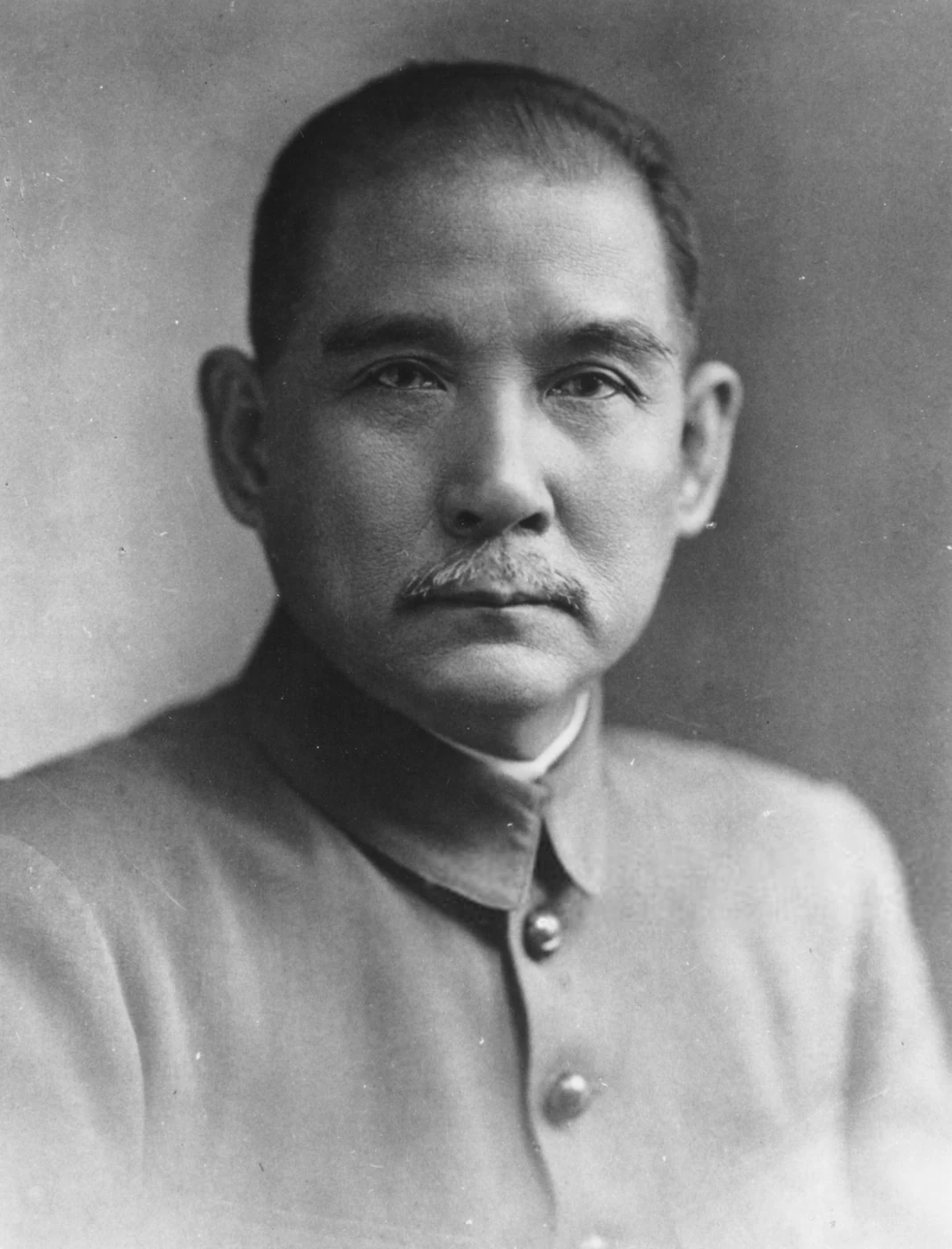
1866 CE–1925 CE
Revolutionarypolitician
Sun Zhongshan
孙中山
Sun Zhongshan (November 12, 1866–March 12, 1925), personal name Wen, courtesy name Zaizhi, art name Yixian, childhood name Dixiang, and also known by the alias Zhongshan Qiao, was a native of Cuiheng Village, Xiangshan County, Guangzhou Prefecture, Guangdong, now in Zhongshan. He was a pioneer of China’s modern democratic revolution, a founder of the Republic of China and the Chinese Nationalist Party, and an advocate of the…
1866 CE–1925 CEQing Dynasty
PROFILE
Sun Zhongshan (November 12, 1866–March 12, 1925), personal name Wen, courtesy name Zaizhi, art name Yixian, childhood name Dixiang, and also known by the alias Zhongshan Qiao, was a native of Cuiheng Village, Xiangshan County, Guangzhou Prefecture, Guangdong, now in Zhongshan. He was a pioneer of China’s modern democratic revolution, a founder of the Republic of China and the Chinese Nationalist Party, and an advocate of the Three Principles of the People. He founded the Xingzhonghui in 1894 and helped establish the Chinese Revolutionary Alliance in 1905. After the Wuchang Uprising of 1911, he was elected provisional president of the Republic of China and took office in Nanjing on January 1, 1912. In his later years, he accepted assistance from the Chinese Communist Party and Soviet Russia, established the three policies of alliance with Russia, cooperation with the Communists, and support for workers and peasants, and promoted cooperation between the Nationalists and Communists. He died in Beijing on March 12, 1925.
- Other Name
- Sun Wen
- Courtesy Name
- Zaizhi
- Art Name
- Yixian
- Period
- Qing
- Dynasty/Regime
- Qing
- Identity
- Revolutionary; politician
- Ethnicity/Ethnic Affiliation
- Not reliably confirmed in available sources
- Native Place
- Cuiheng Village, Xiangshan County, Guangzhou Prefecture, Guangdong (present-day Zhongshan)
- Date of Birth
- November 12, 1866
- Place of Birth
- Xiangshan County, Guangzhou Prefecture, Guangdong
- Date of Death
- March 12, 1925
- Major Achievements
- Leader of the Xinhai Revolution; pioneer of China’s democratic revolution; established the Republic of China
LIFE TIMELINE
Age nine | Entered the village school and received a traditional elementary education
Age thirteen | Traveled with his mother to Honolulu and attended Iolani School after earlier schooling there
Age fifteen | Graduated from Iolani School
Age seventeen | Returned from Honolulu; with Lu Haodong destroyed statues in the village Beidi Temple, then went to Hong Kong to study
Age eighteen | Transferred to the Government Central School in Hong Kong
Age twenty | Studied medicine at the school affiliated with Canton Hospital, then transferred to the Hong Kong College of Medicine for Chinese
Age twenty-six | Graduated from the Hong Kong College of Medicine and became a volunteer physician at Kiang Wu Hospital in Macao
Age twenty-eight | After his memorial to Li Hongzhang failed to gain a hearing, went to Honolulu and founded the Xingzhonghui
Age twenty-nine | Launched the Guangzhou Uprising of the Yiwei year; after the plot was exposed and failed, went into exile abroad
Age thirty | Lured into captivity by the Qing legation in London and rescued through the efforts of James Cantlie and others
Age thirty-four | Sent Zheng Shiliang to launch the Sanzhoutian Uprising in Huizhou
Age thirty-nine | Established the Chinese Revolutionary Alliance in Tokyo, was elected its leader, and advanced the Three Principles of the People
Age forty-one | Personally went to the front line during the Zhennanguan Uprising
Age forty-four | The Huanghuagang Uprising took place in Guangzhou
Age forty-five | The Wuchang Uprising broke out and was followed by responses from many provinces
Age forty-five | Took office in Nanjing as provisional president of the Republic of China
Age forty-five | Resigned the provisional presidency
Age forty-seven | Launched the Second Revolution and went into exile in Japan after its failure
Age forty-eight | Organized the Chinese Revolutionary Party in Tokyo
Age forty-nine | Married Soong Ching-ling in Tokyo
Age fifty-one | Established a military government in Guangzhou, became Generalissimo, and launched the Constitutional Protection movement
Age fifty-two | Resigned as Generalissimo and went to Shanghai to write
Age fifty-three | Reorganized the Chinese Revolutionary Party as the Chinese Nationalist Party
Age fifty-five | Took office in Guangzhou as Extraordinary President
Age fifty-six | Chen Jiongming rebelled; Sun was forced to leave Guangzhou for Shanghai
Age fifty-seven | Issued the Sun–Joffe Manifesto with Soviet representative Adolph Joffe
Age fifty-eight | Convened the First National Congress of the Chinese Nationalist Party in Guangzhou and established the three major policies
Age fifty-eight | Traveled north while ill, passing through Shanghai and Japan en route to Tianjin
Age fifty-nine | Died in Beijing, aged fifty-nine
Posthumous | Remains reinterred in the Sun Zhongshan Mausoleum on the southern slope of Purple Mountain in Nanjing
BIOGRAPHY
Biography
Family Background and Early Years
Sun Zhongshan was born on November 12, 1866, the sixth day of the tenth lunar month in Tongzhi 5, into an ordinary farming family in Cuiheng Village, Xiangshan County, Guangzhou Prefecture, Guangdong. His father, Sun Dacheng, had worked as a shoemaker on Rua de São Domingos in Macao when young and later returned home to farm. His mother was Lady Yang. His elder brother Sun Mei (1854–1915) went to Maui in the Hawaiian Islands at an early age, reclaimed land, operated ranching and retail businesses, and eventually became wealthy. He provided substantial financial support for Sun Zhongshan’s education and revolutionary activities.
Sun’s family was poor during his childhood. Soong Ching-ling later recalled that he did not own shoes until about age fifteen, lived in a mountainous region where going barefoot was difficult, grew up with his siblings in a thatched dwelling, and had so little food that rice was an unaffordable luxury and sweet potatoes were a staple. As a child Sun enjoyed flying kites, kicking shuttlecocks, climbing trees to take birds’ eggs, and other games. Because he often threw stones at birds, local people nicknamed him “Stone Boy.”
In 1875 (Guangxu 1), Sun entered a village school. His first teacher was addicted to opium and often absent. Sun questioned a method based solely on memorization, once asking what value there was in reading books one did not understand. He liked listening to stories told by former Taiping soldiers in the village and developed admiration for figures such as Hong Xiuquan.
Education and Intellectual Awakening
In June 1879, at age thirteen, Sun sailed with his mother to Honolulu. Wu Xiangxiang later described this journey in his biography of Sun as a major turning point in Sun’s life. After arriving, Sun first worked as a clerk in a shop run by his elder brother Sun Mei and later attended a local school where he studied arithmetic and other subjects. In September of the same year he enrolled at Iolani School, then administered by Anglican bishop Alfred Willis, and received an English-language education in English, British history, arithmetic, algebra, geometry, physiology, Latin, drawing, and other subjects. While there he read biographies of George Washington, Abraham Lincoln, and others and began to think about transforming China. He graduated from Iolani School in 1881.
Early in 1883, Sun entered Oahu College, founded in Honolulu by the American Board of Commissioners for Foreign Missions, where he studied basic medicine and law. Because he repeatedly urged Chinese workers in Hawaii not to worship the image of Guan Di, Sun Mei feared that he would provoke public anger, cut off his support, and sent him back to Cuiheng. After returning, Sun became close friends with fellow villager Lu Haodong, and the two frequently discussed current affairs late into the night. In August, they destroyed statues in the village Beidi Temple, provoking local hostility and forcing Sun to leave for Hong Kong.
In Hong Kong, Sun first studied at the Diocesan Home and Orphanage and transferred in 1884 to the Government Central School. In the winter of Guangxu 9, he was baptized into Christianity by Charles Robert Hager, a missionary of the American Congregational mission, and signed the name “Rixin.” This caused strong opposition from Sun Mei and temporarily strained the brothers’ relationship. In November 1884 Sun obeyed his brother’s instructions and went again to Honolulu to relinquish claims to family property, working as a shop clerk at Kahului. The following May he returned to China by way of Japan and resumed studies at the Government Central School in Hong Kong in August. China’s defeat in the Sino-French War deepened his anger at what he saw as the corruption and incompetence of the Qing government and strengthened his determination to seek political change.
Medical Training and the Formation of Revolutionary Ideas
In 1886, Sun enrolled in the medical school affiliated with Canton Hospital, also called the South China Medical School. Outside class he often expressed his affection for China and his ambition to reform politics, and he became acquainted with Zheng Shiliang. The Chinese source describes Zheng as chivalrous, loyal, socially well connected, and closely associated with men of the jianghu; Zheng became the first person said to accept Sun’s ideas about national salvation. In October of that year, through the introduction of Au Fung-chi, a missionary of the London Missionary Society, Sun adopted the art name Yixian.
In 1887 Sun transferred to the Hong Kong College of Medicine for Chinese, predecessor of the medical faculty of the University of Hong Kong, where he studied under the Scottish physician James Cantlie. The school had been funded by the Hong Kong elite figure Ho Kai, who had studied medicine and law in Britain, favored reformist politics, and significantly influenced Sun. During five years at the college, Sun studied diligently, read widely in what was then called “new learning,” developed a strong interest in Darwinian evolution, and reflected on a doctrine summarized as “knowing is difficult, doing is easy.” He often looked at a map of China hanging on the wall and lamented that “such mountains and rivers” had fallen into the hands of unworthy rulers.
Sun’s father Sun Dacheng died on March 24, 1888, aged seventy-six. Thereafter Sun Mei increased his support and provided the tuition his brother needed. In 1890, comparing himself with Hong Xiuquan, Sun later characterized the period as the beginning of his “era of revolutionary discourse.” That year he wrote to the retired official Zheng Zaoru advocating reforms modeled on the West, including prohibition of opium and improvements in agriculture and education.
Sun graduated from the Hong Kong College of Medicine in 1892. In September he went to Kiang Wu Hospital in Macao as the first volunteer physician in its newly established Western medical service, becoming one of the earliest Chinese practitioners of Western medicine in Macao. During this period he formed with Yang Heling, Chen Shaobai, and You Lie a small circle later known as the “Four Bandits.” They often gathered at Yang Heling’s meeting place in Macao to discuss politics. Sun was then strongly influenced by the reformist thinker Zheng Guanying. In the same year Zheng completed Words of Warning in a Flourishing Age in Macao and, after editing Sun’s essay “Agricultural Achievement,” included it in the book.
From Reform to Revolution
By the end of the nineteenth century, the Chinese source describes China as having become a semi-colonial and semi-feudal society. Confronted with national crisis, Sun decided to abandon a career of “healing people” for the work of “healing the nation.” At first he hoped Li Hongzhang could persuade the Qing government to carry out social reform from above. In January 1894 Sun completed his “Letter to Li Hongzhang,” setting out proposals for strengthening China through institutional reform modeled on Western countries. He then traveled with Lu Haodong to Shanghai to meet Zheng Guanying and, through an introduction from Wang Tao, went to Tianjin seeking an audience with Li. He did not obtain the meeting. What Sun saw of Qing official corruption in Tianjin contributed to a fundamental change in his thinking.
On November 24, 1894, Sun founded the Xingzhonghui in Honolulu, taking its name from the idea of “reviving China.” Its secret oath advocated expelling the Manchus, restoring China, and establishing a republican government. The Chinese source describes this as the first program explicitly calling on Chinese people to overthrow the Qing dynasty and establish a democratic republic. Branches were established in parts of Hawaii, membership rose to more than one hundred, and the organization conducted military drills and raised funds in preparation for armed revolt. Sun thereby completed his transition from reformism to democratic revolution.
In February 1895, Sun joined with the Furen Literary Society, organized by patriotic intellectuals in Hong Kong, to establish a Hong Kong branch of the Xingzhonghui. In October, the organization planned an uprising in Guangzhou; the plot was exposed and failed, forcing Sun into exile. In October 1896, Sun was lured into the Qing legation in London and detained. He was freed through the efforts of his British friend James Cantlie and others. He subsequently examined the economic and political conditions of European and American countries in detail, studied several schools of political thought, and interacted with progressive figures in the West. In the Chinese source, these experiences contributed to a distinctive theory of people’s livelihood and to the early formation of the Three Principles of the People. In 1897 Sun went to Japan and established contacts with figures in political and social circles there.
Building the Revolutionary Alliance and Organizing Armed Uprisings
In October 1900, Sun sent Zheng Shiliang to launch an uprising at Sanzhoutian in Huizhou, Guangdong. The insurgents fought for about half a month but failed when funds and weapons ran short. After the Hundred Days’ Reform, Sun discussed cooperation with reformists represented by Kang Youwei and Liang Qichao, but the effort failed because they remained committed to constitutional monarchy and opposed revolution.
In August 1905, Sun and Huang Xing, building on organizations including the Xingzhonghui and Huaxinghui, founded a nationwide revolutionary party in Tokyo, the Chinese Revolutionary Alliance. Sun was elected its leader. The program “Expel the Manchus, restore China, establish a republic, and equalize land rights” was adopted as its platform. In the inaugural statement of the Alliance’s organ, Min Bao, Sun first formulated the three principles of nationalism, democracy, and people’s livelihood. The establishment of the Alliance strengthened revolutionary activity throughout China. Sun sent organizers to develop branches and spread revolutionary propaganda at home and abroad, while in 1905–1906 he traveled through Southeast Asia among overseas Chinese communities to publicize the movement, raise funds, and establish branches.
From 1906 to 1911, the Revolutionary Alliance organized repeated armed uprisings across southern China. Sun helped determine their strategic direction and traveled abroad to raise money. During the Zhennanguan Uprising in December 1907, he went personally to the front. These attempts failed because of limited mass support and insufficiently tight organization, but repeated sacrifices by revolutionaries dealt heavy blows to the Qing government. The Huanghuagang Uprising in Guangzhou on April 27, 1911, caused a major nationwide impact.
Establishing the Republic of China
The Wuchang Uprising broke out on October 10, 1911, and many provinces responded. Sun learned of the uprising while in the United States and returned to China in late December. On December 29, representatives of seventeen provinces met in Nanjing and elected him provisional president of the Republic of China on the basis of one vote per province, with sixteen votes in favor and one opposed. On January 1, 1912, Sun took office in Nanjing and formed the Provisional Government of the Republic of China. On February 12, the Xuantong Emperor Puyi announced his abdication, ending 267 years of Qing rule and, as stated in the Chinese source, more than two millennia of monarchical autocracy. On March 11, Sun promulgated the Provisional Constitution of the Republic of China, which the source characterizes as constitutional in nature for a bourgeois republic.
Under strong pressure from foreign imperialism and domestic conservative forces, and amid the weakness and disunity of the revolutionary camp, Sun agreed after the Qing abdication to resign the provisional presidency on February 13 in favor of Yuan Shikai and formally left office on April 1. For more than a year thereafter he actively promoted the principle of people’s livelihood, advocated equalization of land rights and industrial development, and personally served as director-general of national railway development, seeking foreign capital for trunk lines. His plan for 100,000 miles of railways, however, exceeded the resources then available and was not realized.
In August 1912, the Revolutionary Alliance was reorganized as the Nationalist Party and Sun was elected chairman. In March 1913, acting party chairman Song Jiaoren was assassinated in Shanghai. Sun believed Yuan Shikai was responsible and advocated armed resistance. He launched the Second Revolution in July, but after its failure again fled to Japan. In June 1914 Sun organized the Chinese Revolutionary Party in Tokyo, hoping to restore and strengthen the earlier spirit of the Revolutionary Alliance. On October 25, 1915, he married Soong Ching-ling in Tokyo.
Constitutional Protection and the Struggles of His Later Years
In July 1917, after Beiyang military leader Duan Qirui dissolved parliament and discarded the Provisional Constitution, Sun joined southwestern militarists in establishing a military government in Guangzhou and was elected Generalissimo, launching the Constitutional Protection movement. Military leaders and politicians within the government marginalized him, and in May 1918 he was forced to resign. The failure of the first Constitutional Protection campaign led Sun to conclude that northern and southern militarists were fundamentally alike. Between 1918 and 1920 he completed The International Development of China and related writings collected under Plans for National Reconstruction, reviewing earlier revolutionary experience and setting out a broad program for transforming and building China.
After the Russian October Revolution of 1917, Sun sent congratulations to Lenin and the Soviet government the following summer. The May Fourth Movement of 1919 encouraged him, and he strongly praised and supported the student movement. In August that year he commissioned Hu Hanmin, Zhu Zhixin, Liao Zhongkai, and others to establish the magazine Construction in Shanghai to promote theories of democratic revolution. In October he announced the reorganization of the Chinese Revolutionary Party as the Chinese Nationalist Party.
In August 1920, Sun instructed the Guangdong army then stationed in Fujian to return to Guangdong and drive out the Guangxi faction. He returned to Guangzhou in November and again raised the banner of constitutional protection. In May 1921 he took office as Extraordinary President after election by the Extraordinary Parliament in Guangzhou. He then sent forces into Guangxi, defeated the faction of Lu Rongting, and prepared to use Guangdong and Guangxi as a base for a northern expedition. In December, Sun met Comintern representative Maring in Guilin and discussed the establishment of a revolutionary party and revolutionary armed forces. In June 1922, political disagreement with Chen Jiongming led to a rupture, and Sun was forced to leave Guangzhou for Shanghai. He thereafter accepted assistance from the Chinese Communist Party and Soviet Russia and advanced the three policies of alliance with Russia, cooperation with the Communists, and support for workers and peasants.
In January 1923, Sun and Soviet representative Adolph Joffe issued the Sun–Joffe Manifesto, laying the basis for the policy of alliance with Soviet Russia. Sun immediately sent Liao Zhongkai to Japan for further talks with Joffe. Meanwhile Yunnan and Guangxi forces that declared loyalty to Sun drove Chen Jiongming from Guangzhou. In February Sun returned from Shanghai and reestablished a military headquarters in Guangzhou, exercising military and civil authority as Generalissimo. In August he dispatched a delegation headed by Chiang Kai-shek to the Soviet Union to investigate politics, party organization, and military affairs. In October he engaged Soviet adviser Mikhail Borodin and appointed Liao Zhongkai, Tan Pingshan, and others to a new Provisional Central Executive Committee of the Chinese Nationalist Party to prepare for reorganization.
In January 1924, the First National Congress of the Chinese Nationalist Party met in Guangzhou, adopted a party program and constitution, and reinterpreted the Three Principles of the People. Chen Jiongming’s rebellion had strengthened Sun’s determination to accept assistance from the Comintern and the Chinese Communist Party, and he welcomed Communist Party members such as Li Dazhao into the Nationalist Party in their individual capacities. In May Sun founded the army officer school on Changzhou Island at Whampoa in Guangzhou, later known as the Whampoa Military Academy, laying a foundation for a revolutionary army.
In October 1924, the Fengtian warlord Zhang Zuolin and Zhili commander Feng Yuxiang jointly overthrew the Zhili-dominated government under President Cao Kun. Feng Yuxiang, Duan Qirui, and Zhang Zuolin each invited Sun north to discuss national affairs. Sun accepted, calling for the abolition of unequal treaties and the convening of a national assembly as a solution to the political crisis. He left Guangzhou in November, traveled first to Shanghai, then via Japan to Tianjin, and reached Beijing in late December while seriously ill.
Death and Posthumous Legacy
Sun died of gallbladder cancer in Beijing on March 12, 1925, aged fifty-nine. Shortly before his death he signed three documents: a political testament, a family testament, and a letter to Soviet Russia. In the political testament he summarized forty years of revolutionary experience and concluded that it was necessary to awaken the people and unite with nations of the world that treated China as an equal. He called on his comrades to continue working because the revolution had not yet succeeded. The testament directed followers to continue implementing the program set out in his Plans for National Reconstruction, Outline of National Reconstruction, Three Principles of the People, and the declaration of the First National Congress. In the family testament, he left his books, clothing, residence, and other personal effects to Soong Ching-ling as mementos and asked his children to carry on his revolutionary aspirations. In the letter to Soviet Russia he affirmed his confidence in the three revolutionary policies and in anti-imperialist patriotic struggle, expressing hope that a strong and independent China and the Soviet Union would advance together as friends and allies in the struggle for the freedom of oppressed peoples.
In 1929 Sun’s remains were moved from Beijing to the mausoleum built for him on the southern slope of Purple Mountain in Nanjing. In 1940 the Nationalist Government formally ordered that Sun be honored as the “Father of the Republic of China.” The government of the People’s Republic of China honors him as a great pioneer of China’s democratic revolution, an outstanding patriot, and a national hero.
Major Activities
Founding Revolutionary Organizations
On November 24, 1894, Sun founded the Xingzhonghui in Honolulu and drafted its charter, establishing “reviving China” as the organization’s purpose and advocating the expulsion of the Manchus, restoration of China, and creation of a republican government. In February 1895 he established a Hong Kong branch. In August 1905 Sun and Huang Xing founded the Chinese Revolutionary Alliance in Tokyo, and Sun was elected its leader. The Alliance adopted the program “Expel the Manchus, restore China, establish a republic, and equalize land rights”; in the inaugural statement of its organ Min Bao, Sun first articulated the Three Principles of the People. In 1914 he organized the Chinese Revolutionary Party in Tokyo, and in October 1919 reorganized it as the Chinese Nationalist Party.
Leading Armed Uprisings
After founding the Xingzhonghui, Sun organized or supported repeated armed uprisings against the Qing, including the 1895 Guangzhou Uprising, the 1900 Sanzhoutian Uprising in Huizhou, and the 1907 Zhennanguan Uprising, where he personally went to the front. Between 1906 and 1911, the Revolutionary Alliance organized repeated uprisings in southern China. The Guangzhou Huanghuagang Uprising of April 27, 1911, caused a major national impact. After the Wuchang Uprising broke out on October 10, 1911, many provinces responded, and the Qing dynasty was ultimately overthrown.
Establishing the Republic of China
On January 1, 1912, Sun took office in Nanjing as provisional president of the Republic of China and formed its provisional government. The Qing emperor abdicated on February 12, and the Provisional Constitution of the Republic of China was promulgated on March 11. Sun’s government also issued a series of reform measures, including discouraging footbinding, abolishing kneeling rites, and changing forms of address.
Defending the Republican System
After Song Jiaoren’s assassination in 1913, Sun launched the Second Revolution against Yuan Shikai and went into exile in Japan after its failure. In 1915 he issued two declarations denouncing Yuan. In 1917 he established a military government in Guangzhou and, as Generalissimo, launched the first Constitutional Protection campaign. In 1921 he became Extraordinary President in Guangzhou and prepared for a northern expedition. In 1923 he returned to Guangzhou to reestablish the Generalissimo’s headquarters, and in 1924 promoted cooperation between the Nationalist and Communist parties.
The Three Principles of the People and Five-Power Constitution
Sun adhered throughout his life to the Three Principles of the People—nationalism, democracy, and people’s livelihood. He advocated a distinction between political rights and administrative capacity, summarized as “the people have the rights; the government has the ability,” and supported a capable government oriented toward public welfare. In his formulation, the people’s political rights consisted of election, recall, initiative, and referendum, while government authority was divided among five powers: legislative, executive, judicial, examination, and control. This became his theory of the Five-Power Constitution. His writings, including Plans for National Reconstruction, Outline of National Reconstruction, and Three Principles of the People, laid out wide-ranging proposals for transforming and building China.
Promoting Nationalist–Communist Cooperation
After Chen Jiongming’s rebellion in 1922, Sun accepted assistance from the Chinese Communist Party and Soviet Russia and advanced the three major policies of alliance with Russia, cooperation with the Communists, and support for workers and peasants. In January 1923 he and Soviet representative Adolph Joffe issued the Sun–Joffe Manifesto. In January 1924 he convened the First National Congress of the Chinese Nationalist Party in Guangzhou, reinterpreted the Three Principles, and welcomed Communist Party members such as Li Dazhao into the Nationalist Party in their individual capacities. In May he established the Whampoa Military Academy to help build a revolutionary army.
Travels
Sun’s life involved extensive travel in China and abroad. He studied in Honolulu in his youth. During his revolutionary career he lived or traveled in Japan, Britain, the United States, Southeast Asia, and other regions, promoting revolution and raising funds among overseas Chinese communities. Late in life he traveled north to Beijing to discuss national affairs. His activities spanned Asia, Europe, and the Americas, giving him unusually broad international experience among political figures of modern China.
Personal Relations
Family
- Sun Dacheng (1813–1888): father; worked as a shoemaker in Macao when young and later returned home to farm
- Lady Yang: mother
- Sun Mei (1854–1915): elder brother; wealthy Honolulu businessman who long supported Sun’s education and revolutionary work
- Lu Muzhen: wife; married in 1885 and divorced in 1915
- Soong Ching-ling: wife; married Sun in Tokyo on October 25, 1915
- Sun Fo: son
- Sun Yan: daughter
- Sun Wan: daughter
Teachers and Associates
- James Cantlie: dean at the Hong Kong College of Medicine and Sun’s teacher; helped rescue him during his detention in London
- Charles Robert Hager: American Congregational missionary who baptized Sun
- Au Fung-chi: missionary of the London Missionary Society who gave Sun the art name Yixian
- Zheng Guanying: reformist thinker who edited Sun’s “Agricultural Achievement” for inclusion in Words of Warning in a Flourishing Age
- Lu Haodong: friend from the same village; joined Sun in destroying temple statues and later died for the revolutionary cause
- Huang Xing: major leader of the Revolutionary Alliance; together with Sun known as “Sun and Huang”
- Zheng Shiliang: described as the first to accept Sun’s ideas of national salvation; led the Huizhou uprising
- Yang Heling, Chen Shaobai, and You Lie: with Sun, collectively known as the “Four Bandits”
- Liao Zhongkai, Hu Hanmin, and Zhu Zhixin: important early Nationalist figures
- Soong Ching-ling: wife; later Honorary President of the People’s Republic of China
Political Relationships
- Li Hongzhang: Sun submitted proposals for reform but did not obtain an audience
- Yuan Shikai: succeeded Sun as provisional president; later attempted monarchy, and Sun launched the Second Revolution against him
- Duan Qirui: Beiyang military leader against whom Sun carried out constitutional-protection efforts
- Chen Jiongming: Guangdong military leader and former provincial governor who later rebelled against Sun
- Chiang Kai-shek: important assistant in Sun’s later years; sent to the Soviet Union for study and later made commandant of Whampoa Military Academy
- Li Dazhao: Communist Party member who joined the Nationalist Party individually and helped promote Nationalist–Communist cooperation
- Adolph Joffe: Soviet representative who issued the Sun–Joffe Manifesto with Sun
- Mikhail Borodin: Soviet adviser who assisted in reorganizing the Nationalist Party
- Maring: Comintern representative who met Sun in Guilin in 1921
Conflicts
- Kang Youwei and Liang Qichao: leading reformists who favored preservation of the monarchy and opposed revolution; negotiations for cooperation with Sun did not succeed
- Qing government: principal target of Sun’s revolutionary movement
- Imperialist powers: opposed by Sun in his later political program
Historical Assessment
Qing / Contemporary Assessments
- Li Hongzhang did not respond to Sun’s “Letter to Li Hongzhang,” though the Chinese source states that Sun’s reform proposals attracted attention at the time.
- Reform leader Liang Qichao discussed cooperation with Sun; although no agreement resulted, he acknowledged the influence of Sun’s revolutionary position.
- The Qing government treated Sun as a leader of rebels, offered rewards for his capture, and detained him through its London legation.
- Revolutionaries including Huang Xing and Hu Hanmin honored Sun as a revolutionary leader and praised the breadth of his vision and ambitions.
- Overseas Chinese communities provided extensive support and regarded him as a patriot seeking national salvation.
Republican Period
- In 1940, the Nationalist Government formally ordered that Sun be honored as the “Father of the Republic of China.”
- Chiang Kai-shek presented himself as Sun’s political heir and a follower of the party founder, while official discourse elevated Sun as the “Father of the Republic.”
- The Chinese Communist Party honored Sun as a great pioneer of China’s democratic revolution; Mao Zedong called him a banner of China’s revolutionary democrats.
- Academic assessments have been diverse, ranging from strong praise for his revolutionary contributions to criticism of strategies such as yielding the presidency to Yuan Shikai and relying on military strongmen.
People’s Republic of China Period
- The government of the People’s Republic of China honors Sun as a great pioneer of China’s democratic revolution, an outstanding patriot, and a national hero.
- In “In Memory of Dr. Sun Yat-sen,” Mao Zedong wrote that Sun devoted his entire life to transforming China and worked for that purpose until his death.
- Deng Xiaoping called Sun a great revolutionary in modern Chinese history and a pioneer of democratic revolution revered by the Chinese people.
- Official discourse identifies him as a great pioneer of modern China’s democratic revolution, and a statue of him is displayed in Tiananmen Square in Beijing.
Modern Assessments
- Scholars generally regard Sun as a pioneer of China’s modern democratic revolution and view his revolutionary thought and practice as having had a deep influence on modern Chinese political development.
- Some scholars emphasize the turn in Sun’s later years toward alliance with Soviet Russia, cooperation with the Communists, and support for workers and peasants as an important development in his thought.
- In Taiwan, Sun continues to be honored as the “Father of the Nation,” while on the Chinese mainland he is described as a pioneer of democratic revolution; both sides of the Taiwan Strait recognize his major historical standing.
- International scholarship commonly treats Sun as a representative figure of modern Chinese nationalism and republicanism.
FIGURES ASSOCIATED WITH THIS DYNASTY
Bibliography
- 《孙中山全集》 (Zhonghua Book Company,1981—1986)
- 《孙中山年谱长edited by》 (editor-in-chief,Zhonghua Book Company,1991)
- 吴相湘:《孙逸仙先生传》 (1982)
- 尚明轩:《孙中山传》 (1979)
- 张磊:《孙中山评传》 (People's Publishing House,1984)
- 《中华民国史》第一edited by (editor-in-chief,Zhonghua Book Company,1981)