Age one | Born in the official residence of Guangshan County, Guangzhou, present-day Guangshan County, Xinyang, Henan.
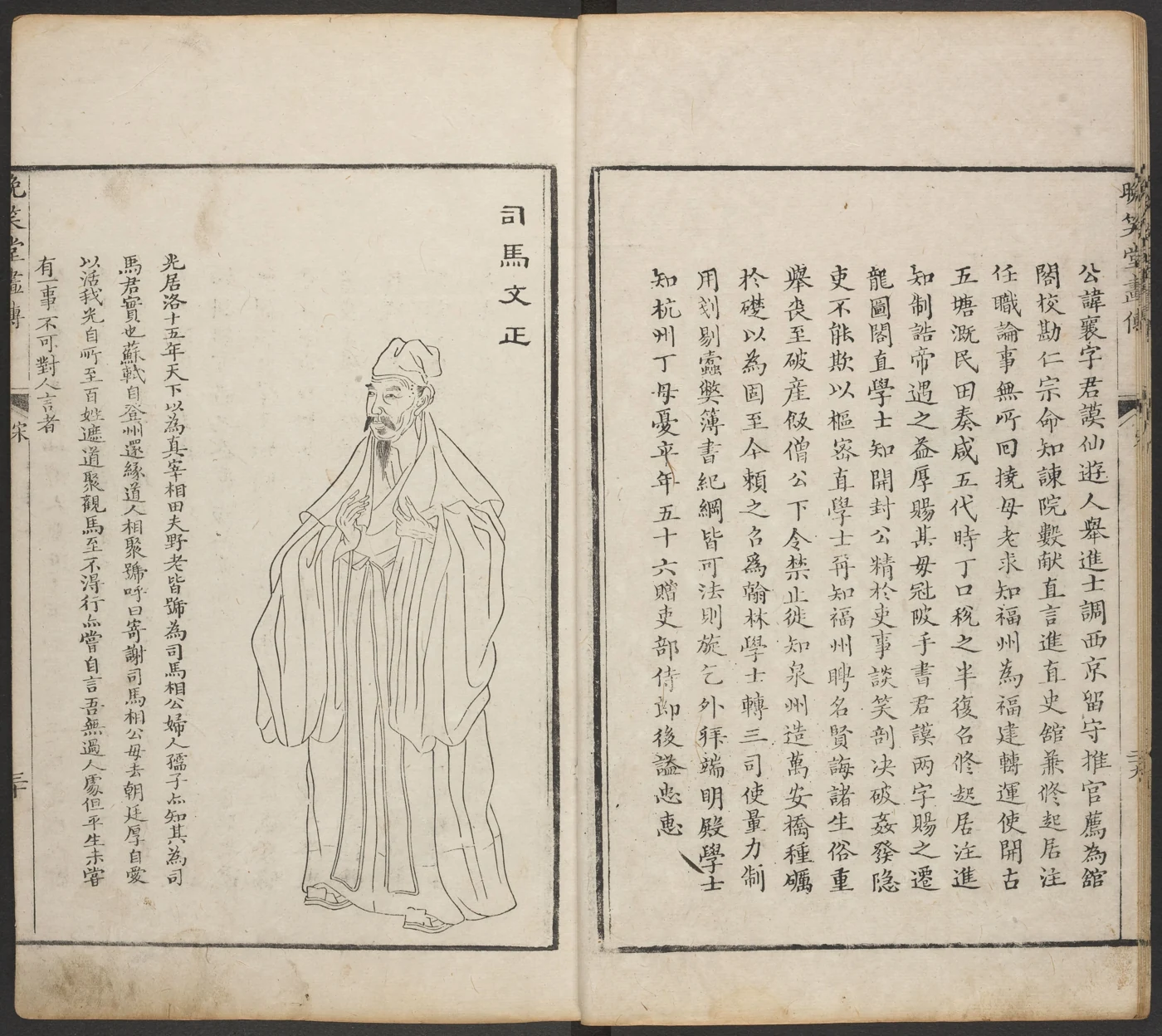
1019 CE–1086 CE
Writer and scholar
Sima Guang
司马光
Sima Guang (November 17, 1019–October 11, 1086), courtesy name Junshi, art name Yufu and later Yusou, was widely known as Master Sushui. His ancestral home was Sushui Township, Xia County, Shanzhou, in present-day Shanxi, and he was born at Guangshan in Guangzhou, present-day Guangshan County, Henan. He was a Northern Song statesman, historian, and writer who claimed descent from Sima Fu, Prince Xian of Anping of the Western…
1019 CE–1086 CENorthern Song
PROFILE
Sima Guang (November 17, 1019–October 11, 1086), courtesy name Junshi, art name Yufu and later Yusou, was widely known as Master Sushui. His ancestral home was Sushui Township, Xia County, Shanzhou, in present-day Shanxi, and he was born at Guangshan in Guangzhou, present-day Guangshan County, Henan. He was a Northern Song statesman, historian, and writer who claimed descent from Sima Fu, Prince Xian of Anping of the Western Jin. He served under Emperors Renzong, Yingzong, Shenzong, and Zhezong and directed the compilation of the Comprehensive Mirror in Aid of Governance, described in the source text as the first comprehensive chronological history in Chinese historiography. After his death he was posthumously made Duke of Wen and given the posthumous title Wenzheng, and was commonly called Lord Wen of Sima or Lord Wenzheng of Sima.
- Other Names
- Sima Junshi; Master Sushui
- Courtesy Name
- Junshi
- Art Name
- Yufu
- Period
- Song · Northern Song
- Date of Birth
- November 17 1019
- Date of Death
- October 11 1086
- Dynasty/Regime
- Song · Northern Song
- Identity
- Writer and scholar
- Ethnicity/Ethnic Affiliation
- Not recorded in historical sources
- Native Place
- Sushui Township, Xia County, Shanzhou (present-day Xia County, Shanxi)
- Place of Birth
- Guangshan, Guangzhou
- Major Achievements
- Northern Song historian and statesman; chief compiler of the Comprehensive Mirror in Aid of Governance; also a major writer and author of literary anecdotes.
LIFE TIMELINE
Age seven | Able to recite the Zuo Zhuan and explain its main ideas; performed the famous “breaking the jar to save a friend” rescue.
Age twenty | Passed the jinshi examination in the top class and was appointed assistant judge of Huazhou.
Age twenty-two | Transferred to assistant judge of Suzhou so that he could attend his father, who was serving there.
Age twenty-three | Left office to observe mourning for his mother; in the twelfth month his father Sima Chi died, and he returned home with his elder brother Sima Dan accompanying the coffin.
Age twenty-six | Completed mourning, joined Pang Ji's staff at Yanzhou, and later became assistant judge of Wucheng Army.
Age twenty-eight | Entered court as an Evaluating Official of the Court of Judicial Review and Lecturer of the Directorate of Education.
Age thirty | On Pang Ji's recommendation, appointed Collator in the Palace Library.
Age thirty-three | Jointly administered the Court of Imperial Sacrifices and wrote the Explanatory Commentary on the Old-Text Classic of Filial Piety.
Age thirty-five | At Pang Ji's invitation, became vice-prefect of Yunzhou.
Age thirty-seven | Transferred to vice-prefect of Bingzhou and served under Pang Ji on the Hedong Circuit.
Age forty | Entered court as judicial commissioner of Kaifeng Prefecture and was granted fifth-rank court dress.
Age forty-three | Promoted to Diarist and jointly administered the Remonstrance Bureau; submitted more than 170 memorials during five years in remonstrance service.
Age forty-four | Promoted to Drafter of Imperial Proclamations but firmly declined; instead appointed Hanlin Awaiting-in-Attendance at Tianzhang Pavilion and Imperial Lecturer.
Age forty-seven | Appointed Direct Academician of the Longtu Pavilion and placed in charge of the Bureau of Civil Appointments, then changed to Right Remonstrance Grandee; became involved in the “Puyi” ritual controversy.
Age forty-eight | Completed eight juan of the Tongzhi and presented them to Emperor Yingzong, who ordered an office established to continue the project.
Age fifty | Emperor Shenzong ascended the throne, bestowed the title Comprehensive Mirror in Aid of Governance on the historical project, and personally wrote a preface.
Age fifty-two | Strongly opposed the New Policies of Wang Anshi, firmly declined appointment as Vice Commissioner of Military Affairs, and went out to govern Yongxing Army.
Age fifty-three | Withdrew to Luoyang, holding the posts of Western Capital Resident Administrator and Censorate official, and brought the historiographical bureau with him.
Age sixty-six | Completed the Comprehensive Mirror in Aid of Governance after nineteen years; the work comprised 294 juan.
Age sixty-seven | Emperor Zhezong ascended the throne; Grand Empress Dowager Gao governed as regent and recalled Sima Guang to lead state affairs.
Age sixty-eight | Became Left Vice Director of the Department of State Affairs and Assistant Director of the Chancellery, presiding over the Yuanyou Restoration and abolishing the New Policies; died on the first day of the ninth month (October 11).
BIOGRAPHY
Biography
Family Background and Early Years
Sima Guang traced his distant ancestry to Sima Fu, Prince Xian of Anping of the Western Jin, whose family lived in Wen County, Henei. During the Eastern Jin's southward migration, a descendant of Sima Yang, grandson of Sima Fu, named Sima Xiaohuai, moved to Xia County in Shanxi. Sima Guang's great-grandfather Sima Zheng did not enter official service during the turmoil of the late Tang and Five Dynasties. In the early Northern Song, his grandfather Sima Xuan passed the jinshi examination and rose to magistrate of Fuping County in Yaozhou, receiving the posthumous gift of Grand Tutor to the Heir Apparent. His father Sima Chi became Vice Director in the Ministry of War and Hanlin Awaiting-in-Attendance at Tianzhang Pavilion. He served in the Hanlin Academy and as an imperial adviser in the palace library, held fourth rank, and was known for integrity and benevolence.
Sima Guang was born on November 17, 1019, the eighteenth day of the tenth month of the third year of Tianxi, in the official residence of Guangshan County, Guangzhou. His father was then magistrate of Guangshan and named him “Guang” after the place. Sima Chi began teaching him to read at age six. At seven, Sima Guang could not only recite the Zuo Zhuan but explain its central meaning to his family. He studied tirelessly and was said never to let go of a book, becoming so absorbed that he forgot hunger, thirst, heat, and cold. In childhood he performed the famous “breaking the jar to save a friend” rescue. The History of Song records that when a child fell into a large water vessel while a group was playing, the others fled, but Sima Guang took a stone and smashed the vessel so the water poured out and the child was saved; images of the episode later circulated around the capital and Luoyang.
Sima Guang was diligent, possessed a strong memory, and was considered honest and intelligent, earning his father's affection. Sima Chi often brought him along when traveling or speaking with colleagues and friends. Through constant exposure, Sima Guang gained knowledge and experience and was said to have “the gravity of an adult.” Many officials and noted scholars admired him. Sima Chi served successively in Henan, Shaanxi, Sichuan, and other regions and took Sima Guang with him. Before age fifteen, Sima Guang had already traveled widely with his father, visited historical sites, composed poems on walls, and observed local customs, greatly broadening his social knowledge.
Examination Success and Early Official Career
In 1038, the first year of Baoyuan, the twenty-year-old Sima Guang took the metropolitan examination and passed in the highest jinshi class. He was appointed assistant judge of Huazhou, present-day Huaxian in Shaanxi. His father was then prefect of Tongzhou, present-day Dali in Shaanxi, and Sima Guang often visited his parents. At Tongzhou he met Shi Changyan, a jinshi of the same examination, and formed a friendship despite their age difference. In the same year he married the daughter of Zhang Cun.
In 1040, the first year of Kangding, Sima Guang sought transfer to the post of assistant judge of Suzhou so he could attend his father there. In 1041 he left office to mourn his mother and returned home for the prescribed three-year mourning period. Before this, Tangut ruler Yuanhao had proclaimed himself emperor and founded Western Xia, and war between Song and Western Xia had broken out with repeated Song defeats. To strengthen defense, Emperor Renzong ordered Zhejiang to recruit additional archers and create more commander posts. Sima Guang and his father believed the measure useless, and Sima Guang drafted for his father the “Memorial Arguing That Zhejiang Should Not Add Archers,” explaining the disadvantages of recruiting more archers and creating more military posts.
In the twelfth month of 1041, Sima Chi died of illness in Jinzhou, and Sima Guang and his elder brother Sima Dan escorted his coffin back to Xia County. Within a single year Sima Guang lost both parents and was deeply grieved. During mourning he turned his sorrow into disciplined reading and writing, producing essays such as “On the Ten Philosophers,” “On the Four Heroes,” and “On Master Jia.” After the mourning period he wrote additional essays on political judgment, talent and virtue, Lian Po, Gong Junshi, Prince Xian of Hejian, ritual hierarchy, and eighteen historical critiques. Many of these ideas later reappeared in the “Your servant Guang comments” passages of the Comprehensive Mirror in Aid of Governance.
Middle Career and Service as a Remonstrance Official
Early in 1044, Sima Guang completed mourning and, on the recommendation of Pang Ji, a friend of his father and then prefect of Yanzhou, joined Pang's staff there. Around the summer and autumn he became assistant judge of Wucheng Army. In the spring of 1045 the Yellow River flooded, badly damaging Huazhou, the administrative center of Wucheng Army, and Sima Guang supervised labor on the river. In the winter of 1046 he entered court as Evaluating Official of the Court of Judicial Review and Lecturer of the Directorate of Education. When he left for the capital, colleagues emptied the office to hold a farewell banquet, and he improvised a poem lamenting the approaching separation.
In 1047, the Wang Ze Rebellion at Beizhou broke out. Sima Guang wrote a letter to Pang Ji, then a high military commissioner, advising that the rebellion be broken through strategy by combining intimidation and inducement, dividing the rebels, and punishing only the ringleaders. Around May 1048, Pang Ji, then Assistant Grand Councilor, recommended him a second time, and Sima Guang was appointed Collator in the Palace Library. In 1051 he jointly administered the Court of Imperial Sacrifices and worked as an official in the examination administration. During this period he systematically studied the Old-Text Classic of Filial Piety and wrote the Explanatory Commentary on the Old-Text Classic of Filial Piety.
After entering government, Sima Guang became known for speaking directly in defense of ritual hierarchy and moral order. In 1051, after the eunuch Mai Yunyan died, the court allowed a funeral procession with imperial honor guards. Sima Guang opposed the decision on the ground that such ceremonial treatment violated proper status. When the minister Xia Song died and the court conferred on him the posthumous title Wenzheng, Sima argued that so exalted a title should not be awarded to a man like Xia Song. In 1052 he was promoted to Assistant in the Palace Administration and appointed Investigating Editor in the Historiography Institute, where he helped compile the court chronicle; he was later transferred to the Jixian Hall as a collator and worked exclusively as a historian.
In the autumn of 1053, Pang Ji was removed from the chief councilorship and appointed prefect of Yunzhou. At Pang's request, Sima Guang became vice-prefect of Yunzhou and also oversaw the prefectural school. In 1055 Pang was transferred to Bingzhou as prefect and Pacification Commissioner for the Hedong Circuit, and Sima Guang became vice-prefect of Bingzhou. In 1056 Sima submitted three memorials urging Emperor Renzong to establish an heir or advance an imperial kinsman, and he also asked Fan Zhen to raise the matter when memorializing at court.
While serving with Pang Ji on the Hedong Circuit, Song and Western Xia were formally at peace, but Sima Guang remained vigilant and consulted local people. The local examination candidate Liu Yong had studied frontier affairs and wrote a ten-juan Border Discussions, which Sima recommended. Sima believed suspending border markets and building forts would protect the frontier, so he supported both closing trade with Western Xia and constructing fortifications. General Guo En, after drinking, launched an attack on Western Xia, suffered a major defeat, and killed himself. Censors investigated, and Pang Ji accepted sole responsibility and was demoted to prefect of Qingzhou. Sima Guang submitted three memorials explaining that Pang had acted on his advice and asking that “I alone be punished, even to the full measure of the law.” Pang then memorialized accepting blame himself and asked that Sima be spared. The two men, despite their difference in age, supported each other closely, and after Pang's death Sima treated his family as his own.
In the seventh or eighth month of 1058, Sima Guang entered court as judicial commissioner of Kaifeng Prefecture and received fifth-rank court dress. The next year he was promoted to a vice-director position in the fiscal administration and placed in charge of its review office. In 1061 Emperor Renzong ordered Sima to participate in compiling the imperial diary. Sima submitted five refusals, stating that the work was “not truly my strength,” but the emperor did not withdraw the command. Soon afterward he was promoted to Diarist and appointed joint administrator of the Remonstrance Bureau. During five years in remonstrance service, he submitted more than 170 memorials.
In 1062, after Consort Dong died, Emperor Renzong posthumously promoted her, suspended court, wore mourning dress, ordered officials to present condolences, fixed a posthumous title and formal investiture, and granted a ceremonial honor guard for her burial. Sima Guang objected that her rank had been too low for such rites and that honor guards were intended to recognize military merit and were even less appropriate for a woman. He also repeatedly warned that Renzong's long delay in naming an heir was a matter of enormous importance. Eventually Zhao Shu, the thirteenth son of Zhao Yunrang, Prince Yianyi of Pu, and Renzong's adopted son, was named crown prince. Sima also opposed lavish palace banquets and rewards. In 1061 he submitted a memorial urging the emperor to abolish banquets out of concern for the people and another opposing excessive grants to officials regardless of the state's finances.
In 1062 Sima Guang was promoted to Drafter of Imperial Proclamations but firmly declined and instead became Hanlin Awaiting-in-Attendance at Tianzhang Pavilion and Imperial Lecturer. Emperor Renzong died on March 29, 1063, and Zhao Shu succeeded as Emperor Yingzong. Conflict intensified between Yingzong and his adoptive mother Empress Dowager Cao. Sima submitted memorials to the empress dowager and to the emperor in the fourth and sixth months, warning that “a thousand-li golden dike can collapse through an ant hole; a blemish in white jade is easy to create and hard to repair.” His repeated remonstrances helped ease the conflict between the two palaces.
In the tenth month of 1065, Sima Guang became Direct Academician of the Longtu Pavilion and head of the Bureau of Civil Appointments, then Right Remonstrance Grandee. Disillusioned with remonstrance service, he submitted three memorials asking to leave the post. He wrote that he had served as a remonstrance official for five years, longer than anyone of the dynasty, that his bluntness had created many enemies, and that he feared one day neither he nor his descendants would have a place to stand. Emperor Yingzong accepted his request to leave the remonstrance post while retaining his promotion at the Longtu Pavilion.
In the same year, the “Puyi” ritual controversy broke out. Sima Guang insisted that Emperor Renzong should be called the emperor's ritual father and the Prince of Pu his imperial uncle. Emperor Yingzong instead supported Han Qi and Ouyang Xiu, who argued that the Prince of Pu should be called the emperor's father, and exiled three opposing censors including Lü Hui from Kaifeng. Sima strongly resisted and, with colleagues, requested to be demoted out of the capital as well. The History of Song records his argument that one adopted as another's heir becomes that person's son and must not privilege private kinship; the Prince of Pu should therefore be honored as imperial uncle with the greatest possible rank and enfeoffment.
Opposition to the New Policies and Retirement in Luoyang
After Emperor Shenzong took the throne, Wang Anshi implemented the New Policies with imperial support. Sima Guang strongly opposed them, arguing that ancestral institutions should not be lightly changed, and debated Wang before the emperor. Shenzong appointed him Vice Commissioner of Military Affairs, but Sima firmly refused. In 1070, the third year of Xining, he asked to leave the capital and went to govern Yongxing Army in Shaanxi as Academician of the Duanming Hall, the first time in thirty years of official service that he held primary responsibility for a local population. When Shenzong asked about conditions in Shaanxi, Sima replied bluntly that the Green Shoots Policy and Hired Service Policy harmed the region. In 1071 he withdrew to Luoyang, holding the titles of Western Capital Resident Administrator and Censorate official, and brought the historical bureau with him to devote himself to the Comprehensive Mirror in Aid of Governance.
For fifteen years in Luoyang, Sima Guang largely withdrew from current politics and devoted his energy to compiling the Comprehensive Mirror. From establishing principles and format to final deletion and revision, he personally handled the work and did not simply leave it to others. He worked intensely, saying that “daylight was insufficient, so I continued into the night.” In 1084, the seventh year of Yuanfeng, the work was completed in 294 juan and about three million characters. It began in 403 BCE, the twenty-third year of King Weilie of Zhou, and ended in 959, the sixth year of Xiande under Emperor Shizong of Later Zhou, covering 1,362 years across sixteen dynasties. After completion, Sima Guang was promoted to Academician of the Zizheng Hall. In his memorial presenting the work, he wrote that his muscles and bones were emaciated, his eyesight dim, few teeth remained, his mind had declined, and everything he saw was forgotten almost at once: “All my strength has been exhausted on this book.” He died less than two years after completing it.
Final Administration and Death
In 1085, the eighth year of Yuanfeng, Emperor Zhezong ascended the throne and Grand Empress Dowager Gao governed as regent. She recalled Sima Guang to the capital to direct government. In 1086, the first year of Yuanyou, he became Left Vice Director of the Department of State Affairs and Assistant Director of the Chancellery and presided over state affairs. He excluded supporters of the New Policies and abolished the measures, a reversal known as the Yuanyou Restoration. In the sixth month of the same year, at Sima's urging, Song returned to Western Xia all territory it had recently captured. He argued that the unexpected grace would move even birds, beasts, trees, and stones, let alone human beings, and cause Western Xia to submit for generations. The source text notes that Western Xia did not stop attacking the Northern Song after receiving the land.
Sima Guang died on October 11, 1086, the first day of the ninth month of the first year of Yuanyou, after only a year and a half at the head of government. The History of Song describes residents of the capital closing markets to mourn him, selling clothing to afford sacrificial offerings, and crying in the streets as his hearse passed. When his coffin was returned to Xia County, the people wept “as if mourning their own kin,” and tens of thousands came from many regions for the funeral. Households hung his portrait and invoked him before meals. He was posthumously awarded the title Grand Preceptor, made Duke of Wen, given the posthumous title Wenzheng, and granted a memorial inscription praising his loyalty, purity, and cultivated virtue.
His Family and Early Years
Sima Guang, courtesy name Junshi, styled the Crooked Fellow and in old age the Crooked Old Man, known to his age as Master Sushui, was a man of Sushui village in Xia county of Shanzhou, born at Guangshan in Guangzhou, and claimed descent from Sima Fu, prince of Anping of the Jin. By his biography in the History of Song, "at seven he was grave as a grown man; hearing the exposition of the Zuo Commentary he loved it, and going home repeated it to his family, at once grasping its main purport; and from that time his hand never left a book, so that he forgot hunger and thirst, cold and heat." It is told that when the children were playing in the courtyard and one climbed into a great jar, slipped and was drowning, all the others ran away, but "Sima Guang took a stone and broke the jar, the water gushed out and the child lived," and afterwards pictures of it were made in the capitals of the west and east. Quick to learn and strong in memory, honest and clever and at the same time sensible, he was much loved by his father; and whenever his father went out or talked with his colleagues and close friends he liked to have him at his side, so that by what he saw and heard he became "grave as a grown man" both in knowledge and in judgment, and was admired by many ministers and famous men of the time. His father Sima Chi, serving in Henan, Shaanxi and Sichuan one after another, always kept him near, so that before he was fifteen Sima Guang had travelled with him to many places, seeking out antiquities and wonders, writing poems on walls and learning the customs of the land, which greatly enriched his knowledge of the world. The Sima family lived together for generations in harmony, keeping the family tradition of poetry and the rites and a strict household discipline. It is told that at five or six, being unable to peel a walnut himself and his elder sister being unable to do it either, a maidservant peeled it for him with hot water; and when his sister came back and asked who had done it, he lied that he had done it himself, whereupon his father rebuked him and asked how a boy dared lie; and from that time Sima Guang never dared lie, and in later years he wrote the matter down to spur himself on, and to the end of his life never spoke an untruth.
His Doctorate and His Early Career
In the first year of Baoyuan, 1038, Sima Guang took the highest grade in the doctoral examination, and served successively as remonstrating grand master, academician of the Hanlin and censor-in-chief. He drafted for his father a memorial on the inexpediency of adding archers in the two Zhe, setting out from every side the harm of adding archers and military officers. During his mourning he turned his grief into the spur of study and writing, reading a great deal and writing many pieces of value, such as the essays on the ten philosophers and the four heroes. On the day he set out for the capital his colleagues emptied their offices and gave him a farewell banquet, and Sima Guang, moved by their warmth, wrote verses on the spot saying that he would not decline to fall drunken before the cup since such joy might not come again, and in high spirits came to Kaifeng. When Pang Ji was vice-commissioner of the privy council with charge of the realm's military business, he wrote him a letter on the affair of Beizhou, offering plans to put down the rising quickly, advising to break it by stratagem with threats and bribes together, to divide and dissolve it, and to kill only the chief criminals and ask nothing of the rest; and in fact the rebels held out only sixty-six days, their leader Wang Ze being killed and the rest all burnt. Serving with Pang Ji in Hedong, when Song and Xia were at truce, he did not relax but went among the people to hear what they said: Liu Yong, a provincial graduate of Bingzhou, had studied frontier affairs and written ten volumes of frontier counsels of much insight, and Sima Guang recommended him. Holding that closing the markets and building forts would keep the border quiet, he had trade with Xia forbidden on the one hand and the forts built on the other; but just then the general Guo En, drunk, attacked the Xia and was heavily defeated and killed himself, and when the censors tried the case Pang Ji took the whole blame on himself and was deprived of his military commission and degraded to be prefect of Qingzhou. Sima Guang memorialised three times to Renzong that Pang Ji had decided on the forts because of his advice, out of a wish to hold the frontier for the state, "from loyal sincerity and with no thought for himself," and that since he had "listened mistakenly to my words" he alone should be punished even to death; and Pang Ji, learning that he meant to defend him, memorialised in turn to take the blame on himself and begged that Sima Guang be spared, so that he escaped punishment.
His Remonstrances, the Reconciling of the Two Palaces and the Question of the Prince of Pu
When the quarrel between Yingzong and the empress dowager worsened, Sima Guang memorialised the empress dowager on the thirteenth day of the fourth month and the emperor on the twenty-seventh, urging that the urgent business of the state required the sovereign and the people to be of one mind and those within and without to work together; and on the twenty-second day of the sixth month he memorialised on the two palaces, saying that a dyke of a thousand li bursts at an ant's hole and that a flaw in white jade is easily made and hard to mend, and that without the empress dowager's support Yingzong "had no way to be sovereign of the realm," while without Yingzong the empress dowager "had no way to keep the realm at peace." On the twenty-sixth day of the eleventh month he wrote two more memorials, one to the empress dowager and one to the emperor, setting out history and the stakes, expounding the great principle and pleading from the whole situation, which at last took effect; and with Yingzong's illness somewhat improved the quarrel was eased. After Renzong's death Yingzong gave the ministers relics of Renzong worth more than a million, and Sima Guang received nearly a thousand strings; but counsels so upright could not be adopted by a decaying court which they offended, and Sima Guang could only begin with himself, giving his own share to the remonstrance office as public funds. On frontier policy he criticised the court, saying that when the barbarians submitted it loved to haggle over trifles and when they were insolent it gave way, and that the western trouble had grown out of Gao Yi and the northern out of Zhao Zi; that the two being then thought able, the frontier officers all took making trouble for ability, a practice not to be allowed to grow; and that an edict should order the frontier officers that for a trifling matter of the border to come to blows should be a crime. In the first year of Zhiping, 1064, he memorialised for the abolition of the Shaanxi militia, holding that organising "braves" on the frontier left the people with "kin scattered and fields laid waste," and begging the court to weigh the matter and abolish it; and when the court would not, he wrote a second memorial and went in person to the emperor, saying that frontier defence must begin with the generals and their government, and that merely conscripting men could only "frighten and disturb without any use at all." Yingzong was somewhat moved and sent the memorial to the secretariat and privy council for discussion, where it appeared that the plan had long been under consideration and was hard to change; and he memorialised six times more and argued with the chief minister Han Qi, who had no answer but held the power, so that Sima Guang could do nothing. After this failure he memorialised five times asking to be degraded. His views on frontier affairs won the respect of Liao and Xia, whose envoys "always asked after Guang's health"; and when he came back to be chief minister, it is said, Liao and Xia ordered their frontier officers that China had made Sima her minister and that they should not lightly make trouble and open a breach. Disillusioned with the office of remonstrance he memorialised three times asking to be relieved of it, saying that he had held it five years and that no one in the dynasty had held it so long, and that being by nature dull and stubborn and knowing only how to repay the state, he had made enemies everywhere and feared that one day he and his descendants would have no place to stand; and Yingzong granted his release and advanced him to be academician of the Dragon Diagram. Afterwards, when the rites for the prince of Pu were discussed by the two drafting offices and the academicians Wang Gui and the rest looked at one another and none dared begin, Sima Guang alone wrote boldly that a man made another's heir is that man's son and may not consult his own kin, and that the prince should be given a high rank and a great state as if the relative of a year's mourning, being called imperial uncle; and the discussion being concluded, Wang Gui had the clerks take his draft as the basis. But this differing from the great ministers, six censors contended for it and were all dismissed; and Sima Guang asking that they be kept and failing, asked to be degraded with them.
The Compilation of the Comprehensive Mirror
In the first year of Zhiping, 1066, Sima Guang presented five volumes of his Historical Chart, which "took from the Warring States to the Xiande of the Later Zhou, great states and small, the traces of order and disorder, rise and fall, setting out the chief points and gathering them in a chart, one line to a year, sixty years to a tier, five tiers to a volume," covering thirteen hundred and sixty-two years; and afterwards he compiled eight volumes of a General Record, presenting them to Yingzong, who thought much of it and ordered a bureau set up to continue it. In the third year of Zhiping, 1066, he was ordered to establish the bureau and the work went on formally until the seventh year of Yuanfeng, 1084, nineteen years in all. In the tenth month the Deeds of Rulers and Ministers of Successive Ages was finished; and because the book "takes the past as a mirror, furnishing matter for the way of government," Shenzong named it the Comprehensive Mirror in Aid of Government, wrote a preface with his own hand, gave it to Sima Guang to insert when the book should be finished, and gave him two thousand four hundred and two volumes of the old books of his own princely residence at Ying. The work was done in three stages, the head-notes, the long draft and the final text: the long draft set out all the material gathered in the head-notes and, after careful analysis and discrimination, the checking of variants and the sifting of the true from the false, worked it into a connected narrative, the rule being rather to err on the side of fullness than of omission; and the final text was Sima Guang's own, cutting away what was redundant and polishing the style to complete the whole. He said of it that his whole strength had gone into the book; and three years after its completion he died. The Mirror is the first great chronological general history in China, complete in scale and without precedent, covering thirteen hundred and sixty-two years in more than three million characters; in content it sets out chiefly the order and disorder, rise and fall of political and military history while touching on economy and culture, closely conceived and well ordered, "neither omitting nor tedious," its language concise and clear. On the third day of the twelfth month of the seventh year of Yuanfeng Shenzong issued an edict commending Sima Guang as widely learned and versed in ancient and modern, forming a book of his own from the late Zhou to the Five Dynasties, with praise and blame well grounded, and rewarded him with silver, silk, clothes and horses, raising him to be academician of the Hall of Government.
His Opposition to the New Laws, His Retirement at Luoyang, and the Restoration of Yuanyou
After Shenzong's accession, young and ardent and resolved to restore his ancestors' work, he sought counsel far and wide and found the whole radical and bold programme of Wang Anshi suited to his ideal; and in the second year of Xining, 1069, he made Wang Anshi assistant administrator in charge of the reform. In principle Wang Anshi held to opening new sources of wealth and Sima Guang to restricting expenditure. Because of their difference Sima Guang and Wang Anshi argued bitterly on some matters, even before the emperor in council, yet Sima Guang did not oppose the reform root and branch, and while it showed no clear evil he did not openly oppose it, even persuading others when some wished to impeach Wang Anshi; and only when the green-shoots law was issued did he differ, holding that county officers lending money at interest by their authority was worse than usury by private men, and showing strong displeasure. Shenzong not heeding him, he was made vice-commissioner of the privy council and firmly declined, going out in the third year of Xining, 1070, to govern Yongxing army, and retiring the next year to Luoyang with his bureau, to go on with the Mirror. At Luoyang he was frugal: he had three qing of land there and sold it to bury his wife; and Wang Gongchen, who lived there at the same time, had a mansion of great luxury with a three-storey hall called the Tower Reaching Heaven, so that the people of Luoyang joked that the Wangs reached to heaven while Sima went into the earth. Renzong, knowing his poverty, had left by testament a gift of gold and treasure to him and other ministers; and Sima Guang, at the head of the memorialists, set out the poverty of the state and would not accept, and being several times refused, gave his own share to the remonstrance office. In the fifth year of Yuanfeng, 1082, Wen Yanbo, as grand commandant, held the western capital, and admiring the Nine Elders society of Bai Juyi of the Tang, gathered the elders of Luoyang in years and virtue into a society of the venerable and worthy, building in the Zisheng cloister a great hall named for it and having Zheng Huan of Min paint their portraits there. Fu Bi was seventy-nine, Wen Yanbo and Xi Ruyan seventy-seven, Wang Shanggong seventy-six, and others seventy-five and so on; and Sima Guang alone was not yet seventy, but Wen Yanbo, esteeming him, asked him to join after the precedent of the Tang nine elders, and though Sima Guang excused himself as too late a comer to rank after Fu Bi and Wen Yanbo, Wen Yanbo would not allow it, so that thirteen were in the society. When Zhezong came to the throne and the grand empress dowager held court, she soon asked Sima Guang's counsel on government, so that he was active in politics again. On the tenth day he memorialised for opening the way for remonstrance; on the twenty-seventh he memorialised for removing the new laws that hurt the people and the state, again urging that the burden on the poor peasants be not increased, that the laws be abolished and a benevolent government shown them, and further memorialised against the tithing law and the office of generals; and in the fourth month he memorialised on the essentials of cultivating the mind and governing the state, repeating his doctrine that a ruler should have three virtues and dwelling on the use of men and rewards and punishments, holding the tithing, commuted service and generals' laws to be harmful to people and state and of no benefit. He was made vice-director of the left of the secretariat and vice-attendant of the chancery, but memorialised declining on the ground that his hair was thinner and his strength spent, asking only to be prefect of Chenzhou, though afterwards, with the support of friends and kin, he took office; and he advised the grand empress dowager to recall to court Liu Zhi, Fan Chunren, Li Chang, Su Shi and Su Che, who had been degraded for opposing the new laws. He memorialised on reforming abuses and again on renewing the laws, likening the new laws to poison and asking that all be at once renewed; he abolished the tithing law and then the square-field, market-exchange and horse-breeding laws; and learning in his illness that the commuted service, green-shoots and generals' laws were not yet abolished, he said in grief that he could not close his eyes in death. He told Lü Gongzhu that since his illness he had given his body to the physicians and his household to his son Sima Kang, and had not yet disposed of the state's affairs, earnestly hoping that Lü Gongzhu would accomplish his wish. In foreign affairs he held, once in power, that the four garrison towns of Mizhi, Futu, Jialu and Anjiang on the northwestern frontier should be returned to Xia, since otherwise the Xia ruler would always fear a Song attack and could not be at peace, and proposed that all the garrisons taken in the fourth and fifth years of Yuanfeng should be returned of set purpose on the occasion of the new emperor's accession. Wiser men warned him that he should consider the young Zhezong's feelings, for if someone later taught him the duty of a son and stirred him against this "changing the father's course by the mother's," the consequence would be terrible; and Sima Guang said that if heaven favoured the altars of state no such thing would happen.
His Death and the Changes of His Reputation
In the first month of the first year of Yuanyou, 1086, Sima Guang fell ill, and falling ill again some months later he died at the western residence on the first day of the ninth month at sixty-eight. The grand empress dowager hearing of it was stricken, and Zhezong too wept, and the sacrifice in the Bright Hall being then performed, at its end no congratulations were offered; both sovereigns came to his funeral and wept bitterly, and court was suspended three days. He was given the post of grand preceptor and the title of duke of Wen, clothed in a robe of the first degree, with three thousand taels of silver and four thousand bolts of silk as funeral gifts and camphor and quicksilver for his coffining, and the vice-minister of revenue Zhao Zhan and the eunuch overseer Feng Zongdao were ordered to escort his coffin home for burial at Xia county, with ten of his kin given office; his posthumous name was Wenzheng and the inscription on his stele was "loyal, pure and of unmixed virtue." When his coffin was taken to Xia county the people of Kaifeng closed their markets to go and mourn, some selling their clothes to pay for the sacrifice, so that the weeping in the lanes outdid the noise of traffic; and at the burial they wept as for their own kin. The elders of Fengzhou in Lingnan also brought offerings, and portraits of him were made throughout the capital and the land and worshipped, with prayer at every meal. His reputation after death went back and forth: in the early Shaosheng period the censor Zhou Zhi first charged him with slandering the late emperor and abolishing his laws, and Zhang Dun and Cai Bian asked leave to open his grave and behead the corpse, which Zhezong refused, and so his honours were taken from him and his stele thrown down; and Zhang Dun pressing further, he was reduced to be vice-commissioner of the Qingyuan army and then to be a registrar of Yazhou. On Huizong's accession his rank of junior guardian of the heir was restored, and under Cai Jing's power he was reduced again and Cai Jing made a stele of the wicked party which every commandery and prefecture was ordered to carve. In the early Jianyan period an edict gave him, as vice-director of the left and grand preceptor, a place in the sacrifices to Zhezong; in the eighteenth year of Shaoxing the transport offices were ordered to send in portraits of the families of the famous ministers to be painted on the walls of the Jingling palace; and in the second year of Baoging of Emperor Lizong the portraits of the meritorious were set up in the Zhaoxun pavilion, Zhao Pu, Cao Bin and others, twenty-four in all, among them Sima Guang; and in the third year of Xianchun Shao Yong and Sima Guang were appointed to the sacrifices in the temple of Confucius.
Major Activities
Historical Scholarship
The Comprehensive Mirror in Aid of Governance, directed by Sima Guang, is described in the source text as China's first comprehensive chronological history. In 1066 Sima completed and presented to Emperor Yingzong eight juan of the Tongzhi, covering the Warring States through Qin. Yingzong ordered a bureau established to continue the project, supplied funds, and expanded its staff. Emperor Shenzong later bestowed the title Comprehensive Mirror in Aid of Governance, explaining that the work “takes warning from past affairs in order to assist the way of government,” and personally wrote a preface. The completed history ran from 403 BCE to 959, covered sixteen dynasties and 1,362 years, and took nineteen years to finish. Sima personally handled overall design, principles, final selection, and revision. Assistants including Liu Shu, Liu Ban, and Fan Zuyu gathered material and prepared drafts, but Sima unified and polished the final text.
The work presents historical arguments in sections introduced by the phrase “Your servant Guang comments,” concentrating Sima Guang's political thought and historical judgment. Many of these discussions developed from essays written during his early mourning period. Sima also authored the Table of Contents to the Comprehensive Mirror, Textual Criticism of the Comprehensive Mirror, Chronological Essentials of the Comprehensive Mirror, and the Jigu Lu, which included tables of Northern Song officials, chronological charts, and records of rulers and ministers through the ages.
Political Activity
During five years as a remonstrance official, Sima Guang submitted more than 170 memorials addressing succession, frontier affairs, palace ritual, systems of reward, and other matters. In 1056 he submitted three memorials urging Emperor Renzong to establish an heir, helping bring about Zhao Shu's appointment as crown prince. In the Puyi controversy he insisted on treating Renzong as the ritual father and the Prince of Pu as imperial uncle and even requested demotion for holding this ritual position.
Later generations often regarded Sima Guang as a firm conservative. He repeatedly memorialized against Wang Anshi's reforms and compared governing the realm to living in a house: when damaged, one repairs it, but does not rebuild it unless it is truly ruined. He believed a stable age should rely heavily on moral and ritual discipline and that even necessary reform had to be prudent. He criticized the New Policies as excessively rapid and faulted the quality of the officials used to implement them. In one memorial he complained that leading ministers from Fujian and Chu would draw fellow provincials into court, a statement reflecting his political polemics of the time.
In old age he led the Yuanyou Restoration, removing supporters of the New Policies and abolishing the measures within months. On frontier affairs he advocated peaceful relations with Liao and Western Xia and opposed officials who provoked conflict. The source text says his position was respected by both states: Liao and Xia envoys reportedly always asked after his health, and when he returned as chief minister their border officials were warned that “China now has Sima as chief minister; do not lightly create incidents or open frontier disputes.”
Literary Achievement
Sima Guang was also a major writer whose prose was plain and rigorous. Wang Anshi praised it as “prose of the Western Han.” In 1071, after Lü Hui died, Sima wrote his epitaph; Wang Anshi reportedly hung it on the wall and said: “Junshi's prose is the prose of the Western Han.”
Sima authored thirty-seven works, including the Collected Writings for Transmission in the Family, Hanlin Poetry Drafts, Qianxu, works on phonology and rhyme tables, commentaries on classical texts, ritual manuals, travel writings, medical inquiries, Sushui Jiwen, and the Collected Works of Lord Wenzheng Sima. The Sushui Jiwen is an important Song collection of anecdotal notes, preserving many political stories from the early Song through the Shenzong reign and providing valuable material for the study of Northern Song history.
Anecdotes
Breaking the vessel to save a friend: As a child, Sima Guang was playing with other children when one fell into a large water vessel. The others fled in fear, but Sima picked up a large stone and smashed the vessel so that the water poured out and the child escaped. The later popular phrase “Sima Guang smashed the vat” substitutes a vat for the original vessel.
Peeling a walnut: According to Shao Bo's Later Record of Things Heard and Seen by Master Shao, when Sima was five or six a maid used hot water to remove the skin from a walnut kernel. When his elder sister asked who had done it, Sima claimed he had peeled it himself. His father rebuked him for lying, and Sima was thereafter said never again to dare tell a lie.
The A Yun case of Dengzhou: A woman named A Yun in Dengzhou, while mourning her mother, was forced to agree to marry Wei Ada and later attacked him with a blade while he slept. Under Song law, attempted murder of a husband was one of the Ten Abominations and carried a death sentence. The Dengzhou prefect Xu Zun sympathized with A Yun and proposed a term of imprisonment. The case was discussed by senior policy officials, with Sima Guang and Wang Anshi taking traditionalist and reformist positions. Emperor Shenzong adopted Wang's recommendation, establishing a rule that treated attempted murder causing injury under the law for voluntary surrender, and A Yun was spared execution.
His Scholarship and the Comprehensive Mirror
Sima Guang's chief achievement was in scholarship, and his greatest contribution the direction of the compilation of the Comprehensive Mirror in Aid of Government: the bureau being set up in the third year of Zhiping and the work finished in the seventh year of Yuanfeng, nineteen years in all, and thirty years from his first resolution to make a book of his own, including the historical chart and the general record. It is the first great chronological general history in China, unprecedented in scale and covering the whole of the past: thirteen hundred and sixty-two years in more than three million characters, chiefly the political and military order and disorder and rise and fall with touches of economy and culture, closely conceived and well ordered, neither omitting nor tedious, concise and profound. A historian of the Song-Yuan transition said that a ruler ignorant of the Mirror would wish to govern without knowing the source of order and hate disorder without knowing how to prevent it, and a minister ignorant of it would have no way to serve his lord above nor govern the people below. From the Mirror came Yuan Shu's narrative of events and Zhu Xi's outline and digest, founding the annalistic-narrative and the outline forms and giving Chinese historiography new genres; and the study of the Mirror became a special discipline of its own.
His Philosophy
In philosophy Sima Guang took the material qi as the second cause of all things, so that the void gives rise to qi and qi to all things, while the void, as the origin of all things, is a bodiless and formless spiritual substance, in truth what the Neo-Confucians called principle; and in the relation of principle and event he held principle to be the root, saying that where there is an event there must be its principle and without the principle there could be no event. On heaven and man he said that heaven is the father of all things, that those who defy its command it punishes and those who obey it rewards, yet he did not wholly deny man's part, saying that a man may live by human effort and yet destroy himself, which was not the decree of heaven, and proposing that heaven and man aid and complete each other: what heaven's strength cannot reach is man's, whence ploughing and harvest; what man's cannot reach is heaven's, whence flood, drought and locust; sowing and reaping are man's and abundance or famine heaven's. He took the "investigation of things" as resisting the enticement of things in order the better to gain knowledge, and objected to making the questions of nature and principle too mysterious, criticising those who made them "so high that men cannot reach and so obscure that they cannot know." On the eight steps of the Great Learning he held the investigation of things and the extension of knowledge to be the foundation, and dwelt chiefly on sincerity of purpose and rectifying the mind: the gentleman who moves others does so by sincerity, he said, and to rectify the mind is to govern the mind, since petty men govern their conduct and gentlemen their minds, the art of it lying in keeping speech and action neither excessive nor deficient and so attaining the mean.
His Calligraphy and His Character
Sima Guang's calligraphy was chiefly in the regular and the clerical scripts, the regular more than the clerical. His regular script is marked by clear lifting and pressing of the brush and a regular, flat structure, often with the clerical intention of the silkworm's head and phoenix tail at the beginning and end of the horizontal strokes, plainly absorbing the clerical tradition; his clerical script has the square, decisive stroke and the ink force reaching the tip, the strokes heavy and firm, the structure tending lengthwise, small in size but powerful in spirit, with rounded and straight lines together, and something most beautiful within the plain. He gathered the strengths of many masters, fusing the round vigour of the Qin seal, the gravity of the Han clerical, the reserve of the Jin and the firmness of the Tang regular into a face and manner of his own, standing apart among the calligraphers of the Song. In character he was loyal, trustworthy, filial and friendly, reverent and frugal and upright by nature, and "from youth to age never spoke at random." At Luoyang, whenever he went to Xia county to tend the graves, he would pass by the house of his elder brother Sima Dan, and though Sima Dan was near eighty he served him like a strict father and protected him like an infant. His sincerity came from nature, and all the realm respected and trusted him, so that the people of Shaanxi and Luoyang took him for their model, and if a man did wrong they would ask whether Sima Junshi could possibly not know of it. He took no concubine and kept no singing girls, and though his wife lady Zhang bore him no child in thirty years he gave it no thought; it is said that when one advised him to buy a maidservant with five hundred thousand cash to relieve his poverty, he answered that at home he did not dare to eat meat often nor wear whole silk, and how should he buy a maid for five hundred thousand. He was most careful of his books, which after decades were still as new as if untouched, telling his son that merchants hoard goods and money but the scholar has only these; every year from the dog days to the double ninth, on the day after clear weather, he would lay his books in the sun, and before reading he would see whether the desk was dusty, reading only when it was spotless, and when tired of sitting he would walk about with the book on a square board rather than hold it in his hand or roll it up, lest the sweat of his fingers soil the pages or the edges be touched.
Personal Relations
- Distant ancestor: Sima Fu, Prince Xian of Anping of the Western Jin
- Great-grandfather: Sima Zheng
- Grandfather: Sima Xuan, jinshi graduate and magistrate of Fuping County, Yaozhou
- Father: Sima Chi, Vice Director in the Ministry of War and Hanlin Awaiting-in-Attendance at Tianzhang Pavilion
- Elder brother: Sima Dan
- Wife: Lady Zhang, daughter of Zhang Cun
- Pang Ji: friend of Sima Guang's father and a close older friend; repeatedly recommended and supported Sima, and the two protected one another
- Shi Changyan: jinshi of the same examination and close older friend
- Fan Zhen: colleague and friend; Sima once asked him to present the succession issue on his behalf
- Liu Shu, Liu Ban, Fan Zuyu: assistants in compiling the Comprehensive Mirror in Aid of Governance
- Emperor Renzong of Song: ruler during Sima's early career; Sima submitted more than 170 memorials while serving in remonstrance
- Emperor Yingzong of Song: ordered continuation of the Tongzhi; disagreed with Sima in the Puyi controversy
- Emperor Shenzong of Song: named the Comprehensive Mirror in Aid of Governance and wrote its preface; Sima opposed the New Policies that Shenzong supported
- Emperor Zhezong of Song and Grand Empress Dowager Gao: recalled Sima to court in his final years to direct state affairs
- Wang Anshi: political opponent in intense debates over reform, contributing to factional conflict between supporters and opponents of the New Policies
- Han Qi: disagreed with Sima in the Puyi controversy and on Shaanxi militia policy
- Ouyang Xiu: argued in the Puyi controversy that the Prince of Pu should be called the emperor's father, opposing Sima's position
Historical Assessment
Northern Song and Contemporary Assessments
- Wang Anshi said of his writing: “Junshi's prose is the prose of the Western Han.”
- Liao and Western Xia were said to respect and fear Sima Guang: envoys “always asked after Guang's health,” and frontier officials were warned that “China now has Sima as chief minister; do not lightly create incidents or open frontier disputes.”
- At Sima's death, residents of the capital reportedly closed markets to mourn, sold clothing to make offerings, and wept in the streets as his hearse passed, in numbers described as tens of thousands.
Song and Yuan Periods
- Sima Guang's biography in the History of Song presents him as a righteous figure who withdrew to Luoyang while the New Policies harmed the people and whose return as chief minister was eagerly awaited by both elites and commoners.
- Under Emperor Huizong, Cai Jing listed Sima Guang first among the “Yuanyou Traitorous Faction” and had his name carved on a public stele; the stele was later destroyed.
- Zhu Xi of the Southern Song included Sima's words and deeds in the Records of the Words and Conduct of Famous Ministers of Three Reigns and treated him as a worthy predecessor of Neo-Confucian learning.
Ming and Qing Periods
- Wang Fuzhi, writing in the late Ming and early Qing in Song Lun, assessed the conflict between Sima Guang and Wang Anshi as one in which both were devoted to state affairs but Sima was excessively conservative.
- Qing scholar Gu Donggao compiled the Chronological Biography of Lord Wen of Sima, systematically examining Sima Guang's life.
- Qing scholar Qian Daxin highly praised the historiographical value of the Comprehensive Mirror in Aid of Governance in his textual studies of the Twenty-Two Histories.
Modern and Contemporary Assessments
- Liang Qichao, in Methods for the Study of Chinese History, praised the Comprehensive Mirror in Aid of Governance as “a great literary work under Heaven and Earth.”
- Chen Yuan, in Subtle Meanings in Hu Sanxing's Commentary on the Comprehensive Mirror, systematically studied the historiographical methods of the work.
- Modern scholars generally interpret the conflict between Sima Guang and Wang Anshi as a fundamental difference in governing philosophy. Both were deeply committed to state service, but favored different practical measures.
FIGURES ASSOCIATED WITH THIS DYNASTY
Bibliography
- History of Song, vol. 336, “Biography of Sima Guang”
- Hu Zhaoxi, “A Study of Sima Guang's Birthplace,” Journal of Sichuan University (Philosophy and Social Sciences Edition), 1985, no. 1
- Liang Qichao, Methods for the Study of Chinese History