Birth | Born at Jicheng in Changli, fifth son of Murong Huang, Emperor Wenming of Former Yan, originally named Murong Ba.
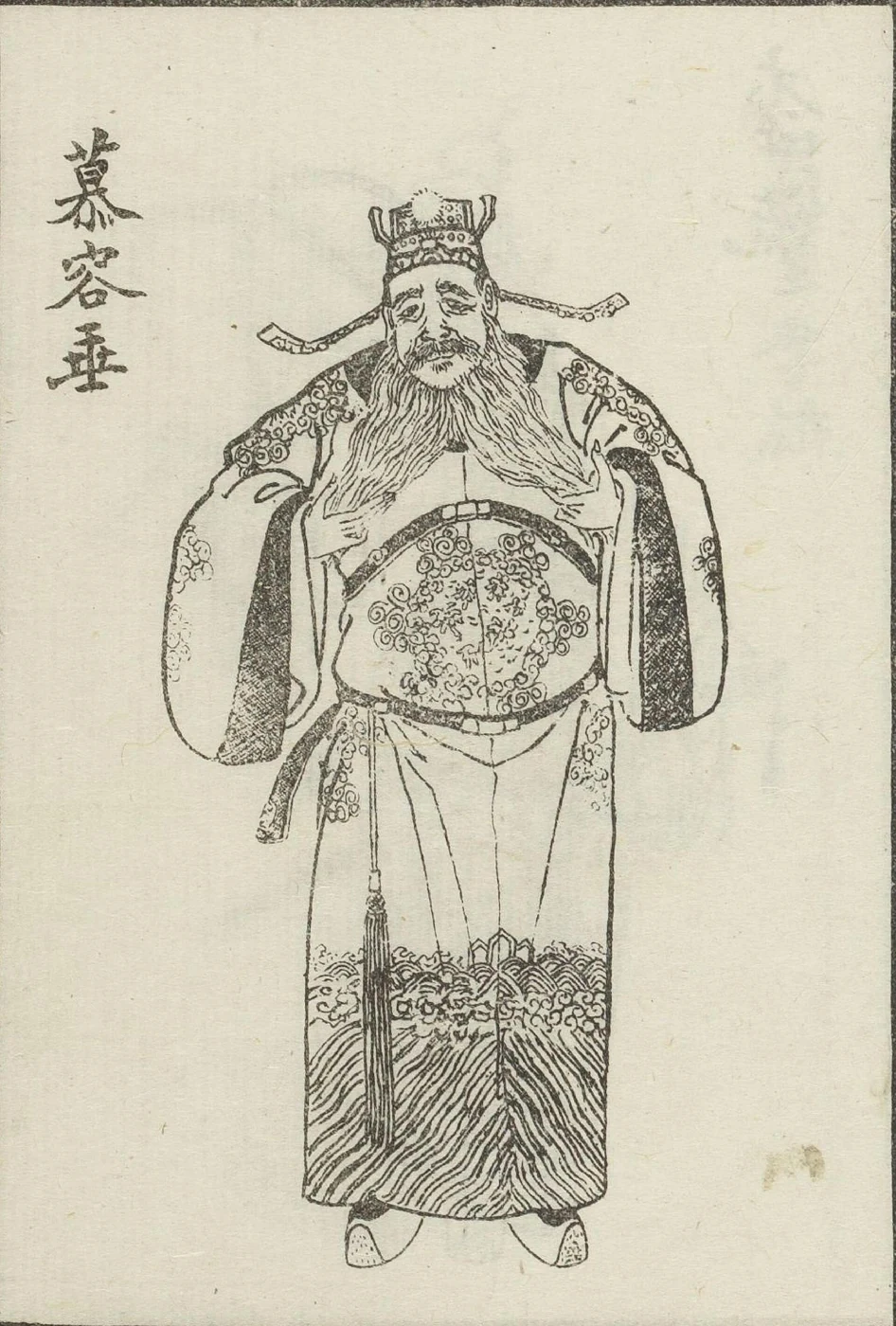
326 CE–396 CE
Emperor
Murong Chui
慕容垂
Murong Chui (c. 326–June 2, 396), originally named Murong Ba, courtesy name Daoye (also said to have been Daoming), and bearing the Xianbei name Altun, was a Xianbei native of Jicheng County, Changli Commandery (present-day Yi County, Liaoning). He was the founding emperor of Later Yan and a military leader of the Sixteen Kingdoms period. He was the fifth son of Murong Huang, Emperor Wenming of Former Yan, and his mother was…
326 CE–396 CELater Yan
PROFILE
Murong Chui (c. 326–June 2, 396), originally named Murong Ba, courtesy name Daoye (also said to have been Daoming), and bearing the Xianbei name Altun, was a Xianbei native of Jicheng County, Changli Commandery (present-day Yi County, Liaoning). He was the founding emperor of Later Yan and a military leader of the Sixteen Kingdoms period. He was the fifth son of Murong Huang, Emperor Wenming of Former Yan, and his mother was Consort Lan. At the age of thirteen, Murong Chui already accompanied his father on campaign and was said to have surpassed the army in courage. He repeatedly distinguished himself in Former Yan and was enfeoffed as Prince of Wu. In 369, the tenth year of the Jianxi era, he defeated the Eastern Jin commander Huan Wen at Fangtou. His success led to accusations from members of the ruling house, and he fled with his family to Fu Jian of Former Qin. After the Battle of the Fei River, he returned toward Ye and raised forces. In 386, the eleventh year of the Taiyuan era, he proclaimed himself emperor, adopted Jianxing as his era name, and made Zhongshan his capital. He subsequently destroyed Zhai Wei and Western Yan. In 395, the tenth year of Jianxing, an Yan army led by Crown Prince Murong Bao was defeated at Canhe Slope by Tuoba Gui of Northern Wei, and fifty thousand soldiers were buried alive. The following year, although already ill, Murong Chui personally campaigned against Northern Wei and killed the Wei commander Tuoba Qian. While passing Canhe Slope, he saw the remains of the Yan army, became overwhelmed with shame and grief, vomited blood, and died during the return march. He received the posthumous name Emperor Chengwu and the temple name Shizu.
- Other names
- Murong Ba / Emperor Chengwu of Later Yan
- Courtesy name
- Daoye (also said to have been Daoming)
- Period
- Later Yan
- Dynasty / Regime
- Later Yan
- Identity
- Emperor
- Ethnicity / affiliation
- Xianbei
- Native place
- Jicheng County, Changli Commandery (present-day Yi County, Liaoning)
- Date of birth
- c. 326
- Place of birth
- Not recorded in historical sources
- Date of death
- June 2, 396
- Reign
- Not recorded in historical sources
- Predecessor
- Not applicable (founding emperor)
- Successor
- Emperor Huimin of Later Yan (Murong Bao)
- Era name
- Jianxing
- Temple name
- Shizu
- Posthumous name
- Emperor Chengwu
- Principal achievements
- A son of Murong Huang; served Former Yan and Former Qin before rising in his later years to found Later Yan, and was one of the outstanding commanders of his age.
LIFE TIMELINE
Age 13 | Accompanied his elder brother Murong Ke in an attack on the Yuwen group; distinguished himself for courage and was appointed Cavalry Commandant.
Age 16 | Accompanied his father Murong Huang in the campaign against Goguryeo and served in the vanguard with Murong Han, helping capture Hwando.
Age 18 | Accompanied Murong Huang in destroying the Yuwen group, killed Sheyegan in a flank attack, and was enfeoffed as Marquis of Duxiang.
Age 19 | Appointed General Who Pacifies the Di and stationed at Tuhe; Deng Heng of Later Zhao feared him and did not advance.
Age 23 | Urged Murong Jun to take advantage of Later Zhao's disorder and enter the Central Plains; appointed Vanguard Commander.
Age 24 | Led troops against Zhao, captured Ji, persuaded Murong Jun not to bury surrendered soldiers alive, and repelled a night attack by Lu Bozao.
Age 26 | Forced Duan Qin to surrender; appointed General Who Pacifies the East and Inspector of Northern Jizhou, stationed at Changshan.
Age 28 | Renamed Murong Chui after breaking a tooth in a fall from a horse; enfeoffed as Prince of Wu and stationed at Xindu.
Age 31 | Led 80,000 infantry and cavalry against the Chile, capturing or killing more than 100,000 people and seizing 130,000 horses.
Age 32 | His wife Lady Duan was falsely accused of witchcraft and died without yielding under interrogation; Murong Chui was sent to govern Liaodong.
Age 39 | Accompanied Murong Ke in attacking Luoyang, captured the city, and captured and killed Shen Jin.
Age 43 | Defeated Huan Wen decisively at Fangtou, taking 30,000 heads; his reputation rose greatly.
Age 43 | Framed by Murong Ping and Empress Dowager Kezuhun, fled west to Former Qin, where Fu Jian personally welcomed him.
Age 57 | Former Qin suffered a major defeat at the Battle of the Fei River; Murong Chui's army returned intact and he escorted Fu Jian.
Age 58 | Killed Fu Feilong in a surprise attack and, at Xingyang, declared himself General-in-Chief, Grand Commander, and Prince of Yan.
Age 60 | Proclaimed himself emperor, adopted Jianxing as the era name, and made Zhongshan the capital.
Age 67 | Destroyed Western Yan and killed Murong Yong.
Age 69 | Crown Prince Murong Bao suffered a disastrous defeat at Canhe Slope; fifty thousand soldiers were buried alive.
Age 70 | Despite illness, personally campaigned against Northern Wei; after passing Canhe Slope he vomited blood and fell gravely ill, dying during the return march.
BIOGRAPHY
Biography
Family Background and Early Years
Murong Chui was born into the Murong branch of the Xianbei and was the fifth son of Murong Huang, Emperor Wenming of Former Yan; his mother was Consort Lan. The Murong group had settled in western Liaoning during the Cao Wei period, and by the time of Murong Huang had founded the Former Yan regime and become dominant in Liaodong. Murong Chui was originally named Murong Ba and was greatly favored by his father, reportedly even more than the heir Murong Jun, which later contributed to tension between the brothers.
In 339, the fifth year of Xiankang, Murong Huang attacked Goguryeo and advanced to Sinseong, where the Goguryeo king Wang Zhao sought an alliance. Murong Huang appointed Murong Chui Cavalry Commandant and ordered him to follow his elder brother Murong Ke in an attack on the Yuwen group. Murong Chui was only thirteen at the time and was said to have surpassed all three armies in courage. The Book of Wei, in its biography of Murong Chui, records: “At thirteen he served as a subordinate commander; wherever he campaigned, his courage surpassed the three armies.”
In 342, the eighth year of Xiankang, Murong Huang, Prince of Yan, campaigned against Goguryeo. Following the plan of his elder half-brother Murong Han, he divided his forces into two routes. Murong Huang personally led 40,000 main troops along the southern route, with Murong Chui and Murong Han in the vanguard. Goguryeo's king Gao Zhao assumed that the main Yan force would come by the northern route and sent his younger brother Gao Wu with 50,000 elite troops to defend it, while he himself guarded the southern route with weaker forces. The Former Yan army routed the Goguryeo troops on the southern route and pursued them into Hwando (present-day Ji'an, Jilin), while Gao Zhao fled. Murong Chui fought bravely in the vanguard.
In 344, the second year of Jianyuan, Murong Huang personally led a campaign against Yuwen Yidougui, with Murong Han as vanguard general and Murong Chui, Murong Jun, Murong Ke, and Muyu Gen advancing in three columns. Yuwen Yidougui sent the Naluocheng commander Sheyegan with elite troops to meet them. During the intense fighting, Murong Chui attacked from the flank and killed Sheyegan, whereupon the Yuwen army collapsed without further resistance. The Yan army pursued and captured the Yuwen capital at Zimengchuan (present-day Chaoyang, Liaoning). Yuwen Yidougui fled and died north of the desert, and the Yuwen polity dispersed. Murong Chui was rewarded with the title Marquis of Duxiang.
In 345, the first year of Yonghe, the Later Zhao commander Deng Heng stationed tens of thousands of troops at Le'an (present-day Laoting County, Hebei), intending to annex Former Yan. Murong Huang appointed Murong Chui General Who Pacifies the Di and stationed him at Tuhe (present-day Jinzhou, Liaoning). Deng Heng feared him and did not advance.
Campaigns against Later Zhao and Renaming as Prince
In 348, the fourth year of Yonghe, Murong Huang died and Murong Jun succeeded as Prince of Yan. Because Murong Ba had once fallen from a horse and broken a tooth, Murong Jun changed his name to a rare written form; later, an added graphic component was removed and his name was changed to Murong Chui. The following year, the Later Zhao emperor Shi Hu died and his sons fell into a violent succession struggle. Murong Chui submitted a memorial urging Murong Jun to attack Later Zhao, but Murong Jun initially refused because Murong Huang had only recently died. Murong Chui hurried to Longcheng (present-day Chaoyang, Liaoning) and personally told Murong Jun: “What is hard to obtain and easy to lose is opportunity. If the Shi house declines and then recovers, or if some hero takes possession of its ready-made resources, not only will we lose this great advantage, but I fear it will become a future danger.” With support from Feng Yi and others, Murong Jun appointed Murong Chui Vanguard Commander and General Who Establishes the Vanguard and selected more than 200,000 elite troops for the campaign against Zhao.
In the second month of 350, the sixth year of Yonghe, Murong Jun ordered Murong Chui to lead 20,000 troops by the eastern route against Zhao, while Muyu Gan went by the western route and Murong Jun personally led the center, thus advancing in three columns. When Murong Chui reached Sanxing (present-day Maoshi Mountain in Funing County, Hebei), Deng Heng panicked, burned the storehouses, and withdrew to Ji (present-day Beijing). Murong Chui seized the troops and grain of Le'an and Beiping commanderies and joined Murong Jun in the attack on Ji. In the third month, the Yan army took the city, and Murong Chui persuaded Murong Jun to abandon a plan to bury the Later Zhao soldiers alive. Soon afterward, Murong Jun personally led troops against Deng Heng. At Qingliang (present-day Qingyuan County, Hebei), the Zhao commander Lu Bozao led several thousand men in a night attack and broke into Murong Chui's camp. Murong Chui fought back fiercely, personally killing more than ten men and checking the assault. Muyu Gen and others then led troops to defeat Lu Bozao and repel the attackers.
In 352, the eighth year of Yonghe, the Zhao “Righteous General” Duan Qin gathered more than ten thousand Hu and Jie troops at Yimu and proclaimed himself emperor of Zhao. Murong Chui attacked him, and Duan Qin and his younger brother Duan Si surrendered the city. That same year, Murong Jun appointed Murong Chui Acting with Imperial Authority, General Who Pacifies the East, and Inspector of Northern Jizhou, with his base at Changshan.
In the fourth month of 354, the third year of Yuanxi, Murong Jun proclaimed himself emperor and used Yuanxi as his era name; the regime is known as Former Yan. Murong Chui was enfeoffed as Prince of Wu and stationed at Xindu. As Palace Attendant and Right General of the Guards, he also supervised affairs of the retained administration and drew substantial revenues from the northeast. This increased Murong Jun's jealousy, and an edict recalled Murong Chui to court.
In 357, the first year of Guangshou, Former Yan sent troops against the Chile north of the frontier, also known as Dingling or Gaoche. In the fifth month, Murong Jun ordered Murong Chui, then General Who Pacifies the Army, together with Central Army General Murong Qian and Guard General Ping Xi, to lead 80,000 infantry and cavalry north of the frontier. They inflicted a major defeat on the Chile, capturing or killing more than 100,000 people, seizing 130,000 horses and innumerable cattle and sheep, and restoring security to the northern border.
The Death of His Wife and Flight to Former Qin
In 358, the second year of Guangshou, Murong Chui had married Lady Duan, daughter of Duan Mobo, who bore Murong Ling and Murong Bao. Talented and strong-willed, Lady Duan had poor relations with Empress Kezuhun, who came to hate her. The Palace Attendant Nie Hao, acting on the imperial will, falsely accused Lady Duan and the Wu administrative official Gao Bi of using witchcraft and curses, hoping to implicate Murong Chui. Murong Jun imprisoned and tortured Lady Duan and Gao Bi, but, as the Book of Jin records, the two “remained resolute in spirit and never gave a wavering confession.” Pitying them, Murong Chui secretly sent word to Lady Duan: “Everyone must die sooner or later; how can you endure such torment? It would be better to confess.” She sighed and answered: “Do you think I cling to life? If I falsely accuse myself of heinous rebellion, above I would disgrace my ancestors and below I would bring ruin upon the prince. I will never do it!” Thereafter she answered her interrogators with still greater clarity. Murong Chui escaped implication, but Lady Duan was eventually tortured to death in prison. Murong Chui was then appointed Inspector of Pingzhou and sent to Liaodong. He took Lady Duan's younger sister as his second wife, but the empress had her removed and arranged another marriage for Murong Chui. He resented this, further worsening his relations with Murong Jun.
In the first month of 360, the fourth year of Shengping, Murong Jun died and Crown Prince Murong Wei succeeded him. Grand Preceptor Murong Ke knew Murong Chui's abilities well and, when gravely ill in 367, the eighth year of Jianxi, recommended to Murong Wei that Murong Chui be entrusted with the government. After Murong Ke died, Murong Ping dominated the government and was deeply suspicious of Murong Chui.
In the fourth month of 369, the fourth year of Taihe, Eastern Jin Grand Marshal Huan Wen personally led 50,000 infantry and cavalry north against Former Yan. The Jin army won repeatedly, and Murong Wei and Murong Ping became so frightened that they discussed fleeing to the old capital of Helong (present-day Chaoyang, Liaoning). Murong Chui requested permission to resist. Murong Wei appointed him Grand Commander for the Southern Campaign and placed 50,000 infantry and cavalry, including Murong De, under his command. Murong Chui deliberately pursued slowly until Huan Wen's army was exhausted and demoralized, then personally led 8,000 cavalry in pursuit. At Xiangyi (present-day Sui County, Henan), he and Murong De attacked from east and west and inflicted a crushing defeat, killing 30,000 Jin troops. The Qin commander Gou Chi then intercepted Huan Wen in Qiao Commandery, and the Jin army again lost tens of thousands. Huan Wen's northern campaign ended in failure.
Murong Chui's victory over Huan Wen greatly enhanced his fame, making Murong Ping both jealous and hostile. Murong Chui proposed rewards for his troops, but Murong Ping suppressed the request. Empress Dowager Kezuhun, who had long hated Murong Chui, disparaged his achievement and plotted with Murong Ping to kill him. Murong Kai, son of Murong Ke, and Murong Chui's maternal uncle Lan Jian learned of the plot and urged him to strike first. Murong Chui refused to initiate bloodshed within the ruling clan, saying: “To begin disorder in the state through slaughter among one's own flesh and blood—I would rather die than do such a thing.”
His heir Murong Ling advised him to flee north to Longcheng and apologize to Murong Wei in hopes of saving himself. Murong Chui left Ye in disguise under the pretext of hunting. At Handan, however, his youngest son Murong Lin informed Murong Ping. Murong Ping sent Murong Qiang with elite cavalry in pursuit. At Fanyang, Murong Chui ordered Murong Ling to guard the rear, and Murong Qiang did not dare continue. Murong Ling proposed fleeing to Former Qin. With no other course, Murong Chui led his followers west, killed the ferry official at Heyang, crossed the river, and from Luoyang fled to Former Qin with Lady Duan, Murong Ling, Murong Bao, Murong Nong, Murong Long, his nephew Murong Kai, his maternal uncle Lan Jian, and Gao Bi, leaving his wife, Lady Duan's younger sister, in Ye.
When Fu Jian, ruler of Former Qin, learned that Murong Chui was coming, he was delighted and personally welcomed him. He appointed Murong Chui General Who Champions the Army and enfeoffed him as Marquis of Bintu.
Service under Qin and the Battle of the Fei River
The year after Murong Chui fled to Qin, Former Qin destroyed Former Yan. Murong Chui rose in Former Qin to become Administrator of the Capital Region and was further enfeoffed as Marquis of Quanzhou. Fu Jian relied heavily on him, but Wang Meng regarded Murong Chui as a grave danger and repeatedly urged Fu Jian to eliminate him; Fu Jian refused. Wang Meng once used the so-called “Golden Knife stratagem” to entrap Murong Chui, causing his eldest son Murong Ling to die, yet Murong Chui continued to endure in silence.
In 382, the eighteenth year of Jianyuan, Fu Jian insisted on attacking Eastern Jin. Fu Rong, Shi Yue, Fu Hong, and others opposed the plan, but Murong Chui said: “The weak are swallowed by the strong, and the small are annexed by the great; this accords with the natural order and is not difficult to understand. With Your Majesty's divine martial ability, acting in accordance with Heaven's time, your prestige extends beyond the seas, with a million guards and a court full of generals like Han Xin and Bai Qi. Jin is merely a small state south of the Yangtze that alone defies the royal command. How can it be left for our descendants? The Book of Odes says, ‘Counselors are exceedingly many; therefore nothing is accomplished.’ It is enough for Your Majesty to decide personally; why ask the entire court? When Emperor Wu of Jin destroyed Eastern Wu, only a few ministers such as Zhang Hua and Du Yu supported him. Had he followed the prevailing opinion of the court, how could he have achieved unification?” Fu Jian was delighted and said: “The one who will pacify the realm together with me is surely you.”
In the fifth month of 383, the nineteenth year of Jianyuan, Eastern Jin Inspector of Jingzhou Huan Chong launched a northern campaign and personally led the main force against Xiangyang. Murong Chui and Fu Rui led relief troops. As the vanguard reached the Mian River, Murong Chui ordered every soldier at night to tie ten torches to tree branches, making Huan Chong believe that the reinforcements were much larger than they were and causing him to withdraw. In the eighth month, Fu Jian formally launched his invasion of Jin and ordered Fu Rong and Murong Chui to lead 250,000 troops as the vanguard. Fu Rong captured Shouchun (present-day Shouxian, Anhui), while Murong Chui led a detached force that captured Yun City (present-day Yunxian, Hubei).
In the eleventh month, Fu Jian suffered a catastrophic defeat at the Fei River. The Former Qin forces at the front collapsed, and only Murong Chui's army, which had not taken part directly in the fighting at the river, remained intact. Fu Jian fled with remnants to Murong Chui. Murong Bao and others urged Murong Chui to kill Fu Jian, but he refused and even returned command of his troops to him. By the time Fu Jian reached Luoyang he had gathered more than 100,000 men. At Mianchi, Murong Chui said that he wished to pacify Hebei and pay respects at the ancestral temples. Fu Jian allowed him to go despite Quan Yi's objections.
Restoration of the Yan House and the Founding of Later Yan
Fu Pi, then defending Ye, knew that Murong Chui was approaching and suspected rebellion. Murong Chui secretly contacted former officials of Former Yan and planned to restore the state. At this time the Dingling leader Zhai Bin rose in rebellion, and Fu Jian ordered Murong Chui to suppress him. Fu Pi gave Murong Chui only 2,000 weak soldiers with poor weapons and armor and sent Fu Feilong as his deputy, intending to use the opportunity to eliminate him.
Murong Chui left Murong Nong, Murong Kai, and Murong Shao at Ye. During the march he learned of Fu Pi's and Fu Feilong's designs and used the revelation to anger his soldiers. Claiming that his force was too small, he remained in Henei Commandery to recruit. Within ten days his following grew to 8,000. He and his sons then planned to kill Fu Feilong, and at night they attacked and killed him together with one thousand Di soldiers under his command. The next day Murong Chui sent Tian Shan back to Ye to inform Murong Nong and the others to rise in support. The three slipped out in disguise with several dozen horsemen and raised troops at Lieren (northeast of present-day Feixiang County, Hebei).
In 384, the first year of Yanyuan, Murong Chui planned to attack Luoyang. Among Zhai Bin's followers were the Former Yan imperial clansman Murong Feng and Duan Yan, son of a former Yan official, who urged Zhai Bin to recognize Murong Chui as alliance leader. When Murong Chui reached Luoyang, Fu Hui, having learned of Fu Feilong's death, refused him entry. Murong Chui then declared himself General-in-Chief, Grand Commander, and Prince of Yan at Xingyang (present-day Xingyang, Henan), adopted Yanyuan as his era name, and established the regime known as Later Yan. He then led troops against Ye, where Fu Pi held out behind the walls. Meanwhile Murong Nong raised forces at Lieren; his following soon reached tens of thousands, and he defeated Fu Pi's commander Shi Yue. Murong Chui joined Murong Nong and laid siege to Ye.
In 385, the second year of Yanyuan, Fu Pi abandoned Ye and fled south, and Murong Chui entered the city. In 386, the eleventh year of Taiyuan, Murong Chui proclaimed himself emperor, adopted Jianxing as the era name, and established his capital at Zhongshan (present-day Dingzhou, Hebei).
Later Years and the Disaster at Canhe Slope
In 393, the eighth year of Jianxing, Murong Chui destroyed Western Yan, killed Murong Yong, and annexed all of its territory. By then Tuoba Gui's Northern Wei was becoming increasingly powerful, and relations with Later Yan deteriorated. In 395, the tenth year of Jianxing, Murong Chui sent Crown Prince Murong Bao with 80,000 troops against Northern Wei. Tuoba Gui avoided the Yan army's initial strength and cut its supply lines. At Canhe Slope (northeast of present-day Liangcheng County, Inner Mongolia), he inflicted a crushing defeat. Fifty thousand Yan soldiers were buried alive, and Murong Bao escaped alone on horseback.
When Murong Chui heard the news, he was overcome with shame and rage. In 396, the eleventh year of Jianxing, although ill, he personally campaigned against Northern Wei. He captured Pingcheng (present-day Datong, Shanxi) and killed the Wei commander Tuoba Qian. Passing Canhe Slope, he saw the piled remains of the Yan dead, became so distressed that he vomited blood, and his illness worsened. He died during the return march. He received the posthumous name Emperor Chengwu and the temple name Shizu.
His Early Years and the Former Yan
Murong Chui, originally named Murong Ba and Murong Que, with the childhood name Aliudun and the courtesy names Daoye and Daoming, was a man of Jicheng county in Changli commandery, of Xianbei stock, the founding emperor of the Later Yan and a commander, son of Murong Huang, the civil emperor of the Former Yan, his mother being the honoured lady Lan. He went to war with his father at thirteen and was foremost among the brave, and in his early years in the Former Yan won merit repeatedly and was enfeoffed as prince of Wu. In the tenth year of Jianxi he defeated Huan Wen, the grand marshal of the Eastern Jin, at Fangtou, and for that merit was framed by the imperial clan and fled with his family to Fu Jian of the Former Qin.
His Victory over Huan Wen at Fangtou
Huan Wen's northern campaign having failed again and again, his grain cut off and hearing that the relief troops of the Former Qin were about to arrive, he ordered his warships burned, abandoned his baggage and armour and led his army back by land. Setting out from Dongyan, and fearing on the retreat that the pursuing Yan troops would poison the upper waters, he had his soldiers dig wells for water, and so went seven hundred li. The Yan generals all wished to pursue, but Murong Chui said they must not, for Huan Wen, newly retreating and in fear, would set a strict guard and choose picked troops for the rear; that to attack him might not succeed, and that it was better to wait, for trusting that they had not come he would hurry day and night, and that when his men's strength was spent and their spirit fallen they might strike and never fail. So Murong Chui with eight thousand horse followed behind Huan Wen's army, and Huan Wen indeed quickened his retreat; and some days later Murong Chui told his generals that Huan Wen might now be struck, and ordered them forward, and broke his army heavily.
His Flight to Qin
After the great victory at Fangtou Murong Chui's merit and fame were high and he was suspected. Murong Ling asked him whether his troubled look were not because the sovereign was young, the grand tutor jealous of the worthy, and his own merit and fame so high that he was the more suspected; and Murong Chui said it was so, that he had strained every nerve to break the strong enemy only to preserve house and state, and how could it be that when the work was done he should find no place for himself, and asked Murong Ling what he advised. And Murong Ling said that the sovereign was weak and had entrusted all to the grand tutor, so that once disaster came it would be swift as a sprung crossbow; and that to preserve the clan and the person without failing in the great right, there was nothing better than to flee to Longcheng and humbly to plead his guilt and await the sovereign's examination, like the duke of Zhou in the east, in hope of awaking him and returning, which would be the greatest fortune; and that otherwise he might quiet Yan and Dai within and win the peoples without, and hold the pass of Feiru, which was the next best. Murong Chui thought it good and agreed. In the eleventh month he went out of Ye in plain clothes on the pretext of hunting, meaning to return to the old capital Longcheng; but at Handan there was a mishap, for his youngest son Murong Lin in discontent fled back to Ye and informed on him, and most of his followers were pursued and taken by troops sent by Murong Ping. Someone told Murong Chui that the grand tutor hated the worthy and the able, and that since the plot men had hated him the more, and that in Ye none knew where he was and the people turned to him as an infant to its mother, Chinese and barbarian alike; and that if he followed the general heart and surprised them unprepared he could take the city as one looks at his palm. But Murong Chui said that such a plan, if it succeeded, would indeed be great fortune, but if it failed no repentance could mend it, and that it was better to flee west, which was wholly safe. His son Murong Manu plotted secretly to flee home, and Murong Chui killed him and set out, leading his followers west; and coming to Heyang he beheaded the ferry officer and crossed, and from Luoyang with the lady Duan and his sons fled to the Former Qin. Fu Jian had long meant to attack Yan, but had never done it, first because of internal troubles and second because he feared Murong Chui's fame; and hearing that Murong Chui had come over he was greatly pleased and went to meet him outside the city, and taking his hand said that Heaven, having produced a worthy hero, meant them to accomplish a great work together, and that he would with him settle the realm and report the accomplishment at Mount Tai, and then return Murong Chui's own state to him and make him hereditary prince of Youzhou, so that in leaving his state he should not fail as a son in filial piety nor in coming to him fail as a minister in loyalty. And Murong Chui thanked him, saying that as a stranger's servant he was fortunate only to escape guilt and did not dare hope for the honour of his own state. Fu Jian loved the talents of Murong Ling and Murong Kai and treated them well with gifts of myriads, and at every audience would gaze at them; and the officers and people of the passes, having long heard of the fame of father and son, all admired them. When Wang Meng campaigned against Yan he took Murong Ling as a guide, and before setting out asked Murong Chui for a keepsake, and Murong Chui gave him his own belt knife; and when they reached Luoyang Wang Meng sent a man disguised as Murong Chui's messenger with the knife to Murong Ling, telling him that his father had returned to Yan; and Murong Ling, unable to confirm it, fled back to Yan on the pretext of hunting; and Wang Meng then memorialised accusing Murong Ling, and Murong Chui, seeing it, fled from the Former Qin but was taken on the road by its troops and brought before Fu Jian, who said he understood Murong Ling's conduct and did not pursue Murong Chui's fault, but treated him as before. When the Former Yan was destroyed Murong Chui, seeing the ministers and grandees of Yan and his old clerks, showed displeasure; and Gao Bi told him that with the accumulated substance of his ancestors and his own surpassing gifts he had met with adversity and lodged in a foreign state, and that though his house and state were overthrown how could one know that this was not the beginning of a rising fortune; and that he should show the measure of rivers and seas to the old men of the state and comfort and bind their hearts, so as to lay the foundation of a basket of earth and achieve the work of nine fathoms, and asked how he could cast it away in a single anger. Murong Chui took his words deeply and gladly followed them. In the second month of the second year of Xian'an Murong Chui told Fu Jian that his uncle Murong Ping was of the company of E Lai in Yan and should not again defile the sacred court, and begged Fu Jian to put him to death for Yan; but Fu Jian would not, and made Murong Ping grand administrator of Fanyang, and the princes of the Former Yan were all given frontier commanderies.
About the Fei River and the Restoration of Yan
Before Fu Jian's campaign against Jin many ministers remonstrated again and again, but his mind was made up and he would not be moved; and Murong Chui, who already had a second mind, strongly urged the attack, telling Fu Jian that the weak are annexed by the strong and the small by the great, which was the natural tendency of things and no hard matter to know; that with the emperor's divine valour answering the times and his majesty reaching beyond the seas, with a million tiger troops and Han and Bai filling the court, how could they leave the petty little Jiangnan alone in its disobedience to the royal command and hand it on to their sons and grandsons; that the Odes said that where the planners are many the work is not done, and that the emperor should decide from his own sacred mind and need not widely consult the court; that when the founder of Jin pacified Wu he relied only on two or three ministers and had he followed the court's voice would never have had the work of union. And Fu Jian was greatly pleased and said that only Murong Chui could settle the realm with him, and gave him five hundred bolts of silk. At the Fei river Fu Jian was heavily beaten, and only Murong Chui's thirty thousand men were whole, and Fu Jian came to him with more than a thousand riders. Earlier a comet had appeared in Wei and Ji, more than ten zhang long, passing through the Taiwei and sweeping the Dongjing, and the grand astrologer of Qin, Zhang Meng, told Fu Jian that Wei and Ji were the divisions of Yan and the Dongjing that of Qin, so that a comet rising in Wei and Ji and sweeping the Dongjing meant that within ten years Yan would destroy Qin, and that the Murong father and sons and brothers, being their enemies yet arrayed in the court and honoured beyond all, should have their chiefs cut off to dispel the heavenly change; but Fu Jian would not hear. Murong Shao, the regular attendant of the principality of Yangping, said privately to his elder brother Murong Kai that Qin, trusting in its strength, strove for victory without rest, garrisoning Yunzhong in the north and guarding Shu and Han in the south, transporting over ten thousand li with the dead lying along the roads, its troops weary without and its people in want within, so that ruin was near; and that their uncle the champion was wise and brave and would surely restore the fortunes of Yan, and that they should only cherish themselves and wait for the time. Murong Chui, entering Ye with Fu Jian, had his son Murong Lin, who had several times informed against him in Yan, and killed Murong Lin's mother at once though he could not bear to kill Murong Lin, whom he lodged in an outer house; and after the killing of Fu Feilong, Murong Lin often offered plans and opened Murong Chui's mind, so that Murong Chui thought him remarkable and treated him equally with his other sons. Murong Chui asked leave to enter Ye to visit the ancestral temple and Fu Pi would not allow it, and Murong Chui therefore entered the city in disguise; and the pavilion officer stopped him, at which Murong Chui in anger killed the officer and burned the pavilion and went off. And Shi Yue told Fu Pi that Murong Chui, who in Yan had broken the state and disordered the house, and coming to the sacred court had received extraordinary treatment, now dared to slight a frontier command, killing an officer and burning a pavilion, so that his rebellion was plain and would end in disorder; and that he might be surprised and taken. But Fu Pi, irresolute, said that after the defeat at Huainan his men had scattered and his kin left him, and that Murong Chui had guarded the imperial person, a service not to be forgotten; and Shi Yue said that Murong Chui, unfaithful to Yan, how could he be wholly faithful to us, that he was a fugitive slave whom the emperor favoured like an old servant of merit, and that if he were not struck now he would be a future calamity; and Fu Pi would not listen. And Shi Yue, going out, said to others that father and son loved small benevolence without regard for the great design, and that they would at last be taken by the Xianbei.
His Rising, the Restoration of Yan, and the Destruction of the Zhai Wei
Fu Jian sent Fu Feilong with Di troops to watch Murong Chui, and the duke of Pingyuan, Fu Hui, sent an envoy urging Murong Chui to advance; and Murong Chui told Fu Feilong that the robbers were not far and that they should halt by day and march by night and strike where they were not looked for, which Fu Feilong thought right; and one night Murong Chui sent his heir Murong Bao with troops ahead and his youngest son Murong Long with troops at his own side, ordering the Di troops into fives, and secretly agreed with Murong Bao that at the sound of the drum they should attack the Di troops and Fu Feilong from front and rear and kill them all, and sent home the staff whose families were in the west and wrote to Fu Jian to say why he had killed Fu Feilong. Murong Chui crossed the river and burned the bridge and had thirty thousand men, and ordered that he had outwardly borrowed the name of Qin while inwardly designing a restoration, that those who broke the law had the standing punishment of the army and those who obeyed orders were rewarded within the day, and that when the realm was settled he would enfeoff them by degree and not fail them. He left the Liaodong Xianbei Kezuhun Tan to gather troops at Shacheng by the river and sent Tian Shan to Ye to tell Murong Nong and the rest to rise in answer. In the first month of the ninth year of Jianxing Murong Feng, Wang Teng and Duan Yan all urged Zhai Bin to make Murong Chui leader of the league, and Zhai Bin agreed; and Murong Chui, meaning to surprise Luoyang and not knowing whether Zhai Bin's submission were true, refused him, saying that he had come to relieve Yuzhou and not to join him, and that if he undertook a great work he would enjoy its fortune and suffer its disasters, and that he himself had no part in it. Coming to Luoyang, the duke of Pingyuan, Fu Hui, hearing that he had killed Fu Feilong, shut the gates against him; and Zhai Bin sent his chief secretary Guo Tong to persuade Murong Chui, who still would not allow it, until Guo Tong said that the reason he refused was surely that he thought the Zhai brothers were mountain rustics of another kind without remarkable talent or far plans and could accomplish nothing, and asked whether he did not consider that with them he might accomplish the great work; and Murong Chui then allowed it. Zhai Bin brought his host to join him and urged him to take the imperial title, and Murong Chui said that the marquis of Xinxing was his lord and that he should be brought back and restored to his place. Coming to Xingyang, his followers urged the title again, and Murong Chui, after the precedent of the Zhongzong emperor of Jin, styled himself grand general, grand commander and prince of Yan, acting by imperial authority, which was called the unified office, with his followers as his subjects and his documents, memorials, appointments and titles as those of a king; he made his brother Murong De general of chariots and cavalry and prince of Fanyang, his brother's son Murong Kai general of the western expedition and prince of Taiyuan, and Zhai Bin general of establishing righteousness and prince of Henan, and with more than two hundred thousand men crossed the river at Shimen and marched on Ye. Coming to Ye, Murong Chui changed the twentieth year of Jianyuan of Qin to the first year of Yan, with dress and court ceremony as of old; he made his heir Murong Bao heir apparent and enfeoffed seventeen of his cousins and his nephews and his uncles' sons as princes, with thirty-seven of his clan and meritorious ministers as dukes and eighty-nine as marquises, earls, viscounts and barons. Zhai Bin, relying on his merit, grew arrogant and insatiable and, the city of Ye being long untaken, secretly turned his heart; and the heir Murong Bao asked leave to remove him, but Murong Chui said that the covenant at Henan could not be broken, and that if Zhai Bin made trouble the guilt would be his, and that to kill him now before anything showed would make men say he feared his merit and ability, whereas he was then gathering heroes for a great work and could not show himself narrow and lose the hope of the realm. And Murong Shao told Murong Chui that the Dingling had no great ambition and only made trouble when too much favoured, and that if pressed they would gather as robbers and if let alone they would scatter, and that when scattered they might be struck and never fail; and Murong Chui followed him. In the eighth month Zhai Zhen went north from Handan and Murong Chui sent Murong Kai and Murong Nong with horse to pursue and came up with him at Xiayi; Murong Kai wished to fight and Murong Nong said that the soldiers were hungry and weary and that in the enemy camp no strong men were seen, so that there was probably an ambush; but Murong Kai would not heed and advanced and the Yan army was badly beaten, and Zhai Zhen went north to Zhongshan. The fodder and grain in Ye being exhausted, they cut pine wood to feed the horses; and Murong Chui told his generals that Fu Pi was a cornered foe who would never surrender, and that it was better to withdraw to Xincheng and open the way for Fu Pi to go west, in requital of the king of Qin's former kindness, and to plan against Zhai Zhen. By night he raised the siege and went to Xincheng, sending Murong Nong through Qinghe and Pingyuan to collect the taxes, and Murong Nong set clear rules, equalized supply and demand, kept his orders strict and did no violence, so that grain and silk came along the roads and the army's stores were plentiful. Afterwards Murong Chui reviewed his troops on the river and sent Lan Han and Ping You across the river forty li west of Qiao'ao with Murong Long in array on the north bank, and Wen Xiang fled by night with his wife and children to Pengcheng while more than thirty thousand households of his men submitted to Yan; and he attacked Zhang Shen, with Murong Kai, Murong Lin and Murong Long joining at Hekou, and Wang Zu raided the Yan camp by night and was beaten back, and Murong Long with Ping You pursued in two columns until dawn and won completely, hanging the heads taken before Zhang Shen's camp, at which Zhang Shen surrendered and Wang Zu too gave himself up. Zhai Zhao asked help of the Western Yan and its lord Murong Yong refused; and in the sixth month Murong Chui camped at Liyang meaning to cross, with Zhai Zhao in array on the south bank to hold him, and Murong Chui moved his camp to Xijin forty li west of Liyang and had more than a hundred ox-hide boats drawn up with a false show of arms and went up the current, so that Zhai Zhao hurried to Xijin, while Murong Chui secretly sent the general of the central rampart, Wang Zhen, across by night at the Liyang ferry to camp on the south of the river, and the camp was made by dawn; and Zhai Zhao turned back and attacked Wang Zhen's camp and could not take it and, his men worn out with heat and marching, was about to withdraw, when Wang Zhen came out and the general of the cavalry Murong Nong crossed from Xijin and attacked with him from both sides and broke him heavily; and Zhai Zhao fled back to Huatai and, taking his wife and children and gathering his scattered men, crossed the river north and climbed Mount Bailu to hold it by its defiles. And Murong Nong said that Zhai Zhao had no grain and could not long stay in the mountains, and withdrew his troops, leaving horse to watch, and Zhai Zhao indeed came down and was attacked and all his men taken, and he fled alone to Changzi, where after more than a year he plotted rebellion and was killed by Murong Yong.
The Destruction of the Western Yan and the Defeat at Canhe Slope
Murong Chui proposed to attack the Western Yan, and his generals all said that Murong Yong had given no occasion, that they had campaigned for years and the soldiers were worn, and that it could not yet be done; but the prince of Fanyang, Murong De, said that Murong Yong was a branch of the state and yet had usurped the title and bewildered the people, and should be removed first to unite men's hearts, and that though the soldiers were weary it could not be helped. And Murong Chui said that the minister of the masses' mind was exactly his own, and that though he was growing old, if he emptied the bottom of his bag of wits it would suffice to take him, and that he would not leave this traitor to burden his sons and grandsons; and so they put the army under strict orders. In the eleventh month of the ninth year of Jianxing Murong Chui sent seventy thousand foot and horse from Zhongshan, sending the prince of Danyang, Murong Zan, and the general of the soaring dragon, Zhang Chong, out through Jingxing against Murong You, duke of Wuxiang of the Western Yan, at Jinyang, and the general of the eastern expedition, Ping Gui, against the general of the eastern garrison, Duan Ping, at Shating; and the lord of the Western Yan, Murong Yong, sent his master of the secretariat Diao Yun and the general of chariots and cavalry, Murong Zhong, with fifty thousand to hold Luchuan. In the twelfth month Murong Chui came to Ye. The next year he left the duke of Qinghe, Murong Hui, to hold Ye and called out the troops of Si, Ji, Qing and Yan, sending the prince of Taiyuan, Murong Kai, out by the Fu mouth and the prince of Liaoxi, Murong Nong, out by the Huguan pass, while he himself went out at Shating against the Western Yan, making a show of his directions and halting his armies each in place so that the enemy could not know where to prepare; and Murong Yong, hearing it, set his troops strictly and held the roads, and stored grain at Taibi. Murong Chui halted southwest of Ye for more than a month without advancing, and Murong Yong wondered at it, thinking the Taihang road broad, and suspecting that Murong Chui meant to take him by a secret road, so he gathered all his armies at the Zhi pass and blocked the Taihang mouth, leaving only the one army at Taibi; and Murong Chui led his great army out at the Fu mouth and entered the Tianjing pass, and in the fifth month came to Taibi, and Murong Yong sent his elder cousin, the grand commandant Murong Dayidougui, to relieve it and he was beaten by Ping Gui; and Murong Xiaoyidougui came out and was beaten by Murong Nong, and Lemaju was beheaded and Wang Ciduo taken, and Taibi was invested. Murong Yong recalled the Taihang army and led fifty thousand picked troops himself, and Diao Yun and Murong Zhong, in terror, brought their men over to Yan, and Murong Yong killed their wives and children. Murong Chui drew up south of Taibi and sent the general of the galloping cavalry, Murong Guo, to hide more than a thousand horse in a ravine; and joining battle with Murong Yong he feigned retreat, and Murong Yong's men pursued several li, when Murong Guo's horse came out of the ravine and cut their rear, and all the armies came on from four sides and broke them heavily, beheading more than eight thousand, and Murong Yong fled to Changzi; and the defending general of Jinyang, hearing it, abandoned the city, and Murong Zan and the rest took Jinyang. Murong Chui advanced and invested Changzi, and Murong Yong wished to flee to the Later Qin, but his palace attendant Lan Ying said that when Shi Hu attacked Longdu the founder had held out and not gone, and so had at last laid the foundation of the great Yan, and that Murong Chui was an old man of seventy, weary of war, and could not keep his troops in the field for years to attack them, so that they had only to hold the city and wear him out; and Murong Yong followed him. Murong Yong, in extremity, sent his son, the duke of Changshan, Murong Hong, and others to ask help of the inspector of Yongzhou, Xi Hui, and offered a seal of royal rank; and Xi Hui memorialised that if Murong Chui swallowed Murong Yong the trouble would be the deeper, and that it was better to keep both alive so as to destroy both in the end; and the emperor thought it right and decreed that the inspectors of Qing and Yan, Wang Gong, and of Yuzhou, Yu Kai, should relieve him. Murong Yong, fearing the Jin troops would not come, sent his heir Murong Liang as a hostage, and Ping Gui pursued Murong Liang to Gaodu and took him; and Murong Yong asked help also of Wei, and the king of Wei, Tuoba Gui, sent the duke of Chenliu, Tuoba Qian, and the general Yu Yue with fifty thousand horse east across the river to camp at Xiurong to relieve him. The Jin and Wei troops not yet arriving, the general under Murong Dayidougui, Fa Qin and others, opened the gates and let the Yan troops in, and the men of Yan took Murong Yong and beheaded him, and beheaded his ministers and great generals Diao Yun and Murong Dayidougui and thirty others, taking the eight commanderies and more than seventy thousand households he had ruled and much of the Qin imperial carriage, robes, musicians and treasures; and Murong Chui made the prince of Danyang, Murong Zan, inspector of Bingzhou to hold Jinyang, and the prince of Yidu, Murong Feng, inspector of Yongzhou to hold Changzi. In his campaigns Murong Chui left one internal and one external danger behind him. The internal danger was that the Murong house loved internal strife; the Later Yan held half of north China, with Murong Nong in the northeast, Murong De in the southeast, Murong Lin in the northwest, and Murong Long, Murong Shao and Murong Kai in the east, south and west, so that the centre needed a great power of attraction; and Murong Chui being old, he gave the great affairs of state to the heir Murong Bao, who was of bold spirit but coarse understanding and not fit for the charge. The external danger came from the relations with the Northern Wei. The king of Wei, Tuoba Gui, secretly had designs on Yan and sent the duke of Jiuyuan, Tuoba Yi, on a mission to Zhongshan, and Murong Chui questioned him asking why the king of Wei did not come himself; and Tuoba Yi said that their former kings had served the house of Jin together with Yan and had been brothers from age to age, and that he now came on a mission and had not failed in propriety; and Murong Chui said that his own majesty now reached the four seas and could not be compared with former days; and Tuoba Yi said that if Yan did not cultivate virtue and ceremony but wished to make itself strong by arms, that was the business of generals and not for an envoy to know. And Tuoba Yi, returning, told Tuoba Gui that the lord of Yan was old, the heir weak, and the prince of Fanyang proud of his talents, so that he would not be a subject of the young lord; and that when the lord of Yan died trouble within must come, and then Yan might be dealt with, but that now it could not be; and Tuoba Gui thought it good. When the king of Wei rebelled against Yan and pressed on the tribes attached to the frontier, in the fifth month Murong Chui sent the heir Murong Bao, the prince of Liaoxi, Murong Nong, and the prince of Zhao, Murong Lin, with eighty thousand men from Wuyuan against Wei, with the prince of Fanyang, Murong De, and the prince of Chenliu, Murong Shao, with eighteen thousand foot and horse as the second column; and the cavalier attendant in ordinary Gao Hu remonstrated, saying that Wei and Yan had been marriage kin from age to age, that when Wei had troubles within Yan had preserved it, so that its kindness was deep and the friendship long, and that the fault of detaining their brother for a horse not obtained lay on their own side, and asked how they could suddenly raise troops; and that Tuoba Gui was deep and brave and had known hardship from youth, with fine troops and strong horses, and not lightly to be despised; and that the heir apparent was in his prime, resolute and keen, and that to give him sole charge would make him slight Wei and underrate it, and that if the matter went as he wished not it would injure his majesty and ruin his weight, and he begged the emperor to consider it deeply. His words were somewhat sharp, and Murong Chui in anger dismissed Gao Hu from office. When Murong Bao set out from Zhongshan Murong Chui was already ill; and coming to Wuyuan, Tuoba Gui sent men to hold the road to Zhongshan and to watch for their envoys, whom they all took; and Murong Bao and the others heard nothing of Murong Chui's health for months, and Tuoba Gui had the envoys he had taken tell them from across the river that if their father were dead why did they not go home early; and Murong Bao and the others were anxious and afraid and the soldiers shaken. The Yan army held on in such a state to the end of the tenth month, when the Wuyuan region was already cold and the winter come, and Murong Bao ordered the boats burned and the army withdrawn; and the ice on the Yellow River not yet formed, Murong Bao was sure the Wei had not enough boats to cross and pursue, so that no guard was needed, and the Yan army went east; and Tuoba Gui on the south bank did not move at once, and eight days after the Yan withdrew the weather changed suddenly and a gale rose and the river froze hard, at which Tuoba Gui, overjoyed, left all his baggage and by night called out twenty thousand picked horse and galloped across the Yellow River after the retreating Yan. Coming to Canhe slope, the Yan met a great wind with a black vapour like a dike coming from behind them and settling over the army; and the monk Zhi Tanmeng told Murong Bao that the violence of the wind showed the Wei troops were coming and that he should send troops to meet them, and Murong Bao, thinking the Wei already far off, laughed and gave no answer; and Zhi Tanmeng pressing him, Murong Lin in anger said that with the heir's divine valour and the strength of their host they could sweep the desert, and how dared the caitiff slaves come from afar, and that Zhi Tanmeng should be beheaded as an example for alarming the men. And Zhi Tanmeng wept and said that the Fu house with a million troops had been beaten at Huainan precisely because they trusted in numbers, despised the enemy and did not believe in Heaven's way; and the minister of the masses Murong De urged Murong Bao to follow Zhi Tanmeng's words, and Murong Bao sent Murong Lin with thirty thousand horse to the rear of the army against the unexpected, but Murong Lin, thinking Zhi Tanmeng a fool, let his horsemen hunt and would not prepare. The Wei army marched day and night, and at dusk reached the west of Canhe slope, the Yan being east of the slope and camped on the water south of Mount Panyang; and Tuoba Gui by night disposed his generals to overwhelm the Yan, the soldiers putting bits in their mouths and binding the horses' jaws and creeping forward, and at sunrise the Wei came up the mountain and looked down on the Yan camp; and the Yan army, about to move east, looked back and saw them and was thrown into great confusion; and Tuoba Gui loosed his men on them, and the Yan fled into the water, men and horses trampling one another, those drowned and trodden down numbering tens of thousands; and the duke of Lüeyang, Tuoba Zun, barred their front, and forty or fifty thousand of the Yan threw down their arms and surrendered, and those who escaped were not more than a few thousand, the heir Murong Bao and the rest barely escaping alone. The Yan right servant, the prince of Chenliu, Murong Shao, was killed, and the prince of Luyang, Murong Wonu, the prince of Guilin, Murong Daocheng, the duke of Jiyin, Yin Guo, and several thousand civil and military officers were taken alive, with armour, weapons, grain and goods beyond reckoning. Tuoba Gui chose those of the Yan ministers who had ability and kept them, meaning to give clothes and food to the rest and send them home to attract the men of the central plains; but the chief of the central department, Wang Jian, said that the Yan host was strong and had come with the whole realm, and that having been fortunate enough to win a great victory they had better kill them all so that their state should be empty and the easier to take, for to capture robbers and let them go would not do; and so they buried them all alive.
His Last Campaign and Death
Murong Chui, taking the shame of Canhe slope to heart, led a campaign against the Northern Wei in his illness. In the third month of the eleventh year of Jianxing he left the prince of Fanyang, Murong De, to hold Zhongshan and secretly moved his troops, crossing the Qing ridge, passing the heaven gate, cutting a road through the mountains, and coming out where Wei did not expect him, straight toward Yunzhong; and the duke of Chenliu of Wei, Tuoba Qian, held Pingcheng with more than thirty thousand households of his tribe, and Murong Chui came to the hunting ridge and made the prince of Liaoxi, Murong Nong, and the prince of Gaoyang, Murong Long, his van to surprise him; and the Yan troops being newly beaten and all afraid of Wei, only the Longcheng troops pressed forward in rivalry. Tuoba Qian had never set a guard, and when the Yan army came to Pingcheng he only then knew it, and led his men out and was beaten and killed, and the Yan took all his tribe; and the king of Wei, Tuoba Gui, was in terror and wished to flee, and the several tribes, hearing that Tuoba Qian was dead, all had two minds, so that Tuoba Gui did not know where to turn. The Yan army went on, and Murong Chui came to the old battlefield of Canhe slope, where the earth over the pit of ten thousand was still fresh, and the tens of thousands who had been full of life were now a piled mountain of bones; and the Yan set up an altar and the fathers and elder brothers of the dead wept aloud so that the sound filled the valley; and the white-haired Murong Chui, facing this, was both ashamed and bitter, and the last remnant of his fighting spirit could hold no longer, and he vomited a mouthful of blood, his old illness breaking out, so that he went on in a carriage and rested thirty li northwest of Pingcheng, while Murong Bao and the rest of the van had to withdraw entirely. Tuoba Gui, learning from Yan deserters, meant to pursue, but hearing that Pingcheng had fallen he withdrew to the Yin mountains. And Murong Chui died on the way home with the army, and was given the posthumous name Chengwu and the temple name Shizu.
Major Activities
Military Campaigns
Murong Chui fought throughout his life. He was already campaigning with his father and brothers at thirteen and was celebrated for his courage. In his youth he joined Murong Huang's campaigns against Goguryeo and the Yuwen group and won distinction. When Later Zhao fell into disorder, he served as Vanguard Commander in the attack on Zhao and helped capture Ji. In 357, the first year of Guangshou, he led 80,000 infantry and cavalry against the Chile, capturing or killing more than 100,000 people and seizing 130,000 horses. In 365, the sixth year of Jianxi, he accompanied Murong Ke in taking Luoyang. His defeat of Huan Wen at Fangtou in 369, the tenth year of Jianxi, in which 30,000 were killed, marked the height of his military career. Under Later Yan he destroyed Zhai Wei and Western Yan, and in his last campaign, undertaken despite illness, he attacked Northern Wei and killed Tuoba Qian.
The Battle of Fangtou
In 369, the tenth year of Jianxi, Eastern Jin Grand Marshal Huan Wen led 50,000 infantry and cavalry north against Former Yan, won a succession of battles, and advanced to Fangtou (present-day Xun County, Henan). Murong Wei and Murong Ping panicked and considered flight, but Murong Chui requested battle. He deliberately pursued slowly, then personally led 8,000 cavalry after Huan Wen when the Jin army had become exhausted and demoralized. At Xiangyi he and Murong De attacked from east and west, inflicting a crushing defeat and killing 30,000. The victory was the high point of Murong Chui's military career and greatly raised his prestige, but it also intensified suspicion among the ruling clan and eventually forced him to flee to Former Qin.
Restoration of the Yan House
Murong Chui endured for many years under Former Qin. After Former Qin disintegrated following the Battle of the Fei River, he seized the opportunity to rise. In 384, the first year of Yanyuan, he declared himself Prince of Yan at Xingyang and adopted Yanyuan as his era name. He subsequently attacked Ye, absorbed Zhai Bin's forces, and destroyed Western Yan. In 386, the eleventh year of Taiyuan, he proclaimed himself emperor, founded Later Yan, and established his capital at Zhongshan. Later Yan became one of the strongest northern regimes in the later Sixteen Kingdoms period.
His Role in the Battle of the Fei River
In 383, the nineteenth year of Jianyuan, Fu Jian launched a massive invasion of Eastern Jin, while Murong Chui led a detached force that captured Yun City. Former Qin was defeated at the Fei River and its armies collapsed, while Murong Chui's force alone remained intact. Fu Jian fled to him with the remnants. Murong Bao and others urged Murong Chui to kill Fu Jian, but he refused and returned command of the troops to him. This preserved his reputation for loyalty while also giving him political capital for the later restoration of Yan.
Relations with Contemporaries
Murong Chui's life intersected with many major figures. He and Fu Jian shared mutual appreciation while each harbored separate political calculations. He and Wang Meng were deeply wary of one another, and Wang Meng's “Golden Knife stratagem” led to the death of Murong Ling. Murong Chui was close to his elder brother Murong Ke, who recommended him to direct the government before his death. He had profound conflicts with Murong Ping and Empress Dowager Kezuhun, which ultimately forced him into exile. He met Huan Wen directly in battle at Fangtou and defeated him decisively.
His Art of War
In war Murong Chui excelled at waiting on the enemy with weight and at feigning weakness to make him arrogant. In pursuing Huan Wen at Fangtou he would not press him, saying that Huan Wen, newly retreating, would set a strict guard and choose picked troops for the rear, so that to attack him might not succeed, and that it was better to wait until his men's strength was spent and their spirit fallen; and so he followed with eight thousand horse for several days before striking, and broke him at one blow. Against Zhai Zhao at Liyang he first moved his camp to Xijin forty li west of Liyang and had more than a hundred ox-hide boats drawn up with a false show of arms going up the current to make a feint, so that Zhai Zhao hurried to Xijin, while he secretly sent Wang Zhen across by night at the Liyang ferry to camp south of the river, the camp being made by dawn; and Zhai Zhao turning back could not take it and, his men worn with marching and heat, was about to withdraw, when Wang Zhen came out and Murong Nong crossed from Xijin and struck with him from both sides and broke him heavily. Against Murong Yong at Taibi he halted southwest of Ye for more than a month without advancing, making a show of no intent, so that Murong Yong gathered all his armies at the Zhi pass and blocked the Taihang mouth and left only the one army at Taibi; and then he led his great army out at the Fu mouth and through the Tianjing pass straight at Taibi; and he drew up south of Taibi and hid more than a thousand horse in a ravine, and feigning retreat lured the enemy to pursue several li, when the hidden horse came out and cut their rear, and all the armies came on from four sides and broke them heavily. After the disaster of Canhe slope he too made a secret march across the Qing ridge and the heaven gate and cut a road through the mountains to come out where Wei did not expect him, straight toward Yunzhong, killing Tuoba Qian by surprise and taking his tribe.
His Use of Men, His Taking of Advice, and His Government of the People
When Murong Chui first entered the Former Qin and saw the ministers and grandees of Yan and his old clerks he showed displeasure, and Gao Bi advised him to show the measure of rivers and seas and comfort and bind their hearts, so as to lay the foundation of a basket of earth and achieve the work of nine fathoms; and Murong Chui took his words deeply. After Fu Jian destroyed Yan he called Murong Ping of the company of E Lai and begged Fu Jian to put him to death for Yan, but Fu Jian would not, and the princes of the Former Yan were all given frontier commanderies. After rising he left Kezuhun Tan to gather troops at Shacheng in Henei and sent Tian Shan to Ye to join with Murong Nong and the rest, and gave the order that those who broke the law had the standing punishment of the army and those who obeyed were rewarded within the day, and that when the realm was settled he would enfeoff them by degree and not fail them; and after destroying the Zhai Wei he sent Murong Nong through Qinghe and Pingyuan to collect the taxes, and Murong Nong set clear rules, equalized supply and demand, kept his orders strict and did no violence, so that grain and silk came along the roads and the army's stores were plentiful. He made Murong Nong holder of the tally, commander of the military affairs of You and Ping and the northern barbarians and shepherd of Youzhou to hold Longcheng, and Murong Nong founded institutions, kept affairs broad and simple, cleared the prisons, reduced taxes and service, encouraged farming and sericulture, so that the people were well off and those who came from the four quarters were several tens of thousands; and he made the prince of Gaoyang, Murong Long, commander of the military affairs of You and Ping, general of the northern expedition and shepherd of Youzhou, and set up a resident office at Longcheng with Murong Long as its president, and Murong Long, following Murong Nong's old rules and extending them, brought peace to the Liao and the Jie.
The Dispute over the Rites and Later Judgements
Murong Chui honoured his mother, the lady Lan, posthumously as empress Wenzhao and wished to remove the empress Wenming of the Duan and give the lady Lan the sacrifices with the founder, and decreed that the hundred officials discuss it, and all thought it proper; but the erudites Liu Xiang and Dong Mi held that the mother of Yao, being a consort of Emperor Ku and third in rank, did not by her honour override Jiang Yuan, and that the way of the wise and sage put perfect impartiality first, so that the empress Wenzhao should have a separate temple; and Murong Chui in anger pressed them, and Liu Xiang and Dong Mi said that what the emperor wished he might do without asking his ministers, but that they, following the classics and observing the rites, dared not be of two minds. And Murong Chui asked the scholars no more, but removed the empress Duan and put the lady Lan in her place; and he posthumously deposed the empress Jingzhao, Kezuhun, for having overthrown the altars of state, and honoured the lady Duan, the consort of the founder, as empress Jingde to be sacrificed with the ancestors. Cui Hong, discussing this, said that Duke Huan of Qi had commanded the princes not to raise a concubine to be wife, and that a man might not put a concubine in his wife's place, how much less a son his own mother; that the Spring and Autumn's saying that the mother is honoured through her son meant that when the principal mother was dead a concubine mother might be a lesser lady, but that as to the sacrifices in the ancestral temple Chengfeng could never be paired with Duke Zhuang; that what lord and father do, ministers and sons must learn and imitate, as echo answers sound and shadow follows form; and that Murong Bao's forcing his mother to death came of Murong Chui's gradual example. And others said that Murong Chui's talent and strategy surpassed other men, so that he could restore the fortunes of Yan and could not but be called a hero of his age, but that he chose his son ill, failing in the heir Murong Bao, and taking the words of the empress Duan for self-seeking.
Personal Relations
- Father: Murong Huang (Emperor Wenming of Former Yan)
- Mother: Consort Lan
- Older brothers: Murong Jun (Emperor Jingzhao of Former Yan); Murong Ke (Prince of Taiyuan)
- Younger brother: Murong De (founding emperor of Southern Yan)
- Wives: Lady Duan (first wife, falsely accused and killed in prison); Lady Duan's younger sister (second wife); Lady Kezuhun (a marriage forced upon him)
- Sons: Murong Ling (son of Lady Duan, died as a result of the “Golden Knife stratagem”); Murong Bao (Emperor Huimin of Later Yan); Murong Nong; Murong Long; Murong Lin (who denounced his father and was later killed)
- Fu Jian: ruler of Former Qin; treated Murong Chui generously after his defection, before Murong Chui restored Yan following the Battle of the Fei River
- Murong Wei: last emperor of Former Yan and Murong Chui's nephew; suspicious of Murong Chui
- Murong Ping: Grand Tutor of Former Yan and political rival of Murong Chui
- Kezuhun: empress dowager of Former Yan, with whom Murong Chui had deep enmity
- Murong Ke: Grand Preceptor of Former Yan and Murong Chui's elder brother; recommended Murong Chui before his death
- Murong Han: prominent Former Yan general and senior commander in Murong Chui's early campaigns
- Wang Meng: chancellor of Former Qin; he and Murong Chui were mutually suspicious
- Zhai Bin: Dingling leader and an important ally and opponent during Later Yan's early phase
- Huan Wen: Grand Marshal of Eastern Jin, defeated by Murong Chui at Fangtou
- Tuoba Gui: Emperor Daowu of Northern Wei; his forces buried fifty thousand Later Yan soldiers alive after the Battle of Canhe Slope
- Murong Yong: ruler of Western Yan, whose state was destroyed by Murong Chui
Historical Assessment
Contemporary Assessments
Before his death, Former Yan Grand Preceptor Murong Ke recommended Murong Chui to Murong Wei: “The Prince of Wu possesses the talent of both general and minister. If he is employed, he will surely bring peace to both the court and the realm.” (Zizhi Tongjian, vol. 101)
Fu Jian, ruler of Former Qin, greatly admired Murong Chui and once said: “The man who will pacify the realm together with me—is it not surely you?” (Book of Jin, “Record of Fu Jian”)
Former Qin chancellor Wang Meng told Fu Jian: “Murong Chui and his son are like dragons and tigers; they are not creatures that can be tamed. If they are given wind and clouds, they will become impossible to control again. It would be better to eliminate them early.” (Zizhi Tongjian, vol. 102)
Eastern Jin contemporaries also rated Murong Chui highly. After his defeat, Huan Wen reportedly sighed: “My defeat was not the fault of battle; it was because I encountered Murong Chui.”
Northern and Southern Dynasties through Sui and Tang
Cui Hong, historian of Northern Wei, wrote in the Spring and Autumn Annals of the Sixteen Kingdoms: “Chui, with the bearing of an outstanding man, encountered repeated calamities in his house. He aided restoration, his achievements were high and his reputation weighty, yet suspicion and slander were woven around him and he fled to another state. In his later years he seized the time and restored the old enterprise; he may indeed be called capable.”
The Book of Wei, in the “Biography of Murong Chui,” says: “Chui showed exceptional intelligence and capacity from youth; he was seven chi seven cun tall, and his hands hung below his knees.” It further describes him as possessing “great heroic talent and broad strategy, with abilities in both civil and military affairs.”
The early Tang compilers of the Book of Jin included Murong Chui among the hereditary-state records and commented: “Murong Chui, with a heroic and martial bearing, met an age of hardship. Once he stumbled and lost his state; rising again, he restored Yan. Though this may be called Heaven's mandate, was it not also human effort?”
Song and Yuan Periods
Sima Guang wrote in the Zizhi Tongjian: “Chui possessed talent and strategy from youth. In warfare he could strike the many with the few and meet the weary while rested; even famous generals of antiquity could not surpass him. Yet suspicion and cruelty were also his shortcomings.”
Hu Sanxing, in his commentary on the Zizhi Tongjian, wrote: “Murong Chui's flight to Qin was like a tiger or rhinoceros escaping its cage; his restoration of Yan was like a flood dragon gaining clouds and rain. Fu Jian failed to restrain him early, and in the end he became a future danger.”
Ming and Qing Periods
The late Ming–early Qing thinker Wang Fuzhi wrote in Reading the Comprehensive Mirror: “Murong Chui's talent was ten times that of Fu Jian. Jian, with a million troops, was defeated at the Fei River; Chui, with eight thousand cavalry, prevailed at Fangtou. Their superiority and inferiority are clear. Yet Chui never in his life willingly betrayed Jian. Though one may say he did not forget an old favor, this is still enough to shame those who abandon their ruler in pursuit of glory.”
The Qing historian Zhao Yi wrote in Notes on the Twenty-Two Histories: “Murong Chui's use of troops was like that of a god. The victory at Fangtou and the defeat at Canhe are both sufficient to serve as lessons for later generations. His rise was sudden; his collapse was swift. How lamentable!”
Modern Assessments
Lü Simian wrote in History of the Jin and Northern and Southern Dynasties: “Murong Chui was the foremost general of the Sixteen Kingdoms; among his contemporaries none surpassed him in the use of troops. Yet the defeat at Canhe Slope in his later years brought the loss of an army and humiliation to the state, also arising from excessive self-confidence and underestimation of the enemy.”
Tian Yuqing, in Aristocratic Politics of the Eastern Jin, discussed Murong Chui as follows: “Murong Chui's flight to Qin and restoration of Yan were key events in the transformation of the political order in the later Sixteen Kingdoms. His personal ability and circumstances profoundly influenced the course of northern politics.”
FIGURES ASSOCIATED WITH THIS DYNASTY
Bibliography
- Book of Jin*, “Record of Murong Chui”
- Book of Wei*, “Biography of Murong Chui”
- Spring and Autumn Annals of the Sixteen Kingdoms*
- Lü Simian, History of the Jin and Northern and Southern Dynasties