Around age twenty | Joined the army as a man of a good commoner household to fight the Xiongnu; received the office Palace Gentleman for military merit and later became Attendant of the Martial Cavalry.
前?–119 BCE
General
Li Guang
李广
Li Guang (died 119 BCE), from Chengji in Longxi, present-day Qin'an County in Tianshui, Gansu, was a famous Western Han general. He served under Emperor Wen of Han, Emperor Jing of Han, and Emperor Wu of Han. Over more than forty years he fought the Xiongnu in over seventy engagements of varying size and became famous for courage and archery. The Xiongnu feared him and called him the “Flying General.” Yet he was never…
前?–119 BCEWestern Han
PROFILE
Li Guang (died 119 BCE), from Chengji in Longxi, present-day Qin'an County in Tianshui, Gansu, was a famous Western Han general. He served under Emperor Wen of Han, Emperor Jing of Han, and Emperor Wu of Han. Over more than forty years he fought the Xiongnu in over seventy engagements of varying size and became famous for courage and archery. The Xiongnu feared him and called him the “Flying General.” Yet he was never enfeoffed as a marquis. During the Battle of Mobei he became lost and missed the appointed time; facing investigation, he killed himself in frustration. Sima Qian gave him a biography in the Records of the Grand Historian and praised him with the saying that although the peach and plum trees do not speak, a path forms beneath them. Under Emperor Dezong of Tang he was included among the sixty-four generals honored in the Martial Temple, and under Emperor Huizong of Song he was posthumously made Count of Huairou and included among the seventy-two Martial Temple generals.
- Other names
- Flying General
- Style / designation
- Called
- Period
- Western Han
- Dynasty / polity
- Western Han
- Identity
- General
- Ethnicity / group
- Not reliably confirmed in the historical record
- Native place
- Chengji, Longxi (present-day Qin'an County, Tianshui, Gansu)
- Date of birth
- Unknown
- Place of birth
- Unknown
- Date of death
- 119 BCE
- Place of death
- Unknown
- Highest office
- See Biography and Major Deeds
- Main achievements
- Famous frontier general who served Emperors Wen, Jing, and Wu of Han; renowned for courage and archery, yet never received a marquisate.
LIFE TIMELINE
Around age thirty | Served as commandant of Longxi and later as cavalry palace gentleman general.
Around age thirty-two | Followed Defender-in-chief Zhou Yafu in suppressing the Rebellion of the Seven States and distinguished himself by capturing a rebel standard; received no reward because he privately accepted a general's seal from King Liu Wu of Liang.
From his thirties into his forties | Successively served as governor of Shanggu, Shangjun, Longxi, Beidi, Yanmen, Dai, and Yunzhong, becoming known for hard fighting.
Around age forty-six | Emperor Wu took the throne and summoned Li as commandant of the Weiyang Palace Guard.
Around age fifty-three | Took part as General of Swift Cavalry in the Mayi ambush plan; returned without battle after the Xiongnu detected the trap.
Around age fifty-seven | Led troops from Yanmen against the Xiongnu, was defeated and captured, escaped after seizing a horse, and was condemned to death but redeemed the sentence and became a commoner.
Around age fifty-eight | Recalled as governor of Youbeiping after Xiongnu incursions in Liaoxi; the Xiongnu feared him as the “Flying General” and for several years avoided his frontier.
Around age sixty-three | Campaigned from Dingxiang under General-in-Chief Wei Qing against the Xiongnu but gained no merit.
Around age sixty-five | Led 4,000 cavalry from Youbeiping as Palace Gentleman Commander, was surrounded by 40,000 cavalry of the Xiongnu Wise King of the Left, fought his way out, and received no reward because merit and losses offset one another.
Around age sixty-seven | Served as Vanguard General in the Battle of Mobei; became lost, missed the appointed time, and killed himself rather than face humiliation in an official inquiry.
BIOGRAPHY
Biography
Family Background and Early Life
Li Guang came from a military family. He was from Chengji in Longxi, with ancestral roots in Huaili, present-day Xingping, Shaanxi. An ancestor was the Qin general Li Xin, who once led troops in pursuit of Crown Prince Dan of Yan. Li Guang's great-grandfather Li Zhongxiang was killed while fighting rebellious Qiang groups. Archery was transmitted within the family and became a foundation for Li Guang's later military reputation.
In 166 BCE, the fourteenth year of Emperor Wen, the Xiongnu invaded through Xiaoguan. Li Guang joined the army as a commoner of good household status. Skilled in riding and archery, he took many enemy heads, was appointed a Han palace gentleman, and later became Attendant of the Martial Cavalry with a salary rank of eight hundred shi. He accompanied Emperor Wen on several occasions and displayed courage in breaking through difficult terrain and killing dangerous animals. Emperor Wen reportedly lamented that Li had been born in the wrong age, saying that had he lived under Emperor Gaozu, even a marquisate of ten thousand households would have been too small for him. The remark became both a tribute to Li's courage and a foreshadowing of his later frustrated career.
Reign of Emperor Jing: Suppressing Rebellion and Frontier Service
After Emperor Jing ascended, Li Guang served as commandant of Longxi and then as a cavalry palace gentleman general. In 154 BCE, the third year of Emperor Jing, the Rebellion of the Seven States broke out. Li served as Commandant of Swift Cavalry under Defender-in-chief Zhou Yafu. At Changyi he captured a rebel standard and won a strong military reputation. During the campaign, however, he privately accepted a general's seal from Liu Wu, King of Liang. The Han court therefore withheld rewards after his return.
Li was then transferred to govern Shanggu, where he fought the Xiongnu almost daily. Gongsun Kunye, an official responsible for dependent states, worried that Li relied too heavily on personal bravery. He reportedly wept before Emperor Jing and warned that Li's talent was unmatched but that his confidence led him repeatedly to engage the enemy and might get him killed. Emperor Jing transferred him to Shangjun. Li later governed Longxi, Beidi, Yanmen, Dai, and Yunzhong and became famous for aggressive frontier fighting.
A celebrated incident at Shangjun illustrated both his daring and tactical judgment. An imperial eunuch serving with his troops took several dozen cavalry and encountered three Xiongnu eagle-shooters, losing almost the entire party. Li concluded that the attackers were specialist archers, led one hundred horsemen in pursuit, killed two, and captured the third. On the return journey they encountered several thousand Xiongnu cavalry. Li's men wanted to flee. He instead advanced to within roughly two li of the enemy, ordered his men to dismount and remove their saddles, and deliberately appeared unprepared. The Xiongnu suspected an ambush and did not attack. Li then shot a mounted enemy officer on a white horse. By midnight the Xiongnu withdrew, and Li returned safely with his hundred men.
Reign of Emperor Wu: Reversals and the Reputation of the Flying General
After Emperor Wu ascended, Li was transferred from the governorship of Shangjun to command the Weiyang Palace Guard, while Cheng Buzhi commanded the Changle Palace Guard. Both were famous generals but governed soldiers very differently. Cheng maintained strict formation and discipline, while Li used a simpler and more relaxed style. Cheng commented that Li's army was extremely simple in organization and could be vulnerable if suddenly attacked, yet Li's soldiers were comfortable and willing to die for him. Many soldiers preferred serving under Li and found service under Cheng burdensome.
In 133 BCE, Emperor Wu accepted Wang Hui's plan for the Mayi ambush intended to annihilate the Xiongnu Chanyu. Li Guang served as General of Swift Cavalry under the army commanded by Han Anguo. The Chanyu detected the trap and withdrew, so the armies returned without achievement.
In 129 BCE Li led troops from Yanmen against the Xiongnu. Outnumbered, his army was defeated and he was captured. The Chanyu had heard of Li's ability and ordered that he be taken alive. Li was placed in a net slung between two horses. He feigned death, then suddenly leapt up when his guards relaxed, seized a good horse, and rode south for dozens of li, using a captured bow to shoot pursuers on the way. He eventually escaped. On returning to court he was condemned to death for defeat and capture, but paid to redeem the sentence and became a commoner.
After several years of retirement in the Lantian mountains, Li was recalled when the Xiongnu invaded Liaoxi and Youbeiping and was appointed governor of Youbeiping. Before taking office, he arranged to summon to his army the commandant at Baling who had once humiliated him at the Baling station, then executed the man and submitted a confession to the throne. Emperor Wu replied with a consoling edict and called Li one of the state's claws and teeth. During Li's command at Youbeiping, the Xiongnu feared his reputation, called him the “Flying General,” and for several years avoided the area.
Final Years: Bad Fortune and Suicide
In 123 BCE Li followed General-in-Chief Wei Qing from Dingxiang in another campaign against the Xiongnu. Many commanders earned marquisates, but Li's force gained no merit. He later privately discussed his failure to receive a fief with the diviner Wang Shuo. Wang asked whether Li had ever done something he regretted. Li recalled that while governing Longxi he had induced more than eight hundred rebellious Qiang to surrender and then killed them all by deception on the same day. Wang replied that no calamity was greater than killing those who had already surrendered and treated this as the reason Li never received a marquisate.
In 121 BCE Li led 4,000 cavalry from Youbeiping as Palace Gentleman Commander while Marquis of Bowang Zhang Qian advanced by a separate route. Li encountered 40,000 cavalry of the Xiongnu Wise King of the Left and was surrounded. More than half the Han force was killed or wounded and its arrows were nearly exhausted. Li ordered the soldiers to keep their bows drawn but not shoot, while he personally used a powerful crossbow to kill several enemy officers. The troops regained confidence. Zhang Qian arrived the following day and the Xiongnu withdrew. Li's force had nearly been destroyed, so his merit and losses were judged to cancel each other and he again received no reward.
In 119 BCE Emperor Wu launched the Battle of Mobei, with Wei Qing and Huo Qubing each commanding 50,000 cavalry. Li repeatedly asked to fight. The emperor, regarding him as unusually unlucky, privately instructed Wei Qing not to use him as the main vanguard. Wei therefore ordered Li and Zhao Shiqi to combine forces and take a long eastern detour. Li was angry at being denied the vanguard. The eastern route lacked water and pasture, the distance was great, and his army became lost and missed the appointed rendezvous with Wei Qing.
After the campaign Wei Qing sent officials to question him. Li refused to face clerks over the matter. He told his subordinates that since youth he had fought the Xiongnu in more than seventy battles and had finally been fortunate enough to accompany the general-in-chief against the Chanyu, only to be reassigned to a long circuitous route and then lose the road. He called this fate and said that, now over sixty, he could not again submit to the interrogation of pen-pushing officials. He then drew his sword and killed himself. News of his death caused widespread grief among people who had known him and those who had not.
Major Activities
Military Activity
Li Guang fought the Xiongnu for more than forty years and in more than seventy engagements, making him an important frontier commander of the early and middle Western Han. He governed seven frontier commanderies and served under Emperors Wen, Jing, and Wu. His military career included the Rebellion of the Seven States, the Mayi ambush plan, the Yanmen campaign, fighting at Youbeiping, and the Battle of Mobei.
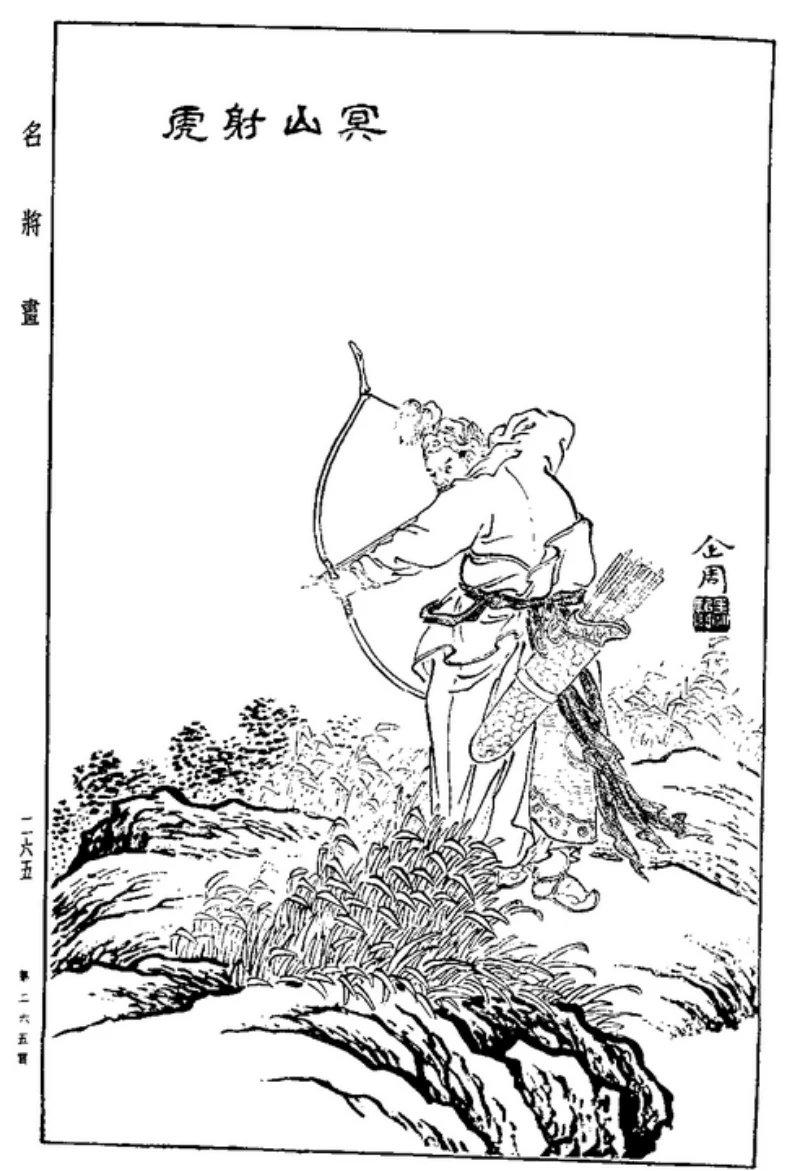
His style emphasized personal courage and rapid judgment. He was exceptionally strong and skilled at mounted archery; later tradition celebrated a story that one of his arrows penetrated a stone. His administration of troops was simple and informal, and he shared hardships with his men, earning great loyalty. Later military writers nevertheless criticized the lack of strict formation and discipline, arguing that his methods were poorly suited to large-scale conventional battle.
Travels and Frontier Geography
Li's military life ranged across the northern frontier of the Western Han. He first fought around Xiaoguan in the area of present-day Guyuan, Ningxia, and later governed Longxi around present-day Lintao, Beidi around Qingyang, Yanmen around Daixian, Dai Commandery around Yuxian in Hebei, and Yunzhong around Togtoh in Inner Mongolia. He later defended Youbeiping around present-day Ningcheng, Inner Mongolia. His career thus covered much of the Han frontier across present-day Gansu, Ningxia, Shaanxi, Shanxi, Hebei, and Inner Mongolia.
Relations with Contemporaries
Li interacted with many major figures of his age. He and Cheng Buzhi were both leading frontier generals but exemplified sharply contrasting styles of military discipline. He served under commanders such as Zhou Yafu and Wei Qing, and his relationship with Wei became controversial after the Battle of Mobei. His son Li Gan also became a prominent officer and in fighting near Youbeiping reportedly led several dozen cavalry directly through enemy ranks. Li's conversation with the diviner Wang Shuo later became a major source for explanations of his failure to receive a marquisate.
Personal Relations
Family
- Ancestor: Li Xin, Qin general
- Great-grandfather: Li Zhongxiang
- Cousin: Li Cai
- Eldest son: Li Danghu
- Second son: Li Jiao
- Youngest son: Li Gan
- Grandsons: Li Ling and Li Yu
Associates
- Cheng Buzhi: colleague and famous general
- Wang Shuo: diviner
Ruler–Subject Relations
- Emperor Wen of Han
- Emperor Jing of Han
- Emperor Wu of Han
- Zhou Yafu, Defender-in-chief
- Wei Qing, General-in-Chief
Conflicts
- Commandant of Baling: later executed by Li in retaliation for a prior humiliation
- Wei Qing: Li resented being denied the vanguard in the Battle of Mobei
Historical Assessment
Han / Contemporary Period
- Emperor Wen lamented that Li had been born in the wrong age and said that under Emperor Gaozu even a fief of ten thousand households would not have been sufficient reward. (Records of the Grand Historian, “Biography of General Li”)
- Gongsun Kunye called Li's talent unmatched but feared his confidence and repeated direct engagements with the enemy would lead to his death. (Records of the Grand Historian)
- Cheng Buzhi said that Li's army was extremely simple and might be unable to prevent sudden enemy attacks, but that his soldiers were relaxed and all willing to die for him. (Records of the Grand Historian)
- Sima Qian praised Li as brave against the enemy, benevolent toward his soldiers, and sparing in orders, so that his men followed him willingly; he also applied the proverb “The peach and plum do not speak, yet a path forms beneath them.”
- Ban Gu described Li as sincere and plain-spoken and noted the widespread grief at his death, while also lamenting the later destruction of the family line.
Tang and Song Periods
- Sima Zhen's commentary praised Li's long arms and archery, his daring tactics, and his frontier service, while lamenting the bad fortune that kept him from receiving a fief.
- Wang Bo's famous line, “Feng Tang grew old too easily; Li Guang found it hard to be enfeoffed,” made Li's failure to receive a marquisate a literary symbol.
- Huang Zhen criticized Li for repeatedly suffering defeat and argued that military reverses frustrated his entire career.
- Sima Guang warned that imitating Cheng Buzhi might bring no victory but would at least avoid destruction, while imitating Li Guang would often end in disaster.
- He Qufei argued that Li wanted every soldier to feel personally at ease, but consequently failed to employ regular military discipline.
- Ye Shi defended Li's exceptional way of using troops and argued that judging him by ordinary regulations was inappropriate.
- Chen Yuanjing praised his martial energy, reconnaissance, archery, courage, and later temple cult as evidence of enduring fame.
Ming and Qing Periods
- Huang Daozhou praised Li's military talent but attributed his failure to gain a fief to the killing of surrendered men and treated his suicide as part of a tragic destiny.
- Wang Fuzhi observed that Li won praise from scholar-officials and deeply moved popular sentiment.
- Li Dongyang turned Li's seventy battles, failure to gain a fief, loss of the road, resentment, and suicide into a poem of frustrated loyalty.
- Xie Jin cited Li, together with Tian Yu, as an example of strong frontier defense against powerful raiders.
Modern Period
Modern scholarship presents multiple views of Li Guang. Traditional narratives emphasize his courage, loyalty, and tragic fate and make him the model of the unlucky general who never obtained a marquisate. Other studies criticize weak discipline and limited ability in large-scale operations, arguing that his reputation rests heavily on individual heroism rather than consistently strong campaign results. The killing of surrendered Qiang and his execution of the commandant of Baling are also cited in ethical criticism. Overall, Li Guang has been repeatedly reconstructed in both literature and historical writing: he is both the legendary “Flying General” and the central figure of the cultural motif that “Li Guang found it hard to be enfeoffed.”
FIGURES ASSOCIATED WITH THIS DYNASTY
Bibliography
- Sima Qian, Records of the Grand Historian, “Biography of General Li”
- Ban Gu, Book of Han, “Biography of Li Guang and Su Jian”