Birth |
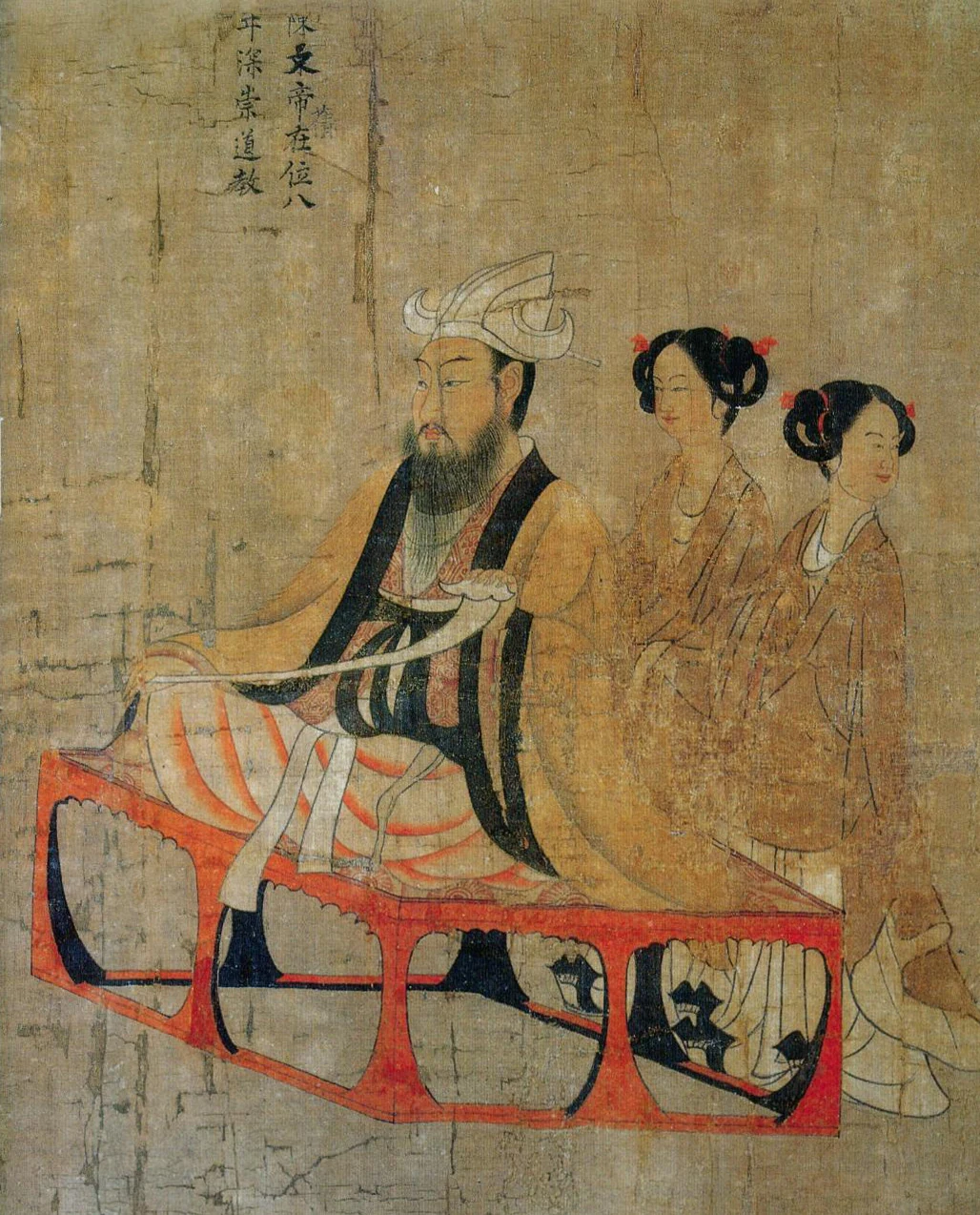
522 CE–566 CE
Second Chen emperorEmperor Wen
Chen Qian
陈蒨
Chen Qian was the son of Chen Daotan and nephew of Chen Baxian, founder of the Chen dynasty. During the wars at the end of the Liang dynasty he was held by Hou Jing. After his release, he fought around Wuxing and Kuaiji and helped defeat Du Kan, Zhang Biao, and other opponents. He was made Prince of Linchuan after the Chen dynasty was established. When Chen Baxian died in 559 (third year of the Chen Yongding era), his son…
522 CE–566 CEChen dynasty
PROFILE
Chen Qian was the son of Chen Daotan and nephew of Chen Baxian, founder of the Chen dynasty. During the wars at the end of the Liang dynasty he was held by Hou Jing. After his release, he fought around Wuxing and Kuaiji and helped defeat Du Kan, Zhang Biao, and other opponents. He was made Prince of Linchuan after the Chen dynasty was established. When Chen Baxian died in 559 (third year of the Chen Yongding era), his son Chen Chang was still held in Northern Zhou, and Hou Andu and other officials supported Chen Qian's accession. During his reign, Chen forces defeated Wang Lin and a Northern Qi-supported army and suppressed Zhou Di, Chen Baoying, and Liu Yi. Chen Qian also sought to improve official conduct, restrain expenditure, and encourage agriculture. He died in 566 (first year of the Chen Tiankang era) and was succeeded by his son Chen Bozong. Historical writers praised his diligence and frugality, while also recording that the authority he gave his brother Chen Xu enabled Chen Xu eventually to displace Chen Bozong.
- Other name and courtesy name
- Tanqian; courtesy name Zihua
- Period
- Chen dynasty
- State
- Chen dynasty of the Southern Dynasties
- Role
- Second Chen emperor, Emperor Wen
- Ancestral home
- Changcheng County, Wuxing Commandery
- Born
- 522
- Died
- May 31, 566 (guiyou day of the fourth lunar month, first year of the Chen Tiankang era)
- Reign
- August 17, 559–May 31, 566
- Predecessor
- Emperor Wu of Chen (Chen Baxian)
- Successor
- Emperor Fei of Chen (Chen Bozong)
- Era names
- Tianjia, Tiankang
- Temple and posthumous names
- Shizu; Emperor Wen
- Tomb
- Yongning Mausoleum; the precise archaeological site is disputed
- Predecessor and successor
- Chen Baxian; Chen Bozong
- Principal activities
- Defeated Wang Lin and other regional rivals, supervised officials, promoted agriculture, and issued five-zhu coins
LIFE TIMELINE
After Hou Jing's defeat |
Appointed General Xinwu |
Defense against Du Kan and pacification of Wuxing |
Founding of Chen |
After Chen Baxian's death |
Defeat of Wang Lin and the Northern Qi relief force |
Zhang Zhaoda's defeat of Zhou Di |
Pacification of Chen Baoying and Liu Yi |
May 31, 566 CE(guiyou day of the fourth lunar month, first year of the Chen Tiankang era) | Death at Jiankang |
BIOGRAPHY
Biography
The last years of Liang
Chen Qian's father, Chen Daotan, died in the Hou Jing rebellion, while his uncle Chen Baxian became a leading commander in the late Liang period. Chen Qian moved to Lin'an for safety and was later detained by Hou Jing. The Book of Chen says he concealed a short knife in hopes of attacking Hou Jing when admitted to see him; he never had that meeting, so no attempt was carried out. After Hou Jing's defeat, Chen Qian joined Chen Baxian, served as administrator of Wuxing, and suppressed Ji Ji, Hao Zhong, and others who had raided the district. He later supervised Southern Xuzhou.
When Chen Baxian turned against Wang Sengbian, Du Kan mobilized troops at Wuxing. Chen Qian was ordered back to Changcheng to establish a fortified camp. With a few hundred men he held out against Du Tai, Du Kan's subordinate, until support arrived. He then joined Zhou Wenyu and forced Du Kan's surrender. Chen Qian also fought Zhang Biao's forces around Kuaiji and became its administrator. Accounts of these campaigns show that he had substantial military and administrative experience before the founding of Chen.
Accession and the defeat of Wang Lin
Chen Baxian founded the Chen dynasty in 557 (first year of the Chen Yongding era), made Chen Qian Prince of Linchuan, and entrusted him with defense and supply. When the founder died in 559 (third year of Yongding), his son Chen Chang remained a hostage in Northern Zhou. With hostile forces still active, the court discussed succession in secret. Lady Zhang Yao'er, Cai Jingli, Hou Andu, and others summoned Chen Qian to Jiankang, where Hou Andu strongly pressed for his accession. Chen Qian then made Shen Miaorong empress and Chen Bozong crown prince. Chen Chang later drowned while crossing the Yangtze on his return. The Book of Chen and related accounts connect the event to Hou Andu; the available evidence does not establish that Chen Qian personally ordered it.
Wang Lin had inherited Liang loyalist forces in the middle Yangtze and allied with Northern Qi against Chen. In 560 (first year of the Chen Tianjia era), Hou Tian and other Chen generals defeated Wang Lin and Northern Qi troops. Wang Lin and the Liang claimant Xiao Zhuang fled north. Chen gained control of Jiang and Ying prefectures and reduced the threat to Jiankang. The emperor directed the court's response; his generals carried out the fighting, and their victories should not be described as battles he personally led.
Consolidation of Jiangnan and final years
Several regional commanders still controlled parts of Jiangnan in the Chen dynasty's early years. Zhou Di, Liu Yi, and Chen Baoying sometimes held court titles but resisted direct control as circumstances changed. Zhang Zhaoda defeated Zhou Di in 563 (fourth year of the Chen Tianjia era), then Chen Baoying and Liu Yi in 564 (fifth year). Zhou Di himself was not killed until 565 (sixth year). Chen Qian used appointments, attempts at accommodation, and military suppression to restore the court's reach over the southern prefectures. Near the end of his life he gave his brother Chen Xu senior offices, including Minister of Works and head of the Secretariat. This left a problem of authority after the young heir succeeded. Chen Qian died at Jiankang in 566 (first year of the Chen Tiankang era). Chen Bozong succeeded him, but Chen Xu later deposed him and took the throne.
Family, Early Years and the Disorders at the End of Liang
Chen Qian, also named Tanqian, styled Zihua, was a son of Chen Daotan, elder brother of Chen Baxian, Emperor Wu of Chen. In youth he was steady, quick and bold, of handsome appearance, well read in the classics and histories, of dignified bearing and observant of propriety, and Chen Baxian was very fond of him, "often praising him as the outstanding man of the family." His father Chen Daotan rose to be general of the Eastern Palace gate; when the rebellion of Hou Jing broke out in 548 he went to the relief (of Jiankang) with two thousand crossbowmen and died of a stray arrow. Most of Chen Qian's fellow townsmen then "trusted to the hills and lakes and plundered and seized," but "Chen Qian alone protected his family from molestation"; as disorder grew he moved (elsewhere). Hou Jing sent men to arrest Chen Qian and Chen Baxian's son, and Chen Qian "hid a sharp blade in his sleeve, meaning to stab Hou Jing when he had audience," and did not act because it was Hou Jing's subordinate who received them; Hou Jing several times meant to kill him, and only when Chen Baxian's army besieged (Jiankang) in 552 and Hou Jing was defeated did Chen Qian escape to Chen Baxian's camp.
He then took part in the settling of Jiangnan at the end of Liang: when the rebel leaders Ji Ji and Hao Zhong of Xuancheng gathered more than a thousand men each to raid the commandery, Chen Qian led troops, put them down and "kept the peace there"; in 553 the Liang court made him general of martial trust and put him in charge (of the commandery); in 554, when Chen Baxian campaigned north (to Guangling), he made Chen Qian commander of the forward army, and "Chen Qian won every battle." In the affair of Chen Baxian's killing of Wang Sengbian, Chen Baxian "first summoned Chen Qian to deliberate with him"; and afterwards, because Du Kan, Wang Sengbian's son-in-law, was strong in troops, Chen Baxian secretly ordered Chen Qian back to Changcheng "to build a stockade against Du Kan." Chen Qian raised only a few hundred men with little equipment, and Du Kan sent his officer Du Tai with five thousand picked troops to fall on him by surprise: "the officers and men looked at one another and turned pale, but Chen Qian jested and laughed as ever and disposed his men the more clearly, so that their hearts were steadied." Du Tai, learning how few were in the stockade, attacked day and night, and Chen Qian encouraged his men and went into the line himself, "holding out for several tens of days until Du Tai's troops withdrew." When Chen Baxian sent (Zhou Wenyu), he joined him in marching on Wuxing; (Du Kan) being strong in numbers and holding the roads with ships and foot in linked formation, Chen Qian sent (Liu Cheng and Jiang Yuanju) against him, and Du Kan's army was heavily beaten and, with no way out, surrendered. He then made a forced march with (Zhou Wenyu) against Zhang Biao, whose officer opened the gate to Chen Qian, who "took over all Zhang Biao's private troops and property"; Zhang Biao came to the rescue, was beaten and fled, and the villagers of Ruoye killed him and sent his head. For this merit Chen Qian was made commissioner with the staff of authority, commander of the military affairs of ten commanderies including Kuaiji, general of spreading righteousness and governor of Kuaiji. The region (of Kuaiji) being wild mountains with no allegiance to the southern court and raiding from time to time, Chen Qian sent out his troops in divisions and "pacified all the divisions of the Shan Yue," whence "his fame and name for virtue greatly spread."
Accession and the Suppression of Wang Lin
In 557, when Chen Baxian usurped the throne and founded Chen, Chen Qian was made prince of Linchuan with two thousand households, attendant of the palace and general of the east; and when the governor of Guangzhou (Xiao Bo) was defeated at Dunkou, Emperor Wu summoned Chen Qian to the capital to guard him, "the storing of the army and all matters of alert being given into his charge," and soon after ordered him to lead troops to Nanwan to build and hold a fort. On the bingwu day of the sixth month of 559 (9 August) Emperor Wu died, and the crown prince Chen Chang being then a hostage in Northern Zhou, "with strong enemies pressing without and no great minister to assist within," the empress dowager (Zhang Yao'er) and (Hou Andu) and others agreed to keep the death secret and "urgently summon the prince of Linchuan into the palace to succeed." On the twenty-ninth of the sixth month Chen Qian returned from Nanwan; once in the palace he several times declined the throne, and the empress dowager, for the sake of her son Chen Chang, would not give the order, so that the ministers hesitated. Then (Hou Andu) said: "The empire is not yet settled, and there is no time to hesitate; the prince of Linchuan has merit for the altars of state, and we should all raise him to the throne," and taking his sword he went up to the hall and asked the empress dowager for the seal; Chen Qian then took the throne that day in the Taiji front hall as Emperor Wen of Chen. On the first day of the seventh month he honoured the empress dowager Zhang Yao'er as grand empress dowager with the palace called Cixun; on the fourth he promoted (Hou Tian) general of the southern expedition and made (Chen Xiuxian) prince of Shixing; and on the seventh of the ninth month he made the crown prince (Chen Bozong) heir apparent, with silk given to officials of every rank in due degrees.
The most urgent business after his accession was the suppression of Wang Lin and resistance to Northern Qi. At the end of Liang and the beginning of Chen "the south was in great disorder, local strongmen rising on every side, seizing prefectures and commanderies and refusing the court's orders," a serious threat to Chen's rule in Jiangnan. In the second month of 560 Ji Ji, governor of Gaozhou, revolted in his camp and went over (to Northern Qi); the Chen armies heavily defeated Wang Lin at Liangshan and beat the invading (Qi) troops at Bowang, "taking the Qi general Liu Boqiu alive and seizing all the Qi ships and stores, with tens of thousands of enemy soldiers captured"; because of this victory the governor of Yingzhou under Xiao Zhuang came over with his prefecture in the third month. The Qi troops holding Lushan city "abandoned it and fled, pressed by the Chen army's prestige and the difficulty of holding it," and Emperor Wen ordered the governor of Southern Yuzhou (Cheng Lingxi) to take it over. In the first month of 561 Pei Jinghui, governor of Hezhou, deserted to Northern Qi; in the same month the commander of Xiangzhou city of Northern Zhou surrendered and Xiangzhou was pacified; and in the fourth month the commanderies of Wuling, Tianmen, Nanping, Yiyang, Hedong and Yidu were all pacified by Emperor Wen.
Major Activities
Officials and expenditure
The Book of Chen depicts Chen Qian as attentive to decisions, rigorous in checking officials' reports, and frugal in state spending. He issued orders against luxury and in favor of wheat cultivation and other agricultural work, seeking to rebuild production and order after the destruction of the Hou Jing rebellion. “Tianjia governance” is a later description of his reign; it does not prove that living standards improved uniformly throughout every district.
Warfare and currency
The defeat of Wang Lin helped secure Jiankang and the middle Yangtze. Subsequent campaigns against Zhou Di, Chen Baoying, and Liu Yi extended the court's effective reach. In 564 (fifth year of the Chen Tianjia era), Chen Qian issued five-zhu coins in response to monetary disorder inherited from the late Liang and early Chen periods. The sources do not establish a precise measure of the policy's long-term success. Conflict with Northern Qi and Northern Zhou continued, and temporary victories did not remove the northern threat.
Administration, Frugality and the Recovery of Jiangnan
The keynote of Chen Qian's reign may be summed up as "straightening the administration and keeping to frugality": in politics he "straightened the administration and distinguished true from false, strictly forbade officials to practise cunning and deceit, and took the lead in practising frugal government," issuing practical edicts (on farming and tax relief) to lighten the people's burdens; in the economy he "valued the restoration of production, encouraging farming and silk and repairing waterworks," applying corresponding measures of taxation and relief; and in war he resisted the inroads of Northern Zhou and Northern Qi, steadying (the new state of Chen). Later ages therefore hold him "a rare wise ruler among the emperors of the Southern Dynasties," whose merit lay precisely in that "having risen from common cloth he well understood the people's hardships and kept the state's expenditure frugal."
These judgments are inseparable from the situation he faced. Jiangnan since the end of Liang was at once wasted by Hou Jing's rebellion and divided by local strongmen "who rose on every side, seized the prefectures and refused the court's orders," with the pressure of Northern Qi and Northern Zhou and the opposition of Wang Lin, Xiao Zhuang and other remnants besides; his reign was an integration carried on under these three pressures — within, gathering men's hearts and restoring farming and waterworks through administration and frugality; without, using both force and conciliation to bring Kuaiji, Xiangzhou, Wuling, Tianmen, Nanping and Yidu step by step under the court's direct rule. His "fame and name for virtue" first came of pacifying the Shan Yue and the rebels of Xuancheng, and this combination — settling disorder by arms and nourishing the people by frugality — is a mode of government rarely seen among the emperors of the Southern Dynasties.
Personal Relations
- Chen Daotan and Chen Baxian: His father and uncle. Chen Daotan died during the Hou Jing rebellion; Chen Baxian founded the Chen dynasty, and Chen Qian succeeded him.
- Chen Xu: His younger brother. Chen Qian gave him extensive authority; Chen Xu later deposed Chen Bozong.
- Shen Miaorong and Chen Bozong: His empress and eldest son. Chen Bozong was the dynasty's third ruler.
- Chen Chang and Hou Andu: Chen Chang was Chen Baxian's son and a former hostage in Northern Zhou. Hou Andu supported Chen Qian's accession and was connected in historical accounts with Chen Chang's drowning.
- Hou Tian and Zhang Zhaoda: Chen generals. Hou Tian defeated Wang Lin; Zhang Zhaoda campaigned against Zhou Di, Chen Baoying, and others.
- Wang Lin, Zhou Di, Chen Baoying, and Liu Yi: Rivals who contested the court's control of various regions.
Historical Assessment
In the Book of Chen, Yao Silian praised Chen Qian as a ruler who had experienced hardship and understood the difficulties of ordinary people, particularly noting his diligence and restraint in expenditure. Wei Zheng credited him with combining civil and military measures while acknowledging that the benefits of his government did not reach everywhere. These are attributed judgments, consistent with the court's military consolidation and attempts at economic recovery but not proof of general peace. The succession was a weakness of his reign: Chen Xu gained the power to supplant Chen Bozong after Chen Qian's death. Later novels and plays about Han Zigao cannot be used as certain evidence for Chen Qian's political life.
FIGURES ASSOCIATED WITH THIS DYNASTY
Bibliography
Bibliographic information is not yet available for this entry.