Middle age | Followed Li Keyong in suppressing Wang Xingyu, Military Commissioner of Binning; promoted for merit to deputy of the inner headquarters and acting Left Vice Director.
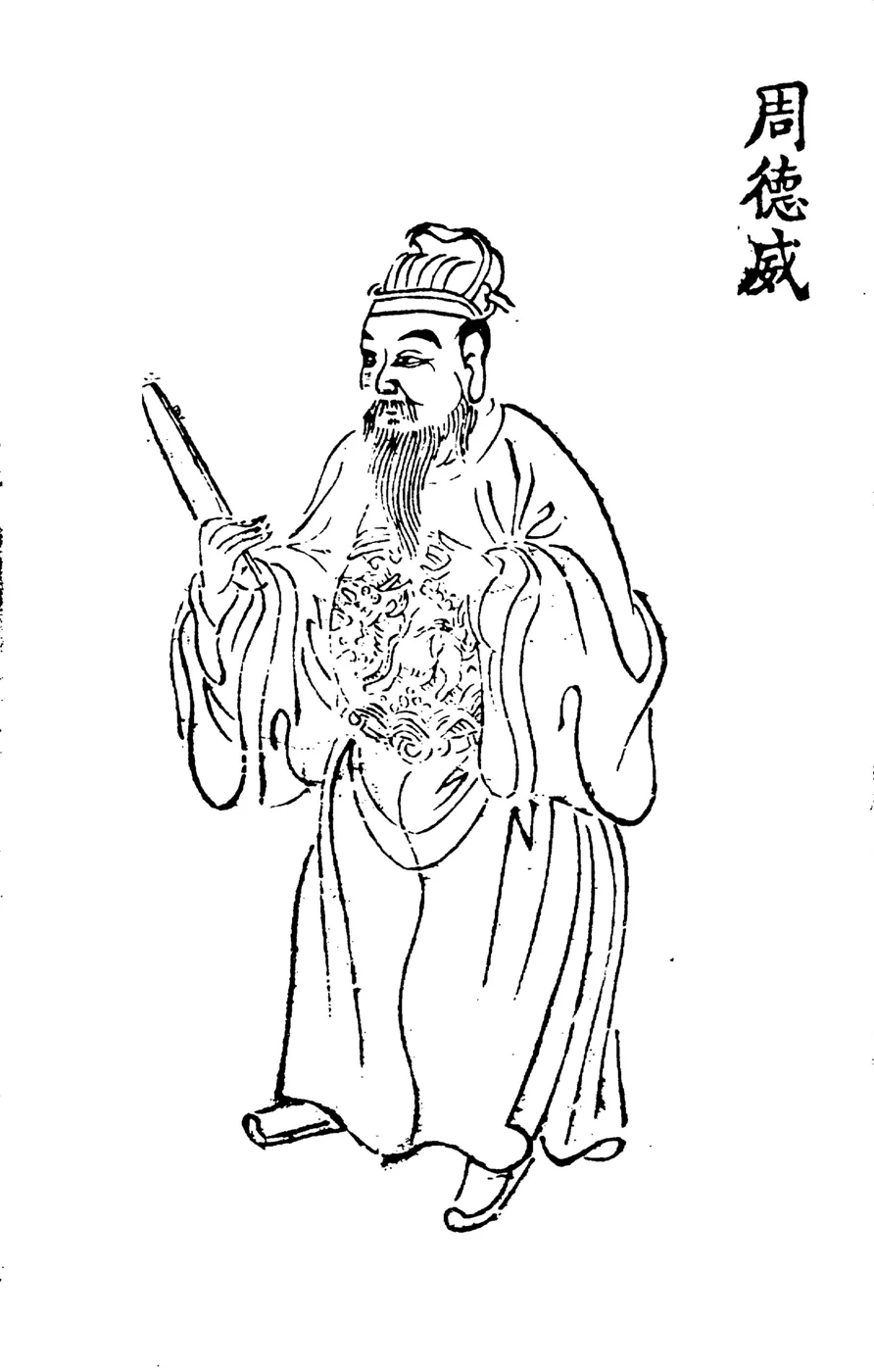
?–918 CE
General
Zhou Dewei
周德威
Zhou Dewei (d. 918), courtesy name Zhenyuan and childhood name Yangwu, was a native of Mayi in Shuo Prefecture, present-day Shuozhou, Shanxi. He was a famous general of the Five Dynasties and Later Tang. He first served Li Keyong, Military Commissioner of Hedong, as a cavalry officer in the personal retinue. Renowned for courage, horsemanship, archery, and exceptional judgment, he spent years garrisoning Yunzhong and became…
?–918 CELater Tang
PROFILE
Zhou Dewei (d. 918), courtesy name Zhenyuan and childhood name Yangwu, was a native of Mayi in Shuo Prefecture, present-day Shuozhou, Shanxi. He was a famous general of the Five Dynasties and Later Tang. He first served Li Keyong, Military Commissioner of Hedong, as a cavalry officer in the personal retinue. Renowned for courage, horsemanship, archery, and exceptional judgment, he spent years garrisoning Yunzhong and became deeply familiar with frontier warfare; tradition held that he could estimate enemy strength simply by observing dust and smoke. He served both Li Keyong and Li Cunxu and rose to commander-in-chief of the mixed tribal and Han horse and foot forces, Military Commissioner of Zhenwu, and Military Commissioner of Lulong, with the honorific rank Tong Zhongshu Menxia Pingzhangshi. Zhou Dewei participated in nearly all the major campaigns of the Liang-Jin rivalry, most famously the Battle of Baixiang and the conquest of Yan at Youzhou, and was regarded as the foremost general of the Jin state, predecessor of Later Tang. In 918, at the Battle of Huliupo, he disagreed with Li Cunxu's strategy but was compelled to fight and was killed together with a son. He was posthumously made Prince of Yan.
- Courtesy name
- Zhenyuan
- Period
- Five Dynasties · Later Tang
- Date of Birth
- Not recorded in historical sources
- Date of Death
- 918
- Dynasty/Polity
- Five Dynasties · Later Tang
- Identity
- General
- Ethnicity/People
- Not recorded in historical sources
- Native place
- Mayi, Shuo Prefecture (present-day Shuozhou, Shanxi)
- Place of birth
- Not recorded in historical sources
- Major achievements
- Foremost general of the Jin armies; a veteran subordinate of Li Keyong, known as “Flying Tiger”; killed at the Battle of Huliupo
LIFE TIMELINE
Middle age | Routed Bian forces at Dongwo Station, defeated Shi Shuqong, pursued them to Shizeng Pass, and killed more than one thousand.
Middle age | Led five thousand cavalry to aid Liu Rengong at Youzhou; joined Liu Shouguang and defeated twenty thousand Bian troops at Wangdu.
Middle age | With Li Sizhao pursued retreating Bian forces and inflicted massive losses; later passed Yindi Pass and took Ci and Xi prefectures.
Middle age | With Li Sizhao attacked Jinzhou and Jiangzhou but was defeated at Pu County by Zhu Youning and Shi Shuqong; later led picked troops out of several gates to attack the Bian camp and forced a withdrawal.
Later life | Joined Li Sizhao and Yan troops in attacking Luzhou; after Ding Hui surrendered, received added ranks as acting Grand Protector and prefect of Daizhou and replaced Li Sizhao as commander of the tribal and Han forces.
Later life | Relieved Luzhou and confronted Later Liang for more than a year, repeatedly attacking the encircling fortifications and capturing Liang champions Huangjiaoying and Fanggulun.
Later life | After Li Keyong's death, rode alone into Jinyang to mourn and stabilize the succession; joined Li Cunxu's ambush at Sanchegang, defeated the Liang army, lifted the siege of Luzhou, and was made Military Commissioner of Zhenwu and Participant in Determining Government Matters, later commander-in-chief of the tribal and Han horse and foot forces.
Later life | During the Baixiang campaign, strongly urged Li Cunxu to withdraw to Gaoyi, lure the enemy out of camp, and await its exhaustion.
Later life | On the second day of the first month, crushed Wang Jingren's army of eighty thousand at Baixiang; in the twelfth month led thirty thousand infantry and cavalry through Feihu Pass against Liu Shouguang of Yan.
Later life | Took Zhuozhou and captured the Yan champion Shan Tinggui at Longtou Ridge, taking three thousand heads.
Later life | Destroyed Yan and captured Liu Shouguang; appointed acting Palace Attendant and Military Commissioner of Lulong.
Later life | Defended Youzhou for more than two hundred days against a Khitan army said to number three hundred thousand.
Later life | At Huliupo, forced into battle despite strategic disagreement with Li Cunxu; killed with his eldest son and posthumously made Prince of Yan.
BIOGRAPHY
Biography
Family Background and Early Life
Zhou Dewei's birth year is unknown. He came from Mayi in Shuo Prefecture, beyond the Yanmen passes, a region where agrarian and pastoral worlds met and martial traditions were strong. He came from a military background. The earliest record places him as a cavalry officer under Li Keyong, probably commanding about a hundred horsemen. He was especially skilled at mounted archery and was reputed to possess unusual courage and judgment. Because he spent long periods garrisoning Yunzhong, present-day Datong, he knew frontier conditions intimately and was said to estimate an enemy's numbers by looking at dust and smoke.
Early Liang-Jin Rivalry, 895–906
In 895 Li Maozhen of Fengxiang, Wang Xingyu of Binzhou, and Han Jian of Huazhou joined forces against the Tang court and killed a chancellor. Li Keyong marched west from Jinyang with tribal and Han forces. Zhou Dewei, then commander of the Tielin unit, distinguished himself and was promoted to deputy of the inner headquarters with the acting rank of Left Vice Director. This is his earliest recorded campaign.
In 899 the Bian general Shi Shuqong took Liaozhou and advanced toward Yuci. Zhou Dewei met him at Dongwo Station and routed his army. Shi abandoned his camp, and Zhou pursued through Shizeng Pass, killing more than a thousand. Zhu Wen came to fear Zhou's ability and reportedly announced that anyone who captured “Zhou Yangwu” alive would be made a prefect. The Liang champion Chen Zhang, nicknamed “Chen Yacha,” volunteered. In battle Zhou feigned weakness, evaded Chen's spear at close range, struck him from his horse with an iron weapon, and captured him alive, an episode that became famous in both armies.
In 900, when Liu Rengong of Youzhou was besieged, Li Keyong sent Zhou Dewei with five thousand cavalry. Joining Liu's son Liu Shouguang, Zhou defeated twenty thousand Bian troops at Wangdu. In 901, as a six-pronged Bian offensive against Jin withdrew after disease and failure before Jinyang, Zhou and Li Sizhao pursued with five thousand elite cavalry and inflicted very heavy losses. That summer they crossed Yindi Pass into the Hezhong region and took Ci and Xi prefectures.
In 902 Zhou and Li Sizhao attacked Jinzhou and Jiangzhou but were defeated at Pu County by a large Bian army under Zhu Youning and Shi Shuqong, losing much of their equipment and baggage. The enemy then advanced toward Jinyang. With the Jin main force still dispersed and the city in alarm, Zhou and Li Sizhao selected elite soldiers and attacked the Bian camps simultaneously from several gates, forcing the enemy to retreat. The episode showed Zhou's ability to restore morale and turn defense into attack.
In 906 Zhu Wen attacked Cangzhou in person. Liu Rengong again requested aid, and Li Keyong sent Zhou Dewei and Li Sizhao with Yan troops against Zhaoyi in order to draw the Liang army away. Ding Hui, Military Commissioner of Zhaoyi, surrendered in the twelfth month, placing the region under Jin control and compelling Zhu Wen to abandon Cangzhou. Zhou received the acting rank of Grand Protector, the post of prefect of Daizhou, and command of the tribal and Han forces.
The Siege of Luzhou and the Li Cunxu Era, 907–910
After Zhu Wen founded Later Liang in 907, Liang general Li Sian besieged Luzhou with a large army and built an enclosing fortified line. Li Sizhao held the city. Zhou Dewei led relief forces, using elite cavalry to disrupt Liang supply routes and repeatedly damage the encircling works. Fighting continued for more than a year. He captured prominent Liang fighters Huangjiaoying and Fanggulun but could not fully lift the siege.
In the first month of 908 Li Keyong became gravely ill and died. Li Cunxu succeeded him and ordered Zhou to return. Because Zhou commanded a large field army and the new ruler's position was not yet secure, rumors spread in Taiyuan that Zhou might act independently. When he reached Jinyang in the fourth month, he left his troops outside the city and entered alone to mourn. He wept before Li Keyong's coffin and then respectfully paid homage to Li Cunxu, dispelling doubts and helping stabilize the succession.
In the fifth month Li Cunxu personally moved to relieve Luzhou. Jin forces hid below Sanchegang and, under cover of morning mist, struck the Liang fortifications by surprise. The Liang army collapsed and the siege was lifted. Zhou was made Military Commissioner of Zhenwu, received the acting rank Grand Protector and the honorific Participant in Determining Government Matters, and later became commander-in-chief of the tribal and Han horse and foot forces, the highest field command of Jin.
The Battle of Baixiang, 910–911
In the eleventh month of 910, Liang general Wang Jingren led eighty thousand troops against Chengde and camped at Baixiang. Wang Rong of Chengde asked Li Cunxu for aid. Li first ordered Zhou Dewei to Zhao Prefecture and then personally joined him. The armies approached the Ye River north of Baixiang.
Liang general Han Qing led thirty thousand elite troops whose armor was decorated with fine silk, gold, and silver. Jin troops were intimidated by their appearance. Zhou told his men that these were merely the Tianwu troops of Liang, many drawn from butchers, tavern workers, and merchants: despite their splendid armor, ten of them were not worth one Jin soldier. He personally attacked both wings with elite cavalry, repeatedly penetrated the formation, captured more than a hundred men, and forced the Liang troops back across the river.
Li Cunxu wanted an immediate battle because the Jin army had come from afar. Zhou strongly disagreed. Chengde troops, he argued, were better at defending walls than fighting in the open, while Jin's advantage lay in cavalry. He urged withdrawal to Gaoyi, raids on enemy provisions, and battle only after the enemy tired. Li Cunxu was displeased, but Zhou persuaded the army supervisor Zhang Chengye, who repeated the advice. A Liang deserter then confirmed that Wang Jingren was secretly building a floating bridge, and Li Cunxu adopted Zhou's plan.
On the second day of the first month of 911, Zhou sent three hundred cavalry to challenge the Liang camp. Wang Jingren deployed the whole army, and Zhou fought while retreating, drawing it south of Gaoyi. Li Cunxu again wanted to attack immediately, but Zhou advised waiting until evening, when the lightly supplied Liang soldiers and horses would be hungry and exhausted. By dusk their formation began to weaken. Zhou shouted that the Bian army was fleeing and ordered a full assault. Li Cunxu also charged, and the Liang force of eighty thousand was nearly annihilated; Wang Jingren and Li Sian barely escaped and 280 officers were captured. Baixiang became a turning point in the Liang-Jin struggle and gave Jin the strategic initiative in Hebei.
Conquest of Yan and Defense of Youzhou, 911–917
In the eighth month of 911 Liu Shouguang proclaimed himself emperor in Youzhou and founded Yan. In the twelfth month Zhou led thirty thousand infantry and cavalry through Feihu Pass, joining Chengde and Yiwu forces. In 912 he took Zhuozhou and besieged Youzhou. Yan champion Shan Tinggui led ten thousand armored troops out to fight and boasted that he would capture “Zhou Yangwu.” During the battle Shan pursued Zhou closely with a spear, but Zhou evaded it and knocked him from his horse, capturing him alive. Yan morale collapsed; Zhou pursued and took three thousand heads and fifty-two officers including Li Shanhai.
In 913 Zhou successively took Shunzhou, Anyuan Army, Tanzhou, Lutai Army, Gubeikou, Juyong Pass, and other Yan strongpoints. Youzhou fell in the eleventh month; Liu Shouguang fled but was captured, and Yan was destroyed. Zhou received the acting rank of Palace Attendant and the Military Commissionership of Lulong, remaining at Youzhou.
In 917 a Khitan army said to number three hundred thousand besieged Youzhou. Zhou led soldiers and civilians in a defense lasting more than two hundred days, and the Khitan finally withdrew. The defense demonstrated his ability in siege warfare, though it also kept him away from Li Cunxu's main campaigns farther south.
Battle of Huliupo and Death, 918
In 918 Li Cunxu launched a major southern offensive and called Zhou's Youzhou army south to join him. In the eighth month the Jin and Liang armies met at Huliupo, west of present-day Puyang, Henan. Zhou advised exploiting Jin's cavalry advantage by waiting until the Liang army was tired. Li Cunxu, eager for victory, ignored him and attacked. Zhou was compelled to enter the battle. The Jin army won initially but then suffered a reversal, and Zhou and his eldest son were killed. Li Cunxu reportedly wept bitterly and later posthumously made him Prince of Yan.
Major Activities
Military Contributions
Zhou Dewei was one of the most accomplished generals of the early Five Dynasties, particularly noted for cavalry operations and battlefield judgment. Having spent many years on the frontier, he was said to be able to estimate the size of an enemy force simply by observing its dust and smoke. At Luzhou he used mobile cavalry tactics to disrupt Liang supply lines and the fortified camps, contending for more than a year with an enemy force said to be ten times larger. At Baixiang he advocated resting his own troops, drawing the enemy forward, and then striking; the campaign ended with the near destruction of the Liang army's main force of 80,000 men. In the Yan campaign he captured Shan Tinggui, described as Yan's foremost valiant general, and broke enemy morale. Before the Battle of Huliupo he again assessed the situation accurately and offered advice that was not adopted, further illustrating his strategic judgment.
Political Character
Zhou Dewei's loyalty stood out among Five Dynasties military commanders. When Li Keyong died in 908 and Li Cunxu's position was uncertain, Zhou deliberately left his army outside Jinyang and entered alone to mourn, dispelling fears that he might use his forces for himself. At Baixiang, when Li Cunxu rejected his proposal, he used Zhang Chengye to transmit the advice rather than challenging the ruler openly, balancing strategic persistence with preservation of the ruler-subordinate relationship.
Travels and Campaign Geography
Zhou's campaigns covered present-day Shanxi, Hebei, Henan, Beijing, and Tianjin. He garrisoned Yunzhong, campaigned in Guanzhong against Wang Xingyu, aided Youzhou in Hebei, moved through the Hezhong region, and fought at Luzhou, Baixiang, and Youzhou. His career closely tracked the entire course of the Liang-Jin rivalry.
Relations with Contemporaries
Zhou Dewei repeatedly fought alongside Li Sizhao from at least 901 onward, including pursuit of Bian troops, operations in Ci and Xi prefectures, the fighting at Pu County, the defense of Jinyang, and the campaign for Luzhou. He also worked well with army supervisor Zhang Chengye, whose intervention helped persuade Li Cunxu to accept Zhou's plan at Baixiang. His relationship with Li Cunxu was more complicated: he was deeply trusted but sometimes disagreed on strategy, and the disagreement at Huliupo preceded his death.
Personal Relations
- Eldest son Zhou Guangfu: killed with Zhou Dewei at Huliupo
- Son Zhou [name unknown]: killed with his father and elder brother
- Son Zhou Guangzhen: served as prefect of Yi and Qian prefectures and later as a general of the palace guards
- Son Zhou Guangxun: prefect of Cai Prefecture
- Son Zhou Guangzan: marching army marshal of Qingzhou, later demoted to marshal of Shangzhou
- Li Keyong: Zhou Dewei first served him as a cavalry officer and rose to commander of the tribal and Han forces
- Li Cunxu: Li Keyong's son; Zhou helped stabilize his succession and campaigned for him, but died after strategic disagreement at Huliupo
- Li Sizhao: long-time comrade-in-arms and partner in the relief of Luzhou
- Zhang Chengye: Jin army supervisor who helped convey Zhou's plan at Baixiang
- Shi Jantang: joined Li Cunxu in the attack on Liang at Baixiang
- Zhu Wen (Zhu Quanzhong): founder of Later Liang, who once offered a prefecture to anyone who captured Zhou Dewei alive
- Shi Shuqong: Liang general who fought Zhou repeatedly
- Wang Jingren: Liang general defeated at Baixiang
- Shan Tinggui: Yan general captured by Zhou
- Liu Shouguang: emperor of Yan, whose state Zhou helped destroy
Historical Assessment
Five Dynasties and Contemporary Period
- The Old History of the Five Dynasties says Zhou, though rising from the army, treated soldiers well and shared hardship with them, thereby winning their willingness to die for him; it also praises his consistent loyalty to Li Keyong and Li Cunxu.
- After Zhou's death Li Cunxu was said to have cried that he had lost a fine general and his right arm.
- Zhu Wen's offer of a prefecture to whoever captured “Zhou Yangwu” alive reflected the fear Zhou inspired in Later Liang.
Song and Yuan Periods
- Xue Juzheng's Old History of the Five Dynasties gives Zhou a full biography and calls him a famous Jin general.
- Ouyang Xiu's New History of the Five Dynasties describes him as skilled in warfare and full of plans and emphasizes his advice at Baixiang as central to victory.
- Sima Guang's Comprehensive Mirror in Aid of Governance gives extensive detail on his campaigns and treats his military ability favorably while also analyzing the failure at Huliupo.
Ming and Qing Periods
- Wang Fuzhi argued in Du Tongjian lun that Zhou's death was a major loss to Jin and that its cavalry never recovered the same strength.
- Ming and Qing historians often paired Zhou Dewei with Li Sizhao as the two most capable generals under Li Keyong and Li Cunxu.
Modern Period
- Cai Dongfan's Historical Romance of the Five Dynasties portrays Zhou as both loyal and courageous and calls him a foremost good general of the age.
- Modern military historians often emphasize his cavalry tactics and battlefield judgment and regard him as a representative cavalry commander of the Five Dynasties.
- Lü Simian's History of the Sui, Tang, and Five Dynasties praises his military skill, ability to win soldiers' loyalty, and capacity to defeat larger forces.
FIGURES ASSOCIATED WITH THIS DYNASTY
Bibliography
- Xue Juzheng, Old History of the Five Dynasties, juan 56, “Biography of Zhou Dewei”
- Ouyang Xiu, New History of the Five Dynasties, juan 25, “Biographies of Tang Ministers XIII”
- Lü Simian, History of the Sui, Tang, and Five Dynasties