Age one | Born into an official family in Qujiang, Shaozhou
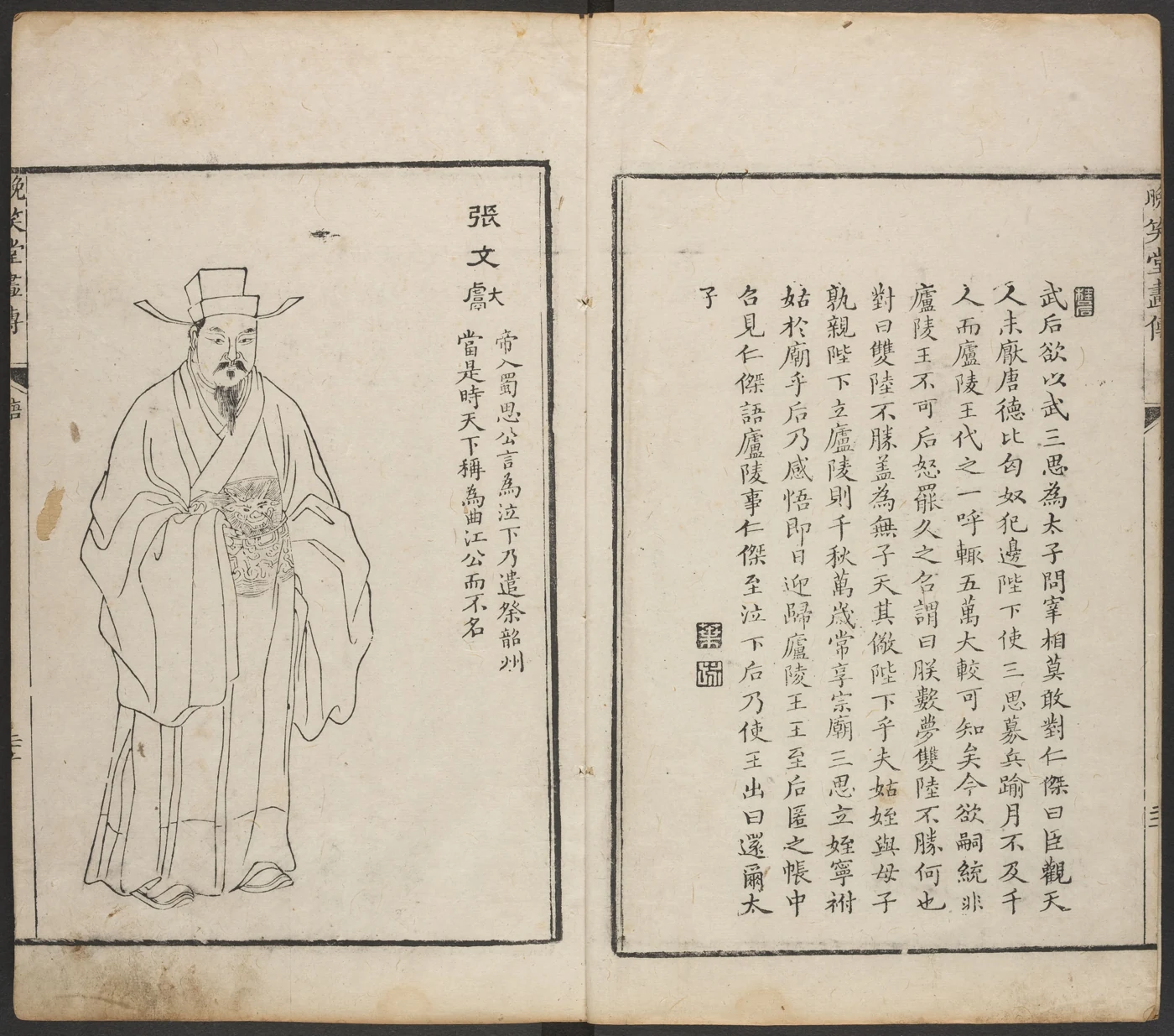
678 CE–740 CE
Tang chancellorpoet
Zhang Jiuling
张九龄
Zhang Jiuling was a prominent chancellor of the late Kaiyuan era. He was celebrated for a clear, restrained poetic style and was the author of the Qujiang Ji. After he was removed from the chancellorship, Li Linfu came to dominate government.
678 CE–740 CETang Dynasty
PROFILE
Zhang Jiuling was a prominent chancellor of the late Kaiyuan era. He was celebrated for a clear, restrained poetic style and was the author of the Qujiang Ji. After he was removed from the chancellorship, Li Linfu came to dominate government.
- Alternative name
- Lord Qujiang
- Courtesy name
- Zishou
- Period
- Tang
- Date of Birth
- 678
- Date of Death
- June 5 740
- Dynasty / regime
- Tang
- Identity
- Tang chancellor, poet
- Ethnicity / affiliation
- Not recorded in historical sources
- Native place
- Qujiang, Shaozhou (northwest of present-day Qujiang, Guangdong)
- Place of birth
- Not recorded in historical sources
- Place of death
- Not recorded in historical sources
- Highest office
- See Biography and Major Deeds
- Major achievements
- Prominent chancellor in the late Kaiyuan era; celebrated for a clear and restrained poetic style; author of the Qujiang Ji; after his removal from the chancellorship, Li Linfu gained control
LIFE TIMELINE
Age twenty-four | Passed the jinshi examination and was appointed Proofreader in the Palace Library
Age twenty-five | Zhang Shuo passed through Shaozhou while exiled to Lingnan, admired Zhang Jiuling's writing, and established a clan relationship with him according to seniority
Age twenty-nine | Passed the special examination for talent capable of governing the state and was appointed Proofreader in the Palace Library
Age thirty-four | Sat the special examination on statecraft comparable to Yi Yin and Lü Shang, received a superior rating, and was promoted to Right Reminder
Age thirty-eight | Resigned at the end of his term to return home and care for his family; supervised construction of a road across Dayu Ridge
Age forty | Recalled to the capital, appointed Left Remonstrator, and participated in personnel selection for the Ministry of Personnel
Age forty-five | Appointed Drafter in the Secretariat
Age forty-seven | Implicated after Zhang Shuo lost the chancellorship; sent out as Governor of Jizhou and later transferred to Area Commander of Hongzhou
Age fifty-two | Transferred to Governor of Guizhou and Investigating Commissioner of the Lingnan Circuit
Age fifty-three | Recalled to the capital and promoted to Vice Director of the Palace Library and Academician of the Academy of Scholarly Worthies
Age fifty-five | Appointed Vice Director of the Secretariat with the designation Tong Zhongshu Menxia Pingzhangshi, becoming chancellor
Age fifty-six | Promoted to Secretariat Director and concurrently charged with compiling the national history
Age fifty-eight | Removed from participation in government and transferred to the largely honorific post of Right Chancellor
Age fifty-nine | Demoted to Chief Clerk of the Grand Commander Area Office at Jingzhou
Age sixty-three by traditional reckoning | Died of illness at Qujiang on the seventh day of the fifth lunar month; posthumously granted Grand Commander of Jingzhou and given the posthumous name Wenxian
BIOGRAPHY
Biography
Family Background and Early Life
Zhang Jiuling was said to be a descendant of Zhang Liang, Marquis of Liu, of the Western Han and a fourteenth-generation descendant of Zhang Hua, Duke Zhuangwu of the Western Jin. His family was originally from Hebei. His great-grandfather Zhang Junzheng served as Assistant Administrator of Shaozhou and died in office, after which the family settled at Qujiang. His grandfather Zhang Zizhou was a recording officer in Douzhou, while his father Zhang Hongyu served as assistant magistrate of Suolu County in Xinzhou and, after Zhang Jiuling became prominent, received posthumous honors including Minister of the Court of Imperial Sacrifices and Area Commander of Guangzhou.
Zhang Jiuling was intelligent from childhood. He was already able to compose prose at seven and wrote accomplished essays by thirteen. At that time Wang Fangqing, Area Commander of Guangzhou, passed through Shaozhou, read his writings, and praised them highly, saying, “This boy will certainly go far.” The source text presents Wang Fangqing's recognition as an important encouragement to the young Zhang Jiuling.
Examination Success and Entry into Court
In 702, the second year of the Chang'an era under Wu Zetian, Zhang Jiuling passed the jinshi examination and was appointed Proofreader in the Palace Library. In 703, Zhang Shuo, then a chancellor, was exiled to Lingnan after offending Wu Zetian's favorite Zhang Changzong through outspoken criticism. Passing through Shaozhou, Zhang Shuo read Zhang Jiuling's writing and praised it as resembling “light silk and fine white cloth” and as suitable for practical service to the age. Zhang Shuo was one of the leading literary figures of the time, and his encouragement strongly influenced Zhang Jiuling at the beginning of his career.
In 707, the third year of Shenlong, Zhang Jiuling traveled to the capital and passed a special examination for talent capable of governing the state, after which he again received appointment as Proofreader in the Palace Library. He remained without significant promotion for several years and began considering a return home. In 712, the first year of Xiantian, Emperor Xuanzong, while still in the Eastern Palace, gathered literary talents from across the realm and personally examined them. Zhang Jiuling sat the special examination on statecraft comparable to Yi Yin and Lü Shang, received a superior rating, and was promoted to Right Reminder. After Xuanzong took the throne, he was transferred to Left Reminder.
As a remonstrance official, Zhang Jiuling memorialized Emperor Xuanzong that local appointments should receive greater attention, that the preference for central over provincial office should be corrected, and that ability rather than simple seniority should govern selection. He also came into disagreement with Chancellor Yao Chong and sent him a warning to “keep flatterers and the impetuous at a distance and advance the pure and steady.” Yao Chong replied favorably. In the autumn of 716, the fourth year of Kaiyuan, however, Zhang Jiuling's direct memorials and lack of harmony with the chief minister caused Yao Chong displeasure. Zhang therefore resigned when his term expired and returned home to care for his family.
Construction of the Dayu Ridge Road and Return to Office
After returning to Lingnan, Zhang Jiuling saw the difficulty local people faced when crossing the Nanling Mountains and decided to open a better route through them to improve north-south transportation. He memorialized Emperor Xuanzong proposing that a road be cut through the mountains, and the proposal was approved. Zhang personally took charge of the project, recruited labor during the agricultural slack season, surveyed the route on site, climbed steep paths, cleared dense vegetation, and directed construction without avoiding hardship.
After completion, the old route extended for more than ten kilometers and was nearly seventeen meters wide, with pine trees planted along both sides. The Meiguan road became a major corridor connecting north and south and was later described in the source text as an “ancient Beijing–Guangzhou route.”
In the spring of 718, the sixth year of Kaiyuan, Zhang Jiuling was recalled to the capital and, in recognition of the Dayu Ridge road project, appointed Left Remonstrator. He participated in the Ministry of Personnel's selection of officials. Together with Right Reminder Zhao Dongxi, he was ordered on four occasions to evaluate official performance and was regarded as fair and convincing. In the seventh year of Kaiyuan he became Vice Director of the Ministry of Rites, and in the eighth year he was promoted to Vice Director of the Bureau of Merit.
Association with Zhang Shuo and Career Setbacks
In 721, the ninth year of Kaiyuan, Zhang Shuo became chancellor. He had long held high expectations for Zhang Jiuling. Because Zhang Jiuling was a talented writer and shared his surname, Zhang Shuo discussed genealogy and clan seniority with him and praised him as “the foremost poet among those who came later.” Through Zhang Shuo's appreciation and patronage, Zhang Jiuling was promoted to Drafter in the Secretariat serving within the palace. Yet despite his close relationship with Zhang Shuo, Zhang Jiuling did not simply echo him and often remonstrated against Zhang Shuo's more arbitrary decisions.
In 725, the thirteenth year of Kaiyuan, Emperor Xuanzong traveled east to Mount Tai to perform the fengshan sacrifices. Zhang Shuo personally decided which accompanying officials would ascend the mountain and recommended many clerks, secretaries, and men close to him, granting them exceptional promotion to fifth-rank offices. Zhang Jiuling warned him that “official rank is a public instrument of all under Heaven; virtue and reputation come first, old service next. If the order is reversed, criticism will arise.” Zhang Shuo did not listen, and after the appointments were announced he faced widespread criticism at court.
Zhang Jiuling also warned Zhang Shuo to guard against Censor-in-Chief Yuwen Rong, but Zhang again failed to heed the advice. In the fourth lunar month of 726, the fourteenth year of Kaiyuan, Yuwen Rong, Li Linfu, and others impeached Zhang Shuo, who was removed from the chancellorship. Zhang Jiuling was implicated by association and transferred to Vice Minister of the Court of Imperial Sacrifices. Soon afterward he was sent out as Governor of Jizhou. Citing his elderly mother at home, Zhang petitioned for a posting in the south and was allowed to become Area Commander of Hongzhou, later Area Commander of Guizhou and Investigating Commissioner of the Lingnan Circuit.
Third Return to the Capital and Chancellorship
In 730, the eighteenth year of Kaiyuan, Zhang Shuo repeatedly recommended Zhang Jiuling for appointment as an Academician of the Academy of Scholarly Worthies shortly before his death. In the third lunar month of 731, Zhang Jiuling was recalled to the capital and promoted to Vice Director of the Palace Library, concurrently serving as Academician of the Academy of Scholarly Worthies and deputy administrator of the institute. He was ordered to draft imperial edicts and was able to compose them directly in the emperor's presence without preliminary drafts, a skill that won Emperor Xuanzong's confidence.
In the second lunar month of the twentieth year of Kaiyuan, he became Vice Minister of the Ministry of Works while retaining his Jixian position, and in the eighth lunar month he was additionally placed in charge of drafting edicts.
In the fifth lunar month of 733, the twenty-first year of Kaiyuan, Zhang Jiuling was promoted acting Vice Director of the Secretariat. In the twelfth lunar month he was appointed Vice Director of the Secretariat with the designation Tong Zhongshu Menxia Pingzhangshi, entering the chancellorship and taking part in government at the highest level. During his tenure he proposed opening agricultural colonies in Henan and irrigating rice fields there, and was concurrently placed in charge of the Henan rice-field administration. In 734, the twenty-second year of Kaiyuan, he was promoted to Secretariat Director and concurrently charged with compiling the national history.
Removal from Office and Later Years
In 736, the twenty-fourth year of Kaiyuan, Zhang Jiuling repeatedly remonstrated with Emperor Xuanzong, opposed the employment of Li Linfu and Niu Xianke, and judged that An Lushan showed signs of rebellion, urging that he be executed. None of these recommendations was accepted. Li Linfu, Niu Xianke, and others formed political alliances against Zhang Jiuling. He lost Emperor Xuanzong's confidence, was removed from participation in government, and transferred to the largely honorific office of Right Chancellor.
In 737, the twenty-fifth year of Kaiyuan, Investigating Censor Zhou Ziliang, whom Zhang Jiuling had recommended, offended Emperor Xuanzong and was killed. Zhang Jiuling was implicated and demoted to Chief Clerk of the Grand Commander Area Office at Jingzhou, where he invited Meng Haoran to serve on his staff.
In the spring of 740, the twenty-eighth year of Kaiyuan, Zhang Jiuling resigned on the pretext of returning home to visit ancestral graves. He died of illness at Qujiang on the seventh day of the fifth lunar month, 5 June, at age sixty-three by traditional reckoning. He was posthumously granted the office of Grand Commander of Jingzhou and the posthumous name Wenxian, and was buried at Luoyuandong.
His Family, His Native Place and His Early Years
Zhang Jiuling, courtesy name Zishou, also known as Bowen, was a man of Qujiang in Shaozhou, of a family of officials. His ancestors were of Fanyang, and his great-grandfather Zhang Junzheng, serving as assistant of Shaozhou, settled the family at Shixing and Qujiang. From childhood he was quick and able, and by five or six could compose verses and couplets, so that he was called a prodigy. By tradition, in the spring of his seventh year, going with his family to the Baolin temple, he met the governor of Shaozhou coming with his officials to burn incense; and having hidden in his sleeve a peach blossom picked before entering, he watched the offerings being set out without any sign of fear. The governor, finding him lively and charming, set him a couplet to test him, and to the line about the pale-faced scholar with spring's colour hidden in his sleeve Zhang Jiuling answered with one about the yellow-hall governor discerning the smallest thing in his breast; and to a second line about a boy climbing dragon, phoenix and cinnamon, he answered with one about the three great Buddhas seated on lion, elephant and lotus, so that the governor and his followers all marvelled that the child would be no common man. There is also a tale that his mother lady Lu, having carried him at Shixing ten months without giving birth, was told by an old man who both practised medicine and told fortunes that the child in her womb was no common person and that the place being too small to contain him he must be born in a larger one, so that the family moved to Shaozhou, where he is said to have been born. By tradition, studying as a boy at the Dajian temple, he used an inkstone as big as a soup basin, and when once a great rat dragged it away he nailed the rat to a board with the words that Zhang Jiuling was sending the rat to court and that if it did not arrive the mountain god and the local deity would have no peace, and laying the board on the river, it went upstream against the current. Another tale tells that in a year of great drought at Shaozhou, when the people prayed for rain from morning to night, he asked them whether they would get rain in that way, and being taunted to bring rain himself if he could, he set his inkstone on the ground and ground ink, saying that he would write an accusation against heaven; and when the whole stick of ink was ground the sky was dark with cloud and thunder, and he dashed the inkstone upward and the ink became a downpour. In the second year of Chang'an, 702, he passed the doctoral examination and afterwards took the first class in the examination of the "way equal to Yi and Lü" and was made remembrancer of the left.
His Early Career and the Esteem of Zhang Yue
When Xuanzong was heir apparent he summoned the literary talent of the realm and examined them in person, and Zhang Jiuling, coming first in the examination, was made remembrancer of the left. The emperor not having yet performed the suburban sacrifice in person, Zhang Jiuling memorialised, citing the Classic of Filial Piety that the Duke of Zhou sacrificed to heaven with Houji as associate, and the words of the Han chancellor Kuang Heng and Dong Zhongshu, that among the affairs of kings none was weightier than the suburban sacrifice, and that to sacrifice to the mountains and rivers without the suburb was to lose the order of sacrifice and to go against the correctness of ritual, so that the Spring and Autumn annals condemned it; and he asked that at the solstice the rite of burning the faggots be performed, the purple altar ascended and the coloured mat spread, to fix the place of heaven and make clear the way of heaven, so that the statutes of the dynasty should lack nothing. In the fourth year of Kaiyuan, 716, he returned south from Chang'an on plea of illness to nourish his mother in his native place; and living at home he was closely associated with Wang Lüchen, commandant of Qujiang, and with the assistant of Shaozhou, Sir Wang, exchanging poems and wine and becoming fast friends, and in the summer and autumn of the fifth year of Kaiyuan he went with Wang Lüchen to Guangzhou, writing a poem on looking out at dawn from the ferry pavilion there. Zhang Yue, being exiled to Lingnan, passed through Shaozhou and read Zhang Jiuling's writings, praising them as "like fine silk and white damask" and as "fit for the uses of the time," and received him with great kindness; and Zhang Yue, a man of wide learning and the leader of the literary men of the day and a minister of much achievement at court, gave great encouragement to Zhang Jiuling at the outset of his career. In the ninth year of Kaiyuan, 721, Zhang Yue became chief minister, and finding Zhang Jiuling a man of outstanding literary talent and of the same surname, he discussed the genealogy with him and praised him as the crown of the poets of the later generation; and by his esteem and promotion Zhang Jiuling was made an attendant of the secretariat and a member of the inner supply. Yet he did not echo Zhang Yue because of their closeness, and often remonstrated with him for his arbitrary acts, showing fairness in business and foresight.
His Remonstrance over the Appointments for the Feng Sacrifice, and His Involved Dismissal
In the thirteenth year of Kaiyuan the emperor went east and performed the great sacrifice to heaven and earth. Zhang Yue himself decided which officials should attend the emperor up the mountain, recommending many recorders and secretaries of the two departments and officials close to himself to act in office and go up, and so gave them special advancement and irregular rank of the fifth degree. When Zhang Yue first had Zhang Jiuling draft the decree, Zhang Jiuling told him that rank and title are the common instrument of the realm, in which moral reputation comes first and old service after, and that if the order were inverted censure would follow; that this sacrifice, spreading grace, was a meeting of a thousand years, and that if men of pure and lofty rank received no special grace while the petty clerks at the bottom were first given seals and ribbons, he feared that once the decree came out all the world would be disappointed; and that now, while the draft was being made, the matter might still be changed, and he begged him to weigh it well and leave no regret. Zhang Yue answered that the matter was settled and that idle talk was not worth heeding, and would not follow him; and when the decree came out, within and without there was much blame of Zhang Yue. At that time the censor-in-chief Yuwen Rong had just taken charge of the household tax, and every time he memorialised Zhang Yue advised the emperor not to listen to him, so that Yuwen Rong too was displeased with Zhang Yue, and Zhang Jiuling urged Zhang Yue to be on his guard against him, and Zhang Yue again would not listen. Not long after, Zhang Yue was indeed impeached by Yuwen Rong and deprived of his place in the government, and Zhang Jiuling was made junior master of ceremonies. In the fourth month of the fourteenth year of Kaiyuan, Yuwen Rong and Li Linfu and others impeached Zhang Yue, who was dismissed from the chancellorship, and Zhang Jiuling being implicated was made junior master of ceremonies; in the sixth month he was ordered to sacrifice at the southern and southern-sea mounts, taking the occasion to visit his family; and returning to the capital in the autumn he was still held to be attached to Zhang Yue and was sent out as governor of Jizhou. Pleading that his old mother would not go with him to his post, he asked to be relieved; and in the third month of the next year he was made governor of Hongzhou, where he wrote two poems on autumn, expressing his grief that he could not be used and his longing to return, with lines that his fame was not established and his purpose outstripped by the years, and that at fifty to be unheard of was what the ancients greatly blamed. Afterwards he was transferred to be governor of Guizhou and still commissioner of Lingnan, and the emperor made his brothers Zhang Jiuzhang and Zhang Jiugao inspectors in Lingnan so that at the seasons he might visit his mother.
His Chancellorship and His Straight Counsels
In the third month of the nineteenth year of Kaiyuan, 731, Zhang Jiuling was summoned to the capital and made junior supervisor of the secretariat and academician of the Jixian college with charge of its business. He was ordered to draft edicts in the emperor's name, writing before the throne without a draft and with the brush flying, and was greatly relied on by Xuanzong, more than a hundred and fourteen imperial edicts of his drafting surviving in his collected works. Zhang Yue, when he directed the Jixian college, had often recommended Zhang Jiuling as fit to be an academician and an adviser; and after his death the emperor, remembering his words, summoned Zhang Jiuling to be junior supervisor of the secretariat and academician of the Jixian college with charge of its business, and advanced him to vice-president of the secretariat; and his secret memorials were mostly adopted. Soon after, on the death of his mother, he went home, and in the twelfth month of the twenty-first year was recalled to be vice-president of the secretariat and a participant in the government, and the next year was made president of the secretariat and given charge of the history of the state. At that time the military commissioner of Fanyang, Zhang Shougui, sent the subordinate general An Lushan to the capital under arrest for his defeat in the campaign against the Xi and the Khitan, asking that the military law be applied; and Zhang Jiuling memorialised that as Rangju on taking the field had to execute Zhuang Jia and Sun Wu in teaching war had beheaded the palace women, Zhang Shougui's orders must be carried out and An Lushan should not escape death. The emperor specially pardoned him, and Zhang Jiuling memorialised again that An Lushan was a wolf-cub with a wild heart and a rebellious face, begging leave to put him to death for this crime to cut off future trouble; and the emperor told him not to repeat the story of Wang Yanfu's knowledge of Shi Le and harm a loyal man by mistake, and sent him back to his command. Earlier, when An Lushan had come to court as a subordinate officer of Fanyang to report on frontier affairs with an insolent air, Zhang Jiuling, seeing him, told Pei Guangting that the man who would throw Youzhou into disorder was this barbarian boy. When Zhang Jiuling was president of the secretariat and the hundred officials offered him birthday gifts on the Heavenly Longevity festival, mostly rare and strange things, he alone presented five volumes of the Record of the Golden Mirror, speaking of the rise and fall of former ages, at which the emperor wondered and rewarded him; and he was on friendly terms with the vice-president of the secretariat Yan Tingzhi, the assistant of the left of the secretariat Yuan Renjing, the junior tutor of the heir Liang Shengqing and the censor-in-chief Lu Yi, men of ability whose friendship he never failed, and much praised at the time. Xuanzong, deceived by Li Linfu's slander, in the twenty-fourth year of Kaiyuan transferred Zhang Jiuling to be assistant of the right of the secretariat and deprived him of his part in the government; and afterwards, whenever a chief minister recommended a man for high office, the emperor would ask whether his conduct, quality and measure were like Zhang Jiuling's. By the old rule the officials tucked their tablets in their belts before mounting; and Zhang Jiuling being frail, he had a man carry his, and so the tablet case was instituted, from Zhang Jiuling's time. On the fifth day of the eighth month of the twenty-fourth year of Kaiyuan, the emperor's birthday, Zhang Jiuling presented the Record of the Thousand Autumns Golden Mirror as his gift, urging the emperor to exert himself in government. Moreover, in the middle of Xuanzong's reign a quarrel over the succession arose, and the favoured consort Wu plotted against the heir Li Ying, sending the eunuch Niu Gui'er privately to Zhang Jiuling with the offer that if he would support her, dismissing one heir and setting up another, he might long remain chief minister; and Zhang Jiuling rebuked him severely and, regardless of the consort's favour with the emperor, reported the matter to Xuanzong at once, so that throughout Zhang Jiuling's life the heir's position was never shaken.
His Last Years, Death and Posthumous Honours
Zhang Jiuling had, as chief minister, recommended the commandant of Chang'an, Zhou Ziliang, as investigating censor; and in the twenty-fifth year of Kaiyuan, 737, Zhou Ziliang having recklessly spoken of omens, the emperor questioned him in person and ordered him judged and executed in the court hall, and Zhang Jiuling, for recommending an unfit man, was degraded to be senior administrator of the metropolitan command of Jingzhou. By the New History of Tang, though dismissed for his uprightness he was not cast down, taking his pleasure in letters and history, and the court allowed him to rank among the excellent; and after a time he was enfeoffed as earl of Shixing county. In the second month of the twenty-eighth year of Kaiyuan, Zhang Jiuling, senior administrator of Jingzhou, died; and though the emperor had driven him out for offending his will, he ever loved and esteemed the man, and whenever a chief minister recommended a scholar would ask whether his bearing were like Zhang Jiuling's. He asked leave to return to tend the graves and died of illness at sixty-eight, being given the post of chief commander of Jingzhou and the posthumous name Wenxian. Early in the Zhide period, when the retired emperor was in Shu and remembered Zhang Jiuling's foresight, he issued an edict of commendation, saying that it is the strength of the pillar and corner-stone that straightens a great house and the ministers who assist that prosper an imperial work; that the late president of the secretariat Zhang Jiuling had been born of the mountains and made chief minister to ferry the state across, and had loyally accomplished his work in the Kaiyuan period; and that since his faithful words had settled the altars of state and his foresight matched the divination stalks, he was to be given the post of minister of education with envoys sent to sacrifice at Shaozhou. His collected works were in twenty volumes. As to his native place, Xu Anzhen's epitaph has him of Fanyang, and his contemporaries called him Zhang Jiuling of Fanyang, and he called himself so himself, calling the chief minister Zhang Yue his clan uncle and signing himself clan grandson; the Old History of Tang says that his great-grandfather Junzheng, assistant of Shaozhou, settled the family at Shixing, and it is first in Zhu Mu's Scenic Description of the Fangyu of the Song that he is expressly said to be a man of Shixing county, followed by the Comprehensive Description of the Ming and the gazetteers of Shixing; while the spirit-way stele by Xu Hao says that his great-grandfather died in office and the family therefore became local people, taking Zhang Jiuling for a native of Qujiang, and the two Tang histories both make him a man of Qujiang. His old home is at Shitoutang village in Aizi town of Shixing county, first built in the second year of Shangyuan of the Tang by his father Zhang Hongyu when he moved there, and containing the ancestral hall with the tablets of father and son; the Zhang Jiuling memorial hall stands in the Lion Rock scenic area of Maba town in Qujiang district of Shaoguan, covering more than two thousand square metres; and the family tombs are brick-chambered, facing south and shaped like the character for antiquity, with the chamber, passage and side chambers, the main chamber seven and a half metres long, four and a half wide and five and a half high, with the earliest Tang wall paintings found in Guangdong. In Meizhou too he is remembered: by the Kangxi gazetteer of Chengxiang county, Zhang Jiuling in his obscurity visited Chaozhou and, coming to Meizhou, loved its beauty and could not bear to leave, whence the place was called Lord Zhang's flat; and the Lord Zhang pavilion at Qunyi village north of the city stands on the old post road from Meizhou to Jiangxi and first honoured the Tang chief minister. In Ming and Qing times the men of Meizhou listed him among their famous Seven Worthies and sacrificed to him in their academies, and in the Republic they built a Seven Worthies pavilion on the Golden Mountain; and when the Hakka association had the Hakka scholar Lai Jixi compile its genealogy early in the Republic, Zhang Jiuling was listed among the Hakka worthies.
Major Activities
Political Measures
As chancellor, Zhang Jiuling advocated lighter corvée and taxes and encouraged agriculture and sericulture, policies presented in the source text as strengthening the foundations of Kaiyuan era of prosperity. In personnel administration, he argued that officials should gain experience in local government before entering the central bureaucracy, in order to correct entrenched problems at court. Economically, he proposed agricultural colonies in Henan to increase production and strengthen the state's material base. He also advocated restoring the ten circuit investigating commissioners to strengthen supervision of local government.
Construction of the Dayu Ridge Road
In 716, the fourth year of Kaiyuan, while at home caring for his family after leaving office, Zhang Jiuling supervised the opening of the road through Dayu Ridge. After it was completed, public and private transport could proceed with far less difficulty. The source text says that transportation “no longer complained of labor, and the high and deep terrain lost its danger.” The road greatly promoted economic and cultural exchange between Lingnan and the Central Plains and continued to benefit later generations.
Literary Achievement
Zhang Jiuling's poetry is described as elegant, upright, restrained, and rich in deeper implication, rejecting the ornate style associated with parts of the early Tang and helping advance the poetry of the High Tang. His twelve poems entitled “Ganyu” were especially famous; the first was placed first among the poems in the Three Hundred Tang Poems, and the series was compared with Chen Zi'ang's thirty-eight “Ganyu” poems. His five-character regulated verse was praised for emotional depth and subtlety. The line “A bright moon rises over the sea; at this moment we share it from the ends of the earth,” from “Looking at the Moon and Thinking of One Far Away,” became one of his best-known verses. Zhang Shuo called him “the foremost poet among those who came later.”
Judging Men and Affairs
Zhang Jiuling promoted Wang Wei to Right Reminder and Lu Xiang to Left Remonstrator. He predicted that An Lushan had “the heart of a wolf cub and a face showing rebellion” and strongly urged his execution to remove a future danger, but Emperor Xuanzong did not accept the advice. After An Lushan later rebelled, the source text states that people admired Zhang Jiuling's foresight.
His Measures of Government
Zhang Jiuling was chief minister when the Tang was at its height but with many social ills latent in it. Against these he proposed the way of the kingly instead of the way of the hegemon, insisting on preserving and teaching the people and opposing the reckless use of arms; advocated light punishments, low taxes and support for farming and sericulture; and held firmly to reforming the bureaucracy and choosing the worthy and able, appointing men of virtue and talent to local office, and maintained that officials must have served in local government before entering the central one. His measures eased social conflict and helped consolidate centralised power: he proposed opening garrison farms in Henan to increase production, and he directed the cutting of the old road over the Dayu ridge, opening the north-south passage and greatly promoting trade and cultural exchange between Lingnan and the central plain. In the last years of Kaiyuan, when Xuanzong wearied of government, gave himself to pleasure and drew away from the worthy, and when petty men prospered, Zhang Jiuling held to the right and hated the wicked, speaking out boldly and straightly, and became the last Tang minister of weight and wholehearted loyalty before the rebellion of An Lushan: he firmly refused the bribes of the consort Wu and broke her plot against the heir, and he opposed the appointment of the wicked Li Linfu and Niu Xianke.
His Literary Achievement and His Poetic Manner
Zhang Jiuling's poetry and prose were in spirit of one line with Zhang Yue's, and he thought highly of Zhang Yue for filling his writings with the spirit of the king and the hegemon; but whereas Zhang Yue's verse chiefly celebrated achievement and ambition, Zhang Jiuling's expressed rather the ideal of a man who keeps his purity in success or failure, in advancement or retreat, and this became especially clear after his dismissal through Li Linfu's exclusion. He wished both to enter into political life and pursue the great work of governing and undying achievement, and to stand above it all, reconciling the contradiction of office and retirement, unwilling to bend and flatter the age for the sake of achievement. In art he relied chiefly on suggestion and allegory, so that his manner is veiled and reserved; his twelve poems on encounters, for instance, all take the images of fragrant herbs and beautiful women to speak of what he held to, expressing the noble character he kept, and these poems owe much to the Songs of Chu while being delicate in feeling, so that in the classical tradition they have the charm both of the airs and of the elegy. He delighted in the clear beauties of landscape and loved to show the accord of a bright wind and moonlit river with a solitary lofty and lucid breast; and in art he sought deliberately that "word and image should fade of themselves and meaning and colour be revealed by themselves," that is, the image beyond the image and the meaning beyond the words, so that some of his landscape poems broke through the earlier manner of close description and fine resemblance and greatly strengthened the lyrical in the fusion of subject and object. His verse has a distinction of its own, "correct and bland," and many of his poems survive, the Encounters and the Gazing at the Moon and Thinking of One Far Away being celebrated for a thousand years, as in the latter: the bright moon rises over the sea, and at this hour we share it from the ends of the earth; the beloved complains of the long night, and all night long longing rises; putting out the candle I love the fullness of the light, and putting on my coat I feel the dew's moisture; I cannot give it to you in handfuls, so I go back to bed to dream of the happy meeting. Other lines show his ambition, as in the second of the two poems on expressing his feelings: in weak years I read the histories of the host and sought to follow the ancients; in coarse cloth I cherished a jewel, and took the seal after carrying firewood.
His Promotion of the Younger Generation and His Influence
Zhang Jiuling and Zhang Yue were important in reversing the empty ornament of court literature since the early Tang: their poems, though from their position they were bound often to express devotion to the sovereign, also contained the ardour of a man actively seeking the worth of his own life, so that they escaped the merely decorative habit of court poetry and had a moving vitality; and the example they set and their promotion of many good poets gave strong continuance and impulse to the transformation and development of Tang poetry. He swept aside the decadent manner of the Qi and Liang and followed the bone and vigour of Han and Wei, and was one of the men who opened the high Tang, influencing a generation of poetry by both his writing and his political standing. The bold and upright temper of Lingnan and his own unbending character gave his verse a vigorous style, "bold and lifted up," "steep in bone and startling in spirit, deep in thought and strong in force," with yet the "correct and bland" bearing of the high Tang. Lingnan being then but partly civilised, Zhang Jiuling's poetic achievement gave the first impulse to the Lingnan school of poetry in its founding, formation and growth; and in the verse of the Guangdong poets who came after, his influence may be seen visibly or invisibly, gradually forming the school's distinctive character. Qu Dajun of the Qing, discussing the two great schools of Lingnan poetry, said that the men of Yue began to treat poetry as poetry with Qujiang, and to treat the way as poetry with Baisha. His collected works, the Qujiang collection, still survive.
Personal Relations
- Zhang Shuo (same-surname clan relative and patron); Zhang Jiugao (younger brother); Zhang Jiuzhang (younger brother); Zhang Zheng (eldest son); Lady Tan (wife); Dong Shaorong (concubine)
- Wang Fangqing (early patron); Zhang Shuo (principal patron); Wang Lüzhen (poetic friend); Meng Haoran (staff member); Wang Wei (promoted by Zhang); Lu Xiang (promoted by Zhang)
- Emperor Xuanzong of Tang, Li Longji (ruler); Yao Chong (colleague, with whom Zhang had disagreements); Li Linfu (political opponent); Niu Xianke (political opponent); Yuwen Rong (political opponent)
- Li Linfu (helped remove him from the chancellorship); Niu Xianke (whose appointment Zhang opposed); An Lushan (whose execution Zhang strongly advocated)
Historical Assessment
Tang / Contemporary
- Zhang Shuo: “The foremost poet among those who came later.” (Old Book of Tang, “Biography of Zhang Jiuling”)
- In his later years Emperor Xuanzong of Tang regretted the An Lushan Rebellion and remembered Zhang Jiuling's earlier foresight. The source text cites him as saying to attendants, “Jiuling was a pure minister of Tang.” (New Book of Tang, “Biography of Zhang Jiuling”)
- Although Li Linfu excluded Zhang Jiuling from power, the source text states that he still had to acknowledge Zhang's reputation, while court officials took the “bearing of Qujiang” as a model.
Song and Yuan
- Ouyang Xiu and Song Qi's New Book of Tang praised Zhang Jiuling as a man “esteemed for talent and discernment” and treated him as a worthy chancellor of the Kaiyuan era.
- Sima Guang's Comprehensive Mirror in Aid of Governance recorded his direct remonstrances and treated him as an exemplary high official.
- Su Shi was said to praise the clear and restrained character of Zhang Jiuling's poetry and prose as anticipating the High Tang style.
Ming and Qing
- Wang Fuzhi's Discussions on Reading the Comprehensive Mirror treated Zhang Jiuling's removal as a turning point between order and disorder in the Kaiyuan era: “Zhang Jiuling was dismissed and Li Linfu employed; from this came the disasters of Tianbao.”
- Qing scholar Shen Deqian wrote in his anthology of Tang poetry that early Tang five-character ancient verse still followed the ornate habits of the Six Dynasties, but “with Qujiang it became elegant, upright, and calm, opening the way for the High Tang.”
- Memorial sites such as the Fengdu Tower at Shaoguan and the ancestral shrine to Duke Wenxian Zhang were repeatedly repaired through the Ming and Qing, and were the subjects of numerous literary inscriptions and poems.
Modern and Contemporary
- Chen Yinke's work on the institutional origins of the Sui and Tang discussed Zhang Jiuling as a representative of Lingnan elites who rose to the chancellorship, reflecting the southward movement of cultural influence.
- Modern scholars summarized in the source text generally regard Zhang Jiuling as the last great worthy chancellor of the Kaiyuan era of prosperity and treat his removal as marking a transition from Kaiyuan political order toward the turmoil of the Tianbao era.
- Lingnan regional historical scholarship regards Zhang Jiuling as a major historical and cultural figure of Guangdong and emphasizes the long-term importance of his Dayu Ridge road project for the development of Lingnan.
FIGURES ASSOCIATED WITH THIS DYNASTY
Bibliography
- Old Book of Tang, juan 99, “Biography of Zhang Jiuling”
- New Book of Tang, juan 126, “Biography of Zhang Jiuling”