Birth | Born in Beijing under the name Zaijiao
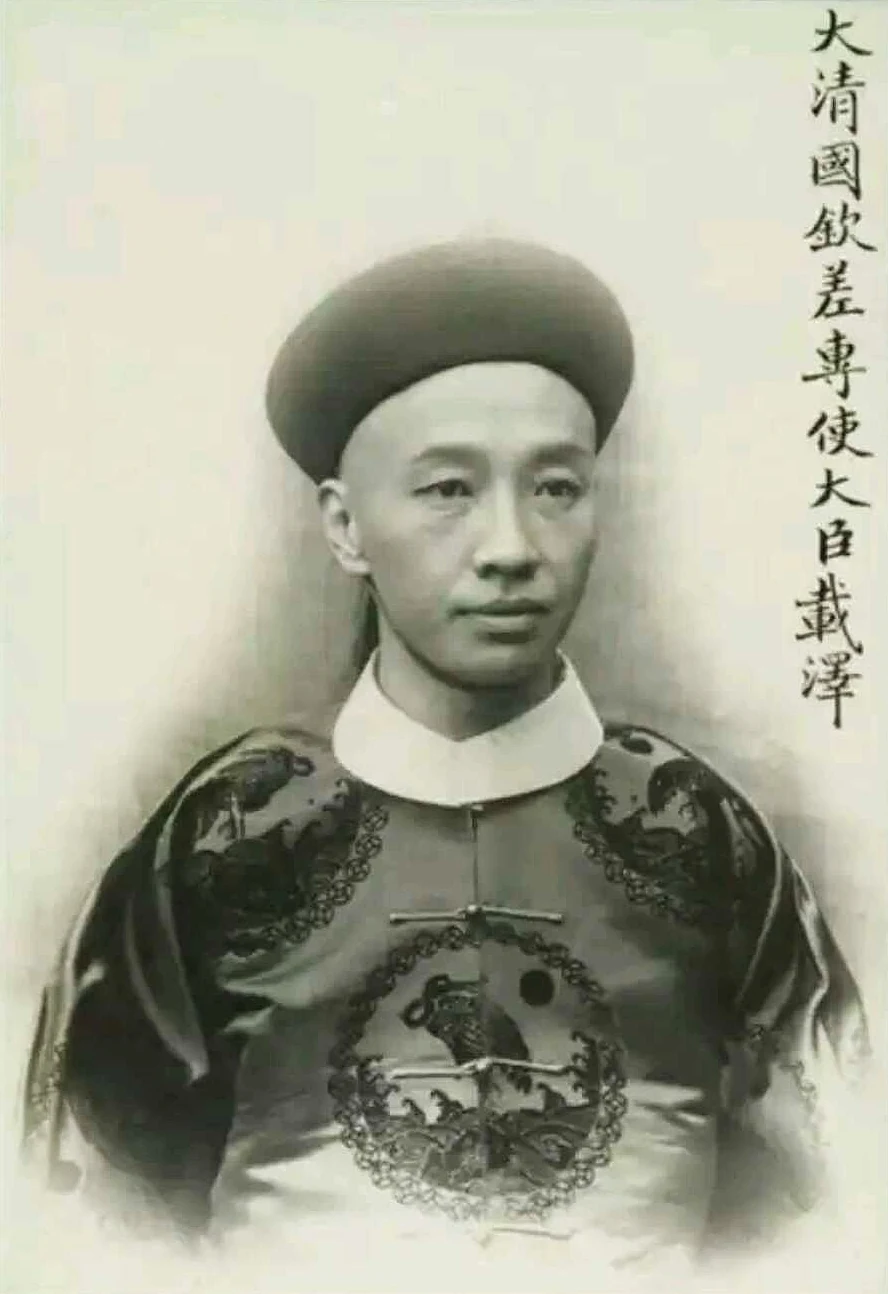
1867 CE–1930 CE
Imperial clansmanminister
Aisin Gioro Zaize
爱新觉罗·载泽
Aisin Gioro Zaize (March 17, 1868–June 5, 1930), originally named Zaijiao and courtesy name Yinping, was a member of the Aisin Gioro clan and the Manchu Bordered Yellow Banner. He was a senior late-Qing imperial clansman and an important advocate of constitutional reform. He was a fifth-generation descendant of Yinyu, Prince Yuke, the fifteenth son of the Kangxi Emperor. After being adopted as heir to Yixun, a grandson of…
1867 CE–1930 CEQing Dynasty
PROFILE
Aisin Gioro Zaize (March 17, 1868–June 5, 1930), originally named Zaijiao and courtesy name Yinping, was a member of the Aisin Gioro clan and the Manchu Bordered Yellow Banner. He was a senior late-Qing imperial clansman and an important advocate of constitutional reform. He was a fifth-generation descendant of Yinyu, Prince Yuke, the fifteenth son of the Kangxi Emperor. After being adopted as heir to Yixun, a grandson of Prince Hui Mianyu, fifth son of the Jiaqing Emperor, Zaize inherited the rank of Duke who Assists the State in 1877 and was promoted to Duke who Guards the State in 1894, later receiving the honorary rank of beizi. In 1905 he was one of the “Five Ministers Sent Abroad,” traveling to Japan, Europe, and the United States to investigate constitutional government. After returning, he submitted the Secret Memorial Requesting the Announcement of Constitutional Government, strongly advocating a constitutional monarchy modeled on Japan and Germany and exerting major influence on the Qing decision to initiate preparatory constitutionalism. He later served as Minister of Finance, minister responsible for planning naval affairs, and minister for drafting a constitution. In 1911 he became Minister of Finance and Salt Administration in the “Imperial Family Cabinet.” After the fall of the Qing, Zaize later represented the former imperial house in arranging the reburial of Empress Dowager Cixi’s remains. The source introduction gives his death as June 5, 1930, in Beijing.
- Other name
- Duke who Guards the State
- Courtesy name
- Yinping
- Period
- Qing
- Dynasty/Regime
- Qing Dynasty
- Identity
- Imperial clansman, minister
- Ethnicity
- Manchu
- Banner affiliation
- Manchu Bordered Yellow Banner
- Native place
- Not reliably established by historical sources
- Date of birth
- March 17, 1868
- Place of birth
- Beijing
- Date of death
- June 18, 1929
- Place of death
- Unknown
- Highest office
- See Biography and Major Activities and Achievements
- Major achievements
- Member of the overseas constitutional investigation mission; led investigations into administrative reform and promoted the Qing program of preparatory constitutionalism.
LIFE TIMELINE
Age nine | Adopted by imperial order as heir to Yixun, renamed Zaize, and inherited the rank Duke who Assists the State
Age eighteen | Married Lady Yehenara, second daughter of Guixiang, younger brother of Empress Dowager Cixi
Age twenty-six | Promoted to Duke who Guards the State
Age thirty-three | Appointed deputy lieutenant-general of the Manchu Bordered Blue Banner, beginning his official career
Age thirty-seven | Appointed one of the ministers sent abroad to investigate political institutions, later known as the Five Ministers Sent Abroad
Age thirty-seven | Slightly wounded by a bomb thrown by revolutionary Wu Yue at Zhengyangmen railway station in Beijing
Age thirty-seven | Left Beijing for Shanghai, beginning the overseas mission
Age thirty-eight | Departed Shanghai for Japan, later visiting the United States, Britain, France, Belgium, and other countries
Age thirty-eight | Returned to Shanghai after an investigation lasting about half a year
Age thirty-eight | Submitted the Secret Memorial Requesting the Announcement of Constitutional Government, advocating a constitutional monarchy modeled on Japan and Germany
Age thirty-nine | Appointed Minister of Finance
Age forty | Granted the honorary rank of beizi
Age forty-one | Appointed minister responsible for planning naval affairs
Age forty-two | Appointed minister for drafting the constitution
Age forty-three | Served as Minister of Finance and Salt Administration in the “Imperial Family Cabinet”; strongly favored killing Yuan Shikai and left office after the 1911 Revolution began
Age forty-nine | Supported Zhang Xun’s restoration attempt
Age sixty | Represented the former Qing imperial house at the Eastern Qing Tombs in reinterring the remains of Empress Dowager Cixi after the tomb robbery
Age sixty-two | Died in Beijing
BIOGRAPHY
Biography
Family Background and Early Years
Zaize was born on March 17, 1868, the twenty-fourth day of the second month of the seventh year of Tongzhi. He was a fifth-generation descendant of Yinyu, the fifteenth son of the Kangxi Emperor and Prince Yuke. The lineage given in the source was: Yinyu; Hongqing, Prince Yugong; Yongzhen, a doroi beile; Mianxiu, a gūsa beise; and his biological father Yicheng, an imperial-clan general. Zaize was Yicheng’s seventh son, born to his principal wife Lady Wanggiya, daughter of Wang Zeng.
By the time of his birth, the Qing had experienced the Taiping Rebellion and the Second Opium War and the Self-Strengthening Movement was developing. As an imperial clansman, Zaize’s early life followed the conventional path of Manchu aristocracy. Because Yixun, fourth son of Prince Hui Mianyu, had no son, Zaize was adopted in the third month of 1877 as Yixun’s heir, renamed Zaize, and inherited the rank Duke who Assists the State. The adoption brought him a higher hereditary rank and a more direct position within the imperial lineage.
In 1886, at eighteen, Zaize married Lady Yehenara, second daughter of Guixiang, younger brother of Empress Dowager Cixi, by imperial order. The Yehenara family held a prominent position in late-Qing politics; Guixiang’s eldest daughter later became the Guangxu Emperor’s empress and the foster mother of the Xuantong Emperor, known as Empress Dowager Longyu. Zaize thus formed close marital ties to Cixi’s family, which became important to his later political career. In 1894 he was promoted to Duke who Guards the State.
Overseas Investigation and Constitutional Views
Zaize’s important political career began after the Eight-Nation Alliance invasion. Following the Gengzi crisis, the Qing government signed the Boxer Protocol, and officials increasingly recognized the urgency of institutional reform. On July 16, 1905, the court appointed Zaize together with Dai Hongci, Xu Shichang, Duanfang, and Shaoying as ministers to investigate political institutions abroad—the group later known as the Five Ministers Sent Abroad. Zaize, still under forty, was the youngest.
On September 2, as the five ministers prepared to leave from Zhengyangmen station in Beijing, revolutionary Wu Yue threw a bomb in an assassination attempt and Zaize was slightly injured. The court did not cancel the mission. In October, after Russia’s October Manifesto announced political reform and a State Duma, the Guangxu Emperor and Empress Dowager Cixi summoned Zaize and urged an early departure. Because Xu Shichang received another appointment and Shaoying was too seriously injured to travel, Shang Qiheng and Li Shengduo were appointed in their places.
Zaize, Shang Qiheng, and Li Shengduo left Beijing for Shanghai on December 11, 1905 and sailed for Japan on January 14, 1906. They later visited the United States, Britain, France, Belgium, and other countries. Li Shengduo remained as minister to Belgium, while Zaize and Shang returned to Shanghai on July 12. The mission lasted more than half a year and focused especially on the political systems of constitutional monarchies such as Japan, Britain, and Germany. In every country the mission reported its observations and conclusions to the Qing government, describing institutions and the strengths and weaknesses of political arrangements. Their investigations covered parliaments, government agencies, factories, banks, schools, police, libraries, museums, zoological and botanical gardens, prisons, public baths, and other institutions. They invited foreign politicians and scholars to explain constitutional principles and collected, purchased, and translated large quantities of printed material.
While in Japan, Zaize met former prime minister Itō Hirobumi, a leading figure of the Meiji Restoration. The two held an extended discussion. When Zaize asked for the basic principle of reform and self-strengthening in China, Itō reportedly replied that “constitutional government must be the first task.” Asked which country China should emulate, Itō argued that China, like Japan, had been a monarchy for thousands of years with sovereignty centered in the ruler and “therefore seems suited to making use of the Japanese political system.” The source states that this conversation directly influenced Zaize’s constitutional thinking.
Administrative Reform and Minister of Finance
After returning in 1906, Zaize and the other investigators edited sixty-seven works in 146 volumes, prepared summaries of thirty for presentation to the Guangxu Emperor and Empress Dowager Cixi, and sent more than four hundred purchased books on diplomacy to the Office for the Investigation of Political Institutions. Zaize submitted the Secret Memorial Requesting the Announcement of Constitutional Government, placing Japan’s constitutional system first among the countries examined and advocating a constitutional monarchy modeled on Japan and Germany. He identified three major benefits: “the imperial throne will be permanently secured,” because the monarch would surrender only administrative power while the throne could remain unchanged for generations; “foreign dangers will gradually lessen,” because a constitutional Qing would no longer be treated internationally as an alien or threatening form of government; and “internal disorder can be extinguished,” because constitutionalism would undermine the appeal of revolutionaries.
The memorial significantly influenced Empress Dowager Cixi’s constitutional decision-making. In the ninth month of 1906 the Qing formally announced that it would “imitate constitutional government,” initiating the program of preparatory constitutionalism. In 1907 Zaize was appointed Minister of Finance with responsibility for national finances. He received the honorary rank of beizi in 1908, became a minister responsible for planning naval affairs in 1909, and in 1910 was appointed a minister for drafting the constitution, making him one of the core figures in the Qing constitutional reform program.
Imperial Family Cabinet and Later Life
In 1911 Zaize served as Minister of Finance and Salt Administration in the “Imperial Family Cabinet,” also known as Prince Qing’s Cabinet. He did not get along with Prince Qing Yikuang and firmly opposed recalling Yuan Shikai, arguing instead that Yuan should be killed to eliminate future danger. After the 1911 Revolution began, Yuan returned to power with the support of Yikuang and others, and Zaize left office. Some scholars have suggested that he joined the Royalist Party, but the source states that evidence is insufficient. It says that after the Qing emperor’s abdication he did not take part in restoration movements, although it also records that in 1917 he supported Zhang Xun’s restoration attempt.
In July 1928, after Sun Dianying’s forces looted Empress Dowager Cixi’s tomb, Zaize represented the former Qing imperial house at the Eastern Qing Tombs and arranged for her remains to be reinterred. On the ninth day of the fifth month of the nineteenth year of the Republic, June 5, 1930, Zaize died in Beijing at the age of sixty-two. His residence, known as the Zaize Mansion, stood at 89 Di’anmen East Street in Beijing.
Major Activities
The Five Ministers’ Overseas Investigation
In 1905, Zaize traveled abroad as one of the Five Ministers investigating constitutional government. The mission lasted more than half a year and visited Japan, the United States, Britain, France, Belgium, and other countries. The group regularly reported its observations and conclusions to the Qing government, explaining each country’s political institutions and governance. Although political and constitutional systems were the main focus, investigations extended to parliaments, government agencies, factories, banks, schools, police, libraries, museums, zoological and botanical gardens, prisons, public baths, and other institutions. Foreign politicians and scholars were invited to explain constitutional principles. After returning, the group compiled sixty-seven works in 146 volumes, prepared summaries of thirty for imperial review, and deposited more than four hundred foreign-affairs books with the Office for the Investigation of Political Institutions. The source presents these activities as an important body of policy material and intellectual resources for Qing constitutional reform.
Promoting Preparatory Constitutionalism
After returning, Zaize submitted the Secret Memorial Requesting the Announcement of Constitutional Government, placing Japan’s system first among those studied and advocating a constitutional monarchy modeled on Japan and Germany. Its three stated benefits—“the imperial throne will be permanently secured,” “foreign dangers will gradually lessen,” and “internal disorder can be extinguished”—directly influenced the constitutional decisions of Cixi and the Guangxu Emperor. The court’s formal announcement in the ninth month of 1906 that it would “imitate constitutional government” marked the beginning of preparatory constitutionalism.
Ministry of Finance and Fiscal Reform
In 1907, Zaize became Minister of Finance and took charge of national fiscal affairs. He worked on clarifying finances, reorganizing taxation, and securing funds for preparatory constitutionalism. In 1911, as Minister of Finance and Salt Administration in the Imperial Family Cabinet, he continued directing fiscal matters.
Opposition to Yuan Shikai
Zaize was known in late-Qing politics for firmly opposing Yuan Shikai. When Prince Qing Yikuang and others advocated recalling Yuan in 1911 to suppress the revolution, Zaize strongly objected and favored killing Yuan. After the 1911 Revolution began, Yuan returned with Yikuang’s backing and Zaize was forced from office.
Reinterment of Empress Dowager Cixi
In July 1928, after warlord Sun Dianying looted the Eastern Qing Tombs and damaged Cixi’s mausoleum, Zaize went to the site as a representative of the former Qing imperial house and reinterred Cixi’s remains.
Personal Relations
Family
- Fifth-generation ancestor: Yinyu, fifteenth son of the Kangxi Emperor and Prince Yuke
- Great-great-grandfather: Hongqing, Prince Yugong
- Great-grandfather: Yongzhen, doroi beile
- Grandfather: Mianxiu, gūsa beise
- Biological father: Yicheng, imperial-clan general
- Biological mother: Lady Wanggiya, daughter of Wang Zeng
- Adoptive father: Yixun, fourth son of Prince Hui Mianyu
- Wife: Yehenara Jingrong, second daughter of Guixiang
- Concubine: Lady Liu, daughter of Liu Duoshou
- Concubine: Lady Zhu, daughter of Zhu Xiaozeng
- Son: Puying, born in 1920 to Lady Zhu
Affinal Relations
- Empress Dowager Cixi: aunt of his wife
- Empress Dowager Longyu: elder sister of his wife
- Guixiang: father-in-law, younger brother of Cixi and a hereditary duke
Colleagues
- Dai Hongci: member of the Five Ministers Sent Abroad
- Duanfang: member of the Five Ministers Sent Abroad
- Xu Shichang: member of the Five Ministers Sent Abroad
- Shang Qiheng: member of the overseas investigative mission
- Li Shengduo: member of the overseas investigative mission
Political Relations
- Yikuang, Prince Qing: head of the Imperial Family Cabinet; had political disagreements with Zaize
- Yuan Shikai: Zaize advocated killing him; Yuan later returned to power and Zaize left office
- Itō Hirobumi: former Japanese prime minister who held a long discussion with Zaize during the Japan visit and influenced his constitutional ideas
Historical Assessment
Qing / Contemporary
- The Draft History of Qing records that Zaize “inherited the rank Duke who Assists the State, was promoted to Duke who Guards the State, and received the honorary rank of beizi,” and also records his overseas mission and constitutional advocacy in a generally neutral manner.
- Puyi mentioned Zaize in From Emperor to Citizen as an imperial clansman inclined toward reform.
- Conservatives of the period criticized Zaize and other constitutionalists for “using the foreign to transform China.”
Republican Period
- Guo Tingyi’s Outline of Modern Chinese History lists Zaize among the important figures of the late-Qing constitutional movement and credits the overseas investigation with helping promote preparatory constitutionalism.
- Republican scholars including Xiao Gongquan paid attention to Zaize’s Secret Memorial Requesting the Announcement of Constitutional Government and regarded it as having directly influenced Qing constitutional decisions.
People’s Republic of China Period
- Scholars generally regard Zaize as a relatively reform-minded member of the late-Qing imperial clan whose overseas investigation and constitutional proposals played a positive role in advancing preparatory constitutionalism.
- Other scholars emphasize that his constitutionalism fundamentally aimed to preserve Qing rule and that formulations such as “the imperial throne will be permanently secured” and “internal disorder can be extinguished” reveal the limitations of his perspective as a member of the imperial clan.
- The actual authorship of the Secret Memorial Requesting the Announcement of Constitutional Government is disputed. One view attributes its drafting to Liang Cheng, minister to the United States, and Wang Daxie, newly appointed minister to Britain; another attributes it to Liang Qichao. The source nevertheless emphasizes Zaize’s political importance as the official who submitted it.
Modern Scholarship
- Contemporary scholars generally treat Zaize as an important representative of late-Qing constitutionalism and recognize his historical role in the Five Ministers’ mission and preparatory constitutionalism.
- Some scholars argue that the Western constitutional institutions and political ideas brought back by Zaize and his colleagues promoted the spread of Western democratic political thought in China and provided usable intellectual resources for Qing reform.
- Zaize’s Diary of the Investigation of Political Institutions is regarded as an important source for studying late-Qing constitutional reform and Sino-foreign exchange.
FIGURES ASSOCIATED WITH THIS DYNASTY
Bibliography
- 《Draft History of Qing·卷二百二十一·列传八》
- 《爱新觉罗宗谱》
- 溥仪:《我的前半生》
- 郭廷以:《近代中国史纲》
- 载泽:《考察政治日记》
- 《出使各国考察政治大臣载泽等奏请以五年为期改行立宪政体折》 (1905)
- 《出使各国考察政治大臣载泽奏请宣布立宪密折》 (1906)