Born in Gaoling | Born in Gaoling, Yong Prefecture, into the Henan Yu lineage.
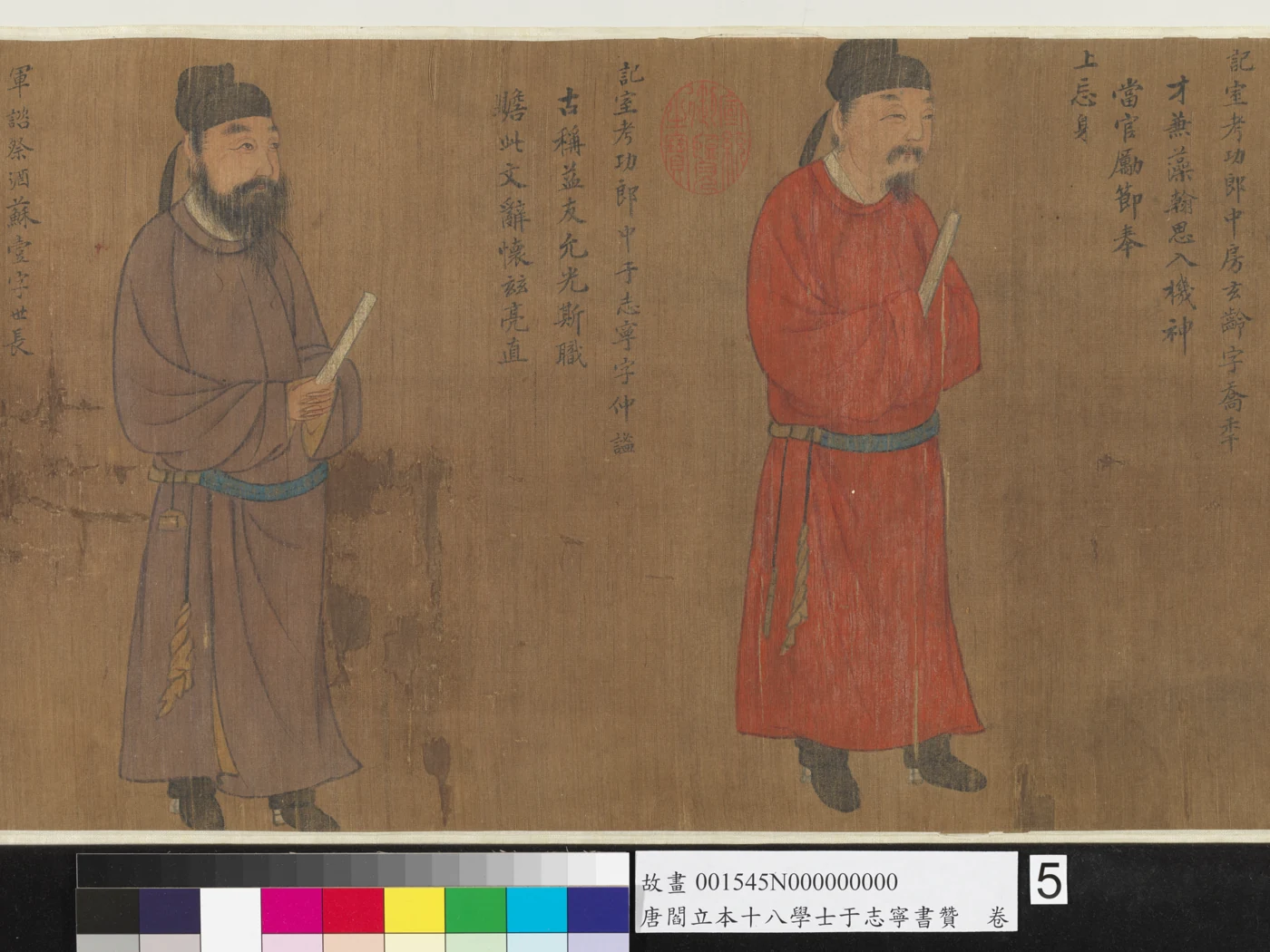
588 CE–665 CE
Tang officialchancellorand tutor to crown princes
Yu Zhining
于志宁
Yu Zhining (588–665), courtesy name Zhongmi, was an early Tang chancellor, remonstrating official, and tutor to crown princes from the Guanzhong Yu lineage. He served as magistrate of Guan County under the Sui and left office when disorder spread through Shandong. After Li Yuan’s uprising, he joined the Tang forces and entered the staff of Prince Li Shimin, becoming an official of the Prince’s Secretariat and a scholar of the…
588 CE–665 CESui Dynasty
PROFILE
Yu Zhining (588–665), courtesy name Zhongmi, was an early Tang chancellor, remonstrating official, and tutor to crown princes from the Guanzhong Yu lineage. He served as magistrate of Guan County under the Sui and left office when disorder spread through Shandong. After Li Yuan’s uprising, he joined the Tang forces and entered the staff of Prince Li Shimin, becoming an official of the Prince’s Secretariat and a scholar of the Literary Institute. Under Emperor Taizong he held central offices and repeatedly admonished Crown Prince Li Chengqian about extravagance, eunuch influence, and misconduct in the Eastern Palace. After Chengqian’s removal, Yu was among the few Eastern Palace officials not implicated and continued to tutor the new heir, Li Zhi. Under Gaozong he became a chancellor and supervised the compilation of history. He remained silent during the deposition of Empress Wang and the elevation of Wu Zhao, and was later demoted after being accused of association with Zhangsun Wuji. His career illustrates the role of early Tang officials in educating heirs, remonstrating on policy, and navigating palace politics.
- Courtesy name
- Zhongmi
- Historical period
- Late Sui and early Tang
- Dynasty or regime
- Sui; Tang
- Identity
- Tang official, chancellor, and tutor to crown princes
- Ethnic affiliation
- Recorded as Xianbei; lineage: Henan Yu clan (Wanniuyu)
- Birth
- 588 (Kaihuang 8)
- Place of birth
- Gaoling, Yong Prefecture (present-day Gaoling area, Xi’an, Shaanxi)
- Death
- 665 (Linde 2)
- Place of death
- Chang’an
- Titles
- Count of Liyang; later Duke of Yan
- Posthumous name
- Ding
- Major offices
- Secretariat Vice Director, Minister over the Masters of Writing, Left Vice Director of the Department of State Affairs, and Grand Tutor to the Crown Prince
LIFE TIMELINE
Left office | Served as magistrate of Guan County and left office amid disorder in Shandong.
Joined Li Yuan’s rising | Joined Li Yuan’s rising forces and became a secretary in the Weibei Command headquarters.
Appointed Secretariat A | Appointed Secretariat Assistant to Prince Li Shimin and scholar of the Literary Institute.
Appointed Secretariat V | Appointed Secretariat Vice Director and later held Eastern Palace posts.
Served as tutor to Crow | Served as tutor to Crown Prince Li Chengqian and repeatedly remonstrated with him.
After Chengqian’s remov | After Chengqian’s removal, received Taizong’s commendation and continued to tutor Li Zhi.
Served Gaozong as Minis | Served Gaozong as Minister over the Masters of Writing and took part in central government.
Held the offices of Lef | Held the offices of Left Vice Director of the Department of State Affairs and Tong Zhongshu Menxia Sanpin.
Became Grand Tutor to t | Became Grand Tutor to the Crown Prince and was later demoted to prefect of Rongzhou.
Served as prefect of Hu | Served as prefect of Huazhou and retired due to age.
Died and received posth | Died and received posthumous honors and the name Ding.
BIOGRAPHY
Biography
Family and Sui Service
Yu Zhining belonged to the Henan Yu lineage, whose members had served northern Chinese regimes since the Northern Wei. His great-grandfather Yu Jin was a prominent official under Western Wei and Northern Zhou, and his father Yu Xuandao held office under the Sui. Yu began his own career as magistrate of Guan County. As disorder spread through Shandong in the final years of the Sui, he resigned and returned home. He joined the emerging Tang regime only after Li Yuan’s uprising and the advance into Guanzhong. The family’s official tradition crossed the political transitions from the Northern dynasties through the Sui and into the Tang.
Service to the Tang and the Prince’s Household
In 617 (Daye 13), after Li Yuan raised forces at Taiyuan and advanced into the Guanzhong region, Yu went to Changchun Palace and entered his service. He became a secretary in the Weibei Command headquarters and worked within the staff supporting Li Shimin. After the Tang was established, Yu’s career developed alongside the political and military household of Prince Li Shimin. In 621 (Wude 4), Li Shimin established the Literary Institute; Yu served as Secretariat Assistant and as one of its scholars. The institute’s work included writing and discussion as well as gathering people who could serve the prince’s administration, preserve texts, and contribute to historical and institutional learning. This transition from a local magistracy to the prince’s headquarters connected Yu with officials who later entered the central Tang government.
Taizong’s Reign and the Tutoring of Li Chengqian
Yu became Secretariat Vice Director in 629 (Zhenguan 3), later adding posts such as Court Gentleman for Consultation and Left Assistant to the Crown Prince. He took part in debates over ritual and state institutions. When Taizong’s court discussed the ancestral temples, Yu argued against treating Li Hao, the ruler of Western Liang, as the founder of the Tang lineage because Li Hao had not established the Tang state. Yu also opposed hereditary provincial governorships for the descendants of meritorious officials, warning that the arrangement could create long-term problems. Taizong accepted both arguments. In each case Yu connected historical precedent or institutional design with its consequences for the dynasty and its administration.
Yu later became Director of the Eastern Palace and helped educate Crown Prince Li Chengqian. As Chengqian grew increasingly extravagant, Yu submitted repeated remonstrances. He objected to prolonged construction and decoration in the palace, warning that workers carrying tools through palace gates could expose security weaknesses if guards could not inspect them. He also warned that eunuchs who controlled access and transmitted orders could use their proximity to the prince to intimidate officials and upset palace discipline. Yu urged the prince to treat servants humanely and criticized his close association with Turkic attendants. Yu collected his admonitions in the twenty-juan Jianyuan, which Taizong praised and rewarded.
Chengqian resented the criticism and secretly sent an assassin against Yu, but the intended killer did not carry out the attack. In 641 (Zhenguan 15), Yu left office to observe mourning for his mother. Taizong considered the education of the heir too important to interrupt and ordered him to resume service, sending Cen Wenben to deliver the recall. When Chengqian was removed in 643 (Zhenguan 17), most Eastern Palace officials were punished. Taizong instead told Yu that his repeated advice had been ignored by the prince and commended him. After Li Zhi became heir, Yu returned as his Left Assistant.
Central Government under Gaozong
After Taizong’s death in 649 (Zhenguan 23), Li Zhi succeeded to the throne. Yu became Minister over the Masters of Writing, received the title Duke of Yan, and took part in compiling the dynastic history. In 651 (Yonghui 2), he served as Left Vice Director of the Department of State Affairs and Tong Zhongshu Menxia Sanpin. When Li Hongtai falsely accused Zhangsun Wuji of treason, Gaozong initially ordered an immediate execution. Yu argued that the case should follow legal procedure and that executions should be deferred until autumn; Gaozong accepted his advice. Yu also objected to the timing of Princess Hengshan’s marriage because the period of mourning for Taizong had not been completed.
In 655 (Yonghui 6), Gaozong deposed Empress Wang and elevated Wu Zhao. Officials took different positions, but Yu did not speak publicly. In 659 (Xianqing 4), Xu Jingzong accused him of association with Zhangsun Wuji. Yu was removed from the chancellorship and demoted to prefect of Rongzhou, then transferred to Huazhou. In 664 (Linde 1), he requested retirement because of his age and was allowed to leave office.
Death and Writings
Yu died in 665 (Linde 2), aged seventy-eight. He received posthumous honors, including the title of Governor of Youzhou, and the posthumous name Ding; some honors were restored later. He contributed to the compilation of the Book of Sui, legal codes, ritual works, and commentaries on the Confucian classics. His writings included a collected works and the Jianyuan. His tomb is located in the present-day Sanyuan area of Shaanxi.
Major Activities
Tutoring and Remonstrating with the Crown Prince
Yu’s long service in the Eastern Palace centered on educating and admonishing the heir. He addressed Chengqian’s palace construction, entertainment, reliance on eunuchs, and treatment of attendants in specific memorials. He continued to advise the prince despite hostility and a threat to his life. After Chengqian’s removal, Taizong recognized that Yu had fulfilled his duty and did not punish him with the rest of the prince’s staff.
Advice on Ritual, Law, and Appointments
Yu opposed making Li Hao the Tang dynastic ancestor, hereditary provincial appointments for meritorious families, and an immediate execution in the Li Hongtai case. These interventions concerned dynastic ritual, local administration, and judicial procedure, revealing his interest in institutional safeguards.
Historical and Classical Compilation
Yu participated in compiling the Book of Sui, Tang laws and administrative regulations, ritual works, and commentaries on the Five Classics. He also supervised historical compilation under Gaozong. These projects were state efforts to record the preceding dynasty, organize legal and administrative rules, and establish texts for ritual and education. Yu’s training in classical learning and experience as a senior official suited him to work across historiography, law, ritual, and the interpretation of the classics. His twenty-juan Jianyuan preserved concrete arguments addressed to the crown prince and shows how remonstrance could be organized as political writing.
Personal Relations
- Yu Jin: Great-grandfather and prominent official under Northern Zhou.
- Li Shimin: Prince whom Yu served in the military and literary staff; later Emperor Taizong.
- Li Chengqian: Taizong’s eldest son and crown prince, whom Yu tutored.
- Li Zhi: Later Emperor Gaozong, whom Yu also served as a crown prince’s tutor.
- Zhangsun Wuji: Chancellor with whom Yu was later accused of political association.
- Zhang Xingcheng and Gao Jifu: Fellow officials to whom Yu once ceded land granted to him by Taizong.
Historical Assessment
Contemporary and Traditional Records
The Old Book of Tang praises Yu for tutoring the heir and speaking frankly to rulers, describing such remonstrance as requiring integrity. The New Book of Tang commends his persistence in admonishing Li Chengqian despite danger, while criticizing his silence during the deposition of Empress Wang and the elevation of Wu Zhao. Traditional historians thus praise his conduct in the Eastern Palace while judging his later political silence by a different standard.
Later Assessments
Later accounts often define Yu through his service as a tutor and remonstrating official, especially his continued advice to Chengqian during the prince’s misconduct. His interventions on dynastic ritual, hereditary appointments, and judicial procedure also illustrate the use of institutional argument by early Tang senior officials.
Modern Scholarship
Modern studies combine the two official histories, inscriptions, and administrative records to examine Yu’s lineage, his work in Li Shimin’s household, his responsibilities in the Eastern Palace, and his political position under Gaozong. His demotion is generally considered in the context of the court’s changing power structure during the Yonghui and Xianqing eras and the case against Zhangsun Wuji.
Representative Works
The twenty-juan Jianyuan and Yu Zhining’s collected writings. He also contributed to legal, ritual, historical, and classical compilations, some of which are no longer extant as independent works.
FIGURES ASSOCIATED WITH THIS DYNASTY
Bibliography
- Old Book of Tang, juan 78, “Biography of Yu Zhining”
- New Book of Tang, juan 104, “Biography of Yu Zhining”