Birth | Eldest son of Yuwen Shu, born into the military aristocracy of Wuchuan in the northern frontier region.
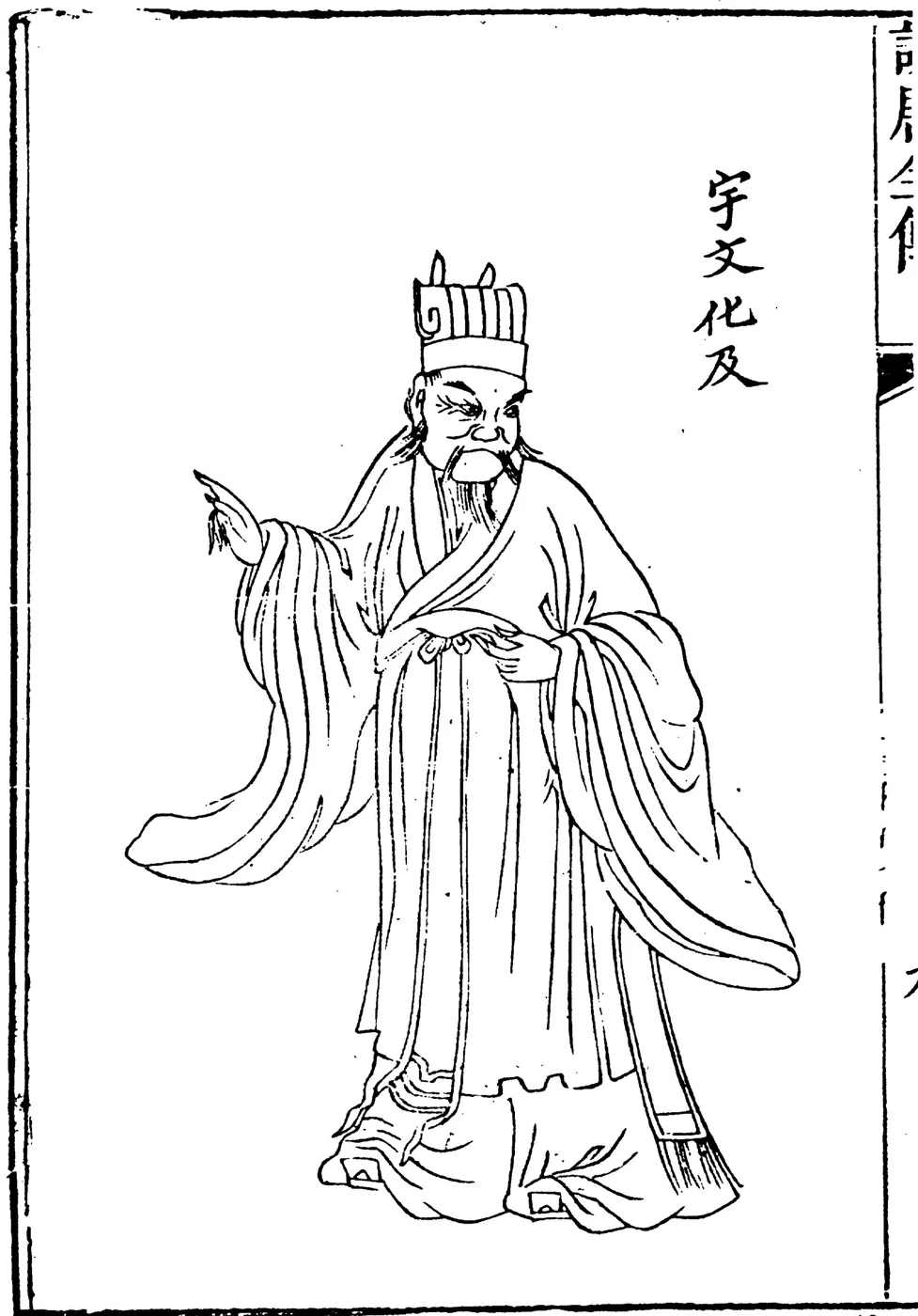
619 CE
Emperor
Yuwen Huaji
宇文化及
Yuwen Huaji (d. 619), a native of Wuchuan in Dai Commandery, west of present-day Wuchuan in Inner Mongolia, was a rebel leader at the end of the Sui Dynasty and the son of Yuwen Shu, Left General-in-Chief of the Imperial Guard. Relying on his powerful family background, he behaved arrogantly in Chang'an in his youth and was nicknamed the “frivolous young lord” by contemporaries. After Emperor Yang of Sui ascended the throne,…
619 CESui Dynasty
PROFILE
Yuwen Huaji (d. 619), a native of Wuchuan in Dai Commandery, west of present-day Wuchuan in Inner Mongolia, was a rebel leader at the end of the Sui Dynasty and the son of Yuwen Shu, Left General-in-Chief of the Imperial Guard. Relying on his powerful family background, he behaved arrogantly in Chang'an in his youth and was nicknamed the “frivolous young lord” by contemporaries. After Emperor Yang of Sui ascended the throne, Yuwen Huaji successively served as Vice Minister of the Court of the Imperial Stud and General of the Right Encampment Guard. In 618, the 14th year of the Daye era, he had Emperor Yang strangled in the Jiangdu Coup, installed Prince of Qin Yang Hao as emperor, and made himself Grand Councilor. He later led his forces westward, was defeated by Li Mi of the Wagang Army, withdrew to Wei County, poisoned Yang Hao, usurped the imperial title, named his state Xu, and adopted the era name Tianshou. In 619, the second year of the Wude era, he was captured and killed by Dou Jiande.
- Period
- Sui
- Date of Birth
- Not recorded in historical sources
- Date of Death
- 619
- Dynasty/Regime
- Sui Dynasty
- Identity
- Emperor
- Ethnicity/Affiliation
- Not recorded in historical sources
- Ancestral home
- Wuchuan, Dai Commandery (west of present-day Wuchuan, Inner Mongolia)
- Place of birth
- Not recorded in historical sources
- Reign
- Not recorded in historical sources
- Predecessor
- Not applicable (made himself emperor of Xu after killing Emperor Yang of Sui)
- Successor
- Not applicable (the Xu regime collapsed)
- Era name
- Not recorded in historical sources
- Temple name
- Not recorded in historical sources
- Posthumous title
- Not recorded in historical sources
- Major achievements
- Close associate of Emperor Yang of Sui and General of the Right Encampment Guard; killed Emperor Yang in the Jiangdu Coup, made himself Grand Councilor, later usurped the imperial title, and was ultimately destroyed
LIFE TIMELINE
Youth | Entered government through hereditary privilege; served as a qianniu attendant to the crown prince and was promoted to groom of the crown prince, becoming a favored associate of Yang Guang.
Accession of Emperor Yang | Appointed Vice Minister of the Court of the Imperial Stud and became especially rapacious by relying on his previous relationship with the emperor.
Violated prohibitions together with Yuwen Zhiji by trading with the Turks | Violated prohibitions together with Yuwen Zhiji by trading with the Turks; narrowly escaped execution and was later reduced to servile status.
After the death of his father Yuwen Shu | After the death of his father Yuwen Shu, restored to office as General of the Right Encampment Guard and inherited the title Duke of Xu.
Jiangdu Coup | Had Emperor Yang of Sui strangled, installed Yang Hao as emperor, and made himself Grand Councilor.
Led more than 100,000 followers westward and killed Sima Dekan and other opponents on the | Led more than 100,000 followers westward and killed Sima Dekan and other opponents on the route.
Fought Li Mi at Mount Tong | Fought Li Mi at Mount Tong, suffered a major defeat, and withdrew to Wei County with only about 20,000 men remaining.
Poisoned Yang Hao | Poisoned Yang Hao, usurped the imperial title, named his state Xu, and adopted the era name Tianshou.
Failed to take Wei Prefecture | Failed to take Wei Prefecture, fled east to Liaocheng, and was captured and killed by Dou Jiande.
BIOGRAPHY
Biography
Family Background and Early Years
Yuwen Huaji came from a military aristocratic family of Wuchuan in Dai Commandery, west of present-day Wuchuan in Inner Mongolia. His ancestors were Xiongnu surnamed Poyetou. After they became affiliated with the Xianbei Yuwen branch, they adopted the surname Yuwen. His father, Yuwen Shu, was an important official under both Northern Zhou and Sui, rising to Left General-in-Chief of the Imperial Guard and receiving the title Duke of Xu. Yuwen Shu had helped Prince of Jin Yang Guang in the struggle for the succession and became one of Emperor Yang's closest supporters.
Yuwen Huaji was Yuwen Shu's eldest son and grew up in a powerful household. The source describes him as having witnessed the corruption and brutality of the ruling elite from an early age and as developing a greedy and arrogant character. He often rode through the streets of Chang'an with household retainers, mounted on tall horses and carrying bows and pellets, racing recklessly through the city. Residents nicknamed him the “frivolous young lord.” When Yang Guang was crown prince, Yuwen Huaji served as a qianniu attendant and frequently entered the Eastern Palace. His relationship with Yang Guang was close, and he was eventually promoted to groom of the crown prince. He was repeatedly dismissed for accepting bribes, but each time Yang Guang's protection helped him quickly return to office. His younger brother Yuwen Shiji married Yang Guang's eldest daughter, Princess Nanyang, and this connection made Yuwen Huaji still more arrogant. He spoke insolently before high officials, insulted others, tried to obtain other people's children, dogs, horses, and valuables whenever they caught his interest, and associated with butchers and petty traders for profit.
At the Court of Emperor Yang of Sui
After Emperor Yang ascended the throne, Yuwen Huaji was appointed Vice Minister of the Court of the Imperial Stud. Relying on his earlier relationship with the emperor, he became especially rapacious. In 607, the third year of the Daye era, when Emperor Yang traveled to Yulin, Yuwen Huaji and his younger brother Yuwen Zhiji violated prohibitions by trading with the Turks. The emperor was enraged and imprisoned them for several months. After returning to the capital he at one point intended to execute them; their clothes were removed and their hair arranged in preparation for death. Because of Princess Nanyang, however, they were eventually spared and were handed over to their father Yuwen Shu as slaves.
After Yuwen Shu died, Emperor Yang remembered his former services and restored Yuwen Huaji as General of the Right Encampment Guard and Yuwen Zhiji as Vice Director of the Directorate for Palace Buildings. Yuwen Huaji was also permitted to inherit the title Duke of Xu.
The Jiangdu Coup
In the seventh month of 616, the 12th year of the Daye era, Emperor Yang traveled to Jiangdu aboard imperial dragon boats. Li Mi, leader of the Wagang Army, then controlled Luokou and blocked the western route, leaving the emperor stranded at Jiangdu. Emperor Yang intended to establish Danyang as a capital and remain in the Jiangnan region. Most of the Xiaoguo guards who accompanied him were men from the Guanzhong area. Homesick and unable to return, they began plotting desertion.
Sima Dekan, a Wuben commandant who commanded the Xiaoguo troops at Jiangdu, learned that the soldiers were planning to flee. He secretly contacted Yuan Li, Pei Qiantong, and others, initially intending merely to loot valuables and escape westward together. Yuwen Zhiji learned of the plot and urged Sima Dekan to use the opportunity to attempt an imperial enterprise. After discussion, the conspirators decided to place Yuwen Huaji at their head. According to the source, Yuwen Huaji was naturally dull and timid; when first told of the rebellion, his face changed and he broke into a cold sweat, but he eventually agreed.
On the night of the tenth day of the third lunar month of 618, the 14th year of Daye, Sima Dekan led the Xiaoguo troops into the palace through the Xuanwu Gate. Pei Qiantong and Yuan Li entered the palace directly, searched for Emperor Yang, and took him to his sleeping quarters. Yuwen Huaji ordered the commandant Linghu Xingda to strangle Emperor Yang with a white silk cloth. Members of the Sui imperial clan and the families connected to it who were present in the Jiangdu palace were then killed. Only Prince of Qin Yang Hao survived because he was on good terms with Yuwen Zhiji; he was installed as emperor. Yuwen Huaji appointed himself Grand Councilor, made Yuwen Zhiji Left Vice Director of the Department of State Affairs, and prepared to lead more than 100,000 followers back west toward Guanzhong.
Westward March and Defeat
As Yuwen Huaji led his forces west, he occupied the six palace establishments and lived with the same extravagance as Emperor Yang. He sat facing south each day in the position of a ruler, but when officials submitted matters he often remained silent and gave no answer. When the army reached Xuzhou and could no longer continue by water, he seized 2,000 carts and oxen from local people to carry palace women and treasures and forced the soldiers to bear armor and weapons themselves. The route was long, and discontent spread throughout the army. Sima Dekan, Zhao Xingshu, and others plotted to attack and kill Yuwen Huaji, but the conspiracy was discovered and they were executed.
Near Luoyang, Yuwen Huaji was blocked by Li Mi's Wagang Army and could not continue west. He therefore led his troops into Dong Commandery, where administrator Wang Gui surrendered the city to him. Li Mi sent Xu Shiji to occupy the Liyang granary. Yuwen Huaji crossed the river to besiege it but repeatedly failed, and his general Yu Hongda was captured. When his provisions ran out, Yuwen Huaji fought Li Mi in a decisive battle at Mount Tong and suffered a major defeat. Generals Chen Zhilüe, Zhang Tonger, and others defected with their troops to Li Mi, leaving Yuwen Huaji fewer than 20,000 followers. He withdrew to Wei County. Knowing that defeat was inevitable, he reportedly sighed, “A man must die in the end; why should I not be emperor for one day?” He then poisoned Yang Hao, assumed the imperial title, named his state Xu, and adopted the era name Tianshou.
Yuwen Huaji later attacked Wei Prefecture for forty days without success and instead was defeated by Yuan Baozang, losing more than 1,000 men. With no other option he fled east to Liaocheng, where he was attacked by the Tang general Li Shentong and by Dou Jiande. Wang Bo, leader of a rebel force in Qi Prefecture, pretended to surrender and secretly brought Dou Jiande into the city. Yuwen Huaji was captured alive and taken to Hejian. Dou Jiande recited his crimes of regicide and then beheaded Yuwen Huaji together with his two sons, Yuwen Chengji and Yuwen Chengzhi. Their heads were sent to Princess Yicheng among the Turks and displayed at the royal court.
Major Activities
The Jiangdu Coup
Yuwen Huaji was a central figure in the Jiangdu Coup. He was not the original architect of the plot, but Sima Dekan, Yuwen Zhiji, and others pushed him forward as their leader. During the coup he ordered Linghu Xingda to strangle Emperor Yang of Sui and then oversaw extensive killings of members of the Sui imperial clan, imperial relatives, and loyal officials, including Prince of Qi Yang Jian, Prince of Shu Yang Xiu, Prince of Yan Yang Tan, Yu Shiji, Pei Yun, Lai Huer, and others. He installed Prince of Qin Yang Hao as emperor, made himself Grand Councilor, and held actual power.
Usurpation of the Imperial Title
After retreating to Wei County in defeat, Yuwen Huaji knew that his cause was collapsing. Nevertheless, he poisoned the puppet emperor Yang Hao, assumed the imperial title, named his state Xu, and adopted the era name Tianshou. The source presents this action as revealing his attachment to rank and power despite the hopelessness of his position.
Military Activity
Yuwen Huaji led more than 100,000 Xiaoguo troops westward and fought a decisive battle with Li Mi's Wagang Army at Mount Tong, where he suffered a major defeat. He later failed to capture Wei Prefecture, fled east to Liaocheng, and was eventually captured and killed by Dou Jiande. The source characterizes his military ability as mediocre and his command as poor, contributing to the dissolution of his forces.
Relations with Contemporaries
Yuwen Huaji joined Sima Dekan, Yuwen Zhiji, and others in launching the coup, but afterward became suspicious of those who had helped him and killed Sima Dekan, Zhao Xingshu, and others. He fought Li Mi on the battlefield; Li Mi mocked him as so mediocre and cowardly that his aspiration to become emperor was absurd. Yuwen Huaji treated some elderly officials such as Pei Ju and Su Wei well but killed loyalists such as Xu Shanxin and Mai Mengcai.
Personal Relations
- Father: Yuwen Shu, Left General-in-Chief of the Sui imperial guard and Duke of Xu.
- Brother: Yuwen Zhiji, Vice Director of the Directorate for Palace Buildings; co-conspirator in the coup and later killed.
- Brother: Yuwen Shiji, Commandant-Escort; married Princess Nanyang, later joined the Tang and rose to Secretariat Director.
- Sons: Yuwen Chengji and Yuwen Chengzhi, beheaded together with their father.
- Emperor: Yang Guang, Emperor Yang of Sui. Yuwen Huaji had been an associate of the Eastern Palace and later killed him.
- Puppet ruler: Prince of Qin Yang Hao, installed as emperor and later poisoned.
- Sima Dekan: commander of the Xiaoguo troops, a principal organizer of the coup, later killed.
- Pei Qiantong: palace officer who participated in the coup and later joined the Tang.
- Yuan Li: palace officer who participated in the coup.
- Li Mi: leader of the Wagang Army, defeated Yuwen Huaji at Mount Tong.
- Dou Jiande: Hebei rebel leader, captured and killed Yuwen Huaji.
- Li Shentong: Tang general who besieged Liaocheng.
Historical Assessment
Sui Period and Contemporary Assessments
- Prince of Yue Yang Tong condemned him: “Huaji, though of such inferior ability, had long received imperial favor, entering and leaving both court and palace and serving before the throne. ... Huaji had the heart of a murderous beast, worse than an animal; he unleashed poison and calamity and overturned the traveling palace.” (Book of Sui, juan 85)
- Li Mi said: “Huaji is so mediocre and cowardly, yet suddenly wishes to plot to become emperor. He is of the sort of Zhao Gao and Liu Shengong. I could drive him away with a broken staff.” (Comprehensive Mirror in Aid of Governance, juan 185)
- Sima Dekan said: “Huaji is mediocre and benighted, with petty men constantly at his side. The enterprise is certain to fail.” (Book of Sui, juan 85)
- Kong Deshao wrote that Yuwen Huaji had intermarried with the imperial house, that his father, brothers, and he himself had all received Sui favor, yet he committed regicide and attempted to replace the dynasty, making him “a thief of all under heaven.” (Old Book of Tang, juan 54)
Tang Period
- Emperor Taizong of Tang, Li Shimin, condemned Yuwen Zhiji, Sima Dekan, Pei Qiantong, and the other Jiangdu conspirators for occupying honored offices at the end of the Daye era, concealing treachery, forgetting loyalty, and committing regicide at Jiangdu. He ordered severe punishment as a warning to ministers. (Old Book of Tang, juan 69)
- The historian of the Book of Sui wrote that Yuwen Huaji was “a mediocre and ordinary man of low ability” whose family had received generations of favor. At the dynasty's collapse, rather than sacrifice himself in loyal service, he seized the moment to violate the established order, led men of disorder, and became a source of rebellion. The judgment concludes that Heaven and Earth could not tolerate him and that both men and spirits shared anger at his conduct. (Book of Sui, juan 85)
Song and Yuan Periods
- Sima Guang's Comprehensive Mirror in Aid of Governance treated Yuwen Huaji as a regicidal rebel and described in detail how his naturally timid disposition caused him initially to turn pale and sweat when he first heard of the coup, while quoting Li Mi's contempt for his mediocrity and cowardice. (Comprehensive Mirror in Aid of Governance, juan 185)
- Hu Sansheng, in his commentary on the Comprehensive Mirror in Aid of Governance, described Yuwen Huaji as a man of poor ability who seized power during a crisis and ultimately fell, arguing that one who occupied the highest position without virtue rarely escaped defeat.
Ming and Qing Periods
- Wang Fuzhi, in Du Tongjian Lun, criticized Yuwen Huaji as a rebel who committed usurpation and regicide, arguing that even had he obtained the realm he could not have enjoyed security for a single day, and that although his talent was insufficient even for great evil, there was no evil he failed to commit. (Du Tongjian Lun, juan 19)
- Cai Dongfan, in Romance of the Northern and Southern Dynasties, described Yuwen Huaji as originally a pampered aristocratic youth with little ability or strategy who was suddenly pushed by circumstances into high position, acted perversely, and brought destruction upon himself.
Modern Assessments
- Lü Simian, in History of the Sui, Tang, and Five Dynasties, argued that Yuwen Huaji originally had neither great ambition nor great ability and that the coup was made possible mainly by the homesickness of the Xiaoguo troops and their manipulation by Sima Dekan and others. In this view, Yuwen Huaji was little more than a puppet, though his responsibility for regicide remained inescapable.
- Cen Zhongmian, in History of the Sui and Tang, treated Yuwen Huaji's rebellion as a key episode in the collapse of the Sui. He characterized Yuwen Huaji as greedy, base, mediocre, and cowardly, but suggested that he was not originally an extraordinary villain and instead became the principal culprit after being propelled by the circumstances of the age.
FIGURES ASSOCIATED WITH THIS DYNASTY
Bibliography
- Book of Sui, juan 85, “Biography of Yuwen Huaji”
- Old Book of Tang, juan 54, “Biography of Dou Jiande”
- Lü Simian, History of the Sui, Tang, and Five Dynasties
- Cen Zhongmian, History of the Sui and Tang