Biography
Family Background and Early Years
Wang Zhene was born into a prominent Former Qin family of generals and statesmen. His grandfather Wang Meng, courtesy name Jinglüe, served as chancellor under Fu Jian and was renowned in northern China for both civil and military ability. His father Wang Xiu rose to Administrator of Hedong. Wang Zhene was born on the fifth day of the fifth lunar month in 373. Because the fifth month and especially the fifth day were regarded in contemporary custom as inauspicious, his parents initially wished to have him raised by distant relatives. Wang Meng, however, was impressed by the infant and compared him with Tian Wen, Lord Mengchang, who was traditionally said to have been born in an inauspicious month and later became chancellor of Qi. Wang Meng therefore named him Zhene.
Wang Zhene's youth coincided with political collapse. In 385, Fu Jian was killed by Yao Chang of Later Qin and Former Qin rapidly disintegrated, throwing Guanzhong into disorder. At twelve or thirteen, Wang Zhene wandered through the Xiao Mountains and Mianchi region and at one point depended on Li Fang of Mianchi for food and shelter. Grateful for Li Fang's kindness, Wang Zhene said that if he ever met an enlightened ruler and won a great fief, he would repay him generously. Li Fang replied that as the grandson of the Qin chancellor Wang Meng, Wang Zhene had no reason to fear failing to attain wealth and rank, and asked only to be made magistrate of his home county if that day came.
Wang Zhene later followed his uncle Wang Yao south and entered Eastern Jin territory, settling in Jingzhou. There he read the works of the various masters and military texts and liked to discuss state and military affairs. The sources say he was not especially skilled at riding or archery and lacked strength with the bow, but possessed many plans and could make decisive strategic judgments. He was thus more a commander of calculation than a conventional warrior.
Emergence under Liu Yu
In March 409, while Liu Yu was attacking Guanggu during his northern expedition against Southern Yan, Wang Zhene, then magistrate of Linli County in Tianmen, was recommended to him. Liu Yu summoned him, was deeply impressed by their conversation, and kept him overnight. The following morning he told his staff that Wang Zhene, as Wang Meng's grandson, proved the saying that a family of generals produces generals. Liu Yu immediately appointed him Administrative Aide of Qingzhou, Acting Military Adviser to the Grand Commandant, and acting officer of the vanguard military bureau.
In 410, after Liu Yu destroyed Southern Yan and returned toward Jiankang to resist the uprising of Lu Xun, Wang Zhene fought at Chapu alongside Liu Zhong and other commanders and repeatedly distinguished himself. He was granted the rank of Fifth-Class Baron of Bolu County. As Liu Yu subsequently defeated Lu Xun and Liu Yi and consolidated his position, Wang Zhene rose steadily within his military establishment.
Defeat of Liu Yi
Liu Yi had originally raised troops with Liu Yu against Huan Xuan and believed his own abilities were no less than Liu Yu's. By 412, as Inspector of Jingzhou, Liu Yi was secretly linking with figures including Xie Hun and Xi Sengshi and preparing to resist Liu Yu. Wang Zhene told Liu Yu that if he intended to act against the western forces, he should give Wang one hundred large ships for the vanguard.
In September 412, Liu Yu marched west. Wang Zhene was made a staff officer and General Who Rouses Might and, together with Dragon-Prancing General Kuai En, led one hundred ships as the vanguard. Liu Yu instructed him to attack if an opening appeared, but otherwise to burn the enemy's ships and wait. Wang Zhene traveled day and night while spreading the false report that Liu Yi's cousin Liu Fan was coming west.
On the twenty-second day of the tenth lunar month, Wang Zhene reached Yuzhangkou, about twenty li from Jiangling. He abandoned the boats and advanced on foot, leaving banners and drums at the landing sites and ordering those who remained behind to beat the drums at an appointed time so that the enemy would believe a great army followed. He also sent men to burn Liu Yi's ships at Jiangjin, cutting off the retreat. Along the route he falsely announced that “Liu of Yanzhou” had arrived, and local garrisons and residents initially believed him.
Only five or six li from the city did Liu Yi's officer Zhu Xianzhi recognize the ruse. Zhu rushed back and ordered the gates closed, but Wang Zhene's troops had already pressed forward, climbed the walls, and opened the eastern gate before it could be secured. Fierce fighting followed within Jiangling and around the inner fortress. Because many soldiers on the two sides had fathers, brothers, sons, or other relatives in the opposing army, Wang Zhene ordered his men to shout that Liu Yu himself was approaching, undermining Liu Yi's morale.
By the first watch, Liu Yi's forward forces collapsed and his brave officer Zhao Cai was killed. Fearing friendly casualties in darkness, Wang Zhene withdrew slightly and left the southern route open. At the third watch Liu Yi fled the north gate with more than three hundred men. He was blocked by Wang Zhene's troops but broke through Kuai En's exhausted force and escaped to the Niumu Buddhist monastery. The monks refused him refuge because of an earlier killing connected with the monastery, and Liu Yi ultimately hanged himself.
Wang Zhene fought in the front ranks, was struck by five arrows, and had the spear in his hand shot apart. Liu Yu's main force did not reach Jiangling until twenty days after the city had been pacified. Wang Zhene was thereafter appointed to the central military staff, then Protector-General Who Pacifies Afar and Administrator of Wuling. In November he was enfeoffed as Baron of Hanshou County with five hundred households.
Campaign against Sima Xiuzhi
In 415, the local leader Xiang Bodigen occupied Ruantou in revolt. Wang Zhene attacked him and requested support from the Jingzhou inspector Sima Xiuzhi, who sent Zhu Xiang with troops. At the same time, Liu Yu had already decided to attack Sima Xiuzhi because he distrusted his influence in Jiangling and resented the behavior of his son in Jiankang.
When Wang Zhene learned that Liu Yu was moving against Sima Xiuzhi, he realized that Zhu Xiang's force had become an enemy as well. He therefore moved east by night on a fast-flowing river, covered several hundred li, blocked the waterways with stone-filled bamboo cages, and ambushed Zhu Xiang from both banks, killing Zhu and more than a thousand of his soldiers.
The sources also criticize Wang Zhene as greedy. After defeating Zhu Xiang he stopped to plunder local communities and therefore returned late. When he reached Jiangling in May, Sima Xiuzhi had already been defeated and Liu Yu angrily refused to see him. Wang Zhene nevertheless said that if he could only meet Liu Yu, there would be nothing to fear. Liu Yu soon summoned him; Wang Zhene's quick and persuasive replies dispelled the anger. He then led Kuai En and others by water in pursuit of Sima Xiuzhi to the frontier and was appointed General of Mobile Warfare.
Northern Expedition against Later Qin
In 416, Liu Yu launched his northern expedition against Later Qin. Wang Zhene became a consulting officer and acting Dragon-Prancing General and, together with Champion General Tan Daoji, led the vanguard toward Xuchang and Luoyang. Liu Muzhi told him that Liu Yu had entrusted him with the great responsibility of the Qin campaign. Wang Zhene replied that unless he took Xianyang he would swear not to cross the Yangzi southward again.
Wang Zhene and Tan Daoji won repeated victories after entering Later Qin territory, and many cities surrendered at their approach. They took Xuchang and Luoyang. In 417 Wang Zhene reached Tong Pass, gateway to Guanzhong. The Later Qin general Yao Shao defended the pass, and Wang Zhene could not immediately advance, so he dug deep trenches and built high ramparts while waiting for Liu Yu. Because the force had advanced far ahead, supply became difficult and the army eventually faced shortages; some urged abandoning the baggage and retreating.
Liu Yu had previously ordered Wang Zhene to remain at Luoyang after its capture, but he had pressed forward. When Wang requested grain, Liu Yu was then confronting Northern Wei troops along the Yellow River and reproached him for advancing too lightly into enemy territory. Unable to obtain immediate help, Wang Zhene returned personally to Hongnong and appealed to local residents, who were moved and competed to donate grain, resolving the shortage.
In August, Liu Yu's main army reached Tong Pass. Wang Zhene asked to lead a fleet from the Yellow River into the Wei River toward Chang'an. Later Qin forces under Yao Nan and Yao Hong attempted to resist; Wang Zhene sent Mao Dezu to attack, Yao Qiang was killed, and Yao Nan withdrew toward Chang'an.
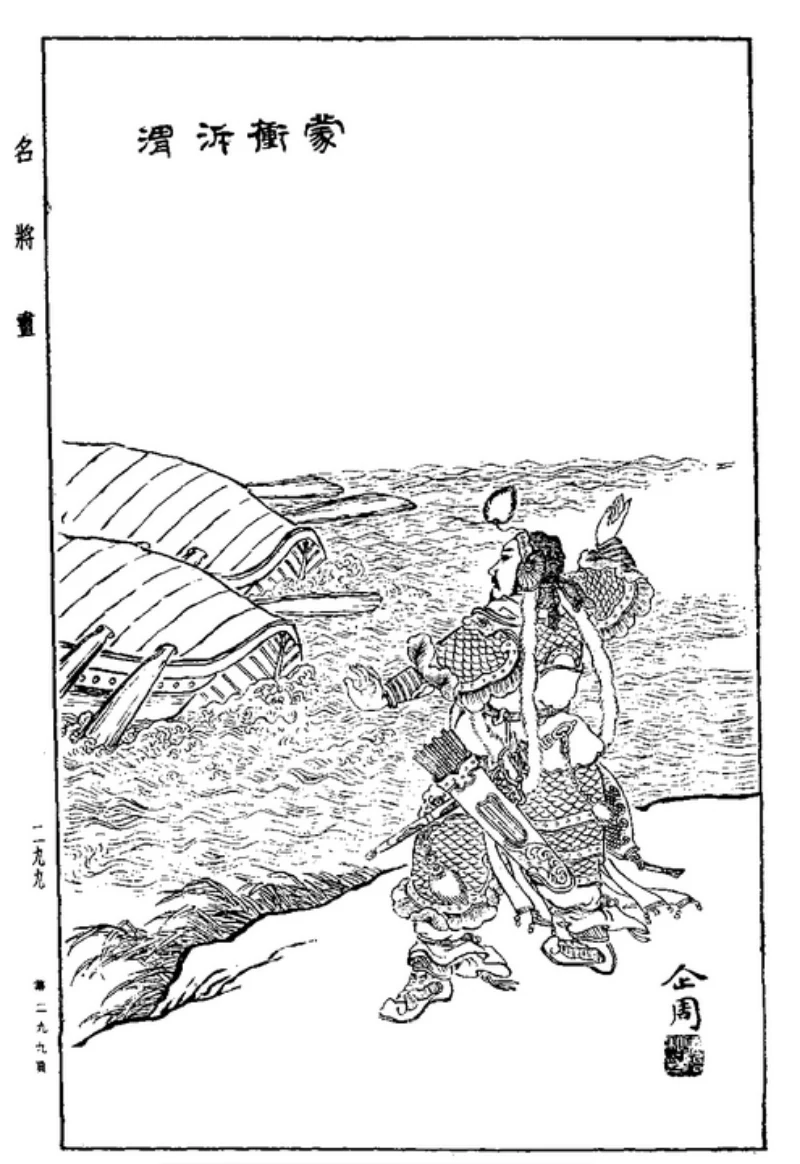
Wang Zhene's fleet traveled upstream on the Wei in covered assault boats whose rowers were hidden inside, so that people on the bank saw vessels moving without visible crews and regarded the sight as supernatural. On the morning of September 19, 417, the fleet reached Weiqiao. Wang Zhene ordered the soldiers to eat, arm themselves, and disembark under threat of execution for the last man ashore. Once the army had landed, the empty vessels drifted eastward down the Wei.
Yao Hong still possessed tens of thousands of troops. Wang Zhene told his soldiers that their families were in Jiangnan, that Chang'an was ten thousand li from home, and that their boats, clothing, and provisions had floated away. Victory would bring merit and fame; defeat meant even their bones would never return. With no second path, they had to fight. Wang Zhene then led the assault in person, destroyed Yao Pi's defending force at Weiqiao, and entered Chang'an through the Pingshuo Gate after Yao Hong's relieving troops collapsed amid the retreating defenders.
The next day Yao Hong, accompanied by the empress and civil and military officials, surrendered at Wang Zhene's camp. More than sixty thousand households of Han and other peoples lived in Chang'an. Wang Zhene proclaimed the benevolence of the Jin court, pacified the population, maintained strict discipline, and kept daily life stable. When Liu Yu reached Chang'an in September, Wang Zhene welcomed him at Bashang. Liu Yu told him that he was the man who had made Liu Yu's hegemonic achievement possible; Wang modestly attributed the victory to Liu Yu's power and the efforts of the officers. For his role in destroying Later Qin, he was promoted to General Who Conquers the Caitiffs.
The sources nevertheless state that Wang Zhene enriched himself after the Later Qin treasury and stores fell into his hands. Liu Yu overlooked this because of his outstanding merit. When someone accused Wang of hiding Yao Hong's imperial carriage as a possible sign of treason, Liu Yu investigated and discovered that Wang had merely stripped off the gold, silver, and jewels and thrown the carriage outside the wall, which reassured him regarding rebellion while confirming his greed.
Guarding Chang'an and Death
In November 417, Liu Yu ordered the army to withdraw south and left his second son Liu Yizhen as General Who Pacifies the West to hold Guanzhong. Wang Zhene became Liu Yizhen's military aide and simultaneously Administrator of Fengyi. The people of Guanzhong had long revered Wang Meng, and Wang Zhene had contributed more than anyone else to the capture of Chang'an. Commanders from Jiangnan therefore envied him. General Shen Tianzi believed his own victory at Yaoliu over Yao Hong's main army had been decisive and competed with Wang Zhene for credit.
Shen Tianzi and Fu Hongzhi repeatedly warned Liu Yu that Wang Zhene's family roots were in Guanzhong and that he could not be trusted. Liu Yu replied that he had left numerous civil and military officers and ten thousand elite troops, and that Wang would only destroy himself if he rebelled. Liu Yu also privately told Shen Tianzi that Zhong Hui had failed to cause a great disturbance because Wei Guan had been present, and used the saying that a group of foxes could overcome a single fierce beast. Liu Yu left Guanzhong in December.
In the first lunar month of 418, the Xia commander Helian Gui reached the northern bank of the Wei River, while many local people began submitting to Xia. Shen Tianzi went out to resist him but, fearing the strength of Xia, withdrew to Liuhui Fort and sent a messenger to Chang'an to report to Wang Zhene. Wang told the senior official Wang Xiu that Liu Yu had entrusted a ten-year-old child to them and that all should exert themselves, yet Shen Tianzi held a large army without advancing against the powerful enemy. The messenger repeated these words to Shen, worsening the longstanding hostility between the two commanders.
Soon both Wang Zhene and Shen Tianzi moved north of Chang'an against Xia. Rumors spread that Wang intended to kill the Jiangnan troops, send Liu Yizhen home with only a small escort, and establish himself in Guanzhong. On the fifteenth day of the first lunar month, March 7, 418, Shen Tianzi invited Wang Zhene to Fu Hongzhi's camp for a military conference and asked that attendants be dismissed for a private discussion. Shen had hidden his clansman Shen Jingren inside the tent, and once Wang's attendants withdrew, Wang Zhene was killed. Shen then claimed to have acted under Liu Yu's secret order.
On learning of the killing, Liu Yu memorialized Emperor An, Sima Dezong, that Shen Tianzi had suddenly gone mad and murdered a loyal and worthy man. Wang Zhene was posthumously appointed Left General and Inspector of Qingzhou. After Liu Yu became emperor, Wang was posthumously created Marquis of Longyang, given the posthumous title Zhuang, and enshrined in the ancestral temple of Emperor Wu of Liu Song.