July 2, 814 CE(twelfth day of the sixth lunar month, ninth year of the Yuanhe era) | Born in the Eastern Pala | Born in the Eastern Palace at Chang'an as the fifth son of Emperor Muzong of Tang
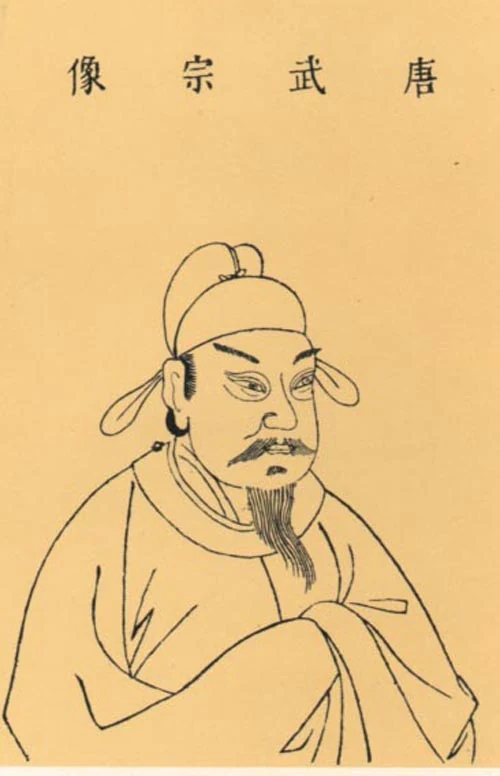
814 CE–846 CE
Emperor
Li Yan
李炎
Emperor Wuzong of Tang, Li Yan (July 2, 814–April 22, 846), originally named Li Chan, was the fifth son of Emperor Muzong of Tang and the son of Empress Xuanyi, Lady Wei. He was the sixteenth emperor of the Tang dynasty, reigning from 840, the fifth year of the Kaicheng era, to 846, the sixth year of the Huichang era, under the era name Huichang. During his reign he appointed Li Deyu as chief councillor, expelled members of…
814 CE–846 CETang Dynasty
PROFILE
Emperor Wuzong of Tang, Li Yan (July 2, 814–April 22, 846), originally named Li Chan, was the fifth son of Emperor Muzong of Tang and the son of Empress Xuanyi, Lady Wei. He was the sixteenth emperor of the Tang dynasty, reigning from 840, the fifth year of the Kaicheng era, to 846, the sixth year of the Huichang era, under the era name Huichang. During his reign he appointed Li Deyu as chief councillor, expelled members of the Niu faction, curbed eunuch power, suppressed the rebellion in Zelu, defeated the Uyghurs, and launched a large-scale campaign against Buddhism, a period traditionally described as the "Huichang Revival." In his final years he was poisoned by alchemical elixirs and died in 846. He received the posthumous name Emperor Zhidao Zhaosu Xiao and was buried at Duanling Mausoleum.
- Other names
- Emperor Wuzong of Tang
- Period
- Tang Dynasty
- Dynasty / regime
- Tang
- Identity
- Emperor
- Ethnicity / ethnic affiliation
- Not recorded in historical sources
- Native place
- Not recorded in historical sources
- Date of birth
- July 2, 814
- Place of birth
- Not recorded in historical sources
- Date of death
- April 22, 846
- Reign
- 840–846
- Predecessor
- Emperor Wenzong of Tang (Li Ang)
- Successor
- Emperor Xuanzong of Tang (Li Chen)
- Posthumous name
- Emperor Zhidao Zhaosu Xiao
- Major achievements
- A mid-Tang emperor who employed Li Deyu during the Huichang era, won military successes against the Tibetan Empire and the Uyghurs, and carried out a large-scale suppression of Buddhism.
LIFE TIMELINE
Age eight | Enfeoffed as Prince of Ying
Age about 22 | Granted the titles Grand Guardian Equal in Honor to the Three Excellencies and Acting Minister of Personnel
February 8, 840 CE(second day of the first lunar month, fifth year of the Kaicheng era) | Age twenty-seven | Eunuchs Qiu Shiliang and Yu Hongzhi forged an edict naming him Imperial Younger Brother and heir to the throne
Age twenty-seven | Emperor Wenzong died; Li Yan took the throne before his coffin
Age about 26 | Posthumously honored his birth mother Lady Wei as Empress Dowager Xuanyi
Age about 26 | Recalled Li Deyu, Military Commissioner of Huainan, to court as chief councillor
Age about 27 | Demoted former chief councillors Li Jue and Yang Sifu; suppressed disorder in Lulong
Age about 28 | Sent three armies north against the Uyghurs; ministers presented the honorific title "Benevolent Sage, Civil and Martial, Supremely Divine, Greatly Filial Emperor"
Age about 29 | In the second lunar month Shi Xiong routed the Uyghurs at Shahu Mountain; in the fourth lunar month Liu Zhen rebelled in Zhaoyi and the emperor overrode opposition to launch a campaign; Qiu Shiliang retired
Age about 30 | Pacified Zhaoyi and killed Liu Zhen
Age about 31 | In the first lunar month ministers presented the honorific title "Benevolent Sage, Civil and Martial, Manifesting Heaven, Accomplished in Merit, Divine in Virtue, Illumined in the Way Emperor"; ordered Buddhist monasteries throughout the realm demolished in the persecution known as the Huichang Suppression of Buddhism
April 22, 846 CE(twenty-third day of the third lunar month, sixth year of the Huichang era) | Age thirty-three | Died in Daming Palace after poisoning from alchemical elixirs
Age about 32 | Buried at Duanling Mausoleum, northeast of present-day Dazheng Town, Sanyuan, Shaanxi
BIOGRAPHY
Biography
Family Background and Early Years
Li Yan was born on July 2, 814, the twelfth day of the sixth lunar month in the ninth year of the Yuanhe era. He was the fifth son of Emperor Muzong of Tang, Li Heng, and Empress Xuanyi, Lady Wei. As a prince he grew up in the Eastern Palace at Chang'an and received a court education alongside his elder brother Li Ang, later Emperor Wenzong. In 821, at age eight, Li Chan was enfeoffed as Prince of Ying. During the Kaicheng era he received the titles Grand Guardian Equal in Honor to the Three Excellencies and Acting Minister of Personnel, with a regular monthly stipend.
Under Emperor Wenzong the succession repeatedly changed. Wenzong first considered making Li Pu, son of his elder brother Emperor Jingzong, heir, but Li Pu died in 828. In 832 Wenzong made his own son Li Yong crown prince, but Li Yong died suddenly in 838. In the tenth lunar month of 839, on the recommendation of his favored consort Lady Yang, Wenzong finally selected Li Chengmei, Prince of Chen and sixth son of Emperor Jingzong, as crown prince, but Wenzong became critically ill before the investiture could be completed.
Accession and Political Struggle
On February 8, 840, Emperor Wenzong was near death and secretly ordered the eunuch palace secretaries Liu Hongyi and the chief councillors including Li Jue to have Crown Prince Li Chengmei supervise the government. Qiu Shiliang and Yu Hongzhi, commandants of the Shence Army, wanted the merit of choosing the next emperor. Claiming that the crown prince was young and sickly, they forged an edict naming Li Chan the imperial younger brother and heir. That night Qiu Shiliang led troops from the Sixteen Residences to escort Li Chan to Shaoyang Court in Daming Palace. On February 10, Wenzong died and Li Chan took the throne before his coffin as Emperor Wuzong, aged twenty-seven.
After his accession, at Qiu Shiliang's urging Wuzong ordered the deaths of Wenzong's Consort Yang, Crown Prince Li Chengmei, Prince Li Rong of An, and other potential political rivals. In the eighth lunar month of the same year, during Wenzong's funeral, Qiu Shiliang also killed palace secretaries Liu Hongyi and Xue Jileng to consolidate his power. Although Wuzong owed his throne to the eunuchs, he privately distrusted Qiu and his allies while outwardly treating them with honor.
The Huichang Revival
In the ninth lunar month of 840, Wuzong recalled Li Deyu, the capable Military Commissioner of Huainan, to court as Minister of Personnel and chief councillor, also making him Vice Director of the Chancellery. Li Deyu advocated returning political decision-making to the Secretariat and Chancellery, and Wuzong relied on him heavily. Together emperor and minister navigated the intertwined domestic and foreign crises of the Huichang era.
In 841 former chief councillors Li Jue and Yang Sifu were removed and sent away. Wuzong initially ordered their execution, but Li Deyu strongly urged clemency and they were spared. Qiu Shiliang tried to incite the imperial army to drive Li Deyu from office, but the emperor intimidated the plotters. In 843 Qiu requested retirement because of age and illness. Wuzong used the opportunity to strip him of military command. Qiu died soon afterward, allowing the emperor to reduce eunuch influence and strengthen imperial authority.
Wuzong's reign saw campaigns against the Uyghurs abroad and Zelu at home. In 842 Uyghur forces moved south; Zhang Zhongwu, Military Commissioner of Lulong, attacked under imperial orders and defeated them. In the eighth lunar month the Tang dispatched three forces north. In the second lunar month of 843 Shi Xiong decisively defeated the Uyghurs at Shahu Mountain, and their ruler Wujie Qaghan fled wounded, after which the northern frontier remained relatively peaceful for more than thirty years. In the fourth lunar month of 843 Liu Congjian, Military Commissioner of Zhaoyi, died and his nephew Liu Zhen attempted to maintain independent control. Wuzong and Li Deyu overrode opposition and ordered a campaign, which successfully suppressed the rebellion.
Suppression of Buddhism and Final Years
Even as a prince Wuzong had been devoted to Daoist practices and techniques of self-cultivation. After accession he summoned eighty-one Daoist priests including Zhao Guizhen into the palace, built Golden Register ritual sites, and personally received Daoist ordination registers. In response to the growth of Buddhist institutions and under the influence of Daoists including Zhao Guizhen and Liu Yuanjing, Wuzong in 845 ordered Buddhist monasteries demolished, more than 260,000 monks and nuns returned to lay life, and 150,000 temple slaves and large areas of monastic land confiscated. This became known as the Huichang Suppression of Buddhism. The policy expanded the state's taxable resources and strengthened central control, but also caused considerable economic loss.
In his later years Wuzong took alchemical elixirs prepared by adepts. His temperament became irritable and his illness did not improve. In the third lunar month of 846, twelve days before his death, he changed his personal name to Yan. On the twenty-third day of the month, April 22, he died aged thirty-three. He was buried at Duanling Mausoleum and received the posthumous name Emperor Zhidao Zhaosu Xiao.
Li Yan was the fifth son of the Tang emperor Muzong and of the empress Wei, born in the Eastern Palace in 814. In 821 he was enfeoffed Prince of Ying under the name Li Chan, and in the Kaicheng years he was given the title of equal of the three ministers and made acting president of the Ministry of Personnel with the stipend of an official. In the first month of 840 the two army inspectors, Qiu Shiliang and Yu Hongzhi, forged an edict summoning the Prince of Ying from the Sixteen Mansions, declaring that the emperor's younger brother, being of a generous nature, should be made imperial younger brother and given charge of military and state affairs, while the Prince of Chen, previously made heir apparent, being young, should return to his princely residence. That night Qiu Shiliang brought troops to escort him to the Shaoyang court and the officials paid their respects to him in the Sixian hall; on the third day Qiu Shiliang arrested and killed the deputy of the palace music office, with his whole family; on the fourth the Wenzong emperor died, and the testament bade the imperial younger brother take the throne before the coffin, Yang Sifu acting as chief mourner. On the fourteenth he was invested in the main hall at the age of twenty-seven, and in 842 and again in 845 he received honorific titles; in the third month of 846 he changed his name to Yan. The Prince of Chen and the Prince of An soon died in their mansions. Consort Yang had been favoured by Wenzong, and the mother of the heir apparent having fallen out of favour and been slandered and died, and the heir deposed, Consort Yang later asked that the Prince of An succeed; the minister Li Jue objected and the Prince of Chen was set up. Qiu Shiliang, wishing the credit of the accession for himself, now raised the old matter, and both princes and the consort died. When Wenzong was buried at the Zhangling, the privy commissioners Liu Hongyi and Xue Jiling, who had long been favoured by him and hated by Qiu Shiliang, led the guards with the hearse and plotted to turn and kill Qiu and Yu; the masters of ceremony discovered it and warned the troops, and the two were executed that day. Qiu Shiliang tried to stir the guards to drive out Li Deyu, but was overawed by the emperor. In 842, at the offering of the honorific title, Qiu spread word that the chancellor's amnesty would cut the guards' rations of cloth, grain and fodder, telling the two armies that if it were so they might protest before the tower; Li Deyu reported it, and the emperor sent envoys to the Shence armies to say that the edict was his own and the chancellor had no part in it, at which the troops quieted. Qiu, uneasy, asked in 843 to retire on grounds of age and illness, and the emperor took the occasion to strip him of military power; he died soon after in his own house, the emperor having for the time being cut back the eunuchs' power. The emperor had been fond of hunting and of wrestling, and had chosen young attendants of the five parks to come and go within the palace. Asking one day how a ruler might become a sage sovereign, he was answered that the memorials of remonstrating officials should be read carefully, adopted when useful and referred to the chancellors when not; that plain speaking should not be refused nor one-sided talk accepted, and that loyal men should be the heart and hands - which made a sage sovereign. He bowed in thanks, and on returning called for the memorials of remonstrance, which mostly spoke of hunting, and thereafter hunted seldom, the park boys and wrestlers receiving no more lavish gifts. When he hunted at Jingyang, Gao Shaoyi and Zheng Lang remonstrated that his hunting had grown frequent and distant, and that he went out before dawn and returned at night, neglecting the government; he changed countenance and excused himself, and told his chancellors that remonstrating officials were meant to speak of the faults of government and that he wished to hear them often, at which the chancellors congratulated him; some days later he promoted both. In his princely days he had loved the arts of Daoist cultivation, and in the autumn of 840 summoned eighty-one Daoists, Zhao Guizhen among them, into the palace to hold a rite of the golden register in the three halls, where he himself received the register at the altar of the nine heavens. When the remonstrating official Wang Zhe objected, his memorial was ignored. In the tenth month of 845 the emperor asked Li Deyu about affairs outside the court, and was told that his severity was unpredictable and that men outside were frightened; that while rebels had been violent severity was proper, but that now the realm was at peace he should govern with leniency, so that the guilty bore no grudge and the good were not alarmed. From that autumn and winter he felt ill, the Daoists calling it the changing of the bones; he kept it secret, and men wondered only why he hunted so seldom, while the chancellors dared not stay long at their reports, and he cancelled the New Year audience of the following year. In the third month of 846 the emperor changed his name to Yan, and on the twenty-third day of that month died at thirty-three, being given the posthumous name Zhaosu Xiao and the temple name Wuzong, and buried in the eighth month at the Duanling with the consort Wang of De buried beside him. Soon after becoming chancellor in the ninth month of 840, Li Deyu laid before the emperor the essentials of government, among them that the government should rest with the Secretariat and the chancellors be given real power of assistance, while their tenure should be limited, since without chancellors the state was not governed; that under Dezong the chancellors had merely executed edicts, and that in the early Kaiyuan years chancellors served three terms and no more, even Yao Chong and Song Jing, while Li Linfu held power nineteen years and brought disaster, so that frequent change and government in the Secretariat was the root of order. In those years the selection of officials was strictly controlled: in 844 the chief examiner's list was cut, and five additional candidates reduced to one; in 845 the list of thirty-seven was re-examined and seven removed, and candidates were forbidden to sit in the two metropolitan prefectures, being required to go to the two national academies. A decree of 842 required that new graduates be appointed as prefectural military officers and county subprefects and not be allowed to hold office before two examinations; and the number of officials whom the circuits might memorialise for appointment was limited, the circuits of Huainan, Zhexi and others being forbidden altogether, and the remote frontier circuits allowed no more than seven a year. The privileges of hereditary office were also restricted, since the sons of great houses were given office in childhood, never studied and knew nothing of the statutes, and being enrolled in the imperial guard, freed their whole families from corvée and taxes, to the loss of the revenue; and officials were forbidden to hold plural offices. The emperor's laws were severe, especially against corruption: at his accession he pardoned all offences except the ten abominations, treason, deliberate homicide and official embezzlement, and he decreed that officials of the central and provincial services who embezzled thirty bolts of silk worth should suffer the extreme penalty. In 841 he decreed by the advice of the Secretariat that officials' salaries be paid on time, and to relieve the debts contracted by officials awaiting appointment he raised salaries and allowed them loans, deducting two months' pay. To purify the administration he forbade in the third month of 841 the drinking and feasting of prefectural and county officials, and Li Deyu abolished the graduation banquet at Qujiang. In 845 he forbade officials to trade or lend at interest in competition with the people, ordering the censorate to report offenders. In these years the registered population of the empire more than doubled from the time of the An Lushan rebellion. In the north, Chen Xingtai in 841 murdered Shi Yuanzhong and sent a memorial through the army inspector asking for the insignia of military commissioner; Li Deyu advised holding the envoy and sending no answer, and the army soon killed Chen and set up Zhang Jiang, again asking and again unanswered. In the fourth month of 843 Liu Congjian, commissioner of Zelu, died and his nephew Liu Zhen seized the command. The chancellors, with the Uighur war just over, urged accepting him, as did the remonstrating officials, but Li Deyu insisted on war, arguing that Zelu, unlike the three Hebei commands long since abandoned to disorder, was inner territory of loyal tradition, and that Liu Zhen's only reliance was the three Hebei commands, so that if Wei and Zhen stood aside he was lost. The emperor said that he and Li Deyu thought alike and would not regret it, and resolved on war. Li Deyu, recalling that in past campaigns the provincial armies had loitered as soon as the treasury paid their expenses and had claimed victory for a single village, asked that Wang Yuankui march straight on Xingzhou and He Hongjing on Cizhou; and with the privy commissioners he agreed that the army inspectors should not interfere in military affairs and should keep only a few guards, with the same rewards and punishments as the generals, so that orders were simple and the commanders could use their plans. When He Hongjing delayed, the emperor moved Wang Maoyuan of the Zhongwu army towards Wei, and He Hongjing, fearing mutiny at home, marched in haste. Li Deyu had Li Yanzuo replaced by Shi Xiong for his slowness, and the day after taking over Shi Xiong stormed Wuling and broke five stockades, killing thousands; and for Wang Yuankui's victory at Yaoshan he asked that he be given the rank of concurrent chancellor. In the eighth month the general Li Pi came over, and though some suspected treachery, Li Deyu advised a generous reward to encourage others. In the ninth month the rebel Xue Maoqing broke the Kedou stockade and burned seventeen camps, and men spoke of a hundred thousand picked troops and ten years of grain in Zelu, so that the emperor wavered, but on Li Deyu's counsel he told his chancellors to warn the officials that whoever memorialised against the campaign would be beheaded on the frontier, and they were quieted. Li Deyu then had five thousand men of the Zhongwu army sent to reinforce Heyang and asked for armour, bows, arrows, swords and silk to equip them. In the eighth month of 843 Xing, Ming and Ci surrendered, and Liu Zhen's officers Guo Yi and Wang Xie murdered him to save themselves; Li Deyu held that they, the authors of the rebellion, must be punished, and the emperor agreed, sending Shi Xiong to bring them to the capital. In the twelfth month the Hengshui garrison at Taiyuan mutinied over insufficient rewards and set up Yang Bian; in the first month of 844 Ma Yuanshi, sent to observe, took bribes and reported fifteen li of armoured men, but Li Deyu exposed him on the spot and insisted that so petty a rebel could not be pardoned and Liu Zhen might be forgiven first, and the order went out, Yang Bian being taken by the army inspector and executed in the capital. Towards the Uighurs who had moved south - some three hundred thousand in twenty-seven tribes under the khan Wujie and Qabix - the court posted the Hedong and Zhenwu armies on guard and gave twenty thousand bushels of grain; when the khan seized the princess Taihe as a hostage and asked to borrow the city of Zhenwu, he was refused, gifts and another twenty thousand bushels being sent, and Liu Mian and Li Zhongshun were appointed to Hedong and Zhenwu. In 842 Qabix killed his rivals and came over with two thousand two hundred men, being made a general and a prince; the commissioner Zhang Zhongwu, ordered in secret to attack the Uighurs, defeated them with thirty thousand men, took seven thousand tents, killed or captured nearly ninety thousand, and then destroyed the Uighur overseers in the Qidan and Xi territories, restoring Tang suzerainty there. In the first month of 843 Liu Mian sent Shi Xiong, who learned from the felt tents that the princess's camp was there, warned her to stay in her carriage, hollowed out the city wall in a dozen places, led his troops out by night to the khan's headquarters, drove him off with the loss of his baggage, broke him utterly at the Shahu mountain, recovered the princess, beheaded ten thousand and took twenty thousand tents; the khan fled north-east to the Heichezi and was killed by his own men three years later. In 844 the Kirghiz khan sent envoys offering to move to the Uighur headquarters and asking for a date, and the emperor decreed that in autumn four garrisons should guard the passes and grant the investiture in the manner of the Uighurs. When it was proposed in 843 to help the Kirghiz against Anxi and Beiting, Li Deyu observed that the two commands lay seven thousand and five thousand li away, that a garrison of ten thousand each could neither be raised nor supplied, and that this would be to buy a reputation at real cost, and the emperor dropped it. From the tenth month of 842 the emperor ordered monks who broke the precepts to return to lay life and forfeit their property, then limited the numbers of monks, forbade private ordination and restricted their bondservants, pulling down many monasteries; at the places holding Buddha's finger bones, such as Famen, offerings and veneration were forbidden on pain of flogging. In 845 the persecution grew: monks under forty were laicised, then under fifty, then all without ordination certificates; in the autumn the monasteries of the realm were reduced, one to each superior prefecture, those in poor repair destroyed, and all in the inferior prefectures closed, only ten monasteries being allowed in each capital and later two with thirty monks each, the relics and bells of the demolished houses being melted for coin and iron for farm tools, and the monks returned to their native places as taxpayers. In all more than four thousand six hundred monasteries and forty thousand shrines were destroyed, two hundred and sixty thousand monks and nuns laicised, tens of millions of qing of temple land and a hundred and fifty thousand bondservants taken for the two-tax registers, and three thousand Manichaeans and fire-worshippers laicised. In the ninth month of 845, on Li Deyu's advice, a frontier reserve was created with a hundred and twenty thousand strings and bolts a year from the Ministry of Revenue and as much from the salt and iron monopoly, reduced by a third the next year. As Prince of Ying the emperor had kept animals in his garden, choosing the ten most engaging and having the Ten Pleasures painted, giving them names - the crane the recluse of the nine marshes, the silver pheasant the gentleman of the dark element, the cock the commandant of the long cry, the tortoise the spirit of longevity, the monkey the wakeful slave, the dog the gate-keeper, the donkey the long-ear, the cat the rat general, the deer the antler guest, the parrot the smooth talker. His consort Wang of the talented rank, a native of Handan who entered the palace at thirteen for her skill in song and dance and was given him by Muzong, was intelligent and of a slender figure much like his own; she always followed him hunting, in robe and on horseback, her uniform almost as splendid as the sovereign's, so that the onlookers could not tell which was emperor. He wished to make her empress, but Li Deyu observed that she had no son and no distinguished family and it would give occasion for talk, and he desisted. Having taken elixirs for years he fell ill, and she told those near her that he burned cinnabar each day and spoke of immortality while his skin dried and withered, which she privately feared; when he was dying he told her that his breath was failing and all his thought spent, and took leave of her, and she answered that if it were so she would follow him in death. When he died she distributed her treasures among the palace women and hanged herself beneath the tent, and though the consorts had envied her they were moved by her constancy; Emperor Xuanzong honoured her fidelity and made her posthumously a virtuous consort, burying her in the pine city beside his tomb at Duanling. The Duanling, at five hundred and forty metres, is an earthen pyramid facing south, its terrace fifty-eight metres east to west, sixty north to south and fifteen high, with a circumference of three hundred and sixty at the base, standing in the centre of the enclosure; damaged since the dynasty's fall, it preserves two pairs of lions at the four gates, three pairs of stone horses, a pair of columns and one human figure, a pair of winged horses and a pair of ostriches, all broken and fallen.
Major Activities
Political Reform
After accession Wuzong placed Li Deyu in power, removed members of the Niu faction, and allowed the Li faction to dominate the chief councillorship. Li Deyu cut redundant posts, reorganized official administration, and restrained the eunuchs, giving the government a period of renewed vigor. Wuzong also curbed the eunuch establishment: Qiu Shiliang, the powerful eunuch who had placed him on the throne, was forced into retirement and stripped of military authority.
Military Achievements
- Defeat of the Uyghurs: In 842 the Uyghurs moved south. Zhang Zhongwu attacked under imperial orders and defeated them, with the source claiming nearly ninety thousand killed or captured. In the second lunar month of 843 Shi Xiong routed them at Shahu Mountain, wounded Wujie Qaghan, and recovered Princess Taihe. The Tang northern frontier then remained comparatively stable for more than thirty years.
- Pacification of Zelu: In the fourth lunar month of 843, Liu Congjian of Zhaoyi died and his nephew Liu Zhen tried to maintain independent rule. Wuzong and Li Deyu rejected calls for compromise and launched a campaign. In 844 the rebellion was suppressed and Zhaoyi recovered, weakening regional military autonomy.
- Settlement of Lulong: In 841 unrest broke out in the Lulong command. Wuzong accepted Li Deyu's advice, handled the crisis cautiously, and ultimately selected Zhang Zhongwu, commander of Xiongwu Army and obedient to court orders, bringing the disorder under control.
Huichang Suppression of Buddhism
In 845 Wuzong ordered Buddhist temples across the empire demolished, more than 260,000 monks and nuns returned to lay life, and 150,000 temple slaves and extensive monastic land confiscated. Apart from a small number of temples permitted in Chang'an, monasteries across the country were dismantled, their clergy secularized, and their land taken into state ownership. This was one of the most severe state attacks on Buddhism in Chinese history and is traditionally grouped with the suppressions under Emperor Taiwu of Northern Wei and Emperor Wu of Northern Zhou as the "Three Wu Disasters of Buddhism."
Travels and Recreation
Wuzong enjoyed hunting, banquets, and wrestling with warriors and allowed attendants of the Five Bureaus to enter the palace precincts. His grandmother, Grand Empress Dowager Guo, admonished him, after which he asked to read officials' remonstrance memorials and found many criticizing his hunting trips. He subsequently hunted much less often. On another occasion, when he went hunting in Jingyang County, remonstrance officials Gao Shaoyi and Zheng Lang objected in Zichen Hall. Wuzong's expression changed, but he acknowledged the criticism, promoting Gao to Supervising Secretary and Zheng to Left Remonstrance Grand Master.
In his seven years Li Yan is remembered for his confidence in his chancellor, his campaigns abroad and at home, his restraint of the eunuchs and his suppression of Buddhism. Employing Li Deyu he restored the government to the Secretariat and gave the chancellors real power of assistance while limiting their tenure, an understanding between ruler and minister rare in the late Tang. His suppression of the Zelu rebellion in 843 was the last victory of the Tang court over a separatist province, greatly raising the court's authority and restoring a nominal unity, the commands returning to obedience. Against the Uighurs Shi Xiong broke them utterly at the Shahu mountain and recovered the Princess Taihe, while Zhang Zhongwu destroyed their overseers in Qidan and Xi and restored Tang suzerainty there; after their defeat the Qidan chief resubmitted and was made a general, and a new seal was cast for them reading "the Qidan who serve the state." The Uighur state broke up and never recovered, and the northern frontier was quiet for more than thirty years. With the Kirghiz, who sent tribute and offered to attack the Uighurs, the emperor agreed to a joint campaign and promised investiture in the manner of the Uighurs; but on Li Deyu's advice he declined their offer to return Anxi and Beiting as a purchase of reputation at real cost. The persecution of Buddhism, one of the three disasters of that faith, destroyed more than four thousand six hundred monasteries and forty thousand shrines, laicised two hundred and sixty thousand monks and nuns as taxpayers, took tens of millions of qing of temple land and a hundred and fifty thousand bondservants, and laicised three thousand Manichaeans and fire-worshippers, though a small space was left for the faith and Emperor Xuanzong at once restored it, having the Daoist Zhao Guizhen beaten to death. In the ninth month of 845 a frontier reserve was created, renamed the Yanzi treasury in 849; and in his own testament the emperor summed up his reign: by night and day anxious and diligent, he had reformed the government, cut off the wily barbarians, opened relations with the Kirghiz, put Liu Zhen to death at Huguan and taken Yang Bian in Bing, abolished the lawless Manichaeans and the depraved rites of the Buddhists, sparing the people and supporting the true teaching.
Personal Relations
- Father: Emperor Muzong of Tang, Li Heng
- Mother: Empress Xuanyi, Lady Wei
- Elder brothers: Emperor Jingzong of Tang, Li Zhan; Emperor Wenzong of Tang, Li Ang
- Younger brother: Li Rong, Prince of An
- Sons: Li Jun, Prince of Qi; Li Xian, Prince of Yi; Li Qi, Prince of Yan; Li Yi, Prince of De; Li Cuo, Prince of Chang
- Daughters: Princess Changle, Princess Shouchun, Princess Yongning, Princess Yanqing, Princess Jingle, Princess Lewen, Princess Changning
- Li Deyu: chief councillor during the Huichang era, relied upon heavily by Wuzong; together they produced the period later called the Huichang Revival
- Zhang Zhongwu: Military Commissioner of Lulong, helped settle Lulong and defeated the Uyghurs
- Shi Xiong: Inspector of Linzhou, won the major victory over the Uyghurs at Shahu Mountain
- Qiu Shiliang: commandant of the Shence Army who placed Wuzong on the throne and was later deprived of military power
- Yu Hongzhi: Shence Army commandant who joined Qiu Shiliang in forging the succession edict
- Li Jue: chief councillor demoted after opposing Wuzong's elevation
- Yang Sifu: chief councillor removed and sent away
- Niu faction: its members were expelled, leaving the Li faction dominant at court
- Buddhist institutions: targeted in the Huichang Suppression of Buddhism, during which monasteries across the empire were demolished
Historical Assessment
Tang / Contemporary
- The Old Book of Tang praised his decisive strategy, restoration of imperial authority, use of exceptional talent, and refusal to be swayed by the many voices at court during the Uyghur and Zelu crises, comparing his accomplishments to earlier Tang military restorations.
- The New Book of Tang wrote that by employing Li Deyu Wuzong achieved substantial success, but criticized the contradiction between his fierce suppression of Buddhism and his own commitment to Daoist ritual and longevity drugs, portraying him as governed by differing preferences rather than consistent enlightenment.
- Li Shangyin composed three elegies for the emperor after his death.
Song–Yuan Period
- Sun Fu, in Judgments on Tang History, said that Wuzong's employment of Li Deyu demonstrated proper delegation: because the emperor entrusted him fully, Li Deyu could use his abilities and state authority revived.
- Ouyang Xiu described Wuzong as a vigorous ruler whose chief councillor Li Deyu was unusually capable and whose directions to commanders during military campaigns helped bring success.
- Fan Zuyu argued that Li Deyu, as a single chief councillor, controlled three military commands as if manipulating objects in his palm and suggested that if Wuzong had reigned longer the realm might have been fully pacified.
- Emperor Zhangzong of Jin, Wanyan Jing, grouped Emperor Wu of Northern Zhou, Wuzong of Tang, and Shizong of Later Zhou as worthy rulers whose lives were nevertheless short.
Ming–Qing Period
- Yang Shen's Ballad of the Twenty-One Histories praised Wuzong's use of an able chief councillor and near pacification of the regional commands but criticized his Daoist ordination, suppression of monks and nuns, and death after taking alchemical drugs.
- Wang Fuzhi wrote in Commentaries on the Comprehensive Mirror: "Had Wuzong not died young and had Li Deyu not been exiled, might the Tang have revived?"
- Wang Shiyun's Four-Character Historical Outline described Wuzong as perceptive, decisive, and skilled in employing intelligent and courageous men, but regretted his short life.
- Feng Hao, in his annotations to Li Shangyin's poetry, compared Wuzong's military achievements and devotion to immortality practices to Emperor Wu of Han.
Modern Period
Modern historians generally recognize Wuzong's political and military achievements and regard the Huichang era as one of the few periods of renewed vigor in the middle and late Tang. His reliance on Li Deyu, restraint of eunuchs, suppression of regional rebellion, and victories over the Uyghurs temporarily strengthened the dynasty, while the persecution of Buddhism and his death after taking alchemical elixirs are commonly cited as major limitations of his reign.
FIGURES ASSOCIATED WITH THIS DYNASTY
Bibliography
- Old Book of Tang, vol. 18, “Annals of Emperor Wuzong”
- New Book of Tang, vol. 8, “Annals of Emperor Wuzong”
- Sun Fu, Judgments on Tang History