Jingkou, Jiankang | Joined his brothers Tan Shao and Tan Zhi in raising troops at Jingkou under Liu Yu to defeat Huan Xuan, entering the capital and serving as Adjutant to Champion General and General of Established Martial Prowess.
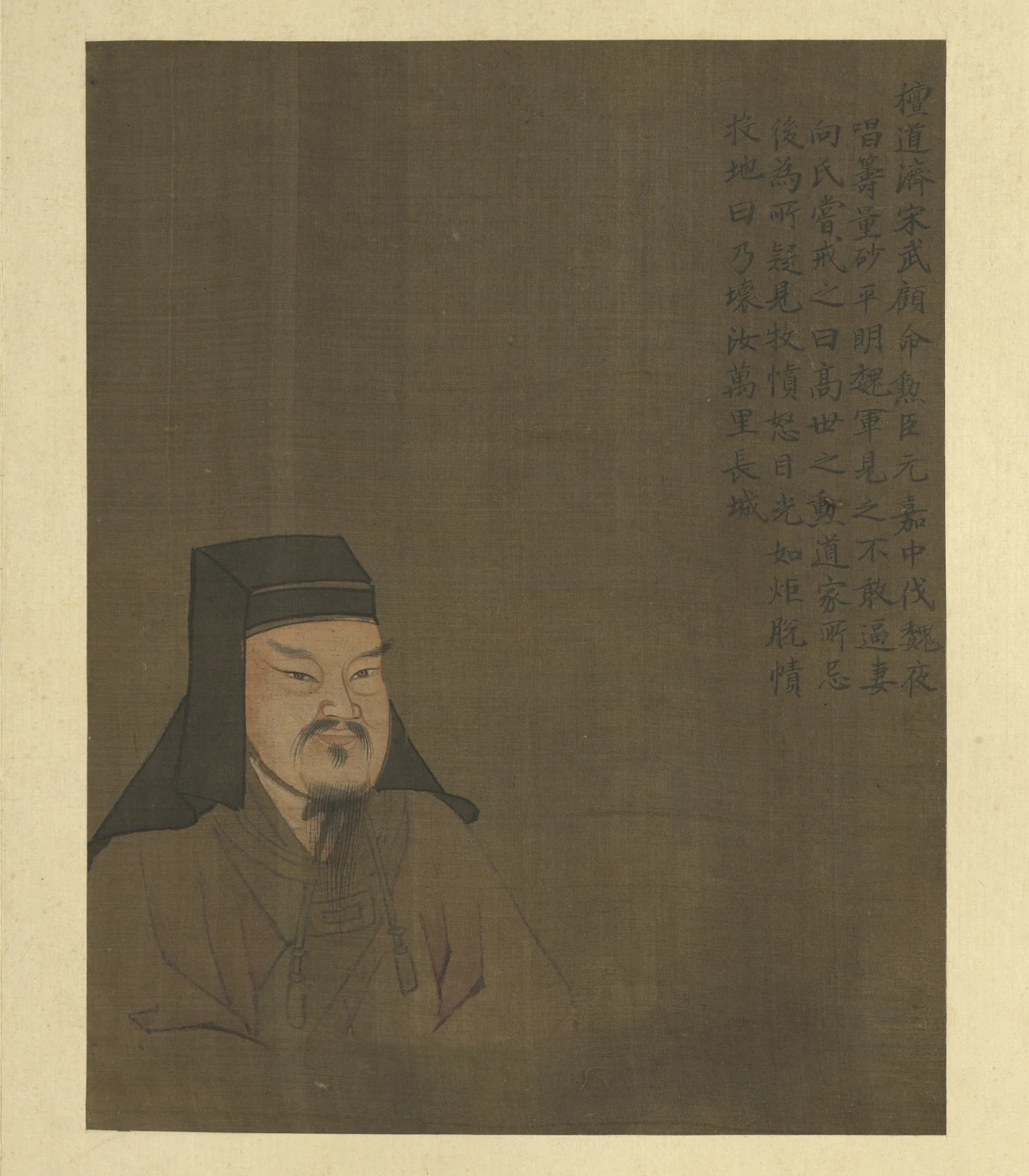
东晋末–南朝宋
Founding general of the Liu-Song of the Southern Dynasties
Tan Daoji
檀道济
Tan Daoji (died 436 AD) was a native of Jinxiang, Gaoping (modern Jinxiang County, Shandong Province). He was a paramount founding general and military strategist of the Liu Song dynasty and an illustrious commander of the Beifu Army during the late Eastern Jin period. In his early career, he joined his elder brothers Tan Shao and Tan Zhi in raising troops at Jingkou under Liu Yu to defeat the usurpation of Huan Xuan. During…
东晋末–南朝宋Eastern Jin
PROFILE
Tan Daoji (died 436 AD) was a native of Jinxiang, Gaoping (modern Jinxiang County, Shandong Province). He was a paramount founding general and military strategist of the Liu Song dynasty and an illustrious commander of the Beifu Army during the late Eastern Jin period. In his early career, he joined his elder brothers Tan Shao and Tan Zhi in raising troops at Jingkou under Liu Yu to defeat the usurpation of Huan Xuan. During Liu Yu's Northern Expedition against the Later Qin in 416 AD, Tan commanded the vanguard columns that captured Xuchang, Luoyang, and Tongguan, gaining immense renown. Following the establishment of the Liu Song dynasty, he was created Duke of Yongxiu and served successively as Senior General of Southern Subjugation, Governor of Jiangzhou, and Minister of Works (Sikong). Entrusted with the regency of the young Emperor Shaodi, he subsequently assisted Emperor Wen of Song (Liu Yilong). During the northern campaign of 431 AD, facing acute supply shortages and surrounding Xianbei cavalry, he devised the famous stratagem of "counting sand to measure grain" to withdraw his entire army intact without losing a single soldier. In his later years, his towering military prestige aroused the acute suspicion of Emperor Wen and the Prince of Pengcheng, Liu Yikang. In 436 AD, summoned to the capital, he was falsely accused of treason and executed alongside his eleven sons; facing death, he cast his headcloth to the ground and shouted indignantly: "You are destroying your own Great Wall!"
- Courtesy / Art Name
- Unknown
- Era
- Ancient times
- Dynasty
- Ancient times
- Identity
- Founding general of the Liu-Song of the Southern Dynasties
- Date of Birth
- Not recorded in historical sources
- Date of Death
- April 9 436
- Ethnicity
- Han
- Ancestral Home
- Jinxiang of Gaoping (present-day Jinxiang county, Shandong)
- Place of Birth
- Jinxiang of Gaoping (present-day Jinxiang county, Shandong)
- Place of Death
- Unknown
- Lifespan
- Unknown
- Highest Office
- Minister of Works、Prefect of Jiangzhou、Grand General Who Conquers the South、Duke Who Opens the State of Yongxiu County
- Major Offices
- Minister of Works、Prefect of Jiangzhou、Grand General Who Conquers the South、Duke Who Opens the State of Yongxiu County
- Peerage
- Baron of Zuotang county
- Major Achievements
- Slaying Huan Xuan and Lu Xun, Northern Expedition conquering Luoyang and Tongguan, retreat by 'counting sand to measure grain'
LIFE TIMELINE
Aged about twenty | Joined his brothers in following Liu Yu against Huan Xuan, serving as Adjutant of Established Martial Prowess.
Xunyang, Jiankang | Resisted the massive maritime rebellion of Lu Xun and Xu Daofu at Chapu, routing rebel fleets and serving as Adjutant of Central Troops and Prefect of Nanyang.
Aged about thirty | Served as General of Uplifting Martial Might and Prefect of Tianmen, suppressing Guo Jisheng at Zuotang, then joined Liu Daogui to defeat Huan Qian, Gou Lin, and Xu Daofu, promoted to Far-Pacifying Protector of Troops and Internal Historian of Wuling.
Jiangling, Jingzhou | Accompanied Liu Yu in pacifying Inspector of Jingzhou Liu Yi at Jiangling, promoted to General of Auxiliary State and Chancellor of Nanjun, enfeoffed as Baron of Zuotang County.
Xiangyang, Jiangling | Joined Liu Yu in campaigning against Sima Xiuzhi and Lu Zongzhi, storming fortified cities across northern Hubei, promoted to Adjutant of Central Troops to Grand Commandant.
Aged about forty | Appointed Adjutant to Liu Yifu and Prefect of Linhuai, with the title of Champion General.
Luoyang, Tongguan | Appointed Vanguard Commander-in-Chief for the Northern Expedition against Later Qin, capturing Xuchang, Luoyang, Shancheng, and Tongguan, defeating Yao Shao and winning top military honors.
Aged about forty-one | Commanded the vanguard of Liu Yu's northern expedition, conquering Xuchang, Luoyang, and Tongguan to destroy Later Qin, promoted to General of Mobilized Subjugation and Internal Historian of Langya.
Jiankang | Following the establishment of the Liu Song dynasty by Liu Yu, rewarded for dynastic founding merit with appointment as General of Army Protection and Prefect of Danyang, created Duke of Yongxiu County.
Aged about forty-five | Enfeoffed as Duke of Yongxiu County with a fief of two thousand households upon Liu Yu's dynastic founding, appointed Prefect of Danyang.
Jiankang | Upon Emperor Wu's critical illness, Tan Daoji, Xu Xianzhi, Fu Liang, and Xie Hui jointly received the testamentary decree as regents to support Emperor Shaodi Liu Yifu.
Aged about forty-eight | Commanded forces to relieve Dongyang, where Northern Wei armies retreated upon news of his approach.
Jiankang | Joined Xu Xianzhi in deposing the errant Shaodi and welcoming Emperor Wen Liu Yilong to the throne, appointed Senior General of Southern Subjugation and Inspector of Jiangzhou.
Aged about forty-nine | Participated in deposing Emperor Shaodi and installing Emperor Wen, advanced to General Who Conquers the North.
Jiangling, Jiankang | Following Emperor Wen's execution of Xu Xianzhi and Fu Liang, summoned to the capital to lead the naval and land expedition against Xie Hui in Jingzhou, whose forces dissolved upon seeing his banners.
Aged about fifty-one | Led the expedition that crushed the rebellion of Inspector of Jingzhou Xie Hui, promoted to Senior General of Southern Subjugation, Equal in Value to the Three Excellencies, and Inspector of Jiangzhou.
Henan, Huatai | Dispatched north by Emperor Wen to reinforce southern positions and recover Licheng following Dao Yanzhi's reverses against Northern Wei.
Lixia, Huatai | Led the northern relief expedition to Huatai, fought over thirty pitched battles, executed tactical deception by counting sand to measure grain when rations ran out, and safely withdrew intact to Licheng.
Aged about fifty-six | Campaigned against Northern Wei, winning numerous engagements to reach Licheng before executing the sand-counting withdrawal to preserve the army.
Jiankang, Xunyang | Returned to court, appointed Minister of Works (Sikong) and Commander of Jiangzhou, with his immense martial reputation revered across the realm.
Aged about fifty-seven | Advanced to Minister of Works, returning to his regional command at Xunyang.
Jiankang | Falsely accused of treason by Prince of Pengcheng Liu Yikang during Emperor Wen's grave illness, summoned to the capital and executed alongside his eleven sons; cried out upon arrest: 'You are destroying your own Great Wall!'
Aged about sixty | Executed by court faction fearful of his military fame during Emperor Wen's sickness, alongside his sons and trusted generals Xue Tong and Gao Jinzhi.
BIOGRAPHY
Biography
Ancestral Lineage and Uprising at Jingkou Tan Daoji hailed from Jinxiang in Gaoping (modern Jinxiang County, Shandong Province). His lineage migrated south across the Yangtze following the catastrophic Disaster of Yongjia during the Western Jin dynasty, eventually making their home in the northern garrison metropolis of Jingkou (modern Zhenjiang, Jiangsu). His great-grandfather Tan Tao served as General of Southern Pacification; his grandfather Tan Pin was an adjutant in Southern Garrison; and his father Tan Jin served as Gentleman Cavalier Attendant. Losing his father at a young age, Tan Daoji displayed filial piety, modesty, and exceptional deference to his elder brothers and sisters. His elder brothers Tan Shao and Tan Zhi, as well as his cousin Tan Pingzhi, were seasoned warriors renowned across the Beifu garrison commands. In 404 AD, the ambitious warlord Huan Xuan usurped the Eastern Jin throne and established the Chu state. Liu Yu rallied loyalist officers at Jingkou in a daring counter-coup. Tan Daoji and his family joined Liu Yu’s banner. In the subsequent combat, Tan Pingzhi fell in action, but Tan Daoji and his brothers fought through enemy cordons, crushing Huan Xuan’s vanguard at Fozhoushan and retaking Jiankang. For his valor, Tan was granted successive commissions in the frontline army. In 410 AD, the Five Pecks of Rice religious revolt led by Lu Xun and Xu Daofu surged northwards from Guangzhou, sweeping past the Southern Dynasties' heartland and threatening the capital. Tan Daoji spearheaded amphibious counterattacks at Chapu, shattering rebel barges and pursuing the insurgents towards Xunyang, contributing decisively to the total pacification of the southeastern coast. ### Northern Expedition and the Conquest of the Central Plains In 416 AD, following the death of Yao Xing of the Later Qin and internal fratricidal succession struggles in Guanzhong, Liu Yu launched a massive Northern Expedition. He appointed Tan Daoji and Wang Zhen'e as supreme vanguard commanders, leading infantry and cavalry columns through the Huai and Si river valleys. Tan maintained impeccable military discipline. His forces quickly overrun Xuchang, and the Later Qin garrison under Yao Guang surrendered. Tan marched directly onto Luoyang, the venerated former capital of Western Jin, routing Later Qin divisions under Yao Ha and Yao Ping. When the citizens of Luoyang welcomed the northern army with supplies and livestock, subordinate commanders advocated slaughtering thousands of captured enemy troops to erect a celebratory skull pyramid (jingguan) to instill terror. Tan resolutely prohibited this, declaring: "Our expedition aims to punish guilt and comfort the oppressed; how can we execute soldiers who have laid down their arms?" He released the prisoners and permitted them to return to their ancestral homes, winning widespread allegiance across the Central Plains. In 417 AD, Tan pushed westwards into Shanxi and Shaanxi, storming the impregnable gates of Tongguan. Facing desperate counter-offensives by Qin imperial general Yao Shao, Tan collaborated with Wang Zhen'e in repeated coordinated strikes until Yao Shao perished in exhaustion and defeat. Liu Yu’s main body arrived shortly after, resulting in the surrender of Yao Hong and the annihilation of Later Qin. ### Regency, Court Crises, and Pacifying Xie Hui In 420 AD, Liu Yu ascended the throne as Emperor Wu of Song, ushering in the Southern dynasties. For his extraordinary achievements, Tan was enfeoffed as Duke of Yongxiu and appointed General of Army Protection. In 422 AD, Emperor Wu fell critically ill. On his deathbed, he summoned Tan Daoji, Xu Xianzhi, Fu Liang, and Xie Hui, designating them as regents (gumeng dachen) to support Emperor Shaodi (Liu Yifu). However, Shaodi was capricious and neglectful of statecraft, prioritizing frivolous amusement while Northern Wei armies seized border garrisons. In 424 AD, the regents deemed him unfit to safeguard the dynasty; Tan led palace guards to enforce the abdication, and Emperor Wen (Liu Yilong) was installed. Emperor Wen soon determined to eradicate the overmighty regents who had slain his predecessor. In 426 AD, the Emperor summoned Tan Daoji to the capital. Tan chose obedience to sovereign legitimacy. Following the execution of Xu Xianzhi and Fu Liang, Emperor Wen dispatched Tan Daoji upriver to suppress the rebellion of Xie Hui in Jingzhou. Confident in his alliance with Tan, Xie was shattered upon seeing Tan's banners advancing across the Yangtze. Xie’s armies dissolved without a fight, cementing Emperor Wen’s uncontested rule. ### The Stratagem of Counting Sand to Measure Grain In 430 AD, Emperor Wen initiated the Yuanjia Northern Expedition under Dao Yanzhi to recover the Henan commands. When winter froze the Yellow River, Northern Wei Emperor Taiwu led tens of thousands of Xianbei horsemen south, rapidly encircling the fortress of Huatai. Emperor Wen rushed Tan Daoji north to restore the crumbling front. Arriving along the Qingshui River in early 431 AD, Tan clashed head-on with elite Wei cavalry led by generals Anping Gong and Shusun Jian. In thirty consecutive pitched battles, Tan deployed dense formations of infantry armed with heavy crossbows, repelling charge after charge and executing multiple enemy commanders. Nevertheless, Huatai fell before relief could arrive, and Wei raiders severed Song supply conduits. With rations entirely exhausted, Tan ordered a withdrawal. Northern Wei cavalry followed closely, seeking to encircle and annihilate the retreating column. Panic threatened to break the Song army. That night, Tan ordered his troops to assemble in camp under torchlight and loudly chant numbers while measuring grain: "One dou, two dou, three dou..." Wei scouts surveilling from nearby elevations saw mountain-sized piles of grain being recorded, completely unaware that the mounds consisted almost entirely of sand covered with a thin crust of actual rice. The following morning, Tan dressed in white civilian clothes, sat calmly in a carriage (suyu), and guided the orderly march forward. Convinced that the Song army was fully provisioned and attempting to bait them into an ambush, the Northern Wei cavalry dared not attack and withdrew. Through this brilliant tactical deception, Tan brought his entire force safely back across the frontier without the loss of a single soldier. ### Towering Prestige and the Destruction of the Great Wall Upon his triumphal return, Tan was elevated to Minister of Works (Sikong) and assigned to administer Jiangzhou. For years, he held undisputed supremacy among military commanders; his veteran officers were seasoned by decades of warfare, and his sons were all capable tacticians. In late 435 AD, Emperor Wen contracted a debilitating, persistent illness. The Emperor’s younger brother, Liu Yikang (Prince of Pengcheng), who held de facto executive authority, regarded Tan with mortal terror, fearing that upon the Emperor's impending demise, no court figure could bridle Tan’s immense military prestige. Liu Yikang conspired with Minister Liu Zhan to eliminate him. In spring 436 AD, under the pretext of border emergencies with Northern Wei, the court summoned Tan to Jiankang. Sensing mortal peril, Tan’s wife Xiang wept and implored him to mobilize his troops in self-defense, warning that summons during an imperial sickness boded certain doom. Tan replied: "All my life I have served the realm with unblemished loyalty; with Heaven as my witness, why should I harbor fear?" Upon arrival in Jiankang, Emperor Wen briefly rallied and intended to release Tan back to his station. However, the Emperor suffered a severe relapse and lapsed into a coma. Liu Yikang and Liu Zhan immediately forged an imperial decree accusing Tan of treason. Imperial guards arrested Tan and eleven of his sons, including Tan Zhi, Tan Can, and Tan Ti. Realizing the treachery, Tan was overcome with righteous fury. Before his execution, his eyes flashed with fire; tearing off his headcloth and throwing it violently to the pavement, he roared: "You are destroying your own Great Wall!" Tan and his entire line of sons, as well as trusted generals Xue Rong and Gao Jinzhi, were slaughtered on the same day. The destruction of Tan Daoji resonated tragically throughout Chinese military history. In 450 AD, Northern Wei Emperor Taiwu launched a catastrophic invasion that crushed Song border armies and advanced directly to Mount Guabu overlooking Jiankang across the Yangtze. Surveying the burning beacon towers from the ramparts of Jiankang, Emperor Wen wept in profound remorse and cried out: "Had Tan Daoji been alive, how could the northern barbarians ever have reached this shore!"
Tan Daoji was a native of Jinxiang in Gaoping of humble family. Losing both parents early, he was most punctilious in mourning and known for his gentle care of his elder brothers and sisters. In 404 he went with two brothers to Liu Yu, and after entering Jiankang became an aide to Liu Yu as general and then an aide on the western expedition. He took Lushan and captured enemy commanders, being made a general of the state and governor of Nanyang and rising by degrees on military merit.
In Liu Yu's northern campaign against the Later Qin he led the vanguard, taking Luoyang and Tongguan and winning merit for the campaign's success. After the Liu Song was founded he served as governor of Nanyang and general of the north, fighting long along the middle Yangtze against the Northern Wei and in the Huai districts. In 431, sent to relieve Huatai, he had to withdraw for want of food and deceived the Wei army on the march by counting sand as if measuring grain, bringing his army back intact — the stratagem becoming famous in Chinese military history.
His high reputation and capable officers made the court wary of him. In 436, when Emperor Wen was gravely ill, the Prince of Pengcheng, Liu Yikang, had him arrested on a forged edict and executed with several of his sons. He is said to have cried out before his death that they had destroyed their own Great Wall — words long remembered. His death cost the Liu Song an experienced commander, and the wars with the Northern Wei went badly afterward, a turning point later writers on the dynasty's frontier often cite.
The vanguard he led in Liu Yu's northern campaign was among the most effective forces of the late Eastern Jin; in the later wars with the Northern Wei he often commanded in chief, his experience supporting the dynasty's frontier in its early years. The stratagem of counting sand as grain is recorded in the histories of Song and of the Southern Dynasties, showing that he kept his troops in order even in retreat.
His position at court reflects the tension between clan and meritorious ministers in the early Liu Song: with Emperor Wen often ill in his last years, the clan and favorites guarded against commanders who might threaten the succession, and his killing came of that setting. The dynasty's military strength was weakened afterward and the northern campaigns of the Yuanjia years failed repeatedly, later writers generally connecting the two.
Major Activities
Relieving Qingzhou and Defending Dongyang
In 423 CE, during the reign of Emperor Shaodi, Northern Wei seized upon the death of Liu Yu to launch a major southern invasion, besieging Zhu Kui, Inspector of Qingzhou, in Dongyang. The Liu Song court granted Tan Daoji imperial emblems and overall command, dispatching him alongside Wang Zhongde to relieve the city. Intimidated by Tan's swift approach, Northern Wei forces burned their siege engines and camps before retreating. Tan entered Dongyang, opened deep underground granaries to mill ancient stores for rations, relocated the devastated provincial seat to Buqi City, and anchored the southern defensive perimeter at Guangling to halt further Wei incursions.
Regent Service and the Collapse of Xie Hui
In 422 CE, on his deathbed, Liu Yu appointed Tan Daoji, Xu Xianzhi, Fu Liang, and Xie Hui as co-regents. When Xu Xianzhi and his allies orchestrated the deposition of Shaodi, Tan Daoji slept peacefully at Xie Hui's headquarters while Xie spent the night in sleepless terror, earning Xie's profound admiration for his composure. In 426 CE, when Emperor Wen moved against the regent faction and dispatched Dao Yanzhi to confront Xie Hui in Jiangling, Dao Yanzhi was pushed back to Yinki. When Tan Daoji arrived in the field with reinforcements, Xie Hui's troops, who believed Tan had been executed in the capital, panicked and dissolved without offering battle, securing Emperor Wen's throne.
The Campaign of Shouzhang and the Sand-Counting Stratagem
In 431 CE, during the northern expedition to relieve Huatai, Tan Daoji engaged Northern Wei Duke of Anping at Shouzhang in Dongping, crushing hostile forces alongside Wang Zhongde and Duan Hong. Advancing to Gaoliang Pavilion, his detachments intercepted and slew Wei general Xiji Kujie. Though forced to retreat when Huatai fell and supplies ran out, Tan faced aggressive pursuit after a defector disclosed his army's starvation. Displaying consummate composure, Tan ordered his men at night to loudly count sand piles covered with thin layers of rice. Wei scouts concluded the defector had lied, prompting the Wei command to execute the informant and abandon pursuit, allowing Tan to lead his army intact back to Licheng. In his later years governing Jiangzhou, he also visited the impoverished poet Tao Yuanming with gifts of wine and delicacies, reflecting his refined patronage of scholars.
The Conquest of Luoyang and Tongguan During the 416 AD Northern Expedition, Tan Daoji directed vanguard armies to conquer Western Jin's ancestral capitals, capturing Xuchang, securing Luoyang, releasing captured combatants to win the populace, and breaking the formidable defenses of Tongguan, sealing the destruction of the Later Qin state. ### The Stratagem of Counting Sand to Measure Grain In 431 AD, surrounded by overwhelming Northern Wei cavalry and facing utter starvation, Tan Daoji conceived the legendary deception of "counting sand to measure grain" and calm carriage progression, completely outwitting Wei leadership and executing an immaculate strategic withdrawal. ### Guardianship and Foundation of the Liu Song Dynasty Serving across three reigns, Tan fulfilled the dying trust of Liu Yu, suppressed domestic rebellions by Lu Xun, Liu Yi, and Xie Hui, and stabilized internal court politics, acting as the indispensable martial cornerstone for the peace and prosperity of the Yuanjia era. ### The Great Wall Prophecy and Legacy Defiantly prophesying the vulnerability of the realm with his dying condemnation "You are destroying your own Great Wall!", Tan Daoji became the eternal archetype of the tragic hero destroyed by court jealousy, while his military exploits provided the tactical inspiration for classical maxims such as "running away is the best choice" in the Thirty-Six Stratagems.
Personal Relations
- Great-Grandfather: Tan Tao (General of Southern Pacification, Eastern Jin)
- Grandfather: Tan Pin (Adjutant in Southern Garrison, Eastern Jin)
- Father: Tan Jin (Gentleman Cavalier Attendant, Eastern Jin)
- Cousin: Tan Pingzhi (General of Eastern Jin loyalist uprising)
- Brothers: Tan Shao (General of Southern Pacification, Liu Song), Tan Zhi (General of the Right)
- Wife: Lady Xiang (Wise matriarch who warned Tan against visiting the capital)
- Sons: Tan Zhi, Tan Can, Tan Ti, Tan Mian, Tan Yan, Tan Xu, Tan Yan, Tan Zan, Tan Gui, Tan Rong, Tan Bo (all perished in 436 AD)
- Subordinate Generals: Xue Rong, Gao Jinzhi (famed combat officers executed alongside Tan)
- Sovereigns: Liu Yu (Emperor Wu of Song), Liu Yifu (Emperor Shaodi), Liu Yilong (Emperor Wen of Song)
- Adversaries & Political Rivals: Liu Yikang (Prince of Pengcheng), Liu Zhan, Yao Hong, Yao Shao, Emperor Taiwu of Northern Wei, Shusun Jian, Xie Hui
Historical Assessment
- *Book of Song (Song Shu)*: "Tan Daoji established extraordinary achievements in previous reigns; his reputation was towering, his veteran followers had survived a hundred engagements, and his sons possessed exceptional talent, filling the court with apprehension... Facing death, he threw his headcloth upon the ground and said: 'You are destroying your own Great Wall!'"
- *History of the Southern Dynasties (Nan Shi)*: "Tan Daoji aroused the fatal jealousy of the imperial princes; his fury upon throwing his headcloth was the enduring grief of a loyal subject. Once the Great Wall was dismantled, Jiangnan possessed no bulwark against northern horsemen."
- Emperor Wen of Song: "Had Tan Daoji been here, how could things have come to such a pass!"
- Emperor Taiwu of Northern Wei: "Now that Tan Daoji is dead, the southern lands are no longer worth our concern."
- Sima Guang: "Tan Daoji rendered monumental services to the dynasty; Emperor Wen slaughtered him out of sheer paranoia, cutting off his own limbs. Consequently, the Tabgatch armies were able to drive unhindered to drink from the Yangtze."
- Wang Fuzhi: "Tan Daoji’s stratagem of counting sand demonstrated intelligence capable of holding off a hundred thousand barbarians. Emperor Wen destroyed his own Great Wall to indulge Liu Yikang's petty malice; the persistent military fragility of the Southern Dynasties dates from this tragedy."
- Zhao Yi: "Emperor Wen executed Tan Daoji and thereby leveled his own Great Wall, culminating directly in the mortal crisis at Guabu."
- Mao Zedong: "Tan Daoji's counting sand to measure grain is an outstanding classical model of turning illusion into reality and mastering crisis through absolute composure."
FIGURES ASSOCIATED WITH THIS DYNASTY
Bibliography
- Shen Yue, Book of Song (Song Shu), Volume 43, Biography 3: Tan Daoji
- Li Yanshou, History of the Southern Dynasties (Nan Shi), Volume 15, Biography 5: Tan Daoji
- Fang Xuanling et al., Book of Jin (Jin Shu), Volume 85