Ninth day of the first lunar month | Born in Qixia, Dengzhou, Shandong.
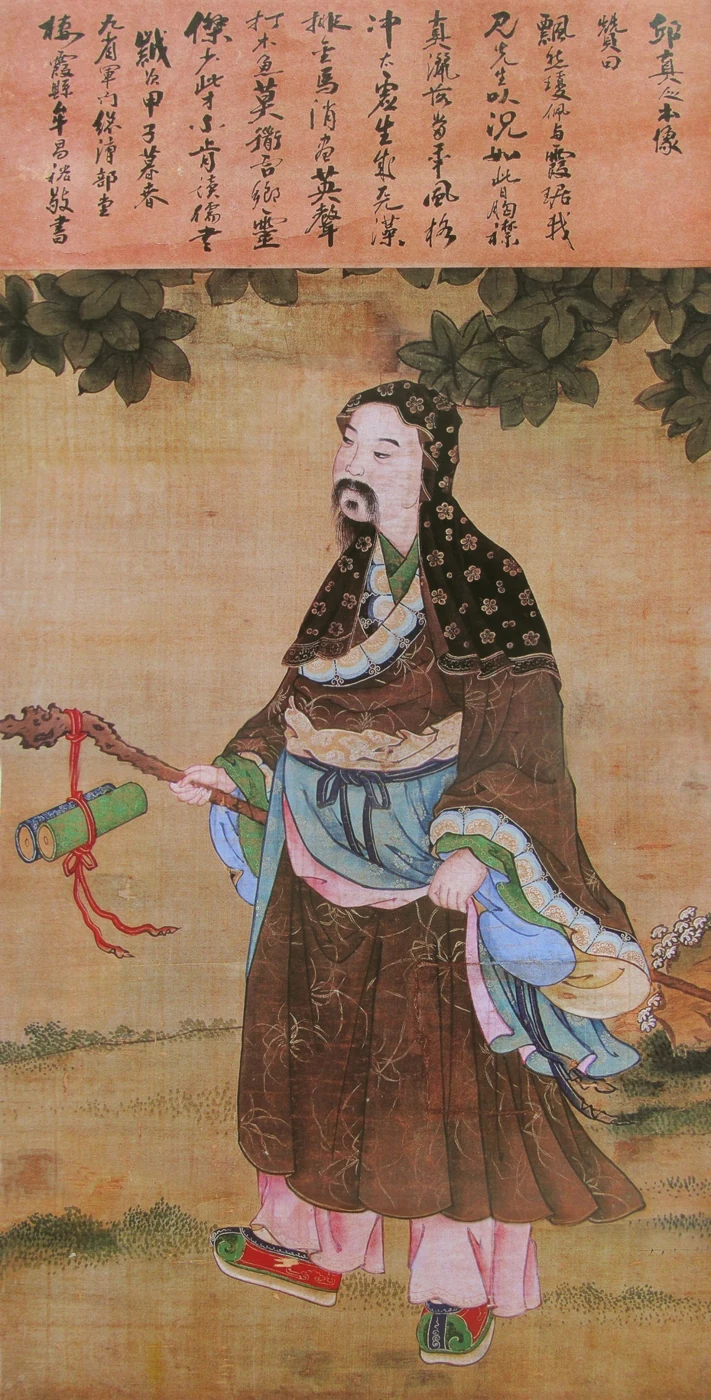
1148 CE–1227 CE
Daoist priest
Qiu Chuji
丘处机
Qiu Chuji (1148–1227), courtesy name Tongmi and Daoist name Changchunzi, was a native of Qixia in Dengzhou, now part of Yantai, Shandong. A prominent Daoist at the transition from the Jin to the Yuan, he was one of the “Seven Masters of the North” of the Quanzhen tradition, the fifth leader of Quanzhen Daoism, and regarded as the patriarch of the Longmen lineage. At the age of seventy-four he traveled far into the Western…
1148 CE–1227 CEYuan Dynasty
PROFILE
Qiu Chuji (1148–1227), courtesy name Tongmi and Daoist name Changchunzi, was a native of Qixia in Dengzhou, now part of Yantai, Shandong. A prominent Daoist at the transition from the Jin to the Yuan, he was one of the “Seven Masters of the North” of the Quanzhen tradition, the fifth leader of Quanzhen Daoism, and regarded as the patriarch of the Longmen lineage. At the age of seventy-four he traveled far into the Western Regions and met Genghis Khan at the khan's residence in the Snow Mountains. He advised the Mongol ruler with teachings summarized as “revere Heaven and cherish the people,” “purify the heart and lessen desires,” and “restrain killing and protect the people.” The account credits his counsel with helping reduce Mongol killing in the Central Plains and preserving many lives. Genghis Khan honored him as a “divine immortal,” bestowed the title Master Changchun, and ordered him to oversee Daoism throughout the realm. Under Qiu Chuji's leadership, Quanzhen Daoism reached its height in the Yuan and became one of the period's most influential Daoist traditions. In 1269, the sixth year of Zhiyuan under Emperor Shizu of Yuan, he was posthumously granted the title “Perfected Lord Changchun, Chief Instructor Who Expounds the Dao,” and in 1310, the third year of Zhida under Emperor Wuzong, he received the further title “Perfect Lord Changchun of Complete Virtue, Divine Transformation, and Manifest Response.”
- Other names
- Master Changchun, Qiu Changchun
- Courtesy name
- Tongmi
- Period
- Yuan
- Date of Birth
- February 10 1148
- Date of Death
- August 22 1227
- Dynasty/State
- Yuan
- Identity
- Daoist priest
- Ethnicity
- Not reliably confirmed by historical sources
- Ancestral home
- Qixia, Dengzhou (now part of Yantai, Shandong)
- Place of birth
- Unknown
- Age at Death
- Unconfirmed; not explicitly stated in the
- Place of death
- Unknown
- Highest office
- See Biography and Major Activities
- Major achievements
- Leader of Quanzhen Daoism at the Jin-Yuan transition; traveled west to meet Genghis Khan in the Snow Mountains and urged restraint in killing; honored as Master Changchun.
LIFE TIMELINE
Age nineteen | Became a disciple of Wang Chongyang, who gave him the religious name Chuji, courtesy name Tongmi, and sobriquet Changchunzi.
Age twenty-two | Wang Chongyang died in Bianliang; Qiu accompanied Ma Yu and others in escorting his coffin for burial at Zhongnan Mountain.
Age twenty-six | After completing mourning, entered Shaanxi and lived in a cave at Panxi for austere cultivation.
Age thirty-two | Moved to Longmen Mountain and undertook seven further years of intensive cultivation.
Age thirty-eight | In winter, returned to Zhongnan Mountain to manage the ancestral monastery, Chongyang Wanshou Palace.
Age forty | Summoned by Emperor Shizong of Jin to Yanjing, presided over ritual services for the Wanshou Festival, and received three imperial audiences.
Age forty-three | Returned east to Qixia after Emperor Zhangzong of Jin restricted Daoism and converted his former residence into Taixu Abbey.
Age fifty-five | After Liu Chuxuan's death, succeeded him as the fifth leader of Quanzhen Daoism.
Age sixty-six | At the request of the Jin imperial son-in-law Pusan Anzhen, helped induce the Shandong rebels led by Yang An'er to surrender; received the title “Master of Natural Response and Expansive Teaching.”
Age sixty-eight | Summoned by Emperor Xuanzong of Jin to Bianliang but declined to go.
Age seventy-one | Emperor Ningzong of Southern Song sent envoys to summon him, which he declined; in the fifth month Genghis Khan sent Liu Zhonglu with an edict inviting him.
Age seventy-two | In the first month, departed from Haotian Abbey in Laizhou with eighteen disciples on his westward journey.
Age seventy-three | Passed through Zhenhai City, leaving nine disciples there to build Qixia Abbey; reached Samarkand in winter.
Age seventy-four | In the fourth month reached Genghis Khan's residence at Baluwan in the Great Snow Mountains, identified with the Hindu Kush; met the khan three times in autumn and winter to discuss the Dao.
Age seventy-five | Took leave and began the journey east; Genghis Khan issued an edict exempting Quanzhen institutions from taxation and corvée; reached Xuande Prefecture in winter.
Age seventy-six | In the second month, accepted an invitation from Yanjing officials to preside over Tianchang Abbey; used imperial certificates of ordination to free twenty to thirty thousand people who had been captured and enslaved.
Death; age unconfirmed | In the fifth month Genghis Khan ordered Tianchang Abbey renamed Changchun Palace, granted Qiu a golden tiger tally, and ordered him to oversee Daoism throughout the realm; on the ninth day of the seventh lunar month, Qiu died in Baoxuan Hall of Changchun Palace.
BIOGRAPHY
Biography
Family Background and Early Life Qiu Chuji's birth name is unknown. He was born on February 10, 1148, corresponding to the nineteenth day of the first lunar month in the eighth year of Huangtong under Emperor Xizong of Jin, in Qixia, Dengzhou, Shandong. Qixia lies on the Jiaodong Peninsula, an area with a long tradition of Daoist belief. Qiu lost both parents at an early age and was raised by an elder brother. Daoist works such as Jinlian Zhengzong Ji state that he was exceptionally intelligent as a youth, read widely, was especially interested in Daoist learning, and cared little for worldly rank. In 1166, the sixth year of Dading, the nineteen-year-old Qiu began studying the Dao. The following year, in Ninghai Prefecture in Shandong, now Muping, he became a disciple of Wang Chongyang, founder of Quanzhen Daoism. Wang gave him the religious name “Chuji,” the courtesy name “Tongmi,” and the Daoist sobriquet “Changchunzi.” Wang Chongyang was a Jin-period Daoist reformer who advocated a synthesis of Confucianism, Buddhism, and Daoism under the ideal of “Quanzhen,” stressing cultivation of both inner nature and vital life and the purification of the mind from desire. Qiu followed Wang closely and was considered deeply attuned to his teaching. Together with Ma Yu, Tan Chuduan, Liu Chuxuan, Wang Chuyi, Hao Datong, and Sun Bu'er, he became known as one of the Seven Masters of Quanzhen. From 1168 to 1170, the eighth through tenth years of Dading, Qiu accompanied Wang Chongyang in spreading the teaching through Wendeng, Ninghai, Fushan, Dengzhou, and Laizhou in Shandong, establishing the “Three Prefectures and Five Associations.” Quanzhen Daoism spread rapidly across the Jiaodong Peninsula. In spring 1170, the tenth year of Dading, Wang Chongyang died in Bianliang, present-day Kaifeng, Henan. Qiu, Ma Yu, Tan Chuduan, Liu Chuxuan, and others escorted their teacher's coffin westward. In 1172, the twelfth year of Dading, they buried Wang at Liujiang Village at Zhongnan Mountain in Shaanxi, later building Chongyang Wanshou Palace there as the ancestral center of the Quanzhen tradition. ### Austere Cultivation at Panxi and Longmen After Wang Chongyang's death, Qiu did not immediately set out to preach. Instead he chose a demanding period of ascetic cultivation. In 1174, the fourteenth year of Dading, after completing the mourning period, he traveled west to Panxi near Baoji in Shaanxi and lived in a cave beside the stream for six years. Panxi was traditionally associated with Jiang Taigong's fishing. Qiu lived in extreme poverty, begging for one meal a day, sleeping on a single mat, wearing a straw rain cape and hat, and becoming known as “Master Straw-Cape.” In his Panxi Ji he described this period as one of enduring hunger, cold, and hardship. He nevertheless persisted and treated asceticism as a necessary discipline for refining the mind. In 1180, the twentieth year of Dading, Qiu left Panxi for Longmen Mountain in Longzhou, in the area of modern Long County, Baoji, and continued intensive cultivation for seven years. The mountain lay in a remote valley. There he studied methods of inner alchemy and gradually developed his own system of religious cultivation. After thirteen years of austerities, his spiritual reputation grew. In winter 1186, the twenty-sixth year of Dading, he returned by invitation to Zhongnan Mountain to manage Chongyang Wanshou Palace, further strengthening Quanzhen's base in the Guanzhong region. ### Encounters with the Jin Court and Return to Qixia In spring 1188, the twenty-eighth year of Dading, Emperor Shizong of Jin, Wanyan Yong, summoned Qiu Chuji to Yanjing, present-day Beijing. This was Qiu's first direct contact with the supreme ruler. Emperor Shizong was devoted to Daoism and treated him with marked respect, personally giving him a large peach as a sign of favor, ordering him to preside over ritual services for the Wanshou Festival, and granting him three audiences in which he was asked about self-cultivation and government. Shizong also ordered an image of Wang Chongyang installed in a palace shrine, helping expand Quanzhen influence and prestige. Qiu remained in Yanjing for half a year and was permitted to return to Zhongnan Mountain in autumn. The favorable situation did not last. In 1190, the first year of Mingchang, Emperor Zhangzong of Jin banned Daoist activities on the grounds that they “misled the populace,” restricting Quanzhen work in Shaanxi. In winter 1191, Qiu led some disciples east to his native Qixia. There he enlarged his former home into Taixu Abbey, locally known as Bindugong, and continued teaching. The abbey occupied more than 86,000 square meters. In 1207, the seventh year of Taihe, Emperor Zhangzong personally granted the plaque “Taixu Guan” and bestowed 6,000 fascicles of the Xuandu Baozang. The abbey flourished and was praised as the foremost Daoist establishment of the east. In 1203, the third year of Taihe, Liu Chuxuan, the fourth leader of Quanzhen Daoism, died, and Qiu succeeded him as fifth leader. From then until 1219, he preached widely in Penglai, Zhiyang, Yexian, Beihai, Jiaoxi, and other areas of Shandong, greatly expanding Quanzhen influence on the Jiaodong Peninsula. ### Pacifying Rebels and Refusing Jin and Song Summonses In autumn 1214, the second year of Zhenyou, a peasant rebellion led by Yang An'er broke out in Dengzhou and Ninghai Prefecture in Shandong. Pusan Anzhen, an imperial son-in-law of the Jin, was ordered to suppress it, but the rebels used mountainous terrain and could not easily be eliminated. Knowing Qiu's great local prestige, Pusan Anzhen asked him to mediate. Qiu personally entered the rebel camp and, according to the account, persuaded Yang An'er and others to accept pacification, after which Dengzhou and Laizhou soon returned to order. The Jin court rewarded him with the title “Master of Natural Response and Expansive Teaching.” Qiu's attitude toward the Jin court nevertheless grew more distant. In 1216, the fourth year of Zhenyou, Emperor Xuanzong of Jin sent Wang Tingyu of the Dongping army to summon him to Bianliang, to which the Jin capital had moved. Qiu declined, judging the Jin emperor guilty of “unbenevolent wrongdoing.” In summer 1219, the third year of Xingding, Emperor Ningzong of Southern Song sent the commanders Li Quan and Peng Yibin with an edict inviting him to Lin'an, present-day Hangzhou. Qiu likewise declined, considering the Southern Song ruler guilty of “failures of government.” At this point the Jin was weakening and Southern Song remained militarily frail; the narrative presents Qiu as observing the political situation and awaiting a true “ruler of Heaven's mandate.” ### Westward Journey to Meet Genghis Khan In the fifth month of 1219, while campaigning against Khwarazm, Genghis Khan sent the trusted official Liu Zhonglu with an edict inviting Qiu Chuji to meet him. The edict was earnest and expressed admiration. Liu reached Haotian Abbey in Laizhou in the twelfth month. Qiu initially hesitated and repeatedly declined, but after receiving a further sincere edict from Genghis Khan, he said, “I act in accordance with the principles of Heaven; where Heaven's envoy goes, I dare not disobey,” and resolved to travel. In the first month of 1220, at the age of seventy-three, Qiu selected eighteen disciples, including Zhao Daojian, Song Dao'an, Yin Zhiping, and Li Zhichang, and left Haotian Abbey in Laizhou for the west. Several months later he reached Yanjing and stayed at Yuxu Abbey. Genghis Khan was already campaigning in Central Asia. Because of his age, Qiu hoped the khan would come to Yanjing and submitted a memorial, but Genghis Khan, occupied with warfare, replied by edict asking him to continue west. In spring 1221, Qiu's party resumed the journey. After leaving Juyong Pass they crossed the southern Mongolian steppe, met Genghis Khan's younger brother Temüge Otchigin north of the Gobi, and continued west. At Zhenhai City, following Tian Zhenhai's advice, Qiu left nine disciples, including Song Dao'an and Li Zhichang, to build Qixia Abbey. The party then passed Uighur settlements, Changbalach, Almaliq, and Sayram, reaching Samarkand in winter. In April 1222, after considerable hardship, Qiu finally arrived at Genghis Khan's residence at Baluwan in the “Great Snow Mountains,” identified with the Hindu Kush in present-day Afghanistan. Because Genghis Khan was born in the Year of the Horse and Qiu in the Year of the Dragon, later accounts called the meeting a “meeting of dragon and horse.” During the autumn and winter of that year, Genghis Khan summoned Qiu three times to discuss government and longevity. Qiu replied that governing the realm should be based on “revering Heaven and cherishing the people,” that the way to long life lay in “purifying the heart and lessening desires,” and that anyone who wished to unify the realm “must not delight in killing people.” Genghis Khan strongly approved of his words, treated him with great respect, and addressed him as “divine immortal.” The khan ordered Yelü Chucai to compile their conversations as Xuanfeng Qinghui Lu. ### Final Years, Leadership of Quanzhen, and Death In spring 1223, the second year of Yuanguang, Qiu asked leave to return east. Genghis Khan issued an edict exempting Quanzhen institutions from taxes and corvée and sent military escorts along the route. In winter the party reached Xuande Prefecture, present-day Xuanhua in Hebei. In February 1224, the first year of Zhengda, Qiu accepted the invitation of Shimo Xiandebu, an official of the Yanjing Branch Secretariat, to preside over Tianchang Abbey. Quanzhen Daoism was then at the height of its influence in Yanjing, where followers organized the eight associations of Pingdeng, Changchun, Lingbao, Changsheng, Mingzhen, Ping'an, Xiaozai, and Wanlian. That year Qiu used the imperial edicts granted by Genghis Khan to issue large numbers of Daoist ordination certificates and rescue Han Chinese who had been captured and enslaved by Mongol troops. The History of Yuan, “Biography of Qiu Chuji,” states that after his return to Yanjing he sent disciples carrying registers and plaques to search among the survivors of warfare, restoring to commoner status people who had become slaves and saving those near death, “numbering in all some twenty or thirty thousand; people of the Central Plains still praise him for this.” The effect was considerable. People from many social strata entered the Quanzhen order, literati and officials considered association with Quanzhen priests prestigious, and other Daoist groups, and even some Buddhist monasteries, adopted Quanzhen banners. In the fifth month of 1227, the fourth year of Zhengda, Genghis Khan ordered Tianchang Abbey renamed Changchun Palace, the northern palace island renamed Wan'an Palace, and granted Qiu a “golden tiger tally,” directing that “all Daoist affairs be disposed of by the Divine Immortal,” effectively placing him in charge of Daoism across the realm. The edict also said, “I constantly think of the Divine Immortal; may the Divine Immortal not forget me,” reflecting the honor accorded to him. On the ninth day of the seventh lunar month, August 22, 1227, Qiu died in Baoxuan Hall of Changchun Palace with age at death unconfirmed. Three days later, Genghis Khan also died, in Qingshui County, Gansu. One year after Qiu's death, his disciples buried him in Chushun Hall of Changchun Palace, now the Qiu Patriarch Hall of Beijing's White Cloud Temple. In 1269, the sixth year of Zhiyuan under Kublai Khan, Emperor Shizu of Yuan, he was posthumously granted the title “Perfected Lord Changchun, Chief Instructor Who Expounds the Dao.” In 1310, the third year of Zhida under Emperor Wuzong, he received the further title “Perfect Lord Changchun of Complete Virtue, Divine Transformation, and Manifest Response.” A cenotaph containing his clothing and cap stands at Shangqing Palace on Mount Lao in Shandong.
Major Activities
Westward Journey and Advocacy of Restraint in Killing The account presents the greatest achievement of Qiu Chuji's life as his journey to the Western Regions at the age of seventy-three to urge Genghis Khan to restrain killing and care for the people. At the time the Mongol Empire was expanding rapidly, and warfare brought widespread destruction. Qiu argued from principles summarized as “revere Heaven and cherish the people” and “purify the heart and lessen desires,” saying that from emperors down to commoners, social rank might differ but life itself was shared, and that one who wished to unify the realm “must not delight in killing people.” The later moderation of Mongol policy toward the Central Plains had multiple causes, but the source credits Qiu's discussions in the Snow Mountains with an important influence. After his return, he continued urging Mongol and Yuan commanders to reduce killing. Later generations summarized his merit as “one word stopped killing.” An imperial couplet attributed to the Qianlong Emperor at White Cloud Temple reads: “For eternal life, there is no need to dine on rosy vapors in search of secret formulas; with one word that stopped killing, one first understands the extraordinary merit of saving the world.” ### Leadership of Quanzhen Daoism Qiu led Quanzhen Daoism for twenty-four years, from 1203 to 1227, a decisive period in its development. He inherited Wang Chongyang's ideal of harmonizing the Three Teachings and regarded purification of the heart and reduction of desire as the foundation of Daoist practice, with cultivation of both inner nature and vital life as essential. Politically, he understood that Daoism's expansion depended on support from rulers, and he successively won the confidence of Emperor Shizong of Jin and Genghis Khan. After returning from the west, he used the tiger tally and sealed edicts granted by Genghis Khan to issue ordination certificates widely, establish eight associations including Pingdeng, Changchun, and Lingbao, build many temples and monasteries, and conduct communal rituals. With Yuan state support, Quanzhen Daoism entered what was described as an unprecedented period of prosperity. The Longmen lineage associated with him later became the principal line of Quanzhen transmission and remains influential. ### Writings and Teachings Qiu is credited with the six-juan Panxi Ji, preserved in the Zhengtong Daozang, a collection of poetry and prose recording his experiences and religious reflections during his Panxi and Longmen years. He is also credited with the two-juan Dadan Zhizhi, a systematic treatment of inner-alchemical theory and practice, though its authorship is disputed and some scholars assign it to the Shi Jianwu tradition, and with the one-juan Shesheng Xiaoxi Lun, included in the Daozang Jinghua Lu, on methods of nourishing life. His disciple Li Zhichang wrote Travels to the West of Master Changchun from the westward journey, a work of major historical-geographical value. Yelü Chucai, acting on Genghis Khan's orders, compiled the conversations between Qiu and the khan as Xuanfeng Qinghui Lu, a primary source for Qiu's political thought. ### Social Relief Although a religious recluse, Qiu remained concerned with social conditions. In 1214 he mediated at the Jin court's request in the Yang An'er rebellion in Shandong, helping avert further bloodshed. After returning from his western journey, he used imperial ordination certificates to rescue large numbers of captives from slavery, restoring twenty to thirty thousand people to commoner status. He also organized ritual prayers for rain and disaster relief. Under his influence, Quanzhen communities engaged in relief work during periods of war, sheltering refugees and providing medicine and aid; the source credits such activity with contributing to social recovery and stability in the Central Plains.
Personal Relations
- Master: Wang Chongyang, under whom Qiu Chuji was ordained in 1167 (7th year of Dading).
- Fellow disciples: Ma Yu, Tan Chuduan, Liu Chuxuan, Wang Chuyi, Hao Datong and Sun Bu'er, known together with Qiu as the "Seven Perfected of Quanzhen".
- Disciples: the eighteen who accompanied his westward journey; nine were left at Zhenhai City to found the Qixia Abbey.
- His summoner: Genghis Khan, whom Qiu travelled west to meet between 1220 and 1222.
Historical Assessment
Yuan and Contemporary Assessments Jinlian Zhengzong Ji, written by Quanzhen Daoists, records a contemporary assessment that Qiu's merit “allowed half of four hundred prefectures to obtain peaceful life” and that the people who escaped disaster numbered beyond calculation. The passage presents his greatest contribution not as personal cultivation or successful religious propagation, but as saving people in a time of crisis. In 1269, the sixth year of Zhiyuan under Kublai Khan, Emperor Shizu of Yuan, Qiu was posthumously granted the title “Perfected Lord Changchun, Chief Instructor Who Expounds the Dao”; in 1310, the third year of Zhida under Emperor Wuzong, he received the further title “Perfect Lord Changchun of Complete Virtue, Divine Transformation, and Manifest Response,” reflecting the Yuan court's approval of his merits. The History of Yuan, “Biography of Qiu Chuji,” states that after his return to Yanjing he sent disciples carrying documents to search among the survivors of warfare, restoring to commoner status those who had become slaves and reviving those close to death, “numbering in all some twenty or thirty thousand; the people of the Central Plains still praise him for it.” ### Ming and Qing Periods The History of Yuan, compiled under the direction of Song Lian in the early Ming, placed Qiu in the “Biographies of Buddhists and Daoists” and recorded in detail his westward journey and advocacy of restraint in killing, affirming the merit later summarized as “one word stopped killing.” The Qianlong Emperor of the Qing is credited with a couplet at White Cloud Temple in Beijing: “For eternal life, there is no need to dine on rosy vapors in search of secret formulas; with one word that stopped killing, one first understands the extraordinary merit of saving the world.” The phrase “one word stopped killing” became a common later summary of Qiu's historical contribution. In Ming popular drama, when priests of the Zhengyi, Maoshan, and Quanzhen traditions meet, the Quanzhen priest invokes the achievement of Patriarch Qiu Changchun in persuading the Mongol khan and preventing the Central Lands from being completely slaughtered. The other two express admiration. The story indicates how deeply Qiu's reputation as a savior from killing had entered popular memory by the Ming. ### Modern Assessments Chen Yuan's Study of the New Daoist Movements of Hebei in the Early Southern Song systematically examined Quanzhen's development around the Jin-Yuan transition and regarded Qiu as the key figure who transformed it from a regional sect into a nationwide religious movement. Modern scholars generally regard Qiu's journey to meet Genghis Khan as a major event in religious history. His advocacy of restraint in killing is often credited with helping moderate Mongol policies toward conquered populations and with contributing to the preservation of society and culture in the Central Plains. Some scholars, however, have questioned the later narrative of “one word stopped killing.” Huang Yi, a historical columnist for Beijing Evening News, argued that the claim lacks reliable documentary support and contains several errors, suggesting that later generations exaggerated Qiu's role. Anthropologist Jack Weatherford went further in his work, calling Qiu a “greedy charlatan.” These disputes illustrate the multidimensional nature of historical evaluation, while Qiu's place as a central figure in the revival and expansion of Quanzhen Daoism remains secure in Daoist history.
FIGURES ASSOCIATED WITH THIS DYNASTY
Bibliography
- History of Yuan*, vol. 202, “Biography of Qiu Chuji,” compiled by Song Lian and others
- New History of Yuan*, vol. 243, “Biography of Qiu Chuji,” by Ke Shaomin
- Qing Xitai, History of Chinese Daoism