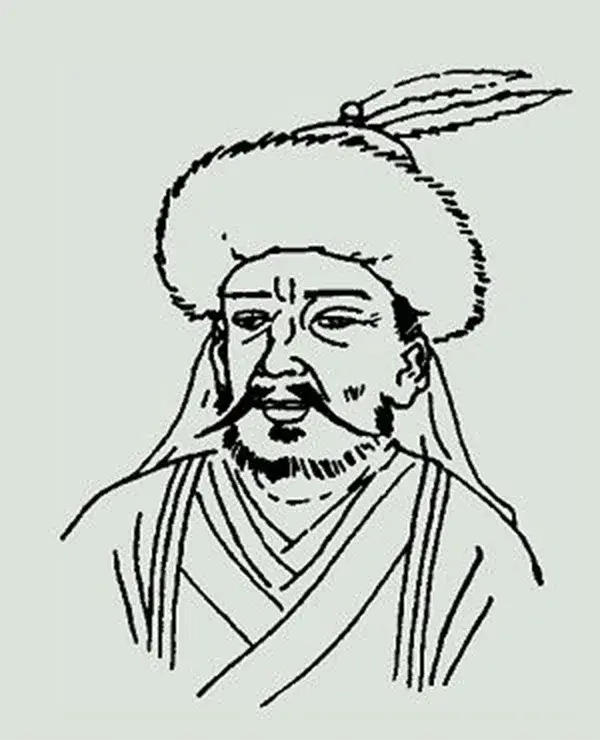
Biography
Youthful Upbringing and Imperial Grandson
Wanyan Jing was born on August 31, 1168, during an imperial progress conducted by Emperor Shizong to Jinlianchuan. He was born at the temporary traveling palace camp at Bingjing within the vicinity of Mount Madage in Rouyuan County. Emperor Shizong deeply admired the serene topography and refreshing mountain air of Mount Madage, choosing to confer the mountain's native name upon his newborn grandson as his Jurchen childhood name. His father Wanyan Yungong was a cultivated and virtuous crown prince, while his mother Empress Xiaoyi belonged to the prestigious Tushan aristocratic lineage, providing Wanyan Jing with exceptional early nurturing within imperial court circles.
In 1178, at the age of ten, Wanyan Jing received the princely investiture of Prince of Jinyuan. Emperor Shizong placed immense value on ensuring imperial scions preserved ancestral martial values and linguistic competence while thoroughly absorbing the governance philosophies of classical Chinese civilization. The emperor designated top scholars including imperial clansman Wanyan Kuang and classicist Xu Xiaomei as official tutors. Wanyan Jing demonstrated precocious intelligence, mastering both the large and small Jurchen scripts while delving deeply into the Confucian Five Classics, historical dynastic annals, and classical poetry.
In June 1185, Crown Prince Wanyan Yungong passed away prematurely, plunging Emperor Shizong into profound grief. In December of that year, Shizong invested Wanyan Jing as Prince of Yuan and appointed him to administer Daxing Prefecture to acquire practical administrative experience. When Wanyan Jing presented himself at court to offer formal gratitude, he observed strict ancestral Jurchen court etiquette, speaking fluent native Jurchen language without hesitation. Emperor Shizong was deeply touched and praised him before senior ministers, commending his dedication to ancestral traditions.
In May 1186, Wanyan Jing was appointed Right Chancellor of the Department of State Affairs, and in November he was formally proclaimed Imperial Grandson and dynastic heir. Taking up residence in the eastern wing of Qinghe Hall, he was assigned to review memorial petitions and administrative drafts. Whenever critical state affairs were deliberated, Shizong summoned him to his side, directly instructing him in the nuances of imperial statecraft, bureaucratic surveillance, and balancing justice with clemency. Through this mentorship, Wanyan Jing developed into a mature statesman.
Accession and Transition of Power
In February 1189, Emperor Shizong passed away in Fu'an Hall at the Central Capital after a prosperous reign of nearly three decades. During the emperor's final illness, Wanyan Jing remained constantly at his bedside alongside trusted regents, including Grand Defender Tushan Kening and Vice Chancellor Zhang Rulin. Following Shizong's death, the twenty-two-year-old Wanyan Jing ascended the throne before the imperial coffin, posthumously honored as Emperor Zhangzong. He declared a nationwide amnesty, remitted delinquent peasant tax arrears, and honored his mother Empress Dowager Tushan.
During his initial months on the throne, Zhangzong relied heavily upon the seasoned elder statesmen bequeathed by his grandfather. He elevated Tushan Kening to the supreme dignity of Grand Preceptor, granting him the fief of Jinyuan, while confirming the able minister Wanyan Xiang as Left Chancellor and promoting Zhang Rulin and Yila Lü to handle routine bureaucratic administration. This continuity ensured a frictionless transition of power, maintaining administrative stability and social tranquility throughout the realm.
Possessing energetic administrative ambition, the young emperor sought to address entrenched social inequities immediately upon assuming personal rule. He proposed the complete abolition of the longstanding practice whereby Buddhist and Daoist monasteries retained bonded domestic serfs, seeking to liberate dependent agricultural labor. Grand Defender Tushan Kening prudently advised that since monastic servile customs had persisted over centuries, sudden radical prohibition could provoke widespread local unrest, recommending gradual moderation instead. Zhangzong accepted this counsel, demonstrating pragmatic flexibility.
To cultivate an incorruptible and fearless censorate, Zhangzong summoned Wanyan Shouzhen, an official famed for uncompromising integrity during Shizong's reign, appointing him Minister of Justice and Right Censor. When Zhangzong consulted him regarding historical methods of verifying administrative realities and evaluating bureaucratic performance, Shouzhen presented comprehensive strategies emphasizing regulatory precision and severe punishment for venal misconduct. Zhangzong enthusiastically adopted these proposals, inaugurating a vigorous campaign to restore ethical discipline across the civil administration.
Administrative Reforms and Legal Codification
In the first lunar month of 1190, Zhangzong adopted the auspicious era name Mingchang, proclaiming his imperial vision of illuminating ritual education and revitalizing constitutional governance. Perceiving that Jin administrative and judicial frameworks suffered from redundant, conflicting statutory accretions inherited indiscriminately from Liao and Song precedents, he resolved upon comprehensive systemic rationalization. He instructed the Department of State Affairs, the Court of Judicature, and local prefectures to conduct thorough reviews of unresolved caseloads and standardize legal protocols.
In the realm of regional surveillance and administrative oversight, Zhangzong carried out an institutional reform by formalizing the system of Surveillance Commissions. Beginning in 1190, the empire was partitioned into regional surveillance circuits overseen by appointed surveillance commissioners. These officials held extraordinary authority directly under the Censorate, empowered to inspect judicial records, audit granaries, investigate official misconduct, and rehabilitate victims of wrongful prosecution. Zhangzong frequently summoned surveillance personnel to the capital to reinforce their mandate to relieve popular distress and avoid superficial bureaucratic posturing.
Zhangzong achieved his most enduring legislative monument through the compilation of the Taihe Law. Recognizing that judicial inconsistency and arbitrary sentencing plagued provincial courts, he established a special codification bureau staffed by eminent jurists and Confucian scholars, including Chief Judge Dong Shizhong and Minister Sun Duo. Building upon earlier dynastic regulations while systematically absorbing the jurisprudence of Tang and Song statutory models, the commission worked for over a decade to construct a cohesive legal framework.
Promulgated nationwide in 1201, the Taihe Law comprised twelve main divisions and 561 comprehensive articles, establishing standardized statutory definitions for offenses, transparent appellate procedures, and uniform penalties across all ethnic groups. Simultaneously, Zhangzong overhauled the hereditary military testing system for Jurchen commanders. Recognizing that decades of peace had eroded the martial readiness of the hereditary garrisons, he mandated that candidates demonstrate proficiency not only in archery and horsemanship, but also in Jurchen literacy, classical essay composition, and administrative law.
Cultural Flourishing and Golden Age
Zhangzong's devotion to classical Chinese literature, aesthetics, and Confucian statecraft surpassed that of all other Jurchen sovereigns. From the beginning of his reign, he embraced Confucian governance as the ultimate instrument for cementing imperial legitimacy and winning the allegiance of his diverse subjects. In 1192, he allocated substantial imperial treasury funds for the comprehensive renovation of the ancestral temple and cemetery of Confucius at Qufu, granting hereditary aristocratic titles and tax immunities to direct descendants of the sage.
In imperial civil service recruitment, Zhangzong introduced institutional refinements. He regularized provincial quota allocations and established diverse examination disciplines, introducing specialized categories for classical commentaries, literary composition, and juvenile prodigies. Crucially, he placed examinations conducted in the translated Jurchen script on an equal administrative footing with traditional Chinese jinshi degrees. This policy enabled talented Jurchen aristocratic youths to master classical administrative principles while encouraging talented Han intellectuals such as Wang Tingyun and Zhao Bingwen to assume prominent positions in the central government.
Under the influence of these policies, the Jin empire attained unprecedented demographic expansion and material wealth during the Mingchang and early Taihe eras. Extensive agricultural reclamation projects and river engineering works fostered sustained economic productivity. By 1206, the official census recorded over 7.22 million households and more than 48.49 million registered inhabitants, representing the demographic peak of the Jin dynasty. State granaries and silver reserves overflowed, earning the period lasting historical acclaim as a golden age of peace and affluence.
Beyond his statecraft, Zhangzong distinguished himself as one of the most accomplished imperial connoisseurs, calligraphers, and poets in Chinese imperial history. He developed an extraordinary mastery of the delicate, sharp slender gold calligraphic script invented by Emperor Huizong of Song, executing it with such vigor and precision that his surviving inscriptions were frequently mistaken for Huizong's original brushwork. He established an imperial painting academy and repository of antiquities within the palace, acquiring and cataloging masterpiece paintings and historic musical instruments, stamping them with his distinctive seven imperial seals.
Frontier Crises and the Kaixi War
Behind the glittering veneer of the Mingchang golden age, dangerous geopolitical transformations were gathering momentum across the northern steppes. During the late twelfth century, various nomadic tribes were gradually consolidated under the formidable leadership of Temüjin. Raiding parties from hostile steppe confederations began penetrating Jin northern border garrisons, threatening strategic pastures and border settlements. Zhangzong dispatched Chancellor Wanyan Xiang and general Jiagu Qingchen on offensive steppe expeditions while authorizing the construction of extensive defensive border ditches.
However, these linear defensive networks failed to provide a permanent strategic solution against mobile pastoral cavalry. While northern campaigns temporarily scattered hostile tribal concentrations, the long-distance operations imposed staggering logistical burdens upon imperial treasuries and depleted veteran cavalry units. Massive financial outlays for earthwork fortifications forced the government to issue depreciated paper currency and levy burdensome surcharges, severely undermining the sound fiscal reserves accumulated since Emperor Shizong's reign.
Exploiting Jin northern distractions, Southern Song Grand Chancellor Han Tuozhou launched an unprovoked military offensive in May 1206, known historically as the Kaixi Northern Expedition. Song armies crossed the Huai River without formal declaration of war, capturing Sizhou and besieging Shouchun. Upon receiving reports of this border violation, Zhangzong rejected defeatist concessions, ordering an immediate and comprehensive military counterstroke.
Zhangzong appointed trusted commander Pusan Kui as supreme pacification commissioner and deployed veteran general Wanyan Kuang to orchestrate defense operations. Adopting patient counteroffensive tactics, Jin armies lured overextended Song divisions deep into the Huai basin before launching devastating cavalry counterattacks. After annihilating Song forces at Zhongli and Luhe, Jin divisions crossed the Huai River, storming southern fortifications and advancing toward the Yangtze River, while western Jin columns breached strategic passes into Sichuan.
Faced with total military collapse, the Southern Song court underwent a palace coup in which peace advocate Shi Miyuan assassinated Han Tuozhou and sued for peace. In early 1208, the Song court dispatched envoys presenting Han Tuozhou's severed head in a ceremonial casket to the Jin camp. The resulting Jiading Peace Accord revised dynastic relations to an uncle-nephew status favoring Jin, increased annual Song silver and silk indemnities to 300,000 units each, and required a indemnity payment of three million strings, reaffirming Jin geopolitical supremacy.
Palace Intrigue and Tragic Demise
Although the Kaixi War concluded with an outward diplomatic triumph, the prolonged mobilization had severely strained state resources and accelerated domestic governance dysfunctions during Zhangzong's twilight years. Following the early death of Empress Qinhuai, Zhangzong became infatuated with Consort Li Shi'er, elevating her to the supreme status of Principal Consort despite strong resistance from conservative court ministers who warned against her humble background and political ambitions.
Li Shi'er's ascendancy fostered widespread nepotism and administrative decay. Her brother Li Xi'er was promoted to high palace office, while unprincipled officials led by Vice Chancellor Xu Chiguo aligned themselves with the consort's faction to monopolize bureaucratic patronage. Ambitious careerists flocked to Xu's residence, while principled ministers who protested against palace favoritism were systematically purged. This cronyism eroded the disciplined bureaucratic ethos established during earlier decades.
Concurrently, Zhangzong's intense insecurity regarding his dynastic title led to tragic persecutions of his closest imperial kin. Haunted by suspicions that his uncles harbored ambitions for the throne, Zhangzong placed princely households under suffocating surveillance by royal supervisors. In 1194, based on dubious denunciations of subversive comments, Zhangzong compelled his uncle Prince Yongzhong and his sons to commit suicide. This judicial murder alienated the imperial clan and dismantled the protective family bulwarks of the dynasty.
Dynastic anxiety was compounded by personal tragedy in succession. Zhangzong fathered six imperial sons, but every prince died in infancy from congenital frailty, leaving no surviving direct male heir. In late 1208, exhausted by administrative anxieties and recurring throat illnesses, Zhangzong fell gravely ill. Aware that his life was drawing to a close, and noting that two imperial concubines were pregnant, he issued a deathbed decree appointing his uncle Wanyan Yongji as successor. On December 29, 1208, Zhangzong died in Fu'an Hall at the age of forty-one, leaving the empire vulnerable to external catastrophe.
Major Achievements
Reorganization of Central Governance and Censorate
Throughout his twenty-year reign, Zhangzong devoted sustained administrative effort toward perfecting a centralized bureaucratic monarchy. Having transitioned from primitive tribal collegial governance to the Tang-Song three-department system under earlier sovereigns, the Jin dynasty still suffered from overlapping jurisdictional mandates and inadequate local surveillance. Drawing inspiration from classical Chinese dynasties, Zhangzong executed comprehensive administrative modernizations.
His most notable surveillance achievement was the full institutionalization of the Surveillance Commissions. Established across nine regional circuits in 1190, these bodies were tasked with auditing judicial cases, supervising agricultural development, and reporting local administrative negligence directly to the throne. Zhangzong frequently summoned regional commissioners to the imperial palace, personally admonishing them to prioritize popular welfare and refrain from vexatious, petty interference.
To maintain administrative vitality in the central bureaucracy, Zhangzong instituted rigorous performance review procedures. High-ranking officials were legally required to sponsor qualified replacements upon assuming office, incurring joint culpability if their nominees subsequently committed corrupt offenses. He systematically purged redundant titular positions accumulated through hereditary privilege, enforcing regular promotional examinations that significantly enhanced bureaucratic efficiency throughout the Mingchang era.
Codification and Enactment of the Taihe Law
The compilation and promulgation of the Taihe Law under Zhangzong's personal sponsorship constitutes a landmark achievement in the history of East Asian statutory jurisprudence. Prior to his reign, Jin tribunals relied upon a contradictory mixture of traditional Jurchen oral customs, Liao administrative precedents, and northern Song statutory provisions, frequently yielding divergent verdicts for identical crimes. Earlier attempts at statutory consolidation under Emperor Shizong remained unfinished.
In 1190, Zhangzong formally initiated the codification project, establishing a dedicated codification commission under senior jurists including Dong Shizhong and Sun Duo. The commission synthesized the jurisprudential architecture of the Tang and Song dynastic codes with contemporary Jurchen customs, subjecting every legal definition to rigorous philological and practical scrutiny over more than a decade of deliberation.
The completed code, promulgated in 1201 as the Taihe Law, contained 561 articles arranged into twelve functional divisions, including General Principles, Palace Security, Administrative Regulations, Family and Marriage, Stables and Treasuries, Military Mobilization, Robbery and Theft, Assault and Litigation, Fraud and Forgery, Miscellaneous Statutes, Arrest of Fugitives, and Judicial Procedure. The code established equitable judicial procedures across Jurchen, Khitan, and Han populations, exerting profound structural influence upon the legal institutions of the subsequent Yuan dynasty.
Promotion of Confucian Education and Statecraft
Zhangzong utilized Confucian ideological frameworks to legitimize his imperial governance and accelerate the cultural integration of the multiethnic Jin state. Deeply versed in the Confucian canon, he elevated sage veneration to a premier state policy. In 1192, he issued imperial edicts directing substantial treasury allocations for the comprehensive structural restoration of the Confucius Temple and ancestral cemetery at Qufu, confirming hereditary titles and tax immunities for the sage's lineage.
In education and civil service recruitment, Zhangzong introduced structural innovations that broadened bureaucratic accessibility. He expanded the National University at the Central Capital, established official academies in every prefecture, and introduced diversified civil service examination tracks, including specialized curricula in classical exegesis and literary composition.
Significantly, Zhangzong institutionalized imperial examinations administered entirely in the Jurchen script, commissioning official translations of Chinese canonical classics into the Jurchen tongue. This measure enabled Jurchen banner youths to assimilate core Confucian moral concepts of loyalty and filial piety while preserving ancestral literacy, thereby forging a unified cultural consciousness among the ruling elite.
Archival Preservation and Calligraphic Connoisseurship
Zhangzong's artistic and calligraphic accomplishments rank him among the most gifted royal connoisseurs in Chinese history. Possessing extraordinary aesthetic discernment, he dedicated substantial resources to safeguarding imperial cultural treasures dispersed during decades of conflict. He established an imperial painting academy and central archive within the palace, appointing eminent literati such as Wang Tingyun to direct the acquisition, authentication, and conservation of historical masterpieces.
In calligraphy, Zhangzong devoted decades to perfecting Emperor Huizong's slender gold script, capturing its dynamic balance, needle-sharp stroke terminals, and structural elegance with such fidelity that his royal inscriptions were frequently attributed to Huizong himself. Masterpieces bearing his verifiable brushwork include the opening calligraphy on the British Museum's Admonitions of the Court Instructress scroll and numerous classical paintings in international collections.
To standardize the imperial collection, Zhangzong instituted the famed system of the Seven Mingchang Seals, including imperial verification marks such as Yufu Baohui and Mingchang Yulan. These seals were meticulously affixed to certified ancient masterworks, including the Court Ladies Preparing Newly Woven Silk scroll and the poems of Li Bai and Huang Tingjian. He also preserved historical musical treasures such as the celebrated Tang dynasty Chunlei Guqin, making the Central Capital a preeminent center of East Asian high culture.
Northern Defense Architecture and Border Ditches
In defensive military strategy, the management of the northern steppe frontier and the construction of extensive defensive border ditches represented the largest logistical mobilization of Zhangzong's reign. Confronted with the rising power of steppe confederations led by the Mongols and Tatars, who repeatedly raided border pastures and frontier forts, Zhangzong made frontier containment a supreme national priority.
In early Cheng'an reign, Zhangzong appointed Chancellor Wanyan Xiang and general Jiagu Qingchen to lead major offensive operations across the northern deserts. Cooperating with local steppe allies, Jin armies defeated hostile Tatar forces along the Ulz River, temporarily stabilizing the northern frontier and earning Wanyan Xiang high ministerial honors.
To establish permanent defensive barriers against mobile cavalry incursions, Zhangzong authorized the construction of the Jin Border Ditch network. Stretching thousands of kilometers from the Yin Mountains in the west to the Songhua River basin in the east, the defensive system integrated deep outer ditches, inner rammed-earth walls, watchtowers, and fortified garrisons. Although this massive construction project offered temporary protection against isolated raids, its crushing fiscal cost severely drained state treasuries and exhausted agrarian corvee labor.
Defense Against the Kaixi Invasion and Jiading Accord
The victorious repulsion of the Southern Song Kaixi Northern Expedition between 1206 and 1208 was Zhangzong's most significant external military triumph. When Southern Song Chancellor Han Tuozhou launched unprovoked invasions across the Huai River, seizing border towns and laying siege to Shouchun, Zhangzong refused defeatist appeasement and launched an immediate, coordinated counteroffensive.
Zhangzong appointed Pusan Kui as supreme field commander, coordinating combined arms divisions across Shandong, Henan, and Shaanxi. Adopting defensive attrition tactics, Jin armies exhausted advancing Song forces before unleashing crushing cavalry counterattacks that shattered southern divisions at Zhongli and Luhe. Exploiting their victory, Jin columns crossed the Huai River, advanced toward the Yangtze River, and breached the strategic Da San Pass into Sichuan.
Faced with impending catastrophe, the Southern Song court executed Han Tuozhou and sued for peace. The resulting Jiading Peace Accord of 1208 reaffirmed Jin regional hegemony, elevating Jin's status to that of elder uncle, increasing annual Song indemnities to 300,000 units each of silver and silk, and securing three million strings in military compensation, thereby preserving Jin territorial integrity and international prestige.
Hydraulic Engineering and Flood Management
Mitigating recurrent catastrophic inundations along the lower Yellow River was an urgent domestic challenge that occupied Zhangzong's governance throughout the 1190s. In 1189, catastrophic breaches occurred in Caozhou and Weizhou, submerging agricultural plains across Weizhou, Qingzhou, and Cangzhou under floodwaters. Zhangzong severely reprimanded negligent water conservancy officials, emphasizing that hydraulic security directly determined national survival.
To combat the disaster, Zhangzong dispatched Vice Minister of Revenue Aotun Zhongxiao and Vice Minister of Works Wen Fang to coordinate flood relief operations on site. Allocating millions of strings in treasury funds and mobilizing hundreds of thousands of corvee laborers, the imperial government constructed double-tier retaining embankments and excavated bypass channels along critical breaches in Weizhou, Caozhou, and Huazhou. By the spring of 1196, the turbulent river was successfully returned to its historical channel, preserving agricultural production across the central plains.
Agricultural Reclamation and the Qu-Field System
Recognizing that agricultural output sustained the imperial army and agrarian population, Zhangzong enacted benevolent agrarian policies to protect farming communities. In 1192, to prevent aristocratic hunting expeditions from trampling standing crops, he restricted Jurchen banner units to two winter hunts per year, with each excursion strictly capped at ten days. In 1193, he ordered imperial park managers to open vacant lands outside traveling palaces and hunting reserves for free cultivation by landless peasants.
To combat recurrent droughts and maximize grain yields, Zhangzong championed the experimental adoption of the ancient qu-field intensive farming method. Promulgated in 1196, the system required able-bodied cultivators with landholdings to dedicate specified acreage to pit-cultivation techniques. While regional soil disparities prevented universal implementation, the initiative reflected progressive agricultural experimentation. Additionally, he enforced mandatory mulberry tree planting quotas upon banner households, stimulating northern sericultural manufacturing.
Currency Modernization and the Cheng'an Silver Ingot
Financial reforms under Zhangzong reflected innovative attempts to resolve acute monetary shortages alongside severe inflationary crises. Because northern China lacked substantial copper reserves, conventional copper coinage proved chronically insufficient for expanding mercantile commerce. Zhangzong established a fiduciary monetary system centered upon paper currency backed by silver reserves.
However, massive military outlays for frontier ditches and war with the Song, combined with flood relief expenditures, generated severe fiscal deficits. The excessive issuance of paper money caused severe currency depreciation, prompting merchants to hoard copper cash and refuse paper notes. To stabilize monetary circulation in 1197, Zhangzong introduced the Cheng'an Baohuo, casting legal-tender silver ingots in five calibrated denominations. This represented the first state-issued counted silver currency in Chinese monetary history, although illicit private debasement eventually forced its suspension.
Jurchen-Han Intermarriage and Cultural Synthesis
In social integration policy, Zhangzong's repeal of ethnic marriage restrictions in 1191 marked an important breakthrough in dynastic harmony. Early Jin legislation had strictly forbidden intermarriage between ruling Jurchen banner families and conquered Han and Khitan subjects, seeking to maintain martial separation. However, as banner households settled permanently among Han farming villages across north China, social interactions rendered legal segregation obsolete.
Acting upon petitions from the Department of State Affairs, Zhangzong recognized that enforced marital barriers bred needless ethnic friction. He issued an imperial edict formally repealing all intermarriage prohibitions, declaring that Jurchens, Hans, and Khitans were fully permitted to contract marriages under customary legal protections. This enlightened decree dissolved legal barriers to ethnic assimilation, accelerating the cultural convergence of the northern populations.
Diplomatic Regulations and Envoy Security
Preserving diplomatic decorum and safeguarding foreign tributary envoys was a consistent administrative priority throughout Zhangzong's reign. With regular diplomatic embassies arriving from the Southern Song, Western Xia, Goryeo, and Dali, Zhangzong recognized that the physical safety of foreign ambassadors directly affected imperial dignity and international prestige.
Following an incident in 1192 in which Goryeo tributary envoys were attacked on their return journey through Liaodong, Zhangzong overhauled diplomatic protocols. He issued stringent decrees requiring provincial governors along transit routes to assign disciplined regular infantry detachments to escort foreign delegations continuously. Local magistrates and surveillance officials were held personally liable to dismissal and criminal punishment if foreign envoys suffered harassment or physical injury within their jurisdictions, establishing secure international travel conditions across East Asia.
Urban Architecture and Scenic Development
Zhangzong's architectural patronage left an indelible imprint upon the urban layout and cultural landscape of the Central Capital. Guided by refined aesthetic tastes, he mobilized imperial resources to develop sophisticated hydraulic garden complexes, creating the renowned Eight Water Courts that harmonized natural springs with royal villas. Key elements of Beijing's modern Beihai Park and Zhongnanhai water systems originated during this period.
On the summit of Qionghua Island, Zhangzong erected the palatial Wanning Palace complex as a scenic summer retreat for his court and Consort Li Shi'er. Contemporary literati celebrated eight particularly evocative vistas surrounding the capital, coining the classical term Eight Scenic Views of Yanjing, which included Spring Shade on Qionghua Island and Autumn Wind over the Taiye Pool. Zhangzong composed original commemorative inscriptions for these sites, leaving architectural legacies that shaped the capital's design through the Yuan, Ming, and Qing dynasties.
Imperial Poetry and Literary Patronage
Zhangzong's poetic and critical accomplishments earned him enduring distinction as one of the most cultured monarchs in Chinese history. Immersed from childhood in the works of Su Shi, Huang Tingjian, and Zhou Bangyan, his lyrical poetry displayed remarkable melodic elegance, emotional sensitivity, and refined diction. His celebrated ci poem To the Tune of Die Lian Hua: The Folding Fan was praised by generations of literary scholars for its graceful courtly imagery and evocative final line.
His other surviving poetic works, including lyrics set to Sheng Cha Zi and commemorative verses on peonies at the Taihe Palace, exemplified the artistic peak of Jurchen courtly poetry. In classical verse, his Palace Quatrains were acclaimed by Yuan dynasty anthologists as possessing true imperial grace. His enthusiastic patronage of literati and regular literary gatherings at court transformed northern cultural life, stimulating the flourishing of Jin dynasty literature.
Regulation of Monastic Orders and Ordination Laws
In religious administration, Zhangzong applied firm regulatory controls to prevent the uncontrolled expansion of monastic wealth. By the late twelfth century, widespread civilian evasion of military corvee through unauthorized monastic ordination had deprived the state of vital manpower and tax revenues, while Buddhist and Daoist establishments accumulated vast untaxed estates.
Zhangzong instituted rigorous state oversight over religious communities, prohibiting unauthorized ordinations and requiring candidates to pass demanding examinations on scriptural doctrine before receiving government ordination certificates. He directed local officials to survey monastic landholdings, revoked extensive tax immunities, and required religious estates to pay standard land taxes. These measures curbed monastic encroachment and preserved state fiscal resources.
Containment of Imperial Princes and Centralization
The severe political constraints and lethal purges Zhangzong inflicted upon imperial princes represented a dark, controversial chapter of his late reign. Seeking to eradicate potential rival power centers, Zhangzong viewed his prominent uncles, particularly Prince of Gao Wanyan Yongzhong, with deep suspicion.
He assigned intrusive royal supervisors to oversee princely residences, scrutinizing their correspondence and social contacts. In 1194, when household servants alleged that Yongzhong's sons had voiced critical political sentiments, Zhangzong succumbed to paranoid instigations from Consort Li and Chancellor Xu Chiguo, ordering the prince and his sons to commit suicide. This severe purge alienated the imperial nobility and dismantled the traditional clan support that had historically safeguarded the throne.
Northern Imperial Progresses and Military Reviews
Maintaining ancestral Jurchen traditions, Zhangzong regularly conducted seasonal hunting progresses to summer residences across Jinlianchuan and Mount Longshan. These journeys served crucial military and political functions, providing opportunities to inspect frontier defenses, review cavalry readiness, and conduct personal diplomacy with northern nomadic chieftains.
During these expeditions, Zhangzong reviewed banner archery formations, distributed imperial gifts to valiant commanders, and personally composed martial poetry celebrating ancestral homelands. However, as the imperial retinue numbered tens of thousands of courtiers and guards, the immense travel expenses and logistical burdens added heavy financial strain to the state budget during his later years.
Suppression of Censorate Factions
During the Mingchang and Cheng'an eras, bitter factional rivalries erupted within the central administration surrounding Chancellor Xu Chiguo's monopolization of patronage. Supported by Consort Li Shi'er, Xu surrounded himself with opportunistic protégés known colloquially as the Ten Worthies of the Xu Clan, provoking fierce resistance from principled censors.
In 1197 and 1198, senior censors submitted coordinated memorials demanding Xu's dismissal for bribery and administrative malpractice. In response to mounting public outcry, Zhangzong temporarily demoted Xu to provincial office and issued edicts reaffirming censorate independence. Nevertheless, because Zhangzong refused to dismantle the underlying palace network that sustained Xu's influence, bureaucratic factionalism continued to smolder beneath the surface of court politics.
Formalization of the Surveillance Circuit System
Zhangzong's institutionalization of the Surveillance Commissions reflected his commitment to systematic regional oversight. Appointed surveillance commissioners conducted triennial audits of regional magistrates, inspecting granaries, reviewing judicial verdicts, and evaluating local agricultural progress.
To prevent regional officials from establishing corrupt local ties, Zhangzong enforced strict geographical rotation policies, forbidding commissioners from serving in their native districts. He dispatched imperial inspectors to conduct unannounced reviews of surveillance commissioners themselves, imposing severe penalties for administrative negligence. This comprehensive surveillance network preserved central executive authority across the empire's vast territories.