Event | Li Yuan decided to raise troops. Princess Pingyang and Chai Shao were in Chang'an; she strongly urged Chai Shao to leave first for Taiyuan while she remained in Guanzhong to make preparations.
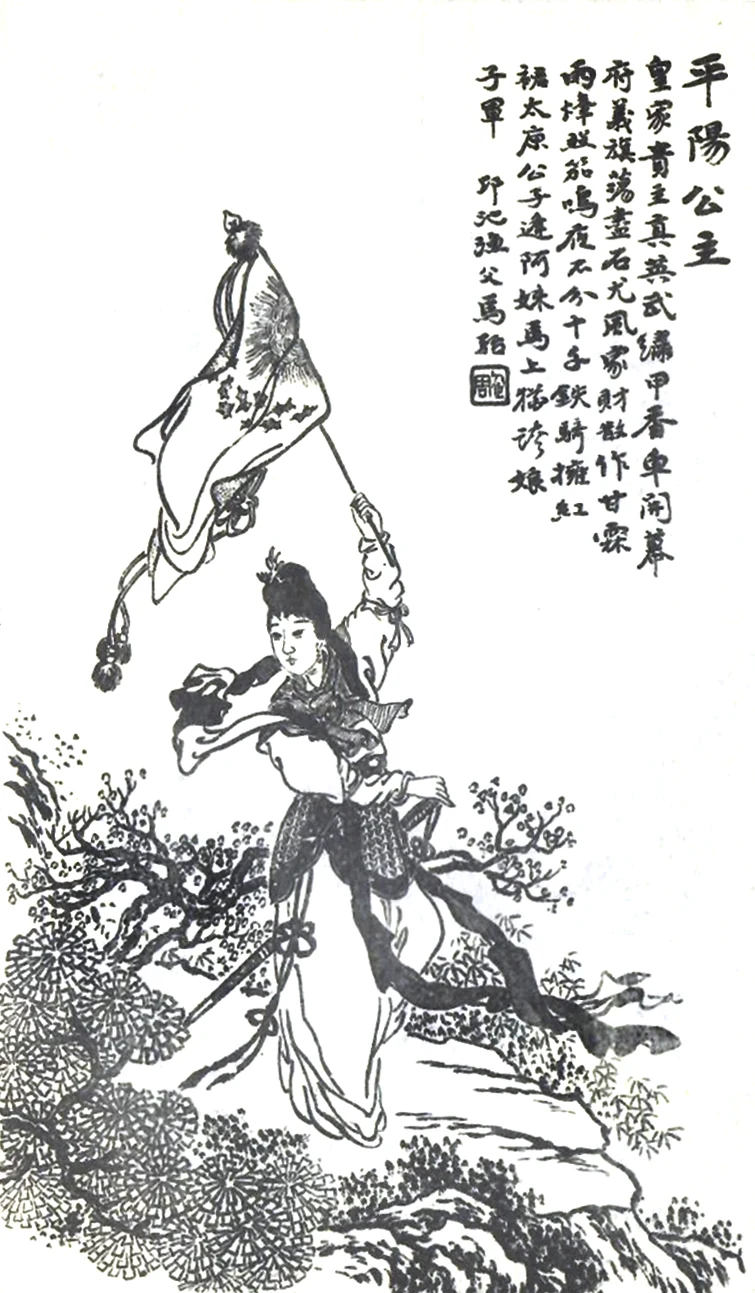
?–623 CE
Imperial Princess of the Tang Dynastymilitary commander
Princess Pingyang (Tang dynasty)
李氏(唐平阳昭公主)
Princess Pingyang (Tang dynasty) (unknown birth date – 12th day of the second month of the sixth year of the Wude era, March 18, 623), whose personal name is unknown, was the third daughter of Li Yuan, Emperor Gaozu of Tang, and his principal wife Empress Taimu Dou. She married Chai Shao, Duke Xiang of Qiao. She was one of the core contributors to the founding of the Tang. When Li Yuan rose in rebellion at the end of the Sui…
?–623 CETang Dynasty
PROFILE
Princess Pingyang (Tang dynasty) (unknown birth date – 12th day of the second month of the sixth year of the Wude era, March 18, 623), whose personal name is unknown, was the third daughter of Li Yuan, Emperor Gaozu of Tang, and his principal wife Empress Taimu Dou. She married Chai Shao, Duke Xiang of Qiao. She was one of the core contributors to the founding of the Tang. When Li Yuan rose in rebellion at the end of the Sui dynasty, she disguised herself as a man in Guanzhong, distributed family wealth, recruited troops, and incorporated several rebel forces, eventually commanding some 70,000 troops known as the “Lady's Army.” Her forces helped lay an important foundation for Li Yuan's entry into Guanzhong. The text records her as the only woman in China's imperial history to have been buried with military rites and as the first Tang princess to receive a posthumous title. She was given the title “Zhao,” and later generations therefore called her Princess Pingyang Zhao.
- Other name
- Princess Pingyang
- Period
- Tang
- Date of Birth
- Not recorded in historical sources
- Date of Death
- March 18, 623 CE(6th year of the Wude era, Tang)
- Dynasty / polity
- Tang Dynasty
- Identity
- Imperial Princess of the Tang Dynasty; military commander
- Ethnicity / group
- Not reliably confirmed by historical sources
- Native place
- Not reliably confirmed by historical sources
- Place of birth
- Unknown
- Place of death
- Unknown
- Highest office
- See Biography and Major Activities
- Major achievements
- Daughter of Emperor Gaozu of Tang; raised troops while disguised as a man; received exceptional rewards for military merit
- Courtesy / Art Name
- Princess Pingyang
- Era
- Sui-Tang Transition
- Dynasty
- Tang Dynasty
- Ethnicity
- Han
- Ancestral Home
- Chengji, Longxi (modern Qin'an, Gansu)
- Place of Death
- Chang'an
- Lifespan
- Unknown
- Posthumous Name
- Zhao
- Highest Office
- Supreme Commander of the Woman's Army
- Major Achievements
- Raising 70,000 troops as Woman's Army to conquer Guanzhong, securing founding of Tang dynasty, only woman in imperial history honored with military funeral
LIFE TIMELINE
Returned | to the Li family estate in Hu County, disguised herself as a man, sold property to aid disaster victims, and recruited several hundred soldiers.
Event | Sent her household servant Ma Sanbao to persuade the forces of He Panren, Li Zhongwen, Xiang Shanzhi, Qiu Shili, and others to submit. Her strength grew to about 70,000. She repeatedly defeated Sui suppression forces and captured Zhouzhi, Wugong, Shiping, and other places.
Event | Li Yuan's main army crossed the Yellow River into Guanzhong. He sent Chai Shao with several hundred cavalry to meet her. Princess Pingyang led more than 10,000 elite troops to join Li Shimin north of the Wei River. She and Chai Shao each maintained a separate headquarters and together took part in the siege of Chang'an.
Event | Chang'an was captured. Because of her military merit, she was granted the title Princess Pingyang and received rewards on a scale different from other princesses.
Event | Died. Li Yuan exceptionally ordered burial with military rites and granted the posthumous title “Zhao.”
BIOGRAPHY
Biography
Family Background and Early Life Princess Pingyang Zhao was the third daughter of Li Yuan, Emperor Gaozu of Tang. Her mother was Li Yuan's principal wife Dou, later Empress Taimu. Neither her personal name nor her birth date is recorded in the Old Book of Tang or New Book of Tang; the text states only that she was probably born in the 590s. Li Yuan married her to the military officer Chai Shao, and the couple settled in Chang'an after their marriage. ### Raising Troops in Guanzhong In May 617, the thirteenth year of the Sui Daye era, Li Yuan decided to rise from Jinyang and secretly summoned his daughter and son-in-law in Chang'an. Chai Shao asked Princess Pingyang what they should do, saying that her father was about to raise a righteous army and that it was impractical for them to leave together, yet he feared for her safety if he went alone. She urged him to leave quickly, saying that as a woman she could more easily hide in danger and would find her own solution. Chai Shao then took a lesser road directly to Taiyuan. Princess Pingyang returned to the Li family estate in Hu County, in present-day Huyi District of Xi'an, Shaanxi. Disguising herself as a man and calling herself “Young Master Li,” she sold property to relieve disaster victims and soon recruited several hundred followers. After news arrived that Li Yuan had risen, she decided to recruit more troops for her father and sent her household servant Ma Sanbao to persuade various anti-Sui forces to join her. The most powerful of them was the merchant He Panren, who commanded tens of thousands at Sizhu Garden and styled himself a chief commander. After Ma Sanbao explained the advantages and disadvantages, He Panren agreed to submit to Princess Pingyang. She subsequently incorporated the forces of Li Zhongwen, Xiang Shanzhi, Qiu Shili, and others, and her army expanded rapidly. ### Power in Guanzhong Princess Pingyang's troops maintained strict discipline and prohibited plunder. People from surrounding areas came to join her, and her forces grew to 70,000. The Sui authorities in the capital repeatedly sent armies against her, but Ma Sanbao and He Panren defeated them. She led her forces in succession to capture Zhouzhi, Wugong, Shiping, and other places, establishing a powerful presence in Guanzhong. She sent messengers by small paths to report developments to Li Yuan, who was greatly pleased. ### Joining the Campaign for Chang'an In September 617, Li Yuan's main army crossed the Yellow River into Guanzhong. He sent Chai Shao with several hundred cavalry toward Huayin and along the southern mountains to meet Princess Pingyang. She selected more than 10,000 elite soldiers and joined Li Shimin north of the Wei River. Husband and wife maintained separate headquarters and each commanded an army; the troops were known as the “Lady's Army.” In November, Tang forces captured Chang'an. After Guanzhong was secured, Li Yuan granted her the title Princess Pingyang, and because of her unique military service, the scale of her rewards differed from that of other princesses. ### Later Years and Burial After the capture of Chang'an, Princess Pingyang's activities disappear from the historical record until her death in the second month of 623, the sixth year of the Wude era. Li Yuan ordered that her funeral include military ceremonial elements described in the source as “feathered standards and drums before and behind, the great carriage, banners and pennants, forty ceremonial swordsmen, and armored huben guards.” Officials of the Court of Imperial Sacrifices objected that drums and wind music were contrary to ancient ritual for a woman's funeral. Li Yuan replied that drums and wind instruments were military music, that the princess had raised troops at Sizhu in response to the righteous standard, personally taken up drums and gongs, and contributed to the conquest; she was not comparable to an ordinary woman. He therefore exceptionally ordered a military funeral and, according to the posthumous-title principle “illustrious virtue with achievement is called Zhao,” granted her the posthumous title Zhao. The text consequently describes her as the only woman in China's imperial history to have been borne to burial by an army.
Princess Pingyang Zhao was the third daughter of Li Yuan, founder of the Tang, borne by his principal wife, the Lady Dou; neither her name nor her birth date survives in the accounts of her deeds. Li Yuan married her to the soldier Chai Shao, and after the marriage Chai took his wife to live at Chang'an.
In 617, when Li Yuan rose at Taiyuan, Chai Shao went to join him while the princess remained in Guanzhong. She sold her property and raised men, organizing a force of tens of thousands about Hu county and linking with Li Shentong, He Panren and other local leaders to take Zhouzhi, Wugong and Shiping and join Li Yuan's armies. Her troops were strictly disciplined and did the people no harm, and were known at the time as the "army of women."
After the Tang was founded Li Yuan made her Princess Pingyang; when she died he had her buried with military honors, ordering the offices to provide the full ceremonial of escorts, drums, carriages, banners and armored troops on the ground that "the princess herself took up the drum and won great merit in the field." She is thus one of the few women in Chinese history to be buried with military rites for services in war.
Major Activities
Military Achievements Princess Pingyang was one of the principal contributors to the founding of the Tang. During the anti-Sui uprising, she independently raised troops in Guanzhong and within three months incorporated several rebel forces, bringing her strength to about 70,000 and helping Li Yuan's forces secure large areas of Guanzhong in advance. Her troops were strictly disciplined and forbidden to plunder, which won popular support. After Chang'an was captured, her outstanding military service earned rewards unlike those of other princesses. Later tradition holds that the pass she once defended, present-day Niangzi Pass in Shanxi, took its name from the “Lady's Army.” ### The Rice-Porridge Ruse According to a later story, when Princess Pingyang and the Lady's Army were stationed at Niangzi Pass, Liu Heita's forces launched a large attack. With insufficient troops inside the pass, she sent urgently for reinforcements from Taiyuan while directing a strict defense. Seeing ripe millet in the surrounding fields, she is said to have ordered soldiers and civilians to harvest it and cook rice porridge, then pour the liquid into ditches before the pass at night. Enemy scouts allegedly mistook the liquid for horse urine, while banners and drums on the walls caused the opposing commander to believe that reinforcements had arrived. Fearing an ambush, the enemy withdrew without battle. By the time they learned the truth, reinforcements from Taiyuan had arrived. ### Relations with Contemporaries Princess Pingyang and her husband Chai Shao each commanded an army and maintained a separate headquarters during the campaign for Chang'an, cooperating as parallel commanders. She joined her elder brother Li Shimin north of the Wei River and participated with him in the encirclement of Chang'an. Her household servant Ma Sanbao was an important assistant in the uprising, acting as her envoy to persuade He Panren, Li Zhongwen, Xiang Shanzhi, Qiu Shili, and other rebel leaders to submit.
Personal Relations
- Mother: Dou, Empress Taimu
- Brothers: Li Jiancheng, Li Shimin, Li Xuanba, Li Yuanji, Li Zhiyun, and others
- Sisters: Princess Changsha, Princess Xiangyang, Princess Gaomi, and others
- Husband: Chai Shao, Duke Xiang of Qiao
- Children: Chai Zhewei; Chai Lingwu ### Subordinates - Ma Sanbao: household servant and key assistant in raising troops
- He Panren: merchant rebel leader who submitted to her command
- Li Zhongwen, Xiang Shanzhi, Qiu Shili: rebel leaders incorporated into her forces ### Ruler and Kin - Li Yuan: father and ruler
- Li Shimin: elder brother and cooperating commander in the Wei River campaign
Historical Assessment
Tang and Contemporary Assessments - Li Yuan, Emperor Gaozu of Tang, argued that drums and wind instruments were military music and that the princess had raised troops at Sizhu, personally taken up military instruments, and contributed to the conquest; she therefore could not be treated as an ordinary woman. (Old Book of Tang)
- The Old Book of Tang states that the princess's achievements contributed to the founding cause and were beyond those of an ordinary woman.
- The New Book of Tang records that she proclaimed regulations to her forces, prohibited plunder, attracted people from near and far, commanded 70,000 troops, and shook Guanzhong with her power. ### Song and Yuan Periods - The Comprehensive Mirror in Aid of Governance records her uprising without omitting it on account of her gender, thereby preserving recognition of her military contribution in the historical narrative.
- The Song-period Cefu Yuangui includes her deeds as an example of distinguished women. ### Ming and Qing Periods - The Ming writer Wang Shizhen praised her in verse, presenting her as a woman whose martial achievement equaled that of men.
- Ming and Qing scholars often discussed her as an example of women's action in times of disorder and treated her as a representative figure of women whose achievements rivaled men's. ### Modern Period - Modern historians have regarded her as an unusually rare princess whose title and rewards rested on military merit, emphasizing her military ability and political courage among women of her time.
- The tradition that Niangzi Pass was named after her has circulated widely and contributed to her image as a female military hero in popular memory.
- Film and television works have repeatedly created characters based on her, including Li Xiuning in Twin of Brothers.
FIGURES ASSOCIATED WITH THIS DYNASTY
Bibliography
- Old Book of Tang*, “Biography of Princess Pingyang”
- New Book of Tang*, “Biography of Princess Pingyang Zhao”
- Institutional History of Tang*