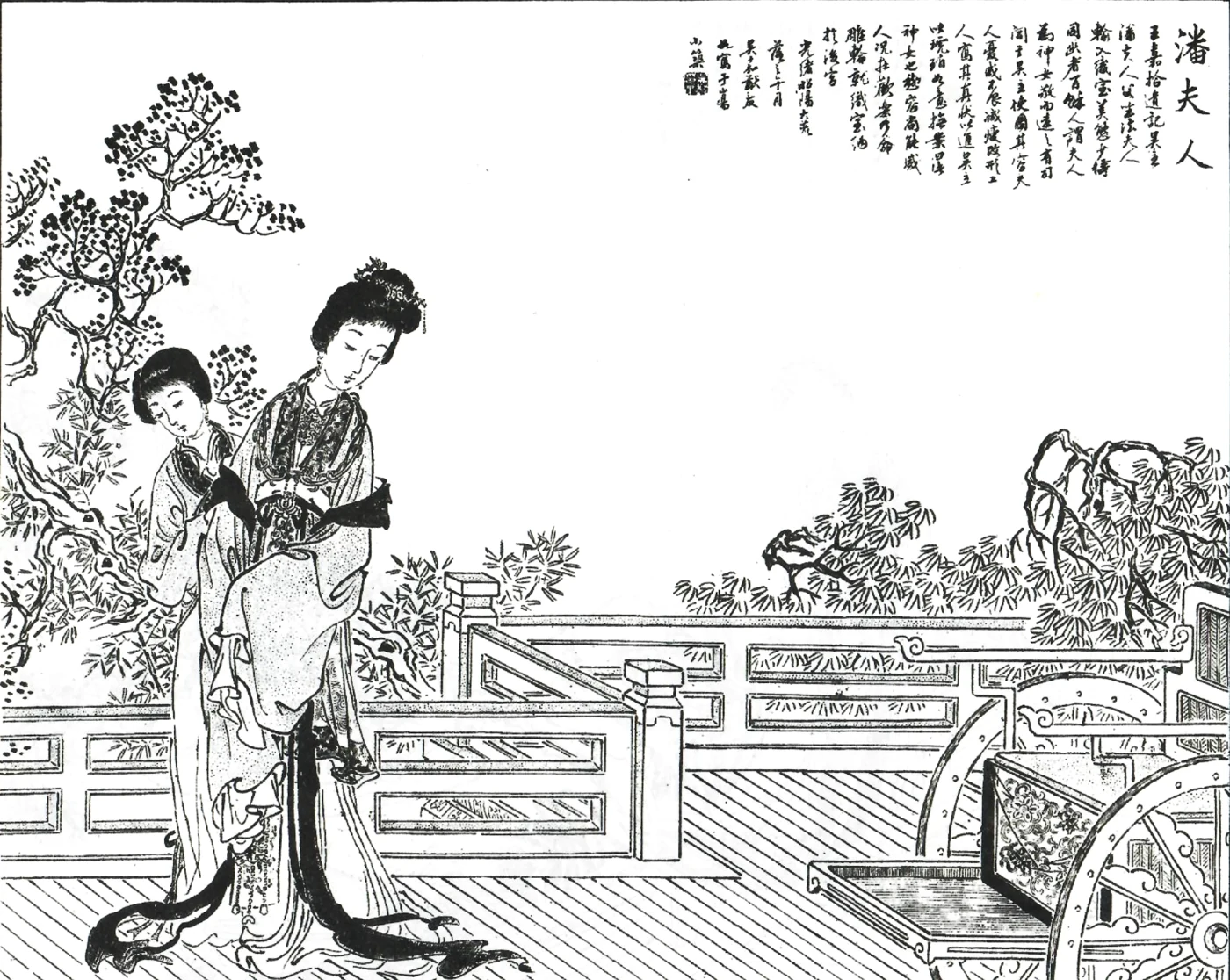
Childhood | Her father was executed for an offense, and Pan Shu and her elder sister were confiscated into the palace weaving establishment as slaves.
252 CE
Empress
Pan Shu
潘淑
Pan Shu (d. 252), a native of Gouzhang County in Kuaiji Commandery (present-day Ningbo, Zhejiang), was the empress of Sun Quan, Emperor Da of Eastern Wu, during the Three Kingdoms period and the mother of Sun Liang. Born into the family of a minor official, she was confiscated into palace service after her father committed an offense and later gained Sun Quan's favor. In 251, the first year of the Taiyuan era, she was…
252 CEEastern Han
PROFILE
Pan Shu (d. 252), a native of Gouzhang County in Kuaiji Commandery (present-day Ningbo, Zhejiang), was the empress of Sun Quan, Emperor Da of Eastern Wu, during the Three Kingdoms period and the mother of Sun Liang. Born into the family of a minor official, she was confiscated into palace service after her father committed an offense and later gained Sun Quan's favor. In 251, the first year of the Taiyuan era, she was installed as empress, becoming the first empress formally invested in Eastern Wu. In the second month of 252, the first year of the Shenfeng era, she was killed in the inner palace while attending the ailing Sun Quan and was later buried with him at Jiangling. Later tradition praised her beauty as extraordinary, calling her a "peerless beauty of Jiangdong" and a "divine woman," and popular tradition identified her as the pomegranate-flower deity among the Twelve Flower Deities.
- Other names
- Empress Pan, Lady Pan, posthumously Empress Dayi
- Period
- Late Eastern Han / Three Kingdoms
- Dynasty / regime
- Late Eastern Han / Three Kingdoms
- Identity
- Empress
- Ethnicity
- Not reliably established in available sources
- Native place
- Gouzhang County, Kuaiji Commandery (present-day Ningbo, Zhejiang)
- Date of birth
- Unknown
- Place of birth
- Unknown
- Date of death
- 252
- Tenure as empress
- Not reliably established in the historical record
- Posthumous title
- Not reliably recorded in the historical record
- Major achievements
- Empress of Sun Quan; rose from palace servitude to imperial favor, gave birth to Sun Liang, was installed as empress, and became the first formally installed empress of Eastern Wu
LIFE TIMELINE
Youth | Sun Quan took notice of her, summoned her into the rear palace, and made her a consort.
About her twenties | Gave birth in the inner palace to Sun Quan's youngest son, Sun Liang.
About age thirty | Sun Quan deposed Crown Prince Sun He and made Sun Liang crown prince; Pan Shu requested that a marriage be arranged for her elder sister, and the request was granted.
About age thirty | Installed as empress; a general amnesty was proclaimed and the reign era was changed to Taiyuan.
About her thirties | While attending the sick Sun Quan, she was strangled by palace attendants, and her death was publicly reported as a sudden illness.
Sun Quan died and Sun Liang succeeded to the throne.
Buried together with Sun Quan at Jiangling.
BIOGRAPHY
Biography
Family Background and Early Years
Pan Shu came from a humble background and was a native of Gouzhang County in Kuaiji Commandery, present-day Ningbo in Zhejiang. Her father was a minor official. After he was executed for an offense, Pan Shu and her elder sister were implicated and were both confiscated as slaves into the palace weaving establishment, the institution responsible for textile production in the palace. Pan Shu therefore began her palace life in a lowly position. According to the Shiyi Ji, Pan Shu possessed exceptional beauty. More than a hundred other women confined with her called her a "divine woman" and kept a respectful distance. When Sun Quan heard of her, he ordered a painter to make her portrait. On seeing it, he exclaimed: "This is indeed a divine woman. Even her sorrowful expression can bewitch a man—how much more so when she is joyful!" He then summoned Pan Shu from the weaving establishment into the rear palace.
Entry into the Palace and Imperial Favor
After entering the palace, Pan Shu was favored for her beauty. In 242, the fifth year of the Chiwu era, Sun Quan made his third son Sun He crown prince. Sun He's mother, Lady Wang, consequently held elevated status, and many other favored consorts were sent away from the palace. No record states that Pan Shu was sent out, indicating that she remained in the rear palace. In 244, the seventh year of Chiwu, Pan Shu gave birth to Sun Liang in the inner palace. Sun Liang was Sun Quan's youngest son and was especially cherished by the aging ruler, so Pan Shu and her son likewise received exceptional favor. Sun Quan's eldest daughter, Princess Quan, was at odds with Sun He's mother and therefore actively cultivated an alliance with Pan Shu and her son. She encouraged Sun Quan to marry her own niece to Sun Liang in order to strengthen the relationship.
Installation as Empress
After proclaiming himself emperor, Sun Quan remained hesitant about installing an empress and had previously set aside proposals to elevate Lady Xu and Lady Bu. In 250, the thirteenth year of Chiwu, he sought to depose Crown Prince Sun He and replace him with Sun Liang. Officials including Chen Xiang, Chen Zheng, Zhu Ju, and Qu Huang repeatedly remonstrated. Sun Quan became enraged, exterminated the families of Chen Zheng and Chen Xiang, had Zhu Ju and Qu Huang beaten, and deposed Sun He, sending him to Guzhang. In the eleventh month of that year, Sun Liang was made crown prince. Pan Shu requested that a marriage be arranged for her elder sister, and Sun Quan agreed. At the end of 250, the thirteenth year of Chiwu, a divine figure was said to have delivered a written message announcing a change of era and the installation of an empress. In the fifth month of 251, the first year of Taiyuan, Sun Quan installed Pan Shu as empress, proclaimed a general amnesty, and changed the era name to Taiyuan. Pan Shu thus became the only empress whom Sun Quan formally installed during his lifetime and, according to the source, the only case in the Three Kingdoms period in which an imperial installation was accompanied by both a general amnesty and a change of era name.
Final Years and Death
In the eleventh month of 251, the first year of Taiyuan, Sun Quan became gravely ill and bedridden. Pan Shu exhausted herself attending him and also became ill. In the second month of 252, the first year of Shenfeng, palace attendants strangled her while she slept and falsely announced that she had died of a sudden illness. The affair was later exposed, and six or seven palace attendants were executed. Sun Quan died in the fourth month of that year and Sun Liang succeeded to the throne. In the seventh month Pan Shu was buried together with Sun Quan at Jiangling. Pan Shu did not participate directly in politics during her lifetime, but she once asked Secretariat Director Sun Hong about the precedent of Empress Lü exercising power at court. This has been interpreted as suggesting that she might have intended eventually to govern on behalf of a young ruler, which may have been one reason behind her killing.
Major Activities
Installation as Empress and Change of Era
Pan Shu was the first formally invested empress of Eastern Wu. In the fifth month of 251, Sun Quan installed her as empress, proclaimed a general amnesty, and changed the era name to Taiyuan, an exceptional combination in the Three Kingdoms period. Sun Quan had previously been very cautious about naming an empress, and Pan Shu's elevation therefore reflected her distinctive status in his eyes.
Birth of Sun Liang
In 244, the seventh year of Chiwu, Pan Shu gave birth to Sun Liang. He was Sun Quan's youngest son and received particular affection in Sun Quan's later years. In 250, the thirteenth year of Chiwu, Sun Quan deposed Crown Prince Sun He and installed Sun Liang as crown prince, solidifying the position of Pan Shu and her son. Sun Liang later succeeded as emperor and became Emperor Fei of Eastern Wu.
Temple Construction and Buddhist Worship
According to the Fozu Tongji and the Gazetteer of Wuchang County, Pan Shu once founded Huibao Temple at Wuchang, the secondary capital of Eastern Wu, in present-day Ezhou, Hubei. The temple was described as one of the earliest Buddhist temples in Hubei. It was ranked alongside Changle Temple and Derun Temple and reached its height during the Datong era of the Liang dynasty. Xiao Lun, Prince of Shaoling and a son of Emperor Wu of Liang, once composed an inscription for it. The temple was later abandoned for a long period.
Legend of Liuhuan Terrace
According to the Shiyi Ji, Pan Shu accompanied Sun Quan on an excursion to Zhaoxuan Terrace. After becoming drunk, she vomited into a jade vessel. When a maid emptied it outside the terrace, a huoqi finger-ring fell out. Pan Shu hung the ring from a pomegranate branch. Sun Quan therefore built a terrace at the spot and called it Huanliu Terrace. An adviser then warned that the name "Huanliu" sounded like "return to Liu," an ominous suggestion in the rivalry between Wu and Shu, so the name was reversed to Liuhuan Terrace. The story later became a literary allusion, and popular tradition consequently came to regard Pan Shu as the deity of the pomegranate flower.
The Admonition of the Weeping Fish
While Sun Quan and Pan Shu were together at a fishing terrace, a large fish was caught and Sun Quan was delighted. Pan Shu invoked the story of Lord Longyang weeping over a fish as a warning, arguing that "joy must be followed by sorrow" and urging Sun Quan to remain cautious. In Sun Quan's final years, slander gradually increased and Pan Shu became more distant from him. Contemporaries praised her as possessing almost supernatural foresight, saying that she understood the first signs of change.
Personal Relations
Family
- Father: Pan's father, a minor official who was executed for an offense.
- Elder sister: Lady Pan, confiscated into the weaving establishment together with Pan Shu; later married at Pan Shu's request.
- Brother-in-law: Tan Shao, a native of Luling; appointed Commandant of Cavalry after Sun Liang's accession and sent back to his home region after Sun Liang was deposed; possibly the occupant of an Eastern Wu tomb in Jishui.
- Husband: Sun Quan, courtesy name Zhongmou, founding emperor of Sun Wu.
- Son: Sun Liang, courtesy name Ziming, Sun Quan's seventh son and the second emperor of Wu, later deposed by Sun Chen.
Rulers and Political Associates
- Sun Quan: Emperor Da of Eastern Wu, Pan Shu's husband and ruler.
- Sun Liang: Emperor Fei of Eastern Wu, Pan Shu's son, who succeeded after Sun Quan's death.
- Princess Quan: Sun Quan's eldest daughter; allied herself with Pan Shu and encouraged Sun Quan to make Sun Liang crown prince.
Conflicts
- Lady Yuan: Pan Shu was said to have falsely accused Lady Yuan and others.
- Chen Xiang, Chen Zheng, Zhu Ju, and Qu Huang: opposed the deposition of Crown Prince Sun He and were punished by Sun Quan for persistent remonstrance.
- Palace attendants: strangled Pan Shu while she was attending Sun Quan during his illness and were later executed after the crime was exposed.
Contemporaries
- Sun Hong: Secretariat Director; Pan Shu asked him about the precedent of Empress Lü governing at court.
- Lady Wang: mother of Sun He and a rival for Sun Quan's favor.
Historical Assessment
Three Kingdoms / Contemporary
- Chen Shou's Records of the Three Kingdoms described her as "dangerous in temperament, jealous, and alluring" and also stated that "Lady Pan and her son were favored."
- The Shiyi Ji called her a "peerless beauty of Jiangdong" and a "divine woman," praising her appearance.
- Xiao Qi of the Liang dynasty praised Pan Shu and Lady Zhao for beauty and talent, comparing them to the goddess of the Luo River and the goddess of Mount Wu.
Song and Yuan Periods
- Sima Guang's Comprehensive Mirror in Aid of Governance held that Pan Shu abused palace women and was killed by attendants who resented her.
- Hu Sanxing, in his commentary on the Comprehensive Mirror in Aid of Governance, rejected Sima Guang's interpretation, noting that the histories do not record Pan Shu mistreating palace attendants. He conjectured that the killing was carried out by powerful ministers who feared that Pan Shu might rule in court and threaten their positions.
Ming and Qing Periods
- Yu Maoheng, in his "Discussion of Sun Quan," criticized Sun Quan for favoring Lady Pan and replacing the heir with his younger son Sun Liang, treating the dynastic succession "like a game of chess."
- Jiang Bao's Outline of Records of Major Government in the Comprehensive Mirror argued that because Sun He and Sun Ba were already in conflict and Sun Liang was Pan Shu's son, "the mother was favored and the son beloved," which led to Sun He's deposition, Sun Ba's death, and Sun Liang's elevation.
- Jin Chengqi's Historical Sketches of Rulers through the Dynasties compared Sun Quan's favoring Pan Shu and installing the young Sun Liang to Duke Xian of Jin being deceived by Li Ji and Emperor Wu of Han trusting Jiang Chong.
- Huang Entong's Supplementary Assessments of the Comprehensive Mirror held that Sun Quan's deposition of Sun He, execution of Sun Ba, and installation of Sun Liang resulted from Pan Shu's desire to become empress, and that the general amnesty and change of era were used to magnify the occasion.
- Xie Zhaozhe's Wuzazu remarked that "Pan bewitched men even in sorrow, while Zhang was not abandoned even after death."
Modern Period
- Zhou Yucheng's annotations to the Records of the Three Kingdoms interpret the alleged auspicious omen as a pretext used by Sun Quan to provide justification for installing an empress and changing the era name.
- Gao Deyao and Kong Dewei argue that Pan Shu has a complex portrayal in the Records of the Three Kingdoms: she is shown both as jealous and prone to slander and as capable of concern for others, such as requesting a marriage for her sister and attending the sick emperor.
- Modern scholars often focus on the cause of her death. Some agree with Hu Sanxing's interpretation and suggest that ministers may have plotted the killing to prevent a repetition of Empress Lü's exercise of authority.
FIGURES ASSOCIATED WITH THIS DYNASTY
Bibliography
- Records of the Three Kingdoms, Book of Wu, "Biographies of the Consorts"
- Records of the Three Kingdoms, Book of Wu, "Biography of the Ruler of Wu"
- Records of the Three Kingdoms, Book of Wu, "Biographies of the Three Successor Rulers"