Age one | Born in Yongxing, Yue Prefecture, present-day Xiaoshan, Zhejiang; described as an eighteenth-generation descendant of He Qi, a general of Eastern Wu in the Three Kingdoms period.
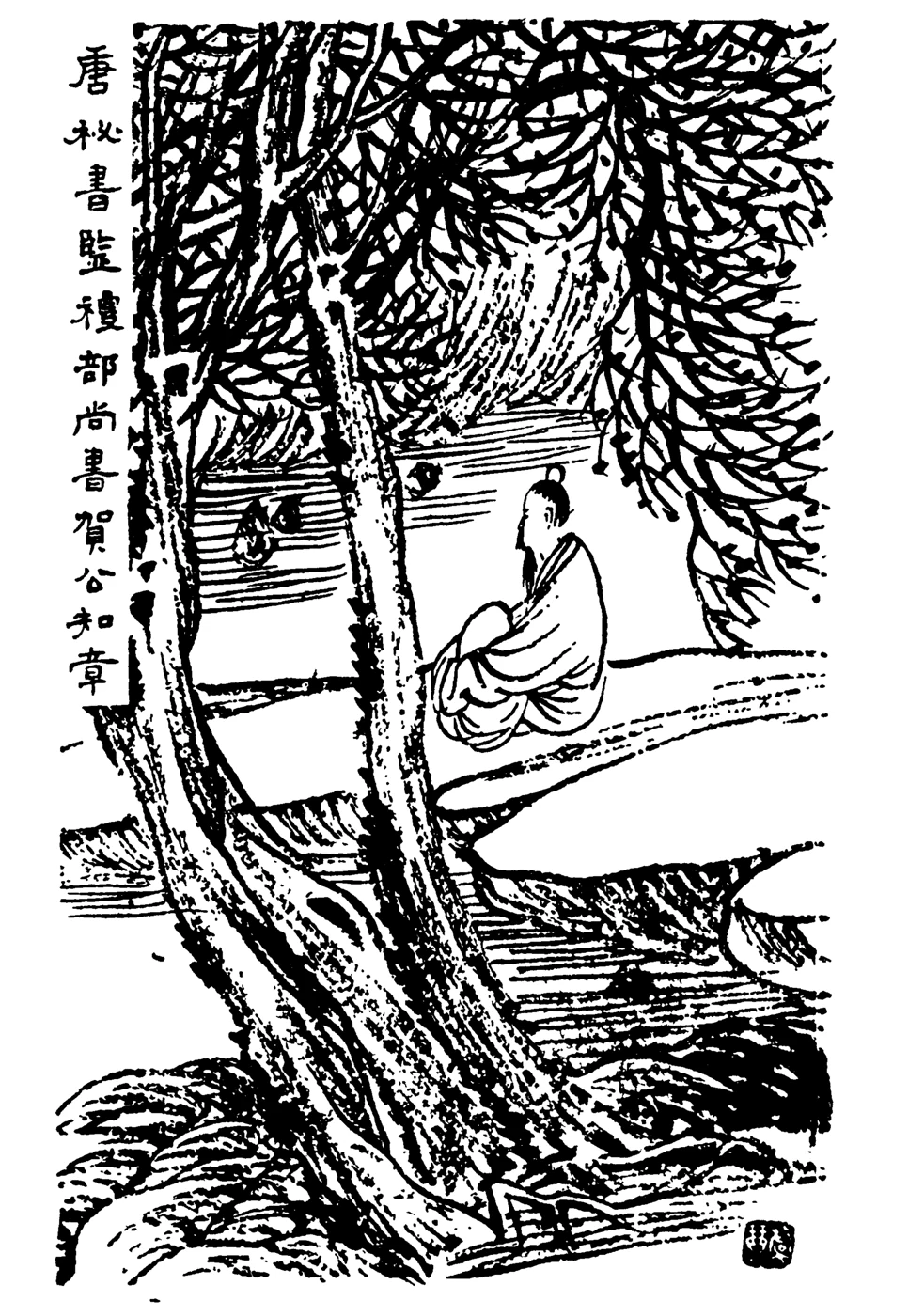
659 CE–744 CE
Statesmancalligrapherpoet
He Zhizhang
贺知章
He Zhizhang (c. 659–c. 744), courtesy name Jizhen, also known by the courtesy name Weimo, art name Shichuang, and in later life self-styled “Wild Guest of Siming,” was from Yongxing in Yue Prefecture, present-day Xiaoshan District, Hangzhou, Zhejiang. He was a Tang poet, calligrapher, and statesman. Because he once served as Director of the Palace Library, he was also known as “He the Library Director” and “Director He.”…
659 CE–744 CETang Dynasty
PROFILE
He Zhizhang (c. 659–c. 744), courtesy name Jizhen, also known by the courtesy name Weimo, art name Shichuang, and in later life self-styled “Wild Guest of Siming,” was from Yongxing in Yue Prefecture, present-day Xiaoshan District, Hangzhou, Zhejiang. He was a Tang poet, calligrapher, and statesman. Because he once served as Director of the Palace Library, he was also known as “He the Library Director” and “Director He.” Famous for poetry and prose from an early age, in 695, the first year of Wu Zetian’s Zhengsheng era, he passed the imperial examination and placed first, becoming the first recorded top examination graduate in Zhejiang history according to the source. He served under Wu Zetian, Zhongzong, Ruizong, and Emperor Xuanzong of Tang and rose to the offices of Crown Prince’s Guest and Director of the Palace Library. In 744, the third year of the Tianbao era, illness prompted him to memorialize for retirement, become a Daoist, and return home. Emperor Xuanzong granted him a stretch of Mirror Lake, and the Crown Prince led the officials in seeing him off. He died not long after returning home, at the age of eighty-six. In 758, the first year of the Qianyuan era, Emperor Suzong of Tang posthumously granted him the office of Minister of the Ministry of Rites. His poetry was especially noted for quatrains, with a fresh and unrestrained style and plain language. Poems such as Yong Liu and Huixiang Oushu became enduringly popular. With Zhang Ruoxu, Zhang Xu, and Bao Rong he was known as one of the “Four Scholars of Wuzhong.” He excelled in cursive and clerical calligraphy and was counted among the “Three Masters of Tang Cursive.” In 742, the first year of the Tianbao era, he met Li Bai in Chang’an, giving rise to the famous story of exchanging a gold tally for wine and to He’s description of Li Bai as an “Exiled Immortal.”
- Other name
- He Jizhen
- Courtesy name
- Jizhen
- Art name
- Shichuang
- Period
- Tang
- Dynasty/State
- Tang
- Identity
- Statesman, calligrapher, poet
- Ethnicity/Group
- Not reliably established in historical sources
- Ancestral origin
- Yongxing, Yue Prefecture, present-day Xiaoshan District, Hangzhou, Zhejiang
- Date of birth
- 659
- Place of birth
- Yongxing, Yue Prefecture, present-day Xiaoshan, Zhejiang
- Date of death
- 744
- Place of death
- Unknown
- Highest office
- See Biography and Major Deeds
- Major significance
- High Tang poet; author of Yong Liu and Huixiang Oushu; celebrated for a free-spirited life of poetry and wine and for recognizing Li Bai in the story of exchanging a gold tally for wine.
LIFE TIMELINE
In his teens | Moved with his family to Shanyin in Yue Prefecture, present-day Shaoxing, Zhejiang; already known for poetry and prose.
About age thirty-six | Passed the imperial examination and ranked first, described as the first recorded top graduate in Zhejiang history; initially appointed Doctor of the Four Gates at the National University.
About age forty-six | Already famous in the capital; promoted to Court Doctor of Imperial Sacrifices.
About age sixty-three | Recommended by Zhang Shuo, commissioner for compiling books at Lizheng Hall, to enter the Lizheng Hall Academy; participated in compiling the Liudian and Wenzuan, which were not completed, and transferred to Vice Minister of the Court of Imperial Sacrifices.
About age sixty-six | Promoted to Vice Minister of Rites and Academician of the Jixian Academy, then transferred to Right Vice Director of the Crown Prince’s Household, Reader-in-Waiting, and Vice Minister of Works.
About age seventy-nine | Appointed Crown Prince’s Guest, Grand Master of Imperial Accord with Silver Seal and Blue Ribbon, and concurrently full Director of the Palace Library; contemporaries called him “Director He.”
About age eighty-three | Met Li Bai at the Ziji Temple in Chang’an; after reading Shu Dao Nan, exclaimed that Li was an “Exiled Immortal,” exchanged his gold tally for wine, and became Li’s friend despite the age difference.
About age eighty-five | Suffering from illness and mental confusion, memorialized to be ordained as a Daoist and return home, donating his residence as a Daoist temple. Emperor Xuanzong granted him a stretch of Mirror Lake and composed a poem for his departure; the Crown Prince led the officials in bidding him farewell.
About age eighty-five | After returning home, wrote the two poems Huixiang Oushu, lived at Qianqiu Temple, built Yiqu Pavilion for his own enjoyment, and died not long afterward.
Posthumous | Because he had formerly served as Reader-in-Waiting, Emperor Suzong of Tang posthumously granted him the office of Minister of the Ministry of Rites.
BIOGRAPHY
Biography
Family Background and Early Life
He Zhizhang came from an official family and was described as an eighteenth-generation descendant of He Qi, a military commander of Eastern Wu in the Three Kingdoms period. He Qi had served as a senior general of Eastern Wu and won notable military achievements, and his descendants multiplied throughout Jiangnan. He Zhizhang moved in his youth to Shanyin in Yue Prefecture, present-day Shaoxing, an area celebrated for scenery and culture. This environment provided favorable conditions for his development. He became known locally for poetry and prose at an early age, displayed his talent early, and won the appreciation of contemporaries. His temperament was open, free, and sociable, qualities that later helped him establish himself in the capital.
Entering Government through the Imperial Examination and Career Advancement
In 695, the first year of Wu Zetian’s Zhengsheng era, He Zhizhang traveled to the capital for the examination and passed with first place, becoming, according to the source, the first recorded top graduate in Zhejiang history. He was initially appointed Doctor of the Four Gates at the National University and later promoted to Court Doctor of Imperial Sacrifices. By the Shenlong era, 705–707, he was already famous in the capital for his literary ability. In 722, the tenth year of Kaiyuan, Zhang Shuo, commissioner for compiling books at Lizheng Hall, recommended him for the Lizheng Hall Academy, where he participated in compiling the Liudian, Wenzuan, and other works. Although the compilations were not completed, he was transferred to Vice Minister of the Court of Imperial Sacrifices. In 725, the thirteenth year of Kaiyuan, he became Vice Minister of Rites and Academician of the Jixian Academy, then successively served as Right Vice Director of the Crown Prince’s Household, Reader-in-Waiting, and Vice Minister of Works. In 738, the twenty-sixth year of Kaiyuan, he became Crown Prince’s Guest, Grand Master of Imperial Accord with Silver Seal and Blue Ribbon, and concurrently Director of the Palace Library, which gave rise to the contemporary title “Director He.” His official career was unusually smooth for a literary figure of the High Tang, and he served under four rulers: Wu Zetian, Zhongzong, Ruizong, and Emperor Xuanzong.
Retirement, Return Home, and Death
In 744, the third year of the Tianbao era, He Zhizhang was eighty-five. Because illness had left him confused, he memorialized to be ordained as a Daoist and return home. He offered his family residence as a Daoist temple and requested several qing of land around Gonghu Lake to serve as a release pond. Emperor Xuanzong approved the request and granted him a stretch of Mirror Lake. The emperor personally composed a poem for his departure, and the Crown Prince led all officials in bidding him farewell, a mark of exceptional imperial favor. He Zhizhang returned to the “Daoist Estate” outside Wuyun Gate at Shanyin, lived at Qianqiu Temple, and built Yiqu Pavilion for recreation. During this period he wrote the two poems Huixiang Oushu, which became widely recited. He died not long afterward at the age of eighty-six. In 758, the first year of Qianyuan, Emperor Suzong of Tang posthumously granted him the office of Minister of the Ministry of Rites because of his former service as Reader-in-Waiting.
Major Activities
Literary Contribution
He Zhizhang was an important poet of the early High Tang, and the source attributes to his work a guiding role in the healthy development of Tang poetry. He was particularly successful in quatrains. Apart from ritual hymns and poems composed on imperial command, his landscape and personal poems were distinctive in style, calm in manner, and subtle in flavor. The source identifies their greatest success as the expression of fundamental human feeling in social life, presenting emotions at once broadly shared and specifically directed. He Zhizhang inherited and developed the ideals associated with Chen Ziang: the “spirit of Wei and Jin,” the pursuit of suggestive comparison and implication, and an emphasis on human feeling and human nature. He also made a bold break with the model of object-poetry promoted and practiced by Li Jiao in the early Tang, producing the enduring poem Yong Liu. Because he lived in a prosperous age, enjoyed a successful official career, and possessed a broad and free-spirited personality, his poems contain little embittered lament over society or personal misfortune. Even when melancholy appears, the dominant tone remains optimistic and expansive. His poetry is described as graceful, fresh, and unrestrained, with natural and sincere emotion, plain and unornamented language, roots in lived experience, and deep conception. Nineteen titles totaling twenty poems, including one fragment, survive under his name in the Complete Tang Poems. Representative works include Yong Liu, the two poems Huixiang Oushu, Ti Yuan Shi Bieye, and Cailian Qu.
Calligraphic Achievement
He Zhizhang was a celebrated Tang calligrapher skilled in cursive and clerical scripts and was counted among the “Three Masters of Tang Cursive.” His cursive brushwork was described as vigorous and free-flowing, with forceful strokes alternating between thick and thin, solid and empty, and structures tilting left and right according to momentum. The overall composition was compared to flowing water and was said to express his romantic, uninhibited personality. The Dou brothers often criticized famous Tang calligraphers but singled out He Zhizhang for praise, saying that at his best his work “contended with creation itself and lay beyond what deliberate human craft could reach.” Surviving works attributed to him include the stone inscription Longrui Gong Ji on a rock on the southern slope of Wanwei Mountain southeast of Shaoxing and a cursive manuscript of the Classic of Filial Piety transmitted to Japan. The Classic of Filial Piety scroll was described as executed in a single rushing movement, with brushwork like dragons and snakes in motion, incorporating traces of clerical and early cursive forms in pursuit of archaic character. It combined Tang rigor with the flowing spirit associated with Jin calligraphy and exerted significant influence on late Tang and Song styles. The painter Wu Daozi was said to have learned calligraphy from He Zhizhang. Lü Zong’s Continuation of Calligraphic Criticism praised his writing as “the brush flying freely, racing on without exhaustion.”
Travels and Residence
He Zhizhang spent most of his life serving in the capital Chang’an and retired late in life to Shanyin in Yue Prefecture. He enjoyed socializing and was related by marriage to Zhang Xu, with whom he had close contact; contemporaries called the pair “He and Zhang.” The two often traveled together. A later account says that when they encountered fine walls or screens in halls and residences, inspiration could suddenly seize them and they would dash off several lines like flying insect-seal forms, surpassing even the ancient masters Zhang Zhi and Suo Jing. Admirers supplied them with paper and writing materials and treasured the results. After returning home late in life, He Zhizhang lived at Qianqiu Temple, built Yiqu Pavilion, and enjoyed the scenery around Mirror Lake.
Relations with Contemporaries
In 742, the first year of Tianbao, Li Bai arrived in the capital Chang’an and stayed alone in a small inn. One day he visited the famous Daoist Ziji Temple and happened to meet He Zhizhang. He had long read and admired Li Bai’s poetry, and the chance meeting led to a warm conversation. He asked to see Li Bai’s new poems. After reading Shu Dao Nan, he exclaimed that Li Bai seemed to be an immortal banished from Heaven. At dusk He invited Li Bai to drink, but only after they sat down at the tavern did he realize that he carried no money. He removed the gold-decorated turtle tally from his waist and offered it in payment for the wine. Li Bai objected that it was an ornament bestowed according to official rank and should not be traded away, but the two continued drinking until both were mildly intoxicated. He Zhizhang later recommended Li Bai to the emperor, who had already heard of Li’s fame and appointed him to await imperial summons at the Hanlin Academy. After He Zhizhang died, Li Bai drank alone and, recalling the old exchange of the gold tally for wine, wrote the two poems Dui Jiu Yi He Jian. He Zhizhang, Li Bai, Zhang Xu, Li Shizhi, Cui Zongzhi, Su Jin, Jiao Sui, and Li Jin, Prince of Ruyang, were collectively called the “Eight Immortals of the Wine Cup.” Du Fu’s Yinzhong Baxian Ge begins with He Zhizhang and describes his drunkenness with the image of riding a horse as though riding a boat and falling into a well while his vision blurred.
Personal Relations
Family
- He Qi: distant ancestor and Eastern Wu general of the Three Kingdoms period.
- He Zeng: son; rose to the posts of Chief of Service in the Service for Palace Internal Arrangements, court gentleman, and commandant of Kuaiji Commandery.
- He Tian: son.
- He Fu: son; given his name by Emperor Xuanzong of Tang.
Teachers and Friends
- Zhang Shuo: recommender and commissioner for compiling books at Lizheng Hall.
- Li Bai: close friend; associated with the story of exchanging the gold tally for wine and a friendship across generations.
- Zhang Xu: relation by marriage and fellow calligrapher; the pair were called “He and Zhang.”
- Zhong Shaojing: friend and Tang calligrapher.
- Wu Daozi: said to have studied calligraphy with He Zhizhang.
Ruler and Subject
- Wu Zetian: He Zhizhang passed the examination in the first year of the Zhengsheng era.
- Emperor Xuanzong of Tang: granted him a stretch of Mirror Lake and composed a poem for his departure.
- Emperor Suzong of Tang: posthumously granted him the office of Minister of the Ministry of Rites.
- Crown Prince Li Heng: led the officials in bidding him farewell.
Conflicts
- No major conflicts are recorded; his official career was generally smooth.
Historical Assessment
Tang Period / Contemporary
- Li Bai’s two poems Dui Jiu Yi He Jian recalled He Zhizhang as the “Wild Guest of Siming,” praised his elegant freedom, and remembered that on their first meeting in Chang’an he called Li Bai an “Exiled Immortal.” The poems were later cited as evidence of He’s open character and perceptiveness.
- Du Fu’s Yinzhong Baxian Ge portrayed He Zhizhang’s drunken state with the famous image of riding a horse as though riding a boat and falling into a well while drunk, contributing to his image as an immortal of wine.
- Dou Ji’s Shu Shu Fu praised his calligraphy and literary talent, comparing the brilliance of his writing to the colors of a spring forest.
- Dou Meng’s commentary said that when inspiration and intoxication took hold, He loved to write large characters in pieces of three hundred or five hundred words, and that when the writing reached its best it “contended with creation itself” beyond deliberate craftsmanship.
- Lü Zong’s Continuation of Calligraphic Criticism praised his cursive hand as “the brush flying freely, racing on without exhaustion.”
Song and Yuan Periods
- Shi Su’s Jiatai Gazetteer of Kuaiji preserved an account of He Zhizhang and Zhang Xu suddenly writing several lines on good walls and screens when inspiration struck, their strokes flying like insect-seal script, while admirers supplied paper and treasured their calligraphy.
- Zhang Dai’s Tao’an Mengyi remarked that Jizhen in court dress showed none of the appearance of a Daoist in a yellow cap, and that retiring at eighty could hardly be called early, yet people nevertheless celebrated his timely withdrawal from office.
- From the Song period onward, He Zhizhang was included among the “Four Scholars of Wuzhong” with Zhang Ruoxu, Zhang Xu, and Bao Rong, and his poetic style was regarded as influential on later generations.
Ming and Qing Periods
- Tao Zongyi praised He Zhizhang’s skill in cursive and clerical scripts and wrote that he was highly esteemed in his own time. He emphasized the increasing abandon of He’s later years and noted that when drunk he composed literary pieces and mixed running and cursive forms in increasingly eccentric ways.
- Feng Fang listed He Zhizhang among Tang calligraphers whose varied achievements nevertheless shared genuine transmission and method rather than careless improvisation.
- In the late Ming, Zhang Dai recorded the shrine to “Director He” during a visit to Ningbo, again noting that his formal court appearance bore none of the outward marks of a Daoist and praising his withdrawal from office.
Modern Period
- Modern scholar Wan Honglian characterized He Zhizhang’s poetry as “fresh and unrestrained, subtle yet flavorful.”
- Tang Jun and Li Jun argued that He Zhizhang’s poetry played a guiding and exemplary role in the development of Tang poetry and helped stimulate the flourishing of High Tang verse.
- Modern scholarship generally regards He Zhizhang as one of the forerunners of High Tang poetry and credits his quatrains with an important guiding influence on the genre’s development.
FIGURES ASSOCIATED WITH THIS DYNASTY
Bibliography
- Old Book of Tang, “Literary Biographies: He Zhizhang.”
- New Book of Tang, “Biographies of Recluses: He Zhizhang.”
- Wan Honglian, “Fresh and Unrestrained, Subtle yet Flavorful: An Appreciation of He Zhizhang’s Poetry,” Modern Chinese (Academic Comprehensive Edition), 2012, no. 6.