Age 1 | Born at the eastern end of Lüroutong Alley inside Xizhimen in the capital (present-day Xisi Toutiao)
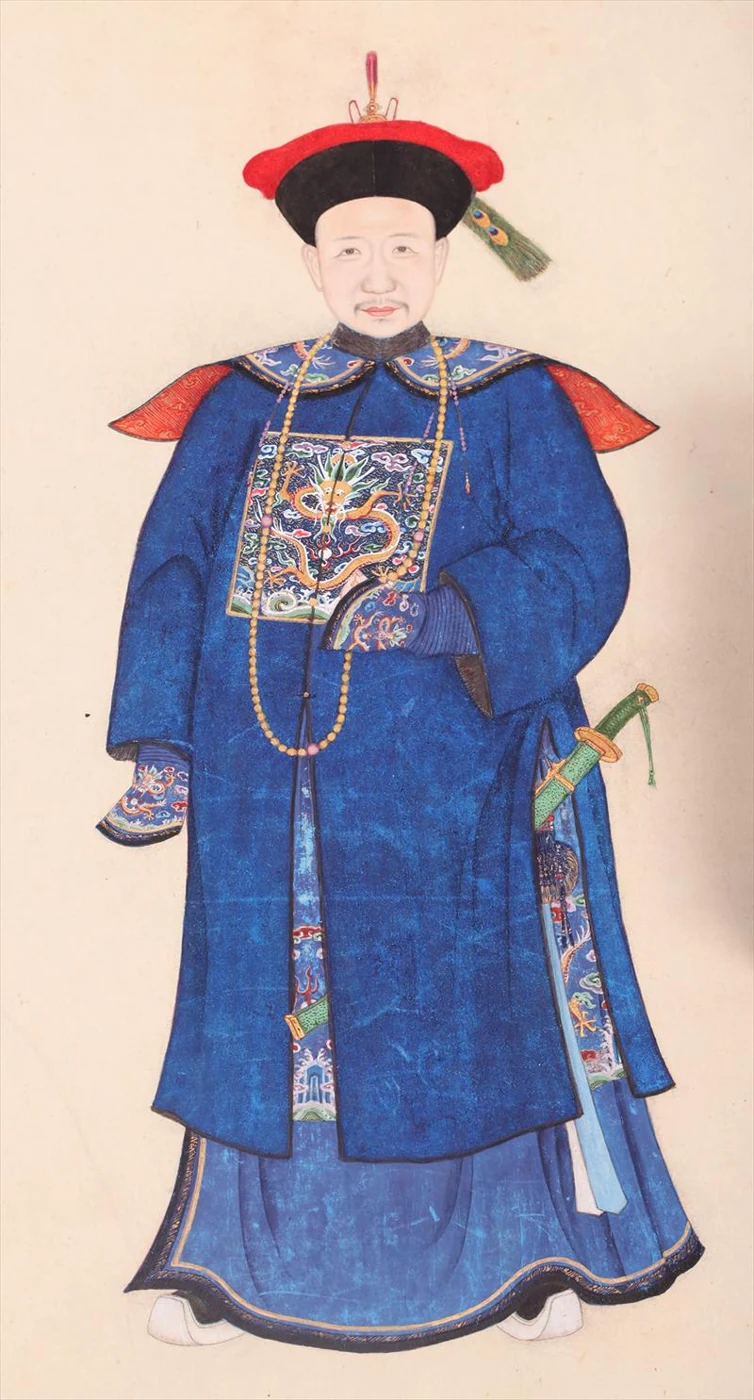
1750 CE–1799 CE
Powerful court official
Niohuru Heshen
钮祜禄·和珅
Niohuru Heshen (1 July 1750 – 22 February 1799), of the Niohuru clan, was originally named Shanbao, with the courtesy name Zhizhai, and styled himself Master of Jialetang, Shihuyuan, and Lüyeting. A member of the Manchu Plain Red Banner who was later transferred to the Plain Yellow Banner, he traced his ancestral home to Kaiyuan County, Fengtian Prefecture (present-day Qingyuan County, Liaoning). He was a powerful mid-Qing…
1750 CE–1799 CEQing Dynasty
PROFILE
Niohuru Heshen (1 July 1750 – 22 February 1799), of the Niohuru clan, was originally named Shanbao, with the courtesy name Zhizhai, and styled himself Master of Jialetang, Shihuyuan, and Lüyeting. A member of the Manchu Plain Red Banner who was later transferred to the Plain Yellow Banner, he traced his ancestral home to Kaiyuan County, Fengtian Prefecture (present-day Qingyuan County, Liaoning). He was a powerful mid-Qing court official who became notorious for corruption. In the late Qianlong reign he dominated court politics, headed the Grand Council while controlling the Ministry of Revenue, rose to Grand Secretary of the Wenhua Hall, and was enfeoffed as First-Rank Duke Zhongxiang. After the Qianlong Emperor died in 1799, the fourth year of the Jiaqing era, the Jiaqing Emperor quickly arrested Heshen, confiscated his property, and ordered him to commit suicide in prison. The enormous size of his fortune gave rise to the saying, “When Heshen fell, Jiaqing was fed,” and he became one of the most famous corrupt officials in Qing and Chinese history.
- Alternative name
- Niohuru clan
- Courtesy name
- Zhizhai
- Era
- Qing
- Dynasty / polity
- Qing
- Identity
- Powerful court official
- Date of Birth
- July 1 1750
- Date of Death
- February 22 1799
- Ethnicity / affiliation
- Manchu
- Banner affiliation
- Manchu Plain Red Banner
- Ancestral home
- Kaiyuan County, Fengtian Prefecture (present-day Qingyuan County, Liaoning)
- Place of birth
- Unknown
- Place of death
- Unknown
- Highest office
- See Biography and Major Activities
- Major achievements
- A dominant court official in the late Qianlong reign; senior leader of the Grand Council while also controlling the Ministry of Revenue; later had his property confiscated by the Jiaqing Emperor
LIFE TIMELINE
Age 3 | In the first month went to Yunnan to investigate the Li Shiyao case; after returning to the capital in the fifth month was appointed Minister of Revenue and a member of the Deliberative Council; the Qianlong Emperor betrothed his daughter Princess Hexiao to Heshen's son Fengshen Yinde; in the tenth month became chief compiler of the Siku Quanshu and concurrently handled the duties of Minister of the Court of Colonial Affairs
Age 31 | In the first month became an adviser on state affairs and concurrently supervised the affairs of the ministries; in the eighth month advanced to First-Rank Duke Zhongxiang
Age 49 | On the third day of the first month the Qianlong Emperor died; on the fourth day Heshen was dismissed from the Grand Council and other offices; on the eighth day he was stripped of office and imprisoned; on the eleventh day twenty major charges were announced against him; on the eighteenth day he was ordered to commit suicide
Studies with renowned tutors | He studied under Wu Shenglan, Li Huang and Li Guangyun, making steady progress and gaining command of Manchu, Chinese, Mongolian and Tibetan.
Age 17 | Despite financial hardship, he completed his studies, passed the preliminary examination for licentiate status, and in 1767 married Yinglian's granddaughter.
Age 18 | ### Imperial Guard Service and Rise In 1768, the thirty-third year of the Qianlong era, Heshen sat for the Shuntian provincial examination but failed.
Inheritance of a hereditary title | He inherited the hereditary title of Third-Class Light Chariot Commandant.
Age 22 | In 1772 he was appointed a third-rank imperial bodyguard and selected to fill a guard post in the pole-carrying service.
Age 25 | In 1775, the fortieth year of the Qianlong era, Heshen finally received an opportunity to display his learning before the Qianlong Emperor.
Rapid promotion within a year | In the first month he was transferred into the Plain Yellow Banner and appointed Right Vice Minister of Revenue; in the third month he was exceptionally appointed a Grand Councillor; in the fourth month he also took charge of the Imperial Household Department, rising six times in a single year.
Age 27 | ### Dominance at Court In the sixth month of 1777, the forty-second year of the Qianlong era, Heshen became Left Vice Minister of Revenue.
Age 30 | In the first month of 1780, the newly appointed governor of Fengtian, Haining, came to the capital for audience and reported to Heshen that Li Shiyao, governor-general of Yunnan and Guizhou, had taken bribes and broken the law.
Age 31 | In the fourth month of 1781, the forty-sixth year of the Qianlong era, the Su Sishisan uprising broke out in Gansu.
Age 32 | In 1782, the forty-seventh year of the Qianlong era, Investigating Censor Qian Feng submitted a memorial impeaching Shandong Governor Guotai and Provincial Administration Commissioner Yu Yijian for corruption.
Age 33 | In 1783 he was awarded a double-eyed peacock feather, became chief compiler of the Historiography Institute, and concurrently served as administrator of the Wenyuan Pavilion and chief compiler of the Manchu Translation Office.
Age 34 | In the seventh month of 1784, after the suppression of the Tian Wu uprising, he was granted a hereditary rank, again became Minister of Personnel and Assistant Grand Secretary, and continued to supervise the Ministry of Revenue.
Age 36 | In the sixth month of 1786, the fifty-first year of the Qianlong era, Investigating Censor Cao Xibao impeached Heshen's household servant Liu Quan for “using his master's influence for private gain” and for clothing, carriages, horses, and residence exceeding the limits prescribed for his status.
Age 38 | In the second month of 1788, for his service in transmitting written imperial instructions during the suppression of the Lin Shuangwen uprising, he advanced to third-rank Count Zhongxiang and received a purple bridle.
Age 40 | In the eleventh month of 1790, the fifty-fifth year of the Qianlong era, Grand Secretariat Academician Yin Zhuangtu sharply criticized current abuses and opposed the system of fines paid in lieu of punishment that Heshen promoted.
Age 42 | In 1792 he concurrently became Chancellor of the Hanlin Academy, and in 1793 he was also placed in charge of the Imperial Medical Academy and Imperial Pharmacy.
Age 43 | In 1793, the fifty-eighth year of the Qianlong era, the British king's envoy George Macartney came to China and Heshen was responsible for receiving him.
Age 44 | On the fourth day of the eleventh month of 1794, the fifty-ninth year of the Qianlong era, Qian Feng requested restoration of old Grand Council procedures.
Age 45 | ### The Jiaqing Reign and Downfall In the autumn of 1795, the sixtieth year of the Qianlong era, the Qianlong Emperor told Heshen that he intended to transmit the throne to his fifteenth son, Prince Jia Yongyan.
Age 46 | When reporting matters to the retired emperor he often asked Heshen to “speak on his behalf,” and when people around him reported Heshen's misconduct he was said to reply: “I now rely on the minister to manage the affairs of all under heaven; how can you speak lightly of him?” In 1796, the first year of the Jiaqing era, Heshen became commander of the imperial bodyguards of the Plain Yellow Banner and lieutenant-general of the Bordered Yellow Banner.
Leadership of the Grand Council | He was transferred to be Minister of Justice while still overseeing the Ministry of Revenue; after Agui died in the eighth month, Heshen took his place as chief Grand Councillor.
Age 48 | In the first month of 1798 he became an adviser on state affairs and concurrently supervised the affairs of the ministries.
Age 49 | On the second day of the first month of 1799, the fourth year of the Jiaqing era, the Qianlong Emperor became ill and died the following day.
BIOGRAPHY
Biography
Family Background and Early Years Heshen came from the Niohuru clan of the Ying'e region, with his ancestral home at Ying'emen (present-day Ying'emen Town, Qingyuan Manchu Autonomous County, Liaoning). His direct ancestor Gahachalu'an belonged to the Manchu Plain Red Banner and submitted to Nurhaci in the early period of the Later Jin, becoming a warrior in the Eight Banners army; Heshen was his ninth-generation descendant. The family had served in the military for generations. His great-great-grandfather Niyahana won the hereditary rank of third-rank light chariot commander for his descendants through military merit in the capture of Hejian Prefecture. His father Changbao inherited the rank and later served as deputy lieutenant-general in Fujian. The Qing court also specially granted Changbao the office of first-rank cloud cavalry commander in recognition of the military service of his brother Ahashuose. In 1750, the fifteenth year of the Qianlong era, Heshen was born at the eastern end of Lüroutong Alley inside Xizhimen in Beijing, in a residence behind Guangji Temple. When he was three, his birth mother died from complications of childbirth while giving birth to his younger brother Helin. His father was serving far away in Fujian, and their stepmother treated the two brothers harshly. When Heshen was ten, his father died in office in Fujian and left very little property. The brothers fell into poverty, borrowed widely to survive, and gradually became estranged from relatives and friends. The upheavals of his youth exposed Heshen early to both kindness and hostility and helped shape an unusually calculating temperament. In 1759, the twenty-fourth year of the Qianlong era, nine-year-old Heshen and his younger brother Helin were selected to study at the Xian'an Palace School, one of the capital's leading schools. Heshen was intelligent and had an exceptional memory. He memorized the Four Books and Five Classics, made rapid progress in written Manchu and Chinese, and also learned Mongolian, Tibetan, and some esoteric incantations from the Western Regions. He improved in poetry, calligraphy, and painting and was highly praised by his teachers Wu Shenglan, Li Huang, and Li Guangyun. The noted scholar Yuan Mei also praised the brothers for having “heard poetry and understood ritual from a young age.” Heshen received the appreciation and care of Grand Secretary Yinglian. Despite financial hardship, he completed his studies, passed the preliminary examination for licentiate status, and in 1767 married Yinglian's granddaughter. ### Imperial Guard Service and Rise In 1768, the thirty-third year of the Qianlong era, Heshen sat for the Shuntian provincial examination but failed. The following year he inherited the hereditary rank of third-rank light chariot commander. In 1772 he was appointed a third-rank imperial bodyguard and selected to fill a guard post in the pole-carrying service. He was soon transferred to serve as a guard in the Imperial Equipage Guard, which gave him more opportunities to come into contact with the emperor. Guard duty was generally light when the emperor was not traveling, so Heshen often used his time on duty to read, practice calligraphy and painting, and compose poetry and prose, gradually accumulating broad knowledge. In 1775, the fortieth year of the Qianlong era, Heshen finally received an opportunity to display his learning before the Qianlong Emperor. By chance he correctly responded to a passage from the Analects, winning the emperor's favor, and was promoted from third-rank imperial bodyguard to Guard of the Gate of Heavenly Purity. In December he became deputy lieutenant-general of the Manchu Plain Blue Banner. In the first month of the following year, the Niohuru clan branch to which he belonged was transferred from the Plain Red Banner to the Plain Yellow Banner, and Heshen was appointed Right Vice Minister of Revenue. On the twenty-ninth day of the third month he received the exceptional appointment of Grand Councilor. In the fourth month he concurrently became Minister of the Imperial Household Department; in the eighth month, deputy lieutenant-general of the Bordered Yellow Banner; in the eleventh month, deputy chief compiler of the Historiography Institute, with the privilege of wearing first-rank court dress; and in the twelfth month he was placed in charge of the troops of the three Imperial Household Banners and received the privilege of riding within the Forbidden City. Within a single year he was promoted six times and moved from membership in one of the “Lower Five Banners” to one of the “Upper Three Banners,” greatly raising his status. Such extraordinary promotion was highly unusual in the Qing dynasty. ### Dominance at Court In the sixth month of 1777, the forty-second year of the Qianlong era, Heshen became Left Vice Minister of Revenue. In the tenth month he concurrently became commander of the infantry garrison. In the first month of 1780, the newly appointed governor of Fengtian, Haining, came to the capital for audience and reported to Heshen that Li Shiyao, governor-general of Yunnan and Guizhou, had taken bribes and broken the law. Heshen immediately reported the matter to the Qianlong Emperor and was ordered to travel with Vice Minister of Justice Kening'a to Yunnan to investigate. They reached Kunming in the second month, arrested Li Shiyao's chief steward Zhang Yong, and obtained evidence of corruption. On the seventh day of the third month, Li Shiyao was interrogated and admitted accepting bribes totaling 35,000 taels of silver. Heshen proposed a suspended death sentence, and the Qianlong Emperor accepted the recommendation. While in Yunnan, Heshen also investigated various administrative abuses, and the emperor was highly satisfied with his reports. Before Heshen had even returned to the capital, the emperor promoted him to Minister of Revenue and member of the Deliberative Council, and betrothed his favorite tenth daughter, Princess Hexiao, to Heshen's eldest son Fengshen Yinde. After returning in the fifth month, Heshen reported in person on customs stations, salt administration, currency, and frontier affairs in Yunnan and Guizhou, and his proposals accorded with the emperor's wishes. In the tenth month he became chief compiler of the Siku Quanshu and concurrently handled the duties of Minister of the Court of Colonial Affairs. In the fourth month of 1781, the forty-sixth year of the Qianlong era, the Su Sishisan uprising broke out in Gansu. Heshen was appointed imperial commissioner and sent with senior Grand Councilor Agui to supervise the campaign. When Heshen reached Gansu first, Hailancha and other commanders had already won an initial success, but Heshen, eager for a quick victory, ordered an aggressive advance. The rebels resisted fiercely and commander Tuqinbao was killed. After Agui arrived, Heshen refused to acknowledge his own command errors and instead shifted blame to the generals. When Agui and Heshen jointly deployed the army, the officers and men competed to advance and won a minor victory. Agui then challenged Heshen to identify which commanders should be executed, and hostility developed between the two men. After learning of their dispute, the Qianlong Emperor ordered Heshen to return quickly to the capital. Although the emperor criticized the poor command, Heshen was not punished. Thereafter Heshen remained at the emperor's side and was not sent on further outside assignments. Because senior Grand Councilor Agui was frequently ordered away to supervise military campaigns, river works, engineering inspections, and judicial investigations, Heshen handled court business in his absence and effectively acted as head of the Grand Council. In 1783 he was awarded a double-eyed peacock feather, became chief compiler of the Historiography Institute, and concurrently served as administrator of the Wenyuan Pavilion and chief compiler of the Manchu Translation Office. In the seventh month of 1784, after the suppression of the Tian Wu uprising, he was granted a hereditary rank, again became Minister of Personnel and Assistant Grand Secretary, and continued to supervise the Ministry of Revenue. In the ninth month he advanced to first-rank baron. In the seventh month of 1786 he became Grand Secretary of the Wenhua Hall, while still supervising the Ministry of Revenue. In the second month of 1788, for his service in transmitting written imperial instructions during the suppression of the Lin Shuangwen uprising, he advanced to third-rank Count Zhongxiang and received a purple bridle. In 1792 he concurrently became Chancellor of the Hanlin Academy, and in 1793 he was also placed in charge of the Imperial Medical Academy and Imperial Pharmacy. ### The Jiaqing Reign and Downfall In the autumn of 1795, the sixtieth year of the Qianlong era, the Qianlong Emperor told Heshen that he intended to transmit the throne to his fifteenth son, Prince Jia Yongyan. On the day before Yongyan was formally announced as crown prince on the third day of the ninth month, Heshen privately presented him with a jade ruyi, hoping to preserve his power after the new emperor's accession. On the first day of the first month of the following year, Yongyan ascended the throne and inaugurated the Jiaqing era, becoming the Jiaqing Emperor, but real power remained in the hands of the retired Qianlong Emperor. Qianlong was now elderly and his speech was unclear, and it was often said that only Heshen could understand him. Heshen therefore acted as the channel through which the retired emperor's orders were issued and reached the height of his power. Korean envoys observed that “Heshen's arbitrary control was even greater than before; everyone watched him askance, yet none dared challenge him.” Heshen also assigned Wu Shenglan to the Jiaqing Emperor, nominally to assist in arranging his poetry and prose but in practice to watch his activities and report to Heshen. The Jiaqing Emperor, meanwhile, outwardly displayed great trust in Heshen. When reporting matters to the retired emperor he often asked Heshen to “speak on his behalf,” and when people around him reported Heshen's misconduct he was said to reply: “I now rely on the minister to manage the affairs of all under heaven; how can you speak lightly of him?” In 1796, the first year of the Jiaqing era, Heshen became commander of the imperial bodyguards of the Plain Yellow Banner and lieutenant-general of the Bordered Yellow Banner. The following year he was transferred to Minister of Justice while continuing to supervise the Ministry of Revenue. After Agui died in the eighth month, Heshen replaced him as senior Grand Councilor. In the first month of 1798 he became an adviser on state affairs and concurrently supervised the affairs of the ministries. In the eighth month, when Lebao reported the capture of rebel leader Wang Sanhuai, the Qianlong Emperor advanced Heshen to First-Rank Duke Zhongxiang. On the second day of the first month of 1799, the fourth year of the Jiaqing era, the Qianlong Emperor became ill and died the following day. The Jiaqing Emperor immediately ordered Heshen and Fuchang'an to manage the former emperor's funeral affairs. Heshen believed the emperor had spared him and “secretly rejoiced that he was still relied upon as before.” On the fourth day of the first month, however, the Jiaqing Emperor suddenly dismissed Heshen from the Grand Council, the infantry garrison command, and other important offices, and ordered Heshen and Fuchang'an to remain day and night in the palace “keeping vigil at the mourning hall, without leaving at will,” effectively placing them under house arrest. On the fifth day, Supervising Secretary Wang Niansun, Censor Guangxing, grand secretaries, and other officials submitted memorials of impeachment. On the eighth day, the emperor dismissed Heshen and his associate Fuchang'an from office and imprisoned them in the Ministry of Justice jail. He simultaneously ordered Prince Yi Yongxuan, Prince Cheng Yongxing, Prince Ding Mian'en, imperial son-in-law Lawang Dorji, Grand Secretaries Liu Yong and Dong Gao, Minister of War Qinggui, and other officials to confiscate the property of Heshen, Fuchang'an, and their stewards, while the princes and ministers jointly tried the case with the Three Judicial Offices. On the eleventh day of the first month, the Jiaqing Emperor issued an edict listing twenty major crimes of Heshen. Among them were that, on the day before the Qianlong Emperor announced the appointment of the crown prince, Heshen had presented a ruyi first, thereby leaking a state secret and claiming merit for supporting the succession; and that in the first month of the third year of Jiaqing, when the retired emperor summoned him at the Old Summer Palace, Heshen had ridden his horse directly through the left gate, past the Zhengda Guangming Hall, and as far as the Shoushan entrance. On the eighteenth day, the court recommended death by slow slicing, but the Jiaqing Emperor instead ordered Heshen to commit suicide in prison. Heshen's eldest son Fengshen Yinde was spared collective punishment because he had married the Qianlong Emperor's tenth daughter, Princess Gurun Hexiao.
Confiscation, the Charges, and After
After the Qianlong emperor's death Heshen's fall was extremely swift. The emperor fell ill on the second day of the first month of 1799 and died on the third, and the Jiaqing emperor at once put Heshen and Fu Chang'an in charge of the obsequies, at which Heshen "secretly rejoiced that he was trusted as before"; on the fourth the emperor suddenly stripped him of the grand councillorship, the command of the gendarmerie and other high offices, ordering him and Fu Chang'an to remain day and night in the palace "to keep vigil at the coffin hall and not to come or go at will" — in effect house arrest. On the fifth, Wang Niansun, an attending secretary, the censor Guang Xing and several grand secretaries sent up memorials of impeachment; on the eighth the emperor dismissed Heshen and his associate Fu Chang'an and threw them into the Board of Punishments prison, ordering Prince Yi Yongxuan, Prince Cheng Yongxing, Prince Ding Mian'en, the imperial son-in-law Lawang Dorji and the grand secretaries Liu Yong and Dong Gao with Qing Gui, minister of war, to confiscate the property of both households and their stewards, and the princes and ministers with the three judicial offices to try the case.
On the eleventh the emperor issued an edict setting out twenty great charges, the first being that "on the day before the Qianlong emperor named the heir apparent, Heshen presented a jade ruyi sceptre and leaked the secret, claiming credit for supporting the new ruler," and the rest including that in the first month of 1798, when the retired emperor summoned him at the Yuanming yuan, Heshen rode straight in through the left gate and past the Hall of Light to the Longevity Gate — acts of presumption. On the eighteenth the court deliberated the sentence of slow slicing, which the emperor commuted to suicide in prison; his eldest son Fengšeninde escaped complicity through his marriage to the Qianlong emperor's tenth daughter, the princess Gulun Hexiao. For a chief grand councillor who had held the government for more than twenty years, the passage from dismissal to death took barely ten days, and the charges laid were largely of presumption and disclosure, so that later judgments of his fall usually take in both the new ruler's need to assert himself and the slipping of real power in the Qianlong emperor's last years.
Major Activities
Political Career Heshen's political rise began in 1775, the fortieth year of the Qianlong era, when his response to a passage from the Analects won the Qianlong Emperor's favor. Thereafter he advanced rapidly. His major offices included Grand Councilor, senior Grand Councilor, Minister of Revenue, Minister of Personnel, Minister of Justice, Grand Secretary of the Wenhua Hall, Minister of the Imperial Household Department, commander of the infantry garrison, customs superintendent at Chongwen Gate, Chancellor of the Hanlin Academy, chief compiler of the Siku Quanshu, and Minister of the Court of Colonial Affairs. In total he concurrently held more than sixty offices.
Heshen was skilled in financial management. When he first rose to high office, both the state treasury and the Imperial Household treasury were depleted, while large expenditures were required for projects including compilation of the Siku Quanshu, military campaigns, garden construction, imperial tombs, river works, and disaster relief. Using his financial abilities, Heshen replenished the treasuries within several years, providing funds for both state projects and the Qianlong Emperor's personal spending. Although he engaged in corruption and accumulation of wealth, he was also demonstrably capable in fiscal management. In the later Qianlong reign, Heshen effectively directed the work of the Grand Council. Agui was frequently sent away from the capital on imperial assignments, leaving court affairs largely in Heshen's hands. As the Qianlong Emperor aged, Heshen acted as the channel for issuing the retired emperor's orders, and his power reached its peak. ### Investigation of Major Cases In 1780, the forty-fifth year of the Qianlong era, Heshen traveled to Yunnan to investigate the corruption case of Li Shiyao, governor-general of Yunnan and Guizhou. He arrested Li's chief steward Zhang Yong and obtained evidence of corruption. Li Shiyao admitted accepting bribes totaling 35,000 taels of silver. Heshen proposed a suspended death sentence, which the Qianlong Emperor accepted. The investigation was an important achievement in Heshen's political career and further strengthened the emperor's trust in him. In 1782, the forty-seventh year of the Qianlong era, Investigating Censor Qian Feng submitted a memorial impeaching Shandong Governor Guotai and Provincial Administration Commissioner Yu Yijian for corruption. The Qianlong Emperor sent Heshen, Left Censor-in-Chief Liu Yong, Vice Minister of Works Nomuqin, and Qian Feng to investigate in Shandong. Guotai was one of Heshen's associates, and Heshen repeatedly tried to shield him. Heshen once used deceptive means to persuade Grand Secretaries Agui, Fulong'an, and others to join him in asking that Guotai merely be transferred back to the capital. The Qianlong Emperor considered this inappropriate and ordered Yu Yijian to come to the capital for questioning, but Yu refused to reveal the truth. Heshen, Liu Yong, Qian Feng, and the others then went to Licheng County in Jinan Prefecture and established the facts of Guotai's corruption. Although Heshen's relationship with Guotai was not openly exposed, the case deepened his conflict with officials who advocated upright public criticism. ### Foreign Relations Heshen was adept at dealing with people and held important positions in Qing foreign-affairs administration. In 1793, the fifty-eighth year of the Qianlong era, the British king's envoy George Macartney came to China and Heshen was responsible for receiving him. Macartney praised Heshen's diplomatic manner, describing him as fair-skinned and handsome, graceful in conduct, lively in conversation, composed at the banquet table, and able to settle matters large and small with a word, displaying the bearing of a great state's chief minister. ### Impeachments and Suppression of Opponents As his power grew, Heshen's private ambitions expanded. He used his offices to build factions and amass wealth. His associates included his younger brother Helin, Fuchang'an, Yijiang'a, Su Ling'a, Jing'an, Mingbao, Wu Shenglan, Wu Shengqin, Zhengrui, and Zhanlu. Officials such as Sun Shiyi, Sun Shou, Jiang Ciji, Qin Cheng'en, Hu Changling, Zheng Yuan, and Wang Ziwan actively courted him. Agui, Fuk'anggan, Wang Jie, Dong Gao, Zhu Gui, Peng Yuanrui, and others were marginalized because they would not align themselves with him. In the sixth month of 1786, the fifty-first year of the Qianlong era, Investigating Censor Cao Xibao impeached Heshen's household servant Liu Quan for “using his master's influence for private gain” and for clothing, carriages, horses, and residence exceeding the limits prescribed for his status. Before submitting the memorial, Cao showed it to his old friend and fellow townsman Wu Shengqin, who quickly forwarded it to Heshen at the imperial summer residence in Chengde. Heshen immediately sent someone to summon Liu Quan there and ordered him to return to the capital to demolish buildings that exceeded regulation, destroy improper carriages and horses, and hide or transfer clothing and ornaments he was not entitled to possess. Heshen then memorialized the Qianlong Emperor that he had questioned Liu Quan, who completely denied the accusations, and requested an impartial investigation by princes and ministers remaining in the capital. Their investigation found no evidence matching Cao's accusations. Cao was forced to admit he had relied on hearsay and was punished by dismissal while being retained in office. In the eleventh month of 1790, the fifty-fifth year of the Qianlong era, Grand Secretariat Academician Yin Zhuangtu sharply criticized current abuses and opposed the system of fines paid in lieu of punishment that Heshen promoted. The Qianlong Emperor demanded evidence. Yin replied that provincial governors and governors-general had acquired terrible reputations and official administration had collapsed, and requested that a senior Manchu official accompany him on secret inspections of provincial deficits. The emperor ordered Vice Minister of Revenue Qingcheng to accompany Yin through Shanxi, Zhili, Shandong, Jiangnan, and other provinces to examine granaries and treasuries. Qingcheng was a close supporter of Heshen and, following Heshen's instructions, obstructed Yin at every turn so that the investigation could not be effectively carried out. Local officials temporarily borrowed merchants' silver to fill their stores before the inspectors arrived, leaving no visible deficit. Yin found nothing and was demoted. On the fourth day of the eleventh month of 1794, the fifty-ninth year of the Qianlong era, Qian Feng requested restoration of old Grand Council procedures. The emperor approved and appointed him a secretary of the Grand Council. Qian's purpose was to collect evidence of Heshen's crimes from within the Grand Council, but he died in the ninth month of the following year. Rumors alleged that Heshen had poisoned him. Qian did write a memorial several thousand characters long impeaching Heshen shortly before his death, but it was stolen and burned. ### Accumulation of Wealth and Property Heshen used his power to take bribes, build factions, usurp authority, and accumulate wealth. He also invested heavily in commercial activities, operating pawnshops, banks, coal mines, and other businesses. He was not only a Grand Councilor who dominated the court but also one of the wealthiest men of the Qing period. Historical sources differ greatly on the size of Heshen's fortune. According to official materials such as copies of memorials from the Grand Council archives and estimates by scholars, Heshen possessed 33,551 taels of gold, 3,014,095 taels of silver, 1,001 buildings inside and outside the capital, and 126,600 mu of land. Scholar Lai Huimin estimated a total value of about 3.5 million taels, while Yun Yan estimated a total of 4,854,792.17 taels. Unofficial works such as the account of Heshen's property in A Broad View of Unofficial Qing History claimed that his fortune exceeded “eight hundred million taels,” compared with annual government revenue of seventy million, and that in twenty years as a grand secretary his holdings exceeded twenty years of state revenue. Xue Fucheng's Yong'an Notes gave a figure of 2.3 billion taels. Scholar Feng Zuozhe regarded these figures as miscellaneous anecdotes transmitted in popular accounts rather than dependable statistics. According to the Inventory of Heshen's Confiscated Property, the seized goods included 4,288 gold bowls and plates, 600 silver spittoons, 119 gold washbasins, 5.8 million taels of gold, and 50,000 silver ingots. The total value of the confiscated objects did not in fact reach one billion taels of silver. In 2001 Heshen was included by The Asian Wall Street Journal among the world's great historical fortunes and was described as the richest man of the eighteenth century.
Factions, Exclusion, and the Suppression of Impeachment
Heshen's power rested on a web of personal ties. His younger brother Helin rose high in office and married into the imperial house; his associates included Fu Chang'an, Yijiang'a, Sulingga, Jing'an, Mingbao, Wu Shenglan, Wu Shengqin, Zhengrui and Zhanlu, Mingbao being his maternal uncle, Wu Shenglan and Wu Shengqin his teachers, and Jing'an a junior kinsman; among the ministers Sun Shiyi, Qin Cheng'en, Hu Changling, Jiang Ciqi, Zheng Yuan and Wang Ziwan courted him assiduously. Against them, Agui, Fukang'an, Wang Jie, Dong Gao, Zhu Gui and Peng Yuanrui were pushed aside for not falling in with him. When the revolt of Su Sishisan broke out in Gansu in 1781, Heshen went with Agui, the chief grand councillor, to direct the campaign; forcing a rash advance, he lost the general Tuqinbao, and afterwards shifted the blame onto the generals, whereupon Agui asked him pointedly, "Now that the generals every one of them fight bravely, which of them is it that ought to be killed?" and the two became enemies. When the Qianlong emperor learned of the quarrel he ordered Heshen back to the capital at once; he criticised his conduct of the campaign but did not punish him, and after that Heshen stayed by the emperor and was never again sent out, while Agui was constantly away directing campaigns, river works, surveys and cases, so that the business of government fell wholly to Heshen, who acted as chief grand councillor in the Grand Council.
Most impeachments were dissolved by his management. In the sixth month of 1786 the censor Cao Xibao accused Liu Quan, Heshen's household steward, of "using his master's power for private gain, with clothes, carriages and dwelling all beyond his station," and asked for severe punishment; before sending it up Cao Xibao showed the memorial to his old fellow townsman Wu Shengqin for polishing, and Wu Shengqin at once passed it to Heshen at the Chengde summer resort. Heshen immediately had Liu Quan summoned and ordered him back to the capital to pull down the offending buildings, destroy the carriages he should not have kept and conceal or move the clothes he should not have worn; this done, he memorialized the Qianlong emperor that he had learned of Cao Xibao's memorial and questioned Liu Quan, who denied everything, asking that the princes and ministers remaining in the capital try the matter impartially. The emperor, thinking it quite natural that Liu Quan should have money as manager of the Chongwenmen customs, suspected that Cao Xibao meant to impeach Heshen himself, demanded that he "specify each count with evidence," and when the inquiry found nothing of what he alleged, Cao Xibao was forced to admit that he had acted on hearsay, and was punished with dismissal from office but retention of rank. Of the same kind was the case of Guotai: in 1782 the censor Qian Feng impeached Guotai, governor of Shandong, for corruption; Guotai was Heshen's man, and Heshen had earlier by a trick got Agui, Fulongan and others to join him in memorializing that Guotai be simply transferred to the capital, which the emperor thought improper and refused; Heshen then went with Liu Yong, censor-in-chief, and Nuomoqin, vice-minister of works, to Shandong with Qian Feng, and at Licheng county in Jinan established the facts of Guotai's corruption, without plainly exposing his own connection with him. After this Heshen was never again sent out, yet his honours went on without hindrance: in 1783 he was granted the double-eyed peacock feather and made director-general of the Veritable Records and of the Manchu bureau; in 1784 he was raised to the first-class barony; in 1786 he became grand secretary of the Wenhua Hall, still managing the Board of Revenue; and in 1788, for "transmitting the imperial instructions" in the suppression of the Lin Shuangwen rising, he was enfeoffed as a third-class count of Zhongxiang and given the purple reins.
The suppression of counsel is seen most fully in the case of Yin Zhuangtu. In the eleventh month of 1790 Yin Zhuangtu, an imperial secretary, spoke out against the abuses of the day, above all against the system of fines in lieu of punishment that Heshen had sponsored; the emperor demanded evidence, and Yin replied that the governors were of ill repute and the administration decayed, and asked that a Manchu official be sent with him to inspect the provincial treasuries in secret. The emperor accordingly sent Qing Cheng, vice-minister of revenue, with Yin Zhuangtu to Shanxi, Zhili, Shandong and the Jiangnan provinces to audit the granaries and treasuries; but Qing Cheng was Heshen's intimate, appointed at his instance, and obstructed Yin at every turn so that no inspection could be carried out, while the local officers borrowed silver from the merchants to fill their coffers, so that by the time the inspectors arrived nothing was amiss and no deficit was found, and Yin Zhuangtu was demoted. A further thread is Qian Feng: in the eleventh month of 1794 he asked that the old rules of the Grand Council be restored, was approved by the Qianlong emperor and made a Grand Council secretary, meaning to collect evidence against Heshen there, but died in the ninth month of the following year; rumour had it that Heshen poisoned him, and in his last illness he did write a memorial against Heshen several thousand characters long, which was stolen and burned. These impeachments and counter-moves show in outline how the channels of counsel were closed and a powerful minister kept his place in the later Qianlong years.
Personal Relations
- Father: Changbao, deputy lieutenant-general in Fujian and hereditary third-rank light chariot commander
- Mother: daughter of Jiamo, governor-general of river conservancy; died from complications of childbirth after giving birth to Heshen and Helin
- Stepmother: daughter of Wu Mitai, Minister of Personnel
- Younger brother: Helin, rose to governor-general of Sichuan and married into the imperial family
- Wife: granddaughter of Yinglian, married to Heshen by arrangement of Grand Secretary Yinglian
- Eldest son: Fengshen Yinde, married the Qianlong Emperor's tenth daughter, Princess Gurun Hexiao - Wu Shenglan: teacher at the Xian'an Palace School; later became one of Heshen's associates
- Li Huang: teacher at the Xian'an Palace School
- Li Guangyun: teacher at the Xian'an Palace School
- Yinglian: grand secretary who recognized Heshen's abilities and married his granddaughter to him
- Yuan Mei: noted scholar who once praised Heshen and Helin - Qianlong Emperor (Emperor Gaozong of Qing, Hongli): Heshen's patron, who trusted and favored him
- Jiaqing Emperor (Emperor Renzong of Qing, Yongyan): the ruler who brought Heshen down and rapidly purged him after Qianlong's death
- Princess Hexiao: the Qianlong Emperor's tenth daughter, who married Heshen's eldest son Fengshen Yinde - Associates: Fuchang'an, Yijiang'a, Su Ling'a, Jing'an, Mingbao, Wu Shenglan, Wu Shengqin, Zhengrui, Zhanlu, Qingcheng, and others
- Opponents: Agui (after their conflict over military command in Gansu), Liu Yong, Qian Feng, Cao Xibao, Yin Zhuangtu, Wang Jie, Dong Gao, Zhu Gui, Peng Yuanrui, Wang Niansun, and others
Historical Assessment
Qing Period / Contemporary Assessments - The Qianlong Emperor assessed Heshen as follows: “He received instruction and transmitted written edicts, and was versed in both Manchu and Chinese. Amid the press of military dispatches, he alone was clear and decisive. In pacifying the Salar, he also supervised the fighting. I granted him rank to encourage loyalty, and he ultimately became a pillar of the state.” (quoted in the Draft History of Qing)
- George Macartney, British envoy, described Heshen as fair-skinned and handsome, graceful in conduct and lively in conversation, composed in social exchange, and capable of resolving matters large and small with a word, possessing the bearing of a chief minister of a great state.
- Wu Xiongguang, as quoted in the Draft History of Qing: “Those who harbor disloyal designs must win men's hearts. Yet among Manchus and Han alike, hardly anyone adhered to Heshen. Even had he harbored disloyal designs, who would have followed him?”
- A Korean envoy observed: “Heshen's arbitrary control was even greater than before. Everyone watched him askance, yet none dared challenge him.” ### Late Qing and Republican Period - Zhang Xuecheng, a mid-Qing scholar, wrote that from after the forty-fifth year of Qianlong through the third year of Jiaqing, Heshen exercised power for roughly thirty years; superiors and subordinates concealed matters from one another and pursued greed, corruption, and illicit profit, first nibbling like silkworms and later swallowing like whales.
- Records of Things Heard described how “in the Qianlong reign of the Qing, Heshen controlled the government and his power overwhelmed his age,” and how he “formed factions for private gain; people watched from the roadside in fear, and court officials did not dare challenge him.”
- Xue Fucheng's Yong'an Notes recorded figures for Heshen's property and became an important source for later research.
- Republican-period unofficial histories such as A Broad View of Unofficial Qing History widely repeated stories about Heshen's fortune and helped construct his image as “the greatest corrupt official of all time.” ### Modern Assessments - Scholar Feng Zuozhe argued that figures for Heshen's fortune found in unofficial histories were miscellaneous popular anecdotes and should not be accepted uncritically.
- Scholars Lai Huimin and Yun Yan, using surviving Qing archival records, estimated Heshen's fortune at roughly 3.5 to 4.85 million taels of silver, far below the amounts in unofficial accounts.
- In 2001 Heshen was included by The Asian Wall Street Journal among the “world's great fortunes” and was described as the richest man of the eighteenth century.
- Modern scholarship has taken a more varied view of Heshen: while recognizing the damage caused by his corruption, it also notes his abilities in financial management, administrative efficiency, and diplomacy.
FIGURES ASSOCIATED WITH THIS DYNASTY
Bibliography
- Draft History of Qing*, “Biography of Heshen”