Birth | Born into an aristocratic family in Xinzheng, the capital of Han
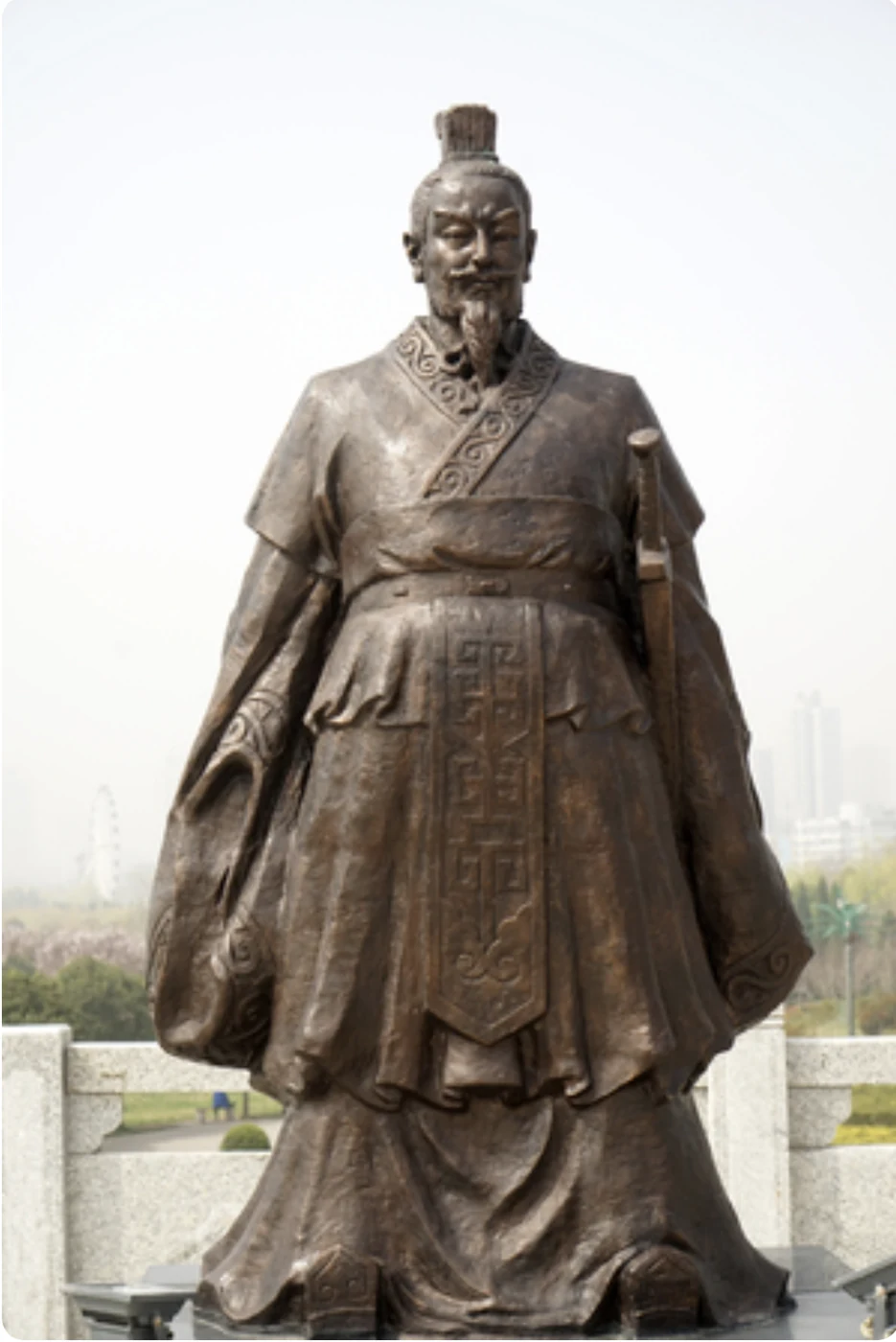
280 BCE–233 BCE
Thinkerphilosopherminister
Han Fei
韩非
Han Fei (c. 280–233 BCE), later respectfully known as Han Feizi or Hanzi, was of the Ji surname and the Han lineage, and came from Xinzheng in the state of Han (present-day Xinzheng, Henan) in the late Warring States period. He was a philosopher, thinker, and prose writer whose thought had a materialist coloring, and he became the great synthesizer of Legalist thought. Born into the royal house of Han, Han Fei studied the…
280 BCE–233 BCEQin Dynasty
PROFILE
Han Fei (c. 280–233 BCE), later respectfully known as Han Feizi or Hanzi, was of the Ji surname and the Han lineage, and came from Xinzheng in the state of Han (present-day Xinzheng, Henan) in the late Warring States period. He was a philosopher, thinker, and prose writer whose thought had a materialist coloring, and he became the great synthesizer of Legalist thought. Born into the royal house of Han, Han Fei studied the "art of the ruler" under Xunzi, traced the foundations of his thought to the Huang-Lao tradition, and was a fellow student of Li Si. After repeatedly urging the king of Han to institute reforms without success, he wrote works including Gufen, Wudu, Shuilin, and Shuinan. He developed a theory of government combining law, administrative technique, and positional power, and advanced an evolutionary view of history summarized by the principle that one should "not expect to cultivate antiquity, nor model oneself on what is permanently acceptable." King Ying Zheng of Qin greatly admired his writings and reportedly said that if he could meet this man and associate with him, he would die without regret; he then ordered an attack on Han. In 235 BCE, the third year of the reign of King An of Han, Han Fei was compelled to go to Qin as an envoy. There Li Si had him framed and imprisoned, and Han Fei was forced to take poison and die. The Han Feizi, comprising fifty-five chapters, integrated Shang Yang's emphasis on law, Shen Buhai's administrative techniques, and Shen Dao's concept of positional power, and stressed the idea that "the law does not bend before the noble, and punishment for wrongdoing does not spare great ministers." Fables such as "waiting by a stump for a hare" and "self-contradiction" became literary classics. His doctrines supplied an important theoretical foundation for the centralized system established by Qin.
- Also known as
- Han Feizi
- Period
- Qin
- Date of Birth
- about 280 BCE
- Date of Death
- 233 BCE
- Dynasty / Polity
- Qin
- Identity
- Thinker, philosopher, minister
- Ethnicity / affiliation
- Not recorded in historical sources
- Native place
- Xinzheng in the state of Han (present-day Xinzheng, Henan)
- Place of birth
- Not recorded in historical sources
- Place of death
- Not recorded in historical sources
- Highest office
- See Biography and Major Deeds
- Major achievements
- Leading synthesizer of Legalist thought; author of the Han Feizi, integrating fa, shu, and shi; imprisoned in Qin after being framed by Li Si and died in prison
LIFE TIMELINE
Age five | Began reading the writings of Shang Yang and Guan Zhong, Sun Wu and Wu Qi, as well as various other works
Age twenty-three | Distressed that capable men were not being appointed to govern the state, he began to devote himself to writing
Age twenty-seven | Entered Xunzi's school to study the "art of the ruler"; Li Si was among his fellow students
Age forty-five | Compelled to serve as an envoy to Qin after Qin attacked Han; slandered by Li Si and Yao Jia, imprisoned, and forced to commit suicide by poison
Death | Death; aged 47sui
BIOGRAPHY
Biography
Family Background and Early Life
Han Fei was born into the royal house of Han in the late Warring States period, around 280 BCE, the fifteenth year of King Xi of Han, in an aristocratic household in the capital Xinzheng. As a member of the ruling clan, he was qualified to participate in state politics, but Han was in an extremely difficult position. Among the Seven Warring States, Han was the weakest and lay between Qin, Chu, Wei, and Zhao, exposed to pressure on every side. In 275 BCE, the twentieth year of King Xi of Han, when Han faced severe national difficulties, the young Han Fei began reading works by Shang Yang and Guan Zhong, Sun Wu and Wu Qi, which were available in his household, together with a wide range of miscellaneous writings. This provided an early intellectual foundation for the development of his Legalist thought.
In 262 BCE, the tenth year of King Huanhui of Han, the Qin general Bai Qi attacked Han and captured fifty cities. The governor of Shangdang then surrendered the commandery to Zhao, and the ruling order of Han began to disintegrate. Around this time, the young Han Fei began submitting memorials to the king of Han, an effort that continued for roughly five years. Seeing Han's poverty and weakness, he repeatedly urged the king to change a system in which government neglected law, supported people it did not employ, and employed people it did not support, but his proposals were never accepted. In 257 BCE, the fifteenth year of King Huanhui of Han, frustrated that the state failed to seek out and employ worthy men while elevating boastful men above those with real achievements, Han Fei withdrew into intensive writing.
Study under Xunzi
In 253 BCE, the nineteenth year of King Huanhui of Han, Xunzi left the Jixia Academy in Qi and went to Chu, where Lord Chunshen appointed him magistrate of Lanling and he continued to teach students. Around this time, Han Fei entered Xunzi's school to study the "art of the ruler," with Li Si among his fellow students. Xunzi was a major Confucian thinker who advocated elevating ritual while giving weight to law and respecting the ruler while caring for the people. Although Han Fei studied under him, his own doctrines differed substantially. Han Fei transformed Xunzi's concern with ritual and law into an emphasis on the study of punishments, names, law, and administrative techniques. He opposed the Confucian effort to ground social order in private emotional ties and the elevation of contemporary moral standards, instead making human self-interest a premise for the construction of social order. Xunzi's emphasis on the ruler also influenced Han Fei. Han Fei treated monarchical authority as the center of decision-making, regarded that authority as inviolable, and argued that a ruler should govern ministers and subjects through severe punishments and strict laws in order to establish a centralized state.
Han Fei traced the foundations of his own doctrine to the Huang-Lao current of Daoist thought. He studied Laozi's Daodejing closely and wrote chapters such as Jielao and Yulao. Among Xunzi's students, Li Si reportedly considered his own learning inferior to Han Fei's. From about 247 to 234 BCE, Han Fei repeatedly submitted memorials to King Daohui of Han and King An of Han, but neither ruler made use of him. Chapters including Gufen, Wudu, Xianxue, and Nanyan were written during this period.
Mission to Qin and Death
Han Fei's writings reached Qin, and King Ying Zheng greatly admired his talent. After reading Han Fei's essays, the king said, "If I could meet this man and associate with him, I would die without regret." Li Si told the king that Han Fei was the author, and the king then used the threat of war to compel Han Fei to come to Qin as an envoy. In 235 BCE, the third year of King An of Han, Qin attacked Han. In the crisis, the king of Han summoned Han Fei to discuss ways of weakening Qin, and Han Fei was forced to go to Qin.
After Han Fei arrived, the king of Qin was pleased by his presence but did not trust or employ him. Li Si knew that his former classmate's talent and intelligence surpassed his own and feared losing his position if Han Fei were given important duties. Together with Yao Jia, he therefore slandered Han Fei, arguing that Han Fei was a prince of Han and that, while Qin sought to annex the other states, Han Fei would ultimately favor Han rather than Qin, as was only natural; if Qin did not employ him yet detained him for a long time before releasing him, it would be creating a future danger for itself, so it would be better to accuse and punish him according to law. The king accepted this argument and handed Han Fei over to the judicial authorities. Li Si had poison sent to Han Fei and told him to kill himself. Han Fei wanted to explain himself personally to the king but could not obtain an audience. The king later regretted the decision and sent men to pardon him, but Han Fei was already dead. Sima Qian records in chapter 63 of the Records of the Grand Historian, the "Biography of Han Fei": Li Si sent poison to Han Fei and made him kill himself; Han Fei wished to state his case but could not see the king; when the king of Qin regretted the matter and sent a pardon, Han Fei was already dead.
Major Activities
Political Ideal
Han Fei's political ideal was the creation of a unified, monarchically centralized feudal state. Confronted with intense conflict between old and new forces and the fragmentation of the late Warring States order, he drew a lesson from a past in which the Son of Heaven had been weak and the feudal lords strong, and advocated a unified state with centralized monarchical power. Expressions in his writings such as "new sage," "austere Son of Heaven," "the resources of kingship," "the resources of an emperor and king," and "uniting all under Heaven" reflected this aspiration. In the chapter Yangquan, he stated still more explicitly that such a unified central authority required "affairs to be in the four quarters but the essential power to be at the center; the sage holds the essential power and the four quarters come to render service," replacing division with unity and fragmentation with centralization.
To prevent the ruler's sacred authority from being infringed, Han Fei advocated elevating the ruler and subordinating ministers. In Neichu Shuo Xia, he called for strengthening the public ruling house and blocking private houses. Powerful ministers and private factions, which he compared to vicious tigers, were to have their parties dispersed, followers taken away, gates closed, and aides removed, so that they could be decisively eliminated and suppressed, as discussed in Zhudao. Although this position could in its own time serve to strike at powerful ministers who "impaired the law for private gain and exhausted the state for family advantage," as Gufen put it, Han Fei's absolutization of monarchical authority and his assumption that ruler and minister necessarily had opposed interests also deepened their conflict.
Reforming government and strengthening the state through institutional change were central to Han Fei's thought. He inherited Shang Yang's view that "there is no single way to govern an age, and what benefits the state need not imitate antiquity," and argued that one should "not expect to cultivate antiquity, nor model oneself on what is permanently acceptable." He maintained that when times change, affairs change, and when affairs change, preparations must change, as stated in Wudu. Holding an evolutionary view of history, he believed that the age continually moved forward; anyone who ignored current realities and merely praised and imitated ancient kings was either foolish or deceptive, as Xianxue put it. Since the times had changed, methods of government should change accordingly. Thus he argued in Wudu that "the sage does not expect to cultivate antiquity, nor model himself on what is permanently acceptable; he discusses the affairs of his age and makes preparations for them." He also wrote that "in high antiquity men competed in the Way, in the middle age they pursued schemes and intelligence, and today they compete in strength." In an age in which men competed in strength, one could not "govern the people of an urgent age with a lenient government." Only policies conducive to establishing and consolidating the emerging feudal order and bringing about political unification, he believed, accorded with the direction of historical change.
Legalist Thought
Han Fei's thought on law took an evolutionary view of history as the theoretical basis for implementing legal institutions, the establishment of a unified and centralized monarchical state as its ideal and goal, government through law as the core of his doctrine, and a materialist theory of knowledge as an instrument for understanding things and conducting struggle. These elements were organically connected and together formed a comparatively complete system of thought.
Han Fei summarized the experience of earlier Legalists and developed a political system centered on law and combining law, administrative technique, and positional power. He became the principal synthesizer of the various Legalist traditions. He particularly drew together the ideas of Shang Yang, Shen Buhai, and Shen Dao. Shang Yang emphasized law, Shen Dao positional power, and Shen Buhai administrative technique, each with a distinct approach. Han Fei argued that all three should be integrated closely. "Law" referred to a sound legal system; "positional power" to the ruler's authority and exclusive control of military and political power; and "technique" to the strategies and methods by which the ruler controlled ministers, held political power, and implemented commands. Positional power served above all to detect and prevent insubordination and rebellion and to maintain the ruler's position. Han Fei integrated these three elements. While admiring Shang Yang and Shen Buhai, he argued that their greatest shortcoming was the failure to combine law and technique. A second problem was that neither had carried his doctrine to completion: "Master Shen did not exhaust technique, and Lord Shang did not exhaust law," as stated in the "Dingfa" chapter of the Han Feizi. In Han Fei's view, good government required a ruler skilled in technique while ministers had to obey the law. Compared with Shen Buhai, Han Fei further developed technique especially as a means of detecting treachery. A ruler, he argued, could not trust ministers too readily and had to scrutinize whether names and realities matched. With respect to law, Han Fei particularly stressed the idea of "using punishment to stop punishment," together with severe penalties and heavy punishment. Yet law and technique alone were insufficient: positional power had to guarantee them. Positional power meant authority and political power, the ruler's power and status, and could be understood as the authority of the state. Han Fei approved Shen Dao's observation that Yao as a commoner could not govern three men, whereas Jie as Son of Heaven could throw all under Heaven into disorder, and argued in Nanshi that government was orderly when one held the law and occupied a position of power, but chaotic when one turned away from law and abandoned power.
Han Fei was the first to state explicitly the principle that "the law does not bend before the noble," arguing that "punishment for wrongdoing does not spare great ministers, and rewards for goodness do not omit common men." The Han Feizi, in the chapter Youdu, states that the law does not bend before the noble and the carpenter's line does not curve around crooked wood; once the law applies, the wise cannot argue their way out of it and the brave dare not resist it; punishment for wrongdoing does not spare great ministers, and rewards for goodness do not omit common men. This was an important contribution to Chinese legal thought and had a positive effect in curbing aristocratic privilege and upholding the dignity of law. Confucian teaching held that ritual did not descend to commoners and punishments did not rise to great officers, whereas Legalists represented by Han Fei developed a principle of equality before law: even people of noble rank and political power were not to be favored by the law.
Han Fei also advocated "taking the law as teaching." This meant that beyond enacting laws, the state had to publicize them, disseminate legal knowledge, and enable the broader population to obey and use the law, creating a social climate in which people knew, understood, and observed the law. Taking law as teaching was one feature of Qin policy for strengthening legal control of thought and consolidating centralized power.
Philosophical Theory
In philosophy, Han Fei attached great importance to a Daoist theory of comparative verification. He held that cognition is a natural human capacity dependent on the sense organs and organs of thought, a view containing elements of simple materialism. He fully affirmed human cognitive ability and advocated acting in accordance with the principles of things, saying in Jielao that those who follow such principles in conducting affairs can accomplish everything, while the contrary must lead to failure. He believed that cognitive activity is purposeful and that words and actions therefore had to be judged by practical effectiveness. In Wenbian he wrote that the target of words and actions is their practical effect and that, if practical effectiveness is not taken as the target, even extremely perceptive words and extremely determined actions amount to reckless claims. He also emphasized comparative verification as a standard for deciding truth and falsehood. "Comparison" meant comparative investigation and "verification" meant confirmation. In Jian Jie Shi Chen he wrote that one should follow names and realities to determine right and wrong and use comparison and verification to examine statements. In other words, only by examining whether names corresponded to realities could right and wrong be judged, and statements could be judged correctly only through comparative verification. In Xianxue he further wrote that it was foolish to affirm something without comparison and verification, while taking as a basis something one was unable to establish with certainty was deceptive.
Han Fei applied this theory of comparative verification to political life. On one hand, he used it to attack Confucian and other doctrines, arguing that their invocations of ancient kings were unverified and therefore empty. On the other, he used it to evaluate ministers, requiring complete consistency among their words, actions, and achievements. Those whose statements, work, and results matched were to be rewarded, while those whose claims did not correspond to performance were to be punished.
Literary Achievements
Han Fei had a mild stutter but was an accomplished writer of fluent prose. His essays are tightly reasoned, sharp in style, penetrating in argument, and direct in their demonstration of principles. They are carefully constructed, bold in description, and humorous in language, displaying striking effects within an otherwise plain style and producing a lasting, admonitory force. Han Fei also made extensive use of accessible fables and a broad knowledge of history as evidence in argument. These materials explained abstract principles and gave vivid form to his Legalist thought and his deep observations on society and human life.
Many of the fables in his writings, with their rich implications and vivid narratives, became widely known idiomatic stories still used today. The Han Feizi contains three or four hundred fables; famous examples include "self-contradiction," "waiting by a stump for a hare," "concealing illness and refusing treatment," "making up the numbers in a flute ensemble," and "an old horse knows the way." These vivid fables contain profound philosophical meaning. Their union of thought and artistry offers intellectual insight and gives them considerable literary value. Drawn from social reality, historical figures and events, and folk stories, they were distilled from Han Fei's close observation of social phenomena. His fables are accessible yet profound, humorous yet severe. He further developed Zhuangzi's method of reasoning through fables while adding elements closer to contemporary reality, making them treasures of pre-Qin philosophical prose.
The outline of his life is as follows: born about 280 BCE into an aristocratic family in Xinzheng, the capital of Hann, from the age of five he read the works of Shang Yang and Guan Zhong, of Sun Wu and Wu Qi, and miscellaneous books besides; in 257 BCE, exasperated that able men were not employed in government, he turned to writing; in 253 BCE he entered the school of Xunzi to study the "arts of emperors" alongside Li Si; in 235 BCE, as Qin pressed Hann, he was sent on a mission to Qin, was slandered by Li Si and Yao Jia, imprisoned and took poison. His writings, his embassy and his death form one sequence, showing that although his doctrines were put to use by Qin, he himself did not live to see them applied.
As to the form of his writings, his essays were arranged by later hands into the book known as the Han Feizi, in which pieces such as "Solitary Indignation", "The Five Vermin", the "Inner and Outer Congeries", the "Forest of Persuasions" and "The Difficulties of Persuasion" are the basic material for the study of his thought; he argued for government combining law, technique and position, in contrast with the rule of virtue advanced by the Confucians and Mohists, and his work stands as the summing up of Legalist doctrine at the end of the Warring States period.
Personal Relations
- Xunzi (Xun Kuang): Han Fei's teacher; Han Fei entered Xunzi's school to study the "art of the ruler."
- Li Si: A fellow student of Xunzi. Li Si reportedly regarded his own scholarship as inferior to Han Fei's; he later became chancellor of Qin and helped bring about Han Fei's death.
- Zhang Cang: A junior fellow student of Han Fei.
- King An of Han: Han Fei repeatedly submitted memorials to him, but his proposals were not adopted.
- King Ying Zheng of Qin: Greatly admired Han Fei after reading his writings and ordered an attack on Han that compelled Han Fei to enter Qin, but did not employ him; he later regretted the decision to prosecute Han Fei, but the pardon came too late.
- Li Si: Together with Yao Jia, slandered Han Fei, leading to his imprisonment and forced suicide.
- Yao Jia: Together with Li Si, slandered Han Fei.
- Shang Yang: Han Fei incorporated his concept of law.
- Shen Buhai: Han Fei incorporated his concept of administrative technique.
- Shen Dao: Han Fei incorporated his concept of positional power.
- Laozi: Han Fei traced his thought to the Huang-Lao tradition and wrote the Jielao and Yulao chapters.
Historical Assessment
Late Warring States to Qin
- King Ying Zheng of Qin, after reading Han Fei's Gufen and Wudu, exclaimed that if he could meet this man and associate with him, he would die without regret, according to the "Biographies of Laozi and Han Fei" in the Records of the Grand Historian.
- Although Li Si caused Han Fei's death, he reportedly admitted that his own learning was inferior, indicating the high regard in which Han Fei's talent was held.
- After Han Fei's death, rulers and ministers of various states competed to study his work Hanzi. The source text states that Qin Shi Huang completed the unification of the six states under the guidance of Han Fei's ideas.
Han Period
- Sima Qian's "Biographies of Laozi, Zhuangzi, Shen Buhai, and Han Fei" in the Records of the Grand Historian states that Han Fei delighted in the study of punishments, names, law, and administrative techniques, while tracing its foundations to Huang-Lao thought; it describes him as applying standards strictly to affairs and distinguishing right from wrong, but as ultimately harsh and lacking in benevolence, while grounding these ideas in the meaning of the Way and virtue.
- The "Author's Preface" of the Records of the Grand Historian states that Han Fei "weighed circumstances and followed the logic of positional power."
- Yang Xiong's Fayan commented that Han Fei wrote Shuinan and died because of the very difficulty of persuasion. It argued that the gentleman acts through ritual and stops according to righteousness, advances when these are compatible, and withdraws when they are not; Han Fei, by worrying that persuasion would fail, was led to extremes.
Song and Yuan Periods
- Sima Guang, in the Comprehensive Mirror in Aid of Governance, criticized Han Fei for devising plans for Qin that first aimed to overturn his own state in order to sell his ideas, arguing that his offense deserved death and was not worthy of pity.
- Sima Zhen, in the Suoyin commentary to the Records of the Grand Historian, wrote that Han Fei had techniques of punishments and names and understood the difficulty of persuasion to the utmost, but despite careful precautions ultimately perished because of Li Si.
Modern and Contemporary
- Mao Zedong, in annotations to the "Biographies of Laozi and Han Fei" in the Records of the Grand Historian, described Han Fei as a student of Xunzi and representative Legalist thinker of the Warring States period, and stated that his combined theory of rule through law, administrative technique, and positional power had a major influence on later monarchic rule.
- Modern scholar Liu Qianxian assessed both the achievements and limitations of Han Fei's thought, arguing that his doctrines had a progressive role in striking at domineering ministers but that the absolutization of monarchical authority intensified conflict between rulers and ministers.
- Contemporary scholar Bai Tongdong has called Han Fei "the first modern political philosopher," arguing that his thought displays features of modernity.
FIGURES ASSOCIATED WITH THIS DYNASTY
Bibliography
- Sima Qian, Records of the Grand Historian, vol. 63, "Biographies of Laozi and Han Fei"