Mengshecheng | Born into the royal house of Mengshe Zhao; educated in equestrian warfare and classical Chinese literature.
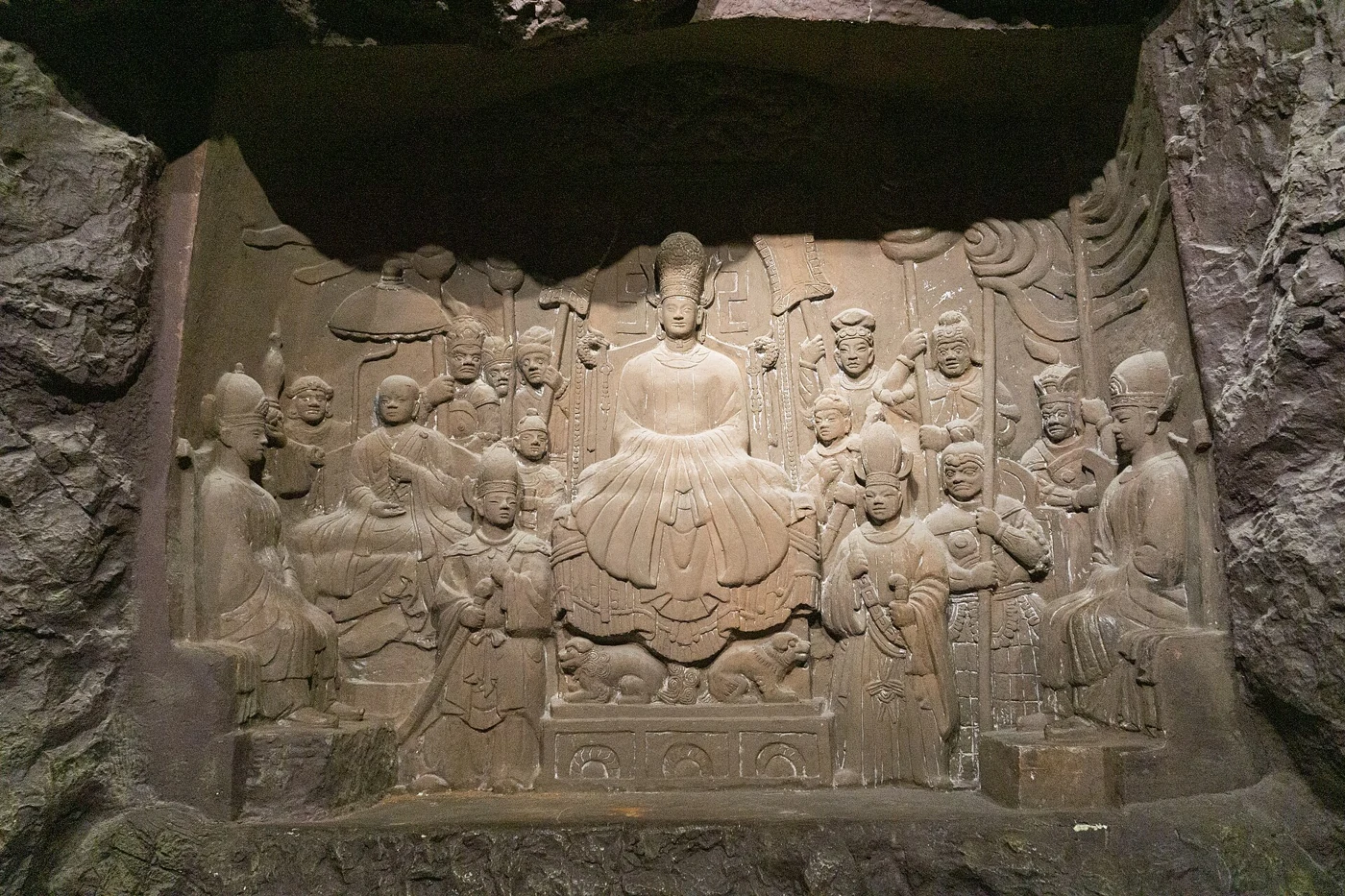
712 CE–779 CE
Ruler of NanzhaoTsenpo ChungEastern Emperor;748–779
Geluofeng
阁罗凤
Geluofeng (712–779), also recorded as Jueluofeng, was a ruler of Nanzhao (the fifth king ; the second-ruler count is unconfirmed) and eldest son of the dynastic founder Piluoge. He was an eminent monarch, strategic commander, and statesman of southwestern China during the mid-Tang Dynasty. In 738, he assisted his father in unifying the Six Zhao of the Erhai Basin under imperial Tang auspices. Inheriting the crown in 748 with…
712 CE–779 CENanzhao
PROFILE
Geluofeng (712–779), also recorded as Jueluofeng, was a ruler of Nanzhao (the fifth king ; the second-ruler count is unconfirmed) and eldest son of the dynastic founder Piluoge. He was an eminent monarch, strategic commander, and statesman of southwestern China during the mid-Tang Dynasty. In 738, he assisted his father in unifying the Six Zhao of the Erhai Basin under imperial Tang auspices. Inheriting the crown in 748 with the imperial title King of Yunnan, Geluofeng initially maintained devout vassal homage toward Chang'an. However, when corrupt Tang Governor Zhang Qianto subjected Geluofeng's household to humiliation and extortion, Geluofeng stormed Yaozhou in 750, executing Zhang and triggering the cataclysmic Tianbao Wars. Demonstrating exceptional tactical genius in the mountainous terrain, Geluofeng annihilated massive Tang punitive legions commanded by Xianyu Zhongtong in 751 and Li Mi in 754. Forced to realign with the Tibetan Empire (Tubo), he was styled "Tsenpo Chung" and "Eastern Emperor." Domestically, he founded Tuodong City (the predecessor of modern Kunming), adopted Han governance systems, and erected the immortal Nanzhao Dehua Stele in 766, explicitly preserving the historical truth of the conflict while pledging ultimate reconciliation with China. He died in 779 at age sixty-eight with the posthumous title King Shenwu.
- Historical Period
- Mid-Tang Dynasty (reigns of Xuanzong to Daizong);Nanzhao Kingdom
- Identity
- Ruler of Nanzhao, Tsenpo Chung, Eastern Emperor;748–779
- Date of Birth
- 712 CE(1st year of Rui Zong Tai Ji)
- Date of Death
- 779 CE(14th year of Dai Zong Da Li)
- Era Names
- Tsenpo Chung; Changshou (adopted in 769);Wuman (ancestral Yi ethnicity)
- Native Place
- Mengshecheng (modern Weishan Yi and Hui Autonomous County, Yunnan Province);712 (Year Taiji 1 of Emperor Ruizong)
- Place of Birth
- Weishan, Yunnan;779 (Year Daling 14 of Emperor Daizong)
- Place of Death
- Taihe City (modern Taihe Village, Dali, Yunnan Province);68
- Highest Office
- King of Nanzhao, King of Yunnan, Eastern Emperor (Tubo);Grand Master for Thorough Counsel, Pacification Commissioner of Yunnan, King of Yunnan, King of Nanzhao
- Noble Title
- King of Yunnan (Tang title), Tsenpo Chung (Tubo title);King Shenwu
- Major Achievements
- Preserved and expanded the unified kingdom created by Piluoge, annihilated Tang invasion legions in the Tianbao Wars, formed a strategic alliance with Tubo receiving the title Eastern Emperor, constructed Tuodong City (modern Kunming), erected the historic Nanzhao Dehua Stele
LIFE TIMELINE
Dynastic Succession and Consolidation of Yunnan Geluofeng was born in 712 as the eldes | ### Dynastic Succession and Consolidation of Yunnan Geluofeng was born in 712 as the eldest son of Piluoge, ruler of the southernmost Mengshe Zhao in the Erhai basin.
Erhai, Taihe | Assisted his father Piluoge in absorbing the five rival Zhao, unifying Yunnan under the capital at Taihe.
Upon Piluoge's death in 748 | Upon Piluoge's death in 748, Geluofeng inherited the kingdom.
When Geluofeng accompanied his royal family to pay respects at Yaozhou in 750 | When Geluofeng accompanied his royal family to pay respects at Yaozhou in 750, Zhang Qianto subjected Geluofeng's consort to lewd indignities and sent false memorials to Chang'an accusing Geluofeng of treason.
Annihilation of Imperial Armies at Erhai In summer 751 | ### Annihilation of Imperial Armies at Erhai In summer 751, Tang Chancellor Yang Guozhong dispatched Jiannan Military Governor Xianyu Zhongtong with an elite army of eighty thousand men to conquer Nanzhao.
Taihe City | Ascended the Nanzhao throne upon Piluoge's death; invested by Emperor Xuanzong as King of Yunnan.
Taihe City | Formed an offensive-defensive alliance with the Tibetan Empire, receiving the title Tsenpo Chung ("Eastern Emperor").
Tiansheng Bridge | Entrapped Tang General Li Mi's seventy-thousand-strong army in the Cangshan mountains, destroying the entire force.
Yaozhou | Provoked by corrupt Tang Governor Zhang Qianto's insolence; captured Yaozhou and slew Zhang in self-defense.
Taihe City | Erected the four-thousand-character Nanzhao Dehua Stele, explaining the origins of the war and affirming Chinese kinship.
West Erhai River | Decisively annihilated Tang General Xianyu Zhongtong's eighty-thousand-man expeditionary army near Dali.
Taihe City | Passed away at age sixty-eight; succeeded by his grandson Yimouxun who later formally reconciled with the Tang court.
BIOGRAPHY
Biography
Dynastic Succession and Consolidation of Yunnan
Geluofeng was born in 712 as the eldest son of Piluoge, ruler of the southernmost Mengshe Zhao in the Erhai basin. During the early Kaiyuan era, with the decisive backing of Emperor Xuanzong, Piluoge consolidated the fractious Six Zhao into a unified regional state, shifting the capital to Taihe City in modern Dali. From youth, Geluofeng accompanied his father on military expeditions, demonstrating strategic poise, linguistic mastery of Chinese, and reverence for Confucian statecraft. Upon Piluoge's death in 748, Geluofeng inherited the kingdom. Tang Emperor Xuanzong officially invested him as King of Yunnan and Grand Master for Thorough Counsel. During his first two years, Geluofeng faithfully dispatched tribute caravans of horses, gold, and tropical aromatics to the Tang court, educating royal princes in Chinese etiquette. ### The Outbreak of the Tianbao Wars Peace was abruptly shattered by the imperial frontier administration. Zhang Qianto, the corrupt Tang Governor of Yunnan and Commander of Yaozhou, continually extorted immense treasures from Nanzhao. When Geluofeng accompanied his royal family to pay respects at Yaozhou in 750, Zhang Qianto subjected Geluofeng's consort to lewd indignities and sent false memorials to Chang'an accusing Geluofeng of treason. Outraged by the intolerable provocation, Geluofeng mobilized Nanzhao forces in winter 750, storming Yaozhou, executing Zhang Qianto, and reclaiming ancestral frontier commanderies. This defensive counter-stroke ignited the famous Tianbao Wars. ### Annihilation of Imperial Armies at Erhai In summer 751, Tang Chancellor Yang Guozhong dispatched Jiannan Military Governor Xianyu Zhongtong with an elite army of eighty thousand men to conquer Nanzhao. Geluofeng attempted diplomatic appeasement, sending envoys with humble petitions offering full reparations and pleading for imperial restraint. Arrogantly dismissing the envoys, Xianyu Zhongtong advanced toward West Erhai. Taking advantage of tropical malaria and unfamiliar mountain defiles, Geluofeng trapped the imperial troops along the Erhai waterways. Cutting the Tang supply bridges, Nanzhao columns launched a coordinated nocturnal assault, annihilating sixty thousand imperial troops. Xianyu Zhongtong fled with a few dozen horsemen. In 752, anticipating an even larger retaliation from Chang'an, Geluofeng concluded a strategic military pact with Emperor Trisong Detsen of the Tibetan Empire (Tubo). The Tibetan sovereign conferred upon Geluofeng the golden seal of "Tsenpo Chung" ("Younger Brother of the Tsanpo") and the exalted title "Eastern Emperor." In 754, Yang Guozhong levied over seventy thousand fresh recruits under Censor Li Mi to mount a second invasion. Geluofeng adopted a strategy of scorched earth and tactical retreat, luring Li Mi deep into the narrow defiles of Tiansheng Bridge near Xiaguan. Stranded without rations, the imperial army collapsed under plague and starvation. Nanzhao and Tibetan cavalry launched a devastating pincer attack, destroying the entire imperial army; General Li Mi drowned in the river. Great Tang poet Du Fu memorialized this tragedy in his masterwork The Ballad of the War Carts (Bing Che Xing). ### The Foundation of Kunming and the Dehua Stele With Tang forces expelled and the imperial center engulfed by the An Lushan Rebellion of 755, Geluofeng expanded his territory across southwestern China and northern Southeast Asia, conquering Pyu (modern Myanmar) and pushing frontiers eastward. In 765, Geluofeng directed his heir apparent Fengjiayi to construct Tuodong City on the shores of Lake Dian, laying the urban and administrative foundation for modern Kunming. He appointed captured Tang scholar-officials, notably Zheng Hui, to high administrative posts, educating native chieftains in Chinese literature and administrative statutes. In 766, Geluofeng erected the monumental Nanzhao Dehua Stele outside Taihe City. Authored by Grand Councillor Zheng Hui, the nearly four-thousand-character inscription articulated the profound historical truth: Nanzhao's rebellion had been forced by Zhang Qianto's tyrannical perfidy, and the kingdom's ultimate aspiration was to return to the benevolent orbit of the Chinese sovereign. Geluofeng died in 779 at age sixty-eight. His grandson Yimouxun inherited the throne, ultimately fulfilling Geluofeng's prophecy by formally reconciling with the Tang Empire at the Mount Diancang Alliance in 794.
Major Activities
Defense of Nanzhao in the Tianbao Wars
Commanded native forces to achieve total victories over two colossal imperial invasion armies under Xianyu Zhongtong (751) and Li Mi (754), preserving the autonomy of southwestern nationalities. ### Strategic Tibetan Alliance Diplomatically aligned with Tubo to balance Tang power, receiving the title "Eastern Emperor" and neutralizing external encirclement. ### Founding of Tuodong City (Kunming) Established the strategic eastern capital of Tuodong in 765, inaugurating the twelve-century history of Kunming as the political and economic hub of Yunnan. ### Inscription of the Nanzhao Dehua Stele Erected the famous Nanzhao Dehua Stele in 766, a masterpiece of ancient southwestern epigraphy that recorded the Tianbao Wars and preserved cultural allegiance to China.
Personal Relations
- Father: Piluoge (Founding King of Nanzhao)
- Son: Fengjiayi (Crown Prince, posthumously King Daohui)
- Grandson: Yimouxun (Successor King, reunited Nanzhao with Tang)
- Adviser / Chancellor: Zheng Hui (former Tang magistrate, Prime Minister of Nanzhao)
- Allies: Trisong Detsen (Tibetan Tsanpo)
- Adversaries: Zhang Qianto, Xianyu Zhongtong, Li Mi, Yang Guozhong
Historical Assessment
The New Book of Tang (Xin Tangshu) praises Geluofeng as an extraordinary barbarian monarch of peerless intellect and strategic breadth, whose adoption of Chinese scholarship and erection of the Dehua Stele revealed a visionary commitment to long-term civilizational unity.
FIGURES ASSOCIATED WITH THIS DYNASTY
Bibliography
- Liu Xu et al., Old Book of Tang (Jiu Tangshu), Chapter 197, Biographies of Southern Barbarians: Nanzhao.
- Ouyang Xiu and Song Qi, New Book of Tang (Xin Tangshu), Chapter 222, Biographies of Southern Barbarians: Nanzhao.
- Fan Chuo, Book of the Southern Barbarians (Man Shu).