Birth | By imperial order, debated Jiang Gong of Xiaqiu, a scholar of the Guliang tradition; the court thereafter gave greater weight to the Gongyang tradition
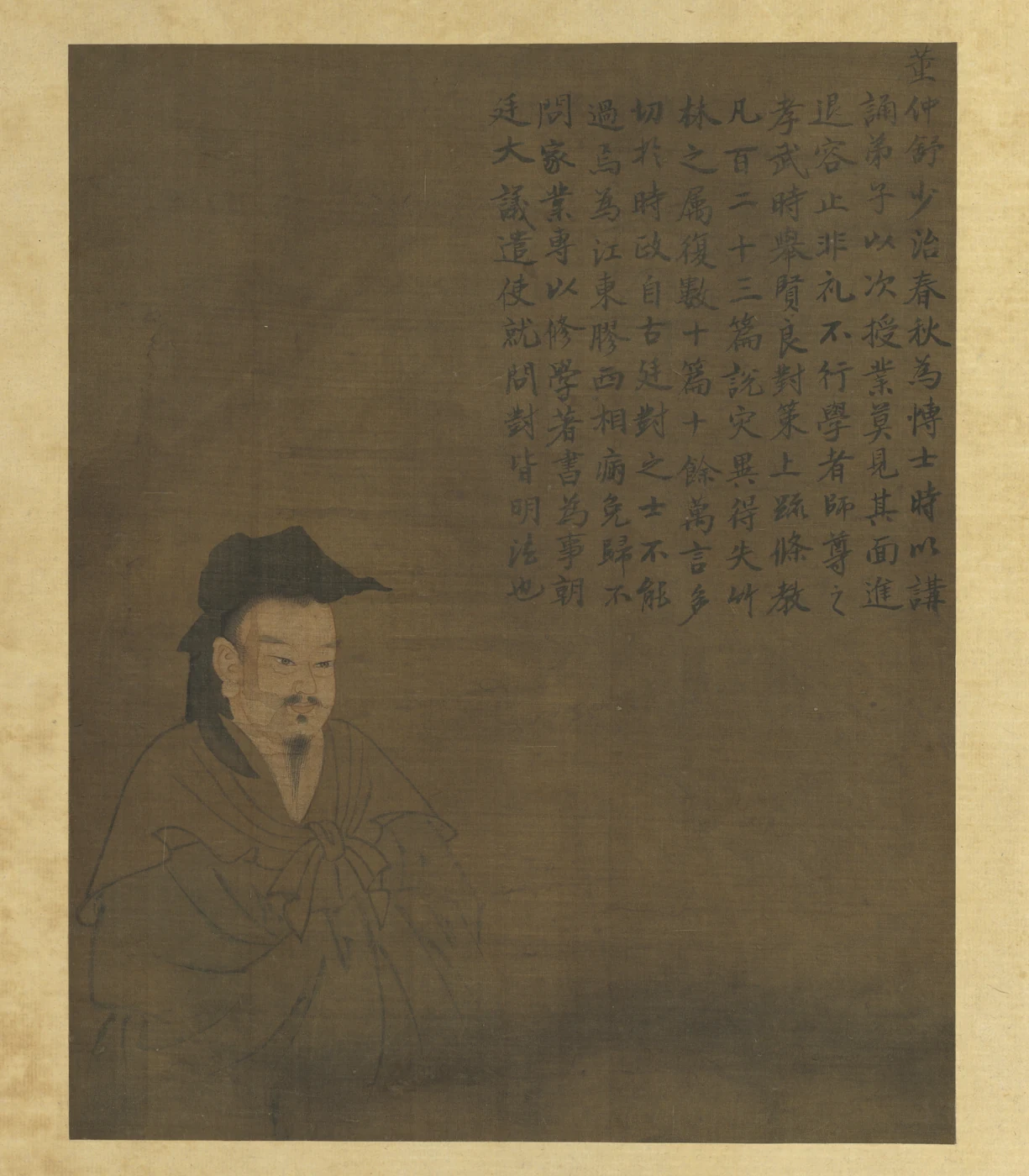
179 BCE–104 BCE
Thinker and statesman
Dong Zhongshu
董仲舒
Dong Zhongshu was a Western Han classical scholar and official known for his study of the Gongyang tradition of the Spring and Autumn Annals, for presenting Three Responses on Heaven and Man to Emperor Wu of Han, and for articulating ideas concerning the relationship between Heaven and humanity, political unity, and governance through ritual, music, and moral education. 179 BC, the first year of the Former Yuan period of…
179 BCE–104 BCEWestern Han
PROFILE
Dong Zhongshu was a Western Han classical scholar and official known for his study of the Gongyang tradition of the Spring and Autumn Annals, for presenting Three Responses on Heaven and Man to Emperor Wu of Han, and for articulating ideas concerning the relationship between Heaven and humanity, political unity, and governance through ritual, music, and moral education. 179 BC, the first year of the Former Yuan period of Emperor Wen of Han, as his birth year Both sources state that he served as an erudite during the reign of Emperor Jing of Han, later became Chancellor of Jiangdu Kingdom and Chancellor of Jiaoxi, and died in 104 BC. His thought linked interpretations of the Spring and Autumn Annals with yin-yang and Five Phases theory, correlations between Heaven and human affairs, and political order, influencing Han classical scholarship and political thought. Later writers often summarize his proposals with the phrase “reject the Hundred Schools and honor Confucian learning,” but the institutionalization of Confucian learning under Emperor Wu was not a policy accomplished by Dong Zhongshu alone.
- Also known as
- Dongzi
- Period
- Western Han
- Date of Birth
- 179 BCE
- Date of Death
- 104 BCE(1st year of Emperor Wu)
- Dynasty / polity
- Western Han
- Identity
- Thinker and statesman
- Ethnicity / group
- Not reliably established in available sources
- Native place
- Guangchuan (present-day Guangchuan Town, Jing County, Hengshui, Hebei)
- Place of birth
- Unknown
- Major achievements
- Major Han Confucian thinker who advanced the doctrine of correspondence between Heaven and humanity and the proposal to accord exclusive status to Confucian learning, exerting a profound influence on Chinese state ideology
- Highest office
- Chancellor of the Principality of Jiangdu; Chancellor of the Prince of Jiaoxi
- Birthplace
- No specific birthplace can be independently confirmed from the available sources;104 BC (first year of the Taichu era of Emperor Wu of Han)
- Lifespan
- Unknown;At home; the specific location is not reliably recorded
- Main offices
- Erudite in the Spring and Autumn Annals; Chancellor of Jiangdu Kingdom; Chancellor of Jiaoxi
LIFE TIMELINE
Death | Died of illness at home; sources differ regarding the specific burial place and the later tradition concerning Xiamaling
Erudite of the Spring and Autumn | Aged about thirty, he served as Erudite of the Spring and Autumn and lectured on the Gongyang commentary.
Chancellorship of Jiangdu | Emperor Wu ascended the throne and Dong Zhongshu was appointed Chancellor of the Principality of Jiangdu, assisting Liu Fei, the Yi Prince of Jiangdu.
Age 45 | In 135 BC, the sixth year of Jianyuan, fires occurred at the Gaoyuan Hall at Changling and the Gao Temple in Liaodong.
BCE(1st year of the Yuanguang era, Emperor Wu of Han; the reign of
134 BCE(1st year of the Yuanguang era, Emperor Wu of Han; the reign of Ling You Gong Yuan Qian 135 Nian Shuo) | In 135 BC | In 135 BC, the sixth year of Jianyuan, fires occurred at the Gaoyuan Hall at Changling and the Gao Temple in Liaodong.
Chancellor of Jiaoxi and Later Writings In 125 BC | ### Chancellor of Jiaoxi and Later Writings In 125 BC, the fourth year of Yuanshuo, Gongsun Hong recommended Dong Zhongshu for appointment as Chancellor of Jiaoxi under Liu Duan, King of Jiaoxi.
Debate on the classics | By imperial order he debated the classics with Xiaqiu Jianggong, a master of the Guliang commentary, and the court came to favour his Gongyang learning.
Approximately sixty years of age | He debated the meaning of the Spring and Autumn with Xiaqiu Jianggong, and the Gongyang school won the court’s esteem.
Death | Dong Zhongshu died of illness at home in 104 BC, the first year of Taichu.
BIOGRAPHY
Biography
Family Background and Teaching Dong Zhongshu was a native of Guangchuan. he came from a family with a substantial collection of books and that he began taking students and teaching the classics at about the age of thirty. His teaching was said to involve lecturing from behind a curtain while senior disciples transmitted the material to later students, a practice later associated with the phrase “lecturing behind the curtain.” Both sources connect his service as an erudite in the Spring and Autumn Annals during the reign of Emperor Jing with his reputation in classical scholarship. The Book of Han, “Biography of Dong Zhongshu,” says that he lectured from behind a curtain and “for about three years did not look into the garden”; Yan Shigu’s annotation explains this as a sign of his single-minded study. This article presents it as a biographical account and does not reconstruct daily details beyond the text. Dong’s teaching centered on the Gongyang tradition of the Spring and Autumn Annals. Disciples named in the two sources include Lü Bushu, Wuqiu Shouwang, Chu Da, Yin Zhong, and Ying Gong. ### Chancellor of Jiangdu and Three Responses on Heaven and Man After Emperor Wu of Han came to the throne, Dong Zhongshu became Chancellor of Jiangdu Kingdom, serving Liu Fei, King Yi of Jiangdu and an elder brother of the emperor. both state that Liu Fei once invoked Duke Huan of Qi and Guan Zhong in expressing ambitions for hegemony. Dong responded by invoking the political unity articulated through the Spring and Autumn Annals and the principles of benevolence and righteousness. Surviving accounts connect this exchange with Dong’s opposition to autonomous expansion by regional kings, but the wording preserved in later sources cannot be treated as a verbatim transcript. During his service in Jiangdu, Dong also interpreted calamities through the Spring and Autumn Annals and participated in rites for seeking or stopping rain. Another account gives a more detailed description of the associated rituals, including prayer, sacrifice, and regulation of yin and yang. These accounts reflect contemporary ritual thought and Dong’s theory of Heaven and humanity; whether the rituals produced rain is not presented here as a verifiable natural causal relationship. After leaving the Jiangdu office, Dong at one point served as Central Grandee. In 135 BC, the sixth year of Jianyuan, fires occurred at the Gaoyuan Hall at Changling and the Gao Temple in Liaodong. Both encyclopedia sources state that Dong drafted a memorial interpreting the calamities and that Zhufu Yan obtained the draft and submitted it to Emperor Wu. Dong was punished but later pardoned. he lost his position as Chancellor of Jiangdu, while The Book of Han, “Biography of Dong Zhongshu,” says that Zhufu Yan privately visited Dong, resented him, took the draft, and submitted it. This article presents that as the historical biography’s account; it does not turn the stated motive into an independently verifiable psychological fact or add details absent from the text. another account places a related dismissal in 139 BC, whereas one account structures the chronology differently; the timeline therefore marks the source difference. In 134 BC, the first year of Yuanguang, Dong Zhongshu responded to the Worthy-and-Good policy questions with Three Responses on Heaven and Man, discussing political governance, the relationship between Heaven and humanity, and classical learning. one account dates the responses to 134 BC Later writers often summarize recommendations in the responses as promoting the teaching of Confucius, suppressing competing schools, and honoring the Six Classics, commonly condensed into the phrase “reject the Hundred Schools and honor Confucian learning.” That shorthand indicates the direction of Dong’s proposals but does not by itself describe the entire process by which policy under Emperor Wu developed; the two encyclopedia sources also differ in their assessment of his concrete political influence. ### Chancellor of Jiaoxi and Later Writings In 125 BC, the fourth year of Yuanshuo, Gongsun Hong recommended Dong Zhongshu for appointment as Chancellor of Jiaoxi under Liu Duan, King of Jiaoxi. After about four years in office, Dong resigned on grounds of age and illness and returned to Chang'an. one account further states that in his later years Dong opposed the state monopoly of salt and iron. This article reports that point only as it appears in the local and does not infer the content or impact of any memorial beyond what the source provides. The event indicates the position of Gongyang learning in court discussions of the classics, but a single debate does not by itself establish that all later institutions of classical learning were determined by Dong Zhongshu. Dong Zhongshu died of illness at home in 104 BC, the first year of Taichu. he was buried west of Chang'an and connects the site with a story that Emperor Wu dismounted when passing his grave. another account does not present the burial location as certain. Traditions concerning Xiamaling and a possible burial near the Maoling complex appear in later local accounts, and the available materials are insufficient to identify either location definitively as his actual grave.
Dong Zhongshu was born about 179 BC; his home district of Guangchuan held a great store of books, his family being landowners with a large library. At about thirty he began to take a great number of pupils and teach them with care. In lecturing he hung a curtain across the hall, speaking from behind it while his pupils listened outside, and he often had his ablest disciples lecture in his place, so that many studied with him for years without ever seeing his face. Through his teaching he trained a body of men for the Han, some of his pupils rising to be chancellors of kingdoms and others to be chief secretaries; among them Lü Bushu was sent with credentials to try the case of Huainan and judged it by the sense of the Spring and Autumn. His fame grew with his pupils and his exposition of the classics, and under Emperor Jing he was made a court scholar in charge of lecturing on the classics. So single-minded was he that for three years he never looked into his garden, and his conduct following the rules of ceremony, many scholars honoured him as their master.
On Emperor Wu's accession the realm was ordered to recommend men of worth and letters, and Dong Zhongshu was sent up to answer the throne's questions. The emperor questioned him three times in succession, chiefly on the relation between Heaven and man, and the exchange is known as the Three Answers. The first asked after the fundamental principle of holding power, the second after the art of governing the state, and the third after the causes of order and disorder past and present. In his answers Dong Zhongshu set out in detail the interaction of Heaven and man, discussed the relation of divine authority to imperial power, and put forward his proposals for government. Afterward the emperor sent him as chancellor to the prince of Jiangdu, Liu Fei, the emperor's elder brother, a violent and overbearing man, who yet respected Dong Zhongshu for his fame and compared him to Guan Zhong, who had aided Duke Huan of Qi, hoping that Dong would do the like for him. Dong Zhongshu replied by indirection, telling him that the benevolent man sets straight his own way without seeking profit and cultivates his principles without hurrying after results, and that to strive to transform the customs of the people by moral teaching is the highest benevolence; he hinted thus that Liu Fei should not aim at overlordship. He was chancellor of Jiangdu for six years, guided by the Gongyang commentary, tracing out the causes of natural calamity and disorder in the yin and yang; in praying for rain he would close the yang and release the yin, and in praying for it to stop he would close the yin and release the yang, and in Jiangdu, it was said, he never once erred. He was afterward reduced to the rank of grand master of the palace.
In 135 BC the Gaoyuan hall, where the emperors sacrificed to their ancestors, and the temple of the High Ancestor at Liaodong were destroyed by fire, and Dong Zhongshu, thinking it a chance to advance the doctrine of Heaven's responses, drew up a memorial while ill, arguing from the two fires that Heaven was angry with the emperor. Before it was sent, it happened that Zhu Fu Yan was visiting him, and envious of his talent he stole the draft and gave it to the emperor, who was enraged and would have had Dong Zhongshu beheaded; then, pitying his ability, he issued a decree of pardon, but Dong was stripped of his chancellorship at Jiangdu. From that time he dared not speak of calamities and portents but returned to his old work of teaching, lecturing on the Gongyang Spring and Autumn for another ten years. Later he was recommended as chancellor to the prince of Jiaoxi, Liu Duan, another brother of the emperor, crueller and more overbearing even than Liu Fei, under whom many former chancellors had been killed or poisoned; but he respected Dong Zhongshu as a scholar of repute. In his later years Dong Zhongshu retired to his house, and when great questions arose at court envoys were often sent to ask his opinion. He died at home.
On instruction and government Dong Zhongshu urged the founding of an imperial university and the appointment of clear teachers to train the realm's scholars, holding that order or disorder turned on whether moral teaching was carried out; he also proposed limits on the land men might hold, the freeing of slaves and lighter taxes, hoping thus to ease the tensions of society. Not all of this was adopted at the time, but it pointed the way for later adjustments of Han institutions. The Luxuriant Dew of the Spring and Autumn, based on the Gongyang commentary, expounds the interaction of Heaven and man, the five agents of yin and yang and the politics of the kingly way, and remains a chief source for the New Text scholarship of the Han; the History of the Han says that he expounded Confucius and suppressed the hundred schools, and later ages have summed up his influence on the intellectual order of Emperor Wu's reign as the rejection of the hundred schools and the honouring of the Six Classics.
Later judgments of Dong Zhongshu have centred on two things: his exposition of the Gongyang tradition of the Spring and Autumn and his writing of the Luxuriant Dew, and the part he played in the answers to Emperor Wu's questions. The History of the Han, treating the Confucian scholarship of the dynasty, calls him the chief of the assembled scholars, and later students of Han New Text learning have likewise taken him as its representative. He and his contemporary Gongsun Hong both entered office through the classics, though their fortunes in office were very different.
Major Activities
Classical Scholarship and the Gongyang Tradition Dong Zhongshu was known for studying and teaching the Gongyang tradition of the Spring and Autumn Annals. He emphasized drawing political, ethical, and ritual principles from the wording and evaluative judgments of the classic. another account connects his interpretive method with calamity theory, views of history, and Chunqiu jueyu (adjudication according to the Spring and Autumn Annals), while one account emphasizes that he took Gongyang learning as a core framework while also incorporating yin-yang and Five Phases ideas and elements associated with Daoist and Legalist thought. The point supported by both sources is that Dong used classical learning to interpret political order rather than merely teaching the text as literature. Related case materials were later transmitted under titles such as Gongyang Dong Zhongshu Zhiyu and Chunqiu Jueshibi. The titles, contents, and numbers of cases differ across later transmission, so those later compilations are not treated here as complete works personally edited by Dong Zhongshu. ### Heaven, Calamities, and Political Thought Dong Zhongshu connected the Way of Heaven and changes in nature with human government. He argued that rulers should govern according to benevolence and righteousness and give priority to moral education; when government failed, calamities could be interpreted as warnings from Heaven. This framework gave Confucian political discourse a cosmological dimension and also allowed officials to use discussions of anomalies to remonstrate with rulers. Modern interpretations differ on whether the theory of resonance between Heaven and humanity primarily constrained imperial authority, reinforced it, or served both functions, so it cannot be reduced to a one-directional limitation on the ruler. In government, Dong advocated honoring the Confucian classics and ruling through ritual, music, and moral education, while not denying a role for law and punishment. Whether and how individual proposals were adopted by Emperor Wu cannot be inferred solely from the fact that Dong advanced them. His concept of political unity focused on political order and the authority of classical orthodoxy. Later use of the expression “honor Confucian learning” to summarize Han intellectual policy likewise requires attention to the multiple political and institutional factors involved in that policy’s development. ### Yin-Yang, the Five Phases, Ethics, and Views of History Dong Zhongshu used yin and yang, the Five Phases, and seasonal change to explain relations between Heaven and human affairs and applied these concepts to politics, ethics, and ritual. His theory of human nature held that human desires required cultivation and regulation through moral instruction and ritual. These ideas had broad later influence in intellectual history and also incorporated hierarchical social and ethical distinctions. In historical thought The theory framed political legitimacy in terms of Heaven’s mandate and classical learning and is not equivalent to a modern theory of historical progress. Scholars summarized by another account also disagree over the authorship and compositional layers of chapters in Luxuriant Gems of the Spring and Autumn dealing with yin-yang and the Five Phases. ### Ritual Practice and Writings Dong Zhongshu’s thought on Heaven and humanity was also expressed in sacrificial and rainmaking or rain-stopping rites. The rainmaking and rain-stopping procedures attributed to him included prayer, fasting, sacrifice, and seasonal arrangements. The details come mainly from research materials summarized in the another account article and are not expanded here into unsupported ritual narratives. Both encyclopedia sources mention Three Responses on Heaven and Man and Luxuriant Gems of the Spring and Autumn. another account also attributes Fu on the Scholar's Misfortune to Dong and notes that Luxuriant Gems of the Spring and Autumn was probably compiled into its received form by later editors around the Northern and Southern Dynasties, with some surviving chapters disputed by scholars as not being Dong’s own work. The text can therefore be described as a representative transmitted work associated with him only with the qualification that the authorship of some chapters remains disputed.
Personal Relations
- Liu Che: Emperor Wu of Han; Dong Zhongshu answered his policy questions in Three Responses on Heaven and Man and presented views on government to him.
- Liu Fei: King Yi of Jiangdu; Dong served as his chancellor and used classical principles to counsel him concerning his political ambitions.
- Liu Duan: King of Jiaoxi; Dong served as his chancellor and later resigned because of age and illness.
- Wuqiu Shouwang: disciple of Dong Zhongshu; - Lü Bushu: disciple of Dong Zhongshu; both encyclopedia sources state that, during the calamity memorial draft incident, he criticized the document without realizing that it had been written by his teacher.
- Gongsun Hong: official under Emperor Wu; recommended Dong Zhongshu for appointment as Chancellor of Jiaoxi, although the sources differ in their assessment of his motives.
- Zhufu Yan: official under Emperor Wu; the Book of Han says he privately visited Dong, took the calamity memorial draft, and submitted it; the motive is reported only as the biography states it.
- Jiang Gong of Xiaqiu: classical scholar; - Zhang Tang: official under Emperor Wu; - Chu Da, Yin Zhong, and Ying Gong: disciples or students of Dong Zhongshu named by another account.
Representative Works
- Three Responses on Heaven and Man: responses to the Worthy-and-Good policy questions, mainly concerning the relationship between Heaven and humanity, political governance, and classical learning.
- Luxuriant Gems of the Spring and Autumn: a transmitted collection dealing with interpretation of the Spring and Autumn Annals, politics, yin-yang and the Five Phases, and ritual; the authorship and compilation of some surviving chapters remain disputed.
- Fu on the Scholar's Misfortune: attributed to Dong Zhongshu by another account; it concerns the situation of an unrecognized scholar, and its transmission and influence are reported only to the extent supported by that source.
- Gongyang Dong Zhongshu Zhiyu (also transmitted as Chunqiu Jueshibi): later texts associated with adjudicating cases according to principles of the Spring and Autumn Annals; their titles, compilation, and textual transmission vary.
Anecdotes
The Book of Han, “Biography of Dong Zhongshu,” records that he lectured from behind a curtain while disciples passed his teaching along by seniority, and that some students had never seen him. It summarizes his concentration with the statement that “for about three years he did not look into the garden”; Yan Shigu’s annotation explains that, although he had a garden, he did not look at it because he was devoted to study. This passage conveys the biographical tradition’s image of his diligence and does not establish recoverable day-to-day details. It is included from the Book of Han; later supernatural tales, including the fox transformation story, are excluded.
Historical Assessment
The concluding assessment in the Book of Han, “Biography of Dong Zhongshu,” quotes Liu Xiang as saying that Dong had talent fit to assist a ruler and comparing him with Yi Yin and Lü Shang. Ban Gu then cautions that the comparison placing Guan Zhong and Yan Ying below Dong, and even saying Yi Yin and Lü Shang could not surpass him, goes too far. The passage preserves Liu Xiang’s high praise alongside Ban Gu’s reservation. Later tradition treated Dong Zhongshu as a major figure in Han Confucian learning and associated the rising institutional status of classical scholarship with his proposals. Later writers valued his systematic interpretations of the classics, the relationship between Heaven and humanity, and political ethics, while modern critics including Liang Qichao argued that proposals to suppress competing schools restricted intellectual development. The another account article also summarizes divergent scholarship on the extent of Dong’s direct influence on specific policies under Emperor Wu. His position in intellectual history is therefore significant, but the precise scope of his direct effect on Han institutional change and the formation of the policy later summarized as “honor Confucian learning” must be distinguished from later shorthand.
FIGURES ASSOCIATED WITH THIS DYNASTY
Bibliography
- Ban Gu, Book of Han, vol. 56, “Biography of Dong Zhongshu,” including the account of lecturing behind a curtain and not looking into the garden for about three years. Online text: