Entered palace service | Began serving in the palace; his exact year of birth is unknown.
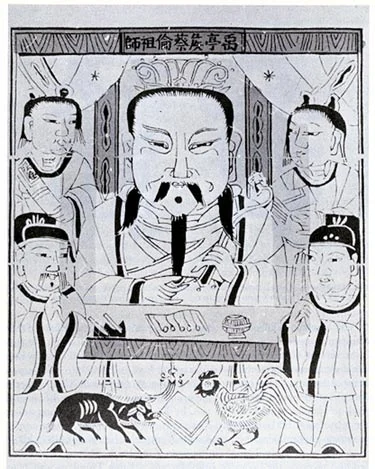
unknown–121 CE
Eunuchcourt officialand improver of papermaking technology
Cai Lun
蔡伦
Cai Lun, courtesy name Jingzhong, was a native of Guiyang Commandery in the Eastern Han. He successively served as a Junior Attendant of the Yellow Gates, Palace Attendant, Director of the Imperial Workshops, and Grand Coachman of Changle Palace, and was enfeoffed as Marquis of Longting. While serving as Director of the Imperial Workshops, he supervised the manufacture of special swords and other implements. The *Book of the…
unknown–121 CEEastern Han
PROFILE
Cai Lun, courtesy name Jingzhong, was a native of Guiyang Commandery in the Eastern Han. He successively served as a Junior Attendant of the Yellow Gates, Palace Attendant, Director of the Imperial Workshops, and Grand Coachman of Changle Palace, and was enfeoffed as Marquis of Longting. While serving as Director of the Imperial Workshops, he supervised the manufacture of special swords and other implements. The Book of the Later Han records that he made paper from materials including tree bark, hemp waste, worn cloth, and fishing nets and presented the result to Emperor He of Han in 105(1st year of the Yuanxing era). After it received imperial approval, the related paper gradually spread and became known as “Marquis Cai's Paper.” Paper already existed during the Western Han, and research on the origins of papermaking does not uniformly regard Cai Lun as the sole inventor who created paper from nothing. A more cautious summary is that he improved and promoted papermaking techniques. Late in life, Cai Lun was ordered to supervise the collation of texts at the Eastern Lodge. In 121(1st year of the Jianguang era), Emperor An of Han pursued his earlier responsibility in the case of Noble Lady Song, and Cai Lun took poison and died after being ordered to report to the Commandant of Justice.
- Courtesy Name
- Jingzhong
- Period
- Eastern Han
- Date of Birth
- Not recorded in historical sources
- Dynasty/Polity
- Han dynasty (Eastern Han)
- Identity
- Eunuch, court official, and improver of papermaking technology
- Ethnicity
- No reliable record has been found in the existing materials
- Native Place
- Guiyang Commandery (in present-day Hunan; the exact place of origin is disputed)
- Birthplace
- No clear record has been found in the existing materials
- Place of Death
- No clear record has been found in the existing materials
- Highest Office
- Grand Coachman of Changle Palace
- Noble Title
- Marquis of Longting
- Principal Offices
- Junior Attendant of the Yellow Gates, Palace Attendant, Director of the Imperial Workshops, Grand Coachman of Changle Palace
- Major Achievements
- Improved papermaking with materials including tree bark, hemp waste, worn cloth, and fishing nets and reported the method to the court; helped promote the adoption of the resulting paper at court; supervised the manufacture of special swords and other implements; was ordered to supervise the collation of classics and commentaries at the Eastern Lodge
- Highest office
- Director of the Imperial Workshops (Shangfang Ling); eunuch Attendant-in-Ordinary; Grand Keeper of the Changle Palace
- Lifespan
- Unknown;No clear record has been found in the existing materials
- Date of Death
- 121 CE(1st year of the Jianguang era, Eastern Han)
LIFE TIMELINE
Court service | Rose to become a Junior Attendant of the Yellow Gates and handled close-attendant duties.
Service as Lesser Yellow Gate | He took part in duties as an attendant of the inner palace.
Involvement in a court case | Was ordered to investigate the case involving Noble Lady Song and her sister; the two were later sent to the prison for palace women and died after taking poison.
Imperial Workshops | Supervised the manufacture of special swords and other implements; the historical record describes the workmanship as refined, strong, and precise.
Reported papermaking method | Presented to Emperor He of Han paper made from tree bark, hemp waste, worn cloth, fishing nets, and similar materials; the court approved and promoted it.
Enfeoffment | Empress Dowager Deng created Cai Lun Marquis of Longting with a fief of 300 households.
Supervised textual collation | Emperor An of Han ordered Liu Zhen and others to collate texts at the Eastern Lodge, and Cai Lun was ordered to supervise the work.
Death | After Emperor An of Han assumed personal rule, he ordered Cai Lun to report to the Commandant of Justice. Cai Lun took poison and died, and his marquisate was abolished.
The “Biographies of Eunuchs” in the Book of the Later Han records that in 117(4th year o | The “Biographies of Eunuchs” in the Book of the Later Han records that in 117(4th year of Yuanchu), Emperor An of Han ordered Liu Zhen and other scholars to go to the Eastern Lodge to collate texts and directed Cai Lun to supervise the work.
Death | In 121(1st year of the Jianguang era), Emperor An of Han pursued his earlier responsibility in the case of Noble Lady Song, and Cai Lun took poison and died after being ordered to report to the Commandant of Justice.
BIOGRAPHY
Biography
Entry into Palace Service and Court Career The “Biographies of Eunuchs” in the Book of the Later Han records that Cai Lun, courtesy name Jingzhong, was from Guiyang. He began serving in the palace in 75, near the end of the Yongping era, and was promoted to Junior Attendant of the Yellow Gates from 76(1st year of Jianchu)to 84(9th year of Jianchu). No reliable record gives his exact year of birth, so later retrospective estimates are not treated here as a definite birth year. After Emperor He of Han ascended the throne in 88(2nd year of Zhanghe), Cai Lun became a Palace Attendant and took part in matters handled within the imperial presence. Fan Ye's Book of the Later Han describes him as learned and capable, diligent and careful in carrying out his duties, willing on several occasions to face the emperor's stern displeasure in order to correct gains and losses, and notes that he commonly shut his doors to visitors when off duty. Cai Lun later concurrently served as Director of the Imperial Workshops and oversaw the manufacture of court objects. In 97(9th year of Yongyuan), he supervised the making of special swords and various implements, which the historical record says were finely made, strong, and precise and became models for later craftsmen. Under Emperor He and Emperor An, Cai Lun and the Palace Attendant Zheng Zhong both participated in government affairs. The biography of He Chang in the Book of the Later Han also records that Cai Lun once submitted an impeachment of He Chang, then General of the Gentlemen of the Five Offices. ### The Case of Noble Lady Song In 82(7th year of Jianchu), Empress Zhangde Dou and her family accused Noble Lady Song and her sister of using apotropaic magic. Emperor Zhang of Han issued an edict deposing Crown Prince Liu Qing and replacing him with Liu Zhao. According to the “Biographies of the Eight Kings of Emperor Zhang” in the Book of the Later Han and the relevant passages of the Comprehensive Mirror in Aid of Governance, Empress Dou ordered Cai Lun, then a Junior Attendant of the Yellow Gates, to investigate the sisters. The Book of the Later Han states that Cai Lun and others followed the empress's implied instructions and forced the case to fit the accusation. The two women were sent to the prison for palace women and then took poison and died. This court episode is preserved in the same historical tradition that records Cai Lun's papermaking and official career. ### Improvement and Promotion of Papermaking While serving as Director of the Imperial Workshops, Cai Lun was involved in court manufacturing. Existing materials do not support the claim that papermaking began entirely with Cai Lun: archaeological finds show plant-fiber paper in the Western Han, and early papermaking had a prior history. Fan Ye's Book of the Later Han records that Cai Lun developed an idea for making paper from tree bark, hemp waste, worn cloth, and fishing nets; surviving passages of the Dongguan Hanji preserve a similar account. The wording indicates that he proposed or improved a method and should not, outside the context of earlier techniques, be understood as having invented every stage of papermaking on his own. In 102(14th year of Yongyuan), Deng Sui ordered commanderies and kingdoms to present paper and ink. In 105(1st year of Yuanxing), Cai Lun presented his paper to Emperor He of Han. The historical sources record that the emperor approved the result; the method was subsequently adopted by the court, and the paper became known throughout the realm as “Marquis Cai's Paper.” Cai Lun's main role lay in broadening the range of papermaking materials, improving the process, and promoting its use at court and in society. Tree bark, hemp waste, old cloth, fishing nets, and similar materials made it possible to reuse discarded fibers, providing an alternative to expensive silk and cumbersome bamboo and wooden slips. The process described in later summaries involved reducing fibrous materials to pulp and lifting the dispersed fibers with a bamboo screen so that they could dry into usable sheets. By relying on comparatively accessible fibers, the method made paper easier to produce and use. Because archaeological evidence shows plant-fiber paper in the Western Han, Cai Lun's technical contribution should be understood within a longer accumulation of materials and techniques. ### Enfeoffment, Textual Collation, and Final Years In 114(1st year of Yuanchu), Empress Dowager Deng, citing Cai Lun's long palace service, created him Marquis of Longting with a fief of 300 households. Cai Lun later served as Grand Coachman of Changle Palace. The “Biographies of Eunuchs” in the Book of the Later Han records that in 117(4th year of Yuanchu), Emperor An of Han ordered Liu Zhen and other scholars to go to the Eastern Lodge to collate texts and directed Cai Lun to supervise the work. In 121(1st year of Jianguang), Empress Dowager Deng died and Emperor An of Han began to exercise personal rule. He ordered Cai Lun to report to the Commandant of Justice. Considering trial a humiliation, Cai Lun bathed, changed his clothes, and took poison, dying by suicide; his marquisate was abolished. The *Compreh The cause of his death and the question of responsibility are stated here according to the historical sources, without adding unverified psychological or court details.
Cai Lun, courtesy name Jingzhong, was a native of Guiyang; his early years are scantily recorded, and he seems to have entered the palace service about the end of the Yongping era. Under Emperor Zhang he was a junior yellow gate attendant, and on Emperor He's accession he was transferred to be an ordinary attendant of the yellow gate, taking part in the counsels of the inner court. A man of learning, conscientious and prudent, he several times braved the imperial anger to correct faults; on his days of rest he shut his door to visitors or went out into the fields to see things for himself. He was afterward given concurrently the office of director of the imperial workshops, in charge of making the utensils for the emperor's use.
In 97 he was charged with supervising the making of the secret swords and other weapons and implements, all of them so finely and solidly wrought that later ages took them as models. The emperor had ordered the commanderies and kingdoms to send in paper and ink, and Cai Lun, in charge of the imperial workshops, was able to see the paper sent as tribute from every quarter, which gave him the means to improve its manufacture. Feeling that silk was costly and bamboo slips heavy, and neither convenient for use, he conceived the idea of making paper from the bark of trees, hemp ends, worn cloth and old fishing nets. In 105 he presented the paper to the throne; the emperor praised his skill and ordered its use throughout the empire, so that paper gradually replaced the slips and silks, and later ages called it Marquis Cai's paper. Of his native place the histories say only that he was of Guiyang, later ages disputing which county it was; and the method he improved spread abroad in time and became one of the far-reaching arts.
Under Emperors He and An, Cai Lun and the attendant Zheng Zhong were both employed in the conduct of affairs; Zheng Zhong had been favoured for his part in destroying the power of the Dou family, and the two were the powerful eunuchs of the day. Cai Lun had quarrelled with the attendant He Chang and in 105 memorialized that he had feigned illness to avoid fasting, so that he was dismissed and punished. In 107 the minister of works Zhou Zhang plotted to kill the empress's kin the Deng brothers and Zheng Zhong and Cai Lun; the plot was discovered, Zhou Zhang was dismissed by decree and killed himself. In 114 the empress dowager Deng, because Cai Lun had long served in the palace guards, enfeoffed him as marquis of Longting with three hundred households, and soon after made him grand equerry of the Changle palace. Later, finding the texts of the classics and histories largely uncorrected, she chose the learned courtier Liu Zhen and doctors and good historians to collate the books in the Eastern Pavilion, and put Cai Lun in charge of the work.
Cai Lun had earlier been involved in an old case of the palace. In Emperor Zhang's time, when Consort Song was in favour, the empress Dou plotted against the Songs; the two sisters were lodged in a side house, and Cai Lun, then a junior attendant, was sent to establish their guilt. Both took poison and died, and the heir apparent Liu Qing was deposed as prince of Qinghe. In 106 Liu Qing's son came to the throne as Emperor An. In 121, after the death of the empress dowager Deng, Emperor An took the government into his own hands and, inquiring into the old matter, ordered Cai Lun to present himself to the judicial authorities. Unwilling to suffer the shame, Cai Lun bathed, put on clean robes, and took poison and died.
Cai Lun lived through the reigns of three emperors and long served in the palace as a eunuch, his power resting on the trust of emperors and empresses dowager. The Hou Hanshu places him among the eunuchs, and he and Zheng Zhong are commonly taken as the beginning of eunuch participation in government under the Eastern Han; the weapons and implements he made as director of the imperial workshops and the paper he presented to the throne are what he left behind in the arts of manufacture and the affairs of state. When Emperor An took the government into his own hands Cai Lun was brought to trial over the old case, took poison and died, and his marquisate of Longting was abolished with him. Paper-making and paper use thereafter spread steadily through the central plains, and documents and private writing passed from slips and silks to paper, which by the Wei and Jin had all but replaced the bamboo slip as the chief material for writing. The method later went east to Korea and Japan and west through the Western Regions to Central Asia, and its influence on writing and the spread of learning endured through the ages. In later ages the improvement of paper-making has been associated above all with Cai Lun, whose name and the term Marquis Cai's paper are still used, and shrines in the Guiyang region commemorate him.
Major Activities
Improvement and Promotion of Papermaking The Book of the Later Han links Cai Lun with the use of tree bark, hemp waste, worn cloth, fishing nets, and similar materials for papermaking and records that his presentation in 105(1st year of Yuanxing) was approved by Emperor He of Han. The resulting paper was thereafter promoted and became known as “Marquis Cai's Paper.” the description of the production process includes cutting and soaking the raw materials, retaining the fibers, pounding them into pulp, lifting the pulp with a bamboo screen, drying it, and peeling off the finished paper. Archaeological materials show plant-fiber paper in the Western Han, so Cai Lun's contribution should be understood against an earlier history of materials and techniques. ### Manufacture of Imperial Workshop Implements While concurrently serving as Director of the Imperial Workshops, Cai Lun supervised the production of court objects. In 97(9th year of Yongyuan), he oversaw the manufacture of special swords and various implements. The Book of the Later Han says that these objects were finely made, strong, and precise. A quotation from the Zhenglun refers to “Grand Coachman Cai's crossbow” and the “sword of the ninth year of Longting,” indicating that his reputation was also associated with the manufacture of court weaponry. ### Collation of Texts at the Eastern Lodge Under Emperor An of Han, Cai Lun was ordered to supervise textual collation at the Eastern Lodge. The surviving record mentions Liu Zhen, erudites, and historiographical officials who collated the classics and commentaries, masters' works, biographies, and writings of the various schools. Cai Lun's own biography in the Book of the Later Han dates this work to 117(4th year of Yuanchu).
Personal Relations
- Emperor Ming of Han (Liu Zhuang): Emperor in whose reign Cai Lun began palace service.
- Emperor Zhang of Han (Liu Da): Emperor during whose reign Cai Lun served as a Junior Attendant of the Yellow Gates.
- Emperor He of Han (Liu Zhao): Emperor under whom Cai Lun served as a Palace Attendant and to whom he presented the results of his papermaking work.
- Deng Sui: Empress Hexi and later Empress Dowager Deng; Cai Lun served during her period of political authority and was created Marquis of Longting.
- Emperor An of Han (Liu Hu): Took personal rule after Empress Dowager Deng's death and ordered Cai Lun to report to the Commandant of Justice.
- Noble Lady Song: Consort of Emperor Zhang of Han; Cai Lun was ordered to participate in investigating her case.
- Liu Qing: Prince of Qinghe, son of Noble Lady Song; was deposed as crown prince in the court case.
- He Chang: General of the Gentlemen of the Five Offices; was the target of an impeachment submitted by Cai Lun.
- Zheng Zhong: Palace Attendant of the Eastern Han; participated in government affairs alongside Cai Lun under Emperor He and Emperor An.
- Liu Zhen: Eastern Han scholar who participated in the collation of texts at the Eastern Lodge, with Cai Lun ordered to supervise the work.
Historical Assessment
The “Biographies of Eunuchs” in the Book of the Later Han describes Cai Lun as learned and capable, diligent and careful, repeatedly willing to face the emperor's stern displeasure to correct policy, and records his supervision of implements, improvement of papermaking, supervision of textual collation, and conviction late in life. The same biography also preserves his participation in the case of Noble Lady Song, showing that Cai Lun's official career cannot be reduced to his technical contribution. Modern research on the history of papermaking usually describes Cai Lun's role as improving papermaking materials and techniques and promoting the spread of paper. Archaeological evidence for plant-fiber paper in the Western Han has led scholars to question the claim that Cai Lun alone invented papermaking from nothing. The existing evidence more securely supports the conclusion that Cai Lun promoted the production and use of paper at the Eastern Han court and expanded its influence; his technical contribution should be understood within an earlier accumulation of materials and techniques.
FIGURES ASSOCIATED WITH THIS DYNASTY
Bibliography
- Fan Ye, Book of the Later Han, vol. 78, “Biographies of Eunuchs: Cai Lun” (checked against the local full text).
- Fan Ye, Book of the Later Han, vol. 55, “Biographies of the Eight Kings of Emperor Zhang” (checked against the local full text for the case of Noble Lady Song).
- Fan Ye, Book of the Later Han, vol. 43, “Biographies of Zhu, Le, and He: He Chang” (checked against the local full text for Cai Lun's impeachment of He Chang).