Imperial Birth
Born in the Northern Palace of Luoyang as the fourth son of Emperor Zhang and Consort Liang; taken by Empress Dou to be raised as her own.
88 CE–105 CE
刘肇
Liu Zhao (刘肇, 79–106), known posthumously as Emperor He of Han, was a native of Caiyang in Nanyang Commandery (southwest of modern Zaoyang, Hubei Province) and the fourth emperor of the Eastern Han Dynasty (reigned 88–106). He was the fourth son of Emperor Zhang (Liu Da) and Consort Liang, raised from infancy by Empress Zhangde of the Dou clan as her own son. In 82, he was created Crown Prince following the deposition of…
Liu Zhao (刘肇, 79–106), known posthumously as Emperor He of Han, was a native of Caiyang in Nanyang Commandery (southwest of modern Zaoyang, Hubei Province) and the fourth emperor of the Eastern Han Dynasty (reigned 88–106). He was the fourth son of Emperor Zhang (Liu Da) and Consort Liang, raised from infancy by Empress Zhangde of the Dou clan as her own son. In 82, he was created Crown Prince following the deposition of Prince Liu Qing. When Emperor Zhang passed away in 88, ten-year-old Liu Zhao ascended the throne. Empress Dowager Dou presided over the court as regent, while her brother, General-in-Chief Dou Xian, and his kin monopolized civil and military offices, dominating the state apparatus. In 92, fourteen-year-old Emperor He allied secretly with his elder brother, Prince of Qinghe Liu Qing, and the eunuch Zheng Zhong, launching a palace coup that closed the capital gates, confiscated Dou Xian's supreme military seals, and compelled Dou Xian and his brothers to commit suicide in their fiefs, extinguishing consort dominance and establishing direct personal rule. During his reign, Emperor He governed with tireless diligence, practiced frugality, reformed the bureaucracy, and enforced judicial prudence. Militarily, he supported campaigns that smashed the Northern Xiongnu at Mount Jinwei, eradicating the century-old nomadic menace; diplomatically, he re-established the Protectorate of the Western Regions, where Ban Chao secured the submission of over fifty kingdoms, Gan Ying reached the Persian Gulf on an embassy toward Rome, and envoys from western domains reached Luoyang; technologically and culturally, he patronized Director of the Palace Workshop Cai Lun in revolutionizing papermaking and supported lady Ban Zhao in completing the canonical Book of Han; institutionally, he reformed the xiaolian selection system to allocate candidate quotas proportionally based on commandery populations. Under his administration, registered households and cultivated acreage reached the zenith of the Eastern Han, an era celebrated as the Yongyuan Golden Age. He passed away in February 106 in the Zhangde Hall at age twenty-seven, receiving the temple name Muzong and being buried at Shenling Mausoleum.
Born in the Northern Palace of Luoyang as the fourth son of Emperor Zhang and Consort Liang; taken by Empress Dou to be raised as her own.
Created Crown Prince at age four after the deposition of Liu Qing; maternal grandfather Liang Song was framed and died in prison the following year.
Succeeded to the throne at age ten following Emperor Zhang's death; Empress Dowager Dou ruled as regent and Dou Xian monopolized central authority.
Dou Xian routed the Northern Xiongnu at Mount Jiluo and inscribed commemorative texts on Mount Yanran, forcing the Chanyu to flee.
Han cavalry destroyed Northern Xiongnu remnants at Mount Jinwei; re-established the Protectorate of the Western Regions under Ban Chao.
Staged an inner palace coup in June with Prince Liu Qing and Zheng Zhong, disarming Dou Xian and restoring monarchical rule.
Empress Dowager Dou died and Emperor He learned his true parentage, preserving her status while rehabilitating the Liang clan; Gan Ying dispatched to Da Qin.
Adopted Grand Commandant Xu Fang's memorial to allocate xiaolian civil service recommendation quotas strictly proportional to commandery populations.
Palace Director Cai Lun presented revolutionary plant-fiber paper; Emperor He commended the invention and decreed its nationwide adoption.
Passed away in February in the Zhangde Hall at age twenty-seven; buried at Shenling Mausoleum with the posthumous title Emperor Xiaohe and temple name Muzong.
Liu Zhao was born in 79 within the Northern Palace of the Eastern Han capital Luoyang, the fourth son of Emperor Zhang and his concubine, Consort Liang (daughter of Marquis Liang Song). Gentle, intelligent, and filial from his earliest childhood, he won the profound affection of Emperor Zhang. Earlier, Emperor Zhang had designated his eldest son, Liu Qing, born of Consort Song and raised by Empress Ma, as Crown Prince. However, Empress Zhangde of the Dou clan, lacking biological sons of her own and burning with jealousy, fabricated witchcraft accusations against Consort Song, driving her to suicide and forcing the deposition of Crown Prince Liu Qing to King of Qinghe.
Empress Dou appropriated infant Liu Zhao to raise as her personal son, while orchestrating systematic persecution against his biological Liang family. In 82, four-year-old Liu Zhao was formally created Crown Prince. In 83, the Dou clan concocted anonymous subversive letters to frame his maternal grandfather Liang Song, who perished in prison, while the surviving Liang family was exiled to the remote border commandery of Jiuzhen. Completely unaware of his true parentage, the young prince revered Empress Dou as his biological mother, fulfilling filial duties diligently throughout his minority.
On April 9, 88, thirty-three-year-old Emperor Zhang died in the Zhangde Hall. Ten-year-old Crown Prince Liu Zhao succeeded to the throne, granting Empress Dou the title Empress Dowager. Because the new sovereign was a child, Empress Dowager Dou presided over the court as regent, assuming supreme executive authority. To consolidate her family's grip over the empire, she appointed her eldest brother, Dou Xian, as Palace Attendant overseeing military decrees, while her younger brothers Dou Du, Dou Jing, and Dou Gui were installed as Regular Attendants and Yellow Gate Attendants within the inner palace.
The Dou brothers entrenched themselves within the corridors of the imperial palaces, controlling the flow of memorials and imperial appointments, creating the first monopolistic consort dictatorship in Eastern Han history. The Empress Dowager was obstinate and indulgent toward her kin. Her brother Dou Jing permitted violent household retainers to terrorize the avenues of Luoyang, seizing women in broad daylight, extorting wealth from merchants, and rescuing convicted criminals from custody, leaving citizens in terror. Capital magistrates and judges, cowed by the family's immense influence, dared not intervene.
Confronted by this lawless usurpation, upright statesmen mounted fierce resistance. Grand Commandant Song You and Minister of Works Yuan An submitted scathing memorials impeaching the Dou brothers for subverting dynastic laws. However, the Empress Dowager dismissed their warnings, driving outspoken officials from court and hounding Prefect of the Masters of Writing Yue Hui into taking poison. The central bureaucracy was gripped with fear, and civil governance was paralyzed by factional intimidation.
Living in the inner palace, young Emperor He maintained extraordinary composure and caution. Deeply versed in Confucian classics, he drew lessons from the usurpations of Empress Lü and Wang Mang. Outwardly, he displayed absolute filial submission to Empress Dowager Dou and treated Dou Xian with honor; inwardly, he observed court developments, quietly awaiting the opportunity to eliminate the consort faction.
In 89, Dou Xian faced severe impeachment after orchestrating the covert assassination of Liu Chang, younger brother of the Prince of Qi, inside the imperial palace. To redeem his crime and deflect political condemnation, Dou Xian requested permission to command an expedition against the Northern Xiongnu. Overriding objections from Yuan An, the Empress Dowager appointed Dou Xian General of Chariots and Cavalry, dispatching an army of forty thousand elite Han cavalry, Southern Xiongnu horsemen, and Qiang auxiliary forces deep into the Gobi Desert.
At Mount Jiluo, Han forces engaged the main host of the Northern Chanyu in a decisive battle. Dou Xian executed devastating cavalry maneuvers that crushed the enemy, slaying over thirteen thousand nomads and receiving the surrender of two hundred thousand tribesmen, while the Chanyu fled into the steppe. Advancing thousands of li to Mount Yanran (modern Khangai Mountains, Mongolia), Dou Xian ordered military secretary Ban Gu to carve the famous Inscription on Mount Yanran into the rock face, immortalizing this landmark frontier victory.
In February 91, Dou Xian dispatched Deputy Colonel Geng Kui and Major Ren Shang with elite cavalry to strike the Northern Xiongnu remnants at Mount Jinwei (modern Altai Mountains). The expedition routed the enemy camp, capturing the Chanyu's mother and noble chieftains, while the wounded Northern Chanyu vanished into Central Asia. The nomadic power that had threatened China since the early Western Han was permanently shattered, bringing total victory to the northern frontier.
However, these victories inflated Dou Xian's ambition to treasonous proportions. Promoted to General-in-Chief ranking above the Three Excellencies, he opened an autonomous administration, staffing provincial governorships with personal partisans. Local administrators extorted commoners to send bribes to his mansion. When Minister of Works Yuan An impeached over forty corrupt officials allied with Dou Xian, Emperor He immediately endorsed their dismissal, sparking deadly enmity between the consort faction and the young sovereign.
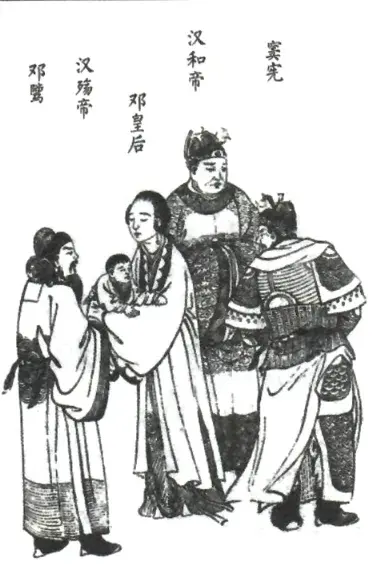
In 92, Dou Xian stationed his legions in Chang'an, where sycophants proposed that court officials should shout "Ten Thousand Years" upon greeting him, an honor reserved solely for the emperor. Palace Attendant Han Leng denounced the proposal, halting the transgression. By this time, Dou Xian's inner conspirators, Guo Huang and Deng Die, were actively scheming to depose Emperor He, bringing dynastic tensions to the brink of an armed showdown.
In the spring of 92, Dou Xian's partisans Guo Ju and Deng Die mobilized palace retainers, plotting to assassinate Emperor He upon Dou Xian's return to Luoyang. Although only fourteen years old, Emperor He perceived the plot through irregularities in palace guard rotations. Recognizing that Dou Xian commanded elite troops, the emperor understood that premature action would trigger an immediate military rebellion.
Under close surveillance, the emperor turned to his trusted elder half-brother, Prince of Qinghe Liu Qing, who frequently stayed in the palace. Emperor He secretly tasked Liu Qing with procuring the Biographies of Consort Clans from the Book of Han, studying the precedents of Emperor Xuan's elimination of the Huo family and Emperor Guangwu's suppression of consort factions. Concurrently, he enlisted the loyal eunuch Regular Attendant Zheng Zhong as his confidential courier between the inner palace and external loyalists.
Zheng Zhong initially urged the immediate execution of Guo Ju and Deng Die, but Emperor He prudently declined, insisting that Dou Xian must first return to the capital and surrender command. On July 14, 92, when Dou Xian reached the outskirts of Luoyang, the emperor took his seat at the southern palace gate, ordering the Superintendent of the Capital and the Five Colonels to seal all twelve city gates and deploy armed guards across the palace perimeter.
As Dou Xian and his co-conspirators entered the palace unaware, hidden palace guards sprang forward, arresting Deng Die, Guo Ju, and Guo Huang, who were promptly executed in prison. The emperor dispatched an imperial messenger to strip Dou Xian of his supreme military seals, demoting him to Marquis of Guanjun and ordering him and his brothers escorted to their respective provincial fiefs, terminating the conspiracy without urban bloodshed.
Balancing filial duty toward his adoptive mother with imperial justice, Emperor He refrained from executing the brothers in public, appointing rigorous chancellors to supervise their fiefs. Upon reaching their destinations under close surveillance, Dou Xian and his brothers committed suicide by poison. Emperor He declared a general amnesty, purging hundreds of corrupt officials and restoring bureaucratic order.
At age fourteen, relying on his brother and loyal attendants, Emperor He had dismantled a formidable consort dictatorship without civil war, securing unconstrained imperial authority and inaugurating the celebrated Yongyuan Golden Age.
Having eradicated consort control, fourteen-year-old Emperor He assumed direct personal governance. Mindful of the suffering inflicted by corrupt officials, he displayed remarkable administrative stamina. Rising at dawn, he held morning audiences with court ministers, retiring to the Zhangde Hall to review provincial memorials late into the night, earning historical praise for being "tirelessly diligent from beginning to end."
The emperor detested flattery and superstitious omens. When provincial governors reported eighty-one auspicious omens (such as twin grain stalks and miraculous birds) to curry favor, Emperor He issued edicts condemning the practice, noting that his virtue was modest and ordering all omen registries sealed away, forbidding officials from exploiting omens for self-promotion.
Believing that "the essence of governance lies in appointing upright talent," Emperor He reformed official evaluation. He issued multiple edicts to recruit virtuous scholars, personally interrogating candidates in palace examinations and elevating upright statesmen including Xu Fang, Lu Gong, Chen Chong, and Zhang Yu to ministerial posts.
He took severe action against extortionate officials. Ordering regional inspectors to scrutinize commandery administrations, he dismissed and prosecuted officials who embezzled famine relief or oppressed peasants, establishing a clean administrative environment unseen since the reigns of Guangwu and Ming.
Toward trusted assistants, Emperor He observed strict constitutional limits. Although he ennobled eunuch Zheng Zhong as Marquis of Weixiang for his pivotal role in the coup, he established strict institutional barriers preventing palace attendants from meddling in external civil governance, maintaining ultimate executive control.
He welcomed candid criticism, encouraging imperial censors to speak without fear. Ministers Xu Fang and Chen Chong frequently submitted blunt memorials regarding penal reforms, all of which were welcomed and adopted by the sovereign.
In imperial recruitment, Emperor He instituted the most significant structural reform of the xiaolian ("filial and incorrupt") recommendation system since its inception under Emperor Wu of Western Han. For over two centuries, dynastic regulations had mandated that every commandery recommend two candidates annually, regardless of geographic size or population. By the Eastern Han, this rigid quota produced glaring administrative inequities.
Populous central commanderies such as Runan and Nanyang had populations exceeding one to two million yet were limited to two annual nominees, denying advancement to countless brilliant scholars. Conversely, remote border commanderies with merely tens of thousands of residents were also assigned two candidates, enabling unqualified candidates to enter civil service. In 101, Emperor He convened court conferences to overhaul the system.
Adopting the proposals of Grand Commandant Xu Fang, Emperor He promulgated the landmark "population-proportional xiaolian selection system." The reform tied candidate quotas directly to commandery populations: jurisdictions with 200,000 residents recommended one candidate annually; those with 400,000 recommended two; and those with 1.2 million recommended six. This adjustment unlocked advancement opportunities for scholars from populous heartland provinces.
Simultaneously, the emperor protected sparse frontier regions. Acknowledging that border commanderies in Youzhou, Bingzhou, and Liangzhou had small populations and heavy defense burdens, he decreed that border commanderies with over 100,000 residents could recommend one candidate every two years, while those with fewer than 100,000 could nominate one every three years, ensuring fair representation for frontier elites.
This reform enhanced administrative quality, eliminated regional monopolies, and provided structural guarantees for talented scholars across the empire, standing as the apex of the Han recommendation system and influencing subsequent civil service quota systems through the Tang and Song dynasties.
Under Emperor He, Chinese control over the Western Regions reached its historical zenith. In 91, following the collapse of the Northern Xiongnu, Emperor He re-established the Protectorate of the Western Regions, appointing legendary commander Ban Chao as Protector General with the title Marquis of Dingyuan, establishing headquarters at Qiuci (modern Kuqa, Xinjiang). Supported by the court, Ban Chao pacified regional revolts, securing the submission of over fifty kingdoms.
In 97, seeking to establish contact with the Roman Empire (known as Da Qin), Emperor He approved Ban Chao's mission to dispatch assistant envoy Gan Ying westward. Departing from Qiuci, Gan Ying traversed the Pamir Mountains, crossed Central Asian kingdoms including Dayuan and the Parthian Empire, and reached the shores of the Persian Gulf (the Western Sea).
Although dissuaded by Parthian sailors from making the maritime voyage across the Mediterranean to Rome, Gan Ying compiled detailed intelligence regarding the geography, customs, and trade of dozens of Near Eastern kingdoms. This official embassy marked the farthest documented westward expedition undertaken by ancient Chinese envoys, dramatically broadening imperial geographical knowledge.
In the winter of 97, embassies and merchant caravans from the Parthian Empire and western kingdoms (recorded as Mengqi and Doule, likely representing Roman merchants) arrived in Luoyang. Emperor He received them in the imperial palace, bestowing golden seals and purple ribbons, inaugurating an era of flourishing Eurasian trade along the Silk Road.
During Emperor He's reign, the imperial palace in Luoyang birthed an invention that transformed human civilization: the standardization of papermaking by Cai Lun. Prior to this, written records relied on cumbersome bamboo slips or costly silk. Recognizing the need for accessible media, Emperor He appointed Director of the Palace Workshop Cai Lun to lead technical innovations in court manufacturing.
Supported by imperial resources, Cai Lun utilized inexpensive raw materials—including tree bark, hemp ends, old fishing nets, and rags—subjecting them to maceration, boiling, pounding, and drying to produce smooth, durable, and highly absorbent paper sheets.
In 105, Cai Lun presented this revolutionary plant-fiber paper to Emperor He. Delighted by its practicality and low production cost, the sovereign commended Cai Lun and ordered the widespread adoption of "Marquis Cai's Paper" across provincial administrations, replacing bamboo and silk and laying the foundation for the global dissemination of knowledge.
In scholarship, Emperor He patronized the completion of the canonical Book of Han. When historian Ban Gu died in prison following the purge of Dou Xian, major sections remained incomplete. Emperor He summoned Ban Gu's brilliant sister, Ban Zhao, to the Dongguan Imperial Archives to finalize the treatises and tables, ensuring the preservation of this masterwork.
Emperor He practiced benevolent statecraft, repeatedly issuing amnesties to review contested convictions and prohibiting torture. He ordered judicial magistrates to interpret statutory laws with Confucian equity, reducing capital punishments across the empire.
He provided welfare relief to vulnerable citizens, remitting head taxes for impoverished peasants and distributing grain to orphans and the elderly during famines. When droughts struck the central plains, he issued self-reproach decrees and prohibited luxury tributes, including the costly high-speed courier transport of fresh lychees from Lingnan.
In 97, upon the death of Empress Dowager Dou, the surviving Liang clan submitted petitions revealing the secret of Emperor He's biological birth. Despite court calls to strip the late empress dowager of her honors and deny her burial with Emperor Zhang, Emperor He refused to dishonor his adoptive mother, declaring: "Affection cannot be severed, and righteousness cannot be impaired!" He buried Empress Dowager Dou with full imperial rites, while simultaneously rehabilitating the Liang clan, elevating his late biological mother as Empress Gonghuai and granting noble titles to his maternal uncles, averting a bloody political vendetta.
Under Emperor He, Eastern Han national strength attained its absolute zenith. Registered cultivated land reached over 7.3 million qing, while imperial census figures surpassed 10.6 million households and 53 million individuals. Treasury reserves overflowed, and civil society enjoyed enduring peace, leading historians to celebrate his seventeen-year rule as the Yongyuan Golden Age.
Tragically, worn down by tireless administrative labor, Emperor He fell fatally ill, passing away in the Zhangde Hall on February 13, 106 at the young age of twenty-seven. He was granted the temple name Muzong and buried at Shenling Mausoleum, revered as one of the most accomplished and compassionate sovereigns of antiquity.
In palace affairs, Emperor He maintained rigorous vigilance against consort clans. In 102, after Empress Yin was deposed over witchcraft accusations, he elevated Consort Deng Sui to the empress seat. Empress Deng was learned, virtuous, and politically astute, frequently advising the sovereign on state matters. Mindful of the Dou clan's abuses, Emperor He barred her relatives from high military commands, preserving central stability.
He advanced legal codification by supporting Minister of Works Chen Chong in aligning Han statutes with classical Confucian ethics, removing convoluted and draconian clauses inherited from earlier legal codes.
Emperor He's seventeen-year reign stood as a luminous chapter in Eastern Han history. Suppressing powerful usurpers in youth, extending imperial authority to the Caspian Sea and Persian Gulf, standardizing papermaking, and governing with deep empathy, his achievements erected an enduring monument of dynastic prosperity.
FIGURES ASSOCIATED WITH THIS DYNASTY