Dynastic Subjugation and Disenfranchisement
Qin annexed the six Warring States; Yue royal descendants were stripped of royal status and reduced to chieftains of Minzhong Commandery.
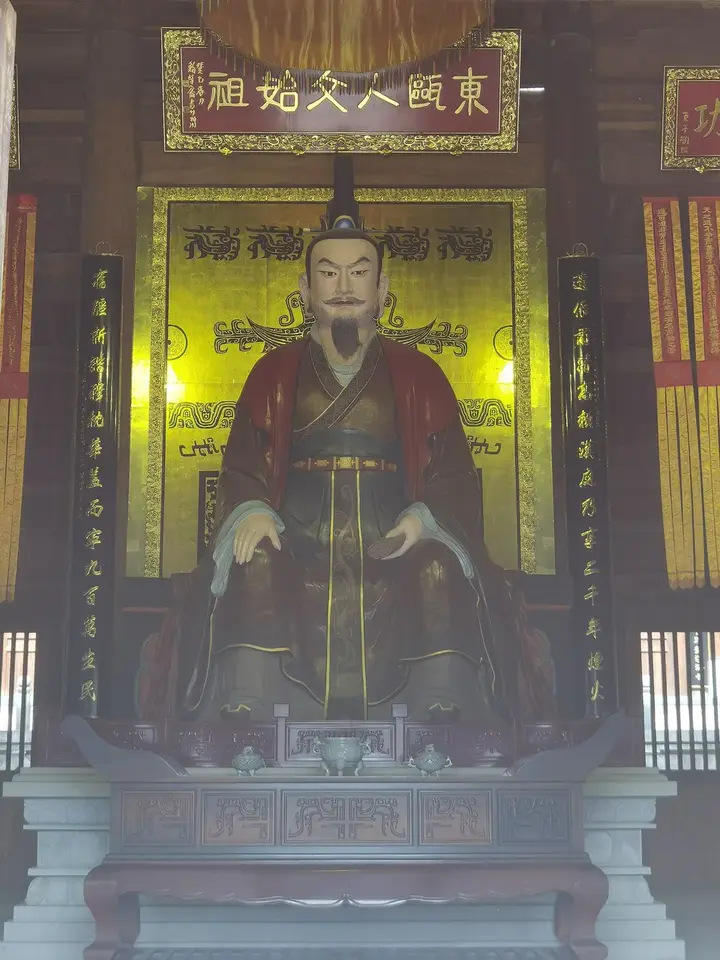
驺摇
Zou Yao (c. 240 BCE–185 BCE), also known as Ouyang Yao, was born into the Si clan and Ouyang lineage in Dong'ou (modern Wenzhou, Zhejiang). He was a direct descendant of King Goujian of Yue from the Spring and Autumn period and a descendant of King Wuqiang of Yue from the Warring States period. He was a prominent feudatory monarch, statesman, and the founding King of Donghai during the Western Han dynasty, widely commemorated…
Zou Yao (c. 240 BCE–185 BCE), also known as Ouyang Yao, was born into the Si clan and Ouyang lineage in Dong'ou (modern Wenzhou, Zhejiang). He was a direct descendant of King Goujian of Yue from the Spring and Autumn period and a descendant of King Wuqiang of Yue from the Warring States period. He was a prominent feudatory monarch, statesman, and the founding King of Donghai during the Western Han dynasty, widely commemorated across generations as the "King of Dong'ou." Following the unification of China under the Qin dynasty, the central imperial government abolished hereditary Yue kingdoms, reducing Yue rulers to local chieftains and establishing Minzhong Commandery across the territories of Dong'ou and Minyue. In the twilight of the Qin dynasty, peasant uprisings led by Chen Sheng and Wu Guang erupted across the empire. Recognizing the historic shift in dynastic fortunes, Zou Yao led the officials and warriors of the Dong'ou region to join the insurgent confederation under Wu Rui, the Magistrate of Poyang. He fought alongside the army of Liu Bang, advancing through Hangu Pass and playing a distinguished role in overthrowing the tyrannical Qin empire. After the fall of Qin, amid the intense Chu-Han Contention between Liu Bang and Xiang Yu, Zou Yao remembered the ancient grievance of Chu's destruction of the Yue kingdom. He steadfastly committed his Dong'ou forces to support Liu Bang, fighting for four years to secure the Guanzhong region and participating in the climactic Battle of Gaixia that encircled and crushed the Western Chu army of Xiang Yu. In 201 BCE (the sixth year of Emperor Gaozu), the imperial court rewarded his meritorious service in suppressing Qin and aiding Han by enfeoffing him as Marquis of Haiyang. In 192 BCE (the third year of Emperor Hui), the Han court re-examined the distinguished wartime achievements of the Yue leaders during Gaozu's founding era. Emperor Hui issued an imperial edict promoting Zou Yao to King of Donghai, granting him leave to establish his capital at Dong'ou and re-found the vassal state of Dong'ou. Upon his investiture, Zou Yao embraced policies of peace and economic recuperation, vigorously introducing advanced iron tools, irrigation technologies, and central Chinese agricultural practices into southern Zhejiang. He mobilized the populace to clear wetlands, build flood dykes, and establish trading markets, transforming the local society from ancient traditions of body tattooing and foraging into a flourishing agrarian culture. Zou Yao is revered as the "Humanities Forefather of Dong'ou" and has been venerated in temples throughout southern Zhejiang for millennia.
Qin annexed the six Warring States; Yue royal descendants were stripped of royal status and reduced to chieftains of Minzhong Commandery.
Following Chen Sheng's rebellion, Zou Yao mobilized Dong'ou warriors and joined Magistrate Wu Rui to march into the central plains.
As the Chu-Han Contention broke out, Zou Yao allied firmly with Liu Bang, leading Yue forces to assist in subduing the Three Qins.
Participated in the encirclement of Xiang Yu at Gaixia, achieving grand military merit that secured Western Han imperial unification.
Awarded the noble title of Marquis of Haiyang by Emperor Gaozu during the imperial ceremonies rewarding founding merit.
Formally created King of Donghai by Emperor Hui, re-establishing the state of Dong'ou with its capital at modern Wenzhou.
Passed away in the Dong'ou palace after decades of enlightened rule; mourned deeply by his subjects and buried at Mount Xi.
| Field | Content |
|---|---|
| Name | Zou Yao |
| Alternative Name | Ouyang Yao |
| Dynasty | Qin-Han Transition, Western Han |
| Noble Title | Marquis of Haiyang, King of Donghai (King of Dong'ou) |
| Historical Identity | First King of Donghai (King of Dong'ou) of Western Han, descendant of King Goujian of Yue, pioneer of southern Zhejiang |
Zou Yao descended from the illustrious royal lineage of the ancient state of Yue, tracing his ancestry back to the mythical figures of Yu the Great and Shaokang. King Goujian of Yue, who attained hegemony over the central plains during the late Spring and Autumn period, was his direct forebear. In the mid-Warring States period, King Weiwang of Chu launched a massive northern assault against Yue, crushing its main army and slaying King Wuqiang. The Yue kingdom subsequently fragmented, and its surviving princes and clan leaders migrated southward along the southeastern seaboard and deep into the mountain valleys of Dong'ou and Minyue, maintaining localized self-rule.
Ti, a son of King Wuqiang, was enfeoffed by the Chu state on the southern sunny slope of Mount Ouyu in Wucheng, adopting Ouyang as his clan name. When the Qin dynasty conquered Chu and swept southward, Qin officials replaced the elaborate ancient surname Ouyang with the homophonic Zou, which became the standard form recorded in Han historical texts. Qin Shihuang abolished the autonomous status of the Yue rulers, demoting them to local chieftains under the imperial administrative apparatus and creating Minzhong Commandery across modern Zhejiang and Fujian.
Living through the turbulent transition of the late Qin era, Zou Yao grew up along the banks of the Ou River. Observing the harsh exactions and penal servitude imposed by Qin administrators, he recognized the deep discontent harbored by the coastal Yue peoples. Resolute, courageous, and strategically minded, Zou Yao maintained the martial pride of his Yue ancestors, quietly stockpiling provisions and earning the deep loyalty and respect of his clan members.
In the autumn of 209 BCE (the first year of Qin Er Shi), Chen Sheng and Wu Guang launched an open insurrection at Dazexiang. Across the empire, populations long oppressed by Qin rule rose in revolt, and descendants of former Warring States aristocrats took up arms.
When reports reached the coastal reaches of Dong'ou, Zou Yao recognized that the historical opportunity to overturn Qin tyranny and restore his ancestral realm had arrived. At that time, Wu Rui, the Magistrate of Poyang, commanded widespread respect among the Yue populations and raised the standard of rebellion. Zou Yao rallied thousands of elite Dong'ou warriors and marched out from the coastal valleys to join Wu Rui's coalition. Renowned for their fierce bravery and agility in rough terrain, Zou Yao's Yue forces rendered distinguished service in sweeping across the Jianghan plains and overwhelming Qin garrisons.
Subsequently, Zou Yao accompanied Wu Rui's divisions to merge with the advancing forces of Liu Bang. Together, they breached Wuguan and Hangu Pass, entering Xianyang and extinguishing the short-lived Qin dynasty. Following the fall of Qin, Xiang Yu presided over the division of the realm, enfeoffing Wu Rui as King of Hengshan and appointing Zou Yao as a military Commandant leading veteran Yue infantry.
The collapse of Qin did not usher in tranquility. The Hegemon-King of Western Chu, Xiang Yu, relied on brutal force, assassinated Emperor Yi of Chu, and expelled other feudatories, sparking the protracted Chu-Han Contention.
At this critical strategic juncture, Zou Yao made a deliberate and far-sighted decision. On one hand, the ancient state of Yue had been extinguished by Chu, establishing a profound ancestral feud; on the other hand, Xiang Yu was prone to widespread massacres, whereas Liu Bang instituted mild laws and earned the goodwill of the common folk. Consequently, when Liu Bang appointed Han Xin as Supreme Commander to covertly pacify the Three Qins, Zou Yao mobilized his Dong'ou warriors to march alongside Han forces, resolved to confront Western Chu on the battlefield.
Throughout the four-year struggle between Chu and Han, Zou Yao commanded his troops across the central plains, Henan, and the Huai River basin, repeatedly repelling elite Western Chu formations. In the winter of 202 BCE (the fifth year of Emperor Gaozu), Han Xin laid out the decisive ten-sided ambush at Gaixia, encircling Xiang Yu's remnants. Zou Yao personally led his Dong'ou forces into the frontline combat, helping to seal the iron cordon around the Chu army until Xiang Yu met his demise at the Wu River. Zou Yao's combat contributions played an instrumental role in securing the imperial unification under the Han dynasty.
Upon establishing the Western Han dynasty, Emperor Gaozu rewarded foundational merit in 201 BCE by officially creating Zou Yao the Marquis of Haiyang, endowed with an extensive landed domain. However, the ancient territories of Dong'ou had not yet regained formal kingdom status, and the local populace continued to desire a recognized monarch of royal Yue descent.
Following Gaozu's demise, Emperor Hui ascended the throne. In the fifth month of 192 BCE (the third year of Emperor Hui), the imperial court conducted a comprehensive review of the military contributions rendered by Yue chieftains during the founding campaigns. Imperial ministers unanimously submitted that Zou Yao had achieved outstanding merit in vanquishing Qin and crushing Chu, while maintaining the deep affection and voluntary allegiance of the Yue populace.
Concurring with the ministerial recommendation, Emperor Hui issued an imperial proclamation promoting Zou Yao to King of Donghai, granting him royal seals and authorizing him to establish his capital at Dong'ou (modern Wenzhou). This act officially reconstituted the feudatory state of Dong'ou. Because of his royal capital, contemporary society universally referred to Zou Yao as the "King of Dong'ou." His investiture firmly established a tripartite frontier stabilization along the southern periphery of the Han empire, alongside Zhao Tuo of Nanyue and Wuzhu of Minyue.
Upon assuming kingship in Dong'ou, Zou Yao recognized that prolonged warfare had exhausted the populace. He consciously refrained from military adventurism, dedicating his full energies to the reclamation and economic uplift of southern Zhejiang.
In that era, the rugged coastal terrain had preserved archaic communal customs; the local inhabitants practiced body tattooing, cut their hair short, lived in dispersed forest settlements, and subsisted on aquatic reptiles, fish, and foraged wild plants. To elevate his people, Zou Yao proactively introduced advanced central Chinese civilization. He brought in draft cattle, iron plowshares, and skilled blacksmiths and potters, organizing massive communal projects across the Wenrui plains and along the foot of Mount Kuocang to dredge waterways, erect sea dykes, and expand terraced paddy fields.
On the cultural front, Zou Yao established administrative offices, introduced formal marriage and funerary rites, and encouraged civil customs, gradually phasing out primitive survival practices. Under his enlightened governance, the state of Dong'ou achieved agricultural abundance and domestic tranquility, marking southern Zhejiang's definitive entry into an era of settled agrarian civilization and maritime commerce.
In 185 BCE (the third year of Empress Dowager Lü), Zou Yao passed away peacefully in his royal palace at Dong'ou. Countless subjects gathered in mourning along the Ou River and laid him to rest at Mount Xi in Oupuyang. To honor his foundational legacy, generations of residents erected the Dong'ou King Temple beneath Mount Huagai in Wenzhou, revering him as the "Zhaolie Guangze King of Yongjia." Annual temple processions and sacrificial ceremonies have persisted uninterrupted for over two thousand years.
In 209 BCE, Zou Yao led the people of Dong'ou to rise against Qin rule, joining Wu Rui to capture the imperial capital; during the Chu-Han Contention, he allied steadfastly with Liu Bang, fighting in the decisive Battle of Gaixia to eliminate Western Chu.
In 192 BCE, Emperor Hui of Han commended Zou Yao's foundational contributions, officially naming him King of Donghai with his capital at Dong'ou, thereby inaugurating an era of autonomous feudatory governance across southern Zhejiang.
Zou Yao promoted advanced iron agricultural tools, hydraulic works, and civilized rites throughout Dong'ou, replacing archaic customs of body tattooing with prosperous rice farming and earning timeless veneration as the "Humanities Forefather of Dong'ou."
FIGURES ASSOCIATED WITH THIS DYNASTY