Pacifying Hebei
Joined Liu Xiu as Master of Records in the Ministry of War; promoted to Lieutenant-General and campaigned to capture Handan.
25 CE–60 CE
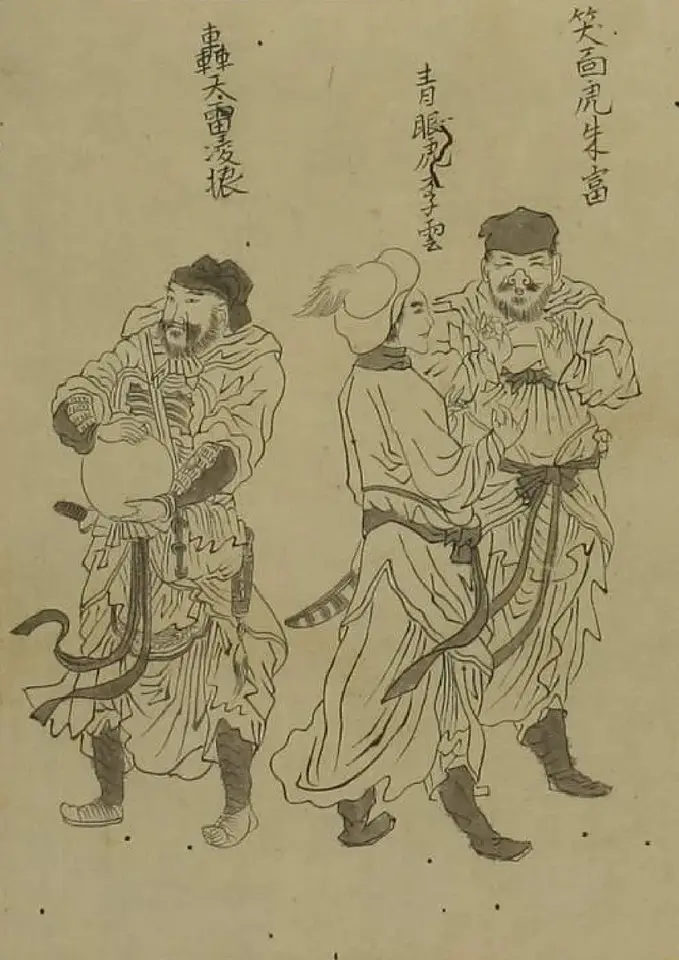
朱浮
Zhu Fu (朱浮, dates of birth and death unrecorded), courtesy name Shuyuan (叔元), was a native of Xiao County in Pei Commandery (modern Xiao County, Suzhou, Anhui). He was a distinguished founding statesman, Grand Minister of Works, and eminent political essayist of the Eastern Han dynasty. During the Gengshi era, Zhu Fu followed Liu Xiu across Hebei as Master of Records in the Ministry of War and Lieutenant-General,…
Zhu Fu (朱浮, dates of birth and death unrecorded), courtesy name Shuyuan (叔元), was a native of Xiao County in Pei Commandery (modern Xiao County, Suzhou, Anhui). He was a distinguished founding statesman, Grand Minister of Works, and eminent political essayist of the Eastern Han dynasty. During the Gengshi era, Zhu Fu followed Liu Xiu across Hebei as Master of Records in the Ministry of War and Lieutenant-General, participating in the capture of Handan. In the early Jianwu era, Emperor Guangwu ordered Wu Han to eliminate Miao Zeng and commissioned Zhu Fu as General-in-Chief and Shepherd of Youzhou to govern the northern frontier, ennobling him as Marquis of Wuyang. Endowed with exceptional talent and administrative pride, Zhu Fu actively recruited former Xin dynasty officials and local scholars, releasing commandery grain to maintain their households. This incurred fierce resistance from Grand Administrator of Yuyang Peng Chong. When Zhu Fu secretly accused Peng Chong of plotting rebellion, Peng Chong mobilized forces to besiege Zhu Fu at Jicheng. During the siege, Zhu Fu penned the celebrated Letter to Peng Chong as Shepherd of Youzhou, coining enduring idioms such as "pigs of Liaodong" and "grieving kin while cheering foes." After surviving a prolonged siege that deteriorated into cannibalism, Zhu Fu escaped south with cavalry assistance from Geng Kuang. Appreciating his talents and founding merits, Emperor Guangwu refrained from executing him, appointing him Bearer of the Gilded Mace, Grand Groom, and Marquis of Fucheng. A keen analyst of statecraft, Zhu Fu submitted major memorials during solar eclipses, warning against frequent dismissals of regional governors, protesting the abolition of investigations conducted by the Three Excellencies, and declaring that "things that grow violently must perish early, and feats achieved abruptly must quickly crumble." His memorials successfully persuaded the court to stabilize administrative tenures and expand doctoral recruitment across the empire. In 44 CE (twentieth year of Jianwu), Zhu Fu succeeded Dou Rong as Grand Minister of Works, entering the supreme ranks of the Three Excellencies, and was later ennobled as Marquis of Xinxin. In his later years during the Yongping era of Emperor Mingdi, he was falsely slandered by political rivals and ordered to commit suicide, a tragedy widely mourned by contemporaries. His profound institutional insights and literary mastery were celebrated by subsequent historians and scholars.
Joined Liu Xiu as Master of Records in the Ministry of War; promoted to Lieutenant-General and campaigned to capture Handan.
Commissioned General-in-Chief and Shepherd of Youzhou at Jicheng; feoffed as Marquis of Wuyang; administrative strife triggered Peng Chong's rebellion.
Escaped the starving garrison of Jicheng with help from Geng Kuang's shock cavalry; returned to court as Bearer of the Gilded Mace and Marquis of Fucheng.
Submitted memorials on solar eclipses condemning frequent governor turnover and judicial bypassing; championed universal doctoral examinations as Grand Groom.
Succeeded Dou Rong as Grand Minister of Works, directing central imperial governance; transferred as Marquis of Xinxin in 49 CE.
Resented by peers for his haughty demeanor; ordered to commit suicide under unsubstantiated slander during Emperor Mingdi's reign.
Zhu Fu belonged to an eminent scholar-official lineage from Xiao County in Pei Commandery. Demonstrating precocious intellect from an early age, he mastered canonical texts and historical treatises, showing particular expertise in the philosophical and prognostic systems of the Classic of Changes (Zhouyi). In the winter of 23 CE, Liu Xiu crossed the Yellow River under imperial commission as Acting Grand Minister of War to pacify Hebei. Recognizing Liu Xiu's virtue and rising prestige, Zhu Fu traveled north to join his camp. Impressed by his administrative efficiency and strategic acumen, Liu Xiu immediately appointed him Master of Records in his staff, charging him with confidential statecraft correspondence and mobile headquarters administration.
In 24 CE, when the astrologer Wang Lang seized Handan and proclaimed himself emperor, Zhu Fu was promoted to Lieutenant-General. He accompanied Liu Xiu in multiple combat operations, assisting in operational maneuvers and the capture of Handan. In the first year of Jianwu (25 CE), northern frontier conditions remained precarious as local warlord Miao Zeng harbored rebellious intent in Youzhou. After Wu Han executed Miao Zeng, Emperor Guangwu promoted Zhu Fu to General-in-Chief and Shepherd of Youzhou, stationing him in Jicheng (modern Beijing) to command northern commanderies and project imperial authority. In 26 CE, during the general distribution of noble titles to founding heroes, Guangwu feoffed Zhu Fu as Marquis of Wuyang with three counties.
Ascending to supreme regional command at a young age, Zhu Fu was determined to transform cultural customs and win the allegiance of northern elites. Upon arriving in Youzhou, he appointed regional elders such as Wang Cen as administrative assistants and absorbed former Xin dynasty senior officials into his headquarters, releasing granary stocks across the commanderies to provide generous stipends for their dependents. However, Grand Administrator of Yuyang Peng Chong, proud of his decisive contributions to Liu Xiu's northern campaign, argued that the empire remained unsettled and war was raging, insisting that frontier commands should not squander military grain on civilian retainers. Peng Chong flatly rejected Zhu Fu's administrative directives.
Zhu Fu was naturally arrogant, assertive, and easily provoked. Deeply resentful of Peng Chong's insubordination, he repeatedly issued formal rebukes denouncing the administrator. Peng Chong, proud and unyielding, harbored growing animosity. Zhu Fu secretly memorialized the throne, charging that Peng Chong welcomed his wife to his headquarters while leaving his mother behind, accepted bribes, murdered companions, and stockpiled grain and weaponry with treacherous intent. When Emperor Guangwu summoned Peng Chong to Luoyang to explain these charges, Peng Chong panicked, revolted in 26 CE, and laid siege to Zhu Fu within Jicheng.
Surrounded inside the fortress, Zhu Fu composed his famous Letter to Peng Chong as Shepherd of Youzhou. Invoking the classic narrative of Gongshu Duan's insatiable greed leading to destruction, he warned Peng Chong that treason was suicide. He introduced the parable of the "pigs of Liaodong," mocking Peng Chong's belief in his unique military merits, and cautioned him with the immortal admonition: "In any undertaking, do not bring grief to your kin while bringing joy to your enemies." Reading the missive, Peng Chong flew into greater fury and pressed the siege with redoubled vigor. By 27 CE, when Grand Administrator of Zhuo Zhang Feng also rebelled, Jicheng was entirely cut off. Food stocks were exhausted, reducing the garrison to cannibalism. In this desperate crisis, Grand Administrator of Shanggu Geng Kuang dispatched shock cavalry to breach the siege lines, enabling Zhu Fu to escape south. Confronted by mutinous cavalry commanders at Liangxiang, Zhu Fu killed his own wife to demonstrate his resolve to die fighting, barely escaping with his life before Jicheng capitulated.
Upon reaching Luoyang, Hou Ba, Prefect of the Masters of Writing, impeached Zhu Fu for ruining Youzhou, inciting Peng Chong's rebellion, and failing to die for the state. Recognizing his learning and founding loyalty, Emperor Guangwu pardoned him, appointing him Bearer of the Gilded Mace in succession to Jia Fu, placing him in charge of capital security, and re-feoffing him as Marquis of Fucheng. Following the elimination of Peng Chong and Zhang Feng, Zhu Fu turned his energies toward institutional reform, presenting penetrating analyses of statecraft.
In 30 CE, during the sixth year of Jianwu, a solar eclipse occurred in the capital. Seizing the cosmological occasion, Zhu Fu submitted a landmark memorial addressing administrative dysfunctions. In his drive to restore order, Emperor Guangwu had enforced severe standards, frequently dismissing regional governors for minor oversights. This practice compelled administrators to exhaust themselves traveling between posts, fostering deceptive reporting and bureaucratic instability. Zhu Fu warned: "Things that grow violently must perish early, and feats achieved abruptly must quickly crumble... The realm cannot be governed through hasty measures, nor can supreme peace be forged in a single day. May Your Majesty attend to lasting governance." Guangwu submitted the memorial for deliberation; senior ministers concurred, leading to a substantial decrease in governor replacements.
Zhu Fu subsequently memorialized against the unchecked expansion of pastoral inspectors. Under traditional Han statutes, impeachment petitions against commandery administrators had to be forwarded to the Three Excellencies for official verification before dismissals could occur. Guangwu had bypassed the Three Excellencies, empowering regional shepherds to dismiss subordinates directly. Zhu Fu warned that relying entirely on low-ranking clerks to determine administrative careers bred sycophancy and false accusations, urging the restoration of the three-ministry review process. In 31 CE, as Grand Groom, Zhu Fu submitted a petition urging nationwide recruitment for doctoral examinations at the newly reopened Imperial Academy. Protesting the court decree that limited candidate examinations to five scholars residing within Luoyang, he stressed that the academy was the fountain of moral transformation and that confining recruitment to the capital would alienate scholars across the four seas. Convinced by his reasoning, Emperor Guangwu expanded the doctoral exams nationwide.
In 44 CE (twentieth year of Jianwu), Grand Minister of Works Dou Rong resigned, and Emperor Guangwu promoted Zhu Fu to Grand Minister of Works, elevating him to the Three Excellencies. In 46 CE, Zhu Fu was removed from office on allegations of abusing imperial favor and exceeding ministerial prerogatives. In 49 CE, the court transferred his noble title to Marquis of Xinxin. Aware of Zhu Fu's haughtiness toward peers, Emperor Guangwu was occasionally vexed by his pride, yet continuously protected him out of appreciation for his strategic intellect.
Following Emperor Mingdi's accession, Zhu Fu lived in retirement. Because of his sharp tongue and unyielding arrogance, he had made numerous enemies at court. During the Yongping era, political adversaries submitted unsubstantiated accusations alleging that he harbored seditious resentment. Enraged, Emperor Mingdi issued an imperial decree commanding Zhu Fu to commit suicide. Changshui Colonel Fan Chou intervened, reminding the emperor that even ancient sage-kings granted deliberate trials before imposing executions and urging that an esteemed founding minister be remanded to the Commandant of Justice for public adjudication. Although Mingdi later experienced regret, Zhu Fu was already dead. Endowed with martial courage and extraordinary literary brilliance, Zhu Fu left institutional and rhetorical legacies that profoundly influenced early Eastern Han governance.
In the dawn of the Eastern Han dynasty, Zhu Fu was entrusted with supreme civil and military command across Youzhou, stationed at Jicheng to oversee regional pacification. His aggressive taxation and appointment policies clashed violently with the proud veteran general Peng Chong.
While Peng Chong's rebellion resulted in the loss of Jicheng, Zhu Fu's experience compelled the Han court to reassess its administrative methods along the northern border, balancing logistical demands with the accommodation of meritorious military leaders.
Composed amid the siege of Jicheng, Zhu Fu's Letter to Peng Chong as Shepherd of Youzhou remains a masterpiece of ancient epistolary and persuasive literature. Utilizing historical precedents from the Spring and Autumn Annals, he laid bare the geopolitical realities of the empire.
His creation of the metaphor "pigs of Liaodong" and his famous phrase "grieving kin while cheering foes" became immortal idioms in the Chinese language, lauded by Liu Xie in The Literary Mind and the Carving of Dragons as a supreme standard of Han rhetoric.
In 30 CE, Zhu Fu leveraged a solar eclipse to present an unsparing critique of the court's aggressive dismissal of local administrators.
His famous formulation—"things that grow violently must perish early, and feats achieved abruptly must quickly crumble; the realm is not an instrument of momentary use"—convinced Emperor Guangwu to curtail hasty reassignments, providing local magistrates with the stable tenures required to rebuild agricultural economies.
Zhu Fu proved a formidable advocate for institutional checks and balances. He fought to preserve the investigative review authority of the Three Excellencies against overreaching regional inspectors, protecting local administrators from arbitrary factional purges.
Concurrently, his successful intervention opening Imperial Academy doctoral examinations to scholars nationwide broke regional monopolies, ensuring that Confucian learning flourished across every corner of the empire.
Ascending through senior civil and military offices, Zhu Fu attained the apex of governance as Grand Minister of Works. Beyond his personal career, he was the founding ancestor of the Xiao County Zhu clan, an illustrious lineage that flourished through the Northern and Southern dynasties and into the Tang dynasty, producing celebrated statesmen such as Chancellor Zhu Jingze and scholar Zhu Rengui.
FIGURES ASSOCIATED WITH THIS DYNASTY