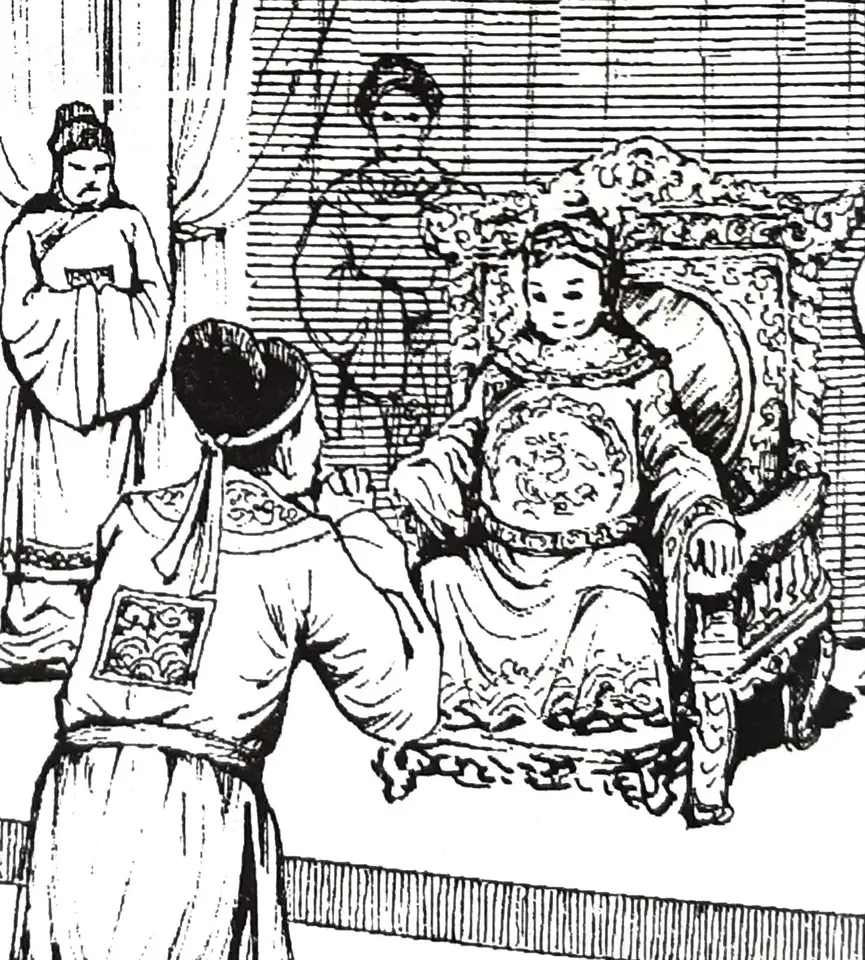
Life and Career
Hostage Heritage and Royal Succession
Zhao Xing's lineage was closely intertwined with Western Han imperial diplomacy toward the southern kingdom of Nanyue. During the early reign of Emperor Wu, Nanyue's second ruler, King Wen (Zhao Mo), dispatched his heir apparent Zhao Yingqi to the Han capital Chang'an as a hostage-prince in exchange for military intervention against invading Minyue forces. During his decade-long residence in Chang'an, Zhao Yingqi served as an imperial palace guard and married Lady Jiu, a noblewoman from Handan, who gave birth to his second son, Zhao Xing. Previously in Nanyue, Zhao Yingqi had married an indigenous Yue woman who bore his eldest son, Zhao Jiande.
In 122 BC, upon the death of King Wen, Zhao Yingqi received imperial permission to return to Panyu and ascend the throne as King Ming. Anxious to manifest absolute loyalty toward the Han court, Zhao Yingqi memorialized Emperor Wu to bypass his elder Yue son Zhao Jiande, requesting that Lady Jiu be recognized as Queen and the young Zhao Xing be designated Crown Prince. Emperor Wu granted the petition, establishing Zhao Xing as the recognized heir to the southern realm.
Accession and the Imperial Summons
In 113 BC, King Ming passed away, and the young Zhao Xing succeeded to the throne as King Ai, with Queen Dowager Jiu presiding over state affairs. At that juncture, actual administrative and military power within Nanyue was firmly concentrated in the hands of Prime Minister Lü Jia, an entrenched elder statesman whose kin occupied over seventy major official posts across the southern kingdom.
Perceiving the vulnerability of the young ruler, Emperor Wu resolved to transform Nanyue from a tributary buffer into an integral part of the imperial domain. The Han court dispatched Anguo Shaoji, a former paramour of Lady Jiu, as imperial envoy, accompanied by the eloquent court consultant Zhong Jun and martial escort Wei Chen, while positioning General Lu Bode at Guiyang to support the diplomatic mission. Arriving in Panyu, Anguo Shaoji presented an imperial edict summoning Zhao Xing and the Queen Dowager to Chang'an to pay personal homage as internal feudatories. Within the royal palace, Anguo Shaoji resumed his private intimacy with the Queen Dowager, provoking widespread indignation among native Yue officials and commoners. Fearing an imminent domestic uprising, the isolated Queen Dowager urged Zhao Xing to seek direct imperial protection through total submission.
Persuaded by his mother, Zhao Xing dispatched an official memorial to Emperor Wu requesting that Nanyue be placed on equal footing with internal Han principalities, establishing triennial imperial audiences, removing frontier customs checkpoints along the Dayu Ridge, and abolishing indigenous corporal punishments in favor of Han dynastic statutes. Emperor Wu enthusiastically ratified the petition, conferring imperial silver seals upon Prime Minister Lü Jia and central ministerial seals upon the kingdom's officers. Zhao Xing and his mother immediately began preparing royal tributes and luggage for their formal procession to Chang'an.
The Palace Banquet and Power Struggle
However, the royal family's drive for integration clashed violently with the interests of the indigenous Yue aristocracy. Prime Minister Lü Jia had served three consecutive Nanyue kings; his male kinsmen married royal princesses, while his female relatives wed royal sons, creating an impregnable political network. Lü Jia vehemently opposed relinquishing border fortifications and submitting to direct Han taxation, repeatedly warning Zhao Xing against surrender. When the young king ignored his remonstrances, Lü Jia feigned illness, refusing all contact with Han emissaries.
Fearing that Lü Jia was preparing an armed insurrection, Zhao Xing and Queen Dowager Jiu hosted an official palace banquet, secretly scheming to exploit the presence of Han imperial envoys to execute the Prime Minister. At the banquet, the Han envoys sat facing east, the Queen Dowager faced south, Zhao Xing faced north, while Lü Jia and his ministerial allies sat facing west. Armed troops commanded by Lü Jia's brother stood watch outside the palace gates.
During the feast, the Queen Dowager directly challenged Lü Jia, demanding: "Submitting Nanyue to the Han Empire brings eternal prosperity to our realm; why does the Prime Minister stubbornly consider it inconvenient?" She intended to incite the Han envoys into immediate action. However, intimidated by the presence of armed guards outside the hall, Anguo Shaoji and Zhong Jun hesitated and failed to strike. Sensing mortal danger, Lü Jia abruptly rose and exited the hall. Infuriated by his defiance, Queen Dowager Jiu seized a spear to impale the Prime Minister, but the young Zhao Xing intervened to restrain his mother, allowing Lü Jia to escape unharmed.
The Coup d'État and Dynastic Annexation
Returning to his compound, Lü Jia transferred a portion of his brother's armed forces to fortify his private residence, severing all communication with the palace and actively mobilizing tribal leaders. The youthful Zhao Xing harbored no personal desire to eliminate an elder statesman who had served his ancestors, while the Queen Dowager, detested by the populace for her indiscretions, lacked independent military power to suppress the mutiny, resulting in a tense political stalemate.
Upon receiving reports of the crisis in Panyu, Emperor Wu severely reprimanded his ambassadors for their cowardice. Believing that Zhao Xing and the Queen Dowager maintained royal authority, the Emperor dispatched Han Qianqiu, a reckless commander from Jia, alongside Queen Dowager Jiu's brother Jiu Le, commanding an expeditionary force of two thousand troops to arrest Lü Jia.
In the fourth month of 112 BC, as Han Qianqiu crossed the northern passes into Nanyue, Lü Jia launched an all-out insurrection. He issued a proclamation to the populace declaring that the young king had been duped by a foreign mother and corrupt Han envoys who intended to surrender ancestral treasures and sell the Yue people into servitude at Chang'an. Exploiting local xenophobia, Lü Jia and his brother led thousands of insurgent soldiers in an assault on the royal palace. Zhao Xing, Queen Dowager Jiu, and the Han ambassadors, including Zhong Jun, were overwhelmed and slaughtered.
Lü Jia placed Zhao Xing's elder brother Zhao Jiande upon the throne as a puppet monarch and ambushed Han Qianqiu's force, annihilating the two-thousand-man expedition. The murder of Zhao Xing and the imperial embassy ignited the fury of Emperor Wu, who deployed a punitive army of one hundred thousand troops under Generals Lu Bode and Yang Pu. By 111 BC, Panyu was captured, Lü Jia and Zhao Jiande were executed, and the Kingdom of Nanyue was formally dissolved into nine imperial commanderies, bringing the century-old southern state to an abrupt end.
Major Achievements
Historical Initiative for Territorial Integration
During his brief reign, Zhao Xing demonstrated progressive statesmanship by seeking to align his border kingdom with the centralized Han Empire. Recognizing the irreversible trend toward imperial unification, he moved beyond the separatist isolationism of his predecessors.
By requesting that Nanyue be treated as an internal principality, dismantling border checkpoints along the mountain passes, and introducing Han legal codes to replace archaic corporal punishments, Zhao Xing sought to integrate Lingnan into mainstream Chinese civilization. Although his initiative was violently aborted by reactionary aristocrats, his diplomatic submission provided Emperor Wu with undisputed legal and moral authority to incorporate the southern territory permanently into the imperial domain.
Tragic Dilemma of Border Assimilation
Zhao Xing's brief and tragic reign reflects the structural fragility of frontier hostage-succession diplomacy. Raised in the imperial capital and inheriting a border throne with an alien Chinese mother, he possessed neither military loyalties nor cultural roots among the indigenous Yue populace.
Caught between the aggressive centralizing demands of the Han court and the entrenched defiance of the indigenous aristocracy, Zhao Xing lacked the political maturity and ruthless decisiveness required to eliminate powerful dissidents like Lü Jia. His tragic death stands as an enduring case study in the volatile transition from indirect frontier protectorates to direct bureaucratic governance in early imperial China.