Born into an established Uya-clan family of the Manchu Plain Yellow Banner.
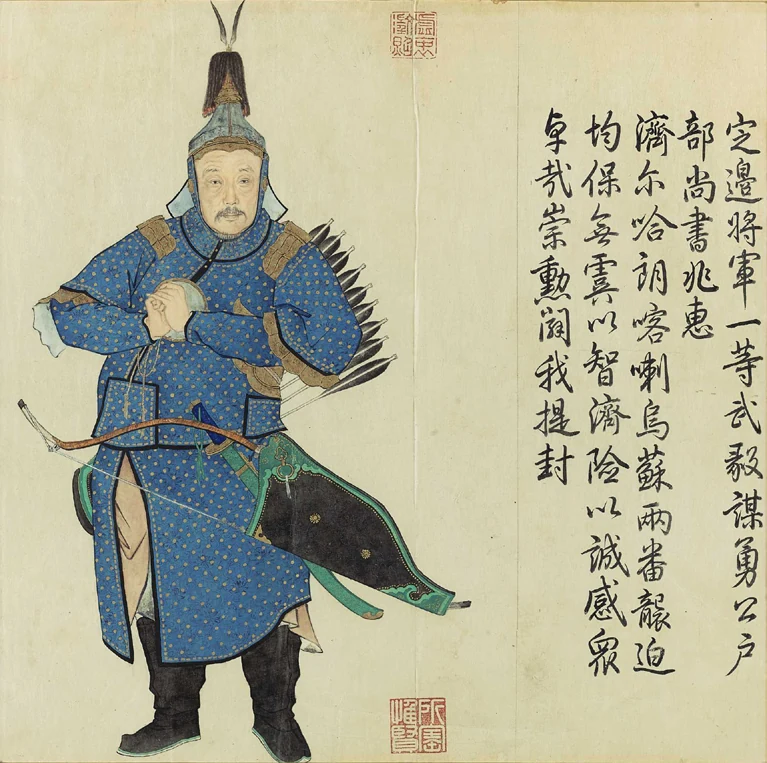
1708 CE–1764 CE
Military commander
Shumulu Zhaohui
舒穆禄·兆惠
Shumulu Zhaohui (1708–1764), courtesy name Hefu, was a member of the Uya clan (also written Wuyashi) of the Manchu Plain Yellow Banner and a prominent general of the Qianlong reign. In 1731, the ninth year of the Yongzheng era, he entered the Grand Council as a bithesi, or clerical official. During the Qianlong reign he successively held important offices including Vice Minister of Justice and Minister of Revenue. Between…
1708 CE–1764 CEQing Dynasty
PROFILE
Shumulu Zhaohui (1708–1764), courtesy name Hefu, was a member of the Uya clan (also written Wuyashi) of the Manchu Plain Yellow Banner and a prominent general of the Qianlong reign. In 1731, the ninth year of the Yongzheng era, he entered the Grand Council as a bithesi, or clerical official. During the Qianlong reign he successively held important offices including Vice Minister of Justice and Minister of Revenue. Between 1755 and 1759, he took part in the Dzungar–Qing Wars and the campaign against the two Khoja leaders, leading expeditions north and south of the Tianshan and bringing Xinjiang into the Qing realm. For his achievements he was enfeoffed as First-Class Duke Wuyi Mouyong. He died in 1764, the twenty-ninth year of the Qianlong era, and received the posthumous name Wenxiang.
- Alternative Name
- Duke Wuyi
- Courtesy Name
- Hefu
- Period
- Qing
- Dynasty/Regime
- Qing
- Identity
- Military commander
- Ethnicity/People
- Manchu
- Banner Affiliation
- Manchu Plain Yellow Banner
- Native Place
- Not reliably confirmed in extant sources
- Date of Birth
- 1708
- Place of Birth
- Unknown
- Date of Death
- 1764
- Place of Death
- Unknown
- Highest Office
- See “Biography” and “Major Deeds”
- Major Achievements
- A leading general of the Qianlong reign; commanded forces in the Dzungar–Qing Wars and advanced into the southern Tianshan region; was enfeoffed as Duke Wuyi Mouyong
LIFE TIMELINE
Age twenty-four | Entered the Grand Council as a bithesi.
Age twenty-nine | Successively served as a director in the Ministry of War, a grand secretariat official, and Vice Minister of Justice at Shengjing, among other offices.
Age forty-one | Concurrently served as Vice Minister of Revenue and went to the Jinchuan front to supervise grain transport.
Age forty-three | Entered service in the Grand Council.
Age forty-six | Sent to Tibet to handle preparations against the Dzungars.
Age forty-seven | Assisted with northern-route military affairs and took overall charge of grain and provisions.
Age forty-eight | Stationed at Uliastai; after Amursana rebelled, moved to Barköl.
Age forty-nine | Appointed Right Deputy General for Pacifying the Frontier and assigned to handle the aftermath in Ili.
Age fifty | Suppressed the Oirats rebellion, was made First-Class Earl Wuyi, and was appointed General for Pacifying the Frontier.
Age fifty-one | Led troops south against the two Khoja leaders; after the siege at the Black River Camp, was promoted to First-Class Duke Wuyi Mouyong.
Age fifty-two | Joined forces with Fude and completed the suppression of the rebellion of the two Khoja leaders.
Age fifty-three | Returned to the capital in triumph; the Qianlong Emperor personally performed the suburban reception ceremony and Zhaohui again entered the Grand Council.
Age fifty-four | Appointed Assistant Grand Secretary and acting Minister of Justice.
Age fifty-seven | Died and received the posthumous name Wenxiang.
BIOGRAPHY
Biography
Family Background and Early Years
According to the Chinese source, Zhaohui came from the Uya clan of the Manchu Plain Yellow Banner and was a collateral descendant of Empress Xiaogongren, the Kangxi Emperor’s Consort De and the mother of the Yongzheng Emperor. His founding ancestor was Ba Bai; later ancestors included Tuo He Tuo Qi, Sa Mu Ha, and Duo Qi, the last of whom rose to the office of director. His grandfather was Bi Xi Na, and his father Fu Biao attained the office of dutong. By the early Qing the Uya clan was already an established family, with many members serving in institutions including the Imperial Household Department and the Censorate and maintaining close ties to the imperial house. Among Zhaohui’s kinsmen, the branch of E Bai Gen was especially prominent: the daughter of Wei Wu, grandson of E Bai Gen, was Empress Xiaogongren. The source therefore describes the Uya clan as one of the Qing imperial-affinal families.
In 1731, the ninth year of the Yongzheng era, twenty-four-year-old Zhaohui entered the Grand Council as a bithesi, beginning his official career. The source explains bithesi as a Manchu term meaning a clerk or scribe, a distinctive Qing documentary office that, although not high in formal rank, brought its holders close to the central government and was a common avenue of advancement for Manchu bannermen. Zhaohui later served successively as a director in the Ministry of War, a grand secretariat official, Vice Minister of Justice at Shengjing, Right Vice Minister of Justice, deputy lieutenant-general of the Manchu Plain Yellow Banner, and commander of the Bordered Red Banner guards. After seven promotions he reached the post of Vice Minister of Justice.
Jinchuan Supply Work and Central-Government Experience
In 1748, the thirteenth year of the Qianlong era, Qing forces were engaged in the war in the Greater and Lesser Jinchuan regions of Sichuan. Zhaohui, concurrently serving as Vice Minister of Revenue, was ordered to the military camp to supervise the transport of grain. He memorialized the Qianlong Emperor directly about supply conditions and stated that among the commanders only Wu Er Deng and Ha Panlong had fought with notable courage; he also reported that provincial troop returns contained many inaccuracies. The Qianlong Emperor ordered Grand Minister Fuheng to verify the matter. After the Jinchuan campaign ended and the troops returned, Zhaohui was ordered to audit military expenditures and was later transferred to the post of Vice Minister of Revenue. In the same year, when a forged memorial attributed to Minister Sun Jiagan circulated in Shandong, Zhaohui was sent to investigate and temporarily acted as governor of Shandong.
In 1750, the fifteenth year of the Qianlong era, Zhaohui entered the Grand Council. In 1753, the eighteenth year, he was ordered to Tibet to handle preparations against the Dzungars. At the time the Dzungar khanate was repeatedly disrupted by internal conflict, and the Qing court had begun preparing for military operations in the northwest. The source states that Zhaohui’s experience with defensive preparations in Tibet helped prepare him for later command in the region.
The Dzungar–Qing Wars
In 1754, the nineteenth year of the Qianlong era, the Qing court decided to launch the campaign against the Dzungars. Zhaohui was ordered to assist with northern-route military affairs and take overall charge of provisioning. In 1755, the twentieth year, Qing armies advanced by western and northern routes. The Dzungar khan Dawachi was defeated and captured. The Qianlong Emperor ordered Zhaohui to be stationed at Uliastai to oversee the northern defenses. After the Dzungar taiji Ga Lei Cang Duo Er Ji submitted, Zhaohui was instructed to provide livestock for his resettlement.
In the eighth month of the same year, Amursana, a taiji of the Khoit who had submitted to Qing, rebelled and seized Ili. General Bandi and assistant commander E Rong An, who were stationed there, were killed after being surrounded. Yongchang, General for Pacifying the West at Urumqi, retreated and was dismissed by the Qianlong Emperor. Zhaohui was ordered to move to Barköl, supervise the E Lin Ha Bi Er Ga relay stations, maintain communications between the northern Tianshan region and the interior, and organize provisions for operations against Amursana.
In 1756, the twenty-first year of the Qianlong era, Qing forces defeated Amursana and recovered Ili. The Qianlong Emperor judged General Tsereng unfit for his position and summoned Zhaohui to Beijing to receive instructions, but before Zhaohui could depart, Tsereng was arrested for falsely reporting military intelligence. The emperor then removed Jalafungga from the post of Right Deputy General for Pacifying the Frontier and appointed Zhaohui in his place, ordering him to handle the aftermath in Ili. That winter, Oirat zaisang serving with the army plotted rebellion. The Choros khan Ga Lei Cang Duo Er Ji secretly warned Zhaohui that Ba Ya Er intended to raid his pastures. Zhaohui ordered Ningxia general He Qi to take a little over one hundred men, collect Oirat troops, and go to the area. Instead, Ga Lei Cang Duo Er Ji’s nephew Zha Na Ga Er Bu and the zaisang Ne Ma, Ha Sa Ke Xi La, Da Shen Ce Ling, and others secretly colluded with the enemy and rebelled en route; He Qi was killed.
On hearing the news, Zhaohui personally led five hundred soldiers from Ili to suppress the rebellion. He passed Ji Er Ha Lang and reached E Lei Zha La Tu, where he fought Da Shen Ce Ling and defeated him decisively. He pursued the rebels to Ku Tu Qi and fought again at Da Lei Qi, killing several thousand. In the first month of 1757, the twenty-second year of the Qianlong era, Zhaohui reached Urumqi, where Ga Lei Cang Duo Er Ji, Zha Na Ga Er Bu, and other rebel leaders had gathered. He fought dozens of engagements in a single day, and the army’s horses were nearly exhausted. The soldiers marched on foot through snow and ice and were surrounded at Tene Geer. Ya Er Ha Shan, the official in charge at Barköl, first sent guard officer Tu Lun Chu with eight hundred men as reinforcements; at the same time Zhaohui dispatched military officer Yun Duo Ke De Leng Che to break out of the encirclement and seek aid. When the news reached the court, the Qianlong Emperor praised Zhaohui’s courage, made him First-Class Earl Wuyi, and appointed him Minister of Revenue, lieutenant-general of the Han Bordered White Banner, and Minister of the Imperial Bodyguard. Tu Lun Chu arrived and lifted the siege. After receiving new troops, Zhaohui pursued Ba Ya Er to the headwaters of the Mulei River, but Ba Ya Er had already moved his herds elsewhere, so Zhaohui returned to Barköl. The Qianlong Emperor rewarded him for pursuing the enemy tirelessly over a long distance and ordered him to operate on separate routes with General for Pacifying the Frontier Cenggūn Jabu against the remaining Oirat forces.
Zhaohui and assistant grand minister E Shi then advanced from E Lin Ha Bi Er Ga. Together with Deputy General Cebdenjab, deputy lieutenant-general Hu Er Qi, guard officer Da Lishan, and others, they advanced by four routes, converged at Ili, and destroyed the remaining Oirat forces. In the fourth month, Zhaohui captured rebel leader E Zhe Te and sent him to Beijing. The Qianlong Emperor nevertheless ordered him to capture the remaining leaders, including Ha Sa Ke Xi La, as quickly as possible.
Campaign Against the Two Khoja Leaders
In 1757, the twenty-second year of the Qianlong era, Zhaohui detected signs that the Muslim leaders Burhan al-Din, the elder Khoja, and Khoja Jahan, the younger Khoja, were preparing to rebel. He ordered assistant grand minister Fude to pursue Amursana while he remained at Ji Er Ha Lang. The Qianlong Emperor reproached Zhaohui and Cenggūn Jabu for “treating the Muslim regions as urgent while delaying the pursuit of Amursana,” judging that they had reversed the proper priorities. Zhaohui therefore followed Fude northward and sent envoys to the eastern and western Kazakhs demanding the return of the fugitive Amursana. Kazakh khan Ablai Khan sent envoys with horses and a memorial requesting permission to attend court. His envoys reported that Amursana had arrived with twenty horsemen, but after Ablai Khan devised a plan to seize his horses, cattle, and sheep, Amursana realized the danger and fled. His nephew Da Shen Che Ling and zaisang Qi Ba Han were captured and delivered in bonds to Zhaohui’s camp. Zhaohui separately sent Tu Lun Chu, San Da Bao, Ailungga, and others to defeat Amursana’s remaining followers and accept the surrender of the commander Na Muqi and his son. When intelligence established that Amursana had fled into Russia, the Qianlong Emperor ordered the army to return.
In the twelfth month of the same year, the two Khoja leaders formally rebelled. The Qianlong Emperor appointed Zhaohui General for Pacifying the Frontier and sent him to campaign in southern Xinjiang. Zhaohui proposed first establishing military farms at Urumqi and waiting until the following spring to advance. He also argued that if the army could not immediately penetrate the Muslim regions, it should accumulate grain and purchase horses as a cautious strategy. The Qianlong Emperor rejected this advice and rebuked him for timidity. In the first month of 1758, the twenty-third year of the Qianlong era, Zhaohui judged that about ten thousand Oirat households still remained at Sha La Bo Lei and decided to eliminate them before concentrating on the Muslim regions. The Qianlong Emperor appointed Ya Er Ha Shan General for Pacifying Rebellion and ordered him to enter southern Xinjiang first, while Zhaohui was to attack by a separate route after finishing the Oirat campaign. Zhaohui and Deputy General Cebdenjab advanced by four routes, converged at Ili, and destroyed the remaining Oirat forces.
The Siege at the Black River Camp
In the eighth month of 1758, the twenty-third year of the Qianlong era, Zhaohui was ordered to lead his troops south and command the Qing campaign against the two Khoja leaders. He sent deputy general Fude to Aksu as a second echelon and personally led more than four thousand cavalry and infantry toward Yarkand, which was held by the younger Khoja, Khoja Jahan. The walls of Yarkand extended for more than ten li and had twelve gates. The defenders dug trenches and built platforms five li east of the city as an outer screen and stripped the surrounding area of supplies.
On the third day of the tenth month, Zhaohui’s force reached Hui Qi A Li Ke, forty li from Yarkand, and camped across a river. He sent troops from both wings to seize earthen platforms east of the city. On the sixth day, several hundred rebel cavalry emerged from the eastern, western, and northern gates. The two sides fought, and the rebels were defeated in three successive engagements before withdrawing into the city. Zhaohui’s main camp stood beside the Black River and was therefore called the “Black River Camp.”
Seeing that Yarkand was strongly defended, Zhaohui detached eight hundred men under deputy lieutenant-general Ailungga to block the route from Kashgar and prevent the elder Khoja Burhan al-Din from bringing reinforcements. Intelligence reported that herds belonging to local Muslims were grazing beneath the hills south of the city. Zhaohui decided to seize the sheep to supplement his supplies and draw the enemy into open battle. On the thirteenth day, he led more than one thousand cavalry south. A river lay ahead, and Qing troops seized the bridgehead and rode across. After only about four hundred men had crossed, the bridge suddenly collapsed. Five thousand rebel cavalry and ten thousand infantry immediately emerged from Yarkand and enveloped the Qing force from both wings. The Qing troops fought individually and swam back to the camp. Zhaohui changed horses twice and suffered wounds to the face and shin. The rebels did not withdraw into the city until nightfall. More than one hundred Qing soldiers were killed and several hundred wounded; zongbing Gao Tianxi, deputy commander E Shi, San Ge, Tetong E, and others were killed.
Zhaohui then held the Black River Camp against rebel forces several times larger than his own. The rebels dug trenches and built successive lines of earthworks around the position. Zhaohui organized the soldiers to dig wells inside the camp for water and accumulate grass as emergency food while waiting for relief. In the eleventh month, the Qianlong Emperor promoted him for his service to First-Class Duke Wuyi Mouyong, with hereditary succession in perpetuity.
Triumph and Final Years
In 1759, the twenty-fourth year of the Qianlong era, Right Deputy General for Pacifying the Frontier Fude arrived with reinforcements and decisively defeated the rebels at Hu Er Men northeast of Yarkand. Zhaohui then moved out to join him. In the seventh month, the two Khoja leaders fled after defeat into Badakhshan, where the sultan of Badakhshan captured and killed them. The rebellion ended, and the Qing court formally incorporated Xinjiang into its realm.
In the first month of the twenty-fifth year of the Qianlong era (1760), Zhaohui returned to the capital with the western expeditionary army. The Qianlong Emperor personally went to Liangxiang and performed a suburban reception ceremony south of the city, offering extensive rewards and consolation. In the second month, Zhaohui, holding the title First-Class Duke Wuyi Mouyong and the office of Minister of Revenue, entered the Grand Council and became a Minister of the Imperial Presence. In 1761, the twenty-sixth year of the Qianlong era, he was appointed Assistant Grand Secretary and acting Minister of Justice. During the metropolitan palace examination that year, the Qianlong Emperor specially appointed him as one of the readers of the examination papers as a mark of favor. Zhaohui died in 1764, the twenty-ninth year of the Qianlong era, and received the posthumous name Wenxiang.
Major Activities
The Dzungar–Qing Wars
Zhaohui played a major role in the Dzungar–Qing Wars. After Amursana rebelled in 1755, the twentieth year of the Qianlong era, Zhaohui was ordered to station himself at Uliastai and later moved to Barköl to keep the northern relay route open. In 1756, when Oirat zaisang rebelled, he personally led five hundred men from Ili in pursuit and fought at E Lei Zha La Tu, Ku Tu Qi, and Da Lei Qi, killing several thousand rebels. In the first month of 1757, he fought repeated engagements around Urumqi and Tene Geer. With horses exhausted, his troops marched through snow and ice; after being surrounded, they held out until relief arrived. The Qianlong Emperor commended his courage and made him First-Class Earl Wuyi. Zhaohui then operated on separate routes with Cenggūn Jabu and eliminated the remaining Oirat forces, laying the groundwork for the final Qing victory over the Dzungars.
Campaign Against the Two Khoja Leaders
In 1758, the twenty-third year of the Qianlong era, Zhaohui, serving as General for Pacifying the Frontier, led troops south against the two Khoja leaders. He first eliminated the remaining Oirat forces and then concentrated on the Muslim regions, directing the Qing advance through the cities of southern Xinjiang. During the siege at the Black River Camp, he held out for several months with more than four thousand troops against tens of thousands of rebels. He eventually received relief from Fude, joined forces with him, and defeated the two Khoja leaders. The source describes this campaign as the decisive struggle by which the southern Tianshan region was incorporated into Qing rule and as a key stage in the Qing unification of Xinjiang.
Characteristics of Military Command
The Chinese source characterizes Zhaohui’s command style as bold and resolute. On several occasions he fought outnumbered and continued operating under extreme conditions. At the Black River Camp, he personally led light cavalry across a bridge to draw out the enemy; after the bridge collapsed, he changed horses twice and continued directing the fighting despite wounds to his face and shin. When surrounded near Urumqi, he and his army marched on foot through snow and ice without allowing morale to collapse. Although the Qianlong Emperor at times rebuked him as “timid,” the source contrasts this with the courage and persistence he displayed in battle. He also attached importance to logistics: his earlier supervision of Jinchuan supplies and later work organizing grain transport in the northwest gave him substantial logistical experience for long-distance campaigns.
Administrative and Political Activity
Zhaohui was not only a field commander but also an important central official. Early in his career he successively served as a director in the Ministry of War, a grand secretariat official, Vice Minister of Justice at Shengjing, and Right Vice Minister of Justice. In 1748 he concurrently served as Vice Minister of Revenue and supervised military supplies at Jinchuan. He later held such offices as Minister of Revenue, lieutenant-general of the Han Bordered White Banner, Minister of the Imperial Bodyguard, and Assistant Grand Secretary and acting Minister of Justice. After returning in triumph in 1760, he entered the Grand Council and became a Minister of the Imperial Presence, placing him among the central decision-makers of the Qianlong court.
Personal Relations
Family
- Fu Biao: Father; attained the office of dutong.
- Bi Xi Na: Grandfather.
- Duo Qi: Great-grandfather; served as a director.
- Sa Mu Ha: Great-great-grandfather.
- Empress Xiaogongren: Clan relative; identified in the source as a member of the Uya clan and Consort De of the Kangxi Emperor.
- Zha La Fen: Son; married a woman of the Yehe Nara clan.
- Jalantai: Son; inherited the title First-Class Duke Wuyi Mouyong in 1765 and married the Qianlong Emperor’s ninth daughter, Princess Heke of the Second Rank.
- Ying Jun and Baishan Bao: Grandsons who successively inherited the title.
- Daughter: Married Hai Cheng of the Shumulu clan, a Manchu of the Plain Yellow Banner who served as governor of Jiangxi.
Ruler–Subject Relations
- Qianlong Emperor: Zhaohui’s ruler; repeatedly entrusted him with important responsibilities, rebuked and pressed him in military matters, and also repeatedly commended and rewarded him.
- Yongzheng Emperor: Zhaohui entered government service in 1731, the ninth year of the Yongzheng era, as a bithesi in the Grand Council.
Colleagues
- Fude: Right Deputy General for Pacifying the Frontier; commanded the relief force for the Black River Camp and later joined Zhaohui in suppressing the two Khoja leaders.
- Ya Er Ha Shan: Official in charge at Barköl; sent troops to relieve Zhaohui, and was later arrested by order of the Qianlong Emperor after failing to prosecute the siege of Kuqa effectively, with Zhaohui replacing him in command.
- Cenggūn Jabu: General for Pacifying the Frontier; advanced on separate routes with Zhaohui against the Oirat forces.
- Tsereng: General for Pacifying the West; arrested for falsely reporting military intelligence, after which Zhaohui assumed the post of Right Deputy General for Pacifying the Frontier.
- Tu Lun Chu: Guard officer; led eight hundred men to relieve Zhaohui’s surrounded army.
- Ailungga: Deputy lieutenant-general; commanded eight hundred men blocking the route from Kashgar during the Black River Camp campaign.
- Fuheng: Grand Minister; ordered by the Qianlong Emperor to verify Zhaohui’s report on the Jinchuan commanders.
- Wu Er Deng and Ha Panlong: Jinchuan commanders whom Zhaohui praised for their courage in battle.
Opponents
- Amursana: Taiji of the Dzungar Khoit; rebelled against the Qing and later fled into Russia, and Zhaohui was ordered to pursue him.
- Burhan al-Din and Khoja Jahan: Muslim leaders known respectively as the elder and younger Khoja; launched a rebellion that Zhaohui led forces to suppress.
- Ga Lei Cang Duo Er Ji: Choros khan; first submitted and later rebelled and fought Zhaohui.
- Zha Na Ga Er Bu: Nephew of Ga Lei Cang Duo Er Ji; took part in the rebellion.
- Da Shen Ce Ling, Ba Ya Er, Ha Sa Ke Xi La, and E Zhe Te: Leaders of the Oirat rebel forces.
Historical Assessment
Qing and Contemporary Assessments
- The Qianlong Emperor praised Zhaohui as “brave” and as proceeding with “sincere courage,” repeatedly rewarding his military achievements. He also repeatedly criticized him as “timid” and for “treating the Muslim regions as urgent while delaying Amursana,” showing that he did not always approve of Zhaohui’s strategic judgments.
- The Draft History of Qing states that Zhaohui began in the Grand Council as a bithesi and rose through seven promotions to Vice Minister of Justice; it emphasizes that at the Black River Camp, though his isolated force was surrounded, he held out until relief arrived and ultimately helped pacify the Muslim regions, and compares his military reputation with that of Agui.
- The official evaluation of the Qianlong court credited Zhaohui with major achievements in the campaigns against the Dzungars and the Muslim regions. He was included among the meritorious officials portrayed in the Hall of Purple Splendor.
Late Qing and Republican-Era Assessments
- Late Qing scholar Wei Yuan described Zhaohui’s campaigns against the Dzungars and the Muslim regions in detail in Shengwu Ji, presenting him as a representative commander of Qianlong-era territorial expansion.
- Republican-era scholar Xiao Yishan, in General History of the Qing Dynasty, characterized Zhaohui as a noted general of the Qianlong reign and regarded his campaigns in Xinjiang as foundational to Qing control of the northwestern frontier.
- The compilers of the Draft History of Qing, including Zhao Erxun, regarded Zhaohui as an outstanding commander and placed him alongside Agui among the leading generals of the Qianlong era.
Modern Assessments
- Modern historian Dai Yi, in The Qianlong Emperor and His Era, is cited in the Chinese source as describing Zhaohui as one of the most outstanding military commanders of the Qianlong reign and emphasizing his persistence and courage during the campaigns against the Dzungars and the two Khoja leaders.
- Scholars of Xinjiang local history, as summarized by the Chinese source, hold that Zhaohui’s suppression of the rebellion of the two Khoja leaders brought Xinjiang formally into the Qing realm and had major significance for the formation of modern China’s territorial extent.
- Military historians cited by the Chinese source regard the siege at the Black River Camp as a classic example in premodern Chinese military history of a smaller force holding out against a larger enemy while awaiting relief.
FIGURES ASSOCIATED WITH THIS DYNASTY
Bibliography
- Draft History of Qing, juan 313, Biography 100
- Ba Qi Manzhou Shizu Tongpu (《八旗满洲氏族通谱》), juan 29
- Xiao Yishan, General History of the Qing Dynasty