Age 1 | Born in Pengcheng, Xuzhou (present-day Xuzhou, Jiangsu).
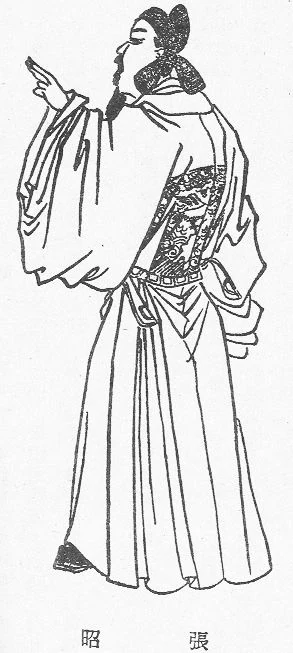
156 CE–236 CE
Senior minister and politician of Eastern Wu
Zhang Zhao
张昭
Zhang Zhao was the first leading civil minister of Eastern Wu, a senior official entrusted with the succession, and a forceful and outspoken remonstrator who played a central role in court deliberations.
156 CE–236 CESun Wu
PROFILE
Zhang Zhao was the first leading civil minister of Eastern Wu, a senior official entrusted with the succession, and a forceful and outspoken remonstrator who played a central role in court deliberations.
- Also Known As
- Courtesy name Zibu
- Courtesy Name
- Zibu
- Period
- Wu
- Date of Birth
- 156
- Date of Death
- 236
- Dynasty/Regime
- Wu
- Identity
- Senior minister and politician of Eastern Wu
- Ethnicity/Ethnic Affiliation
- Not recorded in historical sources
- Ancestral Home
- Pengcheng, Xuzhou (present-day Xuzhou, Jiangsu)
- Place of Birth
- Pengcheng, Xuzhou (present-day Xuzhou, Jiangsu)
- Place of Death
- Not recorded in historical sources
- Highest Office
- See Biography and Major Activities
- Major Achievements
- First leading civil minister of Eastern Wu; senior guardian entrusted with the succession; known for stern integrity and outspoken remonstrance; presided over court deliberations
LIFE TIMELINE
About age 30 | Recommended as Filial and Incorrupt and as Flourishing Talent, but declined both. After refusing Tao Qian's recommendation, he was imprisoned and later released through Zhao Yu's intercession.
About age 40 | Fled the warfare in the north for Jiangdong and accepted Sun Ce's invitation to enter service, becoming Chief Clerk and General of the Household Who Pacifies the Army.
Age 45 | Sun Ce died after an assassination attempt and entrusted the succession to Zhang Zhao. Zhang helped Sun Quan mount his horse and stabilized the situation in Jiangdong.
Age 47 | Lady Wu died and summoned Zhang Zhao and others to entrust final matters to them.
Age 53 | On the eve of the Battle of Red Cliffs, advocated receiving and surrendering to Cao Cao, damaging his prestige.
Age 54 | Served as military adviser and directly remonstrated with Sun Quan over the dangers of hunting.
Age 57 | Cao Cao's staff member Ruan Yu urged Sun Quan in a letter to eliminate Zhang Zhao, reflecting Zhang's high reputation and influence.
Age 66 | After Sun Quan was enfeoffed as Prince of Wu, Zhang openly rebuked the arrogance of Cao Wei envoy Xing Zhen.
Around age 70 | Sun Quan established the office of Grand Councilor but twice declined to appoint Zhang, choosing Sun Shao and then Gu Yong instead.
Age 74 | After Sun Quan proclaimed himself emperor, Zhang retired because of age and illness. He was appointed General Who Assists Wu, redesignated Marquis of Lou, and withdrew to scholarship and writing.
Age 81 | Died and received the posthumous name Marquis Wen.
BIOGRAPHY
Biography
Family Background and Early Life
Zhang Zhao was born into a scholarly family in Pengcheng, Xuzhou. Intelligent and studious from childhood, he became known locally for broad learning. As a young man he studied the Zuo Zhuan under Baihou Zian, undertook especially deep study of the Book of Han, and became skilled in clerical-script calligraphy. He was ranked alongside Zhao Yu of Langya and Wang Lang of Donghai. The three were close friends and prominent young scholars in the Xuzhou region.
After reaching adulthood, Zhang Zhao was recommended as a Filial and Incorrupt candidate but declined the appointment. Tao Qian, Inspector of Xuzhou, admired his reputation and recommended him as a Flourishing Talent, but Zhang again refused. Believing that Zhang looked down on him, Tao angrily imprisoned him. Zhao Yu worked vigorously for Zhang's release, and Zhang was eventually freed. Although the episode subjected him to imprisonment, it also reflected his refusal to pursue power at the cost of principle. After Tao Qian's death, Zhang set aside personal resentment and still composed a memorial text for him, demonstrating his breadth of character.
Flight to Jiangdong and Service under Sun Ce
In the final decades of the Eastern Han, warfare spread through the empire and the Xuzhou region suffered repeated conflict. Zhang Zhao crossed the Yangzi southward with other refugees and sought safety in Jiangdong. At the beginning of Sun Ce's rise, Sun personally visited Zhang and treated him with respect as a worthy man. Moved by Sun's sincerity, Zhang decided to enter service. Sun Ce appointed him Chief Clerk and General of the Household Who Pacifies the Army and entrusted him with major civil and military affairs. Zhang supervised domestic administration and made major contributions to Sun Ce's consolidation of Jiangdong.
Zhang's reputation spread widely, and northern scholar-officials often praised him in letters. One prominent friend wrote that the Sun family's conquest and government of Jiangdong were entirely Zhang Zhao's achievement. Zhang was deeply alarmed by such praise, fearing that excessive credit might arouse his ruler's suspicion and endanger his life. When Sun Ce learned of this, he responded calmly: “In former times, Guan Zhong served Qi, and the people called him Father Zhong again and again, yet Duke Huan of Qi became leader of the hegemons because of Guan Zhong's talent. Now Zibu is worthy, and I am able to employ him. Is that not itself part of my achievement?” Sun Ce's confidence dispelled Zhang's anxiety and strengthened his commitment to the Sun regime.
Entrusted with the Succession and Stabilizing Jiangdong
In 200, the fifth year of Jian'an, Sun Ce was mortally wounded in an assassination attempt. At the time, Sun Ce's third younger brother Sun Yi was, like Sun Ce, brave and decisive, and Zhang Zhao and other ministers suggested him as successor, but Sun Ce chose his second younger brother Sun Quan. Sun Ce entrusted Sun Quan to Zhang Zhao, telling him that if Zhongmou proved incapable, Zhang should select another younger brother, and that if the Sun forces ultimately could not survive the disorder of the age, they could withdraw west and join the strongest power without concern.
After Sun Ce died, Jiangdong faced internal and external danger. Zhang immediately submitted a memorial to the Han court and issued documents to the subordinate counties, ordering civil and military officers to remain at their posts. Sun Quan was overwhelmed with grief. Zhang admonished him that the duty of a successor was to continue the achievements of father and elder brother and establish great accomplishments for the Sun house. With the realm in disorder and armed bands rising in the hills, he argued, Sun Quan could not remain in bed mourning like an ordinary person. Zhang personally helped him mount his horse and had troops drawn up before him, after which the officers and people accepted Sun Quan's authority.
When Sun Quan first took control of Jiangdong, his position remained insecure and some disaffected people conspired in rebellion. Zhang assisted him in pacifying the population and stabilizing local officials and refugee elites. Whenever Sun Quan campaigned, he often left Zhang Zhao in the rear to supervise the headquarters administration. Zhang also led troops against remnants of the Yellow Turbans and directed commanders in defeating the Yuzhang rebel leader Zhou Feng and others. Thereafter he rarely commanded troops directly and usually served at Sun Quan's side as a political adviser. In 202, Lady Wu summoned Zhang and others before her death to entrust final matters to them, showing his high status within the regime.
Stern Remonstrance and Repeated Offense to the Ruler
Zhang Zhao was severe and uncompromising and often criticized Sun Quan directly. Sun enjoyed hunting and frequently rode on horseback to shoot tigers, at times allowing a tiger to leap against the saddle. Zhang, greatly alarmed, asked what protection the ruler had in such circumstances. A ruler, he said, should command heroes and employ worthy men, not race across the fields and compete in bravery with wild beasts. If an accident occurred, how could he avoid becoming the laughingstock of the realm? Sun apologized, saying that his youth had made his judgment short-sighted and that he was ashamed before Zhang. Yet he could not give up the sport and instead constructed a tiger-shooting carriage from which he hunted. Zhang continued to remonstrate bitterly while Sun often responded only with a smile.
On another occasion in Wuchang, Sun Quan became heavily intoxicated at a drinking party on a fishing terrace and ordered water thrown over his ministers, saying that the revelry would stop only when everyone was so drunk that they fell into the water. Zhang Zhao maintained a stern expression, said nothing, and withdrew to sit in his carriage. Sun sent someone to call him back. Zhang replied that King Zhou of Shang had once built wine pools and spent the night feasting, believing he was merely enjoying himself and seeing nothing wrong in it. Sun fell silent in embarrassment and ended the drinking session.
Zhang was equally stern toward colleagues. In 207, the twelfth year of Jian'an, Gan Ning proposed that Sun Quan first attack Huang Zu in the west and gradually move toward Ba and Shu. Zhang objected that Jiangdong itself was in danger and that a western campaign might create domestic disorder. Gan Ning retorted sharply that the state had entrusted Zhang with a responsibility comparable to that of Xiao He, yet he remained behind worrying that trouble would break out; how then could he hope to emulate the men of antiquity? Sun Quan supported Gan Ning, raised his cup, and declared that the western campaign would proceed that year, entrusting the task to Xingba just as he entrusted him with the wine in the cup. The exchange illustrates Zhang's cautious political temperament.
The Red Cliffs Debate and Loss of Prestige
In 208, the thirteenth year of Jian'an, Cao Cao led a great army south. Liu Cong of Jing Province surrendered without a fight. Cao wrote to Sun Quan claiming to command eight hundred thousand naval troops and proposing that they “hunt together in Wu.” Sun circulated the letter among his ministers, who were alarmed. Zhang Zhao and others argued that Cao Cao was ruthless but now acted while holding the Han emperor and issuing commands in the court's name. Open resistance would therefore appear politically illegitimate. More importantly, Sun Quan's main defense against Cao had been the natural barrier of the Yangzi. Cao now controlled Jing Province, including the fleet trained by Liu Biao and thousands of warships, and could advance downstream with both naval and land forces. The Yangzi advantage was therefore no longer exclusive to the Sun regime, while the two sides' manpower was impossible to compare. In their view, the best option was to receive Cao Cao and submit to the Han court.
Under the arguments of the pro-war group led by Zhou Yu, Cheng Pu, and Lu Su, however, Sun Quan ultimately allied with Liu Bei and defeated Cao's forces at the Battle of Red Cliffs. Zhang's advocacy of submission greatly damaged his prestige and pushed him away from the center of military and political decision-making. Sun Quan continued to respect him but never fully forgot the disagreement. In the twelfth lunar month of the same year, Sun personally campaigned at Hefei and ordered Zhang to attack Dangtu County in Jiujiang Commandery, but Zhang failed to capture it.
Honored Retirement and Final Years of Scholarship
In 221, the second year of Huangchu, Sun Quan was enfeoffed as Prince of Wu. When the Cao Wei envoy Xing Zhen arrived in Eastern Wu, he entered without leaving his carriage and displayed an arrogant manner. Zhang Zhao rebuked him directly: ritual admits no lack of respect and laws admit no failure of enforcement, he said; did Xing dare to be arrogant because he thought the people south of the Yangzi were few and weak and lacked even the knives necessary to enforce punishment? Xing hurriedly dismounted and apologized. Eastern Wu General of the Household Xu Sheng, angry at the insult, looked around at his colleagues, spoke contemptuously, and wept. Hearing this, Xing said that with commanders and ministers of such character, Jiangdong would not willingly remain subordinate for long.
After Sun Quan became Prince of Wu, he created the office of Grand Councilor. Many officials proposed Zhang Zhao. Sun first excused himself by saying that current affairs were too numerous and the responsibilities of Grand Councilor too heavy to burden the elderly Zhang. He appointed Sun Shao instead. After Sun Shao's death, Zhang was proposed again. Sun then gave his real reason: he did not dislike Zibu, but the Grand Councilor needed a conciliatory personality capable of harmonizing different opinions, while Zhang was too rigid and forceful. When his views were not accepted, he became resentful and had long-standing disputes with colleagues. The office, Sun concluded, would not benefit him. Gu Yong was therefore appointed Grand Councilor.
In 229, the first year of Huanglong, Sun Quan proclaimed himself emperor. Zhang Zhao retired because of age and illness. Sun appointed him General Who Assists Wu, ranking immediately below the Three Excellencies, redesignated him Marquis of Lou, and granted him a fief of ten thousand households. In retirement Zhang wrote commentaries on the Analects and the Zuo Zhuan. Whenever he attended court, his language remained forceful and his sense of principle visible in his demeanor. At times, after speaking against the ruler's wishes, he stayed away from court. Zhang died in 236, the fifth year of Jiahe, at the age of eighty-one and received the posthumous name Marquis Wen.
Family, Early Years and Service under Sun Ce
In adult life Zhang Zhao was recommended (for the filial and incorrupt list) but declined, and with Wang Lang he discussed the avoidance of the names of former rulers, (men of the day) thinking highly of him. When the governor of Xuzhou (Tao Qian) summoned him he refused, and Tao Qian, taking it for contempt, imprisoned him, from which Zhao Yu's plea released him; even so, after Tao Qian's death Zhang Zhao wrote (a eulogy) for him. In the disorders at the end of Han he fled with other refugees to Jiangdong, where he was much used by Sun Ce, being one of four scholars from the north (with Zhang Hong, Zhang Su and Qin Song), "and among the four his standing was the most prominent," being made general of the pacification army. Sun Ce treated him with the greatest courtesy, once going up to the hall with him to greet Zhang Zhao's mother "like a close friend of his own age"; almost all important business in Sun Ce's territory passed through Zhang Zhao's hands, and he did much to help Sun Ce conquer Jiangdong, so that he was much esteemed by northern scholars, whose letters were full of praise of him. Sun Ce was not suspicious but said generously that in old days (Duke Huan of Qi) was all "uncle" this and "uncle" that and yet became hegemon over the lords and was honoured by the world, and that "now Zibu is wise and I can employ him — will his fame not be mine as well?" — showing that Zhang Zhao stood to Sun Ce as Guan Zhong to Duke Huan of Qi. Even the arrogant Mi Heng, mocking Liu Biao's letter, asked whether it was meant for the children in Sun Ce's camp to read or for Zhang Zibu to see, which shows that even he acknowledged Zhang Zhao's talent.
The Charge of the Orphan and the Steadying of Jiangdong
In 200 Sun Ce was mortally wounded by an assassin and entrusted his younger brother Sun Quan to Zhang Zhao, charging him: "If Zhongmou is not equal to the work, take it yourself. And if things cannot be brought off, then withdraw west by degrees, and have no anxiety." Sun Quan, fearing he could not manage, called in Zhang Zhao and the general Dong Xi and asked whether Jiangdong could be held, and Dong Xi answered that Jiangdong had mountain and river barriers and that the general of the punitive expedition had been a wise governor who had shown kindness to the people, that the general of the captive-taking had inherited the enterprise with high and low of one mind, and that "Zhang Zhao holds the government and manages the great affairs, while we, Dong Xi and the rest, are his claws and teeth — this is the moment of advantage both of ground and of men, and there is nothing whatever to fear." After Sun Ce's death the position was grave, and Zhang Zhao, to preserve the Sun house, at once memorialized the court, sent documents to the counties, and ordered the officers within and without to keep to their posts. Sun Quan being in deep grief, Zhang Zhao said to him: "What matters for an heir is to carry on his predecessor's work, make it flourish and build great merit. The empire is now in turmoil, robbers hold the hills on every side — how can you lie grieving and give way to private feeling like any common man?" and he himself helped Sun Quan onto his horse and had the troops drawn up, after which the others obeyed Sun Quan.
When Sun Quan first ruled Jiangdong his footing was insecure, and some who would not submit conspired in revolt; Zhang Zhao helped him soothe the people, and the local officials and men from elsewhere were employed and settled. Whenever Sun Quan went on campaign he left Zhang Zhao to hold the rear and manage the office, and later, when the remnant party of (Sun Hao) rose, Zhang Zhao led troops and put it down; when Sun Quan attacked Hefei he had Zhang Zhao take a separate force against (Kuang Qi) and others at Nancheng — after which Zhang Zhao seldom led troops and was mostly at Sun Quan's side as counsellor. Sun Quan treated him with special generosity as an old servant, keeping him as senior secretary; and Zhang Zhao dared to speak his mind before the ruler, "often pointing out where Sun Quan was wrong, which had a good effect on him." In 202 or 207 Lady Wu died, summoning Zhang Zhao and others to charge them with her affairs; and in 207, when Gan Ning came over and at once proposed attacking Huang Zu, Zhang Zhao, who was present, thought poorly of the plan, saying that "Jiangdong itself is in danger, and if our army truly marches west there will very likely be great disorder at home," whereupon Gan Ning retorted sharply that the state had given him such a charge while he stayed behind worrying about disorder, and asked how he meant to emulate the ancients; and Sun Quan, seeing the two quarrel, raised his cup to Gan Ning and said that this year he would march west, and that "like this cup of wine I have decided to entrust it to you," telling him to press on with his plan and not to mind what the senior secretary said.
Major Activities
Scholarly Contributions
Zhang Zhao was a prominent scholar of the late Eastern Han and was known for broad learning. He studied the Zuo Zhuan under Baihou Zian, undertook especially deep study of the Book of Han, and was skilled in clerical-script calligraphy. After retiring, he wrote commentaries on the Analects and the Zuo Zhuan, important examples of classical scholarship from the Three Kingdoms period. He was ranked alongside Zhao Yu of Langya and Wang Lang of Donghai, the three being close friends and representatives of Xuzhou's scholar community.
Political Activities
Zhang Zhao was a central civil minister during the founding period of the Eastern Wu regime. Sun Ce appointed him Chief Clerk and General of the Household Who Pacifies the Army and entrusted him with major civil and military affairs. Before his death, Sun Ce entrusted the succession to Zhang, who led the officials in supporting Sun Quan, pacified the population, campaigned against bandits, and together with Zhou Yu helped manage military and political affairs, stabilizing a dangerous internal and external situation. Whenever Sun Quan campaigned, Zhang frequently remained behind to supervise the headquarters. He acquired such prestige that it was said, “Inside the palace one bowed to Sun Quan; outside the palace one bowed to Zhang Zhao,” and he stood at the head of the civil ministers of Eastern Wu.
Travels and Places of Activity
Zhang Zhao was born in Pengcheng, Xuzhou, and fled to Jiangdong during the wars of the late Eastern Han. Most of his life was spent in the Jiangdong region. He accompanied Sun Quan's operations against Hefei and personally led troops against Dangtu. Even after retirement he continued to participate in court deliberations until his death.
Relations with Contemporaries
Zhang Zhao was a friend of Zhao Yu and Wang Lang and was ranked alongside them. Together with Zhang Hong, he was known as one of the “Two Zhangs of Jiangdong,” and both served the Sun regime. Zhang and Zhou Yu jointly handled military and political affairs but often differed in policy, most famously before the Battle of Red Cliffs, when Zhang advocated submission and Zhou advocated resistance. Zhang also argued with younger military figures such as Gan Ning and Lu Su and criticized Gan Ning's proposed western campaign. His relationship with Sun Quan was complex: he was a senior minister entrusted with the succession but repeatedly offended Sun through uncompromising remonstrance.
His Policies, Scholarship, and the Two Disputes about Him
Serving two rulers, Zhang Zhao made the settling of Jiangdong his business: he "pursued the policy of steadying the powerful families, recommending (Zhuge Jin, Bu Zhi and others)," drafted the ceremonies of Wu with others on the model of Zhou and Han, and in his later years urged the lightening of punishments; in scholarship he was a master of the Confucian canon, author of an Explanation of the Zuo Commentary on the Spring and Autumn Annals and a Commentary on the Analects. His temper was blunt, and Sun Quan's remark is the best summary: "When I speak with Master Zhang I dare not be careless" — later ages set him with upright remonstrants such as (Ji An and Wei Zheng). After Sun Quan took the title of king of Wu, Zhang Zhao was general of distant peace and took part in fixing the court ceremonies, and was twice proposed by the ministers as chancellor, twice refused by Sun Quan on the ground that his temper was too blunt and he was easily resentful; his stand for surrender at Red Cliff damaged his prestige, and thereafter, though still respected, he drifted away from the centre of decision. In 229, after Sun Quan took the imperial title, he resigned on grounds of age and illness and was made (general supporting Wu); he died in 236 aged eighty-one, leaving orders for a simple funeral, and Sun Quan went in plain dress to mourn.
Two disputes attach to his life. The first is his motive in urging surrender at Red Cliff: historians hold that he meant to preserve the legitimate Han line and spare the people the misery of war, not to betray the Sun. The second is why he never became chancellor: scholars hold that, as a great scholar of the late Han, he differed in ideas and plans from the low-born Sun Quan, who "both respected and feared him"; and that Sun Quan, wishing to advance the Jiangdong-isation of his regime, meant to give the chancellorship to great Jiangdong families, and so twice passed over the man on whom all expectations rested. In 2023 his tomb was found by archaeologists at (Nanjing), yielding such gold seals as the "Seal of the General Supporting Wu," which give material evidence (for the study of Wu's offices and of Zhang Zhao's life).
Personal Relations
- Sons: Zhang Cheng and Zhang Xiu.
- Baihou Zian: Teacher.
- Zhao Yu: Close friend.
- Wang Lang: Close friend.
- Chen Lin: Admirer.
- Zhang Hong: Colleague; paired with Zhang Zhao as one of the “Two Zhangs of Jiangdong.”
- Sun Ce: Ruler.
- Sun Quan: Ruler.
- Lady Wu: Entrusted final affairs to Zhang.
- Zhou Yu: Colleague; differed with Zhang on policy.
- Lu Su: Colleague; differed with Zhang on policy.
- Gan Ning: Colleague; argued with Zhang.
- Gu Yong: Colleague; later served as Grand Councilor.
- Sun Shao: Colleague; first Grand Councilor.
- Tao Qian: Inspector of Xuzhou; once imprisoned Zhang Zhao.
- Xing Zhen: Cao Wei envoy; rebuked by Zhang Zhao.
Historical Assessment
Wu and Contemporary Views
- Sun Ce: “In former times, Guan Zhong served Qi; once it was ‘Father Zhong,’ twice it was ‘Father Zhong,’ yet Duke Huan became leader of the hegemons. Now Zibu is worthy and I can employ him—does not his achievement also belong to me?” (Records of the Three Kingdoms, “Biography of Zhang Zhao”).
- Sun Quan: “Do you think I do not like Zibu? The duties of Grand Councilor are complicated and burdensome, and this gentleman is rigid by nature. If what he says is not followed, resentment and blame will arise. That would not benefit him.” (Records of the Three Kingdoms, “Biography of Zhang Zhao”).
- Xing Zhen, envoy of Cao Wei: “With commanders and ministers like these in Jiangdong, they will not remain under others for long.” (Records of the Three Kingdoms, citing Biographies from South of the Yangzi).
Jin and Tang Periods
- Chen Shou of the Western Jin wrote that Zhang Zhao had been entrusted with the succession and successfully carried out his responsibilities; he was loyal, forthright, upright, and acted without selfish motive, but because he was feared for severity and kept at a distance for his lofty manner, he neither became Grand Councilor nor rose to the rank of tutor, spending his old age quietly among the lanes. Chen used this to show that Sun Quan did not equal Sun Ce in judgment. (Records of the Three Kingdoms, “Biography of Zhang Zhao”).
- Lu Ji of the Western Jin wrote: “Zhang Zhao's loyalty and uprightness did not arise from fear of danger or destruction.” (Discourse on the Fall of States).
Song and Yuan Periods
- Sima Guang wrote: “Although Zhao argued and remonstrated, Quan always treated him with indulgence.” (Comprehensive Mirror in Aid of Governance).
- Hong Mai of the Southern Song wrote: “Zhang Zhao's remonstrance was such that even the upright officials of antiquity could not surpass it.” (Spontaneous Essays of the Studio of Forbearance).
Ming and Qing Periods
- Wang Fuzhi wrote that Zhang Zhao's wish to receive Cao Cao was not a plan for personal survival but a plan for Wu; however, his understanding was insufficient, which was why he could not overturn the arguments of Zhou Yu and Lu Su. (Du Tongjian Lun).
- Zhao Yi wrote that Zhang Zhao was feared for his severity and excluded for his lofty manner and never became Grand Councilor, seeing in this an example of Sun Quan's harshness and limited generosity. (Notes on the Twenty-Two Histories).
Modern Views
- Lü Simian described Zhang Zhao as the foremost civil minister of Eastern Wu and said that his stern integrity and courage in remonstrance recalled the style of great ministers of antiquity. (Stories from the History of the Three Kingdoms).
- Tian Yuqing argued that Zhang Zhao's advocacy of submission was not cowardice but a realistic assessment of Cao Cao's power. Although the proposal was ill-suited to the moment, it reflected Zhang's political judgment. (Studies in Qin, Han, Wei, and Jin History).
FIGURES ASSOCIATED WITH THIS DYNASTY
Bibliography
- Records of the Three Kingdoms, Book of Wu, “Biography of Zhang Zhao,” by Chen Shou with Pei Songzhi's annotations
- Lü Simian, Stories from the History of the Three Kingdoms
- Tian Yuqing, Studies in Qin, Han, Wei, and Jin History