Birth | Born in Nanyang, Deng Prefecture (present-day Dengzhou, Henan).
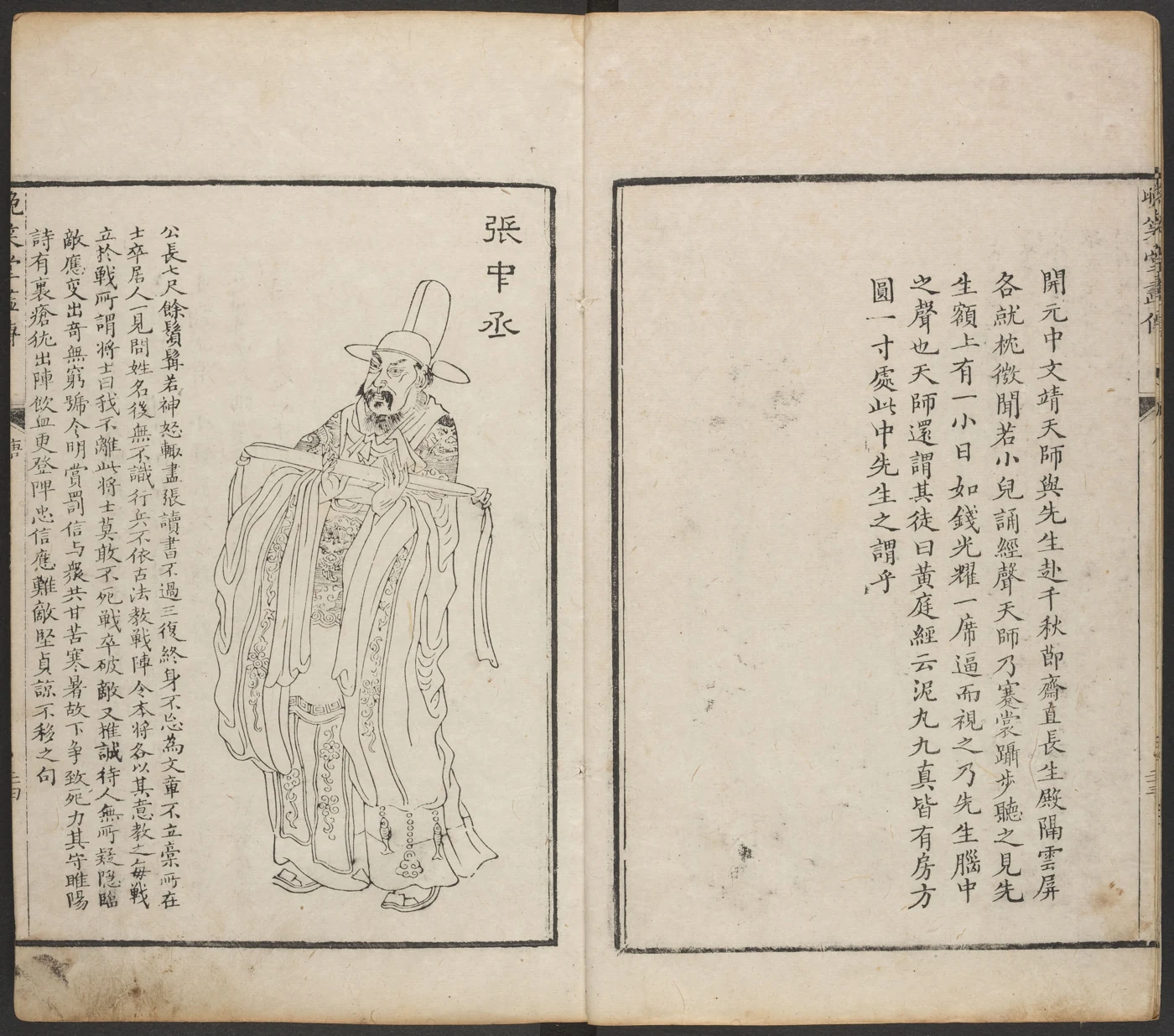
708 CE–757 CE
General
Zhang Xun
张巡
Zhang Xun (708, the second year of the Jinglong era–757, the second year of the Zhide era), courtesy name Xun, was a native of Nanyang in Deng Prefecture (present-day Dengzhou, Henan), with an ancestral home in Hedong, Pu Prefecture (present-day Yongji, Shanxi). He was a noted general of the mid-Tang. After the An Lushan Rebellion broke out, Zhang Xun, then magistrate of Zhenyuan County, raised troops to resist the rebels and…
708 CE–757 CETang Dynasty
PROFILE
Zhang Xun (708, the second year of the Jinglong era–757, the second year of the Zhide era), courtesy name Xun, was a native of Nanyang in Deng Prefecture (present-day Dengzhou, Henan), with an ancestral home in Hedong, Pu Prefecture (present-day Yongji, Shanxi). He was a noted general of the mid-Tang. After the An Lushan Rebellion broke out, Zhang Xun, then magistrate of Zhenyuan County, raised troops to resist the rebels and successively defended Yongqiu and Ningling. In 757, he joined Xu Yuan, prefect of Suiyang, in defending Suiyang with only several thousand exhausted soldiers against more than one hundred thousand rebels led by Yin Ziqi. They held the city for nearly ten months before supplies and relief were exhausted. Zhang Xun was captured when the city fell and was killed together with thirty-six subordinate commanders, aged forty-nine. By holding an isolated city at the gateway to the Jiang-Huai region, Zhang Xun blocked the rebels' route south, protected the Tang's vital fiscal base, and bought crucial time for the suppression of the rebellion. Later generations revered him under titles including Tongzhen Third Prince and Sage King Sima.
- Also Known As
- Zhang Tan
- Courtesy Name
- Xun
- Period
- Tang
- Date of Birth
- 708 CE(2nd year of the Jinglong era)
- Date of Death
- 757
- Dynasty/Regime
- Tang
- Identity
- General
- Ethnicity/Ethnic Affiliation
- Not recorded in historical sources
- Ancestral Home
- Nanyang, Deng Prefecture (present-day Dengzhou, Henan)
- Place of Birth
- Not recorded in historical sources
- Major Achievements
- Celebrated loyalist general who held the isolated city during the Siege of Suiyang in the An Lushan Rebellion and tied down rebel forces.
LIFE TIMELINE
Age 33 | Passed the jinshi examination; his elder brother Zhang Xiao was then serving as Investigating Censor.
Served as magistrate of Qinghe County and governed effectively. After completing his term | Served as magistrate of Qinghe County and governed effectively. After completing his term and returning to Chang'an, he refused to attach himself to Yang Guozhong and was transferred to serve as magistrate of Zhenyuan County.
Age 47 | The An Lushan Rebellion broke out.
Age 48 | Yang Wanshi, prefect of Qiao Commandery, surrendered to the rebels and tried to force Zhang Xun to serve as his chief secretary. Zhang raised troops at Zhenyuan, joined forces with Jia Ben, and entered Yongqiu, which he thereafter defended while repeatedly defeating Linghu Chao.
Age 49 | Withdrew to Suiyang and joined Xu Yuan in resisting the rebels. Yin Ziqi besieged the city with more than one hundred thousand troops. After nearly ten months of defense, the city fell; Zhang Xun was captured and killed together with thirty-six subordinate commanders.
BIOGRAPHY
Biography
Family Background and Early Life
Zhang Xun was born in 708, the second year of the Jinglong era under Emperor Zhongzong of Tang, and was a native of Nanyang in Deng Prefecture. From childhood he read widely, understood battle formations and military methods, possessed high aspirations, and paid little attention to minor matters. He associated only with people of lofty ideals or generous elders and avoided vulgar company. The New Book of Tang describes him as one who “read widely through the books, understood the methods of battle formations, possessed lofty spirit and ambition, slighted minor details, and in friendship always chose great men and senior worthies rather than common people.” In the late Kaiyuan period, in 741, Zhang Xun passed the jinshi examination. His elder brother Zhang Xiao was already an Investigating Censor, and both brothers had established reputations.
Zhang Xun first served as an official attached to the Crown Prince and was then sent out as magistrate of Qinghe County (present-day Qinghe, Hebei). He governed effectively, valued righteousness and moral integrity, and freely used his wealth to assist anyone who came to him in hardship. After completing his term, he was summoned back to Chang'an. At the time, Yang Guozhong monopolized power and was at the height of his influence. Someone urged Zhang Xun to attach himself to Yang in order to obtain advancement, but Zhang refused, replying that this was precisely an abnormal condition of the state and that he could not serve as a capital official under such circumstances. He was accordingly transferred to serve again as a county magistrate, this time at Zhenyuan (present-day Luyi, Henan).
Powerful local families dominated Zhenyuan. A senior local functionary named Hua Nanjin had built up authority and acted arbitrarily, oppressing the people; a local saying ran, “Nanjin's mouth, the magistrate's hand,” implying that Hua's words carried the force of official action. Soon after taking office, Zhang Xun executed Hua Nanjin according to law and pardoned the rest of his faction, immediately changing local conditions. His administration was simple and direct, and he won strong popular support.
Raising Troops and Defending Yongqiu
In the winter of 755, the fourteenth year of Tianbao, the An Lushan Rebellion broke out. An Lushan quickly captured the eastern capital Luoyang and proclaimed himself emperor of a state called Great Yan. Because the realm had long been at peace, many prefectural and county officials surrendered at the rebels' approach. In 756, the fifteenth year of Tianbao, the Yan general Zhang Tongwu captured Song, Cao, and other prefectures. Yang Wanshi, prefect of Qiao Commandery, surrendered to Yan, and Zhenyuan County lay within his jurisdiction. Yang tried to force Zhang Xun to become his chief secretary and ordered him westward to support the Yan forces. In anger, Zhang led officials and people in mourning before the temple of the Xuanyuan Emperor at Zhenyuan and raised troops to resist; more than one thousand people responded.
At this time Emperor Xuanzong appointed Li Zhi, Prince of Wu, as prefect of Lingchang and commander of Henan forces, with responsibility for coordinating troops in the region. Jia Ben, commandant of Shanfu, and others arrived first and joined Zhang Xun, giving them a combined force of more than two thousand. Linghu Chao, magistrate of Yongqiu, had already surrendered to Yan and led troops eastward as reinforcements. Taking advantage of the city's weak defenses, Jia Ben and Zhang Xun entered Yongqiu, forcing Linghu Chao to abandon the city and flee.
In the second lunar month of 756, the first year of Zhide, Linghu Chao attacked Yongqiu with fifteen thousand Yan troops. The Tang defenders numbered fewer than three thousand. Jia Ben was defeated and killed in battle, but Zhang Xun fought hard and repelled the enemy and was chosen as commander. Linghu Chao then joined Li Huaixian, Yang Chaozong, and others in besieging the city with forty thousand troops. Zhang Xun led two thousand defenders in a sudden sortie, attacked while the enemy was unprepared, and drove them back. Yan forces bombarded the city with a hundred stone-throwing engines. Zhang erected wooden barriers against the bombardment and used oil-soaked mugwort and other combustible material to burn attackers at the walls. After more than sixty days of defense and over three hundred engagements of varying scale, Linghu Chao was forced to withdraw. Zhang Xun pursued, captured more than two thousand rebel soldiers, and nearly took Linghu Chao himself.
Linghu Chao returned to renew the siege. Because he had long known Zhang Xun personally, he tried to persuade him to surrender. Zhang replied, “You have always claimed to uphold loyalty and righteousness. Where are loyalty and righteousness in what you do today?” Linghu Chao withdrew in shame. In the fifth lunar month Chang'an fell, Emperor Xuanzong fled toward Sichuan, and Yongqiu was cut off from the outside. Linghu Chao seized the opportunity to send another letter urging surrender. Six officers in Zhang's army, each holding high honorary rank, wavered and demanded capitulation. Zhang pretended to agree. The next day he set up an image of the emperor in the hall, led the officers and soldiers in obeisance, publicly announced the six men's crime of seeking to surrender, and beheaded them before the troops. The army's resolve was restored.
The Battle for Suiyang
In 757, the second year of Zhide, Zhang Xun concluded that Yongqiu could no longer be held and voluntarily withdrew to Suiyang (present-day Shangqiu, Henan), where he joined forces with Xu Yuan, prefect of Suiyang. Recognizing that his own military ability was inferior to Zhang Xun's, Xu Yuan voluntarily yielded operational command to him. Rebel commander Yin Ziqi then besieged Suiyang with more than one hundred thousand troops, while Zhang Xun and Xu Yuan together had only several thousand men.
Zhang repeatedly defeated the rebels through stratagems, including night attacks and ambushes that lured the enemy into traps. Across more than four hundred engagements, the defenders were said to have killed over one hundred thousand enemy troops. When the city's grain ran out, the soldiers ate tree bark, paper, and horses, then caught sparrows and dug for mice. Zhang Xun killed his favored concubine to feed the troops, while Xu Yuan likewise killed household servants for food. Although the people in the city knew the situation was hopeless, no one deserted. Nan Jiyun was ordered to break through the siege and seek relief. He went to Linhuai to request troops from Helan Jinming, but Helan held his own forces back and refused to send aid. Nan Jiyun cut off a finger to demonstrate his resolve and returned to Suiyang.
In the tenth lunar month Suiyang fell and Zhang Xun was captured. Yin Ziqi tried to persuade him to surrender, but Zhang refused. He was killed together with thirty-six subordinate commanders, including Nan Jiyun and Lei Wanchun, at the age of forty-nine.
Zhang Xun, born in 708 and a native of Hedong in Puzhou - though some accounts make him a man of Nanyang in Dengzhou - was a scholar of wide reading who understood the arts of war and battle formations. Proud in spirit and careless of trifles, he kept company only with great and generous men and would not mix with the vulgar, so that his contemporaries could not take his measure. He passed the presented scholar examination in the last years of the Kaiyuan era, his elder brother Zhang Xiao being then a censorial investigating commissioner, and the two were famed in their day. Made magistrate of Qinghe he had the best record of administration in the realm, and being a man of honour he would spend his own substance without grudging to relieve those who came to him in distress. On completing his term he returned to the capital, where Yang Guozhong was then all-powerful. When someone advised him to seek an interview and so obtain promotion, Zhang Xun answered that this was the state's evil portent and that office at court was not to be had, and was transferred to be magistrate of Zhenyuan. That county was full of local bullies, chief among them the clerk Hua Nanjin, whose arbitrary power gave rise to the saying that Nanjin had the mouth and the magistrate the hand. Zhang Xun on arrival had him lawfully executed and pardoned his followers, who all reformed; his government was simple and the people found it agreeable. When An Lushan rose in 755 and took Luoyang, declaring himself emperor of the Great Yan, many officials surrendered at the first breath of rumour. Zhang Xun, magistrate of Zhenyuan, persuaded the governor of Qiao commandery to strengthen the walls and enrol townsmen for defence. Wu Wang Li Zhi was then military commissioner of Lingchang and commander of Henan, ordered to rally the prefectures of Henan and train troops against the rebels, with the governor of Jinan, Li Sui, as his deputy; and Zhang Xun with Jia Ben, the lieutenant of Danfu, each raised volunteers in a common cause. When Yang Wanshi, governor of Qiao, surrendered to the Yan and tried to force Zhang Xun to be his chief secretary and to lead his men west to join the rebels, Zhang Xun in fury led the clerks and people to wail before the shrine of the Dark Prime Ancestor at Zhenyuan and rose against the Yan, a thousand men answering his call. Jia Ben brought his troops to Yongqiu to join him, giving two thousand odd men. The magistrate of Yongqiu, Linghu Chao, had already surrendered the whole county to the Yan, and being sent to reduce the Huaiyang troops at Xiangyi he took a hundred officers prisoner and lodged them in Yongqiu for execution; while he went to see the Yan general, the prisoners killed their guards and the town fell into confusion. In the second month of 756 Linghu Chao returned with fifteen thousand Yan troops to retake Yongqiu, where the Tang force was barely three thousand. Jia Ben went out and was killed, and Zhang Xun, charging into the fight with countless wounds on his body, drove the enemy back by sheer hard fighting; the soldiers then made him commander and he took over Jia Ben's troops, styling himself vanguard of Wu Wang Li Zhi, commander of Henan. Under him the troops beat off repeated Yan assaults and killed or wounded nearly ten thousand of the enemy while losing a thousand of their own, so that Linghu Chao withdrew, and Wu Wang Li Zhi recommended him. An Lushan then set up the prefecture of Qi north of Yongqiu with walls and forts to cut his supply line, and the town was isolated, the siege dragging on with the enemy growing fiercer and the defenders more straitened. In the third month Linghu Chao with Li Tingwang and others brought more than forty thousand men against the town, which held some two thousand soldiers. Zhang Xun told his officers that the enemy, knowing the weakness of the garrison, despised them, and that a surprise would break their nerve, and so dividing his men, a thousand to hold the wall, he led a thousand in person out in small parties at the Yan array, and the enemy, surprised, gave way. The next day the Yan set up a hundred catapults and battered down the towers and parapets; Zhang Xun set up wooden stockades on the wall, and when the enemy swarmed up he threw down bundles of mugwort soaked in oil and set alight, so that they dared not climb. He raided out when they relaxed and raided their camps by night, eating in his armour and fighting with his wounds bound up, holding Yongqiu more than sixty days through several hundred engagements, until Linghu Chao withdrew; and pursuing him, Zhang Xun took more than two thousand prisoners and all but captured Linghu Chao himself. Linghu Chao, angry at his failure, returned to the siege, and being an old acquaintance of Zhang Xun he sought to talk him into surrender, greeting him as of old under the wall and saying that the empire's cause was lost and asked for whom he held a doomed town. Zhang Xun answered that all his life Linghu Chao had claimed loyalty and honour and asked where his honour was now, and Linghu Chao, ashamed, went away. By the fifth month the siege had lasted over forty days and the emperor had fled to Shu, of which Zhang Xun knew nothing; Linghu Chao sent a letter urging surrender, and six of Zhang Xun's officers, all of the rank of kaifu or tejin, asked to lead the troops over to the Yan. Zhang Xun pretended to agree and next day, setting up the emperor's portrait in the hall, led the soldiers in homage and then denounced the six, whom he had executed, so that the army's spirit was strengthened. Provisions running short, Zhang Xun learned that several hundred grain boats for the Yan lay at the river bank unladen; he massed his troops on the south side of the town by night as if to give battle, drew the whole Yan army to face him, and sent picked men silently along the river to seize more than a thousand bushels of salt and rice and burn the rest. When the arrows were spent he had a thousand straw men dressed in black lowered by ropes at night; the Yan soldiers shot at them until dawn and found they were straw, giving him several hundred thousand arrows. On later nights they laughed at the trick and shot no more, whereupon he lowered five hundred dare-to-die troops, who stormed Linghu Chao's camp, set fire to the tents and drove the enemy more than ten li. When Zhang Xun held parley on the wall and the Yan crossbows shot his officer Lei Wanchun in the face with six bolts, Lei stood unmoved, and Linghu Chao, thinking him a wooden dummy, sent men to look and was astonished to find it was Lei himself, telling Zhang Xun that only now did he know how strict his discipline was but asking what it availed against Heaven's will; Zhang Xun answered that a man who did not understand human duty could hardly talk of Heaven. Wood and water failing, Zhang Xun pretended he meant to abandon the town and asked Linghu Chao to retire two stages and let him escape, and when the Yan fell back he had the camps within thirty li of the town dismantled, carrying in the timber for his defences. When Linghu Chao renewed the siege he offered him thirty horses to buy the town; Zhang Xun gave the horses to thirty champions, bidding each take an enemy general when they came, and when Linghu Chao upbraided him for breaking faith he replied that he had wished to go but his soldiers would not let him. Before the Yan could form their ranks thirty horsemen burst out, took fourteen generals and over a hundred heads and much equipment and cattle, and Linghu Chao fled to Chenliu and came out no more. Learning that seven thousand Yan horse and foot had occupied Baishawo to cut his rear, Zhang Xun raided and routed them by night, and coming back took more than four hundred reinforcements prisoner, releasing the pressed men to their homes. Within ten days his name travelled far and more than ten thousand households came over from the Yan to join him; he had then been besieged four months, with tens of thousands of the enemy against a thousand odd men of his own, and won every engagement. The military commissioner of Henan, Li Ju, Prince of Guo, took post at Pengcheng and made him vanguard. In the seventh month Linghu Chao and Qu Boyu attacked once more, sending four men disguised as imperial envoys to summon Zhang Xun; he detected and executed them and sent the rest to Li Zhi. Li Tingwang, with twenty thousand men of mixed barbarian and Chinese troops, was routed by Zhang Xun's three thousand with short weapons in a night raid; on the fourth day of the tenth month Linghu Chao and Wang Fude came with more than ten thousand and were beaten with a thousand killed; on the eighth of the eleventh month Linghu Chao's camp north of the town was attacked and broken. But in the twelfth month the Yan built walls at Qi to cut his supplies, Lu and Dongping fell, and Li Ju fell back to Linhuai, while Yang Chaozong with twenty thousand horse and foot moved to take Ningling and cut his road. Losing Li Ju's support and abandoning Yongqiu, Zhang Xun withdrew east with three hundred horse and three thousand men to hold Ningling and join the governor of Suiyang, Xu Yuan, and Yao Yin, magistrate of Chengfu. Yang Chaozong came up northwest of Ningling that day, and in a day and night of hard fighting Zhang Xun broke him, killing twenty generals and more than ten thousand men, so that the Bian river ran choked with corpses; Yang Chaozong gathered the remnant and fled by night. For this Zhang Xun was made principal guest officer and deputy military commissioner of Henan. When he asked Li Ju for warrants and rewards for his deserving officers, Li Ju gave only thirty warrants of commissioner and commandant, and no rewards at all; Zhang Xun wrote to reproach him that with the state still in danger he could grudge rewards and goods, but Li Ju paid no heed. Suiyang, commanding the Suiyang canal, was of great importance. In 757 An Lushan being dead, his son Qingxu sent Yin Ziqi with the picked Tongluo, Turkic and Xi troops, ten thousand odd, and Yang Chaozong with his men, more than a hundred thousand in all, against Suiyang. Zhang Xun and Xu Yuan urged the troops to hold, fighting twenty times between morning and noon without loss of spirit. Xu Yuan, thinking his own ability inferior, asked Zhang Xun to take command while he himself managed the grain and the equipment. Zhang Xun first dealt with the traitor in the camp: when the officer Tian Xiurong was shown to be in secret communication with the enemy, he had him summoned to the wall, rebuked and beheaded in sight of the Yan, and then going out broke Yin Ziqi, taking horses, cattle, sheep and carts which he distributed entirely among the soldiers, keeping nothing for his own house. He was made vice censor-in-chief, Xu Yuan attendant censor and Yao Yin assistant director of the Ministry of Personnel. In the fifth month, at the wheat harvest, the rebels reaped grain outside the walls; Zhang Xun beat the drums as if to attack, and when they stopped reaping and stood to arms he ordered the drums to cease and the men to rest, and then sent Nan Jiyun out of the gates at the charge to strike Yin Ziqi's camp, killing generals and taking standards, while the champions who had been lowered into the dry ditch rushed out upon the Yan as they stood at ease and did them great damage. In the seventh month the siege was resumed; each soldier had a spoonful of rice a day and ate bark and paper, and the thousand odd left were too weak to draw a bow, with no relief in sight. The Yan tried scaling ladders, which Zhang Xun toppled with hooked poles and burned; they tried hook-carts and wooden horses, and were driven off by stones from the wall; they gave up the assault and dug ditches and palisades for a long blockade. Many of the defenders starved, and Zhang Xun killed his own beloved concubine and boiled her flesh to feed his men, Xu Yuan giving up his servant for the same purpose, while sparrows, rats and the leather of armour and bowstrings were eaten; and still Zhang Xun preached loyalty to the Yan generals who came near the wall, winning over Li Huaizhong and many others who came with their bands to surrender and afterwards fought for him to the death. The censor-in-chief Helan Jinming had replaced Li Ju in command at Linhuai, and Xu Shuji and Shang Heng lay at Pengcheng, all watching and none sending relief. When Nan Jiyun asked Xu Shuji for troops he was refused and given a few thousand bolts of cloth, and when he abused him and challenged him to fight Xu Shuji dared not answer. Zhang Xun then sent Nan Jiyun to Linhuai with thirty picked horsemen, breaking through ten thousand of the enemy; and Helan Jinming told him that Suiyang's fate was settled and troops would be useless, while for fear of Xu Shuji and jealousy of Zhang Xun's fame he had no intention of marching, yet wished to keep the brave Nan Jiyun, and set out a great feast with music. Nan Jiyun wept, saying that in Suiyang his comrades had not tasted grain for a month and that he could not bring himself to enjoy what the general would not use to relieve them; and unable to fulfil his commander's orders he asked leave to leave a finger as a pledge, and cutting it off with his sword set the company weeping. He left without eating, and turning, shot an arrow into the brickwork of a pagoda, vowing that when the rebels were destroyed he would destroy Helan Jinming, and that arrow was the token of his oath. At Zhenyuan Li Ben gave him a hundred horses, at Ningling he got three thousand men of the city commander Lian Tan, and breaking in through the siege by night he lost most of them, only a thousand reaching Suiyang. In a thick fog Zhang Xun heard the fighting and said it was Nan Jiyun's men, and opening the gates drove in several hundred enemy cattle, while the officers and men held one another and wept. The Yan, knowing there was no relief, pressed the siege harder. The leaders spoke of moving east, but Zhang Xun and Xu Yuan held that Suiyang was the shield of the Huai and the Yangzi, and that if it fell the rebels would sweep south and the whole region be lost, and that starving men could not march far anyway, and so resolved to hold. On the ninth day of the tenth month the Yan attacked and the defenders were too sick and wounded to fight. Zhang Xun bowed westward, saying that the defence of the isolated city was exhausted, that he could not report to his sovereign in life and would in death become a ghost to kill the rebels. The town fell and Zhang Xun was taken with Xu Yuan; the soldiers wept when they saw him and he told them to be calm, for death was fated, and none could look him in the face for grief. Yin Ziqi asked him whether it was true that in encouraging his men he had split his eyelids and broken his teeth, and he answered that he had wished to swallow the rebels with his spirit but lacked the strength; Yin Ziqi, enraged, had his mouth forced open with a knife and found only three or four teeth remaining. Zhang Xun cursed him, saying that he died for his prince and father while Yin served rebels and was no better than a dog or pig and could not last. Yin Ziqi admired his honour and would have spared him, but his officers said that so upright a man would never serve them and being beloved of the soldiers could not be left alive; and when Zhang Xun was pressed to submit he refused, and being urged upon Nan Jiyun he called out to him that a man dies but once and must not yield to the unrighteous, and Nan Jiyun answered laughing that he had hoped to do something and that Zhang Xun knew him and he would not dare not to die. So Zhang Xun was killed with Yao Yin, Nan Jiyun and thirty-six others at the age of forty-nine, only Xu Yuan being sent to Luoyang. Emperor Suzong afterwards posthumously made him grand commandant of Yangzhou and Duke of Deng and gave office to his sons; his brother Zhang Xiao had been censorial investigating commissioner under the Kaiyuan emperor, and his sister, married into the Lu family and known in the army as Aunt Lu, was killed before him, while his son Zhang Yafu became general of the imperial guards.
Major Activities
Military Achievements
Zhang Xun used a force of little more than ten thousand over the course of the fighting to tie down more than one hundred thousand rebels, fighting more than four hundred engagements and reportedly killing over one hundred thousand enemy troops. By holding Suiyang for almost a year, he blocked the rebels' southward route into the Jiang-Huai region, protected the Tang's fiscal lifeline, and bought time for Tang forces to organize a counteroffensive. His defensive methods were highly flexible. Stratagems such as using straw figures to draw enemy arrows, feigned surrender to obtain timber, and night attacks were widely celebrated by later generations.
Literary Ability and Learning
Zhang Xun was widely read and had passed the jinshi examination, with distinction in written judgments. Few of his poems and prose writings survive, but works such as “Written While Defending Suiyang” have a tragic and heroic tone and reflect his combined literary and military ability.
Travels and Places of Activity
Zhang Xun's recorded movements were concentrated in areas of present-day Henan, Hebei, and Anhui. He served as magistrate of Qinghe (present-day Qinghe, Hebei), raised troops at Zhenyuan (present-day Luyi, Henan), defended Yongqiu (present-day Qi County, Henan), and fought at Ningling and Suiyang (present-day Shangqiu, Henan).
Relations with Contemporaries
Zhang Xun and Xu Yuan jointly defended Suiyang. Xu Yuan yielded command, and the two cooperated in resistance, later becoming symbols of loyalty and righteousness. Zhang's subordinate commanders Nan Jiyun and Lei Wanchun were both celebrated for courage and loyalty, with Nan Jiyun's attempt to obtain relief from Helan Jinming becoming especially famous. Zhang Xun and Linghu Chao had originally been magistrates in neighboring counties and were acquainted, but later served opposing sides. Linghu repeatedly failed to persuade Zhang to surrender and was repeatedly defeated by him.
Zhang Xun, a notable minister and general of the middle Tang who rose to be deputy military commissioner of Henan and vice censor-in-chief and was posthumously made grand commandant of Yangzhou and Duke of Deng, is remembered above all for his military conduct against the rebels. Though of no high rank, he understood the importance of holding Yongqiu; when Yongqiu could no longer be held he judged the moment, abandoned it, fell back on Ningling and turned the defence to the offensive, beating the rebels again; and after his victory at Ningling he joined forces with Xu Yuan to hold the strategic point of Suiyang, where with scanty troops he pinned the enemy down like a nail so that they never set foot in the Huai and Yangzi region. Through two years of defence he fought several hundred engagements large and small against a superior enemy, killing more than a hundred and twenty thousand, checked the rebels' southward advance throughout, kept open the grain transport of the Han and the Yangzi, protected the dynasty's revenues and communications so that the wealth of the south flowed on to Guanzhong, and won time for the imperial counter-offensive. In tactics he was resourceful and decisive, above all in seizing the moment: burning the enemy, taking arrows with straw men, fetching timber from outside the walls, borrowing horses on the promise of surrender, beating drums to disturb the enemy, laying ambushes in the ditch, making arrows of trimmed mugwort and burning the assault bridges. His stratagems were inexhaustible, so that his own men were won over and even the rebels respected his cleverness and dared not attack the walls again, resorting at last to blockade. He held that officers and men should know one another and each man fight for himself, since the barbarian way was to gallop and scatter like clouds and birds, so that "the soldier must know the officer's mind and the officer the soldier's temper," and he held that defence must be active, striking out in surprise behind feints and deceptions and attacking on several axes so that the enemy could not tell where the weight of the blow would fall. He used his troops flexibly and would not be bound by old methods, holding that they should scatter and gather like clouds and birds, and the histories say his use of troops was never tied to the ancient rules. Since he held an isolated city whose supplies could not be assured, he made the enemy his magazine: half the purpose of every sortie was to take supplies, and he seized or created the occasion for it, so that his weapons and armour were all taken from the enemy and never made by himself. He kept up his men's spirit by appealing to loyalty and honour, standing in the line when they fell back and telling them that he would not leave that place and they must fight it out for him, so that all charged as though worth a hundred; and he worked upon the enemy as well, bringing over more than two hundred who came to surrender and so sowing dissension in their ranks. His orders were clear and his rewards and punishments trusted, he shared hardship with his men, and to see that the deserving were rewarded he did not scruple to write and reproach Li Ju, Prince of Guo. When Suiyang fell after the defenders had eaten all there was, the town that had held forty thousand souls was left with four hundred; relief came three days after the fall and the rebels perished ten days later. The court, honouring Zhang Xun's service, in 767 ordered temples built at the state's expense for Zhang Xun, Xu Yuan and Nan Jiyun, the decree reciting that with starving troops within and a strong enemy without, facing dismemberment and the eating of children, they had never flinched, and that rather than save their lives they would not join the traitors, so that their fame was written in the histories and their example set before mankind. Emperor Suzong had made Zhang Xun grand commandant of Yangzhou and Duke of Deng and given office to his sons, and under Emperor Dezong his son Quji and others were again given office. Emperor Huizong of Song gave him the posthumous title of Marquis of Loyalty and Martyrdom in the Daguan years, and his image was at one time brought into the imperial ancestral temple among forty-one attendant ministers. Temples and shrines were built for him at Suiyang and Poyang, and the shrine rebuilt in 1990 covers more than forty thousand square metres; a Ming stele at his native place Dengzhou bears the words "Native place of Zhang Xun, loyal minister of Tang, enfeoffed Duke of Deng," though several places claim the honour, Puzhou in Hedong and Nanyang in Dengzhou among them.
Personal Relations
- Zhang Xiao: Elder brother; Investigating Censor.
- Xu Yuan: Prefect of Suiyang; defended Suiyang together with Zhang Xun and yielded command to him.
- Nan Jiyun: Subordinate commander; known for courage and loyalty and for seeking relief from Helan Jinming.
- Lei Wanchun: Subordinate commander; reportedly remained standing after being struck in the face by six arrows.
- Emperor Xuanzong of Tang, Li Longji: Zhang Xun was a Tang official under his reign when he raised troops against the rebels.
- Emperor Suzong of Tang, Li Heng: Granted Zhang Xun the office of Censor-in-chief from afar and posthumously granted him the title of Area Commander of Yang Prefecture.
- Linghu Chao: Rebel commander; repeatedly tried unsuccessfully to persuade Zhang Xun to surrender and was defeated by him.
- Yang Guozhong: Powerful minister; Zhang Xun refused to attach himself to him.
- Yin Ziqi: Rebel commander; besieged Suiyang and had Zhang Xun executed after the city fell.
Historical Assessment
Tang and Contemporary Views
- Emperor Suzong of Tang posthumously granted Zhang Xun the office of Area Commander of Yang Prefecture, and his reputation for loyalty and sacrifice spread throughout the realm.
- Li Han wrote the Biography of Zhang Xun, describing his defense in detail and stating that “with exhausted troops numbering only tens of thousands, Xun faced a force of a million, defended one city, and shielded all under Heaven.”
- Han Yu, in “Postscript to the Biography of Zhang Zhongcheng,” praised Zhang Xun and Xu Yuan for “defending one city and shielding all under Heaven, using the thousand or few hundred exhausted soldiers who were being worn away to fight an army of a million that grew by the day.” He argued that by “screening and protecting the Jiang-Huai region and checking the enemy's momentum,” their achievement was central to preventing the empire's destruction.
Song and Yuan Periods
- Sima Guang gave a detailed account of Zhang Xun's defense in the Comprehensive Mirror in Aid of Governance and affirmed his role in tying down rebel forces and protecting the Jiang-Huai region.
- Song scholar Wang Yinglin wrote in Kunxue Jiwen that Zhang Xun's “loyalty and righteousness shine as clearly as the sun and moon.”
- In the late Song, Wen Tianxiang's “Song of Righteousness” included the line “the teeth of Zhang of Suiyang,” placing Zhang Xun among exemplary figures of loyalty and righteousness through the ages.
Ming and Qing Periods
- Ming writer Wang Qi included a portrait of Zhang Xun in Sancai Tuhui, listing him among loyal and martyred ministers.
- Qing scholar Gu Yanwu discussed Zhang Xun's defense of Suiyang in the Record of Daily Knowledge, crediting him with resisting a powerful enemy from an isolated city and protecting the southeast, with merit to the dynasty and state.
- Qing scholar Zhao Yi, in Notes on the Twenty-Two Histories, described the ferocity of Zhang Xun's defense as “rare in ancient or modern times.”
Modern Views
- Qian Mu's Outline of National History described Zhang Xun's defense of Suiyang as “one of the most heroic pages of the An Lushan Rebellion.”
- Fan Wenlan's Concise History of China affirmed the strategic importance of Zhang Xun's defense of Suiyang for suppressing the An Lushan Rebellion.
- Contemporary scholars often examine Zhang Xun from the perspective of military history and regard his flexible defensive methods as significant in the history of warfare in premodern China.
FIGURES ASSOCIATED WITH THIS DYNASTY
Bibliography
- Old Book of Tang, vol. 187B, Biography 137
- New Book of Tang, vol. 192, Biography 117
- Qian Mu, Outline of National History
- Fan Wenlan, Concise History of China