Birth in Pei State
Born in Feng County of Pei State, traditionally recognized as an eighth-generation descendant of Marquis Zhang Liang.
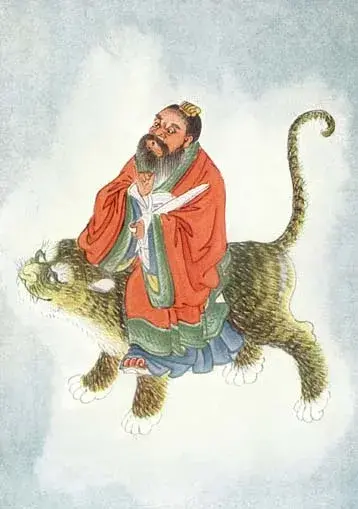
张道陵
Zhang Daoling (张道陵, 34–156), originally named Zhang Ling (张陵) and courtesy name Fuhan (辅汉), was a native of Feng County in Pei State (present-day Feng County, Jiangsu Province) and the preeminent religious scholar and founder of institutional Taoism, universally revered by Daoist traditions as the Ancestral Celestial Master. In his early years, Zhang studied the Confucian Five Classics and prophetic apocrypha at the Imperial…
Zhang Daoling (张道陵, 34–156), originally named Zhang Ling (张陵) and courtesy name Fuhan (辅汉), was a native of Feng County in Pei State (present-day Feng County, Jiangsu Province) and the preeminent religious scholar and founder of institutional Taoism, universally revered by Daoist traditions as the Ancestral Celestial Master. In his early years, Zhang studied the Confucian Five Classics and prophetic apocrypha at the Imperial Academy in Luoyang and served briefly as Magistrate of Jiangzhou in Ba Commandery. Disillusioned with official bureaucracy and realizing that worldly scholarship could not resolve mortality, he resigned to pursue Huang-Lao cultivation in the Beimang Mountains near Luoyang, repeatedly declining imperial summons from Emperors Zhang and He. After traveling through the Huai River and Mount Longhu in Jiangxi to refine external elixirs, he led his disciples into Sichuan during the reign of Emperor Shun. In 142, on Mount Heming (Dazu), Zhang proclaimed divine revelation from Taishang Laojun (Lord Lao the Most High), establishing the Way of the Orthodox Unity and Covenant Authority (popularly known as the Way of the Five Pecks of Rice). He elevated Laozi as supreme religious patriarch and authored the foundational Laozi Xiang'er Zhu, establishing an organized religion that integrated personal spiritual self-cultivation, faith healing, ethical confessions, and communal charity across the Twenty-Four Dioceses in Sichuan.
Born in Feng County of Pei State, traditionally recognized as an eighth-generation descendant of Marquis Zhang Liang.
Recommended for imperial service and appointed Magistrate of Jiangzhou in Ba Commandery, resigning shortly after out of weariness with worldly affairs.
Withdrew to the Beimang Mountains north of Luoyang to practice longevity techniques, rejecting imperial court invitations.
Declined imperial summons to serve as Grand Tutor, traveling southward to Mount Yunjin (Mount Longhu) in Jiangxi to cultivate alchemy.
Accompanied by disciples Wang Chang and Zhao Sheng, entered Sichuan and established a permanent residence at Mount Heming.
Declared divine covenant on Mount Heming, establishing the Way of the Orthodox Unity and assuming the title of Celestial Master.
Passed away in Sichuan at the age of one hundred and twenty-three, transmitting the patriarchal authority and regalia to his son Zhang Heng.
Zhang Daoling, originally named Zhang Ling, was born in the tenth year of the Jianwu reign (34) in Feng County of Pei State. Ancient historical accounts state that he was an eighth-generation descendant of Zhang Liang, the Marquis of Liu and foundational strategist of the Western Han dynasty. From childhood, Zhang exhibited exceptional intellectual capacity and retentive memory, enrolling in the Imperial Academy in the imperial capital of Luoyang during his youth. At the academy, he mastered the Confucian Five Classics—the Classic of Poetry, Book of Documents, Book of Rites, I Ching, and Spring and Autumn Annals—while thoroughly studying the astrological treatises and apocryphal prophetic texts prevalent during the Eastern Han period, earning wide respect among fellow scholars.
During the early Yongping reign of Emperor Ming, Zhang was recommended under the system of Worthy and Upright Candidates and appointed Magistrate of Jiangzhou in Ba Commandery (modern Chongqing). Although he discharged his official responsibilities with legal integrity, he grew deeply troubled by escalating court corruption involving imperial in-laws and eunuchs. Recognizing that bureaucratic success and Confucian commentaries failed to resolve existential anxieties regarding sickness, suffering, and mortality, he decisively resigned his magistracy. Returning north, he secluded himself in the Beimang Mountains north of Luoyang, living as a hermit to pursue ancient Huang-Lao philosophies and respiratory cultivation. When Emperor Zhang and Emperor He issued successive imperial edicts summoning him to serve as Grand Tutor and enfeoffing him as Marquis of Ji County, Zhang declined all honors on grounds of ill health.
Determined to unlock secrets of physical longevity and spiritual enlightenment, Zhang departed northern China with his principal disciples Wang Chang and Zhao Sheng to travel across famous mountains and river basins. He first wandered along the Huai River valley, residing on Mount Tongbai and Mount Taiping, where he gathered medicinal herbs and studied natural cosmic rhythms.
As political instability spread across central China, Zhang crossed the Yangtze River and settled on Mount Yunjin in Guixi County, Jiangxi. Impressed by the tranquil isolation, lush peaks, and crystalline waters of Mount Yunjin, Zhang constructed a thatched hermitage and built an alchemical furnace. He studied the chemical and medicinal properties of minerals and herbs, experimenting with alchemical elixirs alongside interior meditation. According to religious tradition, after three years of continuous cultivation, divine elixirs were completed, accompanied by the auspicious appearance of a dragon and a tiger hovering above the peak. Consequently, the mountain was renamed Mount Longhu (Dragon-Tiger Mountain), which became one of the foremost patriarchal sanctuaries in Daoist sacred geography.
During the reign of Emperor Shun of the Eastern Han, Zhang recognized that southwestern Sichuan possessed temperate climates, secluded mountains, and an honest populace receptive to moral instruction. Furthermore, the marshy climate of the Sichuan basin fostered rampant pestilence and fevers, leaving common people impoverished and vulnerable to predatory shamans. In search of an ideal sanctuary to organize a therapeutic community, Zhang moved into Sichuan, residing temporarily on Mount Yangping, Mount Xicheng, and Mount Qingcheng before establishing his permanent headquarters on Mount Heming in Dayi County.
In the first month of 142 (the first year of the Han'an reign), Zhang proclaimed that Lord Lao the Most High had descended upon Mount Heming to transmit the Covenant Authority of Orthodox Unity and bestow the sacred title of Celestial Master. Drawing upon the Laozi, he composed the Laozi Xiang'er Zhu, formulating a comprehensive religious theology centered on preserving primordial essence, moral self-restraint, and attaining longevity. He organized the converts into Twenty-Four Dioceses, establishing an administrative and pastoral network that combined therapeutic herbal treatments with moral confession. He instituted communal charity lodges to distribute food and water to travelers and displaced refugees. Within a short period, tens of thousands of households embraced his teachings, creating the first mass institutional religious movement in Chinese history.
In 156 (the second year of the Yongshou reign), having established theological treatises, communal covenants, liturgical systems, and administrative institutions, Zhang completed his earthly mission. Religious annals record that in the autumn of that year, he ascended into transcendence from Mount Yuntai or Mount Qingcheng at the age of one hundred and twenty-three. Before departing, he bestowed his classical scriptures, sacred seals, and male-female swords upon his son Zhang Heng, designating him as the Second Celestial Master (the Successor Master) and establishing hereditary succession for the Celestial Master lineage within the Zhang clan.
Following Zhang Heng, his grandson Zhang Lu (the Lineage Master) governed Hanzhong for nearly three decades as an autonomous theocratic society during the Three Kingdoms era, integrating religious codes with regional administration. During the Western Jin dynasty, the fourth-generation descendant Zhang Sheng returned the patriarchal seat to Mount Longhu in Jiangxi. Across successive dynasties—including the Tang, Song, Yuan, Ming, and Qing—imperial courts bestowed sublime titles upon Zhang Daoling, including Grand Tutor, Master of Three Heavens Assisting Teachings, and True Lord of Orthodox Unity. The Celestial Master Mansion on Mount Longhu has maintained its continuous hereditary succession for over eighteen centuries, enduring as a central foundation of indigenous Chinese religious heritage.
Prior to Zhang Daoling, Daoist thought existed primarily as philosophical discourses originating from Laozi and Zhuangzi, or as unorganized practices cultivated by solitary hermits, alchemists, and court diviners. In 142, on Mount Heming, Zhang formally established the Way of the Orthodox Unity and Covenant Authority (Zhengyi Mengwei Dao), marking the birth of institutional Taoism in China.
Zhang achieved three historical innovations: first, he deified Laozi into Taishang Laojun (Lord Lao the Most High), transforming a classical philosopher into the supreme anthropomorphic personification of the Dao and establishing a unified cosmic theology; second, he instituted the office of the Celestial Master as the supreme spiritual authority mediating between cosmic deities and humanity, sanctifying the legitimacy of the religious community; third, he formulated systematic liturgical rituals, scriptural registers, and ethical commandments. Converts were designated as Daoist citizens, unifying scattered folk beliefs into a cohesive, ethical religious community.
To organize tens of thousands of converts scattered across Sichuan, Zhang established the Twenty-Four Dioceses (Ershisi Zhi), representing a systematic model of decentralized religious administration. Divided into Upper Eight, Middle Eight, and Lower Eight Dioceses, these centers radiated from Mount Heming across the Sichuan Basin and neighboring mountainous borders.
Within each diocese, Zhang created a structured administrative hierarchy. The chief director was titled Libationer (Jijiu), responsible for leading scriptural recitations, managing local registers of households, and resolving civil disputes. Below the Libationers were Demon Soldiers (Guizu), recruited from novice initiates to handle surveillance, defense, and communal labor, while senior members of high virtue served as moral overseers. This diocesan infrastructure enabled the Daoist community to maintain self-governing local order amid the collapse of central imperial authority during the late Eastern Han dynasty, establishing the organizational foundation that later allowed Zhang Lu to govern Hanzhong as a successful theocratic entity.
The Laozi Xiang'er Zhu, traditionally attributed to Zhang Daoling, is the earliest surviving commentary that systematically transformed the philosophical Daodejing into a theological and liturgical manual for institutional Taoism.
The commentary developed three core doctrinal dimensions: first, the deification of the Dao, declaring that the Dao disperses as cosmic qi and coagulates into the form of Taishang Laojun, establishing the absolute supremacy of the cosmic Dao; second, the moralization of longevity, rejecting purely physiological or chemical alchemy by insisting that spiritual immortality requires strict adherence to ethical commandments—refraining from greed, arrogance, malice, and conflict—to preserve primordial essence; third, a political theology of benevolent governance, proclaiming that rulers must cultivate the Dao through peace, compassion, and non-violence. By condemning aggressive warfare and oppressive taxation, the commentary infused the movement with deep humanitarian compassion.
The swift expansion of the Celestial Masters was driven by practical medical services and communal social welfare initiatives tailored to vulnerable populations. Confronting widespread epidemics in damp mountainous regions, Zhang provided healing through herbal remedies, sacred water, and prayers.
Significantly, Zhang integrated physical healing with psychological and moral confession. Sick individuals were secluded in quiet chambers to reflect upon their ethical transgressions, recording their life sins in three written petitions known as Memorials to the Three Officials. One memorial was burned on a mountain summit for the Heavenly Official, one buried underground for the Earthly Official, and one submerged in flowing water for the Water Official, accompanied by solemn vows never to commit offenses again. This practice alleviated psychological distress while functioning as an effective mechanism of communal self-discipline. Additionally, Zhang constructed Charity Lodges (Yishe) along transport arteries, stocking them with free grain and meat for traveling refugees, with the stipulation that individuals should take only what was necessary for immediate nourishment. This communal welfare institution provided relief for displaced populations during late Han warfare.
Beyond his spiritual authority, Zhang was celebrated in Sichuan folk history as an agricultural and industrial benefactor who improved local economic livelihoods. Located in an inland basin far from coastal salt pans, Sichuan communities relied heavily on accessible salt for basic survival.
During his travels around Mount Heming and Mount Tiantai, Zhang surveyed local topography and geological brine seepages, teaching local residents how to dig deep wells, extract subterranean saline brine, and construct furnaces to boil brine into edible salt. The initial salt well established under his direction in modern Renshou County was revered by subsequent generations as the Ling Well (Lingjing). The expansion of brine well salt industries alleviated regional salt shortages and stimulated local commerce, grounding Zhang's religious authority in tangible secular benefits for the populace.
FIGURES ASSOCIATED WITH THIS DYNASTY