Life and Career
Penal Branding and the Hero of Julu
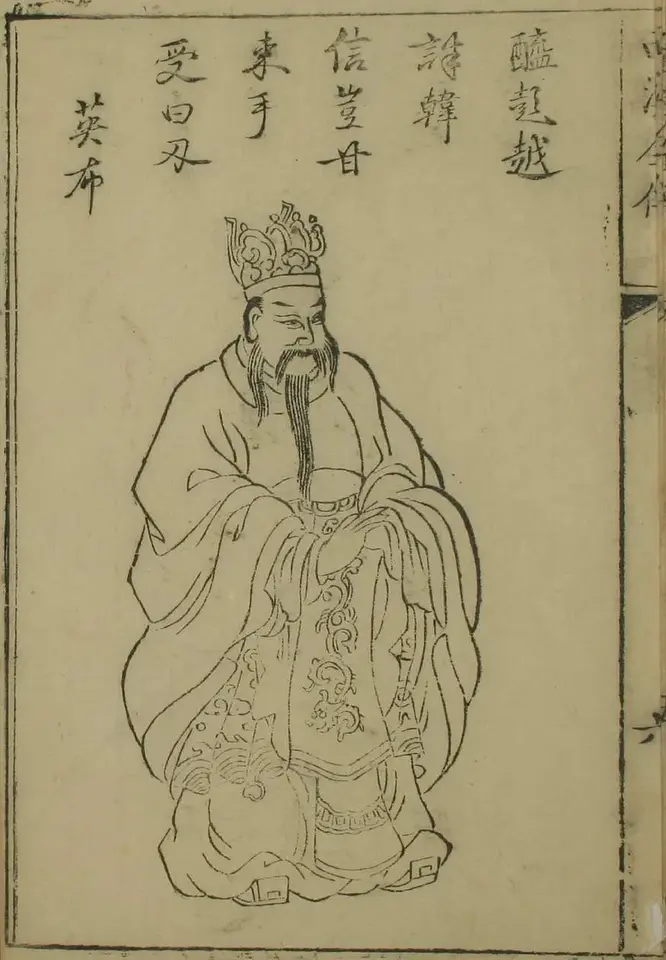
Ying Bu was born during the late Warring States era in Lu County, Jiujiang Commandery. In early youth, a physiognomist predicted: "You shall suffer penal mutilation and thereafter become a king." Reaching adulthood, he violated Qin laws and was sentenced to facial tattooing (qing), earning the popular moniker "Qing Bu." Far from being ashamed, he laughed: "The seer proclaimed I should be king after suffering punishment; my branding confirms my noble destiny!"
Conscripted alongside hundreds of thousands of convicts to labor on the First Emperor tomb at Mount Li, Ying Bu forged close ties among fugitive leaders. When Chen Sheng and Wu Guang launched their insurrection in 209 BC, Ying Bu organized an escape, leading dozens of convicts into the watery reed beds of the Yangtze to form a guerrilla force that rapidly swelled to several thousand. Hearing of the southern rising of Xiang Liang, Ying Bu pledged allegiance. Xiang Liang recognized his peerless combat valor, placing him at the forefront of every assault.
In 207 BC, Qin general Zhang Han and General Wang Li besieged the allied insurgent citadel of Julu with three hundred thousand imperial shock troops. As allied commanders looked on passively in terror, Xiang Yu appointed Ying Bu and General Pu to lead twenty thousand elite warriors across the Zhang River. Ying Bu spearheaded furious assaults against Qin supply lines, winning nine consecutive engagements without pause. He routed Wang Li elite corps, capturing Wang alive. The victory at Julu broke the spine of the Qin military and elevated Ying Bu to imperial fame. Upon the fall of Qin, Xiang Yu partitioned the realm among eighteen feudatory kings, granting Ying Bu the crown of King of Jiujiang with his capital at Lu County.
Sui He Diplomacy and Alignment with Liu Bang
Following his ascension as Hegemon-King, Xiang Yu grew increasingly paranoid and tyrannical. During the Battle of Pengcheng in 205 BC, when Liu Bang attacked Western Chu, Ying Bu feigned illness and sent only a token cavalry detachment to support Xiang Yu. Xiang Yu dispatched envoys repeatedly to reprimand him, widening the breach between monarch and feudatory.
In 204 BC, while besieged by Chu armies at Xingyang, Liu Bang dispatched his confidential envoy Sui He to negotiate Ying Bu defection. Meeting Ying Bu secretly in his palace, Sui He delivered an incisive analysis of the geopolitical landscape, demonstrating that Chu collapse was inevitable and that Liu Bang offered hereditary security. While negotiations were underway, an imperial envoy from Xiang Yu arrived demanding immediate troop deployments. Sui He boldly burst into the hall, declaring: "The King of Jiujiang has surrendered to Han; why does Chu still demand troops?" Realizing his hand had been forced, Ying Bu executed the Chu envoy and mobilized against Xiang Yu.
Xiang Yu dispatched veteran general Long Ju with one hundred thousand troops to assault Jiujiang. Ying Bu resisted tenaciously for months, but overwhelmed by numbers, fled across the lines to Liu Bang headquarters. Liu Bang received Ying Bu with royal ceremonies, confirmed him as King of Huainan, and supplied him with funds and troops to rally his former officers. Operating in the enemy rear, Ying Bu tied down substantial Chu divisions, altering the strategic balance in Liu Bang favor.
Triumph at Gaixia and Tragic Ruin at Fanyang
In 202 BC, the war reached its climax. Ying Bu coordinated his Huainan divisions with Grand Marshal Han Xin and King Peng Yue of Liang, enveloping Xiang Yu exhausted army at Gaixia. Ying Bu troops severed Chu communication lines, driving Xiang Yu to suicide at the Wu River. Ascending the imperial throne, Emperor Gaozu confirmed Ying Bu as King of Huainan, governing four affluent southern commanderies from his capital at Lu County.
However, Liu Bang and Empress Lu viewed autonomous feudatory monarchs with profound suspicion. Han Xin was demoted and murdered in Weiyang Palace in 196 BC; soon afterward, Peng Yue was falsely accused of treason, executed, and his flesh salted and distributed to the feudatories. Receiving the salted remains of Peng Yue, Ying Bu was gripped by terror, recognizing that the liquidation of the remaining feudatories was imminent. He ordered the fortification of Huainan fortresses and collected stockpiles.
In the summer of 196 BC, a subordinate accused Ying Bu of treason, forcing him into preemptive rebellion. Ying Bu fought with veteran ferocity, defeating early imperial columns. Emperor Gaozu, though ill, took personal command of the grand army. Confronting Ying Bu at Qixi, Gaozu observed that Ying Bu battle lines were drawn up in the formidable style of Xiang Yu. Gaozu shouted across the lines: "Why have you rebelled?" Ying Bu retorted proudly: "I simply wish to be Emperor myself!" A furious battle ensued; outflanked by imperial cavalry, Ying Bu lines collapsed.
Wounded, Ying Bu fled across the Yangtze with a hundred riders, intending to take refuge with his brother-in-law Wu Chen, King of Changsha. Unwilling to defy the imperial throne, Wu Chen feigned assistance, luring Ying Bu into a farmhouse in Fanyang where assassins struck him down. With Ying Bu death, the Huainan feudatory was dissolved, concluding the era of powerful non-dynastic kings in the early Han.