Birth into Eminent Clan
Born in Yinyin County, Yingchuan Commandery, as the sixth son of the distinguished magistrate Xun Shu.
荀爽
Xun Shuang (荀爽, 128–190 CE), courtesy name Ciming (慈明), also known as Xu (谞), a native of Yinyin in Yingchuan Commandery, was a prominent statesman and classical scholar of the late Eastern Han dynasty. Descended from the Warring States philosopher Xunzi across twelve generations, he was the sixth son of the revered magistrate Xun Shu. The eight brothers of his generation were universally acclaimed for their virtue and…
Xun Shuang (荀爽, 128–190 CE), courtesy name Ciming (慈明), also known as Xu (谞), a native of Yinyin in Yingchuan Commandery, was a prominent statesman and classical scholar of the late Eastern Han dynasty. Descended from the Warring States philosopher Xunzi across twelve generations, he was the sixth son of the revered magistrate Xun Shu. The eight brothers of his generation were universally acclaimed for their virtue and erudition, collectively known as the Eight Dragons of the Xun Clan, with contemporaries declaring that among them, Ciming was peerless. Master of the Spring and Autumn Annals and the Analects by age twelve, he earned the admiration of Grand Commandant Du Qiao, who proclaimed him fit to be a teacher of men. In 166 CE, Xun was nominated as Utmost Filial and appointed Gentleman. In response to imperial policy inquiries, he submitted a memorial urging the observance of three-year mourning, the rectification of gender hierarchies, fiscal austerity, and the reduction of taxes, resigning immediately after submitting the document. When the Disaster of the Partisan Prohibitions erupted, he went into hiding on the seacoast and later along the Han River for over a decade, authoring extensive commentaries that established his reputation as a great master. Following the lifting of prohibitions, he consistently declined official summonses. In 189 CE, warlord Dong Zhuo forcibly conscripted him into court service, promoting him from commoner to Chancellor of Pingyuan, Minister of the Household, and finally Excellency of Works within ninety-three days. Navigating the perilous court, Xun discreetly deflected Dong Zhuo's wrath during the council on relocating the capital to Chang'an, saving the lives of Yang Biao and Huang Wan. After arriving in Chang'an, he actively allied with Minister over the Masses Wang Yun and Chief Clerk He Yong to plot the overthrow of Dong Zhuo, but died of illness in 190 CE at the age of sixty-three before the coup could be executed. In scholarship, Xun was an authority on the Old Text Fei tradition of the Book of Changes, pioneering the doctrine of Qian ascending and Kun descending, leaving behind over one hundred scrolls that profoundly shaped Han and Wei classical learning.
Born in Yinyin County, Yingchuan Commandery, as the sixth son of the distinguished magistrate Xun Shu.
Mastered the Spring and Autumn Annals and the Analects at age twelve; Grand Commandant Du Qiao praised him as fit to teach men.
Recommended as Utmost Filial and appointed Gentleman; submitted a critical memorial on filial rites and state finances, resigning immediately.
Fled to the coast and the Han River basin during the Partisan Prohibitions, dedicating more than ten years to scholarly writing.
Partisan bans were lifted following the Yellow Turban Rebellion; five chief ministries offered posts, but he declined all appointments.
Observed three years of mourning for his early patron Yuan Feng; observed filial mourning for the deceased local leader Chen Shi.
Emperor Ling issued a special decree appointing fourteen eminent recluses including Xun Shuang as Erudites, which he declined due to illness.
Conscripted by Dong Zhuo as Chancellor of Pingyuan, promoted to Minister of the Household, and appointed Excellency of Works within ninety-three days.
Deflected Dong Zhuo's rage to protect loyalists during capital relocation debates; plotted against Dong Zhuo with Wang Yun in Chang'an; died of illness in May.
His nephew Xun Yu arranged for his remains to be escorted back to Yingchuan, interring him beside his comrade He Yong.
Xun Shuang was born into the celebrated Yingchuan Xun lineage, tracing his ancestry back twelve generations to the prominent Warring States thinker Xun Kuang. His father, Xun Shu, courtesy name Jihe, was renowned for moral purity and erudition, serving as Magistrate of Langling where his benevolent rule earned him the honorific title of Divine Sovereign among the populace. Xun Shu reared eight sons: Xun Jian, Xun Gun, Xun Jing, Xun Tao, Xun Wang, Xun Shuang, Xun Su, and Xun Fu. All eight achieved distinguished renown for virtue and talent, leading contemporaries to celebrate them as the Eight Dragons of the Xun Clan.
The Xun family resided in Xihao Lane within Yinyin County. When magistrate Yuan Kang of Bohai assumed office, he was so impressed by the eight accomplished brothers that he compared them to the eight talented sons of the ancient ruler Gaoyang, renaming the community Gaoyang Lane in their honor. Among these gifted brothers, Xun Shuang stood out for his intellectual brilliance.
From boyhood, Xun was intensely dedicated to canonical study. At the age of twelve, he had already mastered the core principles of the Spring and Autumn Annals and the Analects. When Grand Commandant Du Qiao inspected the commandery and conversed with the youth, he remarked with admiration that Xun Shuang was already qualified to serve as a teacher of men. Following Du Qiao's commendation, Xun Shuang deepened his contemplative studies, withdrawing from superficial social functions and refusing gifts or congratulatory gatherings. The people of Yingchuan coined the saying: "Among the Eight Dragons of the Xun Clan, Ciming is peerless."
In his youth, Xun engaged in frequent intellectual dialogues with his elder brothers and contemporary scholars. Critic Xu Shao compared Xun Shuang and his third brother Xun Jing to fine jade, remarking that Ciming shone with radiant intellect while Shuci possessed deep internal moistness. During a meeting with Runan notable Yuan Lang, when asked to name the prominent men of the region, Xun began by listing his own brothers. Yuan Lang smiled and asked if one could properly count relatives as eminent figures, to which Xun replied that ancient minister Qi Xi had recommended his own son without prejudice, King Wen and King Wu were praised by the Duke of Zhou, and the Spring and Autumn Annals prioritized one's own domain. Yuan Lang yielded to his persuasive logic.
In 166 CE, during the reign of Emperor Huan, Minister of Ceremonies Zhao Dian nominated Xun Shuang as Utmost Filial, leading to his court appointment as a Gentleman. At the time, imperial governance was severely compromised by palace eunuchs and imperial in-laws, resulting in systemic corruption and financial distress. Summoned to provide advice on imperial policy, Xun declined to offer sycophantic praise, instead drafting a direct and comprehensive critique of administrative decay.
In his memorial, Xun asserted that filial piety formed the bedrock of statecraft, urging the court to restore ancient norms by requiring rulers to complete three-year mourning for parents. Drawing upon the balance of Yin and Yang in the Book of Changes, he argued that domestic and political hierarchies were inverted when imperial consorts and palace attendants meddled in governance. He observed that extravagant endowments for imperial princesses and court favorites depleted public treasuries while ordinary families starved.
To resolve the fiscal emergency, Xun proposed a program of curtailing expenditures, filling state granaries, easing conscription, and comforting commoners. He demanded an immediate cessation of palace luxury projects, calling on Emperor Huan to eliminate wasteful construction and alleviate tax burdens across the eastern commanderies.
Recognizing that his outspoken remonstrance would provoke fierce retaliation from powerful eunuchs, Xun removed his official seals on the very day of submission and departed from the capital, returning to his private estate. His decisive retreat earned immense respect among upright literati who admired his integrity and foresight.
Shortly after Xun Shuang's departure from court, the Eastern Han regime launched the devastating Partisan Prohibitions, arresting, executing, or permanently barring reform-minded scholars from public service. Although Xun held no office, his vast prestige and associations with leaders like Li Ying and Du Mi made him a prime target for imperial arrest warrants.
To evade custody and safeguard his intellectual enterprise, Xun fled his ancestral home. He first sought refuge on the remote eastern seacoast, and as imperial surveillance expanded, relocated south into the secluded valleys along the Han River. For more than ten years, he lived under assumed identities in modest cottages, dedicating every waking hour to classical commentary.
During his years in hiding, Xun authored foundational commentaries on the Book of Changes, the Book of Songs, the Book of Documents, and pre-Qin rituals, analyzing the rise and fall of historical regimes. Scholars throughout the empire praised his unbending commitment to principle, venerating him as the Great Master of the realm.
When the Yellow Turban Rebellion erupted in 184 CE, threatening the survival of the dynasty, Emperor Ling was persuaded to lift the Partisan Prohibitions. Following the amnesty, high ministers across the five chief governmental departments vied to recruit Xun, and Excellency of Works Yuan Feng nominated him as Possessor of the Way. Knowing that the imperial house was beyond redemption, Xun declined every offer. When Wang Yun was appointed Inspector of Yuzhou, he dispatched messengers to recruit Xun before even dismounting from his carriage, but Xun remained in retirement.
Later, upon the passing of his former patron Yuan Feng, Xun demonstrated his deep gratitude by observing three full years of filial mourning, establishing a moral precedent that many contemporary literati emulated. When venerated local magistrate Chen Shi died, attracting thousands of carriages from across the realm, Xun donned coarse mourning dress and observed rites as an adopted son alongside Han Rong, solidifying his stature as a paragon of ritual decorum.
During his quiet years, Xun maintained deep friendships with prominent scholars including Li Xie, Zhang Wen, Jia Biao, and Zhao Yao. While serving as Administrator of Yingchuan, Zhang Wen frequently debated the merits of various personalities with Xun and Jia Biao, generating widespread commentary in the capital. When Zhang Wen asked Zhao Yao about Li Xie's opinions, Zhao replied that Li remained silent. Zhang Wen sighed with enlightenment, observing that while they produced empty noise, Li embodied true depth, a realization that prompted Xun to further practice quietude and avoid frivolous critiques.
In 188 CE, Emperor Ling issued a special decree summoning fourteen eminent scholars, including Xun Shuang, Zheng Xuan, Chen Ji, and Han Rong, to serve as court Erudites, but Xun declined citing ill health. General-in-Chief He Jin subsequently drafted him as Attendant Officer and recommended him for Imperial Attendant, but He Jin's assassination in 189 CE voided the appointment.
In September 189 CE, warlord Dong Zhuo seized control of Luoyang, deposed Emperor Shao, and placed Emperor Xian on the throne. Seeking to legitimize his authoritarian regime and mollify the gentry of the eastern provinces, Dong Zhuo adopted the counsel of Zhou Bi and Wu Qiong, issuing mandatory summonses for esteemed recluses such as Xun Shuang, Han Rong, and Chen Ji.
Loathing Dong Zhuo's tyranny, Xun attempted to escape, but imperial guards closely monitored all thoroughfares, forcing him to accept the post of Chancellor of Pingyuan. While traveling toward his commandery, imperial couriers intercepted him at Wanling, delivering a promotion to Minister of the Household.
After serving only three days in the ministry at Luoyang, Dong Zhuo issued another decree in December, elevating Xun to Excellency of Works, one of the supreme Three Excellencies. From the initial imperial summons as a commoner to occupying the pinnacle of administrative authority, only ninety-three days had elapsed.
Such an astonishing promotion within three months was virtually unprecedented in Han history. At a time when principled men were executed and others remained silent, Xun's rapid rise under a despised tyrant provoked skepticism among certain commentators who feared he had compromised his honor. In truth, Xun accepted the post solely to leverage his high status to safeguard loyal ministers and conspire against the usurper.
In January 190 CE, coalition armies across the eastern commanderies mobilized under Yuan Shao to overthrow Dong Zhuo. Terrified by the formidable rebel forces, Dong Zhuo determined to burn Luoyang and forcefully relocate the imperial court west to Chang'an, convening a grand assembly of ministers to impose his decision.
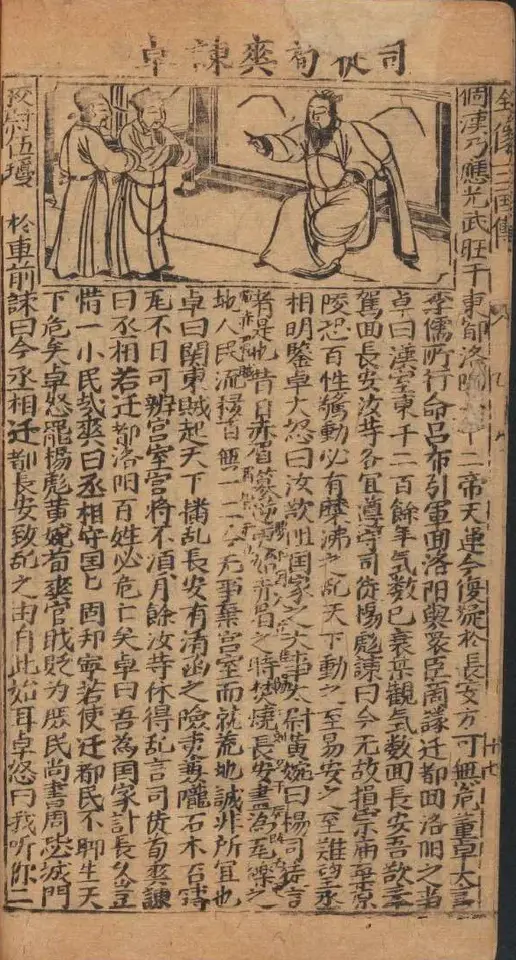
At the conference, Dong Zhuo invoked the apocryphal text Shibaochen to claim that relocating to Chang'an fulfilled celestial prophecy. Minister over the Masses Yang Biao immediately protested, recalling that King Pan Geng's ancient move provoked widespread popular resentment and that Chang'an had been utterly devastated during the Wang Mang era, warning that abandoning ancestral shrines would incite catastrophe and dismissing the prophetic text as fraudulent. Enraged, Dong Zhuo threatened to use military force against anyone who resisted. When Grand Commandant Huang Wan supported Yang Biao's warnings, Dong Zhuo's hand moved toward his sword, putting both ministers in mortal peril.
Recognizing Dong Zhuo's volatility, Xun Shuang stepped forward to intervene with diplomatic tact. Speaking calmly, he observed that the Chancellor took no pleasure in abandoning Luoyang, but that eastern rebels could not be quelled immediately, making a retreat to the defensible passes of Qin and early Han strategic common sense. Appeased by Xun's seemingly compliant assessment of military geography, Dong Zhuo calmed his temper, allowing Yang Biao and Huang Wan to escape execution. Xun's prudent conciliation preserved vital loyalists while preserving his own standing. In February, he accompanied the imperial cortege to Chang'an.
In Chang'an, Dong Zhuo's brutality intensified, as his troops plundered the aristocracy and executed innocents. Realizing that the dynasty faced destruction, Xun utilized the offices of the Excellency of Works to recruit men of martial and strategic talent, preparing an internal uprising.
Xun forged a secret alliance with Minister over the Masses Wang Yun and Dong Zhuo's Chief Clerk He Yong, coordinating plans to deploy palace guards to assassinate the dictator. However, years of hardship in exile followed by intense psychological strain shattered Xun's frail health. In May 190 CE, before the plot could be launched, he succumbed to illness in Chang'an at the age of sixty-three.
Although Xun died before seeing the dictator fall, his co-conspirator Wang Yun ultimately executed Dong Zhuo two years later. In 196 CE, when Cao Cao restored the Han court at Xu, Xun Shuang's nephew Xun Yu, serving as Prefect of the Masters of Writing, dispatched an official mission to Chang'an to bring Xun Shuang's casket back to Yingchuan, interring him beside his loyal comrade He Yong.
Xun Shuang stands as a preeminent figure in Chinese classical studies, recognized for establishing an influential Old Text interpretation of the Book of Changes. Building upon the Fei tradition and incorporating Han observational astronomy, he created the distinctive Xun Family Yijing framework.
At the core of his system lay the doctrine that the creative Yang energy of the Qian hexagram must ascend from below, while the receptive Yin energy of the Kun hexagram must descend from above. When celestial and terrestrial energies circulate and interact, harmony prevails across all living things. Conversely, when Yin occupies superior positions and suppresses Yang below, political and natural disorders inevitably ensue.
Xun used this dynamic framework to compose his Commentary on the Changes and Explanations of the Changes, interpreting the sixty-four hexagrams through internal nuclear trigrams, line transformations, and directional alignments. By linking cosmic patterns with state governance and moral discipline, he elevated classical commentary above vulgar omenology. His interpretations, preserved extensively in Li Dingzuo's Tang compilation Collected Explanations of the Changes, served as a foundational source for Qing evidential scholars such as Hui Dong, Zhang Huiyan, and Ma Guohan.
As a revered ritual master, Xun placed paramount importance on Confucian ceremonial codes to maintain social order and rectify ethical lapses during the twilight of the Eastern Han dynasty.
During the late second century, customary practices had severely deteriorated: men frequently refused to observe formal mourning for deceased wives, mourners entertained callers during parental mourning, and local elites routinely fabricated posthumous honorific titles for deceased patrons and relatives without state authorization. Xun combated these abuses by authoring rigorous treatises grounded in the Book of Rites and Ceremonial Rites, arguing that marriage constituted the foundation of human relations and demanding strict adherence to canonical mourning periods.
Xun practiced the rituals he preached. Following the death of his early benefactor Yuan Feng, he observed three full years of filial mourning, transcending conventional expectations. At the funeral of magistrate Chen Shi, he wore coarse hemp mourning clothes and performed the duties of an adopted son before thousands of assembled scholars, inspiring a widespread return to authentic ritual decorum across the northern provinces.
From the reign of Emperor Guangwu onward, prophetic apocrypha were treated as official state doctrine, leading officials to justify decisions through fabricated heavenly portents. Xun became one of the foremost rationalist critics of this superstitious tradition.
In his treatise Disputing Apocrypha, Xun conducted a rigorous textual and historical examination of omen literature, exposing prophetic writings as fraudulent fabrications crafted by opportunistic diviners. Continuing the intellectual lineage of earlier critics like Huan Tan and Zhang Heng, he petitioned the throne to confiscate and prohibit omen books, urging scholars to return to the verifiable wisdom of the Six Classics.
Politically, Xun championed the classical Mencian concept of governance for the people. He maintained that moral duty and administrative order derived from natural familial relationships: from husband and wife arose father and son, followed by sovereign and minister, and finally ritual propriety. Throughout his career, he vigorously opposed the monopolization of court power by eunuchs and in-laws, advocating low taxation and the preservation of civilian peace.
Xun's intellectual output was extraordinarily broad, encompassing commentaries across the Book of Songs, the Book of Documents, the Book of Rites, and the Spring and Autumn Annals.
According to historical records, he compiled foundational works including the Commentary on Rites, Commentary on the Changes, Traditions of the Songs, Correct Text of the Documents, and Regulations of the Spring and Autumn. To provide practical historical lessons on dynastic governance, he compiled the Historical Discourses of Han, analyzing the political successes and failures of the Western and Eastern Han dynasties. Furthermore, he composed Questions on the Gongyang to resolve disputes between Old Text and New Text traditions, collecting over one hundred essays into his New Book.
His synthetic approach bridged textual philology with philosophical statecraft, profoundly influencing his nephews Xun Yu and Xun You, who became master strategists of the Three Kingdoms era. Prior to the founding of the Cao Wei dynasty, Emperor Wen posthumously honored Xun Shuang as the foremost among twenty-four celebrated historical sages, confirming his lasting intellectual stature.
FIGURES ASSOCIATED WITH THIS DYNASTY