Birth | Born in Yuancheng County, Daming Prefecture, Northern Zhili
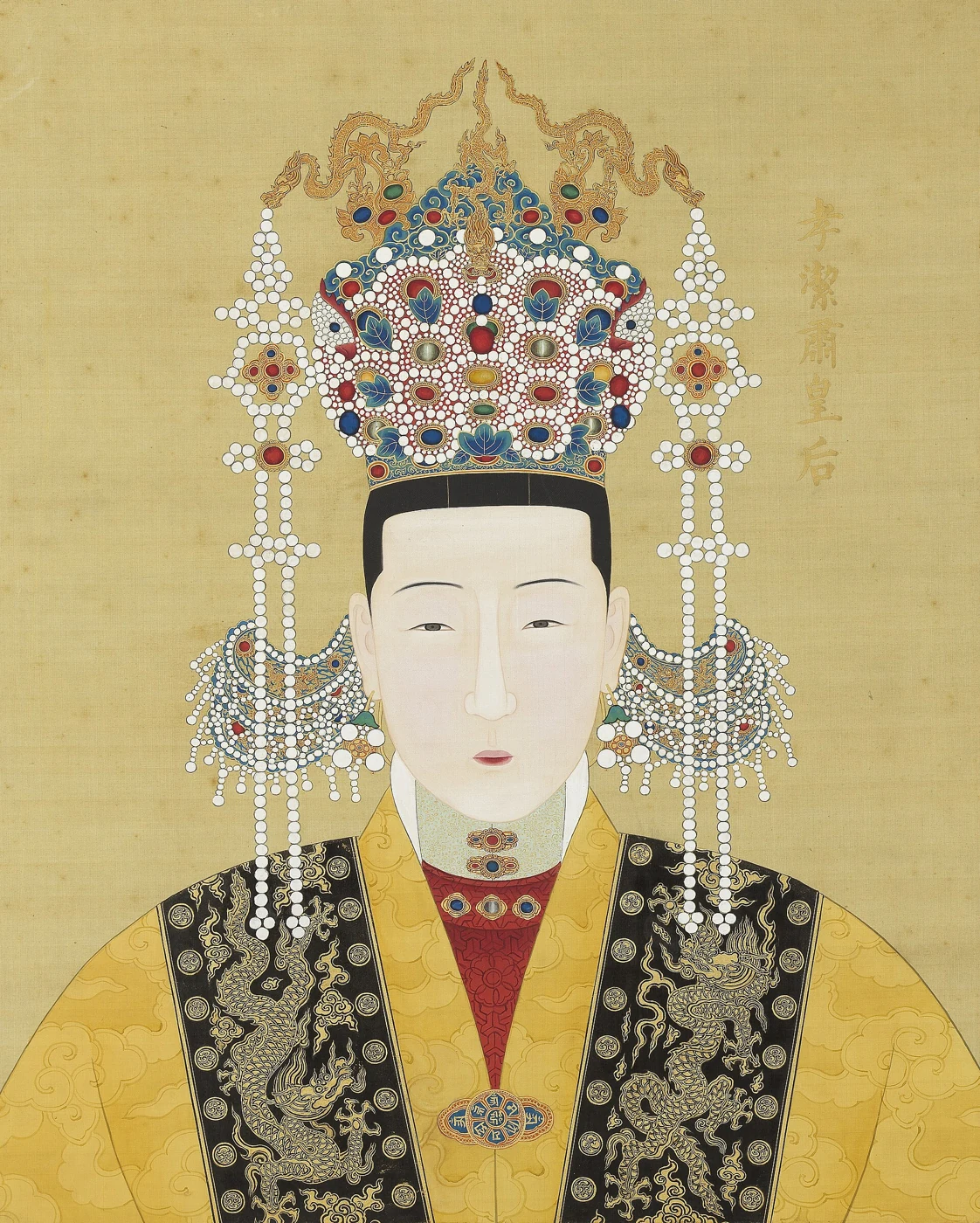
1508 CE–1528 CE
Empress
Empress Chen (Jiajing Emperor)
陈氏(孝洁皇后)
Empress Chen (1508–1528), posthumously known as Empress Xiaojiesu, was a native of Yuancheng County in Daming Prefecture, Northern Zhili, in present-day Daming County, Hebei. She was the first empress of Zhu Houcong, the Jiajing Emperor. Her father Chen Wanyan was a local licentiate and was later enfeoffed as Earl of Taihe because of his daughter's status. Lady Chen entered the palace through imperial selection in 1522, the…
1508 CE–1528 CEMing Dynasty
PROFILE
Empress Chen (1508–1528), posthumously known as Empress Xiaojiesu, was a native of Yuancheng County in Daming Prefecture, Northern Zhili, in present-day Daming County, Hebei. She was the first empress of Zhu Houcong, the Jiajing Emperor. Her father Chen Wanyan was a local licentiate and was later enfeoffed as Earl of Taihe because of his daughter's status. Lady Chen entered the palace through imperial selection in 1522, the first year of the Jiajing era, and was installed as empress in the ninth lunar month. In 1528, the seventh year of Jiajing, she angered the emperor and, according to the source, suffered a miscarriage after becoming frightened; she died on the second day of the tenth lunar month at only twenty-one years of age. She was first given the posthumous title Empress Daoling, which was changed to Empress Xiaojie in 1536. In 1567, the first year of the Longqing era, her full posthumous title was enlarged to Empress Xiaojie Gongyi Cirui Anzhuang Xiangtian Yisheng Su. She was reburied at Yongling and enshrined in the imperial ancestral temple.
- Alternate names
- Empress Chen Xiaojie; Empress Chen of the Jiajing reign
- Period
- Ming
- Date of Birth
- 1508
- Date of Death
- 1528
- Dynasty / polity
- Ming
- Identity
- Empress
- Ethnicity / ethnic affiliation
- Not recorded in historical sources
- Ancestral home
- Yuancheng County, Daming Prefecture, Northern Zhili (present-day Daming County, Hebei)
- Place of birth
- Not recorded in historical sources
- Tenure as empress
- Not recorded in historical sources
- Posthumous name
- Not recorded in historical sources
- Major achievements
- First empress of Zhu Houcong, the Jiajing Emperor; angered the emperor through direct remonstrance and, according to the source, suffered a miscarriage from fright and died
LIFE TIMELINE
Age fifteen | Her father Chen Wanyan was appointed Minister of the Court of State Ceremonial and on the same day promoted to Assistant Commander-in-Chief of the Central Chief Military Commission
Age fifteen | Duke of Dingguo Xu Guangzuo served as chief envoy and Grand Secretary Yang Tinghe as deputy envoy for the betrothal and name-inquiry rites
Age fifteen | Marquis of Wuding Guo Xun served as chief envoy and Grand Secretaries Jiang Mian and Fei Hong as deputy envoys for the rites of confirmation, presentation of betrothal gifts, and setting of the wedding date
Age fifteen | Duke of Chengguo Zhu Fu served as chief envoy and Grand Secretaries Yang Tinghe and Mao Ji as deputy envoys for the formal bridal escort; Lady Chen was brought into the palace
Age fifteen | Lady Wen, who entered in the same selection, was invested as Consort Gong; Lady Zhang was invested as Consort Shun
Age twenty-one | Her father Chen Wanyan petitioned to have his wife Lady Ji admitted to the palace to visit the ill empress; the emperor refused
Age twenty-one | Empress Chen died
— | Invested posthumously as Empress Daoling
— | Buried at Ao'eryu in the Tianshou Mountains
— | Construction of Empress Daoling's tomb completed
— | Minister of the Ministry of Rites Xia Yan requested a change of posthumous title; on the twenty-ninth day the title was changed to Empress Xiaojie
— | Her spirit tablet was moved to the western chamber of Fengxian Hall
— | Received the full posthumous title Empress Xiaojie Gongyi Cirui Anzhuang Xiangtian Yisheng Su, was reburied at Yongling, and was enshrined in the imperial ancestral temple
BIOGRAPHY
Biography
Family Background and Early Years
Lady Chen was born in 1508, the first year of the Hongzhi era, in Yuancheng County, Daming Prefecture, Northern Zhili. Her grandfather Chen Zhi had served as a county magistrate and was posthumously granted the rank of Assistant Commander-in-Chief. Her father Chen Wanyan was a stipendiary student in the county school and was later enfeoffed as Earl of Taihe because of his daughter's status. Her mother, Lady Ji, was granted the title of Lady. Lady Chen was the eldest daughter in the family. She had a younger brother, Chen Shaozu, and a sister who later married into the family of the Earl of Qingping and died young.
Wang Shizhen's Ming-period Zhouzai records a legendary story about Lady Chen's youth. It says that while playing a coin-tossing game with other girls, she threw four copper coins and all four stood on edge without falling, astonishing her parents. She was later betrothed to Wang Zhengchen, a man from the same county, but he was chronically ill and unable to marry. When the Jiajing Emperor selected a wife, officials from the Directorate of Ceremonial and the Ministry of Rites traveled to Daming Prefecture and at first found no suitable candidate. A palace official reportedly said that a diviner had observed “the qi of an empress” in Daming. Lady Chen then happened to present herself, was carried directly into the central hall, and impressed the selectors. The account continues that a palace official, dressed in ceremonial robes and jade belt, knelt to offer her a basin of water as a test while staying at the government office. Lady Chen washed calmly without alarm and was eventually selected for the central palace. The source identifies this as unofficial anecdote rather than fully reliable history, but notes that it reflects contemporary fatalistic narratives about her rise to the empress's position.
Entering the Palace and Becoming Empress
In 1522, the first year of the Jiajing era, Zhu Houcong had recently taken the throne at age sixteen and needed to select an imperial wife. Lady Chen, described as beautiful, entered the palace through the selection. On the nineteenth day of the eighth lunar month, the emperor appointed Chen Wanyan Minister of the Court of State Ceremonial and on the same day promoted him to Assistant Commander-in-Chief of the Central Chief Military Commission; Lady Ji was granted the title of Lady.
On the eleventh day of the ninth lunar month, the betrothal and name-inquiry rites were conducted, with Duke of Dingguo Xu Guangzuo as chief envoy and Grand Secretary Yang Tinghe as deputy envoy. Chen Wanyan submitted a statement identifying his daughter as the child born to himself and his wife, the great-granddaughter of a posthumously honored Assistant Commander-in-Chief named Yu, the granddaughter of the former county magistrate Chen Zhi, and fifteen years old. On the fifteenth day the confirmation, betrothal-gift, and date-setting rites were carried out, with Marquis of Wuding Guo Xun as chief envoy and Grand Secretaries Jiang Mian and Fei Hong as deputies. On the twenty-eighth day, Duke of Chengguo Zhu Fu served as chief envoy and Grand Secretaries Yang Tinghe and Mao Ji as deputies for the bridal escort, bringing Lady Chen into the palace with the formal investiture documents and seal. The investiture text praised her as a woman whose excellence had arisen in an auspicious household, whose reputation enhanced an honorable clan, who had moved freely among historical and literary texts, cultivated harmony within, and absorbed poetry and books while embodying gentleness and virtue. The source takes this language as evidence that Lady Chen came from a literate family and had received substantial education. On the sixteenth day of the tenth lunar month, Lady Wen and Lady Zhang, who had entered in the same selection, were invested as Consort Gong and Consort Shun respectively.
Lady Chen was fifteen by traditional age when she became empress and head of the six palaces. The Jiajing Emperor, however, was severe in temperament and had already become embroiled in the Great Rites Controversy, creating tense relations with senior officials and an unsettled atmosphere in the inner court. The emperor later recalled that “unruly persons” in the palace had acted arbitrarily around the time of his marriage and continually influenced Empress Dowager Jiang, his biological mother, without her recognizing their motives. The source reads this as suggesting competition among Empress Chen, Consort Zhang, and Consort Wen.
Angering the Emperor and Death
In the spring of 1528, the seventh year of the Jiajing era, the emperor was seated with Empress Chen when Consort Shun Zhang and Consort Wen brought tea. The History of Ming states that the emperor “looked along their hands.” Empress Chen became angry, threw down her cup, and stood up. The emperor flew into a rage. Empress Chen, then pregnant, was frightened and suffered a miscarriage. Her health deteriorated afterward, and she remained seriously ill for several months.
Different sources give different details. The History of Ming says that the emperor looked at the hands of the two consorts and that the empress became angry. In 1536, the fifteenth year of Jiajing, the Korean envoy Kim Gwang-cheol reported to King Jungjong of Joseon that he had met students Zhang Yunni and Wei Chaopin, who in turn had heard from eunuchs that Consort Zhang was favored. According to this version, Empress Chen showed displeasure at a banquet. The emperor ordered her to offer wine; she did so three times and he refused to drink. She then threw the cup, and the emperor ordered her to kneel as punishment before going with Lady Zhang into another room and leaving the empress there until late at night. The empress became physically and emotionally exhausted, fell ill, and soon died. The two accounts differ in detail but both attribute the emperor's anger to Empress Chen's jealousy toward Consort Zhang.
While the empress was gravely ill, the Jiajing Emperor ordered her removed from Kunning Palace and considered deposing her. Yang Yiqing's Miyu Lu records discussions between the emperor, Yang Yiqing, and others. The emperor accused the empress of allowing jealousy to obstruct the imperial succession and of shirking ritual duties at Fengxian Hall. Yang argued that had formal charges been listed earlier, reported to the ancestral temple, and submitted to Empress Dowager Jiang, deposition might have been procedurally possible. But with the empress already close to death, a sudden deposition would not be believed. He proposed following the precedent of Emperor Xuanzong of Ming and Empress Hu: the empress might voluntarily withdraw, reside in another palace while retaining the title of empress, receive an empress's funeral when she died, but not be buried in the ancestral mausoleum. The emperor replied that he had repeatedly asked Empress Dowager Jiang for permission to depose the empress and had always been prevented. Empress Chen thereafter lived in another residence but continued to receive ceremonial treatment appropriate to an empress.
On the twenty-second day of the ninth lunar month in 1528, Chen Wanyan petitioned for his wife Lady Ji to enter the palace and visit the sick empress. The emperor showed the memorial to his senior ministers and noted that Chen Wanyan had several times asked palace intermediaries to transmit requests for a visit, all of which had been refused. The emperor argued that the palace precinct was strictly regulated by ancestral rules, that there was no precedent for relatives by marriage entering on the pretext of visiting the sick, and that physicians had already been ordered to treat the empress. He therefore rejected the request.
Empress Chen died on the second day of the tenth lunar month in 1528 at the age of twenty-one. The Ministry of Rites submitted proposed funeral and sacrificial ceremonies, but the emperor considered them too elaborate and ordered reconsideration. On the ninth day of the tenth month, the ministry resubmitted a revised plan based on earlier precedents. On the twenty-seventh day, the emperor ordered senior minister Zhang Cong and others to inspect possible burial sites in the Tianshou Mountains; Ao'eryu was selected. On the second day of the intercalary tenth month, she was posthumously invested as Empress Daoling. Ouyang Bijin, a Ministry of Rites official, handed the credential for the posthumous investiture to a subordinate, who carried it into the palace through a side gate. Censor Li Zongshu impeached him for disrespect, and the emperor deducted four months of Ouyang's salary. On the eighth day of the intercalary tenth month, Chen Wanyan requested permission to sacrifice before the empress's funeral altar; the emperor allowed him to enter through Xihua Gate.
Posthumous Honors
In the first lunar month of 1529, the eighth year of the Jiajing era, the emperor ordered the Imperial Astronomical Bureau to choose a burial date, citing the severe winter cold and the long delay of the coffin. The bureau proposed the first day of the third lunar month. The emperor wished to advance the burial to mid-second month, but the Ministry of Rites argued that a specified dingmao day in the second month was ritually unsuitable, so the first day of the third month was retained. On the sixth day of the second month, Minister of Rites Fang Xianfu and others proposed that Empress Daoling's spirit tablet be attached to sacrifices in Fengci Hall beside that of Grand Empress Dowager Xiaohui. Fengci Hall stood west of Fengxian Hall and, during the Hongzhi through Jiajing reigns, served as a place to worship empress dowagers who had not been principal empresses. For a principal empress such as Empress Chen to be enshrined there therefore represented a reduction in status. Her tomb was completed on the fourteenth day of the ninth lunar month that year.
On the seventeenth day of the ninth lunar month in 1536, the fifteenth year of the Jiajing era, Minister of Rites Xia Yan memorialized that the character ling in the posthumous title “Daoling” was not favorable and requested a change. By then the emperor's anger had subsided, and he approved the proposal, changing the title to Empress Xiaojie. On the twenty-ninth day, after the spirit tablets of three empress dowagers in Fengci Hall were moved to their respective tombs and Empress Xiaojie had no appropriate tablet with which to be associated there, her tablet was moved to the western chamber of Fengxian Hall.
After the Longqing Emperor came to the throne, ritual officials argued that Empress Xiaojie had been the late Jiajing Emperor's first principal wife and should therefore be buried with him and enshrined with him. If the deceased emperor's earlier arrangement of association with Empress Xiaolie Fang were followed, they argued, his first wife would be displaced; but enshrining both would create two principal empresses. They recommended that when the late emperor was installed in the ancestral temple, Empress Xiaojie should be associated with him, that she should be reburied at Yongling, and that Empress Xiaolie's spirit tablet should be worshiped separately. The Longqing Emperor accepted the proposal. In the second lunar month of 1567, the first year of Longqing, Empress Chen was granted the full posthumous title Empress Xiaojie Gongyi Cirui Anzhuang Xiangtian Yisheng Su, reburied at Yongling beside the Jiajing Emperor, and enshrined in the imperial ancestral temple.
Major Activities
Installation as Empress
In 1522, the first year of the Jiajing era, Lady Chen was installed as empress at the traditional age of fifteen, becoming the first empress appointed after Zhu Houcong's accession. The investiture followed a complete set of formal rites: presentation of the proposal, inquiry into the bride's name and lineage, confirmation of auspiciousness, presentation of betrothal gifts, fixing the wedding date, and formal bridal escort. Senior nobles including Duke of Dingguo Xu Guangzuo, Marquis of Wuding Guo Xun, and Duke of Chengguo Zhu Fu served as chief envoys, while Grand Secretaries Yang Tinghe, Jiang Mian, Fei Hong, and Mao Ji served as deputies. Lady Chen entered the central palace as head of the emperor's six palaces.
Favor toward Her Family
Lady Chen's elevation brought rapid advancement to her relatives. Her father Chen Wanyan rose from licentiate status to Minister of the Court of State Ceremonial, then Assistant Commander-in-Chief of the Central Chief Military Commission. On the third day of the eighth lunar month in 1523, the second year of the Jiajing era, he was enfeoffed as hereditary Earl of Taihe with an annual stipend of one thousand shi; his son Chen Shaozu was appointed Assistant Director of the Imperial Seal Office. In the same year the emperor granted Chen Wanyan a residence outside Xi'an Gate.
In 1524, the third year of the Jiajing era, Chen Wanyan requested grants of more than one thousand qing of land in each of Wuqing and Dong'an counties. Although the Ministry of Revenue objected, the emperor still granted 462 qing 68 mu at Erzhuang, 40 qing at Caocunqiao, and 250 qing 93 mu in villages including Zhongloushe and Qingzhong. Governor Liu Lin of Baoding and Censor Ren Luo memorialized that these lands had been recovered from powerful families and should be returned to commoners rather than granted again. In the seventh lunar month that year, Chen Wanyan's servants He Xi and others beat a commoner named Fan Tong to death. The emperor initially ordered their arrest and trial, but after Chen Wanyan pleaded for them they were released. Liu Ji, Supervising Secretary-in-Chief of the Office of Scrutiny for Justice, and others protested that Chen Wanyan was already fortunate to escape punishment for allowing his servants to kill a man, and that releasing the servants made imperial law impossible to enforce against relatives of the throne. In 1525, the fourth year of Jiajing, Chen Wanyan and imperial son-in-law Wu Jinghe were impeached for allowing household servants to open shops and exploit merchants and commoners. The emperor pardoned the two men and ordered only the servants arrested. In the seventh lunar month, Chen Wanyan accused Zhang Haogu, magistrate of Yuancheng County, of improperly detaining imperial relatives; the emperor ordered the Embroidered Uniform Guard to arrest and interrogate Zhang. The source concludes that Chen Wanyan's family frequently acted illegally while relying on the empress's position, and that although the emperor occasionally rebuked them, he generally protected them.
Angering the Emperor and Death
In 1528, the seventh year of the Jiajing era, Empress Chen became angry when the emperor looked at the hands of Consorts Zhang and Wen, threw down her cup, and stood up. The emperor became furious. The empress, then pregnant, was frightened and miscarried, after which she became gravely ill. The emperor ordered her moved from Kunning Palace and considered deposition. Yang Yiqing advised against carrying it out at that stage, while Empress Dowager Jiang had already opposed deposition. Empress Chen died on the second day of the tenth lunar month at age twenty-one. Her funeral ceremonies were reduced, she received the posthumous title Empress Daoling, and she was buried at Ao'eryu. On the day of burial, the coffin left through the princes' gate and officials observed mourning for one day. Supervising Secretary Wang Rumei remonstrated, but the emperor did not accept his advice.
Change of Posthumous Title and Joint Burial
In 1536, the fifteenth year of Jiajing, Minister of Rites Xia Yan requested a change of posthumous title. The emperor approved the memorial and renamed her Empress Xiaojie. In 1567, the first year of Longqing, the Longqing Emperor accepted the ritual officials' argument that Empress Xiaojie, as the Jiajing Emperor's first principal wife, should be jointly buried and associated with him in the ancestral temple. She was reburied at Yongling and granted the full title Empress Xiaojie Gongyi Cirui Anzhuang Xiangtian Yisheng Su. Thirty-nine years after her death, she thus received full posthumous treatment as the Jiajing Emperor's principal empress.
Personal Relations
- Father: Chen Wanyan, originally a licentiate; enfeoffed as Earl of Taihe because of his daughter, appointed Assistant Commander-in-Chief of the Central Chief Military Commission; died in 1535 and was posthumously granted the title Junior Guardian of the Heir Apparent
- Mother: Lady Ji, granted the title of Lady; had died by 1529
- Grandfather: Chen Zhi, former county magistrate; posthumously granted the rank of Assistant Commander-in-Chief
- Brother: Chen Shaozu, appointed Assistant Director of the Imperial Seal Office
- Nephew: Chen Shu, eldest grandson of Chen Wanyan; appointed in 1536 as an Assistant Commander-in-Chief of the Embroidered Uniform Guard with stipend but without active command
- Sister: Married into the family of the Earl of Qingping and died young
- Husband: Zhu Houcong, the Jiajing Emperor; their relationship shifted from formal installation and favor to later conflict
- Imperial predecessor by dynastic succession: Zhu Houzhao, Emperor Wuzong of Ming, the Jiajing Emperor's elder cousin; died without an heir in 1521, after which Zhu Houcong inherited the throne as a princely relative
- Principal mother-in-law: Empress Dowager Zhang, Empress Xiaokangjing, mother of Emperor Wuzong
- Biological mother-in-law: Empress Dowager Jiang, Empress Cixiaoxian, biological mother of the Jiajing Emperor; repeatedly prevented him from deposing Empress Chen
- Consort Shun Zhang: Entered the palace in the same selection and was invested as Consort Shun; gained favor after the Empress Chen incident, became empress in the eleventh lunar month of 1528, and was deposed in 1534
- Consort Gong Wen: Entered in the same selection and was invested as Consort Gong
- Empress Fang: Third empress of the Jiajing Emperor; installed in 1534, alive when Empress Chen's posthumous title was changed in 1536, and died in 1547
- Yang Yiqing: Senior grand secretary; discussed the proposed deposition with the emperor while Empress Chen was gravely ill and advised against immediate deposition
- Xia Yan: Minister of the Ministry of Rites; requested in 1536 that Empress Daoling's posthumous title be changed to Empress Xiaojie
- Zhang Cong: Senior grand secretary; ordered in 1528 to inspect a burial site for the empress
- Fang Xianfu: Minister of the Ministry of Rites; proposed in 1529 that Empress Daoling's spirit tablet be associated with sacrifices in Fengci Hall
- Wang Rumei: Supervising Secretary; remonstrated at the empress's burial but was not heeded
Historical Assessment
Ming / Contemporary
- The investiture text preserved in the Veritable Records of the Jiajing Emperor praised Lady Chen as one whose excellence arose in an auspicious household and honorable clan, who was cultivated in history and poetry, and whose inner character was harmonious and gentle. (Veritable Records of the Jiajing Emperor, vol. 18)
- Yang Yiqing's Miyu Lu records the emperor criticizing Empress Chen for allowing jealousy to obstruct the imperial succession and for shrinking from ritual duties at Fengxian Hall. Yang replied that deposition might have been possible earlier but was inappropriate when she was already gravely ill, reflecting a more reserved attitude toward the charges against her.
- In 1536, Minister of Rites Xia Yan argued that Empress Daoling had occupied the central palace for seven years and possessed virtuous conduct sufficient to serve as mother of the realm, and requested a change in her posthumous title. The memorial indicates a positive court reassessment after the emperor's anger had subsided.
Early to Mid-Qing
- The History of Ming records the episode by first characterizing the emperor as severe in temperament, then describing Empress Chen throwing down the cup, the emperor's anger, and the empress's fright, miscarriage, and death. The narrative therefore places substantial causal weight on the emperor's severity. (History of Ming, vol. 114)
- Mao Qiling's Shengchao Tongshi Shiyi Ji records the same episode of the emperor looking at the hands of the two consorts and Empress Chen throwing down her cup, without adding a strong moral judgment.
- He Qiaoyuan's Mingshan Cang gives a similar account and likewise frames the empress's death against the background of the Jiajing Emperor's severity.
Late Qing and Republican Period
- Meng Sen's Mingshi Jiangyi, in discussing the Jiajing inner court, used Empress Chen's death as an example of the emperor's severe temperament and treated the incident as a manifestation of authoritarian behavior within the palace.
- Modern scholars have often analyzed Empress Chen's death through the lenses of inner-court politics and the Jiajing Emperor's personality, seeing it as an example of the vulnerable position of imperial consorts under concentrated monarchical power.
Modern Period
- Empress Chen's death is often treated as a representative incident in Jiajing-period palace politics. The story that jealousy angered the emperor and that she then miscarried and died from fright has become a case used in discussions of the emperor's personality and Ming inner-court institutions.
- Historians have generally expressed sympathy toward Empress Chen, noting that she died at only twenty-one after a single episode of emotional conflict, received reduced funeral rites and an unfavorable first posthumous title, and was not fully rehabilitated until the Longqing reign.
FIGURES ASSOCIATED WITH THIS DYNASTY
Bibliography
- History of Ming.