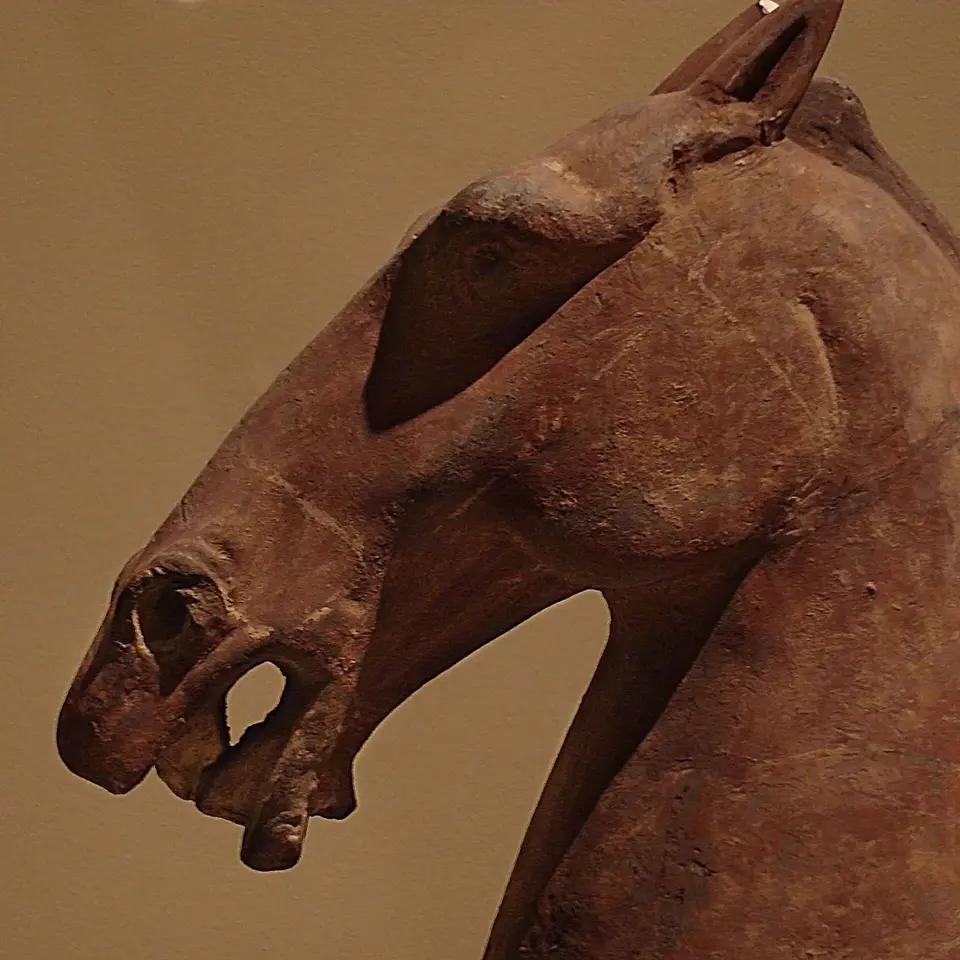
PROFILE
Wang Chong (王充, 27–c. 97), courtesy name Zhongren, was a native of Shangyu County, Kuaiji Commandery. He was an eminent materialist philosopher, rationalist thinker, and literary critic of the Eastern Han dynasty, recognized as one of the most formidable atheist and skeptical minds in ancient Chinese intellectual history.
Born into an impoverished and humble family, Wang displayed extraordinary precocity from childhood. In his youth, he traveled to the Eastern Han capital of Luoyang to study at the Imperial Academy, studying under the celebrated historian Ban Biao. Unable to purchase books due to extreme poverty, he spent years browsing commercial bookstalls in Luoyang's markets, relying on his photographic memory to master the philosophies of the Hundred Schools. In official life, Wang served in subordinate secretarial and censorial posts in Kuaiji Commandery and the Yangzhou regional inspectorate. However, his upright, uncompromising personality and fierce opposition to bureaucratic flattery and corruption led to repeated conflicts with his superiors, forcing him to resign and abandon officialdom. In his later years, Emperor Zhang dispatched an imperial carriage to summon him to court, but Wang declined due to failing health, ultimately passing away in poverty at his ancestral home.
Confronting the mystical teleology, prophetic omen apocrypha (chenwei), and ubiquitous ghost superstitions of the Han era, Wang dedicated three decades of solitary labor to composing his eighty-five-chapter philosophical masterpiece, the Lunheng (Discourses in the Balance). Embracing the overarching imperative to "hate falsehood and fabricated claims," Wang established a naturalistic materialist worldview centered on primordial qi (yuanqi). He asserted that heaven and earth combine their qi and all things are generated spontaneously, denying that Heaven possesses conscious intent to reward virtue or punish vice. In his treatment of mortality, he demonstrated that the spirit depends entirely upon physical blood vessels and qi, arguing that death is like an extinguished fire and refuting belief in ghosts and spirits. In epistemology, he pioneered an empirical method demanding evidence and factual verification, fearlessly questioning and criticizing the canonical sayings of Confucius and Mencius. In literary criticism, he condemned ornate, deceptive writing, demanding that literature reflect genuine human reality and social utility. Wang's rational critique constitutes a monumental landmark in classical Chinese philosophy.
- Courtesy Name
- Zhongren (仲任)
- Dynasty
- Eastern Han Dynasty
- Ancestral Home
- Shangyu County, Kuaiji Commandery (Present-day Shangyu District, Shaoxing, Zhejiang Province)
- Date of Birth
- 27
- Date of Death
- c. 97
- Age at Death
- 71
- Highest and Primary Official Posts
- Attendant Officer in the Secretariat of Yangzhou, Section Director of Kuaiji Commandery, Revenue Section Clerk, Chief Scribe (Declined imperial summons by public carriage)
- Historical Identity
- Prominent Eastern Han philosopher, literary critic, materialist thinker, and atheist scholar
BIOGRAPHY
Chronology
- 27 | Birth in Eastern Zhejiang | Born in Zhangzhen Township, Shangyu County, Kuaiji Commandery, into an impoverished commoner family.
- 34 | Early Classical Training | Entered primary school at age eight, displaying remarkable intellectual maturity, memorizing classics, and mastering calligraphy without error.
- 46 | Academic Studies in Luoyang | Traveled north to Luoyang to study at the Imperial Academy under Ban Biao; memorized texts in market bookstalls.
- 48 | Service in Commandery Administration | Returned to Kuaiji and entered local administration as a clerk and section director; clashed with corrupt superiors over legal integrity.
- 76 | Appointment in Yangzhou Inspectorate | Appointed Attendant Officer and Assistant Commissioner in the Secretariat by Regional Inspector Dong Qin; resigned after his policy remonstrances were ignored.
- 84 | Reclusive Authorship | Withdrew permanently to his Shangyu home to write the Lunheng, completing eighty-five chapters totaling over two hundred thousand words.
- 86 | Imperial Summons Declined | Declined an imperial summons by public carriage authorized by Emperor Zhang, citing chronic infirmity.
- 88 | Later Theoretical Treatises | Composed sixteen chapters of the Book on Nourishing Nature, exploring longevity and physical vitality, alongside political essays.
- 92 | Commendation by Xie Yiwu | High official Xie Yiwu submitted an imperial memorial praising Wang as an extraordinary intellect comparable to Xunzi and Jia Yi.
- c. 97 | Death in Shangyu | Passed away at his residence in Shangyu at the age of seventy-one; his masterwork Lunheng was later recovered and popularized by scholar Cai Yong.
Biography
Humble Origins and Classical Erudition in the Capital
Wang Chong was born in 27 CE (the third year of the Jianwu era under Emperor Guangwu) in Zhangzhen Township, Shangyu County, Kuaiji Commandery. His family originally hailed from Yuancheng in Wei Commandery, but due to violent feuds with local gentry families during the late Western Han dynasty, his ancestors relocated south to Shangyu. Over successive generations, the family's martial fortunes waned, reducing Wang Chong's immediate forebears to impoverished commoner status, belonging to what Han society termed "isolated and humble lineages."
From early childhood, Wang displayed solemn self-discipline. At age six, he showed an earnest demeanor, avoiding childish petulance. At age eight, he entered a local school to learn reading and writing; among more than a hundred pupils, Wang was noted for his immaculate conduct, advancing rapidly in classical recitation and calligraphy. At age eleven, his father passed away, and Wang served his mother with deep filial devotion. When he was seventeen, he encountered the renowned scholar Ban Biao visiting Kuaiji with his young son Ban Gu. Observing Ban Gu's poise, Wang patted the youth on the back and accurately predicted to Ban Biao that the boy would one day chronicle the history of the Han dynasty.
In 46 CE, the twenty-year-old Wang traveled to the imperial capital of Luoyang to enter the Imperial Academy, formally becoming a student of Ban Biao. Because his family possessed no wealth to buy costly bamboo slips and scrolls, Wang spent his days visiting the bookstalls in Luoyang's busy market quarters. Endowed with a photographic memory, Wang read rapidly and memorized entire scrolls upon a single reading. In this manner, he mastered not only the Confucian classics but also the philosophical treatises of the Daoists, Legalists, Mohists, Logicians, and Yin-Yang school, laying the foundation for his encyclopedic erudition.
Public Service and Conflicts with Local Officials
Having completed his studies in the capital, Wang returned to Kuaiji Commandery. He was characterized by rigorous personal rectitude and disdain for worldly wealth or high office, dedicating himself to moral integrity and philosophical reflection.
Beginning around 48 CE, Wang served in various subordinate clerical roles in Shangyu County and the Kuaiji military commandant's bureau, later rising to Section Director in the Kuaiji commandery government. In these offices, he applied the law strictly and sought to curb illegal land seizures by local magnates. However, the commandery bureaucracy was dominated by entrenched gentry cliques accustomed to mutual collusion and flattery. Wang's unyielding criticism of administrative improprieties antagonized his colleagues and superiors, prompting his early resignation. During his subsequent unemployment, observing how erstwhile companions abandoned him once he lost official status, Wang composed twelve chapters of Jisu Jieyi (Criticisms of Customs and Morality) to castigate social hypocrisy, followed by Zhengwu (Administrative Affairs) to examine the principles of virtuous governance.
In 76 CE, Regional Inspector Dong Qin, having heard of Wang's erudition, recruited him as an Attendant Officer in the Yangzhou regional inspectorate, later advancing him to Assistant Commissioner in the Secretariat to oversee regional administration. Wang fulfilled his duties with fearless rigor, impeaching corrupt officials and enforcing disciplinary standards. However, Dong Qin proved unwilling to challenge powerful vested interests and repeatedly ignored Wang's reform proposals. Disillusioned with bureaucratic futility, Wang resigned his post and permanently retired to his village.
Solitary Authorship and the Completion of the Lunheng
Returning to Shangyu, Wang shut his doors to outside society and devoted himself to teaching and scholarly inquiry. Deeply distressed by the suffocating influence of omen theology, imperial apocrypha, and widespread superstition that held the Han empire in thrall, Wang resolved to challenge these delusions through systematic philosophical writing.
Wang converted his modest cottage into an intellectual laboratory, placing writing brushes, bamboo slips, and inkstones upon doors, walls, windowsills, and bedposts, recording insights the moment they arose. Over three decades of solitary labor, enduring severe poverty and recurring illnesses, he produced his monumental work, the Lunheng (Discourses in the Balance), comprising eighty-five chapters (eighty-four of which survive) and over two hundred thousand characters. Animated by the central motto "to hate falsehood," the work launched an intellectual assault upon the mystical dogmas of his time. In addition to the Lunheng, Wang authored sixteen chapters of Yangxing Shu (Book on Nourishing Nature) around 88 CE, examining physiological wellness and human longevity.
Final Years and Posthumous Discovery
In 84 CE, Emperor Zhang toured Kuaiji and solicited recommendations for virtuous recluses. Kuaiji Commandery Administrator Song You praised Wang Chong's exceptional intellect, prompting the emperor to issue an imperial decree dispatching a public carriage to convey Wang to court. However, aged and physically exhausted by decades of hardship, Wang declined the appointment due to illness.
In 92 CE, his close friend Xie Yiwu, having attained the high office of Chamberlain for Law Enforcement, submitted an eloquent memorial to Emperor Gaozong (Emperor He), praising Wang's transcendent scholarship and administrative wisdom, comparing him to ancient luminaries like Xunzi and Jia Yi. By then, however, Wang was bedridden with paralysis and unable to answer the imperial call.
Around 97 CE, Wang Chong died quietly in his humble residence in Shangyu at the age of seventy-one. For decades after his death, the Lunheng circulated only in hand-copied manuscripts in the southern Wu region. During the late Han dynasty, the eminent scholar and statesman Cai Yong, seeking refuge in Jiangnan, acquired a copy of the Lunheng. Stunned by its profound wisdom, Cai regarded it as a secret treasure and carried it back to the central plains, where Wang Chong's revolutionary thought subsequently influenced generations of Chinese thinkers.
Major Achievements
Formulating the Naturalist Theory of Primordial Qi
Following Dong Zhongshu's theological synthesis in the Western Han, Confucian orthodoxy incorporated Yin-Yang and Five Phases speculation into a doctrine of mutual resonance between Heaven and humanity. This doctrine claimed that Heaven was a conscious, supreme deity that actively monitored human actions, sending auspicious omens to reward virtuous rulers and calamitous portents to punish tyrants.
Wang Chong systematically dismantled this teleological cosmology in the Lunheng. Drawing upon classical Daoist naturalism, he established a materialist cosmology grounded in primordial qi (yuanqi). He formulated the foundational principle that "heaven and earth combine their qi, and all things are generated spontaneously." Nature operates through the objective, self-generating movements of material qi rather than the conscious purpose of an anthropomorphic deity. Natural occurrences such as seasonal rotation, wind, rain, and thunder are spontaneous physical processes lacking moral or divine intention.
Wang argued that the generation of humanity through the combination of heavenly and earthly qi is entirely analogous to human reproduction through the union of husband and wife: a natural, biological outcome rather than a deliberate, divine creation. Consequently, natural disasters and auspicious anomalies are purely natural coincidences, devoid of supernatural messages for the reigning monarch. Wang's philosophy severed the ideological link between supernatural omen theology and imperial legitimation.
Demonstrating the Mortality of the Soul and Advancing Rational Atheism
To combat ubiquitous superstitious beliefs in ancestral ghosts, vengeful spirits, and demonic possession, Wang developed a rigorous, logical critique of life and death across chapters such as "On Death" (Lun Si), "Falsehoods Concerning Death" (Si Wei), and "Investigating Ghosts" (Ding Gui).
Grounding his argument in psychosomatic unity, Wang demonstrated that the human intellect is completely inseparable from the physical organism. He argued: "That by which humans live is refined qi; upon death, this refined qi is extinguished. That which sustains refined qi is the blood vessels; upon death, the blood vessels dry up, the refined qi perishes, and the physical form decays into dust. How could it become a ghost?" He famously analogized human consciousness to a flame: "The extinction of fire is the cessation of light; human death is like the extinguishing of a fire. When a fire is extinguished, its light vanishes; how could it continue to shine?"
Wang pointed out that if human souls survived bodily death, the spirits of countless generations would overcrowd every home and road, leaving the living no space to walk. He concluded that perceived apparitions are either psychological hallucinations induced by illness or subjective delusions born of fear. His rational atheism represented the pinnacle of skeptical philosophy in classical China.
Establishing Empirical Epistemology and Questioning Confucius and Mencius
In epistemology, Wang championed intellectual independence, adopting the principle of "hating falsehood and pursuing truth." He opposed dogmatic veneration of canonical texts, asserting that true knowledge must be derived from empirical study and verified by observable evidence: "Knowledge of things comes from study; only through learning does one comprehend. That one should know without asking, or understand ancient and modern matters without empirical observation, has never occurred."
Demonstrating unprecedented intellectual courage, Wang included specific chapters in the Lunheng titled "Questioning Confucius" (Wen Kong) and "Criticizing Mencius" (Ci Meng). In these essays, he scrutinized historical contradictions, logical inconsistencies, and moral double standards recorded in the Analects and Mencius, demonstrating that even ancient sages were fallible human beings whose words must be tested against reason and fact. Wang demanded that scholars weigh evidence independently rather than blindly venerate established orthodoxy.
Historical Realism and the Cultivation of Human Nature
In social philosophy, Wang rejected conservative historical views that idealized antiquity at the expense of the present. In chapters like "Equalizing Generations" (Qi Shi) and "Restoring the Han" (Hui Guo), he argued that history develops objectively, demonstrating that the Han dynasty surpassed the mythical Three Dynasties in territorial administrative organization and material culture. He argued that periods of peace and disorder are determined by material conditions, population size, and agricultural resources rather than dynastic virtue or cosmic fate.
Regarding human nature, Wang criticized the innate goodness posited by Mencius and the innate wickedness posited by Xunzi, asserting that human nature contains both benevolent and selfish potentials determined by the quality of endowed qi. Comparing human nature to unspun silk that turns green or red depending on the dye applied, he emphasized that education, moral instruction, and penal laws are indispensable tools for guiding moral transformation.
Reforming Literary Criticism and Advocating Realistic Prose
Wang also revolutionized literary criticism, attacking the ornate, hyper-embellished rhymed prose (fu) popular in the Han era. He argued that superficial verbal ornamentation without substantive moral or administrative value was socially pernicious.
In chapters such as "Superlative Talents" (Chao Qi) and "Self-Record" (Zi Ji), Wang asserted that the ultimate standard of literary excellence was factual truth and practical utility: "A hundred compositions that serve no worldly use are inferior to a single essay that eliminates falsehood and reveals the truth." He demanded clear, direct, and accessible language, condemning obscure pedantry and arguing that writing must aim for immediate intellectual clarity: "Speech must strive for clarity; writing must strive for plain words." His literary philosophy laid the foundation for Chinese realistic literary criticism.
Personal Relationships
- Teacher: Ban Biao. Celebrated Eastern Han historian and classicist; Wang studied under him at the Imperial Academy in Luoyang.
- Close Friend: Xie Yiwu. Native of Kuaiji who rose to Chamberlain for Law Enforcement; repeatedly recommended Wang to Emperor He.
- Promoter: Cai Yong. Distinguished scholar and statesman who discovered the Lunheng in Jiangnan and brought it back to Luoyang.
- Intellectual Successor: Wang Fu. Later Eastern Han social critic and author of Qianfulun, profoundly inspired by Wang's skepticism.
- Intellectual Successor: Zhongchang Tong. Late Eastern Han political thinker and author of Changyan, who inherited Wang's materialist philosophy.
Historical Evaluation
- Hou Hanshu (Book of the Later Han): "Chong was fond of extensive reading without adhering to pedantic commentary. Lacking books due to poverty, he frequented the Luoyang markets, reading books on sale and memorizing them upon a single glance. In character, he was pure and upright, caring nothing for glory or wealth, delighting in deep contemplation."
- Xie Yiwu: "The genius of Wang Chong is not something attained by mere study; neither Mencius and Xunzi of old, nor Yang Xiong and Sima Qian of recent times could surpass him. He is truly a transcendent talent of our age."
- Cai Yong: "When I first obtained the Lunheng, I kept it as a secret treasure, and it greatly aided my writing and intellectual strategy."
- Fan Ye: "Scholars like Wang Chong were argumentative and refused to bow to vulgar trends, taking the refutation of falsehood as their fundamental purpose; though their words were sharp, they rendered genuine service to the world."
- Zhang Xuecheng: "Wang Zhongren's Lunheng possessed deep comprehension of literary meaning; in hating falsehood and verifying truth, he opened the path for all subsequent criticism."
Related Entries
- Lunheng
- Chenwei (Apocrypha)
- Ban Biao
- Cai Yong
- Materialism
- Atheism