Birth | Tugh Temür was born as Khaishan's second son.
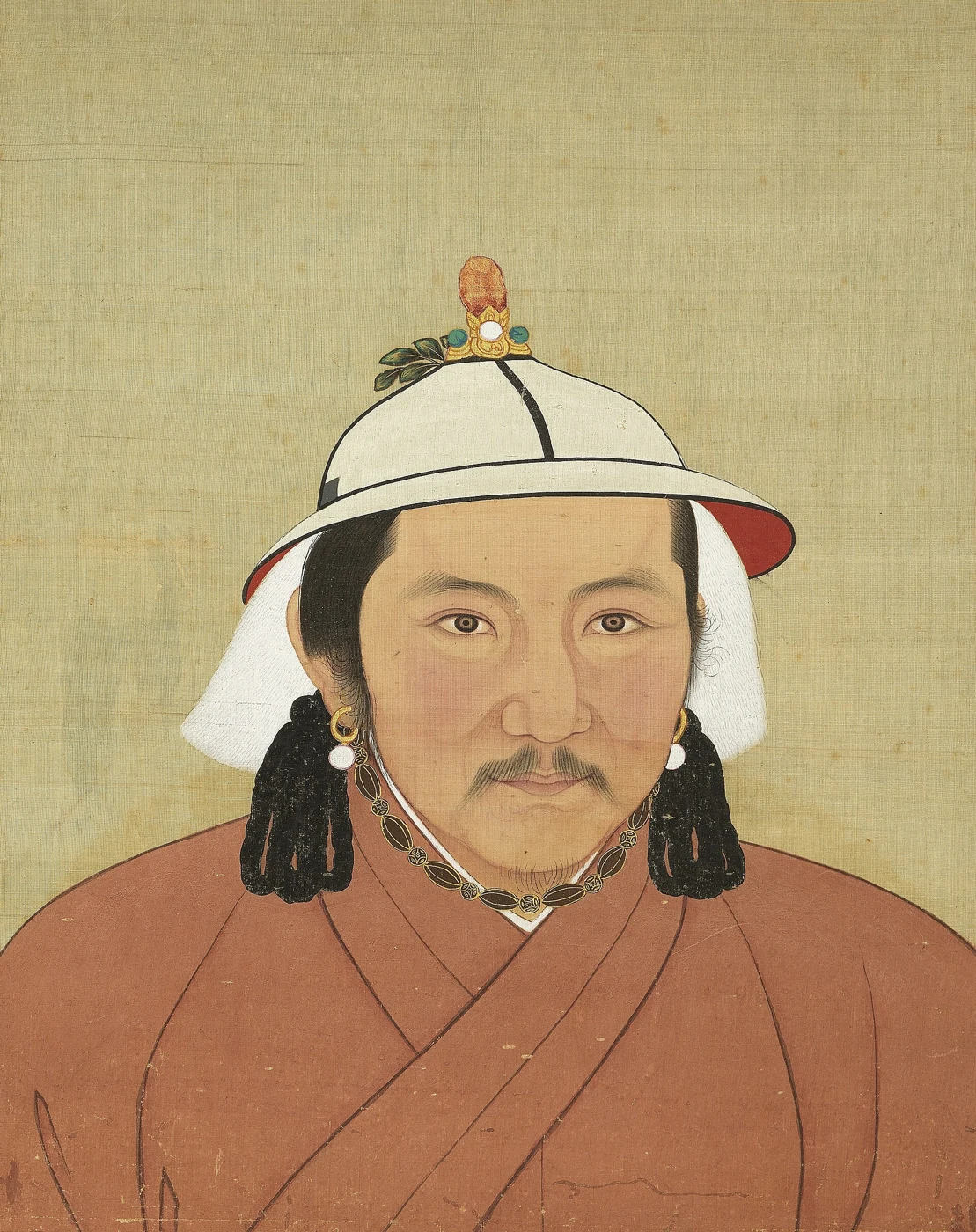
1304 CE–1332 CE
Historical figure
Borjigin Tugh Temür
孛儿只斤·图帖睦尔
Borjigin Tugh Temür (1304–1332) was the younger son of Borjigin Khaishan, Emperor Wuzong of Yuan, and a brother of Kusala, the future Emperor Mingzong. His temple name was Wenzong and his Mongolian khan title is provisionally rendered Jayaatu Khan. As a young man he was moved and exiled to places including Hainan, Jiankang, and Jiangling. After Emperor Taiding died in 1328(Zhihe year 1, Yuan), El Temür seized control in the…
1304 CE–1332 CEYuan Dynasty
PROFILE
Borjigin Tugh Temür (1304–1332) was the younger son of Borjigin Khaishan, Emperor Wuzong of Yuan, and a brother of Kusala, the future Emperor Mingzong. His temple name was Wenzong and his Mongolian khan title is provisionally rendered Jayaatu Khan. As a young man he was moved and exiled to places including Hainan, Jiankang, and Jiangling. After Emperor Taiding died in 1328(Zhihe year 1, Yuan), El Temür seized control in the capital Dadu and brought Tugh Temür to the throne. Another court at Shangdu elevated Asu-Jiba, but Dadu prevailed in the ensuing War of the Two Capitals. Tugh Temür then yielded the throne to his elder brother Kusala, who came south from the Mongolian steppe. When Kusala died suddenly in 1329(Tianli year 2, Yuan), Tugh Temür became emperor again. His court established the Kuizhang Pavilion Academy of Scholars and compiled the Jingshi Dadian, while El Temür's faction remained highly influential. Historical sources dispute responsibility for Mingzong's sudden death. Tugh Temür's last instruction that a son of Mingzong should succeed him should be reported separately from that unresolved case.
- Other names
- Emperor Wenzong of Yuan; Jayaatu Khan (provisional rendering of his Mongolian khan title)
- Period
- Yuan dynasty
- Date of Birth
- February 16 1304
- Date of Death
- September 2 1332
- State
- Yuan dynasty and Mongol Empire
- Position
- Yuan emperor and great khan of the Mongol Empire
- Successor
- First abdicated to his elder brother Kusala (Mingzong); after his restoration succeeded by Rinchinbal (Ningzong, nephew)
- Predecessor
- Before his first accession: Yesün Temür (Taiding Emperor); before his restoration: Kusala (Mingzong, elder brother)
- Ethnic affiliation
- Mongol
- Reigns
- First reign, 1328–1329; second reign, 1329–1332
- Era names
- Tianli and Zhishun
- Temple name
- Wenzong
- Posthumous title
- Emperor Shengming Yuanxiao
- Burial
- Qinian Valley, as the sources record
- Predecessors
- Before his first accession, Borjigin Yesun Temur, Emperor Taiding (whose son Asu-Jiba was separately enthroned at Shangdu); before his restoration, his brother Kusala, Emperor Mingzong
- Successors
- First, he yielded to his brother Kusala; after his second reign, Rinchinbal, Emperor Ningzong, succeeded
- Principal activities
- Took the throne during the War of the Two Capitals, later returned to it, established the Kuizhang Pavilion Academy of Scholars, and sponsored compilation of the *Jingshi Dadian
- Place of death
- Shangdu;First reign, 1328–1329; second reign, 1329–1332
LIFE TIMELINE
Residence in Qiongzhou | Amid court suspicion, he was sent to Qiongzhou on Hainan.
Prince of Huai | Following a proposal to recall him late in Emperor Yingzong's reign and the accession of Emperor Taiding, Tugh Temür received the title Prince of Huai.
War of the Two Capitals | Emperor Taiding died. El Temür and his allies acted in Dadu and summoned Tugh Temür, while Shangdu enthroned Asu-Jiba; the War of the Two Capitals began.
First accession | Tugh Temür first took the throne in Dadu.
Abdication and death of Mingzong | Kusala took the throne north of the steppe. Tugh Temür sent him the imperial seal and yielded; after the brothers met at Wanghuchadu, Emperor Mingzong died suddenly.
Kuizhang Pavilion established | The court established the Kuizhang Pavilion Academy of Scholars.
Restoration | Tugh Temür resumed the throne at Shangdu.
Zhishun era adopted | He adopted the Zhishun era name and continued the compilation of state institutions.
Death | He died at Shangdu, instructing that a son of Mingzong should succeed.
September 8, 1329 CE(2nd year of the Tianli era, Yuan, 8th month, 15th day) | With El Temür's backing | With El Temür's backing, Tugh Temür took the throne again at Shangdu on 8 September 1329(fifteenth day of the eighth month of Tianli year 2, Yuan).
Change of era name to Zhishun | The era name was changed to Zhishun, and work on compiling the dynastic regulations continued.
September 2, 1332 CE(3rd year of the Zhishun era, Yuan, 8th month, 12th day) | Death | Tugh Temür died at Shangdu on 2 September 1332(twelfth day of the eighth month of Zhishun year 3, Yuan).
BIOGRAPHY
Biography
Exile and accession at Dadu Tugh Temür was the son of Khaishan and a Tangut consort; his elder brother Kusala had also been excluded from court. The History of Yuan, in its annals of Wenzong, records that Tugh Temür was sent to Hainan in 1321(Zhizhi year 1, Yuan). Emperor Yingzong considered recalling him late in his reign, but after Yingzong's assassination and Emperor Taiding's accession, ministers still controlled his movements. He eventually became Prince of Huai and lived in Jiankang and Jiangling. Emperor Taiding died at Shangdu in 1328(Zhihe year 1, Yuan). El Temür, who controlled military and political resources in Dadu, joined princes and officials in a coup. Although they claimed to be inviting Kusala, the elder son of Wuzong, they first brought Tugh Temür to Dadu. He ascended the throne there on 16 October 1328(thirteenth day of the ninth month of Tianli year 1, Yuan). At Shangdu, Daolasha and his allies installed Taiding's son Asu-Jiba. Dadu won the ensuing War of the Two Capitals. ### Yielding to Mingzong and taking the throne again At his first accession, Tugh Temür publicly said that he would yield the throne to his elder brother. In 1329(Tianli year 2, Yuan), Kusala became emperor in the north, and the Dadu court sent him the imperial seal. Tugh Temür moved to the position of heir. Shortly after the brothers met at Wanghuchadu, Emperor Mingzong died unexpectedly. With El Temür's backing, Tugh Temür took the throne again at Shangdu on 8 September 1329(fifteenth day of the eighth month of Tianli year 2, Yuan). Yuan and later writings offer different explanations of Mingzong's death and of responsibility for it. one account discusses a possible plot using a later imperial decree, unofficial histories, and scholarship; The sudden death and subsequent restoration are established, but the exact acts alleged in that theory should not be treated as undisputed fact. ### Cultural policy and final years Tugh Temür valued Chinese writing and painting and gathered scholars including Yu Ji around the Kuizhang Pavilion. After the Kuizhang Pavilion Academy of Scholars was established in 1329(Tianli year 2, Yuan), its work included discussion of the classics, textual editing, and the compilation of institutions. The resulting Jingshi Dadian preserved information on Yuan administration; although the original compilation has been lost, later citations preserve parts of it. The History of Yuan also records measures concerning printing blocks for currency, fiscal and Buddhist expenditure, and rebellions in Sichuan and Yunnan. Such court actions should not all be attributed to the emperor acting alone. El Temür and his faction controlled major military and civil offices, limiting Wenzong's room for independent action. Tugh Temür died at Shangdu on 2 September 1332(twelfth day of the eighth month of Zhishun year 3, Yuan). one account says that near death he regretted what had happened at Wanghuchadu and wanted a son of Mingzong to inherit. The actual immediate successor was Mingzong's young son Rinchinbal; his elder brother Toghon Temür followed him.
Tugh Temur was the second son of Külüg Khan (Wuzong) and younger brother of Khoshila (Mingzong), his mother being of the Tangut people. On his accession Wuzong had made his younger brother Ayurbarwada heir apparent, the two agreeing that the throne should pass from brother to brother and then to the nephew. On his own accession, however, Ayurbarwada sent Wuzong's sons, the prince of Zhou, Khoshila, and Tugh Temur, into exile in the south, Tugh Temur being banished to Hainan; only when Yesün Temür (Taidingdi) came to the throne was he recalled to the capital, made prince of Huai and sent to live at Jiankang and elsewhere.
In 1328 Taidingdi died at Shangdu, and El Temür, holding Dadu, carried out a coup and controlled the government there. He first meant to set up Wuzong's eldest son, the prince of Zhou, Khoshila, but, the road being long, turned to Tugh Temur; and though El Temür announced that envoys had been sent north to welcome Khoshila, none were in fact sent. In the month after Tugh Temur reached Dadu, he was urged that the turn of men's hearts allowed no delay, and five days later he took the throne at Dadu, making that year the first of Tianli and declaring that he would wait for his elder brother's coming to satisfy his own wish to yield. The forces of Shangdu and Dadu then fought for months, the so-called war of the two capitals, in which Dadu prevailed; El Temür, for his part in the enthronement, took the government into his hands, and his family's power was at its height in Wenzong's reign.
At the end of 1328 Khoshila, who had been living among the princes of the northwest, set out southward acclaimed by the princes of the desert, being then just thirty. By the principle of uncle and nephew in succession he should have been Ayurbarwada's heir, but had been driven into the northern marches, which won him wide sympathy among the northern princes; the resentment of the steppe nobility at the strengthening of Chinese law under Ayurbarwada and Shidibala may also have moved them to set him on the great khan's throne. At the end of the first month of 1329, without telling Tugh Temur, Khoshila took the imperial title in the north after council with the princes and ministers about him, becoming Emperor Mingzong. He then moved east and south, with the chancellor Popi and the prince of Wuning, Chechektu, riding west and then east to welcome him, wholly delighted by the scene of peace about him.
Khoshila seems to have overrated the weight of northern opinion in settling the succession. He thought to repeat his father's story, of returning from the north to the throne after his younger brother had cleared the palace, forgetting that Wuzong had commanded the northern frontier with thirty thousand picked troops behind him, while he himself had no great army but only some eighteen hundred guards about him. In the eighth month of 1329 the brothers met at Wangghuchadu, and some days later Mingzong died suddenly, a matter generally connected with El Temür and Tugh Temur; Tugh Temur returned to the throne and gave the eighteen hundred and thirty guards who had come south with Mingzong fifty ding of paper money each, and the twelve kesig officers two hundred, to conciliate his followers. Of Mingzong's death the Yuan History records only that it was sudden, and the accounts of the time and later discussion have left it one of the puzzles of Yuan history.
On his return to the throne Wenzong gave much weight to learning: he established the classics colloquium and the Academy of the Kuizhang Pavilion, gathering scholars such as Yu Ji, Jie Xisi and Ke Jiusi, had the Institutions of Government compiled as a systematic digest of the institutions and documents of the day, and continued the examinations. He died in 1332, leaving a will that Mingzong's son Irinjibal should succeed, which he did as Ningzong, dying within a month, after which Toghon Temür was brought in as Emperor Shun. The disputes over the succession in the Yuan appear at their most concentrated in Wenzong's reign, his brother-to-brother succession and Mingzong's death being commonly cited as evidence of the turbulence of the middle Yuan; his measures in letters have also left him a distinct mark among the Yuan emperors.
In the eleventh month of 1328 the first envoys to welcome Khoshila to the capital left Dadu; barely a fortnight later Tugh Temur ordered jade patents and seals of empress made for his own consort. In the first month of the next year, when Khoshila's envoys reached Dadu, Tugh Temur, knowing that his elder brother was resolved to return south, pressed on with the ceremonies of announcing the investiture of his empress at the southern suburb and the ancestral temple and of installing her in the Daming hall. A minister observed that the emperor had proclaimed to the realm his yielding of the throne to his elder brother, and that to make an empress now contradicted the decree; Tugh Temur commended his frankness and rewarded him with gold-woven silk, but the ceremonies went forward all the same.
In the latter part of the fifth month Tugh Temur went north from Dadu to welcome Khoshila in person; on the third day of the journey he set up the Huai and Jiang revenue office, of the third rank, under the household of the heir apparent. The revenues it managed had belonged to the empress's palace and had been abolished in 1304; to restore the office and attach it to the heir apparent's establishment was plainly to prepare for controlling so important a source of wealth when he became heir apparent himself. It took him more than a month to travel from Dadu to Shangdu, where he stayed some twenty days, and then he took the same road to Wangghuchadu to meet Khoshila.
On the first day of the eighth month Khoshila reached Wangghuchadu; the next day Tugh Temur paid his respects to his elder brother in the travelling palace, and Khoshila feasted the prince his brother with the princes and ministers. Less than five days of brotherly reunion passed before Khoshila died suddenly on the sixth of the month. Tugh Temur came to mourn him with every show of grief; El Temür, by the command of Mingzong's empress, handed him the imperial seals, and those about him hurried him back to Shangdu, riding by day at the head of his guards and by night, in armour, patrolling the tent-palace. On the fifteenth day of the eighth month, on the sixth day after his return, he was enthroned again in haste as Emperor Wenzong. The details of Mingzong's sudden death may be forever hidden; Khoshila's son Toghon Temür, once in power, issued a decree removing Wenzong's tablet from the temple, saying that Wenzong, persisting in evil, had plotted with his ministers Yuelubuhua, Yeliya and Minglidong'a at the time of the ceremonial welcome and brought his father to a resentful end.
Among Wenzong's other measures was the compilation of the Institutions of Government, carried out under the Academy of the Kuizhang Pavilion with the help of Yu Ji and others and completed in 1331, arranged under the affairs of the ruler, the affairs of ministers and other heads — a great digest of Yuan institutions on which later study of the dynasty's government has largely drawn.
Major Activities
Tugh Temür's two accessions and the War of the Two Capitals altered the Yuan succession and led the court to remove the Shangdu faction. His clearest cultural initiatives were the Kuizhang Pavilion and the Jingshi Dadian: the former brought scholars together for reading and counsel, while the latter assembled records of institutions. Historical sources also discuss his calligraphy and painting, but works attributed to him today should not all be declared authentic without separate evidence. The History of Yuan and both encyclopedias also describe fiscal pressure from Buddhist ceremonies, grants, and uprisings during his reign. The court accepted some recommendations to reduce spending, but the power of El Temür continued to grow and political tensions remained. His record should therefore distinguish institutional compilation and cultural activity from the operation of the military and political faction around him.
Personal Relations
- Khaishan was his father, and the Tangut consort later honored as Empress Wenxian Zhaosheng was his mother. Kusala was his elder brother; each ruled, and Tugh Temür resumed the throne after Kusala's death.
- Budashiri of the Onggirat clan was his empress. Historical sources name Aratnadar, El Tegüs, and Taipingna as his sons.
- El Temür installed him in 1328(Zhihe year 1, Yuan) and held extensive power after his restoration. Daolasha and Asu-Jiba represented the Shangdu side in the War of the Two Capitals.
- Rinchinbal and Toghon Temür, sons of Mingzong, succeeded one another. Toghon Temür was Tugh Temür's nephew.
Historical Assessment
The History of Yuan, New History of Yuan, and later historians such as Shao Yuanping and Tu Ji praised Wenzong's skill in writing and painting and his sponsorship of the Kuizhang Pavilion and institutional compilation. They also criticized the disputed legitimacy of the succession after the War of the Two Capitals, the unresolved circumstances of Mingzong's death, and El Temür's dominance. Wei Yuan strongly praised Wenzong's learning, although another account questions his broader claim about the Chinese literary abilities of other Yuan emperors. These assessments emphasize different cultural and political issues; the unresolved death should not be written up as a judicially settled crime.
FIGURES ASSOCIATED WITH THIS DYNASTY
Bibliography
- History of Yuan*, “Annals of Wenzong” and “Annals of Mingzong” (project local historical texts).